- Product Description Description
- Table of Contents TOC
- List of Table & Figure LOT
- Get Free Sample PDF Sample PDF
Market Size, 2025
$2.07 BnMarket Estimate, 2026
$2.15 BnMarket Forecast, 2034
$2.86 BnCAGR, 2026–2034
3.66%Europe Cleanroom Technology Market Report Summary
The Europe cleanroom technology market was valued at USD 2.07 billion in 2025, is estimated to reach USD 2.15 billion in 2026, and is projected to reach USD 2.86 billion by 2034, growing at a CAGR of 3.66% from 2026 to 2034. Market growth is driven by stricter EU GMP Annex 1 requirements, rising demand from pharmaceutical, biotech, semiconductor, and medical device manufacturers, and the expansion of advanced therapy and cell-based manufacturing. Regulatory audits, the need for continuous environmental monitoring, and investments in modular and AI-enabled monitoring systems are sustaining steady investment in cleanroom equipment, consumables, and integrated validation services across Europe.
Key Market Trends
- Enforcement of EU GMP Annex 1 and ISO 14644 standards is driving upgrades to higher-class cleanrooms and continuous monitoring.
- Rapid expansion of ATMP and cell-therapy manufacturing, increasing demand for Grade A/B isolators and compact modular suites.
- Rising preference for modular and mobile cleanrooms for faster deployment and point-of-care manufacturing.
- Integration of real-time environmental monitoring + AI analytics for predictive maintenance and data integrity.
- Sustainability and energy-efficiency pressures are prompting low-carbon HVAC designs and eco-friendly consumables.
Segmental Insights
- Based on product type, the equipment segment was the largest in 2024, accounting for a 48.2% share, driven by investments in HEPA/ULPA filtration, HVAC systems, isolators, laminar flow units, and particle counters required for compliant sterile manufacturing.
- Based on construction type, the hardwall cleanrooms segment captured the largest share in 2024 at 35.4%, favored for high-classification pharmaceutical suites and long-term facilities.
- Based on end-use, the pharmaceutical industry segment dominated with a 52.3% share in 2024, driven by aseptic processing upgrades and vaccine/biologics manufacturing.
Regional Insights
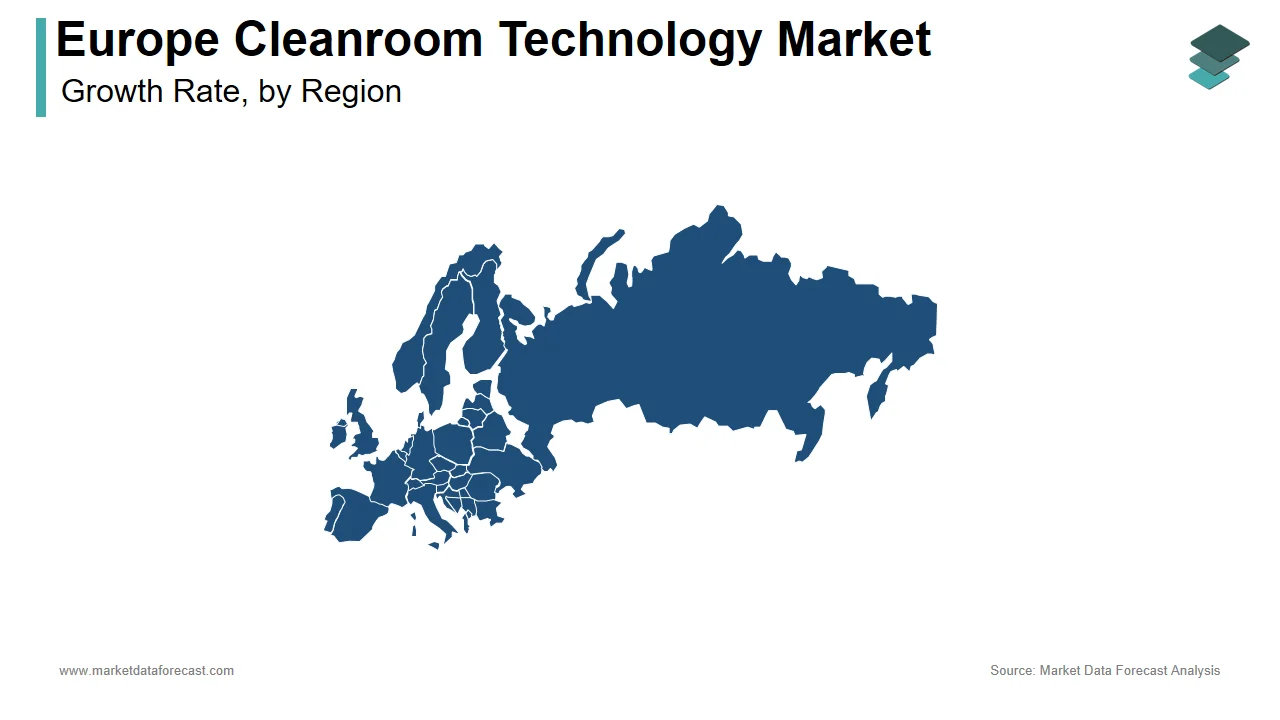
The Europe cleanroom technology market is expanding across leading markets, shaped by national inspection rigor, pharmaceutical manufacturing density, and public funding for biomanufacturing infrastructure.
- Germany was the largest market in 2024, driven by a dense pharma and medtech manufacturing base, strong regulatory enforcement (BfArM/PEI audits), and industry programs supporting cleanroom modernization.
- United Kingdom shows robust demand supported by biopharma clusters, hospital ATMP adoption, and public funding for cleanroom infrastructure and hospital pharmacy upgrades.
- France is growing due to national biomanufacturing initiatives (Plan France 2030), aerospace cleanroom demand, and significant upgrades across hospital and pharmaceutical cleanrooms.
Competitive Landscape
The Europe cleanroom technology market features global engineering firms, modular cleanroom specialists, materials suppliers, and integrators competing on regulatory expertise, speed of deployment, digital monitoring integration, and sustainability. Vendors differentiate via full validation support, turnkey modular offerings, low-energy HVAC solutions, and consumable portfolios aligned to Annex 1. Market consolidation is increasing as certification and data-integrity requirements favour established players with pan-European service networks. Key market players include: Terra Universal Inc., Azbil Corporation, Connect 2 Cleanrooms Ltd, Ahlstrom Munksjö Oyj, Kimberly-Clark Corporation, Taikisha Ltd., and Clean Air Products.
 Download Free Sample Report
Europe Cleanroom Technology Market Size
The size of the Europe cleanroom technology market was valued at USD 2.07 billion in 2025. This market is expected to grow at a CAGR of 3.66% from 2026 to 2034 and be worth USD 2.86 billion by 2034 from USD 2.15 billion in 2026.
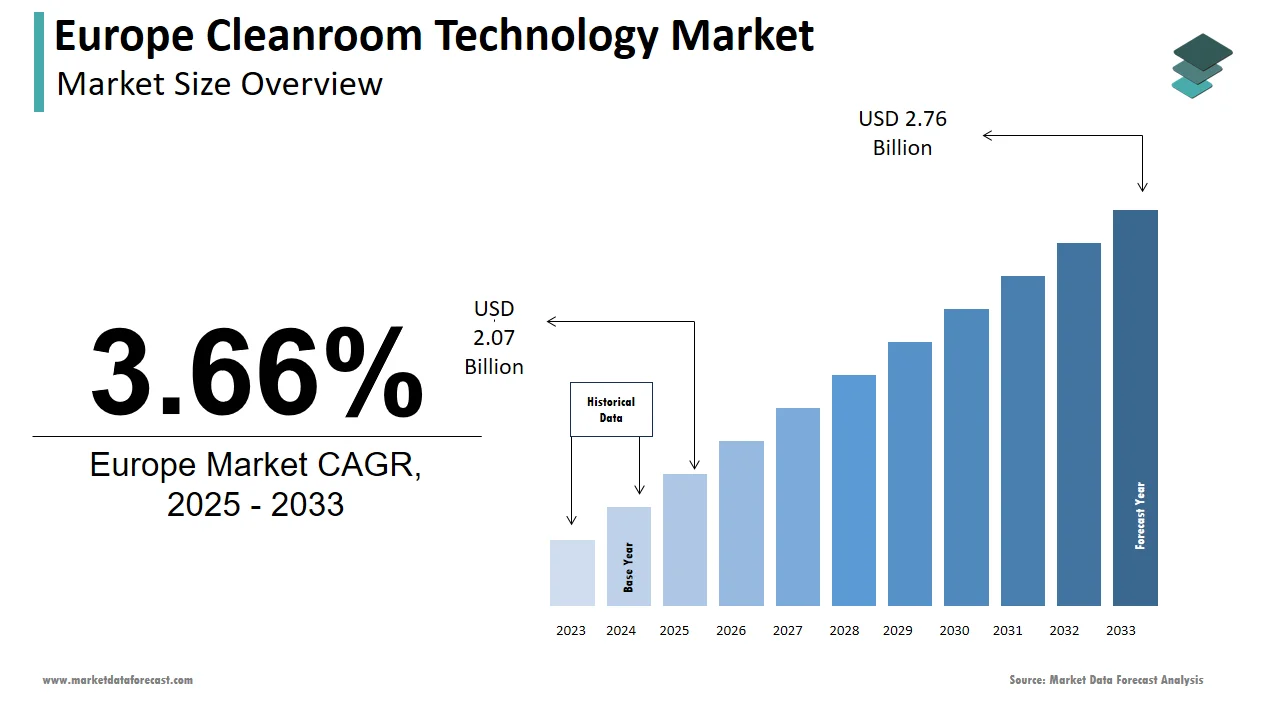
Cleanroom technology is an engineered controlled environments that minimize airborne particulates, microorganisms, and chemical vapors to safeguard sensitive manufacturing and research processes. In Europe, these environments are the pharmaceutical, biotechnology, semiconductor, medical device, and aerospace sectors, where product integrity and sterility are non-negotiable. The European Union enforces rigorous standards through ISO 14644 for air cleanliness and EU Good Manufacturing Practice Annex 1, which mandates stringent environmental monitoring for aseptic processing. As per the European Medicines Agency, over 1200 pharmaceutical manufacturing sites in the EU were inspected in 2023, with cleanroom compliance as a primary assessment criterion. The rise of advanced therapy medicinal products, which require Grade A isolators for cell manipulation, further intensifies demand. This regulatory, scientific, and industrial convergence defines the operational and technological trajectory of the Europe Cleanroom Technology Market.
MARKET DRIVERS
Stringent Regulatory Mandates for Aseptic Pharmaceutical Manufacturing
The enforcement of updated EU Good Manufacturing Practice Annex 1 has emerged as a driver for cleanroom technology adoption is a major factor boosting the growth of the Europe cleanroom technology market. As per the European Medicines Agency, the revised Annex 1 implemented in August 2023 requires continuous environmental monitoring, real-time particulate detection, and stricter classification of cleanroom zones for all aseptic processes. Over 850 sterile drug manufacturing facilities in the EU had to upgrade their cleanrooms by 2024 to comply with new requirements for Grade A and B areas, including unidirectional airflow integrity and viable particle control. The regulation mandates closed processing systems, isolators, and restricted access barrier systems to minimize human intervention, which directly increases demand for modular cleanrooms and contamination control equipment. National agencies such as Germany’s BfArM and France’s ANSM conduct unannounced audits, with non-compliance leading to production halts. This regulatory rigor ensures sustained investment in advanced cleanroom infrastructure across the pharmaceutical value chain.
Expansion of Advanced Therapy and Cell-Based Manufacturing Facilities
The rapid growth of advanced therapy medicinal products, including CAR T cells, gene therapies, and tissue-engineered constructs, is accelerating demand for high classification cleanrooms across Europe. The expansion of advanced therapy and cell-based manufacturing facilities is additionally to further escalate the growth of the Europe cleanroom technology market. As per the European Society for Gene and Cell Therapy, many ATMP clinical trials were active in the EU in 2023, requiring Grade A laminar flow hoods or isolators for cell manipulation under sterile conditions. These therapies are often manufactured in hospital-based cleanrooms or decentralized facilities, necessitating compact yet compliant modular units. Unlike traditional drug manufacturing, ATMPs involve open processing of living cells, making contamination control non-negotiable. Companies like Miltenyi Biotec and Lonza have deployed mobile cleanroom units to support point-of-care manufacturing.
MARKET RESTRAINTS
High Capital and Operational Expenditure for Compliance
The substantial financial burden of designing, constructing, and maintaining compliant cleanrooms acts as a significant restraint for small and mid-sized enterprises and academic institutions. The high capital and operational expenditure for compliance is solely impeding the growth of the Europe cleanroom technology market. Annual operational costs for energy maintenance and monitoring can reach 150000 euros, due to constant air recirculation and stringent validation requirements. According to a 2023 survey by the European Biotechnology Network, emerging cell therapy developers cited cleanroom infrastructure as a top barrier to clinical scale-up. Moreover, EU GMP Annex 1 requires extensive documentation, including airflow visualization, smoke study, and personnel gowning validation, which demand specialized consultants. These costs delay technology adoption in Southern and Eastern Europe, where public funding is limited and discourages innovation in resource-constrained settings despite scientific potential.
Complexity of Integrating Legacy Facilities with Modern Standards
Many existing pharmaceutical and research facilities in Europe operate in buildings constructed decades ago, which lack the structural or spatial capacity to accommodate modern cleanroom requirements. The complexity of integrating legacy facilities with modern standards is additionally inhibiting the growth of Europe cleanroom technology market. As per the European Federation of Hospital Pharmacists, hospital pharmacy units in Italy and Spain still use non-isolator-based compounding systems that struggle to meet ISO Class 5 standards mandated by EU GMP Annex 1. Retrofitting these legacy spaces involves major engineering challenges, including ceiling height limitations, inadequate power supply, and insufficient floor loading capacity for heavy HVAC units. Additionally, historical sites often cannot support the vibration-free environments required for semiconductor or precision optics cleanrooms. This infrastructural inertia slows compliance timelines, increases project risk, and forces organizations to seek off-site solutions, thereby fragmenting production workflows and raising logistics costs.
MARKET OPPORTUNITIES
Adoption of Modular and Mobile Cleanroom Solutions
The deployment of prefabricated modular and mobile cleanrooms by offering rapid deployment, cost efficiency, and regulatory compliance for emerging applications, which is anticipated to leverage the growth of the Europe cleanroom technology market. As per the European Commission’s Joint Research Centre, over 60 hospital-based ATMP units installed modular cleanrooms between 2022 and 2023 to accelerate point-of-care therapy delivery. These units, constructed from stainless steel or composite panels with integrated HEPA filtration, can be operational in under 8 weeks compared to 12 months for traditional builds. Companies like GMP Cleanroom Solutions and Connect 2 Cleanrooms have supplied ISO Class 5 mobile units to vaccine response centers during public health emergencies. The European Defence Agency also adopted containerized cleanrooms for field-based medical device sterilization in 2023.
Integration of Real-Time Environmental Monitoring and AI Analytics
The incorporation of intelligent monitoring systems using real-time sensors and artificial intelligence is revolutionizing contamination control and predictive maintenance in European cleanrooms. The integration of real-time environmental monitoring and AI analytics is expected to drive the growth of the Europe cleanroom technology market. As per the European Pharmaceutical Review, new cleanroom installations in Germany and Switzerland in 2023 included continuous particle counters, viable air samplers, and AI-driven anomaly detection platforms. These systems feed data into cloud dashboards that flag deviations before they breach limits, enabling proactive intervention. The European Medicines Agency’s 2023 guidance on data integrity endorses such systems as part of Quality by Design frameworks. Companies like TSI and Particle Measuring Systems offer EU GMP-compliant sensor networks that integrate with building management systems. Furthermore, AI algorithms can predict filter saturation or airflow imbalances, reducing downtime by up to 30%. This digital transformation enhances compliance reliability while reducing manual monitoring burdens across regulated industries.
MARKET CHALLENGES
Shortage of Skilled Personnel for Cleanroom Validation and Operation
The acute shortage of technicians and engineers trained in cleanroom validation, environmental monitoring, and GMP compliance is one of the challenges for the growth of Europe's cleanroom technology market. As per the European Biotechnology Training Network, biomanufacturing employers in the EU reported difficulty recruiting staff proficient in ISO 14644 testing and Annex 1 documentation in 2023. Academic curricula rarely include hands-on cleanroom operation and contamination control principles, leaving graduates unprepared for regulated environments. The complexity of modern systems, including isolators, restricted access barriers, and real-time monitoring that further widens the skills gap. This human capital deficit delays facility commissioning, increases contamination risks, and forces companies to rely on expensive third-party consultants.
Fragmented Certification and Audit Requirements Across Member States
The national competent authorities impose divergent interpretations and audit frequencies that complicate cleanroom compliance for multinational operators is also declining the growth of the Europe cleanroom technology market. As per the European Medicines Verification Organisation, national inspectorates in France and Italy require quarterly viable monitoring reports, while Germany and the Netherlands accept semi-annual submissions. Additionally, countries like Poland and Greece mandate on-site requalification every 12 months regardless of system stability, whereas Sweden allows risk-based intervals up to 24 months. This regulatory asymmetry forces pharmaceutical companies to maintain multiple validation protocols and documentation sets, increasing administrative costs by up to 25%. Furthermore, hospital-based cleanrooms fall under national health ministries rather than medicine agencies, creating dual oversight in countries like Spain and Belgium.
REPORT COVERAGE
| REPORT METRIC | DETAILS |
| Market Size Available | 2025 to 2034 |
| Base Year | 2025 |
| Forecast Period | 2026 to 2034 |
| Segments Covered | By Product Type, Construction Type, End-Use, and Country. |
| Various Analyses Covered | Global, Regional, and Country-Level Analysis, Segment-Level Analysis, Drivers, Restraints, Opportunities, Challenges; PESTLE Analysis; Porter’s Five Forces Analysis, Competitive Landscape, Analyst Overview of Investment Opportunities |
| Countries Covered | UK, France, Spain, Germany, Italy, Russia, Sweden, Denmark, Switzerland, Netherlands, Turkey, Czech Republic, and the Rest of Europe. |
| Market Leaders Profiled | Terra Universal Inc., Azbil Corporation, Connect 2 Cleanrooms Ltd, Ahlstrom Munksjö Oyj, Kimberly-Clark Corporation, Taikisha Ltd., Clean Air Products, and Others. |
SEGMENTAL ANALYSIS
By Product Type Insights
The equipment segment was the largest by accounting for 48.2% of the Europe Cleanroom Technology Market share in 2024 due to the essential role of high-integrity hardware in maintaining air quality, personnel protection, and process control. This category includes HEPA and ULPA filtration systems, HVAC units, laminar flow hoods, isolators, and environmental monitoring devices. As per the European Medicines Agency, sterile pharmaceutical facilities inspected in 2023 required upgraded HEPA filtration and continuous particle counters to comply with the revised EU GMP Annex 1. The European Commission’s Joint Research Centre reported that advanced therapy manufacturing centers installed an average of 12 isolators and 8 real-time monitoring units per facility in 2023. National standards, such as Germany’s VDI 2083, mandate rigorous airflow validation for all critical zones, further driving equipment demand. Additionally, semiconductor and medical device producers rely on vibration-controlled workstations and antistatic flooring systems to prevent microcontamination.

The consumables segment is expected to witness the fastest CAGR of 14.8% during the forecast period, with the recurring demand for sterile garments, gloves, disinfectants, and wipe systems in daily cleanroom operations. As per the European Federation of Pharmaceutical Industries and Associations, many cleanroom operators across the EU use an average of 250 sterile gloves and 120 gowns per person annually. The implementation of EU GMP Annex 1 in 2023 intensified gowning requirements mandating double gloving and frequent change protocols in Grade A and B areas. Additionally, the rise of hospital-based ATMP units increased demand for single-use sterile drapes and disinfectant sprays compatible with cell culture. Companies like Ansell and Kimberly-Clark expanded gamma-sterilized consumable lines in the Netherlands and the Czech Republic to meet regional demand.
By Construction Type Insights
The hardwall cleanrooms segment was the largest by capturing 35.4% of the Europe Cleanroom Technology Market share in 2024 due to their structural durability, long-term compliance, and suitability for high classification environments required in pharmaceutical and biotechnology manufacturing. Constructed from rigid materials such as steel, aluminum, or thermoplastic panels, these cleanrooms provide seamless surfaces, low particle shedding, and excellent resistance to cleaning agents. As per the European Medicines Agency, new aseptic filling facilities approved in 2023 specified hardwall construction to meet ISO Class 5 to 7 requirements under EU GMP Annex 1. Additionally, national building codes in France and Switzerland mandate fire-resistant materials for cleanrooms over 50 square meters, favoring hardwall solutions.
The modular and softwall cleanrooms segment is likely to grow at the fastest CAGR of 19.2% from 2025 to 2033, with the demand for rapid deployment flexibility and cost-effective solutions in decentralized and emerging applications. These systems use vinyl or polyethylene curtains mounted on aluminum frames, enabling installation in under four weeks at a fraction of traditional build costs. The European Defence Agency also adopted mobile softwall units for field sterilization during medical missions. Additionally, academic labs in Poland and Greece use these systems to create temporary ISO Class 8 environments for diagnostics under tight budgets.
By End-Use Insights
The pharmaceutical industry segment was the largest by occupying 52.3% of the share in 2024, with the mandatory aseptic processing requirements for sterile drugs, biologics, and vaccines. As per the European Medicines Agency, many pharmaceutical manufacturing sites underwent GMP inspections in 2023 with cleanroom classification and monitoring as compliance criteria. The revised EU GMP Annex 1, enforced from 2023, requires Grade A environments for all open processing operations, necessitating isolators, restricted access barrier systems, and continuous viable monitoring. According to the European Federation of Pharmaceutical Industries and Associations, the sector invested 4.3 billion euros in cleanroom upgrades in 2023 alone. Major companies like Novartis, Sanofi, and GSK operate multi-suite cleanroom facilities across France and the UK, producing monoclonal antibodies and mRNA vaccines under strict environmental control.
The hospitals and diagnostic centers segment is projected to grow at the fastest CAGR of 14.8% from 2025 to 2033, with the expansion of hospital-based advanced therapy manufacturing and sterile compounding services. As per the European Society for Gene and Cell Therapy, many hospitals across the EU initiated CAR T or stem cell therapy programs in 2023, requiring ISO Class 5 clean environments for cell manipulation. The European Commission’s Hospital Cleanroom Guidelines 2023 mandate that all hospital pharmacies preparing cytotoxic or parenteral nutrition must operate in certified cleanrooms. National initiatives like Germany’s Klinik Zukunftsfonds allocated 1.2 billion euros in 2023 to modernize hospital infrastructure, including cleanroom suites for personalized medicine. Additionally, diagnostic labs handling PCR and genomic sequencing require ISO Class 7 environments to prevent cross-contamination.
COUNTRY LEVEL ANALYSIS
Germany Cleanroom Technology Market Analysis
Germany was the largest contributor in the Europe Cleanroom Technology Market with its world-class pharmaceutical industry, stringent regulatory enforcement in industrial engineering. As per the German Federal Ministry of Health, many sterile drug manufacturing facilities and hospital ATMP units operated under GMP cleanroom requirements in 2023. The Paul Ehrlich Institute conducted 180 cleanroom audits that year, with non-compliance resulting in immediate production suspension. Companies like Bosch Siemens and Merck operate semiconductor and biopharma cleanrooms requiring ISO Class 5 to 8 environments with advanced monitoring. The German Engineering Federation VDI 2083 sets national standards that often exceed EU minimums, driving adoption of high-end equipment. Additionally, Germany’s KfW development bank provided low-interest loans for hospital cleanroom modernization under its 2023 Healthcare Resilience Program.
United Kingdom Cleanroom Technology Market Analysis
The United Kingdom cleanroom technology market growth is likely to grow with its strong biopharmaceutical base, hospital innovation, and post-Brexit regulatory alignment. The Cell and Gene Therapy Catapult supported the commissioning of 28 hospital cleanrooms for point-of-care manufacturing in 2023 alone. Institutions like the Francis Crick Institute and University College London maintain ISO Class 7 labs for viral vector production. The National Health Service’s Cleanroom Infrastructure Fund allocated 320 million pounds in 2023 to upgrade hospital pharmacy suites.
France Cleanroom Technology Market Analysis
France cleanroom technology market growth is likely to grow with the national biomanufacturing initiatives, robust hospital networks, and aerospace cleanroom demand. As per the study, 110 pharmaceutical and 75 hospital cleanrooms underwent compliance audits in 2023, with 92% requiring filtration or monitoring upgrades. The national Plan France 2030 allocated 1.1 billion euros to establish eight hospital-integrated ATMP production centers, each requiring ISO Class 5 suites. Additionally, Airbus uses ISO Class 7 cleanrooms in Toulouse for avionics assembly, where particulate control prevents micro short circuits. Companies like Stellantis also deploy cleanrooms for battery R and D, supporting the electric vehicle transition.
COMPETITIVE LANDSCAPE
The Europe Cleanroom Technology Market features competition among global engineering firms, European modular specialists, and niche material suppliers. The market is segmented by application complexity, with pharmaceutical and advanced therapy sectors demanding high-integrity hardwall systems and hospitals favoring cost-effective modular units. Barriers to entry are moderate but rising due to stringent EU GMP Annex 1 validation requirements and the need for ISO 14644 certification expertise. Leading players differentiate through speed of deployment, digital monitoring integration, and regulatory support services. Regional players thrive in localized hospital and diagnostic projects where customization and service responsiveness outweigh scale. Competition is also shaped by sustainability mandates driving innovation in low-carbon materials and energy-efficient HVAC designs.
KEY MARKET PLAYERS
The leading companies operating in the Europe cleanroom technology market include:
- Terra Universal Inc.
- Azbil Corporation
- Connect 2 Cleanrooms Ltd
- Ahlstrom Munksjö Oyj
- Kimberly-Clark Corporation
- Taikisha Ltd.
- Clean Air Products
TOP PLAYERS IN THE MARKET
- Terra Universal is a global cleanroom solutions provider with a strong European footprint, offering modular hardwall and softwall cleanrooms, environmental monitoring systems, and contamination control equipment. The company serves pharmaceutical, biotechnology, and medical device clients across the EU with ISO compliant prefabricated units. Terra Universal emphasizes rapid deployment and regulatory alignment with EU GMP and ISO 14644 standards. The company expanded its distribution hub to reduce lead times for hospital and biotech customers. It also introduced a line of antimicrobial wall panels validated under the European Biocidal Products Regulation for use in clinical cleanrooms.
- Connect 2 Cleanrooms is a UK-based specialist in modular and mobile cleanroom solutions, widely recognized for its rapid deployment capabilities across healthcare and advanced therapy sectors. The company designs ISO Class 5 to 8 units tailored for hospital pharmacies, cell therapy labs, and diagnostics centers throughout Europe. Connect 2 Cleanrooms prioritizes user-friendly engineering and real-time monitoring integration to support decentralized manufacturing. The company launched a compact ISO Class 5 mobile unit specifically for CAR T processing, validated under MHRA guidelines. It also partnered with German hospital networks to deploy turnkey cleanrooms within existing clinical spaces. These actions position the company at the forefront of flexible, compliant cleanroom adoption in clinical settings.
- Ahlstrom Munksjö is a Finland-headquartered specialty materials company supplying critical cleanroom consumables, including sterilizable wipes, filtration media, and garment fabrics, across Europe and globally. Its products meet stringent EU medical device and pharmaceutical standards, including ISO 13485 and GMP Annex 1 requirements. The company leverages its sustainable fiber technology to produce low-linting low low-extractable materials essential for high classification environments. In 2023, Ahlstrom Munksjö upgraded its nonwoven production line in France to increase the output of gamma-sterilizable cleanroom wipes for biopharma clients. These innovations strengthen its contribution to contamination control and environmental compliance in regulated industries.
TOP STRATEGIES USED BY THE KEY MARKET PARTICIPANTS
Key players in the Europe Cleanroom Technology Market focus on modular and prefabricated solutions to enable rapid deployment in hospital and biotech settings. They integrate real-time environmental monitoring and data analytics to support compliance with EU GMP Annex 1. Companies invest in sustainable materials such as bio-based filtration media and recyclable cleanroom panels to align with the European Green Deal. Strategic partnerships with hospital networks and ATMP developers facilitate co-designed clinical-grade units. Additionally, firms enhance validation support through in-house testing labs and documentation packages accepted by national competent authorities.
EUROPE CLEANROOM TECHNOLOGY MARKET NEWS
- In March 2024, Azbil Corporation partnered with the German government to develop energy-efficient HVAC systems for pharmaceutical cleanrooms. This initiative aims to reduce carbon emissions while improving operational efficiency.
- In June 2023, M+W Group launched its next-generation modular cleanroom system in Switzerland, designed to achieve 99.99% particle filtration. This move underscores the company’s commitment to technological innovation.
- In September 2023, Kimberly-Clark Professional acquired a UK-based startup specializing in IoT-enabled consumables tracking, expanding its portfolio of smart solutions. This acquisition strengthens Kimberly-Clark’s leadership in hospital hygiene applications.
- In January 2024, Siemens introduced an AI-driven monitoring tool for cleanrooms in France, targeting pharmaceutical manufacturers. This launch positions Siemens as a leader in real-time contamination control.
- In November 2023, Air Liquide unveiled its portable clean zone network in Italy, catering to small-scale biotech firms. This initiative enhances accessibility while addressing space constraints in urban areas.
MARKET SEGMENTATION
This Europe cleanroom technology market research report is segmented and sub-segmented into the following categories.
By Product Type
- Equipment
- Heating Ventilation and Air Conditioning System (HVAC)
- Cleanroom Air Filters
- Air Shower and Diffuser
- Laminar Air Flow Unit
- Others
- Consumables
- Gloves
- Wipes
- Disinfectants
- Apparels
- Cleaning Products
By Construction Type
- Standard/Drywall Cleanrooms
- Hardwall Cleanrooms
- Softwall Cleanrooms
- Pass-Through Cabinets
By End-Use
- Pharmaceutical Industry
- Medical Device Industry
- Biotechnology Industry
- Hospitals And Diagnostic Centers
By Country
- UK
- France
- Spain
- Germany
- Italy
- Russia
- Sweden
- Denmark
- Switzerland
- Netherlands
- Turkey
- Czech Republic
- Rest of Europe