- Product Description Description
- Table of Contents TOC
- List of Table & Figure LOT
- Get Free Sample PDF Sample PDF
Market Size, 2025
$5.13 BnMarket Estimate, 2026
$5.38 BnMarket Forecast, 2034
$7.82 BnCAGR, 2026–2034
4.78%Europe Coal Bed Methane Market Report Summary
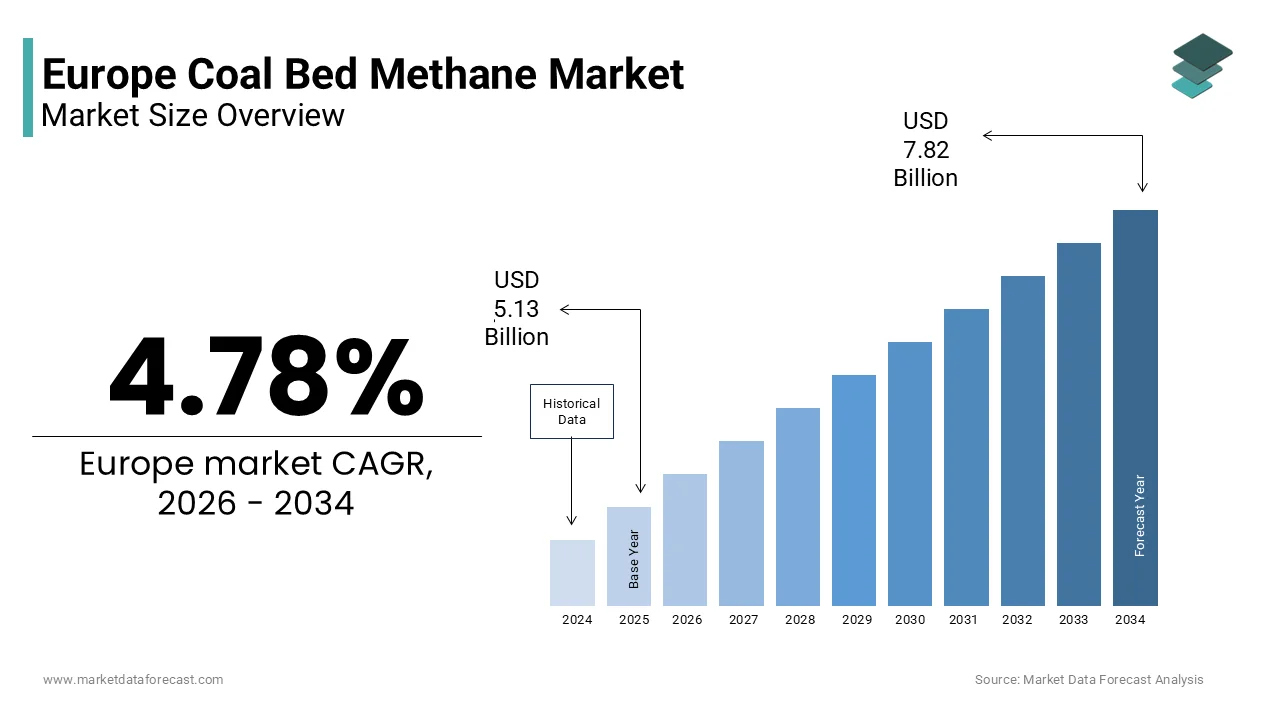
The Europe coal bed methane market was valued at USD 5.13 billion in 2025 and is projected to reach USD 7.82 billion by 2034, growing at a CAGR of 4.78% during the forecast period. The market is supported by rising demand for cleaner-burning natural gas alternatives, increasing focus on energy security across European nations, and the need to utilize untapped coal seam resources efficiently. Growing investments in advanced extraction technologies, supportive regulatory frameworks for unconventional gas development, and the strategic shift toward reducing carbon emissions are further strengthening the growth trajectory of the Europe coal bed methane market.
Key Market Trends
- Growing adoption of hydraulic fracturing and enhanced recovery technologies to improve methane extraction efficiency from deep coal seams.
- Rising emphasis on domestic gas production to reduce reliance on imported natural gas amid geopolitical uncertainties.
- Increasing integration of coal bed methane into power generation applications as a transitional fuel supporting decarbonization goals.
- Advancements in drilling technologies and reservoir modeling to optimize production output and operational performance.
- Expansion of public and private investments in unconventional gas exploration projects across coal rich regions in Europe.
Segmental Insights
- Based on technology, the hydraulic fracturing segment held 58.2% of the Europe coal bed methane market share in 2024. The dominance of this segment is attributed to its effectiveness in enhancing permeability in coal seams, enabling higher methane recovery rates and improved production economics.
- Based on end user, the power generation segment was the largest in 2024, accounting for a dominant share of the Europe coal bed methane market. Coal bed methane is widely utilized in gas fired power plants due to its relatively lower carbon intensity compared to coal, making it a viable transition fuel within Europe’s evolving energy mix.
Regional Insights
- Poland was the largest contributor to the Europe coal bed methane market in 2024, driven by its extensive coal reserves, ongoing exploration activities, and national focus on strengthening domestic energy production.
- Other European countries with significant coal reserves are gradually expanding coal bed methane development initiatives to enhance energy diversification and reduce import dependency.
Competitive Landscape
The Europe coal bed methane market is characterized by the presence of multinational energy corporations, specialized exploration firms, and technology service providers. Market participants are focusing on strategic partnerships, advanced drilling technologies, and reservoir optimization techniques to enhance production efficiency and expand their regional footprint. Companies are also investing in sustainable extraction practices and regulatory compliance to align with Europe’s environmental standards.
Prominent players in the Europe coal bed methane market include BP plc, Royal Dutch Shell plc, ConocoPhillips Company, Gazprom, Halliburton Company, The Coal Authority, Polish Oil and Gas Company, Baker Hughes Company, Arrow Energy Pty Ltd, Santos Ltd., Essar Oil and Gas Exploration and Production Ltd., China United Coalbed Methane Co., Ltd., RAG Foundation, IGas Energy plc, and Fortune Oil PLC.
Europe Coal Bed Methane Market Size
The Europe coal bed methane market size was valued at USD 5.13 billion in 2025 and is projected to reach USD 7.82 billion by 2034 from USD 5.38 billion in 2026, growing at a CAGR of 4.78%.
The coal bed methane (CBM) is a natural gas extracted from coal seams through dewatering and desorption processes, where methane is liberated as groundwater pressure is reduced. In Europe, CBM is primarily viewed as a transitional energy source with potential to enhance energy security while utilizing legacy coal infrastructure. Unlike conventional shale gas, CBM development often repurposes abandoned or active coal mines by offering a pathway to decarbonize former mining regions. According to the European Environment Agency, over 2500 former coal mines exist across the EU, many of which retain significant methane reserves that could be harnessed for local power generation or injection into gas grids. As per the International Energy Agency, Europe’s technically recoverable CBM resources are estimated at 1.8 trillion cubic meters, with Poland, Germany, and the United Kingdom holding the largest deposits. However, commercial production remains limited; in 2023 Poland was the only EU country with active CBM wells, producing approximately 120 million cubic meters annually. The European Commission’s REPowerEU plan acknowledges CBM’s role in reducing reliance on imported gas but emphasizes strict environmental safeguards.
MARKET DRIVERS
Energy Security Imperatives Following Geopolitical Disruptions
The urgent need to reduce dependence on imported natural gas from politically unstable regions has revitalized interest in indigenous unconventional sources, including coal bed methane. According to the European Commission, the EU imported 83% of its natural gas in 2021 with Russia supplying nearly 45% of that volume. Following, the 2022 energy crisis the REPowerEU strategy explicitly encouraged member states to assess domestic unconventional gas potential including CBM as part of emergency diversification measures. Poland responded by accelerating its CBM development program targeting 1.5 billion cubic meters of annual production by 2030 as outlined in its National Energy Policy 2040. The Polish Geological Institute confirmed in 2023 that the Upper Silesian Coal Basin alone contains an estimated 370 billion cubic meters of recoverable CBM. Similarly, Germany’s Federal Ministry for Economic Affairs and Climate Action launched a feasibility study in 2024 to evaluate CBM extraction from decommissioned Ruhr Valley mines. These initiatives reflect a strategic shift where energy sovereignty outweighs historical reluctance toward fossil fuel expansion, positioning CBM as a short to medium term buffer during the renewable transition.
Repurposing of Abandoned Coal Infrastructure for Methane Capture and Utilization
Europe’s extensive legacy of coal mining offers a unique opportunity to convert environmental liabilities into energy assets through CBM recovery. The repurposing of abandoned coal infrastructure for methane capture and utilization is accelerating the growth of Europe caol bed methane market. According to the European Environment Agency, over 2500 closed coal mines across the EU continue to emit methane, where a greenhouse gas 28 times more potent than CO₂ over a 100 year horizon. Capturing this fugitive methane not only generates usable energy but also mitigates climate impact. In the United Kingdom, the Coal Authority operates 82 methane drainage plants at former collieries producing over 60 gigawatt hours of electricity annually as of 2023, enough to power 15000 homes. Germany’s RAG Foundation runs similar projects in the Saarland region using mine water circulation systems to extract and combust methane for district heating. The European Commission’s Innovation Fund has allocated 220 million euros since 2022 to support, such circular economy models under its “Just Transition” framework.
MARKET RESTRAINTS
Stringent Environmental Regulations and Water Usage Concerns
Coal bed methane extraction faces significant regulatory hurdles in Europe due to concerns over groundwater contamination and high-water consumption during dewatering. The stringent environmental regulations and water usage concerns is solely restraining the growth of Europe coal bed methane market. The EU Water Framework Directive mandates that all extraction activities must not cause deterioration in groundwater chemical status, a requirement that complicates CBM operations, which inherently alter aquifer pressure and chemistry. According to the European Environment Agency pilot, CBM projects in Germany and the Czech Republic were suspended between 2020 and 2023 due to elevated sulfate and heavy metal concentrations in discharge water exceeding permitted thresholds. Additionally, the process requires removing thousands of liters of water per well daily in Poland’s Lublin Basin operators reported average dewatering rates of 15 cubic meters per hour per well, as per the Polish Geological Institute. This raises competition with agricultural and municipal users in water stressed regions. The European Chemicals Agency further restricts chemical additives used in stimulation fluids under REACH by limiting operational flexibility.
Public Opposition and Stigma Associated with Fossil Fuel Extraction
CBM development encounters strong public resistance rooted in broader anti fossil fuel sentiment and mistrust of extractive industries. This factor is also hampering the growth of Europe caol bed methane market. Community groups often conflate CBM with hydraulic fracturing leading to protests even though most European CBM projects rely on passive dewatering without fracking. In 2023, a proposed CBM pilot in the Czech Republic’s Ostrava region was abandoned after sustained demonstrations by environmental NGOs citing risks to drinking water and forest ecosystems. Similarly, Germany’s attempts to explore CBM in North Rhine Westphalia faced legal challenges from citizen coalitions invoking the precautionary principle under national environmental law. This social license deficit is particularly acute in post coal regions where communities seek clean energy transitions rather than extended hydrocarbon dependence.
MARKET OPPORTUNITIES
Integration with Carbon Capture and Storage for Near Zero Emission Gas Production
The emerging technologies enable coal bed methane operations to achieve near zero emissions by coupling extraction with carbon capture and storage or utilization. The integration with carbon capture and storage for near zero emission gas production is solely propelling the growth of Europe coal bed methane market. Since, CBM is typically 95% pure methane with minimal impurities it requires less processing than conventional gas reducing associated CO₂ emissions. More significantly the same coal seams can serve as secure geological storage sites for captured CO₂ through enhanced coal bed methane recovery, where a process injected CO₂ displaces additional methane while being permanently sequestered. The Norwegian research institute SINTEF initiated a pilot in collaboration with Polish operators to test CO₂ injection in the Upper Silesian Basin with early results showing 1.8 cubic meters of methane produced per cubic meter of CO₂ stored. The European Commission’s Net Zero Industry Act identifies, such hybrid projects as strategic net zero technologies eligible for streamlined permitting and state aid.
Deployment of CBM for Localized Power Generation in Just Transition Regions
The coal bed methane offers a pragmatic solution for powering microgrids and industrial clusters in former mining areas undergoing economic transformation under the EU’s Just Transition Mechanism. The deployment of CBM for localised power generation in just Instead of relying on distant renewable sources these regions can utilize locally available methane to provide stable baseload power during the energy transition. In Poland, the Silesian Voivodeship launched a 2024 initiative to supply CBM from state owned mines to a new hydrogen electrolysis plant ensuring consistent operation while reducing grid dependency. Similarly, the UK’s Coal Authority partners with local authorities to feed methane generated electricity directly into community heating networks in Yorkshire and Wales. According to the survey, over 12 just transition territories have included CBM powered generation in their territorial plans approved between 2022 and 2024. These decentralized applications avoid long distance transmission losses and create skilled jobs in gas handling maintenance and monitoring.
MARKET CHALLENGES
Geological Heterogeneity and Low Permeability Limiting Commercial Viability
The coal seams exhibit significant geological variability with many deposits characterized by low permeability thin seams and complex faulting that hinder efficient methane drainage. The geological heterogeneity and low permeability limiting commercial viability is ascribed to pose a challenge for the growth of the Europe coal bed methane market. Unlike the thick continuous seams of the Powder River Basin in the United States, European coal formations, such as those in the Ruhr or Upper Silesia are heavily tectonized and interbedded with shale layers reducing gas flow rates. According to the British Geological Survey, UK coal seams average permeability of less than 0.1 millidarcy far below the 1 to 10 millidarcy threshold considered economically viable for large scale production. In Poland, despite decades of exploration only 15% of identified CBM zones have demonstrated sustainable flow rates above 500 cubic meters per day as per the Polish Oil and Gas Company’s 2023 technical review. This necessitates dense well spacing and prolonged dewatering periods increasing capital intensity and extending payback horizons. Consequently, many projects remain stuck in pilot phases unable to attract the scale investment required for commercial rollout despite policy support.
Lack of Dedicated Regulatory Framework and Fiscal Incentives
Unlike wind or solar energy coal bed methane lacks a clear supportive policy architecture within the European Union creating uncertainty for developers. The Renewable Energy Directive excludes CBM from eligibility for subsidies or guarantees of origin even when used for methane mitigation. National frameworks are equally fragmented, while Poland offers tax breaks for CBM used in power generation Germany classifies it as conventional gas subject to full excise duties. According to the European Court of Auditors, a 2023 review found that only three EU member states had specific permitting guidelines for CBM leading to inconsistent environmental assessments and approval delays. Moreover, the absence of a carbon credit mechanism for avoided methane emissions, despite its high global warming potential removes a key financial incentive present in other jurisdictions like Canada. Without harmonized classification fiscal treatment and streamlined licensing CBM projects face disproportionate administrative burdens compared to both renewables and conventional gas undermining their competitiveness in a rapidly decarbonizing energy market.
REPORT COVERAGE
| REPORT METRIC | DETAILS |
| Market Size Available | 2025 to 2034 |
| Base Year | 2025 |
| Forecast Period | 2026 to 2034 |
| CAGR | 4.78% |
| Segments Covered | By Technology, End User, and Region |
| Various Analyses Covered | Global, Regional, & Country Level Analysis; Segment-Level Analysis; DROC, PESTLE Analysis; Porter’s Five Forces Analysis; Competitive Landscape; Analyst Overview of Investment Opportunities |
| Regions Covered | UK, France, Spain, Germany, Italy, Russia, Sweden, Denmark, Switzerland, Netherlands, Turkey, and the Czech Republic |
| Market Leaders Profiled | BP plc, Royal Dutch Shell plc, ConocoPhillips Company, Gazprom, Halliburton Company, The Coal Authority, Polish Oil and Gas Company, Baker Hughes Company, Arrow Energy Pty Ltd, Santos Ltd., Essar Oil and Gas Exploration and Production Ltd., China United Coalbed Methane Co., Ltd., RAG Foundation, IGas Energy plc, and Fortune Oil PLC |
SEGMENTAL ANALYSIS
By Technology Insights
The hydraulic fracturing segment was accounted in holding 58.2% of the Europe coal bed methane market share in 2024 from the necessity to enhance permeability in Europe’s geologically complex and low-permeability coal seams, which rarely yield commercial gas flows through passive dewatering alone. According to the Polish Oil and Gas Company, producing CBM wells in the Upper Silesian Basin utilize micro-fracturing with water-based fluids to stimulate flow rates above 300 cubic meters per day. The technique involves injecting small volumes, typically under 500 cubic meters per well far below shale gas operations, reducing environmental impact while improving economics. In the United Kingdom, the Coal Authority permits limited hydraulic stimulation only in deep, non-potable aquifer zones, with strict monitoring protocols enforced by the Environment Agency. As per the European Commission’s 2023 Technical Guidance on Unconventional Gas, member states may authorize low-volume fracturing if baseline groundwater studies and real-time seismic monitoring are implemented. These controlled applications ensure that hydraulic fracturing remains the most viable method for achieving economically sustainable CBM production in Europe’s challenging subsurface conditions.
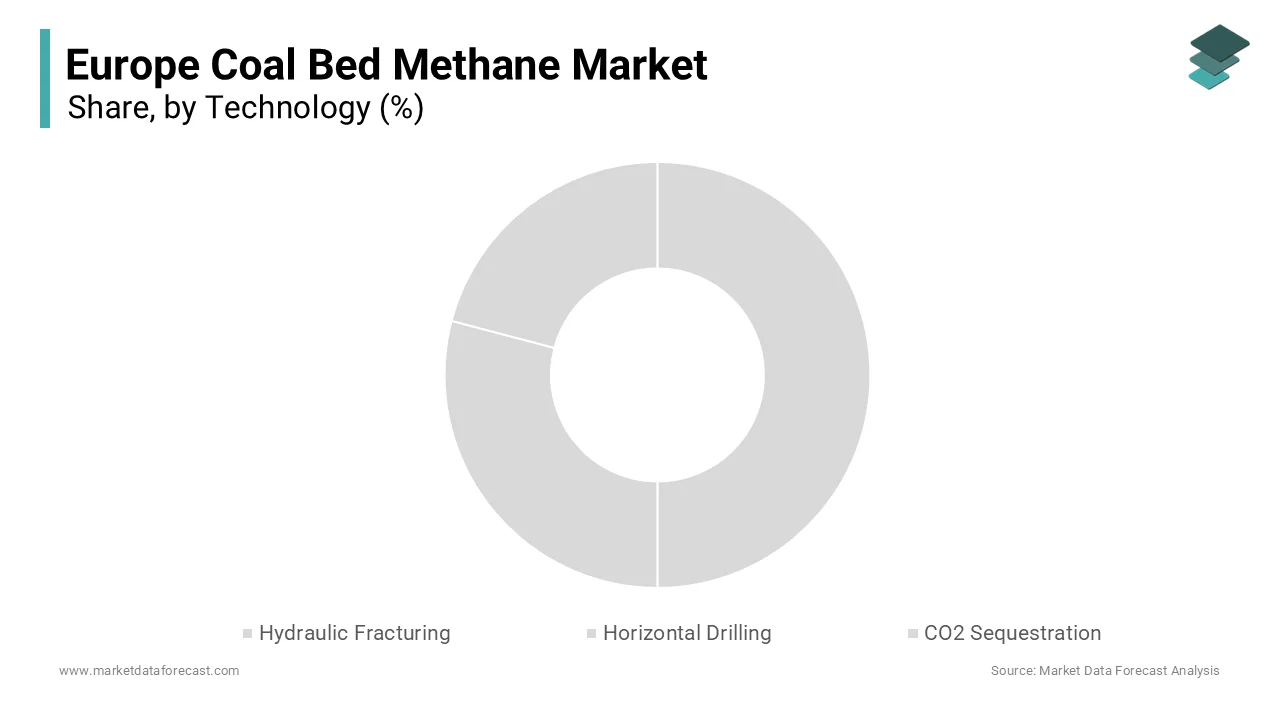
The CO₂ sequestration segment is projected to grow at a CAGR of 14.2% from 2025 to 2033 with the dual benefit of enhanced methane recovery and permanent carbon storage by aligning with EU climate neutrality goals. The process is known as CO₂-Enhanced Coal Bed Methane (CO₂-ECBM) that involves injecting captured CO₂ into unmineable coal seams where it adsorbs more strongly than methane, displacing additional gas while being securely stored. The Norwegian research institute SINTEF launched a pilot in Poland’s Upper Silesian Basin demonstrating a methane yield increase of 1.8 cubic meters per cubic meter of injected CO₂, with over 95% retention after 12 months. The European Commission’s Net Zero Industry Act explicitly lists CO₂-ECBM as a strategic net zero technology eligible for state aid and fast-tracked permitting. Additionally, the EU Innovation Fund allocated 85 million euros in 2023 to support integrated CBM-CCS projects in just transition regions.
By End User Insights
The power generation segment was the largest by holding a dominant share of the Europe coal bed methane market in 2024 with the integration of CBM into localized electricity and heat production systems at former mining sites. Unlike pipeline-quality gas, much of Europe’s CBM is used on-site or regionally due to modest volumes and infrastructure constraints by making decentralized power generation the most practical application. According to the UK Coal Authority, its 82 methane drainage plants generated over 60 gigawatt hours of electricity in 2023, feeding directly into the national grid or local district heating networks in Yorkshire and Wales. In Poland, state-owned mining companies operate combined heat and power units fueled by CBM, supplying energy to industrial parks in Silesia while reducing reliance on imported gas.
The industrial end-user segment is expanding at a CAGR of 9.8% during the forecast period driven by demand for stable, low-carbon thermal energy in manufacturing and chemical processes within former coal regions. Industries such as cement, glass, and food processing require consistent high-temperature heat that intermittent renewables cannot reliably provide by making locally sourced CBM an attractive transitional fuel. The Silesian Voivodeship in Poland launched a program to supply CBM directly to 14 industrial facilities, reducing their natural gas imports by an estimated 120 million cubic meters annually. Similarly, Germany’s RAG Foundation supplies methane-derived heat to chemical plants in the Saarland region through repurposed mine infrastructure. According to the European Environment Agency, industrial users in just transition areas prioritize energy sovereignty and price predictability over full decarbonization in the short term. The European Commission’s Industrial Carbon Management Strategy further supports this shift by allowing CBM with verified methane mitigation to count toward Scope 1 emission reduction targets. These policy and operational synergies position industrial use as the most dynamic growth corridor for CBM beyond power generation.
REGIONAL ANALYSIS
Poland Coal Bed Methane Market Analysis
Poland was the largest contributor of the European coal bed methane market by holding a prominent share in 2024 with its vast coal reserves, active mining legacy, and national energy security strategy. The country possesses an estimated 370 billion cubic meters of recoverable CBM in the Upper Silesian and Lublin Basins, according to the Polish Geological Institute. As per the National Energy Policy 2040 Poland aims to produce 1.5 billion cubic meters of CBM annually by 2030 to reduce gas imports. State-owned companies like PGNiG and Kompania Węglowa operate over 200 producing wells, primarily using micro-fracturing and dewatering. The government provides tax exemptions for CBM used in power and industry and has allocated 320 million zloty under the Just Transition Fund for infrastructure upgrades.
United Kingdom Coal Bed Methane Market Analysis
The United Kingdom coal bed methane market growth is likely to be driven by the mature methane drainage infrastructure at decommissioned collieries. The Coal Authority manages 82 active methane capture sites across England and Wales by generating over 60 gigawatt hours of electricity, annually as of 2023. Unlike Poland, the UK focuses on passive dewatering without hydraulic fracturing, complying with strict environmental regulations enforced by the Environment Agency. Most CBM is used for on-site power or fed into local grids under the Renewable Obligation Certificate scheme which grants partial green credits for methane mitigation. The Department for Energy Security and Net Zero expanded eligibility for CBM projects under the Green Gas Support Scheme, enabling injection into the national gas network.
Germany Coal Bed Methane Market Analysis
Germany coal bed methane market growth is anticipated to be driven by its repurposing of Ruhr and Saarland coal infrastructure for methane capture and district heating. The RAG Foundation operates a pioneering project in the Saarland region using mine water circulation to extract and combust methane for residential heating, serving over 8000 households. According to the Federal Ministry for Economic Affairs and Climate Action, Germany’s technically recoverable CBM resources exceed 100 billion cubic meters, though commercial development remains limited due to public opposition and stringent water regulations. However, the 2024 feasibility study on CBM in North Rhine Westphalia signals renewed interest under the Just Transition framework.
Netherlands Coal Bed Methane Market Analysis
The Netherlands coal bed methane market growth is anticipated to grow with the research-driven initiatives rather than commercial production. Although, the country has no active coal mines, the Geological Survey of the Netherlands confirmed significant CBM potential in deep Carboniferous seams beneath Limburg. TNO and Delft University of Technology launched a laboratory-scale CO₂-ECBM project simulating Dutch subsurface conditions to assess storage capacity and methane yield. The Ministry of Economic Affairs supports such work under its Carbon Capture and Utilization roadmap, viewing CBM not as a fuel source but as a potential CO₂ sink. The Netherlands’ role is thus primarily scientific, contributing data and modeling to EU-wide efforts while avoiding on-ground extraction due to high population density and strict land-use policies.
COMPETITIVE LANDSCAPE
The Europe coal bed methane market features limited but highly specialized competition dominated by state affiliated entities and public foundations rather than international oil companies. Unlike conventional upstream sectors the market is not driven by profit maximization but by environmental liability management energy security and regional economic revitalization. Poland’s PGNiG represents the only large scale commercial operator while the UK’s Coal Authority and Germany’s RAG Foundation focus on passive methane capture from decommissioned mines. Competition is therefore not price based but revolves around technical expertise in low impact extraction regulatory compliance and access to just transition funding. Barriers to entry remain high due to complex permitting geological uncertainty and public opposition to any form of fossil extraction. Innovation is concentrated in CO₂ enhanced recovery and emission verification rather than production volume. The absence of private equity interest and exclusion from renewable support schemes further constrain market dynamics. Success depends on aligning CBM activities with EU climate mechanisms and demonstrating verifiable methane mitigation rather than gas sales.
KEY MARKET PLAYERS
Some of the notable key players in the Europe coal bed methane market are
- BP plc
- Royal Dutch Shell plc
- ConocoPhillips Company
- Gazprom
- Halliburton Company
- The Coal Authority
- Polish Oil and Gas Company
- Baker Hughes Company
- Arrow Energy Pty Ltd
- Santos Ltd.
- Essar Oil and Gas Exploration and Production Ltd.
- China United Coalbed Methane Co., Ltd.
- RAG Foundation
- IGas Energy plc
- Fortune Oil PLC
Top Players in the Market
- Polish Oil and Gas Company is a leading European developer of coal bed methane resources with extensive operations in the Upper Silesian and Lublin Basins. The company leverages its national energy mandate to advance CBM as a strategic component of Poland’s energy diversification strategy. PGNiG utilizes micro hydraulic fracturing and advanced dewatering techniques to enhance gas recovery from low permeability seams while adhering to strict environmental monitoring protocols. The company expanded its CBM infrastructure by connecting 15 new wells to a regional gas processing hub near Katowice enabling direct injection into the national transmission network. It also partnered with the Polish Academy of Sciences to develop real time methane emission tracking systems using satellite and ground-based sensors. These initiatives reinforce PGNiG’s role as a pioneer in sustainable unconventional gas development within the EU framework.
- The Coal Authority is a non-departmental public body responsible for managing the legacy of coal mining in Great Britain with a unique focus on methane capture and utilization. Operating over 82 methane drainage plants at former collieries the organization generates clean electricity and supplies heat to local communities while mitigating greenhouse gas emissions. The Coal Authority does not pursue commercial extraction but transforms environmental liabilities into public assets through engineered water management and passive degasification systems. It launched the National Mine Methane Strategy integrating CBM data into the UK’s Net Zero Registry and enabling third party developers to access verified emission reduction credits. Its model of post mining stewardship has become a benchmark for just transition policies across Europe demonstrating how decommissioned sites can contribute to climate goals without active drilling.
- RAG Foundation is a German nonprofit organization managing the long term consequences of coal mining in the Ruhr and Saarland regions with a pioneering focus on methane-based energy recovery. The foundation operates innovative projects that circulate mine water to extract dissolved methane which is then combusted for district heating and power generation. Unlike conventional CBM developers RAG emphasizes passive recovery without hydraulic stimulation aligning with Germany’s stringent environmental standards. The foundation inaugurated a CO₂ enhanced coal bed methane pilot in collaboration with RWTH Aachen University testing the feasibility of permanent carbon storage in unmineable seams. Funded by the Federal Ministry for Economic Affairs this initiative positions RAG as a leader in carbon management rather than fossil fuel production thereby redefining the role of legacy mining institutions in the energy transition.
Top Strategies Used by the Key Market Participants
Key players in the Europe coal bed methane market pursue strategies centered on environmental stewardship regulatory alignment and integration with climate policy. Companies and public bodies prioritize methane mitigation over pure extraction framing CBM as a greenhouse gas reduction tool rather than a fossil fuel source. Passive dewatering and minimal intervention techniques are favored to comply with EU water and chemical regulations. Strategic partnerships with research institutions enable innovation in CO₂ sequestration and emission monitoring technologies. Public entities leverage just transition funding to repurpose mining infrastructure for community energy projects ensuring social license. Private firms focus on connecting CBM to existing gas grids or industrial clusters to avoid stranded assets. All participants actively engage with national and EU level policy frameworks to secure eligibility for carbon credits subsidies and fast tracked permitting. These approaches collectively position CBM within the circular economy and net zero agendas rather than traditional hydrocarbon markets.
MARKET SEGMENTATION
This research report on the European coal bed methane market has been segmented and sub-segmented based on categories.
By Technology
- Hydraulic Fracturing
- Horizontal Drilling
- CO2 Sequestration
By End User
- Residential
- Commercial
- Industrial
- Power Generation
- Transportation
By Country
- UK
- France
- Spain
- Germany
- Italy
- Russia
- Sweden
- Denmark
- Switzerland
- Netherlands
- Turkey
- Czech Republic
- Rest of Europe