- Product Description Description
- Table of Contents TOC
- List of Table & Figure LOT
- Get Free Sample PDF Sample PDF
Market Size, 2025
$52.84 BnMarket Estimate, 2026
$55.86 BnMarket Forecast, 2034
$87.10 BnCAGR, 2026–2034
5.71%Europe Coffee Beans Market Size, Growth, Trends & Forecast (2026–2034)
The Europe coffee bean market size was calculated to be USD 52.84 billion in 2025, is estimated to reach USD 55.86 billion in 2026, and is projected to scale up to USD 87.10 billion by 2034, registering a compound annual growth rate (CAGR) of 5.71% during the forecast period from 2026 to 2034. Propelled by the deep cultural entrenchment of coffee traditions across Europe, rising demand for ethically sourced and traceable beans under the EU Deforestation Regulation, and the expansion of home brewing and specialty premiumization, the market continues its robust trajectory.
Key Executive Metrics (At-a-Glance)
- 2025 Base Valuation: USD 52.84 Billion
- 2026 Current Valuation: USD 55.86 Billion
- 2034 Forecast Valuation: USD 87.10 Billion
- Compound Annual Growth Rate (CAGR): 5.71% (2026–2034)
- Dominant Product Type Segment: Whole Bean (44.3% share in 2025)
- Fastest-Growing Product Type Segment: Whole Bean (CAGR of 8.6%)
- Dominant Flavor Segment: Plain Coffee Beans
- Fastest-Growing Flavor Segment: Flavored Coffee Beans (CAGR of 6.2%)
- Dominant Distribution Channel Segment: Off-Trade Channel
- Fastest-Growing Distribution Channel Segment: On-Trade Channel (CAGR of 9.4%)
- Dominant Regional Market: Germany (19.2% share in 2025)
- Fastest-Growing Regional Markets: United Kingdom, Sweden, France
Core Market Drivers
- Cultural Entrenchment: Deeply ingrained rituals (such as Nordic *fika* and German *Kaffee und Kuchen*) supporting consistent, high-volume baseline consumption.
- Ethical & Traceable Demand: Growing consumer awareness and regulatory mandates (EU Deforestation Regulation) driving transparency and geolocation tracking from farm to roaster.
Primary Market Restraints & Challenges
- Regulatory Compliance Costs: Stringent EU due diligence mandates imposing heavy operational hurdles and digital traceability burdens on smallholders and independent roasters.
- Supply Volatility: Climate-driven crop disruptions and speculative global futures price swings squeezing profit margins.
- Fragmented Certifications: Saturated eco-labels causing consumer confusion and undermining trust in sustainability claims.
Europe Coffee Beans Market Classification Breakdown
| Segment Category | Largest (Dominant) Segment | Fastest-Growing Segment |
|---|---|---|
| By Product Type | Whole Bean (44.3%) | Whole Bean (CAGR: 8.6%) |
| By Flavor | Plain | Flavored (CAGR: 6.2%) |
| By Distribution Channel | Off-Trade | On-Trade (CAGR: 9.4%) |
| By Region | Germany (19.2%) | UK, Sweden, France |
Major Industry Players Profiled
Key enterprise participants shaping the European coffee beans market include JAB Holding Company (Jacobs Douwe Egberts, Peet's Coffee), Nestlé, Lavazza Group, Illycaffè, Tchibo, Melitta Group, Segafredo Zanetti, Paulig Group, Massimo Zanetti Beverage Group, and Dallmayr.
Europe Coffee Beans Market Size
The Europe coffee bean market size was calculated to be USD 52.84 billion in 2025 and is anticipated to be worth USD 87.10 billion by 2034, growing from USD 55.86 billion in 2026 at a CAGR of 5.71% during the forecast period.
The coffee beans are sourced, roasted, and distributed as green and roasted coffee beans, primarily Coffea arabica and Coffea canephora (robusta) for household, foodservice, and specialty consumption, across the European Union and associated countries. According to Eurostat, over 94% of European households consumed coffee in 2023, with per capita annual consumption exceeding 5 kilograms in countries like Finland and Sweden. As per the European Commission, the EU imported 3.2 million tonnes of green coffee beans in 2023, making it the world’s largest coffee importer. Crucially, the EU Deforestation Regulation enacted in 2023 requires full geolocation traceability for all coffee entering the bloc from 2026, fundamentally reshaping supply chain accountability. This convergence of cultural entrenchment, regulatory rigor, and consumer demand for provenance defines the unique contours of Europe’s coffee bean landscape.
MARKET DRIVERS
Deep Cultural Entrenchment of Coffee Consumption Across Diverse European Traditions
Coffee is not merely a beverage in Europe but a cultural institution with regionally distinct rituals that sustain consistent demand for high-quality beans. The deep cultural entrenchment of coffee consumption across diverse European traditions. According to Eurostat, 94% of EU households reported regular coffee consumption in 2023, with daily intake averaging 2.4 cups per adult. Nordic countries lead in per capita usage, Finland at 12.5 kilograms and Sweden at 10.8 kilograms annually, as per the International Coffee Organization, driven by the fika and kaffe traditions that integrate coffee into social and work life. Meanwhile, Germany’s Kaffee und Kuchen afternoon custom supports demand for balanced filter roasts. These ingrained behaviors create a resilient baseline demand less susceptible to economic volatility.
Rising Consumer Demand for Ethically Sourced and Traceable Coffee Originating from Sustainability Awareness
European consumers increasingly prioritize environmental and social ethics in coffee purchasing decisions, driving demand for certified and transparently sourced beans. The rising consumer demand for ethically sourced, traceable coffee originating from sustainability awareness is additionally fuelling the growth of Europe coffee bean market. As per a 2025 Eurobarometer survey, many EU citizens aged 18 to 45 consider fair trade or direct trade labeling important when buying coffee, and 59% actively avoid brands lacking deforestation-free claims. This shift is amplified by legislation, where the European Commission’s Deforestation Regulation mandates that all coffee imported into the EU after December 2025 must be produced on land not deforested after December 2020, with GPS coordinates verified via digital traceability systems. Roasters like Germany’s Five Elephant and Sweden’s Koppi now publifarm-levelled,ata including soil health and farmer income. This emergence of civic consciousness and regulatory enforcement is transforming coffee from a commodity into a credence good where provenance equals value.
MARKET RESTRAINTS
Stringent EU Regulatory Requirements on Deforestation and Supply Chain Due Diligence Increasing Compliance Burden
The European Union’s Deforestation Regulation imposes unprecedented traceability and verification obligations on coffee importers that significantly raise operational complexity and costs. The stringent EU regulatory requirements on deforestation and the d supply chaareare is substantially hindering the growth of Europe coffebeanns market. As per the European Commission, all economic operators must ensure that coffee entering the EU market is deforestation-free based on geospatial data from after December 2020 and submit a due diligence statement to national authorities. As per the r 2025 impact assessment by the European Environment Agency, over 80% of smallholder coffee farms in key exporting countries like Brazil and Vietnam lack the digital infrastructure to provide plot-level coordinates, forcing importers to invest in satellite monitoring and blockchain verification systems. Non-compliance carries penalties of up to 4% of EU turnover. These barriers disproportionately affect independent roasters and specialty importers who lack the scale to absorb costs, potentially consolidating the market and limiting bean diversity.
Volatility in Global Coffee Prices and Climatic Disruptions Affecting Supply Stability
The persistent supply insecurity due climate-drivenven production shocks and speculative price swings is hampering the growth of Europe coffbeanans market. According to the International Coffee Organization, the average price of arabica beans on the New York ICE futures exchange surged to 245 US cents per pound in early 20,th the highest in 15 years, driven by drought in Brazil and frost damage in Colombia. Simultaneously, Vietnam is the world’s largest robusta producer, which saw output drop 12% in 2023, according to its General Statistics Office, because of prolonged dry spells. These disruptions directly impact European roasters, who relya a on ca onsistent green bean supply. Without long term hedging or direct farm partnerships, price volatility erodes margins and destabilizes product consistency, particularly for small businesses.
MARKET OPPORTUNITIES
Expansion of Direct Trade and Farm to Roaster Partnerships Enhancing Quality and Equity
European specialty roasters are increasingly bypassing traditional import channels to establish direct relationships with coffee farmers by creating mutual benefits in quality premiums and social equity. This factor is expected to propel new opportunities for the growth of Europe coffbeanns market. These partnerships often include pre-harvest financing,, ing agronomic support, and price floors well above commodity rates. The AgriBusiness program supports traceable coffee supply chains that integrate smallholders into direct trade networks. By aligning with EU deforestation rules and consumer ethics, direct trade transforms coffee from a bulk import into a collaborative craft ecosystem with shared value creation.
Growth of Home Brewing and Premiumization Driving Demand for Single Origin and Micro Lot Beans
The post pandemic normalization of home coffee preparation has catalyzed sustained demand fhigh-end single-origingin amicro-lotlot beans across Europe. According to a 2025 NielsenIQ report, sales of specialty whole bean coffee in Western Europe grew by 18% year on year, with single-origin offerings accounting for 62% of premium segment revenue. Consumers are investing in grinderspour-over over equipme. Household ownership of manual brewing devices rose to 34% in the UK and 41% in France as per GfK by enabling nuanced appreciation oterroir-drivenen flavors. This connoisseurship mirrors wine culture and supports pricing 3 to 5 times above mainstream blends. As home brewing becomes a lifestyle practice rather than a substitute, the shifts toward differentiation through origin story and sensory precision open avenues for micro importers and artisan roasters.
MARKET CHALLENGES
Fragmented Certification Landscape Confusing Consumers and Diluting Ethical Impact
The saturated market with overlapping and sometimes contradictory sustainability certifications Fairtra Rainforest Alliance, Organic, UTZ Direct Trade, creates consumer confusion and diminishes the perceived value of ethical claims. The fragmented certificationlandscapecape confusinconsumersrs and dilutes ethical impact, whichis degrading the growth of Europe's coffee market. According to a 2025 study by the European Consumer Organisation, only 31% of surveyed shoppers could correctly distinguish between the social and environmental criteria of major labels. This opacity allows brands to engage in “certification shopping,” selecting the least stringent scheme that suits marketing narratives. The proliferation of self-declared “ethical” labels with third-party verification further erodes trust. As the EU moves toward mandatory due diligence under the Corporate Sustainability Reporting Directive, this fragmentation undermines coherent progress, leaving consumers skeptical and farmers inadequately compensated despite premium pricing.
Limited Domestic Roasting and Processing Capacity Constraining Value Addition Within Europe
Despite being the world’s largest coffee importer, Europe adds limited value through domestic roasting and processing, with the majority of green beans shipped as raw commodities and only partially roasted locally. According to Eurostat, only a few of the imported green coffee undergoes full roasting within the EU, where the rest is either re-exported or processed into low-value industrial blends. This dependency on external processing limits Europe’s ability to respond to specialty demand and capture higher margins. Moreover, small roasters face bottlenecks in accessing certified green beans due to minimum order volumes imposed by large importers. Without investment in decentralized micro-roasting hubs and green bean distribution networks, Europe remains a consumption rather than value creation hub in the global coffee chain.
REPORT COVERAGE
| REPORT METRIC | DETAILS |
| Market Size Available | 2025 to 2034 |
| Base Year | 2025 |
| Forecast Period | 2026 to 2034 |
| CAGR | 5.71% |
| Segments Covered | By Product Type, Flavor, Distribution Channel, and Region |
| Various Analyses Covered | Global, Regional & Country Level Analysis; Segment-Level Analysis; DROC, PESTLE Analysis; Porter’s Five Forces Analysis; Competitive Landscape; Analyst Overview of Investment Opportunities |
| Regions Covered | UK, France, Spain, Germany, Italy, Russia, Sweden, Denmark, Switzerland, Netherlands, Turkey, and the Czech Republic |
| Market Leaders Profiled | Nestlé, JDE Peet’s, Lavazza Group, Illycaffè, Tchibo, Melitta Group, Segafredo Zanetti, Paulig Group, Massimo Zanetti Beverage Group, Dallmayr |
SEGMENTAL ANALYSIS
By Product Type Insights
The whole bean coffee segment wacounted in holding 44.3% of the Europe coffee beans market share in 2025, with the continent’s deepening specialty coffee culture and consumer preference for freshness and flavor control. According to the European Coffee Roasters Association, over 68% of specialty coffee consumers in Germany, France, and the Nordic countries grind beans immediately before brewing to preserve volatile aromatic compounds. The European Food Safety Authority confirmed in 2023 that whole beans retain up to 40% more flavor compounds after 30 days compared to pre-ground alternatives stored under identical conditions. Additionally, the rise of home espresso machineand s household ownership in 29% in the EU in 2023 p, according to Eurostat, whichequires freshly ground beans for optimal extraction. This synergy of sensory quality, equipment adoption, and retail support ensurethat s whole bean remains the preferred choice for discerning European consumers.
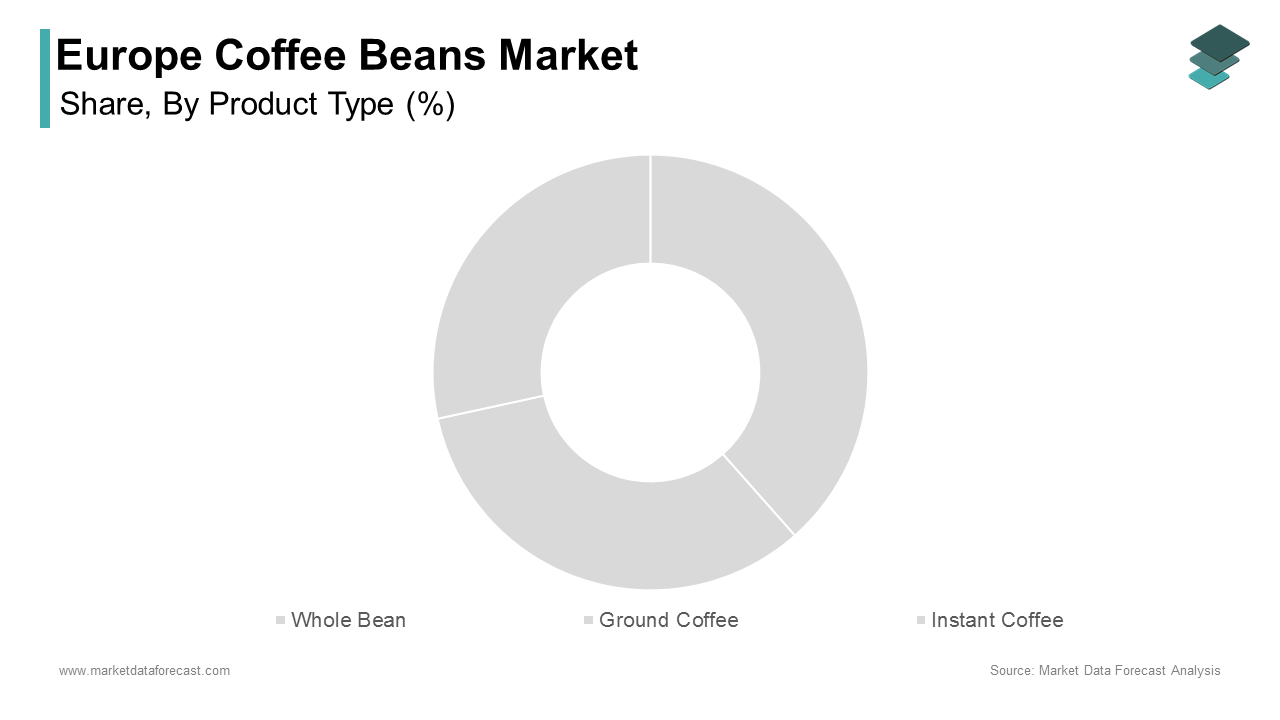
The whole bean coffee segment is expected to grow at the fastest CAGR of 8.6% during the forecast period, from the emergence of home brewin,, sophisticati,, on sustainabilitawarenesses,s and premiumization. Consumers increasingly view whole beans as a marker of connoisseurship akin to wine, with 57% of buyers aged 25 to 45 consulting roast dates and origin details before purchase, as per a GfK survey. The EU’s push for reduced packaging waste also favors whole beans, which generate less waste than capsules or sachets. Furthermore, specialty roasters like Germany’s Five Elephant and Denmark’s Coffee Collective exclusively sell whole beans to ensure quality integrity. As home preparation evolves from convenience to ritual, the whole bean segment thrives on authenticity and control.
By Flavor Insights
The plain coffee beans segment held a significant share of the Europe coffee beans market in 2025, with the increasing consumer preference for unadulterated coffee profiles that highlight terroir and roasting craftsmanship. As per the European Coffee Roasters Association, over 92% of specialty coffee sold in Europe is unflavored, allowing natural tasting notes, such as citrus from Ethiopian Yirgacheffe or chocolate from Brazilian Santos, to shine. This aligns with EU food labeling regulations under Regulation EC 1334 2008, which restrict the use of artificial flavorings in roasted coffee and require full ingredient transparency. Traditional brewing methods like espresso and pour ovare er prevalent in Italy and Scandinavia that further emphasize bean origin over artificial enhancement. Even in mainstream retail, plain beans dominate with private label offerings from Tesco, Albert Heijn, and Li, dl focusing on origin blends rather than flavoring. This cultural and regulatory environment solidifies plain coffee as the core of European coffee identity.
The flavored coffee beans segment is expected to witness the fastest CAGR of 6.2% during the forecast period, with the younger demographics and Eastern European countries, where novelty and sensory experimentation drive trial. Natural flavorings derived from vanilla,lla cinnamon, and hazelnut comply with EU purity standards and are gaining traction over artificial alternatives. Brands like Illy and Lavazza have introduced limited edition naturally flavored whole bean lines in Germany and the UK using EU-approved botanical extracts. Additionally, the rise of cold brew and ready-to-drink formats creates demand for stable flavor profiles that mask bitterness without synthetic additives.
By Distribution Channel Insights
The off-trade channel segment was the largest by occupying a dominant share of the Europe coffee beans market in 2025 due to convenience household consumption patterns and strong private label penetration. As per Eurostat, 94% of European households purchased coffee from retail outlets in 2023, with supermarkets alone handling 62% of total volume. Major retailers like Carrefour, REWE, ka, and Tesco leverage scale to offer diverse bean selections ranging from economy blends to premium single origins, often at lower margins than specialty stores. NielsenIQ reported that private label coffee grew by 11% in 2023 across Western Europe as cost-conscious consumers traded down without sacrificing bean integrity. E-commerce further amplifies off-trade reach with platforms like Amazon and Picnic, enabling subscription-based whole bean deliveries. The post pandemic normalization of home brewing has entrenched retail as the primary sourcing channel, ensuring off-trade dominance through accessibility pricing and shelf diversity.
The on-trade segment is likely to grow with an anticipated CAGR of 9.4% from 2026 to 2034, with the post pandemic revival of social and workplace coffee culture in urban centers. The European Commission’s Sustainable Food Systems Framework encourages trade venues to source certified beans, which has led to partnerships between roasters and hospitality groups, such as Accor and Compass Group. Moreover, corporate wellness programs now include high-quality coffee as an employee benefit, with 38% of Fortune 500 European offices upgrading to specialty bean suppliers, as per a 2025 Mercer survey. As experiential consumption returns, the on-trade channel thrives on quality curation and sensory education.
REGIONAL ANALYSIS
Germany Coffee Beans Market Analysis
Germany was the top performer of the Europe coffee beans market by holding 19.2% of the share in 2025, with high per capita consumption, strong retail infrastructure, and a vibrant specialty coffee scene. According to the German Coffee Association, the average German consumes 166 liters of coffee annually, with 82% of households purchasing fresh beans weekly. The country hosts over 1,200 specialty roasters, including Tres Cabezas and Bonanza, which champion direct trade and light roasting. Germany’s EDEKA and REWE supermarket chains offer over 200 whole bean SKUs, each with extensive origin labeling. The Federal Ministry of Food and Agriculture supports sustainability through the “Coffee Dialog” platform, which aligns industry practices with the EU Deforestation Regulation. This blend of volume tradition and innovation secures Germany’s leadership in both mainstream and premium segments.
Italy Coffee Beans Market Analysis
Italy's coffee bean market was ranked second by capturing 14.7% of the market share in 2025, with its espresso heritage and deep cultural integration of coffee into daily life. The country’s 150,000 coffee bars serve as primary consumption points, with each sourcing freshly roasted beans from regional torrefazioni like Caffè Vergnano and Kimbo. Italy’s strict “torrefazione” labeling laws require roasters to disclose origin roast date and blend composition, ensuring transparency. Despite global trends, Italians remain resistant to flavored or instant coffee, with such formats accounting for less than 3% of consumption according to Federdistribuzione. However, third-wave cafés in Milan and Turin are introducing single-origin filter brews, attracting younger consumers. Italy’s unwavering commitment to tradition, combined with selective modernization, maintains its pivotal role in shaping European coffee identity.
France Coffee Beans Market Analysis
France coffee bean market is likely to grow with the cafe culture revival andthe rising interest in origin transparency. According to FranceAgrimer, the average French adult consumes 5.4 kilograms of coffee annually, with whole bean purchases growing by 13% in 2023. Paris alone hosts over 800 specialty cafes, including Coutume and Telescope, which source directly from Latin American and African farms. The French National Institute for Origin and Quality awards “Café de Specialité” certification to beans meeting strict sensory and ethical criteria, a framework adopted by major retailers like Monoprix. Additionally, the government’s “Plan Café” allocates 10 million euros annually to support sustainable sourcing and farmer training in partner countries like Colombia and Ethiopia. While traditional dark roast blends dominate households, the younger generation increasingly seeks light-roasted single origins. This duality of heritage and evolution positions France as a bridge between old-world and new-world coffee sensibilities.
United Kingdom Coffee Beans Market Analysis
The United Kingdom coffee beans market is likely to grow with the adoption of rapid specialty coffee and strong ethical consumption trends. London is Europe’s most concentrated specialty hub with over 1,000 third-wave cafes, including Notes and Ozone that roast in-house and publish farm data. Supermarkets like Waitrose and Sainsbury’s have expanded whole bean sections featuring UK roasters, such as Has Bean and Union Hand Roasted. This confluence of ethics, convenience, and connoisseurship drives the UK’s dynamic and forward-looking coffee market.
Sweden Coffee Beans Market Analysis
Sweden's coffee bean market growth is likely to grow with the world’s highest per capita consumption and institutionalized coffee rituals like fika. According to Statistics Sweden, the averageSweden consumes 8.2 kilograms of coffee annually, with 92% of workplaces providing daily coffee breaks. The country’s coffee culture emphasizes freshness and social connection, leading to strong demand for lightly roasted arabica beans from Ethiopia and Kenya. Swedish roasters like Koppi and Drop Coffee pioneer transparent sourcing, often paying triple commodity prices to farmers. The Swedish Board of Agriculture enforces strict labeling requiring roast dates and origin details on all retail beans. Additionally, Sweden’s public procurement guidelines mandate that all government offices serve certified sustainable coffee, a policy adopted by 95% of municipalities.
COMPETITION OVERVIEW
Competition in the Europe coffee beans market is characterized by a dual structure where global conglomerates dominate volume segments through retail and instant coffee, while agile specialty roasters capture premium demand with traceable single-origin beans. Large players like JAB and Nestlé leverage scale, procurement power, and multi-channel distribution to maintain household presence, whereas artisan roasters differentiate through terroir storytelling direct farmer relationships, and light roast profiles. Regulatory pressure under the EU Deforestation Regulation is reshaping competition by raising compliance barriers and favoring firms with integrated traceability systems. Private labels from major retailers are gaining ground in mid-tier segments by offering certified beans at competitive prices. Meanwhile, the on-trade channel fuels rivalry as cafés seek exclusive micro lots to build brand identity. Innovation in sustainable packaging, ethical certification, and home brewing compatibility now defines competitive advantage more than price alone in this culturally rich and increasingly conscientious market.
KEY MARKET PLAYERS
A few major players of the Europe coffee beans market include
- Nestlé
- JDE Peet’s
- Lavazza Group
- Illycaffè
- Tchibo"]
- Melitta Group
- Segafredo Zanetti
- Paulig Group
- Massimo Zanetti Beverage Group
- Dallmayr
Top Strategies Used by the Key Market Participants
Key players in the Europe coffee beans market focus on embedding full supply chain transparency to comply with the EU Deforestation Regulation by implementing geolocation tracking and digital traceability systems. They invest in direct trade and farmer capacity building programs to secure high-quality, sustainable beans while ensuring social equity. Companies are reformulating packaging to meet circular economy mandates using recyclable or compostable materials for beans and capsules. Premiumization strategies emphasize single-origin micro lot offerings and roast freshness with detailed origin storytelling. Additionally, firms align product portfolios with consumer demand for plain unflavored beans while selectively introducing natural flavor variants in growth markets. Strategic partnerships with retailers, foodservice groups, and certification bodies further strengthen market access and brand credibility across diverse European segments.
Leading Players in the Market
- JAB Holding Company exerts significant influence over the Europe coffee beans market through its portfolio of premium and mainstream coffee brands, including Jacobs Douwe Egberts, Tassimo's Peet’s Coffee, and Pret A Manger. The company supplies roasted beans to retail foodservice and office channels across the continent with a strong emphasis on sustainability and vertical integration. Globally, JAB sources green coffee from over 30 countries and operates roasting facilities in Germany, the Netherlands, and France. JAB enhanced its European footprint by launching a blockchain-based traceability platform for its Jacobs brand, enabling consumers to verifydeforestation-freee compliance from farm to package. It also expanded its partnership with Rainforest Alliance to certify 100% of its European arabica supply by 2026, aligning with EU regulatory expectations and reinforcing its commitment to ethical sourcing at scale.
- Nestlé is a major force in the Europe coffee beans market primarily through its Nescafé and Nespresso brands, which span instant ground and whole bean segments. The company’s global coffee sourcing network includes direct relationships with over 700000 farmers and operates sustainable farming programs like the Nescafé Plan. In Europe, Nestlé supplies both household and professional markets with a focus on innovation and circularity. In early 2025, the company introduced its first fully recyclable paper-based coffee capsule for Nespresso in France and Germany, using responsibly sourced arabica beans. It also upgraded its Nescafé Gold whole bean line with EU deforestation regulation-compliant traceability features. These initiatives demonstrate Nestlé’s strategy of embedding sustainability into core product architecture while maintaininga broad consumer reach across price tiers.
- illycaffè is a distinguished player in the Europe coffee beans market, renowned for its 100% arabica blends and premium positioning rooted in Italian espresso heritage. The company sources beans from 9 countries under its Direct Trade mode,l ensuring quality consistency and farmer partnerships that exceed fair trade standardIllylly supplies whole beans to high-end retail luxury hotels and its global network of illy Caffè outlets, including over 250 locations across Europe. In 2025, illy launched its “Open Source Sustainability” platform publishinreal-timeme data on carbon footprint,t water usage, and farmer income for every batch. It also introduced a limited edition single-origin whole bean line from El Salvador featuring QR code-enabled farm stories. These actions reinforce ILLY’s legacy as a pioneer in ethical excellence and sensory precision while deepening consumer trust in an increasingly regulated market.
MARKET SEGMENTATION
This research report on the Europe coffee beans market has been segmented and sub-segmented based on product type, flavor, distribution channel, and region.
By Product Type
- Whole Bean
- Ground Coffee
- Instant Coffee
By Flavor
- Plain
- Flavored
By Distribution Channel
- On-Trade
- Off-Trade
By Region
- UK
- France
- Spain
- Germany
- Italy
- Russia
- Sweden
- Denmark
- Switzerland
- Netherlands
- Turkey
- Czech Republic
- Rest of Europe