- Product Description Description
- Table of Contents TOC
- List of Table & Figure LOT
- Get Free Sample PDF Sample PDF
Market Size, 2025
$297.61 BnMarket Estimate, 2026
$317.46 BnMarket Forecast, 2034
$532.14 BnCAGR, 2026–2034
6.67%Executive Summary: Europe Commercial Insurance Market
- Market Scope: Comprehensive analysis of the European commercial insurance landscape, tracking general liability, cyber risks, property insurance, parametric climate solutions, and dynamic pricing models (forecast period: 2026-2034).
- Market Valuation: Valued at USD 297.61 billion in 2025, estimated to reach USD 317.46 billion in 2026, and projected to expand to USD 532.14 billion by 2034, growing at a steady CAGR of 6.67% from 2026 to 2034.
- Primary Growth Drivers: Escalating frequency and severity of sophisticated cyberattacks against enterprises, coupled with stringent regulatory mandates (such as the NIS2 Directive) and heightened litigation complexity across European jurisdictions.
Key Market Segment Metrics
| Category | Leading Segment (Base Position) | Fastest-Growing / High-Growth Segment |
|---|---|---|
| By Insurance Type | Commercial Property Insurance (largest capturing 34.2% share in 2025 driven by asset protection needs and rising non-residential construction) | Liability Insurance (fastest CAGR of 6.8% propelled by stricter corporate accountability laws, class actions, and cyber liability inclusion) |
| By Distribution Channel | Agents & Brokers (dominant channel in 2025 owing to complex commercial risk profiles, bespoke underwriting, and claims advocacy) | Direct Response / Digital (fastest 9.4% CAGR driven by small business digitization and instant, embedded micro-enterprise solutions) |
| By Country / Region | United Kingdom (top performer accounting for 26.3% share in 2025 anchored by London's specialty insurance and reinsurance hub) | France, Germany, Italy, & Netherlands (high-growth industrial, manufacturing, and trade logistics hubs) |
Major Market Players & Industry Landscape
Market Structure: Highly competitive landscape governed by Solvency II requirements, featuring global multi-line conglomerates and specialized risk underwriters driving digital transformation.
Key Companies & Leaders: Allianz SE, AXA S.A., Zurich Insurance Group, Assicurazioni Generali S.p.A., Munich Re Group, Aviva plc, Chubb Limited, HDI Global SE, Mapfre S.A., Swiss Re Group, and Lloyd’s of London.
 Download Free Sample Report
Europe Commercial Insurance Market Size
The Europe commercial insurance market was valued at USD 297.61 billion in 2025, is estimated to reach USD 317.46 billion in 2026, and is projected to reach USD 532.14 billion by 2034, growing at a CAGR of 6.67% from 2026 to 2034.
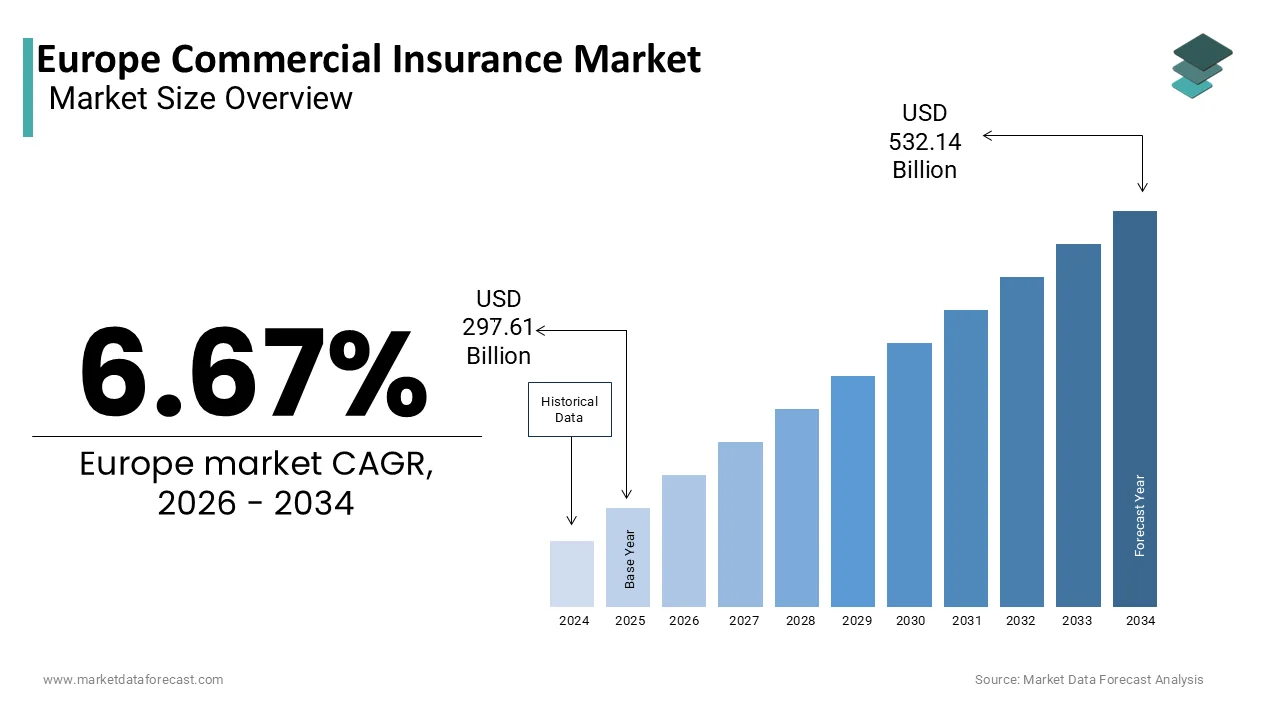
Commercial insurance is a risk transfer mechanism designed to protect businesses, institutions, and public entities against financial losses arising from property damage, liability claims, cyber incidents, and operational interruptions. This sector encompasses a diverse array of products, including general liability, professional indemnity, marine cargo, and directors and officers coverage, tailored to the specific regulatory and economic landscapes of European nations. The definition has expanded significantly in recent years to include parametric triggers and embedded insurance solutions that integrate directly into business workflows. According to Eurostat, small and medium-sized enterprises constitute 99% of all businesses in the European Union, creating a vast and fragmented base of potential policyholders requiring specialized coverage. As per the European Central Bank, the total number of non-financial corporations in the euro area exceeded 24 million in 2025, underscoring the sheer scale of the addressable market for commercial underwriters. The region also hosts over 4,500 active insurance undertakings, which is fostering a highly competitive environment driven by solvency requirements and capital adequacy standards. In 2025, the market witnessed a paradigm shift towards dynamic pricing models fueled by real-time data analytics, allowing insurers to assess risks with unprecedented granularity.
MARKET DRIVERS
Escalating Frequency and Severity of Cyber Threats Against Enterprises
The surging prevalence of sophisticated cyberattacks targeting corporations is propelling the growth of Europe commercial insurance market. Businesses across the continent face an evolving landscape of ransomware, data breaches, and state-sponsored hacking attempts that threaten operational continuity and reputational standing. According to the European Union Agency for Cybersecurity, reported cyber incidents in the EU increased by 38% in 2025 compared to the previous year, with the average cost of a data breach reaching €4.2 million for European companies. This alarming trend forces organizations to seek comprehensive cyber insurance policies that cover not only direct financial losses but also forensic investigation costs, legal fees, and customer notification expenses. The implementation of the NIS2 Directive has further heightened awareness, mandating stricter cybersecurity measures and reporting obligations that make insurance a vital component of risk management strategies. Companies are increasingly recognizing that internal security measures alone cannot prevent all breaches, leading to a surge in demand for coverage that includes business interruption due to system downtime. Insurers are responding by developing specialized products that offer proactive threat monitoring and incident response services alongside traditional indemnification.
Regulatory Mandates and Increasing Litigation Complexity
Stringent regulatory frameworks and a rising tide of complex litigation across European jurisdictions serve as powerful drivers for the adoption of commercial insurance products. The regulatory mandates and increasing litigation complexity are also amplifying the growth of Europe commercial insurance market. Governments and supervisory bodies have introduced rigorous laws holding corporate directors and officers personally liable for governance failures, environmental damages, and workplace safety violations. As per the European Commission, the number of class action lawsuits filed in EU member states has risen by 25% since the introduction of the Representative Actions Directive, exposing companies to unprecedented financial risks. This legal environment compels businesses to secure robust Directors and Officers liability coverage and Employment Practices Liability Insurance to protect their leadership teams and balance sheets. Furthermore, sector-specific regulations in healthcare, finance, and construction mandate minimum insurance limits that companies must maintain to operate legally. The complexity of cross-border operations within the Single Market adds another layer of risk, as firms must navigate varying legal systems and liability standards across different countries. Insurers are seeing increased demand for policies that provide global coverage extensions and legal defense support in multiple jurisdictions. The fear of debilitating fines and settlement costs drives even small businesses to prioritize adequate coverage by ensuring that the commercial insurance market remains essential for regulatory compliance and legal protection.
MARKET RESTRAINTS
Persistent Inflationary Pressures on Claims Costs and Replacement Values
High inflation rates are driving up the cost of claims settlements and asset replacement values, thereby squeezing insurer margins and limiting capacity. This attribute is limiting the growth of Europe commercial insurance market. The rising prices of raw materials, labor, and construction services mean that the cost to repair or replace damaged commercial property has escalated dramatically, often exceeding the sums insured in older policies. According to Eurostat, the annual inflation rate in the euro area averaged 2.6% in early 2025, with producer prices for industrial goods increasing by over 4% in key manufacturing sectors. This phenomenon, known as social inflation in the context of liability claims, leads to larger jury awards and higher settlement amounts that strain insurer reserves. Insurance carriers are forced to increase premiums sharply or reduce coverage limits, which can price out smaller businesses and suppress overall demand. The uncertainty regarding future inflation trajectories makes underwriting long-tail liability lines particularly challenging, causing some insurers to withdraw from certain markets or lines of business entirely. Reinsurers are also demanding higher rates to offset their exposure to inflated loss costs by passing these expenses down to primary insurers.
Acute Shortage of Specialized Underwriting and Risk Management Talent
The shortage of skilled professionals possessing the expertise to underwrite complex commercial risks and develop innovative insurance products severely constrains the growth potential of the European commercial insurance market. The acute shortage of specialised underwriting and risk management talent is degrading the growth of Europe commercial insurance market. The industry faces an aging workforce and a lack of younger talent entering the field with the necessary analytical and technical skills to manage modern risks like cyber threats and climate change. According to Insurance Europe, the sector anticipates a deficit of nearly 150,000 skilled workers by 2027 due to retirements and insufficient recruitment pipelines. This talent gap limits the ability of insurers to accurately price emerging risks, leading to conservative underwriting practices that restrict capacity in high-demand areas. Furthermore, the rapid pace of technological change demands continuous upskilling, which many traditional insurers struggle to provide effectively. The inability to recruit and retain top talent results in slower product development cycles and reduced agility in responding to market shifts.
MARKET OPPORTUNITIES
Integration of Internet of Things and Telematics for Dynamic Pricing
The widespread adoption of Internet of Things devices and telematics technologies to shift from static to dynamic, usage-based pricing models is setting up new opportunities for the growth of Europe commercial insurance market. Sensors installed in commercial vehicles, machinery, and buildings generate real-time data on usage patterns, maintenance needs, and safety behaviors, allowing insurers to assess risk with unprecedented accuracy. According to the International Data Corporation, spending on IoT solutions in Europe is projected to reach €260 billion by 2026, with logistics and manufacturing being the largest adopters. Insurers can leverage this data to offer personalized premiums that reward safe operating practices and proactive maintenance, reducing loss ratios and enhancing customer engagement. For instance, fleet operators can receive discounts based on driver behavior monitored via telematics, while factories can lower premiums by demonstrating optimal machine performance through connected sensors. This approach not only improves profitability for insurers but also provides valuable insights to policyholders for risk mitigation. The ability to intervene in real time to prevent accidents or equipment failures creates a partnership model rather than a simple transactional relationship.
Development of Parametric Insurance Solutions for Climate Resilience
The increasing frequency of extreme weather events driven by climate change creates a significant opportunity for the expansion of parametric insurance products within the European commercial insurance market. The development of parametric insurance solutions for climate resilience is also expected to elevate the growth of Europe commercial insurance market. According to the European Environment Agency, the number of weather-related disasters in Europe has doubled over the past three decades, causing billions in economic losses and highlighting the need for faster recovery mechanisms. Parametric solutions offer immediate liquidity to businesses affected by floods, droughts, or storms, enabling them to resume operations quickly without waiting for loss verification. This model is particularly attractive for agriculture, tourism, and renewable energy sectors, where weather volatility poses a constant threat. Insurers can utilize satellite data and advanced meteorological modeling to design precise triggers that minimize basis risk and ensure fair payouts. The transparency and speed of parametric products address a critical gap in traditional coverage, making them an appealing option for risk-averse enterprises.
MARKET CHALLENGES
Navigating Fragmented Regulatory Landscapes Across Member States
The lack of complete harmonization in insurance regulations across European Union member states poses a formidable challenge for insurers seeking to offer standardized commercial products on a pan-European basis. This factor is certainly a major factor degrading the growth ofEurope'se commercial insurance market. While the Solvency II framework provides a common foundation, national regulators retain significant discretion over contract law, consumer protection rules, and distribution channels, creating a complex patchwork of compliance requirements. According to the European Insurance and Occupational Pensions Authority, divergent interpretations of key directives often lead to legal uncertainties and increased operational costs for cross-border insurers. Companies must tailor their policies and administrative processes to meet specific local mandates, which hinders economies of scale and slows down product launches. The ongoing evolution of regulations related to sustainability disclosures and digital taxation adds further layers of complexity, requiring constant monitoring and adaptation. This fragmentation makes it difficult for insurers to deploy unified technology platforms and data analytics tools across the region. Additionally, Brexit has introduced new barriers between the UK and EU markets, complicating passporting rights and necessitating separate legal entities.
Managing Accumulation Risks from Systemic Climate and Geopolitical Events
Insurers face the daunting challenge of managing accumulation risks arising from systemic events that can trigger simultaneous large-scale losses across multiple lines of business, which is substantially hindering the growth of Europe commercial insurance market. Climate change increases the likelihood of widespread catastrophes such as European flooding or heatwaves that affect thousands of commercial properties at once, potentially overwhelming insurer capital reserves. Furthermore, geopolitical tensions and supply chain disruptions pose systemic risks that can lead to cascading business interruption claims across various sectors simultaneously. The interconnectivity of the global economy means that a single event, such as a cyberattack on a major cloud provider or a blockade of a key trade route, can generate massive aggregated losses that are difficult to model and predict. Traditional reinsurance structures may prove insufficient to cover these tail risks, forcing insurers to hold higher capital buffers that reduce return on equity. The difficulty in accurately pricing and diversifying these systemic exposures threatens the long-term stability of the market. Developing robust catastrophe models and securing adequate reinsurance capacity for such scenarios remains a critical and unresolved challenge for the industry.
REPORT COVERAGE
| REPORT METRIC | DETAILS |
| Market Size Available | 2025 to 2034 |
| Base Year | 2025 |
| Forecast Period | 2026 to 2034 |
| Segments Covered | By Insurance Type, Distribution Channel, and Region. |
| Various Analyses Covered | Global, Regional, and Country-Level Analysis, Segment-Level Analysis, Drivers, Restraints, Opportunities, Challenges; PESTLE Analysis; Porter’s Five Forces Analysis, Competitive Landscape, Analyst Overview of Investment Opportunities |
| Countries Covered | UK, France, Spain, Germany, Italy, Russia, Sweden, Denmark, Switzerland, Netherlands, Turkey, Czech Republic, Rest of Europe |
| Market Leaders Profiled | Allianz SE, AXA S.A., Zurich Insurance Group, Assicurazioni Generali S.p.A., Munich Re Group, Aviva plc, Chubb Limited, HDI Global SE, Mapfre S.A., Aegon N.V., Ageas SA/NV, Swiss Re Group, Lloyd’s of London, Talanx AG, Vienna Insurance Group |
SEGMENTAL ANALYSIS
By Type Insights
The commercial property Insurance segment accounted in holding 34.2% of the European commercial insurance market share in 2025. The growth of the segment is driven by the fundamental necessity for businesses to protect their physical assets, including buildings, machinery, inventory, and equipment, against a wide array of perils ranging from fire and theft to natural catastrophes. According to Eurostat, the value of non-residential construction output in the European Union grew by 4.2% in 2025, reflecting significant investment in physical assets that require comprehensive coverage. Furthermore, the increasing frequency and severity of climate-related events such as floods and storms have forced businesses to expand their property policies to include broader peril coverage and business interruption extensions. The mandatory nature of property insurance for mortgage holders and lease agreements also ensures a consistent baseline demand.
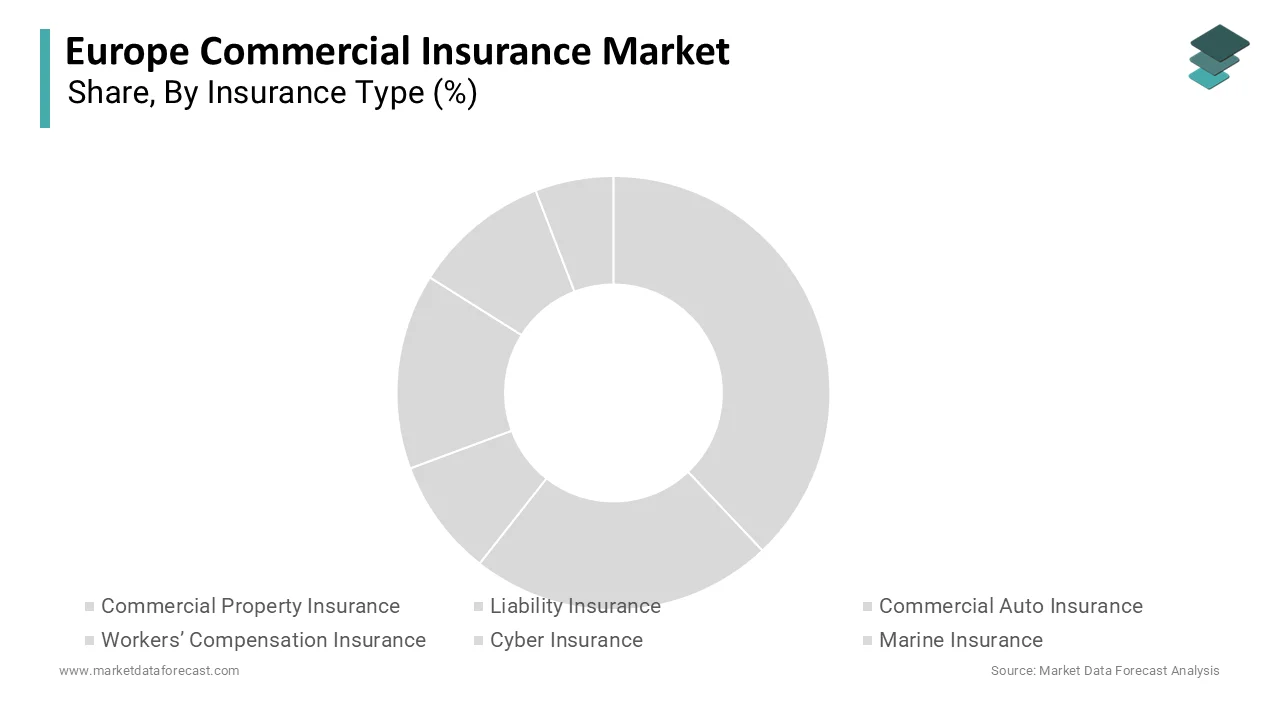
The liability Insurance segment is emerging as a fastest CAGR of 6.8% from 2025 to 2033. The segment’s growth is propelled by the dramatic shift in the legal and regulatory environment that holds corporations accountable for a wider range of risks, including cyber breaches, environmental damage, and director misconduct. A key driving factor is the implementation of stringent EU directives such as the Corporate Sustainability Due Diligence Directive, which imposes heavy liabilities on companies for human rights and environmental violations in their supply chains. Additionally, the rising trend of litigation funding and class action lawsuits across Europe has increased the potential financial exposure for businesses, making high-limit liability policies essential. The emergence of cyber liability as a critical component of general liability packages also contributes significantly to this growth, as companies seek protection against data breach claims and regulatory penalties.
By Distribution Channel Insights
The agents and brokers channel segment held a dominant share of theEuropeane commercial insurance market in 2025, owing to the inherent complexity of commercial risk profiles, which often require bespoke underwriting, nuanced risk assessment, and tailored policy wording that standardized direct channels cannot provide. The growth of the segment is likely to grow with the role brokers play in navigating the fragmented regulatory landscape and negotiating favorable terms with multiple carriers on behalf of their clients. Small and medium-sized enterprises also rely heavily on local agents who provide personalized service and help interpret complex policy exclusions and conditions. The value added by brokers in claims advocacy is another crucial factor, as they assist clients in securing fair settlements during disputes, a service highly valued in times of crisis. Furthermore, the consolidation of the brokerage sector has led to the emergence of global giants with sophisticated analytics capabilities, enabling them to offer advanced risk management consulting alongside insurance placement. The inability of digital-only platforms to replicate this high-touch, advisory relationship ensures that agents and brokers remain the preferred conduit for commercial insurance transactions across the continent.
The direct response channel segment is expected to witness the fastest CAGR of 9.4% during the forecast period. The growth of the segment is propelled by the rapid digitization of small business operations and the increasing appetite of micro-enterprises for instant, transparent, and cost-effective insurance solutions without intermediary fees. According to the European Central Bank, the number of digital-only small businesses in the EU increased in 2025, creating a vast addressable market that prefers seamless digital interactions over traditional face-to-face meetings. Insurers are leveraging big data analytics to streamline the application process, reducing issuance times from days to minutes for standard products like public liability or cyber insurance for startups. The cost efficiency of direct distribution allows carriers to offer competitive premiums that appeal to price-sensitive small business owners operating on thin margins. Additionally, the integration of insurance offerings into business banking platforms and accounting software ecosystems facilitates embedded sales, making purchase frictionless.
COUNTRY LEVEL ANALYSIS
United Kingdom Commercial Insurance Market Analysis
The United Kingdom was the top performer of the European commercial insurance market in 2025, holding 26.3% of the market share. The country's dominance is anchored in London's status as a global center for specialty insurance and reinsurance through the historic Lloyd's of London, which handles complex and high-value risks worldwide. British commercial insurance is characterized by a highly mature broker network and a legal system that fosters innovation in policy wording and risk transfer mechanisms. According to the Prudential Regulation Authority, the UK insurance sector manages assets exceeding £2 trillion, providing immense capital depth to support large-scale commercial underwriting. The presence of numerous multinational headquarters and a robust financial services sector drives demand for sophisticated products, including cyber, marine, and aviation coverage. The UK market is also a pioneer in adopting InsurTech solutions, with regulators actively supporting sandbox environments to test new digital models. The strong culture of risk management among British corporations ensures high penetration rates across all commercial lines.
Germany Commercial Insurance Market Analysis
Germany's commercial insurance market held 21.3% of the share in 2025, owing to its massive industrial base and export-oriented economy. German companies in the automotive, engineering, and chemical sectors require extensive coverage for property, business interruption, and product liability to protect their complex supply chains and manufacturing facilities. The growth of the segment is driven by the "Mittelstand" phenomenon, where thousands of highly specialized small and medium-sized enterprises operate globally and demand tailored insurance solutions to mitigate cross-border risks. Termany is known for its rigorous risk engineering standards, where insurers work closely with clients to implement loss prevention measures before issuing policies. Strict regulatory oversight by BaFin ensures high solvency and consumer protection, fostering trust in the insurance mechanism. The country's focus on energy transition and renewable energy projects has also created new avenues for specialized commercial coverage.
France Commercial Insurance Market Analysis
FFrance'scommercial insurance market growth is anticipated to witness the fastest growth in the coming years with a balanced mix of large state-influenced corporations and a vibrant private enterprise sector. The French market is heavily influenced by government initiatives to support industrial competitiveness and agricultural stability, which is leading to unique insurance structures and public-private partnerships. French corporations place a high value on long-term relationships with insurers and brokers, favoring comprehensive programs that cover global operations under a single master policy. The regulatory environment, shaped by the ACPR, emphasizes strict compliance and sustainability reporting, pushing insurers to develop green insurance products. France is also a leader in the development of parametric insurance for agricultural risks, addressing the growing threat of climate change to its farming sector.
Italy Commercial Insurance Market Analysis
Italy's commercial insurance market growth is likely to grow with the dense network of small and medium-sized enterprises that form the backbone of the economy. The Italian commercial insurance market is driven by the specific needs of the manufacturing, fashion, and tourism sectors, which require flexible and responsive coverage options. Italian SMEs are increasingly aware of risk management needs, moving away from self-insurance towards formal coverage due to rising litigation costs and supply chain vulnerabilities. The fragmentation of the business landscape creates a diverse demand pattern, requiring insurers to offer scalable solutions ranging from simple packages for artisans to complex programs for industrial groups. The government's push for resilience against seismic and hydrogeological risks has also spurred innovation in catastrophe coverage.
Netherlands Commercial Insurance Market Analysis
The Netherlands commercial insurance market growth is fueled by its strategic role as a logistics hub and the home of numerous international trading companies. Dutch corporations, particularly in the shipping, agri-food, and technology sectors, require advanced commercial insurance to manage the risks associated with global trade and complex supply chains. The country's high concentration of multinational headquarters and its status as a gateway to Europe drive demand for sophisticated marine cargo, transit, and liability coverage. According to Statistics Netherlands, the logistics sector contributes significantly to the national GDP, necessitating robust insurance frameworks to protect goods in motion and warehouse inventories. The Dutch market is known for its progressive approach to risk financing, with many companies utilizing captive insurance structures to optimize their risk retention strategies. The presence of major reinsurers and specialized insurers in Amsterdam fosters a culture of innovation in areas like cyber risk and climate adaptation. The open and export-oriented nature of the Dutch economy means that commercial insurance is viewed as a critical enabler of international business activities.
COMPETITIVE LANDSCAPE
The competition in the European commercial insurance market is intensely fierce, characterized by a mix of large global conglomerates and specialized regional carriers vying for dominance in a highly regulated environment. Market participants constantly innovate their product offerings and digital capabilities to distinguish themselves in a sector where price competition is often secondary to service quality and financial stability. The presence of strict solvency requirements under Solvency II creates high barriers to entry that favor established players with robust capital reserves and sophisticated risk management frameworks. Strategic partnerships with technology providers and brokers are common as companies seek to enhance their distribution reach and operational agility. The rise of cyber risks and climate change has intensified the race to develop specialized coverage solutions that address these emerging threats effectively. Insurers must balance the need for profitability with the demand for comprehensive coverage while navigating diverse regulatory landscapes across different European nations. Success in this environment depends on the ability to leverage data for precise underwriting, deliver exceptional customer experiences, and maintain strong relationships with intermediaries who control significant market access.
KEY MARKET PLAYERS
Some of the companies that are playing a dominating role in the globalEuropeane Commercial Insurance Market include
- Allianz SE
- AXA S.A.
- Zurich Insurance Group
- Assicurazioni Generali S.p.A.
- Munich Re Group
- Aviva plc
- Chubb Limited
- HDI Global SE
- Mapfre S.A.
- Aegon N.V.
- Ageas SA/NV
- Swiss Re Group
- Lloyd’s of London
- Talanx AG
- Vienna Insurance Group
TOP LEADING PLAYERS IN THE MARKET
- Allianz SE stands as a preeminent global insurer with a profound footprint across the European commercial insurance landscape. The company provides a comprehensive suite of risk transfer solutions ranging from property and casualty to specialized cyber and marine coverage for large corporations. Their global contribution involves setting industry standards for underwriting discipline and capital management while supporting economic stability worldwide. Recent actions to strengthen their market position include the aggressive expansion of their digital platforms to streamline claims processing and enhance customer engagement for business clients. Allianz actively invests in artificial intelligence tools to improve risk assessment accuracy and detect fraud more effectively. They also focus on sustainability by offering green insurance products that incentivize eco-friendly business practices among policyholders.
- AXA S.A. operates as a leading international insurance group with a dominant presence in the European commercial insurance market through its diverse portfolio of protective products. The company specializes in helping businesses manage risks related to liability, property damage, and business interruption with a strong emphasis on prevention services. Their global contribution lies in pioneering parametric insurance solutions and fostering resilience against climate change impacts for corporate clients across multiple continents. Recent strategic moves involve the acquisition of niche specialty insurers to broaden their capabilities in the cyber risk and professional indemnity sectors. AXA strengthens its market position by integrating advanced analytics into its underwriting processes to offer more competitive and precise pricing models. They actively partner with technology firms to develop innovative risk mitigation tools that provide real-time monitoring for commercial assets.
- Zurich Insurance Group serves as a major multi-line insurer with a deep commitment to the European commercial insurance market through its extensive range of general and specialty insurance products. The company is renowned for its expertise in managing complex corporate risks, including supply chain disruptions and environmental liabilities on a global scale. Their global contribution involves driving initiatives for sustainable infrastructure and offering insurance solutions that support the transition to a low-carbon economy. Recent actions to solidify their standing include the launch of new digital ecosystems that connect insurers, brokers, and corporate clients for seamless policy administration. Zurich actively expands its workforce optimization tools to enhance the productivity of commercial underwriting teams across European regions. They also focus on developing modular insurance products that allow businesses to customize coverage based on specific operational needs.
TOP STRATEGIES USED BY KEY MARKET PARTICIPANTS
Key players in the European commercial insurance market primarily focus on digital transformation by implementing artificial intelligence and machine learning to automate underwriting and accelerate claims settlement processes significantly. Companies aggressively pursue strategic acquisitions of specialty insurers and InsurTech startups to expand their product portfolios and gain access to innovative technologies. Major participants are investing heavily in data analytics capabilities to enhance risk modeling accuracy and enable dynamic pricing strategies for complex commercial lines. Firms are developing sustainable insurance products that align with environmental goals and offer incentives for businesses adopting green practices. Additionally, market leaders are strengthening relationships with brokers through advanced digital portals and collaborative tools to improve distribution efficiency and customer service quality. These strategies aim to increase operational efficiency, manage emerging risks effectively, and capture growth opportunities in a competitive world.
MARKET SEGMENTATION
This research report on the europe commercial insurance market is segmented and sub-segmented into the following categories.
By Insurance Type
- Commercial Property Insurance
- Liability Insurance
- Commercial Auto Insurance
- Workers’ Compensation Insurance
- Cyber Insurance
- Marine Insurance
- Others
By Distribution Channel
- Agents & Brokers
- Direct Response (Digital / Insurer Websites)
- Bancassurance
- Affinity & Embedded Insurance
By Country
- United Kingdom
- Germany
- France
- Italy
- Netherlands
- Spain
- Sweden
- Rest of Europe