- Product Description Description
- Table of Contents TOC
- List of Table & Figure LOT
- Get Free Sample PDF Sample PDF
Market Size, 2025
$32.49 BnMarket Estimate, 2026
$34.77 BnMarket Forecast, 2034
$59.78 BnCAGR, 2026–2034
7.01%Executive Summary: Europe Connected Car Market Analysis
- Market Scope: Comprehensive European connected car industry evaluation covering service types, communication technologies, end-user categories, country-level adoption metrics, safety regulations, and infrastructure rollouts.
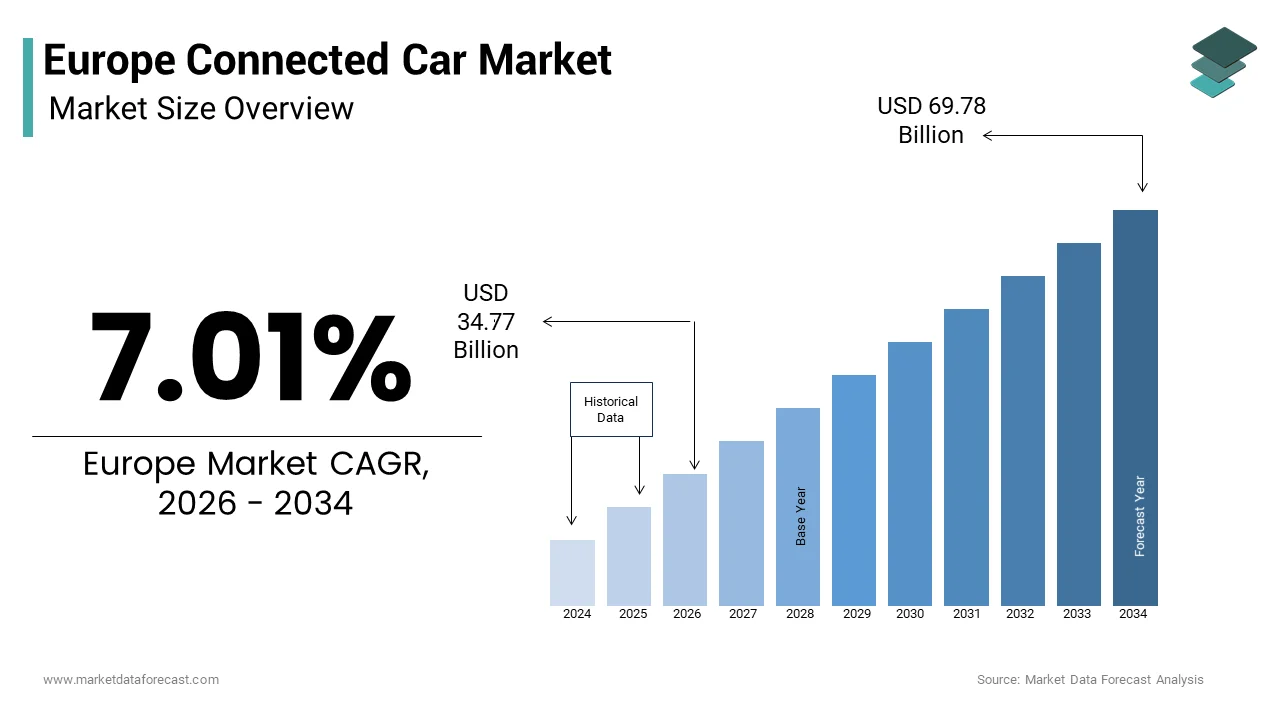
- Market Valuation: Valued at USD 32.49 billion in 2025, estimated at USD 34.77 billion in 2026, and projected to reach USD 59.78 billion by 2034, registering a CAGR of 7.01% during the forecast period from 2026 to 2034.
- Primary Growth Drivers: Mandatory integration of advanced driver assistance systems (ADAS) under the European Union’s General Safety Regulation (GSR), ongoing expansion of high-speed 5G networks, and the proliferation of cellular vehicle-to-everything (C-V2X) infrastructure.
Key Market Segment Metrics (2026–2034)
| Category | Leading Segment (2025 Position) | Fastest-Growing Segment |
|---|---|---|
| By Service | Safety & Security (held 36.5% share, fueled by EU General Safety Regulation mandates like eCall, ISA, and drowsiness detection) | Autonomous Driving (predicted to witness the highest CAGR of 24.7% driven by Level 3 framework adoption and highway testing) |
| By Technology | 4G/LTE (captured the majority share due to near-complete coverage and cost-effective bandwidth for standard telematics) | 5G (estimated to register the fastest CAGR of 38.2% for ultra-low latency, real-time V2X, and HD map streaming) |
| By End-User | Original Equipment Manufacturers (OEMs) (largest segment due to factory-installed telematics and regulatory compliance integration) | Aftermarket (anticipated to register a 15.3% CAGR propelled by retrofitting connectivity and OBD-II solutions into legacy fleets) |
| By Country / Region | Germany (dominated with a 25.5% share, anchored by luxury automotive groups, Level 3 laws, and 5G testbeds like A9 autobahn) | UK, France, Sweden, and Netherlands (scaling via smart transport corridors, eCall standards, and EV ecosystems) |
Major Market Players & Industry Structure
Market Structure: Highly competitive landscape involving major European automotive OEMs, technology giants, and specialized telematics providers racing toward software-defined vehicle architectures, cybersecurity standards, and unified digital platforms.
Key Companies: Airbiquity Inc., Aptiv PLC, Stellantis N.V., Volkswagen Group, Mercedes-Benz Group, Autoliv, Continental AG, Denso, NXP Semiconductors, Robert Bosch GmbH, TomTom, WirelessCar, and ZF Friedrichshafen.
Europe Connected Car Market Size
The Europe-connected car market was valued at USD 32.49 billion in 2025 and is anticipated to reach USD 34.77 billion in 2026 and USD 59.78 billion by 2034, growing at a CAGR of 7.01% during the forecast period from 2026 to 2034.
A connected car is a vehicle equipped with internet access and advanced sensors, allowing it to communicate bidirectionally with other systems outside the vehicle. These systems support functionalities ranging from over-the-air software updates and remote diagnostics to advanced driver assistance, predictive maintenance, and in-vehicle infotainment. The market operates within a tightly regulated framework shaped by the European Union’s General Safety Regulation (GSR), which mandates the inclusion of advanced driver assistance systems, including intelligent speed assistance and drowsiness detection. The European automotive market is rapidly transitioning toward a standard where the vast majority of new vehicles are equipped with digital communication features, a shift fueled by evolving safety regulations and a growing preference for integrated digital services. Widespread mobile network availability across Europe provides a robust foundation for advanced vehicular communication, as the continued rollout of high-speed cellular technology supports the data requirements of next-generation traffic and safety systems. Furthermore, European legislative frameworks are mandating that digital products and various automotive-related components maintain high security standards throughout their entire operational life, ensuring that cybersecurity is integrated into the initial design and maintained through regular updates. This convergence of safety mandates, digital infrastructure, and regulatory oversight defines the structural trajectory of the Europe Connected Car Market.
MARKET DRIVERS
Mandatory Integration of Advanced Driver Assistance Systems Under EU Safety Regulations
The European Union’s General Safety Regulation (GSR), fully enforced from July 2024, serves as a major accelerator of the Europe connected car market. The regulation mandates that all new vehicle types must include 15 advanced driver assistance systems, many of which rely on embedded connectivity to function effectively. Technologies such as intelligent speed assistance (ISA), which uses GPS and traffic sign recognition to alert drivers or automatically limit speed, require real-time data exchange and over-the-air update capabilities. Similarly, drowsiness and attention detection systems use biometric and driving behavior data processed through cloud-connected algorithms. According to the European Commission, the mandatory implementation of advanced vehicle safety technologies on new vehicles is expected to significantly reduce road fatalities and serious injuries across the EU in the coming years. Automakers like Volkswagen, Stellantis, and Renault have accelerated integration of telematics control units (TCUs) to comply, transforming connectivity from a premium feature into a baseline safety requirement. This regulatory imperative ensures that even entry-level vehicles incorporate connected hardware, dramatically expanding the addressable market and standardizing core digital infrastructure across the European automotive fleet.
Expansion of 5G and Cellular Vehicle-to-Everything (C-V2X) Infrastructure
The rollout of 5G networks and dedicated C-V2X infrastructure is enabling next-generation connected car applications and further contributes to the expansion of the Europe connected car market. These advancements enhance safety, traffic efficiency, and autonomous driving readiness. The goal was set to have uninterrupted 5G in cities and major transport paths by 2025. By 2026, this is recognized as the target for enabling CCAM (Cooperative, Connected, and Automated Mobility). The "Digitales Testfeld Autobahn" (Digital Motorway Test Bed) was established in 2015. While the initial setup included numerous tests, by 2025/2026, it is considered a matured, high-tech infrastructure for C-ITS (Cooperative Intelligent Transport Systems). 5G-V2X is confirmed as a key technology for reducing, not just collision risk, but overall traffic hazards, with studies demonstrating massive improvements over previous technologies (like DSRC). Additionally, 5GCroCo (5G Cross-Border Control) is a well-documented EU 5G-PPP project that successfully demonstrated cross-border handover, with results confirming that seamless service is achievable, mitigating traditional roaming issues. This infrastructure momentum transforms vehicles from isolated machines into nodes in an intelligent transportation ecosystem, unlocking use cases that justify deeper consumer and fleet investment in connected technologies.
MARKET RESTRAINTS
Stringent Data Privacy Regulations Limiting Personalization and Monetization
The European Union’s robust data protection framework, particularly the General Data Protection Regulation (GDPR), imposes significant constraints on how automakers and service providers can collect, process, and monetize vehicle-generated data, which in turn hampers the growth of the Europe connected car market. Connected cars produce vast amounts of personal data, including location history, driving behavior, and biometric inputs, which are classified as sensitive under GDPR. Consent must be explicit, granular, and revocable, complicating efforts to deliver personalized services like dynamic insurance pricing or targeted advertising. European data protection authorities are placing intense scrutiny on automotive data-sharing, forcing manufacturers to heavily revise contractual agreements to meet regulatory compliance standards. Moreover, the implementation of the EU Data Act shifts control of vehicle-generated data from manufacturers to consumers, enabling vehicle owners to dictate how their data is shared with third parties and challenging traditional OEM data monopolies. These regulations, while protecting consumer rights, stifle innovation in data-driven business models and reduce potential revenue streams from connected services, slowing the economic viability of advanced connectivity features beyond regulatory minimums.
High Development and Certification Costs for Cybersecurity Compliance
The increasing sophistication of connected car systems has elevated cybersecurity to a top regulatory and engineering priority, which significantly raises development costs and time-to-market, and thereby hinders the expansion of the Europe connected car market. The EU’s Cyber Resilience Act, to be fully applied by late 2027, requires manufacturers of digital products, including certain automotive components and off-road vehicles, to implement security measures throughout the product life cycle, such as secure boot and vulnerability disclosure, to ensure digital safety. Compliance demands extensive penetration testing, threat modeling, and third-party audits, processes that can add several months to development cycles. According to research, the increasing demand for rigorous automotive cybersecurity compliance to meet, for example, UNECE standards is significantly driving up expenditures for manufacturers, making the cost of certification a major financial investment. Small and medium-sized suppliers, which form the backbone of Europe’s automotive supply chain, struggle to absorb these expenses, leading to consolidation or reliance on larger OEMs for security validation. This financial and technical burden disproportionately affects affordable vehicle segments, risking a two-tier market where only premium models offer advanced connected features, thereby limiting equitable access to safety-enhancing technologies.
MARKET OPPORTUNITIES
Integration of Connected Cars into Smart City and Energy Grid Ecosystems
Connected vehicles are increasingly positioned as mobile sensors and actuators within broader smart city and energy management frameworks, which creates the pathway for the growth of the Europe connected car market. This positioning creates high-value synergies beyond transportation. In cities like Amsterdam and Copenhagen, municipal platforms aggregate anonymized vehicle data to optimize traffic light sequencing, reduce congestion, and improve emergency response times. Simultaneously, vehicle-to-grid (V2G) technology enables electric connected cars to discharge power back to the grid during peak demand, supporting renewable energy integration. A large-scale vehicle-to-grid project in the Netherlands has demonstrated that a fleet of electric cars can function as a distributed energy storage system, offering significant flexibility to support the national electricity grid and reduce congestion. This initiative showcases the potential for connected electric vehicles to balance renewable energy supply with demand, strengthening infrastructure stability. The EU’s revised Electricity Market Design now recognizes aggregated EV fleets as market participants, enabling new revenue streams for owners. Integrating vehicles as active grid assets and urban data sources unlocks systemic value, strengthening the economic case for connectivity while supporting Europe’s green and digital goals.
Growth of Usage-Based Insurance and Personalized Mobility Services
The proliferation of connected car data is enabling the rapid expansion of usage-based insurance (UBI) and tailored mobility services across the region, which provides fresh prospects for the Europe connected car market. These innovations offer consumers fairer pricing and enhanced convenience. Insurers like Allianz and AXA now offer telematics-based policies that adjust premiums based on actual driving behavior, such as speed variation, braking intensity, and time of day, rewarding safe drivers with discounts. Usage-based insurance (UBI) policies continue to show a strong, increasing trend in the EU, driven by consumer adoption of digitalized, personalized motor and household insurance products as highlighted in recent market analysis. Beyond insurance, connected platforms facilitate personalized services like predictive maintenance alerts, dynamic parking guidance, and concierge features that learn user preferences. The EU’s upcoming Data Act empowers consumers to securely share their vehicle data with third-party providers, fostering competition and innovation. This shift from ownership to service-centric models not only improves user experience but also creates recurring revenue streams for automakers and tech partners, accelerating the transition to software-defined vehicles.
MARKET CHALLENGES
Fragmented National Approaches to V2X Deployment and Spectrum Allocation
The deployment of vehicle-to-everything (V2X) infrastructure remains fragmented across member states due to divergent national priorities, funding mechanisms, and spectrum allocation strategies, which inhibits the growth of the Europe connected car market. While the EU endorsed cellular C-V2X as the primary technology path, countries like Germany initially invested in IEEE 802.11p-based ITS-G5, creating interoperability risks. Furthermore, the allocation of the 5.9 GHz band, the global standard for V2X, is inconsistent. France and Italy have fully assigned it to C-V2X, but other nations retain portions for Wi-Fi or delay reallocation. The ECA indicates that the goal for completing the core Trans-European Transport Network (TEN-T) by 2030 is unlikely to be met due to delays in cross-border projects. Furthermore, audits suggest that the deployment of digital infrastructure and intelligent transport systems, while ongoing, is facing bottlenecks that hinder seamless, cross-border, connected, and automated mobility. This fragmentation increases complexity for automakers, who must support multiple communication standards, and reduces the effectiveness of safety applications that rely on ubiquitous infrastructure. The full benefits of V2X-enabled safety and efficiency will remain out of reach across the European transport network without a unified spectrum policy and coordinated infrastructure deployment.
Consumer Skepticism Over Data Security and Feature Reliability
Many European consumers remain wary of connected car features owing to concerns about hacking, data misuse, and system reliability, which further slows down the expansion of the Europe connected car market. European consumers express growing apprehension regarding the security of vehicle location and driving data, with substantial skepticism toward over-the-air software updates following high-profile recalls. High-profile incidents, such as the 2023 remote exploit of a major German automaker’s infotainment system, have eroded trust. Additionally, inconsistent user experiences across brands, including voice assistant failures or delayed navigation updates, reinforce perceptions of immaturity. This skepticism translates into low activation rates. Furthermore, despite the rise of connected vehicle technology, consistent user adoption remains limited to basic, foundational services. The market’s transition to a software-defined future will remain stalled until manufacturers can guarantee cybersecurity, data transparency, and reliable performance to win over cautious consumers.
REPORT COVERAGE
| REPORT METRIC | DETAILS |
| Market Size Available | 2025 to 2034 |
| Base Year | 2025 |
| Forecast Period | 2026 to 2034 |
| CAGR | 7.01% |
| Segments Covered | By Service, Technology, End-User, and Region. |
|
Various Analyses Covered | Global, Regional, an, Country-Level Analysis, Segment-Level Analysis; DROC, PESTLE Analysis; Porter’s Five Forces Analysis; Competitive Landscape; Analyst Overview of Investment Opportunities |
| Regions Covered | North America, Europe, APAC, Latin America, Middle East & Africa |
|
Market Leaders Profiled | Airbiquity Inc, Aptiv PLC, Autoliv, Continental AG, Denso, NXP Semiconductors, Robert Bosch GmbH, TomTom, WirelessCar, ZF Friedrichshafen, and Others. |
SEGMENTAL ANALYSIS
By Service Insights
The safety & security segment led the Europe Connected Car Market by accounting for a 36.5% share in 2025. The leading position of the safety & security segment is driven by the European Union’s General Safety Regulation (GSR), which mandates advanced driver assistance systems—including emergency call (eCall), intelligent speed assistance, and drowsiness detection. These features rely on embedded connectivity to function, transforming safety from a passive attribute into an active, data-driven service. According to the European Commission, the mandatory implementation of automated in-vehicle emergency calling technology is expected to significantly accelerate emergency response times in rural locations and prevent a substantial number of fatalities annually across the European Union. Automakers like Volkswagen, Stellantis, and BMW have integrated telematics control units as standard across their fleets to comply, ensuring near-universal adoption. Additionally, consumer demand for peace of mind, especially among families and fleet operators, fuels uptake of theft tracking, remote immobilization, and automatic crash notification services. This regulatory-cum-cultural alignment positions Safety & Security as the foundational pillar of connected car value in Europe.
The autonomous driving segment is predicted to witness the highest CAGR of 24.7% from 2026 to 2034 due to the convergence of regulatory support, infrastructure investment, and technological maturation. The EU’s Automated Vehicles Framework, adopted in 2024, establishes a legal pathway for Level 3 conditional automation on highways, enabling features like hands-free driving under specific conditions. German transport authorities have approved advanced Level 3 autonomous driving systems from major luxury manufacturers, allowing for hands-off, eyes-off operation on motorways under specific traffic conditions, with, for example, Mercedes-Benz rolling out updated, faster systems early in the year. Simultaneously, the European Union is heavily funding collaborative research programs to advance connected and automated driving, with major initiatives focusing on large-scale piloting of high-level automation to test complex, real-world driving scenarios. Urban pilots in cities like Paris and Stockholm are deploying autonomous shuttles for first- and last-mile connectivity. Autonomous driving is moving from testing to deployment in Europe, driven by advances in sensor fusion, HD mapping, and V2X, marking it as the top growth area in connected mobility.
By Technology Insights
The 4G/LTE technology segment captured the majority share of the Europe Connected Car Market in 2025. The prominence of the 4G/LTE technology segment is attributed to its optimal balance of coverage, bandwidth, and cost-effectiveness for current connected car applications. All major European mobile network operators, including Deutsche Telekom, Orange, and Vodafone, have achieved near-complete 4G coverage across urban and major transport corridors, ensuring reliable connectivity for services like over-the-air updates, remote diagnostics, and navigation. According to European Commission monitoring and industry studies as of 2024, nearly all EU inhabitants are covered by 4G networks, which provide a reliable, widespread foundation for mass-market vehicle connectivity. Automakers standardized on 4G/LTE modules during the 2018–2023 model cycles, embedding them across entry-level to premium segments. 4G maintains its role as the workhorse for non-latency-sensitive applications despite rising 5G adoption, offering unmatched cost efficiency and infrastructure stability for both manufacturers and users.
The 5G segment is estimated to register the fastest CAGR of 38.2% during the forecast period owing to the need for ultra-low latency, high reliability, and massive device connectivity required for next-generation applications like cooperative driving, real-time V2X communication, and high-definition map streaming. The EU’s 5G Action Plan mandates that all urban centers and major transport corridors be covered by 2025, creating the necessary infrastructure backbone. In Germany, the A9 autobahn hosts one of Europe’s most advanced 5G corridors, enabling vehicles to receive warnings about accidents or roadworks beyond line-of-sight. According to the European Commission, 5G-enabled V2X can reduce intersection collision risk. Automakers like Volvo and Polestar are launching 5G-native models, while telecom partnerships, such as Ericsson and BMW’s joint innovation lab, accelerate integration. As autonomous and highly connected use cases scale, 5G transitions from a premium feature to a critical enabler of Europe’s intelligent transportation future.
By End-User Insights
The OEMs segment was the largest segment in the Europe Connected Car Market by holding a substantial share in 2025. The dominance of the OEMs segment is credited to the deep integration of connectivity into vehicle design, manufacturing, and regulatory compliance from the outset. European automakers like Volkswagen, Stellantis, and Renault embed telematics control units (TCUs) directly into vehicle architectures, ensuring seamless functionality, warranty coverage, and data ownership. The EU’s General Safety Regulation further entrenches OEM control by mandating factory-installed connected safety systems such as eCall and intelligent speed assistance. According to reports from the European Automobile Manufacturers’ Association, nearly all new vehicles in the EU now come equipped with manufacturer-installed connectivity, with these digital features frequently packaged alongside long-term, subscription-based service agreements. Additionally, OEMs leverage connectivity to enable over-the-air software updates, remote diagnostics, and digital service marketplaces, creating recurring revenue streams. This end-to-end control over hardware, software, and customer relationship ensures OEMs remain the primary gateway to connected car services across Europe.
The aftermarket segment is anticipated to witness the fastest CAGR of 15.3% from 2026 to 2034. This rapid growth is propelled by the rising demand for retrofitting connectivity solutions in the continent’s vast legacy vehicle fleet, millions of cars registered as of 2024. Independent providers offer plug-and-play OBD-II devices and smartphone-integrated systems that deliver core services like driving behavior monitoring, theft tracking, and maintenance alerts. Usage-based insurance programs from insurers like AXA and Allianz further accelerate adoption, requiring telematics data from non-factory systems. The EU’s upcoming Data Act empowers vehicle owners to access and share their in-vehicle data with third parties, opening the door for innovative aftermarket apps and services. The aftermarket is democratizing connected car tech, offering affordable, flexible, and regulated solutions to a wider audience.
COUNTRY ANALYSIS
Germany Connected Car Market Analysis
Germany dominated the Europe Connected Car Market by accounting for a 25.5% share in 2025. The supremacy of the German market is driven by its powerful automotive industry and proactive regulatory environment. Home to Volkswagen, BMW, and Mercedes-Benz, Germany drives innovation in embedded connectivity and autonomous driving. The country was the first in the EU to legalize Level 3 autonomous systems, with thousands of vehicles approved for hands-free highway driving as per the Federal Motor Transport Authority. The German government is actively driving the development of automated and connected mobility by investing in multiple digital infrastructure test beds across the country, with the A9 autobahn serving as a premier site for testing high-speed 5G communications and intelligent traffic systems. Additionally, the mandatory eCall system and General Safety Regulation compliance ensure near-universal connectivity in new vehicles. With strong industrial R&D, supportive policy, and consumer readiness, Germany remains the continent’s most influential market for advanced connected car technologies.
United Kingdom Connected Car Market Analysis
The United Kingdom was the second largest country in the Europe connected car market by capturing a 16.1% share in 2025. The expansion of the UK market is fuelled by its ambitious regulatory framework and urban-focused innovation. The UK’s post-Brexit Automated Lane Keeping System (ALKS) regulation permits Level 3 automation on motorways, aligning with but diverging from EU standards. London's Smart Mobility Living Lab continues to serve as a key, real-world, and public road testing environment for advanced, autonomous, and connected shuttle services in the UK. Driven by consumer demand, insurance incentives, and technological advancements, factory-installed connectivity is increasingly becoming a standard feature in new vehicles sold within the UK market. The National Highways agency is also deploying roadside units along major routes to support cooperative awareness. This blend of regulatory agility, urban experimentation, and high consumer adoption solidifies the UK’s role as a dynamic and forward-looking connected car market.
France Connected Car Market Analysis
France continues to be a significant player in the European market due to state-led digital infrastructure and strong public-private collaboration. The French government is driving the transition toward autonomous and connected mobility by allocating substantial research funding under long-term industrial investment plans, which has established vehicle testing zones in major urban centers. Stellantis leverages this national innovation ecosystem to deploy connected services across its portfolio, making embedded telematics a standard feature in the vast majority of its new Peugeot, Citroën, and Opel models. The mandatory eCall system and EU General Safety Regulation ensure baseline connectivity, while partnerships with Orange and Atos accelerate 5G-V2X deployment. Additionally, Paris’s low-emission zone and planned internal combustion engine ban amplify demand for smart, connected EVs. This synergy of national strategy, industrial capability, and urban policy sustains France’s influential position in the connected car landscape.
Sweden Connected Car Market Analysis
Sweden is moving ahead steadfastly in the Europe connected car market and is emerging as a leader in safety-focused and sustainable connected mobility. The country’s Vision Zero policy, aiming to eliminate traffic fatalities, has made it a pioneer in adopting advanced driver assistance systems, with Volvo and Polestar integrating comprehensive connectivity suites as standard. As of July 2024, EU regulations require that almost all newly registered passenger vehicles in Sweden come standard with automated emergency call systems and technology to help drivers manage speed limits. Sweden also hosts the AstaZero test facility, one of Europe’s most advanced proving grounds for V2X and autonomous systems, used by global OEMs and tech firms. The government’s 5G strategy prioritizes transport corridors, ensuring robust connectivity for cooperative driving. Sweden demonstrates a pioneering approach to mobility, blending data-driven technology with safety and ecological responsibility.
Netherlands Connected Car Market Analysis
The Netherlands is likely to grow in the Europe Connected Car Market from 2026 to 2034. It is renowned for its integrated smart mobility ecosystem and cross-border cooperation. The Dutch government is widely deploying cooperative intelligent transport systems, transforming major road networks into connected, real-time communicative infrastructure for smarter, safer mobility. Rotterdam and Amsterdam serve as living labs for autonomous shuttles and connected logistics, supported by the national “ConneCTed” platform that aggregates traffic data from vehicles and sensors. The majority of new vehicles sold in the Netherlands come with factory-installed connectivity, driving a surge in data-driven automotive services and behavior-based insurance adoption. The Netherlands also co-leads the EU’s 5GCroCo project, testing seamless 5G handovers across borders. This commitment to interoperability, data sharing, and urban innovation positions the Netherlands as a critical testbed for scalable, pan-European connected mobility solutions.
COMPETITIVE LANDSCAPE
Competition in the Europe Connected Car Market is intensifying as traditional automakers, global tech firms, and telecom providers converge to capture value in a software-defined future. European OEMs like Volkswagen and Stellantis leverage manufacturing scale and regulatory compliance to embed connectivity at the source, while premium brands such as Mercedes-Benz differentiate through advanced autonomy and luxury digital experiences. Tech giants like Google and Apple exert influence via Android Auto and CarPlay, though EU regulations increasingly favor embedded systems over smartphone tethering. Telecom operators compete to provide secure, low-latency 5G networks essential for V2X applications. The market is further shaped by stringent data privacy laws, cybersecurity mandates, and national infrastructure disparities, creating a complex landscape where success depends on balancing regulatory adherence, consumer trust, technological depth, and ecosystem collaboration. Ultimately, the race is shifting from hardware to software, data, and services, redefining automotive competition in the digital age.
KEY MARKET PLAYERS
These are some of the notable companies in the European connected car market.
- Airbiquity Inc.
- Aptiv PLC
- Stellantis N.V.
- Volkswagen Group
- Mercedes-Benz Group
- Autoliv
- Continental AG
- Denso
- NXP Semiconductors
- Robert Bosch GmbH
- TomTom
- WirelessCar
- ZF Friedrichshafen
Top Players In The Market
- Volkswagen Group is a cornerstone of the Europe Connected Car Market, integrating advanced telematics across its multi-brand portfolio including Volkswagen, Audi, and Porsche. The company’s Car.Software Organization develops proprietary operating systems and cloud platforms that enable over-the-air updates, predictive maintenance, and personalized infotainment. In Europe, Volkswagen leverages its scale to embed connectivity as standard in all new models, ensuring compliance with the EU General Safety Regulation. Recently, it launched its Unified Data Platform to aggregate anonymized vehicle data for traffic optimization and smart city integration. It also expanded partnerships with Deutsche Telekom to deploy 5G-enabled vehicles on German autobahns. These initiatives reinforce Volkswagen’s role as both a volume leader and digital ecosystem architect in Europe’s connected mobility transformation.
- Mercedes-Benz Group plays a pivotal role in the Europe Connected Car Market through its leadership in premium connected and automated driving technologies. The company was the first in Europe to receive regulatory approval for Level 3 autonomous driving under Germany’s 2021 legislation, with its DRIVE PILOT system now active on highways in multiple EU countries. Mercedes-Benz integrates its MB.OS software platform across all new models, enabling seamless connectivity, AI-driven personalization, and secure over-the-air updates. Mercedes-Benz defines premium European connected driving by merging regulatory foresight, innovative software, and trusted luxury.
- Stellantis N.V. exerts significant influence in the Europe Connected Car Market through its diverse portfolio of mainstream brands including Peugeot, Opel, Fiat, and Citroën. The company’s STLA SmartCockpit platform delivers embedded connectivity, voice assistants, and smartphone integration across affordable vehicle segments, democratizing access to digital services. Stellantis has strengthened its European position by ensuring all new models comply with eCall and intelligent speed assistance mandates ahead of deadlines. Additionally, it integrated its vehicles into France’s national C-V2X test corridors. By focusing on scalable, compliant, and user-friendly connectivity, Stellantis ensures mass-market adoption across Southern and Western Europe.
Top Strategies Used by the Key Market Participants
Key players in the Europe Connected Car Market are embedding telematics control units as standard across all new vehicle models to comply with the EU General Safety Regulation and eCall mandates. They are developing proprietary software platforms and cloud ecosystems to enable over the air updates personalized services and data monetization. Companies are forming strategic partnerships with telecom operators like Vodafone and Deutsche Telekom to ensure robust 5G connectivity and support vehicle to everything communication. Investments in cybersecurity frameworks aligned with the EU Cyber Resilience Act are being prioritized to protect vehicle data and ensure regulatory compliance. Additionally firms are expanding into smart city and energy grid collaborations to position connected cars as integral nodes in broader digital infrastructure networks.
MARKET SEGMENTATION
This research report on the European connected car market has been segmented and sub-segmented into the following categories.
By Service Insights
- Fleet Management
- Driver Assistance
- Entertainment
- Safety & Security
- Autonomous Driving
By Technology Insights
- 2G
- 3G
- 4G/LTE
By End-User Insights
- OEMs
- Aftermarket
By Country
- UK
- France
- Spain
- Germany
- Italy
- Russia
- Sweden
- Denmark
- Switzerland
- Netherlands
- Turkey
- Czech Republic
- Rest of Europe