- Product Description Description
- Table of Contents TOC
- List of Table & Figure LOT
- Get Free Sample PDF Sample PDF
Market Size, 2025
$789 MnMarket Estimate, 2026
$872.32 MnMarket Forecast, 2034
$1,948 MnCAGR, 2026–2034
10.56%Europe Contract Lifecycle Management (CLM) Software Market Size
The Europe contract lifecycle management (CLM) software market was worth USD 789 million in 2025. The European market is projected to reach USD 1,948 million by 2034 from USD 872.32 million in 2026, growing at a CAGR of 10.56% from 2026 to 2034.
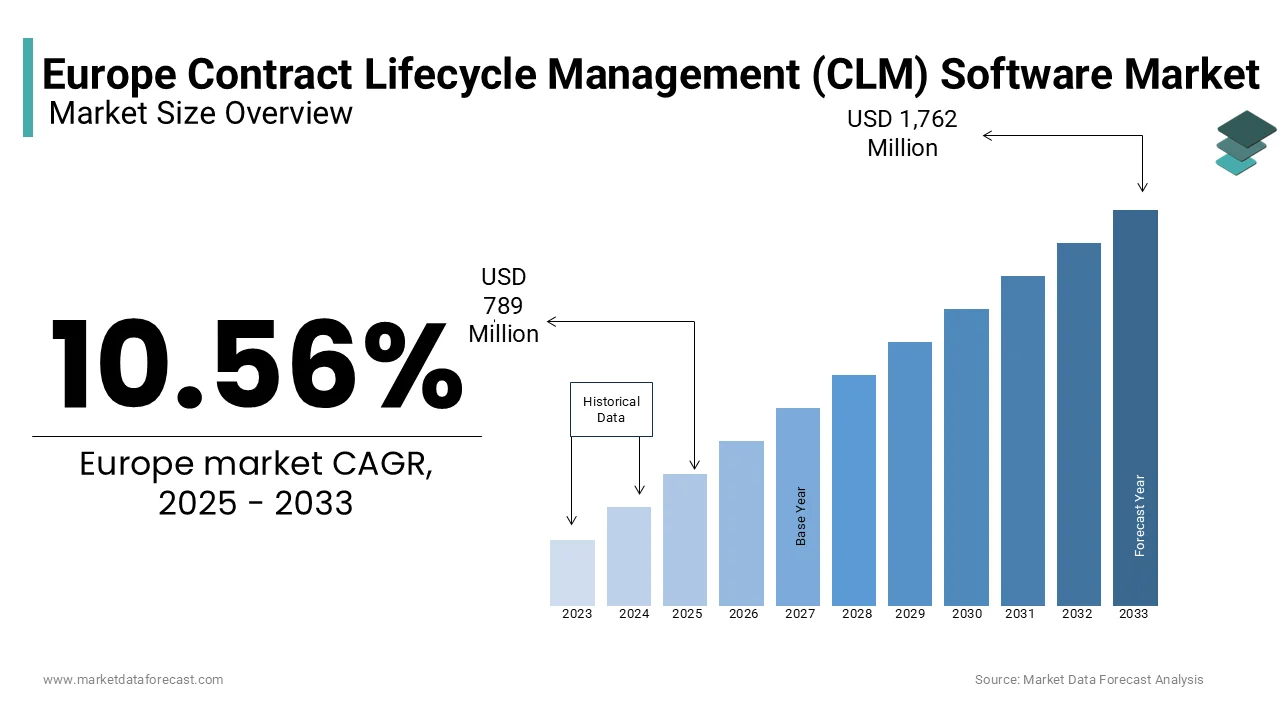
The contract lifecycle management (CLM) software is a rapidly growing segment within the broader enterprise software ecosystem and is primarily driven by the increasing complexity of contracts and the need for efficient contract management. CLM software automates and streamlines the entire contract lifecycle, from creation and negotiation to execution, compliance, and renewal, enabling organizations to reduce risks, improve operational efficiency, and ensure regulatory adherence. According to Eurostat, around 45.2% of European enterprises used cloud computing services in 2023, which reflects the region’s growing adoption of digital solutions, including contract management tools (Eurostat, 2024). The CLM market in Europe is expected to expand significantly through 2030 due to the digital transformation initiatives and the rise of remote and hybrid work models. As industries across Europe embrace automation and data-driven decision-making, CLM software has become indispensable for managing complex contractual relationships and ensuring compliance with stringent regulations like GDPR.
MARKET DRIVERS
Rising Regulatory Complexity Accelerating Adoption of CLM Software in Europe
The increasing complexity of regulatory compliance is a major driver of the Europe CLM software market. According to the European Union Agency for Cybersecurity (ENISA), non-compliance with regulations such as the General Data Protection Regulation (GDPR) can result in fines of up to EUR 20 million or 4% of global annual turnover, which is prompting organizations to adopt robust CLM solutions. According to a 2024 report by Deloitte, around 70% of large enterprises in Europe are investing in Contract Lifecycle Management (CLM) platforms to automate compliance tracking, manage contract obligations, and mitigate legal risks. Additionally, advancements in AI and machine learning have enhanced CLM capabilities, which is enabling predictive analytics for risk assessment and contract performance monitoring. These innovations not only reduce administrative burdens but also improve decision-making, making CLM software a vital tool for modern businesses.
Cloud Adoption and Digital Transformation Fueling CLM Market Growth in Europe
The growing adoption of cloud-based solutions and digital transformation initiatives is further boosting the expansion of the European CLM software market. According to a 2024 report by Eurostat, nearly two-thirds of European businesses have adopted cloud computing technologies to improve scalability, flexibility, and collaboration, which is driving the adoption of cloud-based CLM platforms. According to the European Investment Bank, cloud-based CLM solutions enable seamless integration with other enterprise systems, such as ERP and CRM, that enhance operational efficiency. Furthermore, the rise of remote work models has increased demand for accessible and secure contract management tools, with many organizations citing improved productivity as a primary benefit. This shift toward digitalization positions cloud-based CLM as a transformative force in the European market.
MARKET RESTRAINTS
High Implementation Costs Limiting CLM Adoption Among European SMEs
The high cost of implementation and subscription fees that limit adoption among small and medium-sized enterprises (SMEs) is a major restraint on the regional market growth. According to a 2024 Eurostat survey, nearly half of small and medium-sized enterprises (SMEs) in Europe identify budget constraints as a major obstacle to adopting advanced CLM solutions. While subscription-based pricing models reduce upfront costs, ongoing expenses for customization, integration, and training can be prohibitive, particularly for smaller organizations with limited IT budgets. According to the European Investment Bank, the total cost of ownership for CLM software can reach up to EUR 50,000 annually for mid-sized businesses, which is deterring widespread adoption. Additionally, the complexity of integrating CLM with legacy systems often leads to additional expenses, further exacerbating financial challenges. These barriers hinder market growth, particularly in regions with lower economic development.
Resistance to Digital Adoption and Limited Technical Expertise Hindering CLM Market Growth in Europe
The resistance to change and lack of technical expertise among end-users are also impeding the regional market growth. According to the European Centre for the Development of Vocational Training, more than half of employees in traditional industries such as manufacturing and retail show reluctance to adopt new technologies due to fears of job displacement or unfamiliarity with digital tools. According to Eurostat, only about one-third of the European workforce possesses advanced digital skills, which indicates a persistent digital literacy gap. Furthermore, inadequate training programs and insufficient support from vendors often lead to underutilization of CLM features, reducing its effectiveness. These cultural and educational barriers slow down the pace of adoption, which is limiting the market’s potential to achieve widespread penetration across all sectors.
MARKET OPPORTUNITIES
Integration of Artificial Intelligence (AI) and Predictive Analytics Transforming Contract Management in Europe
The integration of artificial intelligence (AI) and predictive analytics is a significant opportunity for the Europe CLM software market. According to a 2024 report by McKinsey & Company, the adoption of AI-driven contract management solutions in Europe is expanding rapidly due to their ability to enhance contract analysis, risk assessment, and performance monitoring. These platforms leverage machine learning algorithms to identify patterns, predict outcomes, and automate routine tasks that enable organizations to achieve greater efficiency. According to the European Commission, industries such as banking, financial services, insurance (BFSI), and pharmaceuticals are increasingly adopting AI-enabled CLM to address compliance challenges and improve contract lifecycle visibility. Additionally, predictive analytics helps reduce risks by identifying potential breaches or delays, which is positioning AI-integrated CLM as a transformative force in the market.
Expansion of CLM Solutions Tailored for Small and Medium-Sized Enterprises (SMEs) Driving Market Growth in Europe
The expansion of CLM solutions tailored for small and medium-sized enterprises (SMEs) is another major opportunity for the European market. According to Eurostat, small and medium-sized enterprises (SMEs) make up more than 99% of all businesses in Europe, yet their adoption of CLM solutions remains relatively limited. According to the European Small Business Alliance, affordable, scalable, and user-friendly CLM platforms could unlock significant growth potential in this underserved segment. Cloud-based solutions that eliminate the need for extensive on-premise infrastructure are particularly appealing to SMEs seeking cost-effective options. Furthermore, the rise of subscription-based pricing models has made CLM more accessible and enabling smaller organizations to benefit from advanced features without upfront costs. By addressing the unique needs of SMEs, CLM providers can tap into a vast and largely untapped market, which is driving innovation and inclusivity.
MARKET CHALLENGES
Rising Data Privacy and Cybersecurity Concerns Hindering the Growth of the European CLM Software Market
The growing concern over data privacy and cybersecurity risks associated with CLM platforms is one of the major challenges to the European CLM software market. According to the European Union Agency for Cybersecurity (ENISA), cyberattacks targeting enterprise software systems in Europe have increased significantly in recent years, with attackers exploiting vulnerabilities to access sensitive contract data. According to the European Commission, non-compliance with the General Data Protection Regulation (GDPR) can result in fines of up to EUR 20 million or 4% of global annual turnover. Organizations face significant pressure to ensure robust data protection measures, which often require additional investments in cybersecurity infrastructure. According to Eurostat, more than half of European businesses report difficulties in aligning their CLM systems with GDPR standards, which is creating hesitancy among potential adopters. These challenges not only increase operational risks but also undermine trust in CLM solutions and slowing the regional market growth.
Complexity of Integrating CLM with Existing Enterprise Systems Hindering Market Scalability in Europe
The complexity of integrating CLM with existing enterprise systems, such as ERP and CRM platforms, is another key challenge to the European CLM software market. According to a 2024 report by the European Investment Bank, more than half of organizations in Europe face challenges in achieving seamless interoperability between CLM and legacy systems, leading to inefficiencies and higher operational costs. This issue is particularly pronounced in cross-border projects, where varying standards and protocols hinder data sharing and collaboration. According to the European Commission’s Digital Transformation Monitor, integration challenges disproportionately affect large enterprises with complex IT ecosystems. Additionally, the absence of unified industry standards exacerbates the problem, which is leaving organizations reliant on proprietary solutions. These technical barriers not only slow down adoption but also limit the scalability of CLM deployments across industries.
REPORT COVERAGE
| REPORT METRIC | DETAILS |
| Market Size Available | 2025 to 2034 |
| Base Year | 2025 |
| Forecast Period | 2026 to 2034 |
| Segments Covered | By Deployment Mode, Enterprise Size, Industry, and Country |
| Various Analyses Covered | Global, Regional and Country-Level Analysis, Segment-Level Analysis, Drivers, Restraints, Opportunities, Challenges; PESTLE Analysis; Porter’s Five Forces Analysis, Competitive Landscape, Analyst Overview of Investment Opportunities |
| Countries Covered | UK, France, Spain, Germany, Italy, Russia, Sweden, Denmark, Switzerland, Netherlands, Turkey, Czech Republic, and the Rest of Europe. |
| Market Leaders Profiled | SAP SE, IBM Corporation, Oracle Corporation, Icertis Inc., Coupa Software Inc., Zycus Inc., Agiloft Inc., and Planon. |
SEGMENTAL ANALYSIS
By Deployment Model Insights
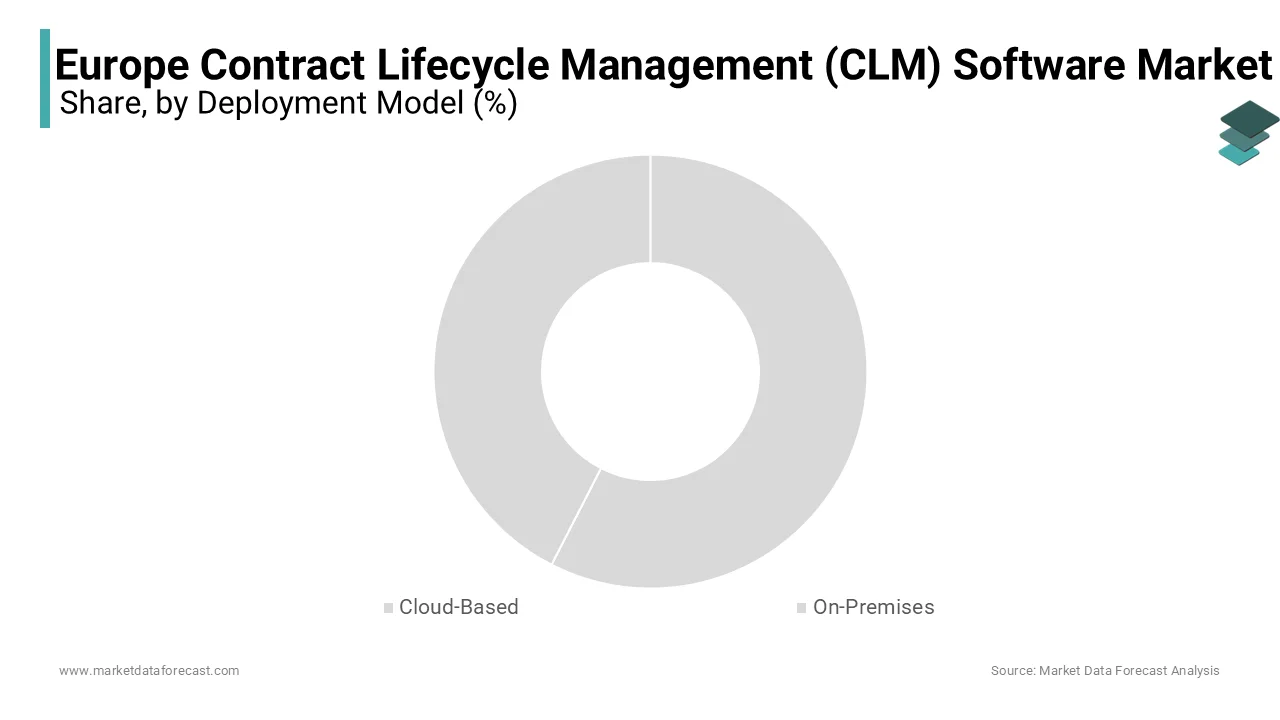
The cloud-based segment held the most significant share of the European CLM software market in 2024 due to their growing demand for scalable, flexible, and cost-effective solutions, particularly among SMEs and remote teams. According to a 2024 report by Eurostat, the majority of European enterprises are increasingly adopting cloud-based solutions to improve collaboration and integration across business functions, which is driving the shift toward cloud-based CLM deployments. Its importance lies in providing accessible and secure contract management tools, which make it indispensable for modern businesses.
By Enterprise Size Insights
The large enterprises segment accounted for the major share of 58.8% of the regional market in 2024. The growth of the large enterprises segment in the European CLM software market is attributed to the high volume of contracts they manage and the need for advanced compliance and risk management tools. According to a 2024 report by Eurostat, a significant share of large enterprises in Europe are prioritizing CLM solutions to streamline operations and ensure regulatory adherence. Its importance lies in addressing the unique challenges of managing complex contractual relationships, which is making it a cornerstone of the market.
The SMEs segment is growing exponentially and is likely to register a CAGR of 19.4% over the forecast period, owing to the increasing availability of affordable and scalable CLM solutions tailored for smaller organizations. According to a 2024 report by the European Small Business Alliance, a growing number of SMEs in Europe are adopting cloud-based CLM platforms to reduce costs and improve operational efficiency. Its importance lies in enabling smaller organizations to compete with larger enterprises by leveraging advanced contract management tools.
By Industry Insights
The BFSI segment captured the leading share of 26.7% of the European market in 2024. The dominance of the BFSI segment in the European market is attributed to the sector’s high regulatory requirements, complex contract structures, and the need for advanced risk management solutions. According to a 2024 report by Eurostat, a significant share of banks and financial institutions in Europe have adopted CLM solutions to enhance compliance and reduce operational risks. Its importance lies in addressing the unique challenges of the BFSI sector, which is making the BFSI segment a cornerstone of the market.
The retail and e-commerce segment is estimated to register the fastest CAGR of 20.9% over the forecast period, owing to the increasing complexity of supplier contracts, customer agreements, and regulatory compliance in the retail sector. According to a 2024 report by Eurostat, a majority of retailers in Europe are investing in CLM solutions to streamline operations and enhance contract visibility. Its importance lies in enabling agility and competitiveness in a rapidly evolving industry.
COUNTRY LEVEL ANALYSIS
Germany Contract Lifecycle Management (CLM) Software Market Analysis
Germany dominated the Europe CLM market by holding a 26.2% share of the regional market in 2024. The growth of Germany in the European market is driven by the country’s strong industrial base, with over 40% of European manufacturing hubs relying on CLM for contract optimization. According to the European Investment Bank, Germany’s strong emphasis on Industry 4.0 and digital transformation has accelerated the adoption of CLM solutions. Its robust infrastructure and focus on innovation further solidify its position as a market leader.

United Kingdom Contract Lifecycle Management (CLM) Software Market Analysis
The UK held a substantial share of the European CLM software market in 2024. The growth of the UK market is fueled by its rapid adoption of cloud-based CLM solutions, driven by the growing emphasis on remote work and digitalization. According to a 2024 report by the British Chambers of Commerce, a majority of businesses in the UK have upgraded their contract management systems to enhance productivity and compliance. London’s status as a global financial hub has also spurred demand for advanced CLM in sectors like BFSI and retail.
France Contract Lifecycle Management (CLM) Software Market Analysis
France is anticipated to account for a notable share of the European CLM software market during the forecast period, owing to the growing focus of France on improving public services and enhancing workforce efficiency has significantly boosted CLM adoption. According to the European Commission, France’s investment in smart city technologies and digital transformation initiatives has created a strong demand for AI-integrated CLM platforms. Additionally, stringent labor laws have encouraged organizations to adopt compliant and scalable solutions, positioning France as a key contributor to the market.
KEY MARKET PLAYERS
The major players in the Europe contract lifecycle management (CLM) software market include
- SAP SE
- IBM Corporation
- Oracle Corporation
- Icertis Inc.
- Coupa Software Inc.
- Zycus Inc.
- Agiloft Inc.
- Planon
MARKET SEGMENTATION
This research report on the Europe contract lifecycle management (CLM) software market is segmented and sub-segmented into the following categories.
By Deployment Model
- Cloud-Based
- On-Premises
By Enterprise Size
- Large Enterprise
- Small and Medium Enterprise
By Industry
- Automotive
- Electrical and Electronics
- Pharmaceutical
- Retail and E-commerce
- Manufacturing
- BFSI
- Others
By Country
- UK
- France
- Spain
- Germany
- Italy
- Russia
- Sweden
- Denmark
- Switzerland
- Netherlands
- Turkey
- Czech Republic
- Rest of Europe