- Product Description Description
- Table of Contents TOC
- List of Table & Figure LOT
- Get Free Sample PDF Sample PDF
Market Size, 2025
$73.25 BnMarket Estimate, 2026
$77.04 BnMarket Forecast, 2034
$115.39 BnCAGR, 2026–2034
5.18%Europe Cookies Market Size, Growth, Trends & Forecast (2026–2034)
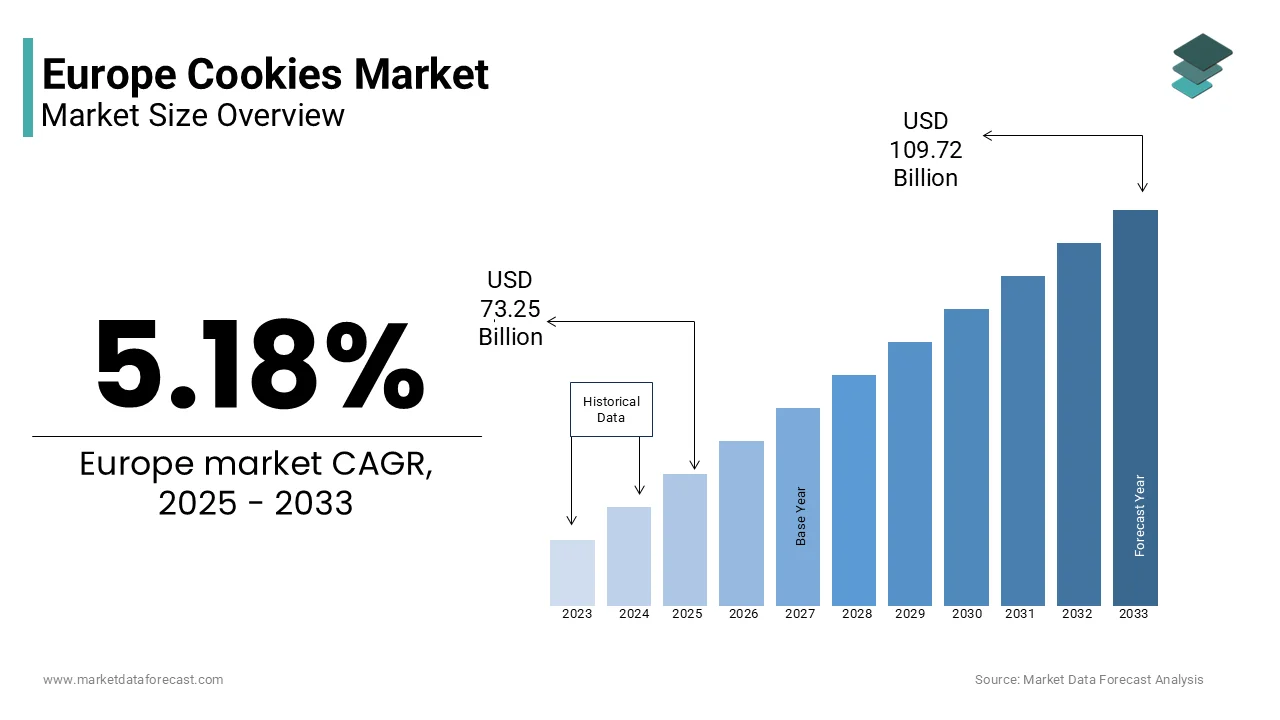
The Europe cookies market size was valued at USD 73.25 billion in 2025, reached USD 77.04 billion in 2026, and is projected to scale up to USD 115.39 billion by 2034, registering a compound annual growth rate (CAGR) of 5.18% during the forecast period from 2026 to 2034. Driven by deep-rooted snacking rituals, surging demand for indulgent and premium experiences, and a rising preference for functional and clean-label alternatives, the market continues to expand steadily across the continent.
Key Executive Metrics (At-a-Glance)
- 2025 Base Valuation: USD 73.25 Billion
- 2026 Current Valuation: USD 77.04 Billion
- 2034 Forecast Valuation: USD 115.39 Billion
- Compound Annual Growth Rate (CAGR): 5.18% (2026–2034)
- Leading Country Market: Germany (18.3% share in 2025, highest per capita consumption)
- Leading Type Segment: Sandwich Cookies (28.3% share in 2025)
- Fastest-Growing Type Segment: No-Bake Cookies (Projected CAGR of 9.7%)
- Leading Ingredient Segment: Chocolate (35.4% share in 2025)
- Fastest-Growing Ingredient Segment: Oatmeal (Projected CAGR of 8.9%)
- Leading Distribution Channel: Supermarkets and Hypermarkets
- Fastest-Growing Distribution Channel: Online Sales (Projected CAGR of 12.4%)
Core Market Drivers
- Indulgent & Premium Snacking: Post-pandemic shifts favoring at-home comfort consumption, artisanal packaging, and small-batch formulations as affordable luxuries.
- Functional Integration: Growing inclusion of wellness ingredients like magnesium, adaptogenic herbs, and botanicals to target mental well-being and cognitive function.
Primary Market Restraints & Challenges
- Regulatory Constraints: Tightening nutrient profiling models, health claim frameworks (EU Regulation EC No 1924/2006), and national scoring systems restricting product positioning and shelf space.
- Supply Chain Volatility: Severe price fluctuations and availability issues concerning key inputs like cocoa and palm oil, alongside pressures to adopt sustainable, non-plastic packaging.
Europe Cookies Market Segmentation Highlights
| Segment Category | Leading / Dominant Segment | Fastest-Growing / Prominent Segment |
|---|---|---|
| By Type | Sandwich Cookies (28.3% share in 2025) | No-Bake Cookies (Projected CAGR of 9.7%) |
| By Ingredient | Chocolate (35.4% share in 2025) | Oatmeal (Projected CAGR of 8.9%) |
| By Distribution Channel | Supermarkets and Hypermarkets | Online Sales (Projected CAGR of 12.4%) |
| By Country | Germany (18.3% share in 2025) | Spain & France (High-growth premium and urban segments) |
Major Industry Players Profiled
Key multinational and regional bakery leaders operating across Europe include Mondelez International, Nestlé SA, Bahlsen, PepsiCo, Kellogg Co., Campbell Soup Co., United Biscuits (McVitie's), Barilla G. e R. Fratelli, Britannia Industries, and M. Dias Branco.
Europe Cookies Market Size
The Europe cookies market size was valued at USD 73.25 billion in 2025, and the market size is expected to reach USD 115.39 billion by 2034 from USD 77.04 billion in 2026. The market is growing at a CAGR of 5.18%.
The cookies are baked sweet and savory confections primarily formulated from flour, sugar, fats, and flavorings, consumed as snacks, desserts, or breakfast accompaniments. These products span traditional butter cookies, chocolate-dipped variants, filled sandwich cookies, and health-oriented functional biscuits. Unlike broader baked goods, cookies in Europe are deeply embedded in cultural rituals—from afternoon tea pairings in the UK to festive Weihnachtsplätzchen in Germany. As of 2024, Europeans consumed an average of 6.8 kilograms of cookies per capita annually, reflecting deeply rooted snacking habits, as per Eurostat’s food consumption survey.
MARKET DRIVERS
Rising Demand for Indulgent and Premium Snacking Experiences
The European consumers are increasingly prioritizing sensory satisfaction and emotional well-being in their food choices, which is driving the growth of Europe cookies market. The post-pandemic shift toward at-home comfort consumption has elevated the role of indulgent snacks as a form of affordable luxury. Brands like LU (Mondelez), Danone’s LU Biscuits, and German specialty baker Bahlsen have responded with artisanal packaging, single-origin cocoa, and small-batch formulations. The trend is particularly strong among urban millennials and Gen Z consumers, who associate premium cookies with self-reward and mindfulness.
Integration of Functional Ingredients for Cognitive and Emotional Wellness
The growing support for mental well-being and cognitive function with innovation in functional formulations is escalating the growth of Europe cookies market. Ingredients such as magnesium, L-theanine, chamomile, and adaptogenic herbs are being incorporated into cookie matrices to promote relaxation and stress relief. Companies like Eat Your Happy (UK) and SereniTea (France) have launched melatonin-infused and botanical-enriched cookies targeting sleep and anxiety. The European Food Safety Authority has approved several health claims related to magnesium and nervous system function, lending scientific credibility.
MARKET RESTRAINTS
Stringent Nutrient Profiling Regulations Under the EU’s Health Claims Framework
The Europe Union’s tightening regulatory environment the evolving Nutrient Profiling Model under Article 4 of the Nutrition and Health Claims Regulation (EC) No 1924/2006, is restricting the growth of Europe cookies market. National implementations are already underway France’s Nutri-Score system has led to a 27% reduction in shelf space for D- and E-rated sweet snacks since 2020, according to INSEE. The Netherlands’ Hoschedé Table has prompted reformulation delays. These frameworks complicate innovation for products aiming to include functional ingredients while remaining compliant. Manufacturers face rising costs in reformulation and clinical substantiation, which is slowing time-to-market and limiting creative freedom in product development.
Consumer Skepticism Toward Ultra-Processed Ingredients and Artificial Additives
The rejecting products perceived as ultra-processed is hindering the growth of Europe cookies market. As per a 2024 Eurobarometer survey, 63% of EU citizens believe that processed foods negatively impact long-term health, with particular concern over emulsifiers, artificial flavors, and preservatives commonly used in mass-produced cookies. The Nordic Council’s 2022 report on food additives recommended phasing out certain emulsifiers like E471 due to gut microbiome concerns, influencing consumer behavior. Retailers such as Denmark’s Irma and Germany’s Alnatura have delisted conventional cookie lines in favor of organic, short-ingredient alternatives.
MARKET OPPORTUNITIES
Expansion of Plant-Based and Allergen-Free Cookie Variants
The surge in plant-based diets and food allergy awareness is likely to pose new opportunities for theg growth of Europe cookies market. As per the European Federation of Allergy and Airways Diseases Patients’ Associations (EFA), over 22 million Europeans suffer from food allergies, with milk, eggs, and nuts being among the most common triggers. Companies like Pip & Nut (Netherlands) and Biscuiteers (UK) have launched egg-free, dairy-free cookies using oat milk, aquafaba, and pea protein. Supermarkets including Tesco and Carrefour now dedicate shelf space to allergen-free ranges.
Leveraging Regional Culinary Heritage for Export-Oriented Premiumization
The rich tapestry of regional recipes that offer authenticity and differentiation is additionally to elevate the growth of Europe cookies market. Traditional varieties such as Italian amaretti, Austrian linzer, and Danish havregrynskager are increasingly positioned as premium gourmet exports. Countries like Italy and Belgium are branding their cookies as protected gastronomic heritage Parma’s Biscotti di Valtellina received PGI status in 2022 by enhancing market exclusivity. Domestic producers are partnering with luxury retailers such as Harrods and Le Bon Marché to position cookies as gifting items. The European Commission’s “Taste of Europe” campaign has further amplified visibility.
MARKET CHALLENGES
Volatility in Key Raw Material Supply Chains, Particularly Palm Oil and Cocoa
The instability in the supply of ingredients like palm oil and cocoa, both of which are subject to geopolitical, climatic, and regulatory disruptions is hindering the growth of Europe cookies market. In 2022, Indonesia’s temporary palm oil export ban caused prices to spike by over 40% within three weeks, severely impacting production margins. Similarly, cocoa prices reached a 47-year high in early 2025 due to crop failures in West Africa, where Côte d’Ivoire and Ghana produce 60% of global supply, according to the International Cocoa Organization.
Balancing Sustainability Commitments with Packaging Performance
The manufacturers are under increasing pressure to eliminate plastic-based packaging in preserving freshness and preventing breakage with eco-friendly alternatives, which is likely to limit the growth of Europe cookies market. As per the European Environment Agency, flexible plastic packaging accounts for 39% of all plastic waste in the EU, prompting legislation like the Packaging and Packaging Waste Regulation (PPWR) mandating 65% recyclability by 2030. Brands like McVitie’s and Kelsen have delayed rollouts of sustainable packaging due to quality concerns. This tension between environmental goals and product integrity forces companies into costly R&D cycles, which is slowing progress despite strong consumer demand for greener solutions.
REPORT COVERAGE
| REPORT METRIC | DETAILS |
| Market Size Available | 2025 to 2034 |
| Base Year | 2025 |
| Forecast Period | 2026 to 2034 |
| CAGR | 5.18% |
| Segments Covered | By Type, Ingredient, Distribution Channel and Region |
| Various Analyses Covered | Global, Regional, and country Level Analysis; Segment-Level Analysis; DROC; PESTLE Analysis; Porter’s Five Forces Analysis; Competitive Landscape; Analyst Overview of Investment Opportunities |
| Countries Covered | UK, France, Spain, Germany, Italy, Russia, Sweden, Denmark, Switzerland, Netherlands, Turkey, Czech Republic and Rest of Europe |
| Market Leaders Profiled | Mondelez International, Kellogg Co., Campbell Soup Co., Nestle SA, United Biscuits, PepsiCo, M. Dias Branco, Britannia Industries, Barilla G. e R. Fratelli, and Arcor U.S.A., Kraft Foods, Thomas Tunnock Limited, Nutrexpa, Paterson Arran Limited |
SEGMENTAL ANALYSIS
By Type Insights
The sandwich cookies segment was accounted in holding 28.3% of the Europe cookies market share in 2025 with their versatility, portability, and strong appeal across age groups, particularly children and young adults. The emotional and nostalgic association with well-established brands is escalating the growth of Europe cookies market. Mondelez’s Oreo, for instance, reported a 12% year-on-year sales increase in Western Europe in 2024, driven by limited-edition flavors and seasonal packaging, as noted in the company’s regional performance review. Additionally, the rise of premium sandwich cookies with fillings like salted caramel and matcha has expanded their appeal beyond traditional consumers.
The no-bake cookies segment is projected to grow with an expected CAGR of 9.7% during the forecast period with the shifting consumer preferences toward convenience, clean-label ingredients, and home-based experiential cooking. As per a 2024 Eurobarometer survey, 68% of European parents with children under 12 prefer no-bake or minimal-cook recipes for weekend family activities, reflecting a cultural shift toward interactive, low-effort food preparation. The alignment of no-bake cookies with clean-label and plant-based trends is amplifying the growth of segment.
By Ingredient Insights
The chocolate ingredient segment was accounted in holding 35.4% of the Europe cookies market share in 2025 with the chocolate’s universal appeal, sensory richness, and deep integration into European confectionery culture. From dark chocolate-dipped digestives in the UK to filled Schokoladenkekse in Germany, chocolate remains the most preferred flavor enhancer in cookie formulations. The psychological association between chocolate and mood enhancement is escalating the growth of Europe cookies market. Chocolate contains compounds such as theobromine and phenylethylamine, which are linked to serotonin release.
The oatmeal ingredient segment is swiftly emerging with a CAGR of 8.9% from 2026 to 2034 with the rising emphasis on whole grains, digestive health, and sustained energy release. Oatmeal cookies are increasingly perceived not as mere snacks but as functional foods that support balanced diets. The recognition of beta-glucan, a soluble fiber in oats, for its cholesterol-lowering effects. This scientific backing has elevated oatmeal cookies from traditional home baking to mainstream health positioning. Brands like Alpro and Oatly have extended into baked snacks, which is launching oat-based cookies with added plant protein and no added sugar by appealing to fitness-conscious and diabetic consumers.
By Distribution Channel Insights
The supermarkets and hypermarkets segment held a dominant share of the Europe cookies market in 2025. These channels remain the primary destination for cookie purchases due to their wide product assortment, competitive pricing, and integration into weekly grocery routines. The format allows consumers to access everything from mass-market brands like McVitie’s and LU to premium and organic variants under one roof. Retailers use data-driven planograms to maximize visibility and impulse buying.
The online sales channel is projected to grow at a CAGR of 12.4% during the forecast period with the changing consumer behavior, digital accessibility, and the rise of specialty and direct-to-consumer (DTC) brand. Cookies, particularly artisanal, limited-edition, and subscription-based varieties, are well-suited for online fulfillment due to their shelf-stable nature and gifting appeal. The proliferation of niche brands leveraging digital platforms to bypass traditional retail gatekeepers is additionally to elevate the growth of Europe cookies market.
REGIONAL ANALYSIS
Germany Cookies Market Analysis
Germany was the top performer and held 18.3% of the Europe cookies market share in 2025. Germans consume an average of 7.3 kilograms of cookies annually, the highest in Western Europe, as reported by the German Nutrition Society. This cultural habit drives consistent demand, with cookies consumed daily in homes, workplaces, and cafés. The Federal Ministry of Food and Agriculture notes that over 60% of packaged cookies sold in Germany are purchased for home consumption, often as part of weekly grocery hauls. Major players like Bahlsen, Hero, and Nestlé maintain strong domestic production by ensuring freshness and supply chain control. In recent years, Germany has also emerged as a testbed for innovation, with brands launching sugar-reduced, fiber-enriched, and allergen-free variants in response to tightening nutritional guidelines.
United Kingdom Cookies Market Analysis
The UK was positioned second by capturing 12.3% of the Europe cookies market share in 2025. It is distinguished by its concentration of globally recognized brands and a highly competitive retail landscape. The brand’s dominance is reinforced by nostalgic branding, consistent quality, and strategic innovation, such as the launch of chocolate-coated and light versions.British consumers exhibit strong brand loyalty but are also receptive to premium and health-oriented variants. As per a 2024 YouGov survey, 52% of UK adults consume biscuits daily, with afternoon tea being a key consumption occasion.
France Cookies Market Analysis
France cookies market growth is likely to be driven by the premiumization and artisanal production. The country’s biscuiteries régionales, such as those in Alsace and Brittany, produce high-margin, heritage-based cookies that command price premiums both domestically and internationally. As per the French Federation of Baking Industries, over 220 artisanal cookie producers operate in France, many with protected geographical indications. This preference supports niche brands like LU, which has revitalized its image with organic and limited-edition lines.
Italy Cookies Market Analysis
Italy cookies market growth is likely to grow with the unique role due to its culinary heritage and export strength. Italian cookies are often linked to protected designations, such as Amaretti di Saronno (IGP), which enhances authenticity and pricing power. Retailers like Conad and Esselunga promote regional varieties, supporting local producers. Additionally, Italy is a leader in gluten-free innovation, with rice- and almond-based cookies catering to celiac populations.
Spain Cookies Market Analysis
Spain represents 9% of the Europe cookies market in 2024, according to Spain’s National Statistics Institute (INE), and is emerging as a high-potential market due to shifting consumption habits and urbanization. Traditionally, churros and pastries dominated the sweet snack space, but packaged cookies are gaining ground, especially among younger, urban consumers. As per a 2024 study by the Spanish Nutrition Foundation, cookie consumption among adults aged 18–35 increased by 17% between 2020 and 2024.
COMPETITIVE LANDSCAPE
The competition in the Europe cookies market is characterized by a dynamic interplay between multinational corporations, regional artisans, and emerging direct-to-consumer brands. Established players like Mondelez and Nestlé dominate through brand equity, distribution scale, and R&D capabilities, while local producers leverage heritage and authenticity to capture niche segments. The rise of health-consciousness, sustainability demands, and digital shopping has intensified rivalry, forcing companies to innovate beyond taste into functionality and ethics.
KEY MARKET PLAYERS
A few of the notable players in the Europe cookies market include
- Mondelez International
- Kellogg Co.
- Campbell Soup Co.
- Nestle SA
- United Biscuits
- PepsiCo
- M. Dias Branco
- Britannia Industries
- Barilla G. e R. Fratelli
- Arcor U.S.A.
- Kraft Foods
- Thomas Tunnock Limited
- Nutrexpa
- Paterson Arran Limited
TOP PLAYERS IN THE MARKET
- Mondelez International is a dominant force in the Europe cookies market, which is leveraging iconic brands such as Oreo, LU, and Cadbury to shape consumer preferences across the continent. The company has consistently invested in product innovation, introducing region-specific flavors like Oreo Red Velvet in Germany and LU Petit Écolier in France. In 2024, Mondelez expanded its sustainability-driven "Cocoa Life" program across European supply chains, ensuring ethically sourced ingredients while reducing environmental impact. It also enhanced its digital engagement through augmented reality packaging and e-commerce partnerships with Amazon and Picnic. Additionally, Mondelez strengthened its manufacturing footprint by upgrading its biscuit facility in Warsaw, Poland, to increase output efficiency and support export demand.
- Nestlé prioritized health-oriented innovation, reformulating several cookie lines to reduce sugar by up to 30% without compromising taste, in alignment with WHO recommendations and national sugar reduction strategies. It has also deepened retail integration through smart shelf technology in partnership with Carrefour, enabling real-time inventory tracking and personalized promotions. Nestlé’s investment in AI-driven consumer insights has accelerated product development cycles, allowing rapid response to flavor trends and dietary shifts.
- Bahlsen is a German-origin biscuit manufacturer, which remains a cornerstone of the Europe cookies market with heritage brands like Leibniz, Choco Leibniz, and Jaffa Cakes. The company has maintained strong regional loyalty while expanding its presence through strategic innovation and sustainability initiatives. It also launched a line of protein-enriched cookies in collaboration with fitness nutrition platforms, targeting active consumers in Scandinavia and Benelux. Bahlsen has enhanced its digital footprint by partnering with online grocery platforms like Edeka.de and REWE.to, optimizing direct-to-consumer delivery.
TOP STRATEGIES USED BY THE KEY MARKET PLAYERS
Key players in the Europe cookies market are deploying multifaceted strategies to maintain competitiveness amid evolving consumer demands and regulatory pressures. Major approaches include product innovation focused on health enhancement, such as sugar reduction, fiber enrichment, and allergen-free formulations. Companies are investing in clean-label transparency, sourcing non-GMO, organic, and ethically produced ingredients. Sustainability is a central pillar, with brands transitioning to recyclable packaging and carbon-neutral production. Digital engagement through e-commerce optimization, direct-to-consumer models, and AI-driven personalization is accelerating customer retention.
MARKET SEGMENTATION
This research report on the Europe cookies market has been segmented and sub-segmented into the following categories.
By Type
- Bar
- Sandwich
- Drop
- Rolled
- Molded
- Refrigerator
- No-Bake
- Fried
By Ingredient
- Chocolate
- Chocolate Chip
- Oatmeal
- Butter
- Cream
- Ginger
- Coconut
- Honey
- Others
By Distribution Channel
- Supermarkets and Hypermarkets
- Independent Retailers
- Convenience Stores
- Online Sales
By Country
- UK
- France
- Spain
- Germany
- Italy
- Russia
- Sweden
- Denmark
- Switzerland
- Netherlands
- Turkey
- Czech Republic
- Rest of Europe