Europe Copper Foil Market Size, Share, Trends & Growth Forecast Report – Segmented By Application (Circuit Boards, Batteries, Electromagnetic Shielding, and others), and Country (UK, France, Spain, Germany, Italy, Russia, Sweden, Denmark, Switzerland, Netherlands, Turkey, Czech Republic & Rest of Europe), Industry Analysis From 2026 to 2034
Market Size, 2025
$1.83 BnMarket Estimate, 2026
$2.07 BnMarket Forecast, 2034
$5.45 BnCAGR, 2026–2034
12.87%Executive Summary: Europe Copper Foil Market
- Market Scope: European copper foil technology market analysis covering application segments, material/quality specifications, regional leadership frameworks, and adoption metrics.
- Market Valuation: Valued at USD 1.83 billion (2025), estimated at USD 2.07 billion (2026), and projected to reach USD 5.45 billion by 2034, growing at a robust CAGR of 12.87% (2026–2034).
- Primary Growth Drivers: High demand across batteries, printed circuit boards, and electromagnetic shielding (with thicknesses typically ranging from 4 to 120 micrometres), alongside nearly 50% of Europe's total copper demand being met through recycling. Key operational metrics include the EU's ~48% import dependency for raw copper at the extraction stage, European battery projects projected to exceed 1.2 TWh of annual capacity by 2030 (with ~15–20 plants operational or under construction as of early 2025), and advanced manufacturing requiring cathode-grade copper with purity exceeding 99.9%.
Key Market Segment Metrics (2026–2034)
| Category | Leading Segment (2025 Position) | Fastest-Growing Segment |
|---|---|---|
| By Application | Batteries (dominated the application segment with 48.2% market share in 2025, supported by expanding lithium-ion battery and EV manufacturing) | Electromagnetic shielding (identified as the fastest-growing application, with a 12.4% CAGR) |
| By Region | Germany (led the European market with 24.7% share in 2025, supported by its automotive, battery, and advanced-electronics manufacturing base), followed by France with 15.3% share (driven by investments in electric mobility, battery production, and defence electronics) | — |
Major Market Players & Market Structure
Market Structure: Highly competitive European copper foil landscape featuring 10 prominent market leaders competing on high-purity feedstock, advanced surface treatments, recycling partnerships, and gigafactory collaborations.
Key Companies: UACJ, SKC & Co., LS Mtron, Doosan Corporation Electro-Materials, Circuit Foil, Chang Chun Group, Nippon Denkai, Lingbao Wason Copper Foil, Lotte Chemical, and Furukawa Electric Co., Ltd.
Europe Copper Foil Market Size
The Europe copper foil market size was valued at USD 1.83 billion in 2025 and is projected to reach USD 5.45 billion by 2034 from USD 2.07 billion in 2026, growing at a CAGR of 12.87%.
Copper foil refers to electrolytically- or rolled-deposited thin sheets of copper, typically ranging from 4 to 120 micrometres in thickness, primarily used as conductive layers in printed circuit boards, battery electrodes, and electromagnetic shielding applications. Unlike bulk copper products, copper foil is defined by its purity, surface roughness, tensile strength, and elongation characteristics, which directly influence electrical conductivity and adhesion in advanced electronics. Europe’s copper foil demand is tightly coupled to its strategic ambitions in electrification and digital sovereignty rather than general industrial activity. According to the European Commission’s Critical Raw Materials Act, copper is classified as a strategic material due to its essential nature for key technologies in renewable energy and electric mobility, and the need to secure future supply despite its currently lower supply risk compared to other materials. The European Union's battery industry is growing rapidly, with a focus on developing domestic production capacity and implementing new regulations that mandate minimum levels of recycled content for materials like copper in electric vehicle batteries from 2031. Furthermore, as per sources, the EU has a significant import dependency for raw copper at the extraction stage (around 48%), but its supply is diversified, and nearly 50% of its total copper demand is met through recycling, which reduces overall reliance on third countries. The Critical Raw Materials Act aims to further reduce import reliance and increase domestic capacity. This positions the European copper foil market not as a commodity segment but as a precision enabler of the continent’s clean tech and semiconductor independence agendas.
MARKET DRIVERS
Surge in Electric Vehicle Battery Manufacturing Under the European Battery Alliance
The rapid expansion of gigafactory capacity in the region is one of the major contributors to the growth of the European copper foil market. This surges the demand for copper foil specifically for ultra-thin battery-grade variants used as anodes in lithium-ion cells. According to industry reports and the European Battery Alliance, there are numerous gigafactories planned, under construction, or operational in the EU, with the number constantly evolving and combined annual capacity projected to reach over 1.2 TWh by 2030 across all project stages. The number of operational and under-construction plants is likely closer to 15-20 as of early 2025. Each gigawatt hour of battery capacity requires a significant amount of copper foil, with figures varying based on cell chemistry and foil thickness. As per sources, the EU's battery production is expanding rapidly due to strong market demand and supportive policies, such as the proposed Net-Zero Industry Act, aiming to boost domestic manufacturing capacity. Countries like Germany, Hungary and Poland have become focal points. This industrial build-out transforms copper foil from a niche electronic material into a strategic industrial input.
Integration of Advanced Printed Circuit Boards in Defence and Aerospace Electronics
Renewed focus on defence autonomy and aerospace innovation is boosting the expansion of the European copper foil market. This accelerates the demand for high-performance rolled copper foil used in multilayer flexible and high-frequency printed circuit boards. According to the European Defence Agency, the EU's defence electronics procurement is on an upward trend, with radar communication and avionics systems requiring ultra-low profile copper foil with exceptional signal integrity. Civil aerospace also contributes.. National initiatives reinforce this trend. France's Future Combat Air System requires domestically sourced materials that comply with strict security standards for its electronic subsystems. These defence and aerospace imperatives create a premium segment insulated from consumer electronics volatility.
MARKET RESTRAINTS
Heavy Reliance on Asian Imports for Battery Grade Copper Foil
Significant supply chain fragility and pricing vulnerability continue to be a barrier to the European copper foil market. This is due to the region's near-total dependence on East Asian suppliers for advanced copper foil. According to sources, the European Union is highly dependent on imports from specific Asian countries (Japan, South Korea, and China) for the majority of its battery-grade copper foil consumption. Japanese companies maintain a dominant position in the market for ultra-thin copper foil, largely due to their advanced manufacturing and processing technologies. Lead times for obtaining high-specification copper foil from Asian suppliers have significantly increased over the past few years, as per research. This dependency contradicts the EU’s strategic autonomy goals. Europe's lack of domestic production capacity leaves it vulnerable to geopolitical risks and inconsistent quality, which in turn endangers the timelines for gigafactory expansion and compromises defence readiness.
Stringent Environmental Regulations on Electrolytic Production Processes
The electrolytic deposition method used to produce the majority of copper foil generates significant chemical and energy footprints, which face escalating scrutiny under Europe’s Industrial Emissions Directive, and thereby constrains the expansion of the European copper foil market. The standard electrolytic process for foil production is associated with high energy consumption and requires the use of sulfuric acid-based electrolytes, which necessitate rigorous wastewater treatment procedures, as per studies. EU regulations for non-ferrous metals production are becoming stricter, requiring all new foil production lines to adopt closed-loop acid recovery systems and utilise carbon-neutral energy sources within the next few years. These regulations increase capital expenditure for greenfield plants. Consequently, many potential European producers defer investment pending regulatory clarity while existing facilities face costly retrofits. This environmental compliance burden stifles local capacity development despite strong strategic demand.
MARKET OPPORTUNITIES
Emergence of European Copper Foil Recycling from End-of-Life Batteries
The growing volume of end-of-life electric vehicle batteries in the region offers a key opportunity for the growth of the European copper foil market. This can establish a circular supply chain for copper foil through urban mining. According to research, the quantity of end-of-life lithium-ion batteries in the EU is projected to increase substantially in the coming years. Copper is a significant component in battery mass, largely present as recoverable foil. Companies have already launched pilot hydrometallurgical plants that recover high-purity copper suitable for reprocessing into new foil. As per studies, recycling copper for battery use offers considerable environmental benefits, substantially lowering the carbon footprint compared to producing new copper from raw sources. This closed-loop model aligns with the EU’s circular economy action plan and offers a path to mitigate import dependency while meeting regulatory mandates.
Development of Domestic Foil Production Under the Net Zero Industry Act
The European Union’s Net Zero Industry Act has caused public-private initiatives to establish local copper foil manufacturing capacity that reduces strategic vulnerabilities and ultimately creates fresh opportunities for the expansion of the European copper foil market. According to research, the European Union, through the Net Zero Industry Act, is providing regulatory support, including streamlined permitting and state aid, to foster the development of battery material production technologies, such as copper foil. In addition, notable financial investment from institutions and national programs is being directed towards establishing domestic battery-grade copper foil production capacity. National governments are also acting. These initiatives benefit from guaranteed offtake agreements with battery cell makers under the European Battery Passport framework. By anchoring production within the EU’s clean tech value chain, Europe aims to transform copper foil from an imported commodity into a sovereign industrial capability.
MARKET CHALLENGES
Volatility in High-Purity Copper Feedstock Availability
The production of advanced copper foil requires cathode-grade copper with purity exceeding 99.9 per cent, yet the region’s domestic refining capacity for such high-purity feedstock is insufficient and unstable, which hinders the growth of the European copper foil market. The production of cathode copper meeting the specific quality standard (ASTM B115) required for electrolytic foil is limited to a small number of refineries within the EU. Even minor impurities in feedstock, such as bismuth or selenium, can cause pinholes or reduced elongation in foil, resulting in entire batches being unusable for battery applications. This upstream barrier constrains scalability and quality consistency despite growing downstream demand.
Lack Standardised Specifications for Next Generation Foil in Solid State Batteries
The absence of standardised technical specifications for the copper foil variants required in these emerging architectures is holding back the expansion of the European copper foil market. The absence of standardised measurements for adhesion, thermal stability, and interfacial resistance leads to a fragmented market, as individual cell manufacturers develop their own proprietary requirements. This lack of interoperability discourages large-scale foil producers from investing in new production lines and slows the commercialisation of Europe’s next-generation battery technologies.
REPORT COVERAGE
| REPORT METRIC | DETAILS |
| Market Size Available | 2025 to 2034 |
| Base Year | 2025 |
| Forecast Period | 2026 to 2034 |
| CAGR | 12.87% |
| Segments Covered | By Application, and Region |
| Various Analyses Covered | Global, Regional, & Country Level Analysis; Segment-Level Analysis; DROC, PESTLE Analysis; Porter’s Five Forces Analysis; Competitive Landscape; Analyst Overview of Investment Opportunities |
| Regions Covered | UK, France, Spain, Germany, Italy, Russia, Sweden, Denmark, Switzerland, Netherlands, Turkey, and the Czech Republic |
| Market Leaders Profiled | UACJ, SKC & Co., LS Mtron, Doosan Corporation Electro-Materials, Circuit Foil, Chang Chun Group, Nippon Denkai, Lingbao Wason Copper Foil, Lotte Chemical, and Furukawa Electric Co., Ltd. |
SEGMENTAL ANALYSIS
By Application Insights
The batteries segment led the European copper foil market and accounted for a 48.2% share in 2025. The continent’s aggressive electrification agenda and the structural role of copper foil as the anode current collector in lithium-ion cells drive the growth of the batteries segment. As per studies, Battery manufacturing within the EU has experienced considerable growth, spurred by regulations promoting localised supply chains for electric mobility solutions. National policies amplify this trend. Regulations in Germany, such as the Battery Passport, require full traceability of essential materials, including copper foil, throughout the entire supply chain from origin to the final battery cell. Electric vehicles contain a substantial amount of copper, and copper foil is a major component, particularly in terms of surface area within the battery system. This convergence of industrial policy, regulatory enforcement, and technological necessity solidifies batteries as the core demand driver.
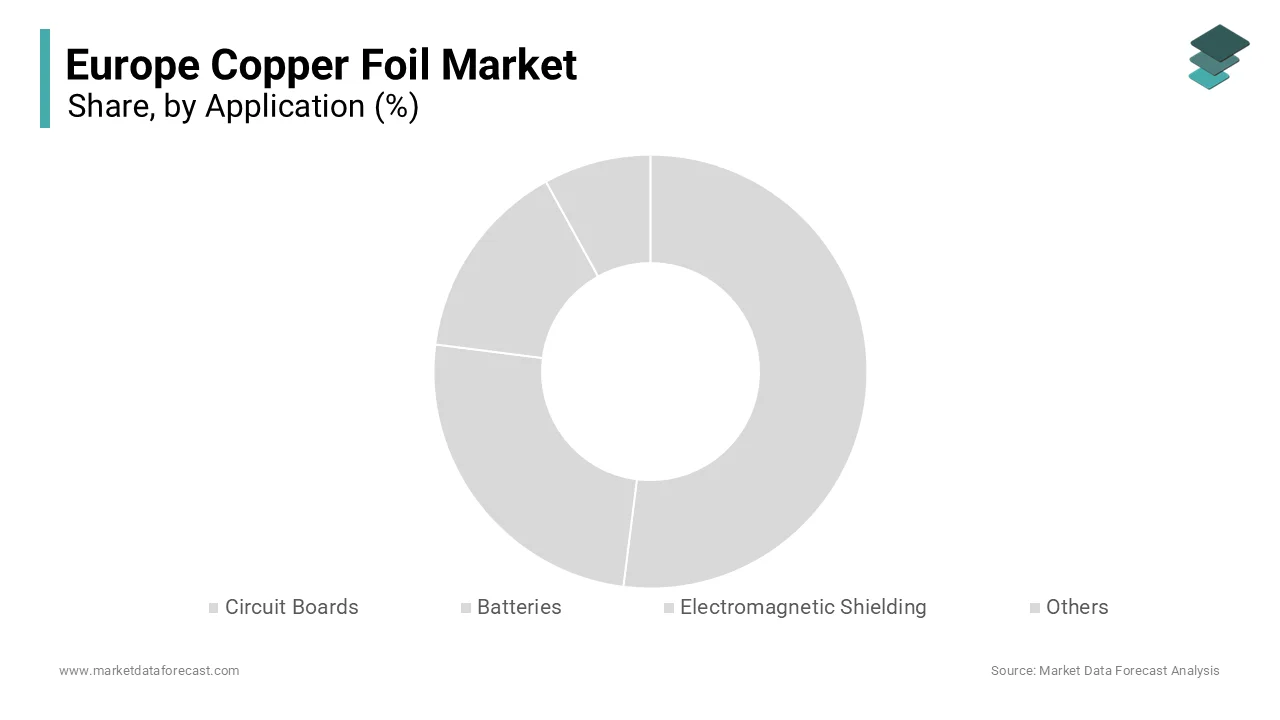
The electromagnetic shielding segment is likely to experience the fastest CAGR of 12.4% share in 2025. The swift expansion of the electromagnetic shielding segment is fuelled by the proliferation of high-frequency electronic systems in defence, 5G infrastructure and medical devices, which require thin, highly conductive copper layers to suppress electromagnetic interference. Civil applications are equally dynamic. The use of copper foil for electromagnetic shielding in 5G base stations is increasing due to the transition to higher frequency bands. Furthermore, regulatory requirements, such as the European Medical Devices Regulation, are driving demand for advanced, biocompatible copper foil coatings for implantable electronics where EMI protection is a critical safety function. These regulatory and technological forces are transforming shielding from a niche use into a high-growth vector.
REGIONAL ANALYSIS
Germany Market Analysis
Germany dominated the European copper foil market and accounted for a 24.7% share in 2025. The domination of the German market is primarily driven by its dual role as Europe’s automotive powerhouse and a hub for advanced electronics manufacturing. As per research, Germany hosts many operational or planned gigafactories representing a notable share of total EU battery capacity. These facilities create massive localised demand for battery-grade copper foil with stringent quality requirements. Simultaneously, Germany’s electronics sector, led by companies, drives demand for high-frequency circuit board foil. According to sources, production of printed circuit boards in Germany is experiencing significant growth, driven by demand from key sectors like industrial automation and renewable energy. National regulations reinforce this ecosystem. German legislation is shifting toward promoting self-sufficiency and domestic supply chains for critical materials used in battery manufacturing. This policy of industrial and technological alignment ensures Germany remains the epicentre of copper foil consumption in Europe.
France Market Analysis
France followed closely in the European copper foil market and captured a 15.3% share in 2025. The growth of the French market is attributed to strategic investments in defence electronics and electric mobility under the France 2030 recovery plan. Moreover, France hosts major battery cell plants, including the Automotive Cells Company facility in Hauts de Franc, which consumed notable tonnes of copper foil. This blend of sovereign tech ambition, industrial policy, and innovation sustains France’s strong market position.
Hungary Market Analysis
Hungary holds a key position in the European copper foil market and has emerged as Central Europe’s battery manufacturing hub, hosting major gigafactories operated by Samsung SDI, Envision AESC, and SK On. These plants collectively consumed significant tonnes of copper foil, which makes Hungary the major per capita consumer in the EU. The government’s incentive regime offers tax credits for local material integration, accelerating efforts to establish foil pre-processing facilities. Besides, Hungary’s electronics sector, led by semiconductor packaging firms in the Budapest tech corridor, drives demand for circuitboard-grade foil. This concentrated industrial strategy transforms Hungary into a critical node in Europe’s copper foil supply chain.
Poland Market Analysis
Poland moderately expanded in the European copper foil market owing to the rapid expansion of battery and automotive supply chains in the Silesian and Lower Silesian regions. There is a significant and growing demand for copper foil in the European electric vehicle battery manufacturing sector, particularly driven by the expansion and ramp-up of large-scale production facilities in Poland. Also, there is an increasing trend of substantial government and development fund investment aimed at bolstering local supply chains for battery components, including the processing of key materials like copper foil. Poland’s strategic location also makes it a logistics gateway for fuel distribution to Germany and the Baltic. These coordinated industrial and policy actions position Poland as a rising force in the European copper foil ecosystem.
Sweden Market Analysis
Sweden is likely to grow in the European copper foil market from 2026 to 2034 due to its command in sustainable battery innovation and recycling rather than volume production. The battery manufacturing industry is shifting towards the utilisation of fossil-free and renewable energy sources in materials refining processes. As per research, there is an increasing regulatory push and corporate goal to incorporate a substantial percentage of recycled materials into new energy storage products. Furthermore, Sweden hosts Europe’s most advanced battery recycling cluster with companies like Stena Recycling recovering high-purity copper suitable for reprocessing into new foil. A dedicated and advanced domestic infrastructure for end-of-life battery material recovery is being established within Europe to facilitate a circular economy. This focus on green tech and circularity gives Sweden outsized strategic importance despite its modest market share.
COMPETITIVE LANDSCAPE
KEY MARKET PLAYERS
Some of the notable key players in the European copper foil market are
- UACJ
- SKC & Co.
- LS Mtron
- Doosan Corporation Electro-Materials
- Circuit Foil
- Chang Chun Group
- Nippon Denkai
- Lingbao Wason Copper Foil
- Lotte Chemical
- Furukawa Electric Co., Ltd.
TOP STRATEGIES USED BY THE KEY MARKET PLAYERS
Key players in the European copper foil market focus on securing low-carbon, high-purity copper feedstock through vertical integration and urban mining partnerships to meet EU regulatory mandates. They invest in advanced surface treatment technologies to enhance foil adhesion, conductivity and thermal performance for batteries and high-frequency electronics. Strategic collaborations with gigafactory operators and defence electronics manufacturers ensure alignment with end-user specifications. Companies actively participate in European standardisation initiatives to shape technical requirements for recycled and solid-state compatible foils. Apart from these, they deploy digital traceability systems to comply with the Battery Passport and Critical Raw Materials Act, ensuring supply chain transparency and compliance.
COMPETITION OVERVIEW
The European copper foil market features limited domestic production capacity and intense pressure to localise supply chains amid strategic decoupling from Asian dominance. Competition is not primarily price-based but centres on technical certification, sustainability credentials and regulatory compliance. While global foil giants like Fukuda Metal and Iljin Material maintain strong export footholds, European players such as Aurubis and Umicore compete by integrating circularity, low-carbon refining, and proximity to gigafactories. The market remains highly specialised with entry barriers including capital intensity, purity contcontrold surface engineering expertise. Public policy acts as a key competitive lever as firms vie for inclusion in EU critical raw materials projects and battery alliance supply lists. Innovation in recycled content foil and solid-state compatible architectures is becoming the new frontier where differentiation occurs. Currently, the competition is one-sided due to the lack of operational European foil plants; only those with strong feedstock and regulatory strategies have the upper hand.
TOP PLAYERS IN THE MARKET
- Aurubis AG is a pivotal European player in the copper value chain with expanding capabilities in high-purity copper materials essential for foil production. Headquartered in Germany, the company leverages its integrated smelting and refining operations to supply cathode-grade copper meeting the stringent purity requirements of electrolytic foil manufacturers. The company also invested in advanced analytical systems to ensure trace metal impurities remain below critical thresholds that affect foil ductility and surface quality. Aurubis contributes globally by setting benchmarks for sustainable copper sourcing and enabling circular economy models through its urban mining initiatives, which recover copper from electronic waste for reuse in advanced applications.
- Umicore SA plays a strategic role in the European copper foil market through its advanced materials division, which supports the battery and electronics sectors with high-performance metal solutions. Based in Belgium, the company integrates copper recovery from end-of-life batteries into its refining stream, producing ultra-pure copper suitable for foil reprocessing. The company also participates in EU-funded research projects on solid-state battery interfaces, where copper current collector properties are redefined. Globally, Umicore influences sustainability standards by embedding lifecycle assessment into material certification processes and advocating for responsible sourcing frameworks that align with OECD due diligence guidelines.
- Elkem ASA contributes to the European copper foil ecosystem through its expertise in speciality silicon and metal alloys that support advanced electronics and energy storage. Although headquartered in Norway, its materials technology division supplies critical additives and surface treatment chemicals used in copper foil manufacturing to enhance adhesion and thermal stability. The company also leverages hydropower-based production in Scandinavia to offer low-carbon material solutions aligned with the EU’s green industrial policy. Globally, Elkem advances material innovation by co-developing next-generation current collectors with cell manufacturers and promoting clean production practices across the electronics supply chain.
MARKET SEGMENTATION
This research report on the European copper foil market has been segmented and sub-segmented based on categories.
By Application
- Circuit Boards
- Batteries
- Electromagnetic Shielding
- Others
By Country
- UK
- France
- Spain
- Germany
- Italy
- Russia
- Sweden
- Denmark
- Switzerland
- Netherlands
- Turkey
- Czech Republic
- Rest of Europe
Frequently Asked Questions
1. What is the Europe copper foil market?
The Europe copper foil market focuses on the production, distribution, and application of thin copper sheets used in various industries such as electronics, batteries, and energy systems.
2. What are the main applications of copper foil in Europe?
Key applications include circuit boards, lithium-ion batteries, electromagnetic shielding, and other industrial uses.
3. What are the major factors driving the growth of the copper foil market in Europe?
Growth is driven by the increasing adoption of electric vehicles (EVs), expansion of renewable energy systems, and rising demand for electronic devices.
4. Which industries are the largest consumers of copper foil in Europe?
Major consumers include the automotive, electronics, energy storage, and telecommunications industries.
5. How is copper foil used in electric vehicles (EVs)?
Copper foil serves as a key component in lithium-ion battery anodes, offering high conductivity and stability essential for EV performance.
6. What are the main types of copper foil available in the market?
The market typically includes rolled copper foil and electrolytic copper foil, each offering distinct advantages for different industrial applications.
7. What challenges are faced by the Europe copper foil market?
Challenges include fluctuating raw material prices, high energy consumption during production, and competition from alternative conductive materials.
8. Which countries are leading in copper foil production and usage in Europe?
Germany, France, the United Kingdom, and Luxembourg are among the leading countries, driven by strong electronics and automotive sectors.
9. Who are the key players in the Europe copper foil market?
Key players include UACJ, SKC & Co., LS Mtron, Doosan Corporation Electro-Materials, Circuit Foil, Chang Chun Group, Nippon Denkai, Lingbao Wason Copper Foil, Lotte Chemical, and Furukawa Electric Co. Ltd.
10. What technological advancements are impacting the copper foil market?
Advancements include ultra-thin foil development, improved surface treatments, and automation in manufacturing for enhanced quality and efficiency.
Related Reports
Access the study in MULTIPLE FORMATS
Purchase options starting from
$ 2000
Didn’t find what you’re looking for?
TALK TO OUR ANALYST TEAM
Need something within your budget?
NO WORRIES! WE GOT YOU COVERED!
Call us on: +1 888 702 9696 (U.S Toll Free)
Write to us: sales@marketdataforecast.com