Europe Copper Scrap Market Size, Share, Trends & Growth Forecast Report – Segmented By Feed Material (Old Scrap, New Scrap), By Grade (Bare Bright, #1 Copper, #2 Copper Scrap), By Application, By End Use, and Country (UK, France, Spain, Germany, Italy, Russia, Sweden, Denmark, Switzerland, Netherlands, Turkey, Czech Republic & Rest of Europe), Industry Analysis From 2026 to 2034
Market Size, 2025
$16.49 BnMarket Estimate, 2026
$17.72 BnMarket Forecast, 2034
$31.56 BnCAGR, 2026–2034
7.48%Executive Summary: Europe Copper Scrap Market
- Market Scope: Regional market analysis covering feed-material sources, scrap grade classifications, regional collection architectures, and green-transition demand drivers across Europe.
- Market Valuation: Valued at USD 16.49 billion (2025), estimated at USD 17.72 billion (2026), and projected to reach USD 31.56 billion by 2034, growing at a CAGR of 7.48% (2026–2034).
- Primary Growth Drivers: Massive regional green-energy buildouts—such as Europe adding 56 GW of solar capacity in 2025 (translating to >220,000 tonnes of copper demand, with PV systems requiring 3.5–5 kg per kilowatt) and 2.8 million battery electric vehicles sold in the EU generating over 230,000 tonnes of annual copper demand. Key environmental drivers include carbon reduction incentives (primary copper production generating 4–6 tonnes of CO₂ per tonne versus only 0.5–1 tonne from recycled copper) alongside collection gaps, as only 58% of end-of-life electrical cables are formally collected for recycling in the EU, dropping to 32% in Southern and Eastern member states.
Key Market Segment Metrics (2026–2034)
| Category | Leading Segment (2025 Position) | Fastest-Growing Segment |
|---|---|---|
| By Feed Material / Source | Old Scrap (held dominant share in 2025, supported by aging infrastructure; >40% of EU building stock built before 1970 and construction/demolition waste yielding >310,000 tonnes annually) | New Scrap (projected to grow at a 6.2% CAGR) |
| By Scrap Grade | #1 Copper (dominated grade segment with 45.3% market share in 2025; recovery yields exceeding 98%) | Bare Bright Copper Scrap (forecasted to expand at an 8.4% CAGR) |
| By Region / Country | Germany (led Europe with 26.3% market share in 2025, collecting 480,000 tonnes via >1,200 certified non-ferrous processors) | — |
Major Market Players & Market Structure
Market Structure: Highly fragmented European secondary metals landscape characterized by more than 5,000 small scrap yards operating across the EU, coexisting with large-scale multinational multi-metal recyclers focused on high-purity yield optimization and low-carbon compliance.
Key Companies: Jain Metal Group, Ames Copper Group, Aurubis AG, Glencore PLC, OmniSource Corporation, and Commercial Metals Co.
Europe Copper Scrap Market Size
The Europe copper scrap market size was valued at USD 16.49 billion in 2025 and is projected to reach USD 31.56 billion by 2034 from USD 17.72 billion in 2026, growing at a CAGR of 7.48%.
The copper scrap is the collection, sorting, ng process, and redistribution of post-consumer and post-industrial copper-bearing materials for remelting into secondary copper products. Furthermore, the EU’s Urban Wastewater Treatment Directive mandates upgrades to over 12000 treatment plants by 2030, requiring extensive copper-based electrical infrastructure as per the European Commission’s Implementation Review. These structural material flows anchor copper scrap as a strategic secondary resource rather than a mere waste stream.
MARKET DRIVERS
Accelerated Deployment of Renewable Energy Infrastructure Is Driving Secondary Copper Demand
Europe’s aggressive expansion of wind and solar power for high conductivity copper, which in turn elevates the role of scrap as a low-carbon feedstock, is driving the growth of Europe's copper scrap market. Similarly, solar photovoltaic systems use 3.5 to 5 kilograms of copper per kilowatt, as SolarPower Europe reported 56 gigawatts of solar were added in 2025, translating to over 220000 tonnes of copper demand. Primary copper production carries a carbon footprint of 4 to 6 tonnes of CO2 per tonne, whereas recycled copper from scrap emits only 0.5 to 1 tonne, as verified by the International Copper Association. The EU’s Net Zero Industry Acprioritises materials with certified low embedded carbon, making secondary copper from scrap indispensable.
Electrification of Transport and Grid Modernisation Are Sustaining Structural Demand
The shift toward electric mobility and smart grid infrastructure is creating durable demand for copper that increasingly relies on scrap due to supply constraints and ESG mandates. As per the European Automobile Manufacturers Association, 2.8 million battery electric vehicles were sold in the EU in 2025, each containing 80 to 90 kilograms of copper in motors, inverters and charging systems. This translates to over 230000 tonnes of annual copper demand from light-duty EV segment alone. Simultaneously, the EU’s Grid Expansion Acceleration Act targets a 425000-kilometre increase in high-voltage transmission lines by 2030, requiring approximately 300000 tonnes of additional copper, as estimated by ENTSO-E. Major cable manufacturers like Nexans and Prysmian now source more than 60% of their copper input from certified scrap refiners to comply with the Corporate Sustainability Reporting Directive’s supply chain due diligence requirements.
MARKET RESTRAINTS
Inconsistent Waste Collection Systems Across Member States Limit Feedstock Availability
The fragmented and inefficient collection infrastructures that vary widely are restraining the growth of the European copper scrap market. According to the European Environment Agency, only 58% of end-of-life electrical cables are formally collected for recycling in the EU, with rates as low as 32% in Southern and Eastern member states. Germany and the Netherlands achieve collection rates above 80% through deposit schemes and extended producer responsibility programs, as documented by the European Copper Institute. Over 120000 tonnes of recoverable copper are lost annually to informal dismantling or landfill due to inadequate take-back systems. Moreover, construction and demolition waste, which contains significant copper from plumbing and wiring, is recycled at an average rate of just 43% across the EU.
Stringent Quality and Traceability Requirements Increase Processing Costs
The growing emphasis on certified low-carbon and conflict-free materials has imposed rigorous quality and documentation standards on copper scrap that raise operational barriers for processors, which is hampering the growth of the European copper scrap market. Under the EU Battery Regulation and the upcoming Critical Raw Materials Act, all secondary copper used in strategic applications must be accompanied by a chain of custody documentation verifying origin, composition and environmental footprint. Compliance requires capital investment in sorting facilities with advanced eddy current and optical sorting technologies,s, which smaller yards cannot afford. Additionally, contamination from plastic insulation or mixed metals reduces yield and increases refining energy use. These regulatory complexities, while necessary for sustainability, inadvertently constrict the supply of compliant scrap and elevate input costs for downstream smelters.
MARKET OPPORTUNITIES
Policy-Driven Urban Mining Initiatives Are Unlocking New Scrap Streams
The EU’s strategic focus on urban mining is transforming cities into material reservoirs and creating structured pathways for copper scrap recovery. These policy-driven urban mining initiatives are unlocking new scrap streams is leveraging new opportunities for the growth of Europe's copper scrap market. The revised Waste Framework Directive mandates that all member states implement the separate collection of waste electrical and electronic equipment from households by 2026. In Germany, the Circular Economy Act requires public infrastructure projects to conduct material passports for all copper-containing assets, enabling end-of-life recovery.
Integration of Scrap Processors into Industrial Symbiosis Networks Enhances Value Recovery
The integration of scrap processors into industrial symbiosis networks is greatly influencing the growth of the European copper scrap market. In Finland, the Harjavalta industrial cluster links scrap processors with Outokumpu’s copper smelter and a district heating network, allowing residual heat from refining to warm 15000 households, as documented by the Finnish Ministry of Economic Affairs. Similarly, Belgium’s Ghent port zone hosts a circular hub where copper wire scrap is processed alongside aluminium and steel streams, enabling cross-material optimisation and shared logistics. These integrations are supported by the EU Innovation Fund w,, which granted €85 million in 2025 to projects combining scrap preprocessing with green hydrogen-based refining.
MARKET CHALLENGES
Price Volatility and Speculative Trading Undermine Long-Term Supply Contracts
The highly susceptible to price swings driven by global macroeconomic sentiment, speculative activity on the London Metal Exchange, and fluctuations in primary copper output, limiting the growth of the European copper scrap market. This instability discourages long-term offtake agreements between scrap suppliers and smelters who prefer spot transactions to avoid margin compression. The situation is exacerbated by financial players holding over 35% of LME copper warrants, as per the London Metal Exchange’s annual ownership report, distorting physical market signals.
Illicit Trade and Cross-Border Smuggling Distort Market Transparency
The integrity of informal and illicit cross-border movements that bypass environmental and tax regulations is a challenge for the growth of Europe's copper scrap market. These practices depress legitimate processor margins and distort supply data used for policy planning. Moreover, illicit operators often use rudimentary burning techniques to strip cable insulation, releasing dioxins and furans, where the European Environment Agency linked over 200 unlicensed sites to severe soil and air contamination in 2023.
REPORT COVERAGE
| REPORT METRIC | DETAILS |
| Market Size Available | 2025 to 2034 |
| Base Year | 2025 |
| Forecast Period | 2026 to 2034 |
| CAGR | 8.76% |
| Segments Covered | By Feed Material, Grade, Application, End Use, and Region |
| Various Analyses Covered | Global, Regional, & Country Level Analysis; Segment-Level Analysis; DROC, PESTLE Analysis; Porter’s Five Forces Analysis; Competitive Landscape; Analyst Overview of Investment Opportunities |
| Regions Covered | UK, France, Spain, Germany, Italy, Russia, Sweden, Denmark, Switzerland, Netherlands, Turkey, and the Czech Republic |
| Market Leaders Profiled | Jain Metal Group, Ames Copper Group, Aurubis AG, Glencore PLC, OmniSource Corporation, and Commercial Metals Co. |
SEGMENTAL ANALYSIS
By Feed Material Insights
The old scrap segment was the largest by accounting for a dominant share of the European copper scrap market in 2025, with the end-of-life copper from demolished buildings, decommissioned electrical infrastructure and discarded consumer electronics and dominates due to its scale and alignment with circular economy mandates.
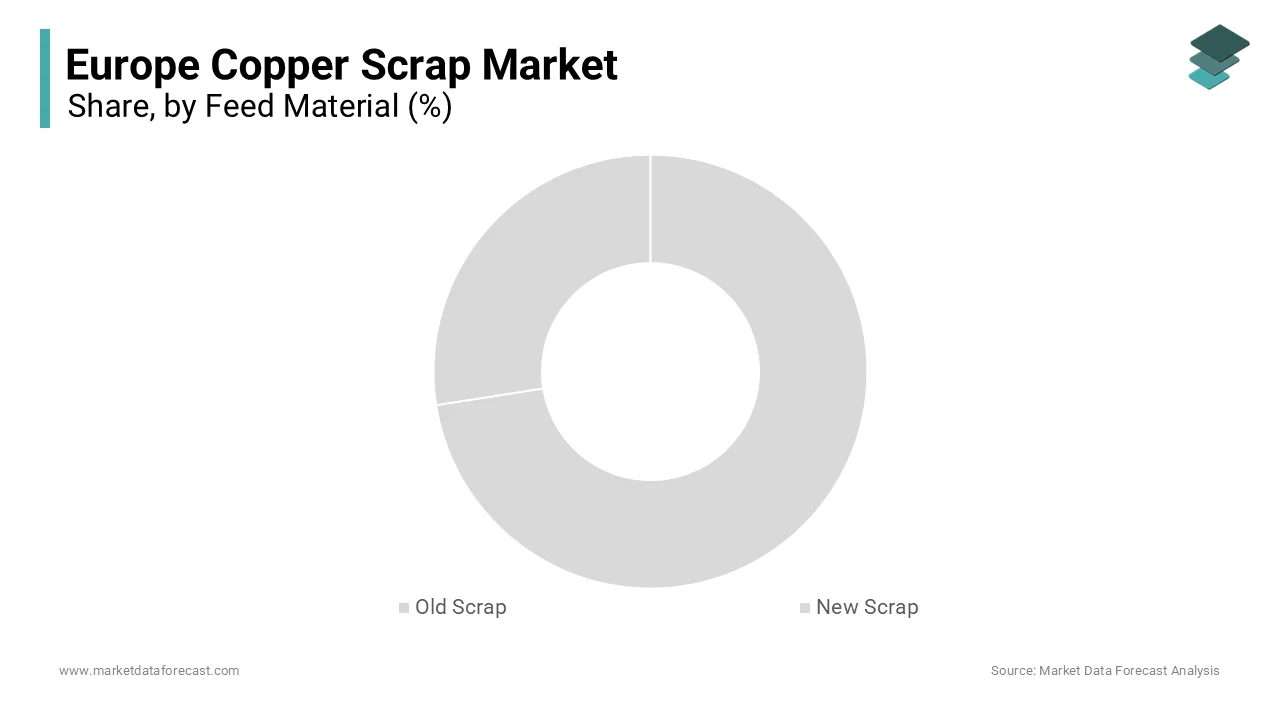
Europe’s ageing built environment is a vast reservoir of recoverable copper, with over 40% of the EU’s building stock constructed before 1970, as per Eurostat. In 2025, Germany alone demolished 128000 residential units, releasing an estimated 22000 tonnes of copper scrap, according to the German Federal Institute for Research on Building Urban Affairs and Spatial Development. The European Environment Agency estimates that construction and demolition waste contributes over 310000 tonnes of copper scrap annually across the bloc. This structural deconstruction wave ensures that old scrap remains the backbone of the secondary copper supply.
The new scrap segment is expanding at a CAGR of 6.2% throughout the forecast period. Europe’s strategic push for supply chain resilience is driving investment in domestic cable motor and transformer production. Nexans’ €300 million cable plant in Poland, which began operations in early 20,24, produces an estimated 1200 tonnes of clean copper turnings annually, according to the company’s sustainability disclosure. Similarly, Siemens’ motor assembly lines in Germany yield over 800 tonnes of stamping scrap per year.
By Grade Insights
The #1 Copper segment was the largest by occupying 45.3% of the European copper scrap market share in 2025, with the clean unalloyed copper pipe and busbars with minimal impurities, and dominates due to its balance of availability, purity and processing efficiency. Copper piping and electrical busbars have been standard in European construction for decades, creating a vast and consistent stream of #1 scrap during renovations and demolitions. In Germany, over 65% of residential buildings constructed between 1960 and 2000 used copper plumbing as per the German Copper Institute. #1 Copper’s consistent composition and low contamination allow it to be processed in standard induction furnaces with recovery yields exceeding 98%, as verified by the International Copper Association.
The Bare Bright copper scrap segment is lucratively growing with an estimated CAGR of 8.4% throughout the forecast period. The production of high-conductivity copper rods for electric vehicle charging cables and wind turbine interconnects requires feedstock with minimal oxygen and impurity content. Bare Bright scrap meets these requirements without electrolytic refining. Similarly, the European Automobile Manufacturers Association confirmed that EV high voltage cables demand conductivity levels achievable only with premium scrap or cathode. This performance linkage drives premium pricing and dedicated collection channels. Innovations in e-waste shredding and separation have dramatically improved Bare Bright recovery rates from communication and power cables.
REGIONAL ANALYSIS
Germany Market Analysis
Germany was the largest contributor in the European copper scrap market with 26.3% of the share in 2025, with its advanced recycling infrastructure, dense industrial base and stringent waste legislation. Over 1200 certified non-ferrous scrap processors operate under the German Circular Economy Act, which mandates traceability and quality grading for all secondary metals. In 2025, Germany collected 480000 tonnes of copper scrap from construction and e-waste streams as per the Federal Environment Agency. The presence of major smelters like Aurubis and Norddeutsche Affinerie ensures domestic consumption of high-grade material. Additionally, Germany’s Energiewende policy drives copper-intensive grid and renewable projects, releasing end-of-life material while creating new scrap.
Italy Market Analysis
Italy's copper scrap market growth is likely to grow with its extensive network of small and medium-sized scrap yards concentrated in the Lombardy and Emilia Romagna regions,, specialise in high-grade sorting. This positions it as a key recovery hub for Bare Bright and #1 Copper. The National Recovery and Resilience Plan allocated €420 million to modernise scrap processing facilities, enhancing ppurity and ompliance with EU standards. Furthermore, Italy’s large construction sector is undergoing seismic upgrades, releasing significant copper piping scrap.
United Kingdom Market Analysis
The United Kingdom copper scrap market growth is likely to grow at the fastest CAGR in next coming years. The UK maintains robust scrap flows through its well-established municipal and industrial collection systems. Over 320000 tonnes of copper scrap were recovered in 20,24, primarily from infrastructure projects, including HS2 rail construction and offshore wind farm decommissioning, as per the sources. The UK’s Waste Electrical and Electronic Equipment regulations achieve a 70% collection rate, the highest in Europe, according to the Environment Agency. Major ports like Liverpool and Immingham facilitate efficient export of secondary copper to European smelters while domestic demand from cable makers like BICC remains strong.
France Market Analysis
France's copper scrap market growth is likely to be driven by strong policy integration between waste management and industrial strategy. The French Anti-Waste Law mandates extended producer responsibility for electrical goods, resulting in 6868% collection rates. Large-scale infrastructure modernisation, including the renovation of 800000 social housing units under the MaPrimeRénov scheme, releases significant copper piping scrap. Additionally, France’s nuclear fleet life extension program involves rewiring and control system upgrade, generating high-purity #1 Copper. The national recycling champion Suez operates integrated copper recovery lines that supply European rod mills.
COMPETITIVE LANDSCAPE
KEY MARKET PLAYERS
Some of the notable key players in the European copper scrap market are
- Jain Metal Group
- Ames Copper Group
- Aurubis AG
- Glencore PLC
- OmniSource Corporation
- Commercial Metals Co
TOP STRATEGIES USED BY THE KEY MARKET PLAYERS
Leading participants in the European copper scrap market are adopting vertically integrated circular models that combine collection, processing and remelting under one ecosystem. They are investing in advanced sorting technologies,ies, including AI-driven optical and eddy current systems to improve scrap purity and meet smelter specifications. Companies are establishing closed-loop partnerships with electrical equipment and automotive manufacturers to secure high-grade industrial scrap. Digital traceability platforms are being deployed to provide chain of custody and carbon footprint data in compliance with EU regulations. Additionally, players are expanding logistics networks through strategic port and rail hubs to optimise cross-border scrap flows while reducing transport emissions.
COMPETITION OVERVIEW
The European copper scrap market features a dynamic, competitive landscape shaped by scale integration and regulatory compliance. Large integrated players like Aurubis and KME leverage in-house smelting capacity to secure premium pricing for high-grade scrap, while mid-sized processors compete on specialisation and regional collection density. The market is highly fragmented below the top tier, with over 5000 small scrap yards across the EU, creating both opportunity and inefficiency. Competition intensifies around quality certification as EU battery and electronics regulations demand verified low-carbon feedstock. This favours technologically advanced recyclers with digital traceability over informal operatorsCross-borderer arbitrage remains common due to VAT and regulatory disparities, with significant volumes moving from Western to Eastern Europe. However, the EU’s Environmental Crime Directive and new scrap shipment rules are curbing illicit flows. Simultaneously, global players like Sims Metal and Befesa are expanding European footprints through greenfield investments in e-waste and cable processing. The entry of financial investors into recycling infrastructure further escalates competition for clean scrap streams.
TOP PLAYERS IN THE MARKET
- Aurubis is a German-based integrated copper producer and one of Europe’s largest processors of copper scrap with operations spanning Germany, Belgium, and the United States. The company plays a pivotal role in the global secondary metals market by converting complex scrap into high-purity copper cathodes and speciality alloys. Aurubis sources over two million tonnes of copper-bearing materials annually, end-of-life electronics and industrial residues. To strengthen its circular capabilities, the company commissioned a state-of-the-art anode furnace in Hamburg in 2025, optimised for high scrap input with reduced energy consumption. It also launched a digital scrap tracking platform with real-time quality verification and carbon footprint calculation aligned with EU due diligence requirements.
- Sims Metal is a global leader in metal recycling with a significant footprint across the United Kingdom and Sweden. The company specialises in the collection, processing,,g and distribution of us scrap, including high-grade copper from urban mining and industrial sources. Sims operates advanced e-waste and cable processing facilities that recover Bare Bright and #1 Copper at scale. This investment supports its long-term supply agreements with European rod mills and reinforces its role in closing the loop for electric vehicle and renewable energy supply chains.
- KME Group, headquartered in Italy, is a major European producer of copper and copper alloyed semi-finished products with integrated scrap recycling operations across Germany, France and Italy. The company utilises over 70% recycled content in its manufacturing, reflecting its commitment to circularity. KME sources copper scrap directly from industrial partners and municipal collection systems, ensuring traceable low-carbon feedstock. This program not only secures high-quality scrap but also supports compliance with the EU’s Ecodesign for Sustainable Products Regulation, enhancing KME’s sustainability credentials.
MARKET SEGMENTATION
This research report on the European copper scrap market has been segmented and sub-segmented based on categories.
By Feed Material
- Old Scrap
- New Scrap
By Grade
- Bare Bright
- #1 Copper Scrap
- #2 Copper Scrap
- Other Grades
By Application
- Wire Rod Mills
- Brass Mills
- Ingots Makers
- Other Applications
By End Use
- Building & Construction
- Electrical & Electronics
- Industrial Machinery & Equipment
- Transportation Equipment
- Consumer and General Products
By Country
- UK
- France
- Spain
- Germany
- Italy
- Russia
- Sweden
- Denmark
- Switzerland
- Netherlands
- Turkey
- Czech Republic
- Rest of Europe
Frequently Asked Questions
1. What is the Europe copper scrap market?
The Europe copper scrap market involves the collection, processing, recycling, and resale of copper scrap generated from industrial, construction, and consumer sources.
2. What factors are driving the growth of the copper scrap market in Europe?
Key drivers include rising demand for recycled metals, sustainability goals, stricter environmental regulations, and cost advantages compared to primary copper production.
3. Which industries are the major consumers of copper scrap in Europe?
Major end-users include electrical & electronics, construction, industrial machinery, transportation, and consumer goods.
4. Why is copper scrap important for Europe’s sustainability goals?
Recycled copper reduces carbon emissions, lowers energy consumption, and supports the EU’s circular economy policies.
5. What are the main types of copper scrap available in the market?
Common types include Bare Bright, #1 Copper Scrap, #2 Copper Scrap, and mixed or lower-grade copper scrap.
6. Which countries lead the copper scrap market in Europe?
Germany, Italy, Spain, Poland, and the UK are key markets due to strong recycling infrastructure and industrial activity.
7. How does copper scrap pricing fluctuate in Europe?
Prices depend on global copper demand, LME spot prices, macroeconomic conditions, and scrap quality.
8. What are the primary applications of copper scrap?
Copper scrap is widely used in wire rod mills, brass mills, alloy production, and ingot manufacturing.
9. How does the EU regulate copper scrap recycling?
The EU implements strict waste management rules, recycling targets, and environmental standards under the Waste Framework Directive.
10. What challenges affect the copper scrap market in Europe?
Challenges include scrap availability, export restrictions, fluctuating copper prices, and rising operational costs.
Related Reports
Access the study in MULTIPLE FORMATS
Purchase options starting from
$ 2000
Didn’t find what you’re looking for?
TALK TO OUR ANALYST TEAM
Need something within your budget?
NO WORRIES! WE GOT YOU COVERED!
Call us on: +1 888 702 9696 (U.S Toll Free)
Write to us: sales@marketdataforecast.com