- Product Description Description
- Table of Contents TOC
- List of Table & Figure LOT
- Get Free Sample PDF Sample PDF
Market Size, 2025
$5.39 BnMarket Estimate, 2026
$6.13 BnMarket Forecast, 2034
$17.18 BnCAGR, 2026–2034
13.75%Europe Core Banking Solutions Market Report Summary
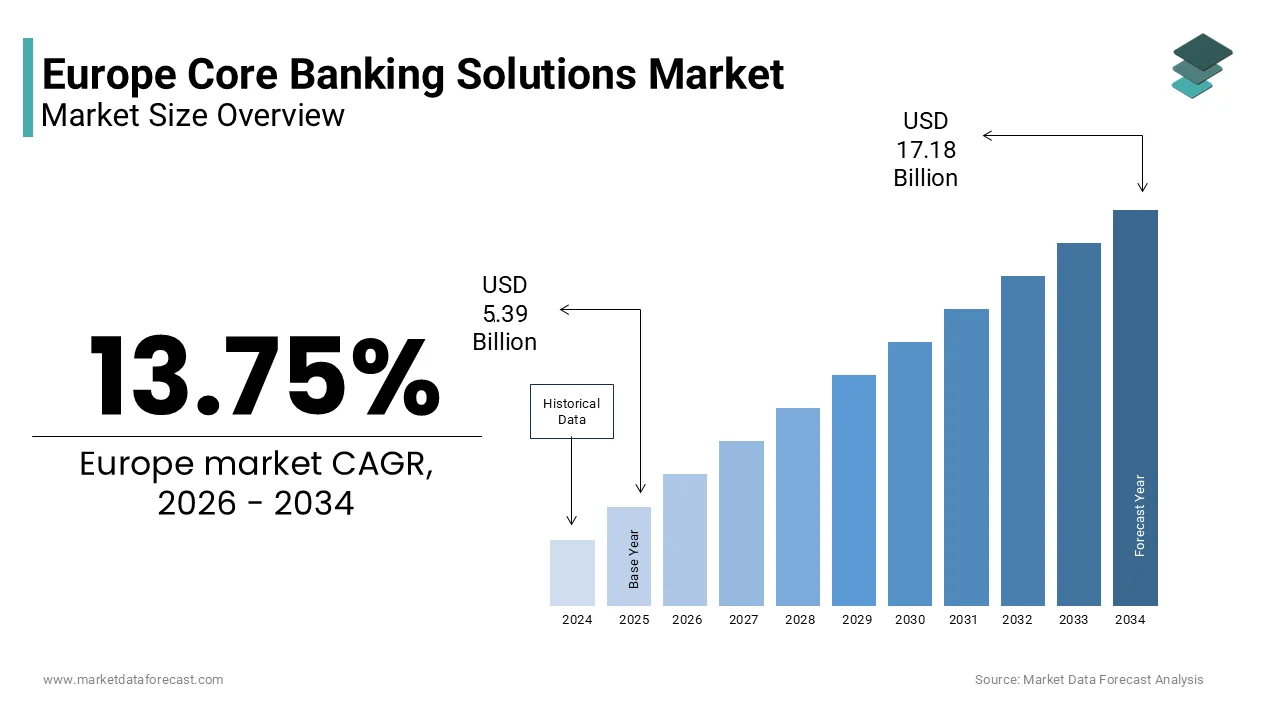
The Europe core banking solutions market was valued at USD 5.39 billion in 2025, is estimated to reach USD 6.13 billion in 2026, and is projected to reach USD 17.18 billion by 2034, growing at a CAGR of 13.75% during the forecast period from 2026 to 2034. The growth of the Europe core banking solutions market is driven by increasing digital transformation in the banking sector, rising demand for real time banking services, and the need for efficient customer data management. The shift toward modern banking infrastructure, adoption of cloud enabled solutions, and integration of advanced technologies such as AI and analytics are further accelerating market growth. Additionally, regulatory compliance requirements and the push for enhanced customer experience are encouraging financial institutions to upgrade their core banking systems.
Key Market Trends
- Increasing adoption of advanced core banking solutions driven by the need for real time processing and enhanced customer experience.
- Growing preference for on premises deployment among banks due to data security, control, and regulatory compliance requirements.
- Rising demand from large enterprises supported by complex banking operations and higher IT spending capacity.
- Expansion of digital banking and fintech ecosystems driving modernization of legacy banking systems.
- Integration of AI, analytics, and automation within core banking platforms to improve operational efficiency and decision making.
Segmental Insights
- Based on component, the solutions segment accounted for 61.5% of the Europe core banking solutions market share in 2025. The dominance of this segment is attributed to increasing demand for integrated banking platforms that streamline operations and enhance service delivery.
- Based on deployment, the on premises segment accounted for 66.9% of the Europe core banking solutions market share in 2025. The segment leads due to higher data security, regulatory compliance, and control over banking infrastructure.
- Based on organization size, the large enterprises segment held the highest share of the Europe core banking solutions market in 2025. This dominance is driven by large scale operations, higher investment capabilities, and the need for advanced banking solutions.
- Based on end users, the banks segment held the largest share of the Europe core banking solutions market in 2025. The growth of this segment is driven by increasing adoption of digital banking platforms and modernization of legacy systems.
Regional Insights
- The Europe core banking solutions market is witnessing strong growth across major economies driven by rapid digitalization in the financial sector and increasing adoption of advanced banking technologies.
- Germany was the leading country, accounting for 30.6% of the Europe core banking solutions market share in 2025, supported by a strong banking infrastructure, high technology adoption, and increasing investments in digital transformation initiatives.
Competitive Landscape
The Europe core banking solutions market is highly competitive with leading technology providers focusing on innovation, cloud integration, and digital banking capabilities. Companies are investing in advanced platforms, strategic collaborations, and product enhancements to strengthen their market presence. Prominent players in the Europe core banking solutions market include Temenos CH, FIS US, Finastra GB, SAP DE, Oracle US, NICE IL, Avaloq CH, Sopra Banking Software FR, and TCS BaNCS IN.
Europe Core Banking Solutions Market Size
The Europe core banking solutions market size was valued at USD 5.39 billion in 2025 and is projected to reach USD 17.18 billion by 2034 from USD 6.13 billion in 2026, growing at a CAGR of 13.75%.
Core banking solution encompasses the centralized backend systems that process daily banking transactions and post updates to accounts and other financial records. These solutions serve as the backbone for credit institutions across the region enabling seamless management of deposits loans and customer information. In the European context the landscape is defined by a high density of financial institutions operating under strict regulatory frameworks. According to Eurostat, individuals in the European Union widely adopted internet banking in 2023, which indicates the necessity for robust backend infrastructure. As per the European Central Bank, thousands of credit institutions operate within the Euro Area, demonstrating the scale of deployment required. This ecosystem relies heavily on interoperability and security to maintain trust among millions of users. The shift from branch-based services to digital channels has forced banks to modernize their underlying architecture. Consequently, the definition of core banking in Europe now extends beyond simple ledger maintenance to include API connectivity and real time processing capabilities. The region continues to prioritize stability while encouraging innovation through initiatives like the Digital Finance Strategy. This environment creates a complex demand for solutions that balance legacy compliance with modern agility. Furthermore, the integration of open banking standards requires these systems to expose data securely to third party providers. As per the European Banking Authority, a large number of registered account information service providers were recorded in recent years. Core banking is no longer an isolated function but a connected hub within a broader financial network. The operational scope now includes compliance monitoring and automated reporting to satisfy local and union wide mandates.
MARKET DRIVERS
Regulatory Compliance and Open Banking Mandates Drive System Upgrades
The implementation of the Revised Payment Services Directive has fundamentally altered the operational requirements for banks across Europe, which is one of the key factors propelling the European core banking solution market growth. This legislation compels financial institutions to open their data infrastructure to authorized third party providers through secure application programming interfaces. As per the European Banking Authority, a large number of registered 3rd party providers were recorded by the end of 2022. This surge requires that core banking solutions possess advanced API management capabilities to facilitate safe data exchange. Banks must upgrade their backend systems to ensure compliance with strong customer authentication protocols mandated by regulators. Failure to adapt results in significant fines and loss of operating licenses within the jurisdiction. The demand for compliant systems is further amplified by the ongoing development of the European Financial Data Space. Institutions are investing heavily to ensure their core platforms can handle the increased traffic and security checks required by open banking frameworks. This regulatory pressure acts as a primary catalyst for replacing obsolete software that cannot support modern connectivity standards. The need to maintain seamless interoperability while adhering to strict privacy laws forces continuous investment in core banking technology. According to Deloitte, many European banks identified regulatory compliance as a top priority for IT investment in 2023. Consequently, vendors are prioritizing compliance features in their product roadmaps to meet this specific regional demand.
Cloud Migration for Scalability Enhances Operational Efficiency
Financial institutions in Europe are increasingly shifting from on premise data centers to cloud based core banking architectures to improve scalability, which is further propelling the European core banking solution market growth. This transition allows banks to adjust computing resources dynamically based on transaction volumes without maintaining excessive physical hardware. According to McKinsey and Company, cloud adoption in European banking is expected to grow significantly in the coming years. The ability to deploy updates rapidly and access advanced analytics tools drives this migration trend. Core banking vendors are responding by offering cloud native solutions that reduce the total cost of ownership for clients. The flexibility provided by cloud infrastructure supports the integration of new digital services such as mobile wallets and instant payments. Legacy systems often struggle to handle peak loads during holiday seasons or salary processing days, whereas cloud systems scale automatically. This reliability is crucial for maintaining customer satisfaction in a competitive digital landscape. Furthermore, the cloud environment facilitates better disaster recovery and business continuity planning which is essential for regulatory adherence. Banks are leveraging these capabilities to innovate faster than traditional infrastructure allowed. The shift also enables better collaboration between different departments through unified data access. As per Google Cloud, a majority of European financial services leaders plan to increase cloud spending in the near future. This commitment ensures sustained demand for modern core banking solutions compatible with major cloud providers.
MARKET RESTRAINTS
High Costs of Legacy System Migration Hinder Adoption
Replacing established legacy infrastructure with modern core banking solutions involves substantial financial expenditure that deters many institutions is impeding the growth of the European core banking solution market. Banks often operate on decades old mainframe systems that are deeply embedded into their daily operations and customer workflows. According to Accenture, the average cost of a core banking transformation project can be very high for large European banks. This capital requirement creates a barrier to entry especially for smaller regional banks with limited budgets. The complexity of migrating data without disrupting services adds to the overall expense and risk profile. Institutions must maintain parallel systems during the transition phase which doubles operational costs temporarily. There is also the hidden cost of training staff to manage new software interfaces and backend processes. Many organizations fear that the return on investment will not materialize quickly enough to justify the initial outlay. The risk of project failure or delays further complicates the decision-making process for board members. Consequently, some banks opt to patch existing systems rather than undertake a full replacement. This reluctance slows down the overall market penetration of advanced core banking solutions. As per Boston Consulting Group, only a limited portion of legacy modernization projects are completed on time and within budget. This highlights the significant financial and operational risks associated with upgrading core infrastructure in the European region.
Escalating Cybersecurity Threats Complicate System Deployment
The increasing frequency and sophistication of cyber-attacks is further hindering the European core banking solution market expansion. Financial institutions are prime targets for hackers seeking to exploit vulnerabilities during system transitions or through API connections. According to Europol, financial crime remains one of the most profitable activities for organized cyber-criminal groups in Europe. Banks must invest heavily in security layers alongside core banking implementations to protect sensitive customer data. The threat landscape evolves rapidly requiring constant updates to security protocols which can delay system rollouts. Fear of data breaches leads to stricter internal approval processes that slow down procurement and installation timelines. Regulatory bodies impose heavy penalties for security lapses which makes banks overly cautious about adopting new technologies. The complexity of securing a distributed core banking environment across multiple countries adds another layer of difficulty. Institutions must ensure compliance with varying national security standards while maintaining a unified system. This necessity for robust security architecture increases the total cost and time required for deployment. As per the European Union Agency for Cybersecurity, ransomware attacks against critical sectors have been rising in recent years. This threat level forces banks to prioritize security over innovation, thereby restraining the speed of core banking solution adoption across the market.
MARKET OPPORTUNITIES
Integration of Artificial Intelligence for Personalization Creates Value
The incorporation of artificial intelligence into core banking platforms offers significant opportunities for the European core banking solution market. AI algorithms can analyse transaction data in real time to provide personalized financial advice and product recommendations to users. According to PwC, artificial intelligence is expected to contribute significantly to the global economy by 2030, with financial services being a key beneficiary. In Europe, banks are leveraging machine learning to detect fraud more accurately and automate routine compliance checks. This capability reduces manual workload and allows staff to focus on high value customer interactions. Core banking vendors are embedding AI tools directly into their suites to offer predictive analytics for cash flow management. The ability to process unstructured data enables banks to understand customer sentiment and behavior patterns better. This insight drives the creation of tailored banking products that meet specific demographic needs within the diverse European market. Automation of back-office processes through intelligent workflows reduces errors and speeds up transaction processing times. Furthermore, AI driven credit scoring models allow banks to serve underbanked populations more effectively. As per IBM, many banks expect AI to be a key driver of productivity gains in the coming years. This trend opens avenues for core banking providers to differentiate their offerings through advanced intelligent capabilities.
Rise of Neobanks and Digital Only Entities Expands Market Reach
The proliferation of neobanks and challenger banks across Europe presents a substantial opportunity for the European core banking solution market. These digital only entities require agile and scalable backend systems to support their rapid growth and customer acquisition strategies. Unlike traditional banks, neobanks do not have legacy constraints and are willing to adopt modern cloud-based core banking platforms from the inception. This creates a greenfield market for vendors offering modular and API first banking infrastructure. The competitive pressure from these new entrants also forces incumbent banks to upgrade their systems to retain market share. Neobanks often partner with technology providers to offer banking as a service which further widens the deployment scope. The expansion of these entities into lending and wealth management requires robust core systems to handle diverse financial products. Core banking vendors can capitalize on this trend by offering specialized packages designed for digital native business models. The speed to market advantage provided by modern solutions aligns perfectly with the operational needs of challenger banks. As per McKinsey, neobanks could capture up to 20% of European banking profits by 2025 if current trends continue. This potential shift in market dynamics ensures sustained demand for flexible and innovative core banking technologies.
MARKET CHALLENGES
Scarcity of Specialized Fintech Talent Impedes Implementation
The shortage of skilled professionals capable of managing modern banking technology is significantly challenging the expansion of the European core banking solution market. Implementing and maintaining advanced core banking systems requires expertise in cloud computing, cybersecurity, and data analytics. According to Eurostat, there is a persistent digital skills gap in the European Union, with a significant portion of adults lacking basic digital skills in 2023. This deficit makes it difficult for banks to find personnel who can operate sophisticated core banking platforms effectively. The competition for talent is intense as technology firms and fintech startups also vie for the same pool of experts. Banks often struggle to retain staff who are trained on new systems, leading to knowledge loss during transitions. The lack of internal expertise can result in suboptimal utilization of core banking features and increased reliance on external consultants. This dependency raises operational costs and reduces the agility of the institution in responding to market changes. Training existing employees takes time and resources which delays the realization of benefits from new implementations. The educational system has not yet fully aligned with the rapid pace of technological change in the financial sector. As per ManpowerGroup, many employers in Europe report difficulty in finding skilled workers. This labor market constraint poses a significant hurdle to the smooth deployment and optimization of core banking solutions across the region.
Economic Volatility Impacting IT Budgets Restrains Spending
Fluctuations in the economic landscape of Europe create uncertainty regarding IT spending and investment in core banking infrastructure, which is also challenging the regional market expansion. High inflation rates and interest rate hikes compel banks to tighten their budgets and prioritize essential expenditures over transformation projects. According to the European Central Bank, inflation rates in the Euro Area reached record highs in 2022, affecting overall corporate spending power. Financial institutions may postpone major core banking upgrades to preserve capital during periods of economic instability. The return on investment for technology projects becomes harder to justify when revenue growth slows due to macroeconomic headwinds. Banks focus on maintaining liquidity and managing risk rather than investing in long term technological enhancements. This conservative approach delays the adoption of new core banking solutions that could improve efficiency in the long run. Vendors face pressure to lower prices or offer flexible payment terms to secure deals in this environment. The uncertainty also affects the planning horizon for multi year implementation projects which are common in this sector. Clients may demand shorter contracts or pilot programs instead of full scale deployments to mitigate financial risk. As per Deloitte, a considerable portion of financial services firms plan to reduce technology spending in response to economic pressure. This fiscal caution presents a notable challenge for market growth and the pace of digital modernization within the European banking sector.
REPORT COVERAGE
| REPORT METRIC | DETAILS |
| Market Size Available | 2025 to 2034 |
| Base Year | 2025 |
| Forecast Period | 2026 to 2034 |
| CAGR | 13.75% |
| Segments Covered | By Component, Deployment, Organization Size, End Users, and Region |
| Various Analyses Covered | Global, Regional, & Country Level Analysis; Segment-Level Analysis; DROC, PESTLE Analysis; Porter’s Five Forces Analysis; Competitive Landscape; Analyst Overview of Investment Opportunities |
| Regions Covered | UK, France, Spain, Germany, Italy, Russia, Sweden, Denmark, Switzerland, Netherlands, Turkey, and the Czech Republic |
| Market Leaders Profiled | Temenos (CH), FIS (US), Finastra (GB), SAP (DE), Oracle (US), NICE (IL), Avaloq (CH), Sopra Banking Software (FR), TCS BaNCS (IN) |
SEGMENTAL ANALYSIS
By Component Insights
The solutions segment dominated the market by holding 61.5% of the European market share in 2025. The growth of the solutions segment in the European market can be credited to the fundamental requirement of banks to possess robust software infrastructure that processes transactions, manages accounts, and ensures regulatory adherence. The escalating demand for integrated platforms that unify disparate banking functions into a single operational framework is further fuelling the dominance of the solutions segment in this regional market. Financial institutions prioritize solutions that offer modularity, allowing them to adopt specific modules such as loan management or payment processing without overhauling entire systems. Banks are investing heavily in software that supports real time data processing and seamless integration with third party applications. The complexity of European banking regulations necessitates sophisticated solutions capable of automated compliance reporting and risk assessment. Furthermore, the rise of open banking frameworks requires core systems to expose secure application programming interfaces for external developers. This technological imperative ensures sustained demand for advanced core banking software across the region. The solutions segment benefits from continuous innovation by vendors who incorporate artificial intelligence and machine learning to improve decision making capabilities.
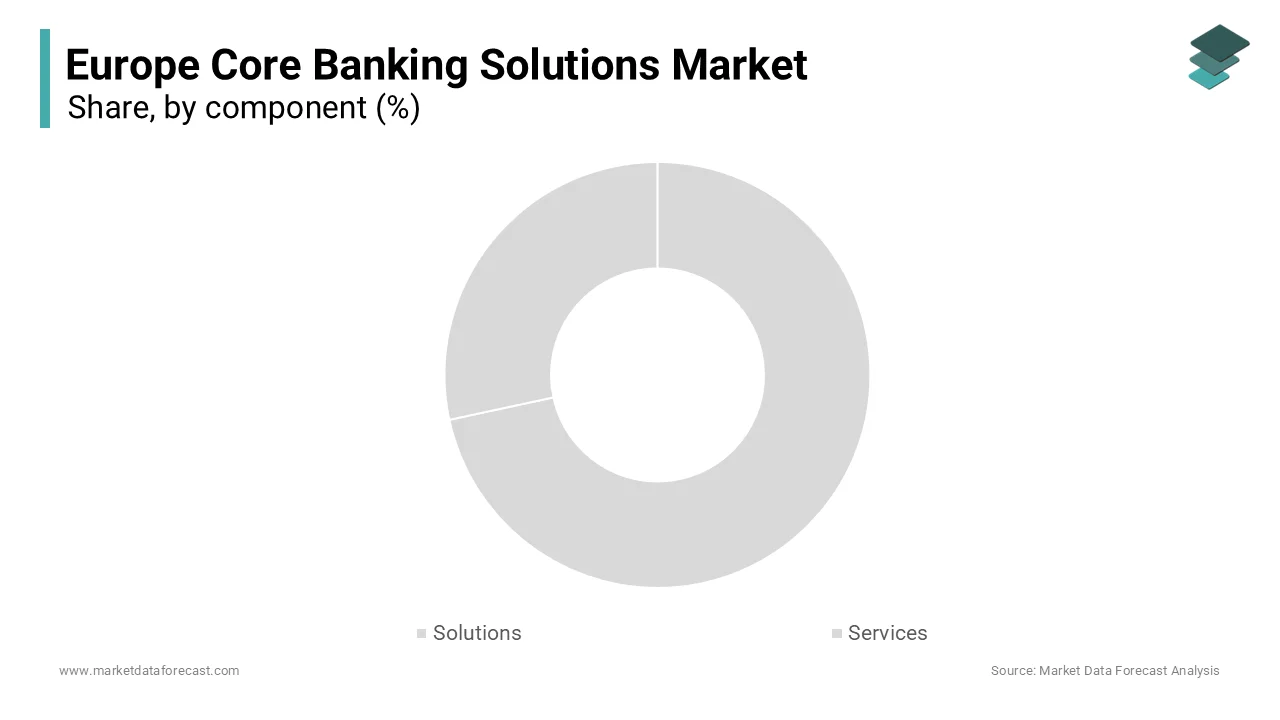
On the other end, the services segment represents the fastest growing component within the Europe core banking solution market and is estimated to exhibit a CAGR of 13.5% over the forecast period owing to the increasing complexity of implementing and maintaining sophisticated core banking platforms. Financial institutions require specialized expertise to deploy, customize, and optimize these systems, which fuels demand for professional and managed services. The shortage of in-house technical talent compels organizations to partner with service providers who offer end to end support from consultation to post implementation maintenance. Cloud migration projects particularly necessitate expert guidance to ensure data integrity and minimal disruption during transition. Service providers also deliver critical training programs that enable bank staff to leverage new system capabilities effectively. The growing emphasis on cybersecurity further amplifies the need for specialized services that conduct vulnerability assessments and implement protective measures. As per industry analysis, the managed services sub segment is gaining traction as banks prefer predictable operational expenditure models over large capital investments. This trend aligns with the broader shift towards outsourcing non-core functions to focus on strategic business objectives. The services segment thus benefits from the evolving operational paradigms within European financial institutions.
By Deployment Insights
The on-premises segment led the market by capturing 66.9% of the European market share in 2025. This dominance is anchored in the preference of large financial institutions for complete control over their data infrastructure and security protocols. Banks operating under stringent regulatory frameworks often perceive on premises systems as offering superior compliance management and data sovereignty. The ability to customize hardware configurations and implement bespoke security measures appeals to institutions managing sensitive customer information. Legacy systems that have served banks for decades are often deeply integrated with on premises architectures, which is making migration a complex and costly endeavour. Regulatory requirements in certain European jurisdictions mandate that specific data categories remain within national boundaries, which reinforces the appeal of on premises deployments. Furthermore, the perceived reliability of dedicated servers during network outages provides operational continuity that cloud alternatives may not guarantee. The segment also benefits from ongoing investments in modernizing existing infrastructure rather than complete replacement. Banks with substantial IT budgets continue to enhance their on-premises capabilities with advanced analytics and automation tools. This strategic approach ensures that on premises deployments remain a cornerstone of European core banking architecture.
However, the cloud deployment segment is expanding at the fastest pace within the Europe core banking solution market and is predicted to register a CAGR of 14.02% over the forecast period owing to the compelling advantages of scalability, cost efficiency, and accelerated innovation cycles that cloud platforms provide. Financial institutions are increasingly recognizing that cloud infrastructure enables them to deploy new features and respond to market changes with unprecedented speed. The subscription-based pricing model of cloud solutions reduces upfront capital expenditure, which is making advanced core banking capabilities accessible to a broader range of institutions. Cloud platforms also facilitate seamless integration with emerging technologies such as artificial intelligence and blockchain, which are critical for future competitiveness. The ability to scale computing resources dynamically allows banks to handle peak transaction volumes without maintaining excess capacity. Regulatory bodies in Europe are increasingly providing clarity on cloud adoption guidelines, which reduces uncertainty and encourages migration. As per Yahoo Finance, cloud is the fastest growing segment with institutions leveraging hybrid models that balance control with flexibility. The segment benefits from continuous improvements in cloud security and data protection that address historical concerns. Vendor innovation in cloud native core banking solutions further accelerates adoption by offering superior performance and user experience. This momentum positions cloud deployment as the transformative force reshaping European banking infrastructure.
By Organization Size Insights
The large enterprises segment held the highest share of the European core banking solution market in 2025. This leadership is attributable to the substantial resources that major financial institutions allocate toward technology modernization and digital transformation initiatives. Large banks operate complex multi-jurisdictional operations that require sophisticated core banking platforms capable of handling high transaction volumes and diverse product portfolios. These institutions prioritize solutions that ensure regulatory compliance across multiple European markets while maintaining operational efficiency. The scale of their operations justifies significant investments in customized core banking systems that integrate with existing enterprise resource planning and customer relationship management tools. Large enterprises also benefit from economies of scale that reduce the per unit cost of implementing advanced technologies. Their strategic focus on innovation drives adoption of cutting-edge features such as real time analytics and automated decision making. For instance, the persistent need for system resilience and disaster recovery capabilities reinforces the preference for enterprise grade solutions. The segment is further strengthened by the tendency of large banks to engage in long term partnerships with leading technology vendors. This collaborative approach ensures continuous enhancement of core banking capabilities aligned with evolving business objectives. The dominance of large enterprises thus reflects the convergence of financial capacity, operational complexity, and strategic ambition within the European banking sector.
However, the small and medium enterprises segment is emerging as the fastest growing category within the Europe core banking solution market and is expected to record a CAGR of 13.9% over the forecast period owing to the increasing digital adoption and competitive pressures. SMEs are increasingly recognizing that modern core banking solutions provide the technological foundation necessary to compete with larger institutions and fintech disruptors. The availability of cloud based and software as a service models has dramatically reduced the entry barriers for smaller institutions seeking advanced banking capabilities. These flexible deployment options allow SMEs to access enterprise grade functionality without prohibitive upfront investments. The growing demand for personalized customer experiences compels SMEs to adopt core systems that enable data driven insights and targeted product offerings. Regulatory requirements such as strong customer authentication and open banking compliance create a baseline necessity for modern infrastructure that SMEs cannot ignore. The segment benefits from vendor strategies that offer modular and scalable solutions tailored to the specific needs of smaller institutions. This targeted approach ensures that SMEs can implement core banking capabilities aligned with their growth trajectories. The increasing availability of implementation support and managed services further reduces the operational burden on resource constrained organizations. Consequently, the SME segment is positioned for sustained expansion as digital transformation becomes a strategic imperative across all organization sizes.
By End Users Insights
The banks segment commanded the predominant position in the Europe core banking solution market by capturing the largest share of the European market in 2025 due to the fundamental role that core banking systems play in enabling the daily operations of commercial, retail, and investment banks across the region. Banks require comprehensive platforms that manage deposits, process loans, facilitate payments, and ensure regulatory compliance across multiple jurisdictions. The competitive landscape within European banking compels institutions to invest in advanced core systems that enhance customer experience and operational efficiency. Banks are particularly focused on solutions that support open banking initiatives and seamless integration with third party financial services. The scale of their customer bases and product portfolios justifies substantial investments in customized core banking platforms. Regulatory pressures including capital adequacy requirements and anti-money laundering protocols further amplify the need for robust systems capable of automated reporting and risk assessment. For instance, the ongoing digital transformation within banking institutions reinforces the preference for integrated core solutions that unify disparate functions. The segment benefits from the strategic priority that banks place on technology as a key differentiator in an increasingly digital marketplace. Vendor partnerships with major banks often involve long term collaborations that ensure continuous enhancement of core capabilities. This symbiotic relationship sustains the leadership position of banks within the core banking solution ecosystem.
However, the financial institutions segment is anticipated to showcase a CAGR of 12.5% over the forecast period in this regional market owing to the diversification and innovation in financial services. This category encompasses credit unions, community banks, and specialized financial entities that are increasingly adopting sophisticated core banking platforms to enhance their service offerings. Non-bank financial institutions are recognizing that advanced core systems provide the technological foundation necessary to compete in an evolving marketplace. The rise of embedded finance and banking as a service models has created new opportunities for these institutions to leverage core banking capabilities. Regulatory frameworks such as PSD2 have levelled the playing field by enabling authorized third parties to access banking infrastructure through secure APIs. The availability of modular and scalable solutions that can be tailored to specific business models is further boosting the expansion of the financial institutions segment in the European market. Cloud based deployment options have dramatically reduced the entry barriers for smaller financial entities seeking advanced capabilities. The growing emphasis on customer experience and operational efficiency further accelerates adoption across this diverse category. Consequently, the financial institutions segment is positioned for sustained expansion as digital transformation becomes a strategic imperative across the entire financial services spectrum.
REGIONAL ANALYSIS
Germany Core Banking Solutions Market Analysis
Germany maintained its position as the leading national market within the Europe core banking solution market by holding 30.6% of the regional market share in 2025. The country's robust financial services sector, characterized by a dense network of universal banks, savings banks, and cooperative institutions, creates substantial demand for sophisticated core banking infrastructure. The German regulatory environment, which emphasizes data protection and operational resilience, reinforces the preference for advanced core systems capable of ensuring compliance. The country's strong industrial base and export-oriented economy generate complex banking requirements that necessitate integrated platforms supporting multi-currency transactions and cross border operations. German banks are particularly focused on solutions that enhance operational efficiency while maintaining the high service standards expected by corporate and retail clients. The ongoing digital transformation initiatives within the sector are accelerating adoption of cloud enabled and API first core banking architectures. As per industry analysis, persistent investment in technology modernization by major German financial institutions sustains the market leadership position. The presence of leading technology vendors and system integrators within the country further facilitates implementation and optimization of core banking solutions. This ecosystem of expertise ensures that German banks remain at the forefront of technological innovation within the European banking landscape.
United Kingdom Core Banking Solutions Market Analysis
The United Kingdom accounted for a promising share of the European core banking solution market in 2025. The country's dynamic financial services sector, centred in London, benefits from a mature regulatory framework that encourages innovation while ensuring stability. The widespread adoption of open banking standards has created a competitive environment that compels traditional banks to modernize their core infrastructure. UK financial institutions are particularly focused on solutions that enable seamless integration with third party providers and support real time payment systems. The country's strong emphasis on digital transformation is reflected in the high penetration of mobile and online banking services, which necessitates robust backend platforms. Regulatory initiatives such as the Consumer Duty framework further amplify the need for core systems capable of enhanced customer protection and transparency. As per industry analysis, persistent innovation within the UK fintech ecosystem drives continuous demand for flexible and scalable core banking solutions. The availability of specialized talent and technology partners within the country facilitates rapid implementation and optimization of new systems. This conducive environment positions the UK as a critical market for core banking solution providers seeking to establish a strong European presence.
France Core Banking Solutions Market Analysis
France is estimated to account for a prominent share of the European core banking solution market during the forecast period. The country's banking sector, characterized by a mix of large universal banks and specialized institutions, creates diverse requirements for core banking infrastructure. French financial institutions are increasingly focused on solutions that enhance customer experience while ensuring compliance with stringent data protection regulations. The country's strong emphasis on digital sovereignty reinforces the preference for core systems that can be deployed within national boundaries while supporting European wide operations. The ongoing modernization of payment systems and the adoption of instant payment frameworks necessitate advanced core banking platforms capable of real time processing. As per industry analysis, strategic partnerships between French banks and technology vendors are accelerating the deployment of innovative core solutions. The presence of leading European technology providers within the country facilitates knowledge transfer and localized support. This collaborative ecosystem ensures that French financial institutions remain competitive in an increasingly digital marketplace. The persistent focus on customer centric services further amplifies demand for core systems that enable personalized offerings and seamless omnichannel experiences.
Russia Core Banking Solutions Market Analysis
Russia is anticipated to record a healthy CAGR in the European core banking solution market during the forecast period. The country's banking sector is undergoing significant transformation, driven by regulatory reforms and increasing digital adoption among consumers. Russian financial institutions are increasingly focused on solutions that enhance operational efficiency while ensuring compliance with evolving regulatory requirements. The country's emphasis on developing domestic technological capabilities creates opportunities for both local and international core banking solution providers. The ongoing modernization of payment infrastructure and the adoption of digital currencies necessitate advanced core systems capable of supporting new transaction paradigms. As per industry analysis, strategic investments in technology by major Russian banks are accelerating the deployment of innovative core banking platforms. The presence of specialized system integrators within the country facilitates implementation and optimization of complex systems. This evolving landscape positions Russia as a significant market for core banking solution providers seeking to expand their European footprint. The persistent focus on enhancing customer experience through digital channels further amplifies demand for flexible and scalable core infrastructure.
Italy Core Banking Solutions Market Analysis
Italy is estimated to account for a notable share of the European core banking solution market during the forecast period owing to the country's banking sector, characterized by a mix of large national banks and numerous regional institutions that creates diverse requirements for core banking infrastructure. Italian financial institutions are increasingly focused on solutions that enhance operational efficiency while ensuring compliance with European regulatory frameworks. The country's emphasis on supporting small and medium enterprises creates demand for core systems capable of delivering tailored financial products. The ongoing modernization of payment systems and the adoption of open banking standards necessitate advanced core banking platforms that support seamless integration with third party providers. As per industry analysis, strategic initiatives by Italian banks to enhance digital capabilities are accelerating the deployment of innovative core solutions. The presence of European technology vendors within the country facilitates knowledge transfer and localized support. This collaborative environment ensures that Italian financial institutions remain competitive in an increasingly digital marketplace. The persistent focus on improving customer experience through personalized services further amplifies demand for flexible and scalable core banking infrastructure.
COMPETITIVE LANDSCAPE
The Europe Core Banking Solutions Market features intense competition among global technology providers and regional specialists vying for leadership positions. Established players leverage extensive client relationships and proven platforms to maintain market presence while emerging vendors disrupt through innovative cloud native architectures. According to industry analysis major players such as Temenos FIS and Finastra adopt distinct strategies to solidify their market positions. Competitive dynamics center on technological superiority regulatory compliance and customer experience enhancement. Providers differentiate through modular offerings that allow incremental adoption and reduced implementation risk. Price competition intensifies as software as a service models lower entry barriers for smaller institutions. Strategic alliances with consulting firms and system integrators extend reach and implementation capabilities. Innovation cycles accelerate as vendors incorporate artificial intelligence blockchain and advanced analytics into core platforms. Customer retention depends on continuous value delivery through system reliability performance and support quality. Market consolidation through mergers and acquisitions reshapes competitive landscapes as larger entities absorb specialized capabilities. The convergence of banking and technology expertise creates high barriers to entry while rewarding providers that demonstrate tangible business outcomes for financial institutions across Europe.
KEY MARKET PLAYERS
Some of the notable key players in the Europe core banking solutions market are
- Temenos (CH)
- FIS (US)
- Finastra (GB)
- SAP (DE)
- Oracle (US)
- NICE (IL)
- Avaloq (CH)
- Sopra Banking Software (FR)
- TCS BaNCS (IN)
Top Players in the Market
Temenos stands as a pivotal force in the Europe Core Banking Solutions Market through its comprehensive cloud native platform serving financial institutions globally. The Switzerland based company delivers integrated solutions for retail corporate and private banking that enable digital transformation across diverse markets. According to industry analysis Temenos adopts distinct strategies to solidify its market positions through continuous innovation and strategic partnerships. The company recently strengthened its European presence by collaborating with Accenture to drive significant pipeline opportunities across the region. Temenos also integrated Mastercard Move into its Payments Hub enhancing real time payment capabilities for European clients. These initiatives demonstrate the company commitment to delivering agile and compliant core banking infrastructure that meets evolving regulatory and customer expectations throughout Europe.
FIS maintains a prominent position in the Europe Core Banking Solutions Market by providing advanced digital core banking platforms that support financial institutions worldwide. The United States based corporation delivers comprehensive solutions encompassing payments banking technology and capital market systems that drive operational efficiency. According to industry analysis FIS employs distinct strategies to strengthen its foothold through targeted acquisitions and product innovation. The company completed a significant acquisition of Global Payments Issuer Solutions business expanding its issuer processing capabilities. FIS also earned recognition as a Leader in IDC MarketScape North America Digital Core Banking Platforms Vendor Assessment reinforcing its technological leadership. These strategic moves enable FIS to deliver scalable and secure core banking solutions that address the complex requirements of European financial institutions.
Finastra operates as a key contributor to the Europe Core Banking Solutions Market through its cloud first financial software platform serving institutions across the globe. The United Kingdom headquartered company offers integrated solutions for lending payments treasury and digital banking that foster innovation and agility. According to industry analysis Finastra implements unique strategies to enhance its market position through expanded global presence and strategic collaborations. The company opened new offices in the United States and India strengthening its ability to serve European clients with localized support. Finastra also unveiled an enhanced Lending Cloud Service supported by IBM delivering comprehensive managed services to clients across Europe. These initiatives underscore Finastra dedication to providing flexible and compliant core banking infrastructure that empowers European financial institutions to thrive in a digital economy.
Top Strategies Used by Key Market Participants
Key players in the Europe Core Banking Solutions Market employ strategic partnerships to accelerate innovation and expand market reach. Companies collaborate with system integrators and technology providers to deliver comprehensive solutions that address complex client requirements. Cloud migration initiatives represent a central strategy as vendors develop native platforms that offer scalability and reduced operational costs. Product differentiation through artificial intelligence and machine learning capabilities enables providers to deliver personalized banking experiences. Regulatory compliance integration remains a priority as solutions embed automated reporting and risk management features. Acquisitions of specialized fintech firms allow established players to incorporate emerging technologies and talent. Customer centric design approaches ensure solutions meet evolving expectations for seamless omnichannel experiences. Open banking compatibility drives development of secure application programming interfaces that facilitate third party integrations. Continuous investment in research and development sustains technological leadership and competitive advantage. Vendor ecosystems that combine software services and support create sticky relationships that enhance client retention and long term growth.
MARKET SEGMENTATION
This research report on the European core banking solutions market has been segmented and sub-segmented based on categories.
By Component
- Solutions
- Services
By Deployment
- On-Premises
- Cloud-Based
- Hybrid
By Organization Size
- SMEs
- Large Enterprises
By End Users
- Commercial Banks
- Retail Banks
- Investment Banks
- Cooperative Banks
By Country
- UK
- France
- Spain
- Germany
- Italy
- Russia
- Sweden
- Denmark
- Switzerland
- Netherlands
- Turkey
- Czech Republic
- Rest of Europe