- Product Description Description
- Table of Contents TOC
- List of Table & Figure LOT
- Get Free Sample PDF Sample PDF
Market Size, 2025
$12.30 BnMarket Estimate, 2026
$13.73 BnMarket Forecast, 2034
$33.15 BnCAGR, 2026–2034
11.65%Europe Cosmetic Dentistry Market Size
The Europe cosmetic dentistry market size was calculated to be USD 12.30 billion in 2025 and is anticipated to be worth USD 33.15 billion by 2034, growing from USD 13.73 billion in 2026 at a CAGR of 11.65% during the forecast period.
Cosmetic dentistry is a specialized segment of dental care focused on enhancing the aesthetic appearance of teeth and smiles through procedures such as veneers, teeth whitening, dental bonding, orthodontic alignment,,nt and full mouth rehabilitation. Unlike general dentistry, which prioritizes oral health and disease prevention, cosmetic dentistry addressespatient-drivenn desires for improved confidence, social perception, and professional image. The market operates within a highly regulated healthcare environment where aesthetic interventions must comply with stringent medical device and practitioner licensing standards. According to Eurostat, data on dental visits in 2025 highlights unmet needs rather than aesthetic improvements, with around 6% of adults reporting they could not access dental care due to affordability or accessibility issues. As per the European Commission, under the EU Medical Devices Regulation (EU MDR 2017/745), dental veneers, crowns, and whitening gels are classified as Class IIa medical devices requiring CE certification and traceability. Furthermore, while the European Centre for Disease Prevention and Control does not provide statistics on cosmetic dental services, market reports indicate that cosmetic dentistry is a rapidly expanding segment across Europe, with a growing number of clinics integrating aesthetic services into comprehensive care. These dynamics reflect a market where rising consumer self-awareness converges with clinical professionalism and regulatory oversight to redefine oral aesthetics as a legitimate health-adjacent discipline.
MARKET DRIVERS
Rising Emphasis on Personal Appearance and Social Media Influence
A primary driver of the Europe cosmetic dentistry market is the rising societal focus on physical appearance, amplified by digital culture and professional image expectations. According to Cosmetic Europe, the European cosmetics and personal care industry continues to grow, with appearance-related factors strongly influencing consumer behaviour in 2025. For instance, social media has become a significant force in shaping beauty standards, with platforms like Instagram and TikTok fuelling demand for smile makeovers and cosmetic dental procedures. Influencer culture further validates demand with celebrities and public figures in the UK, Germany, and France frequently showcasing veneers or orthodontic results, which are creating aspirational benchmarks. Employers also reinforce this trend with surveys indicating that professional image plays a role in candidate evaluation. According to NHS statistics, cosmetic dental consultations in the UK have increased steadily, which reflects growing demand for aesthetic procedures. In Germany, young adults aged 18–34 are the primary users of teeth whitening treatments, which confirms the normalization of dental aesthetics as part of routine grooming. This confluence of digital visibility, professional pressure,e and personal aspiration sustains robust demand across urban and suburban Europe.
Integration of Minimally Invasive and Digital Dentistry Technologies
The Europe cosmetic dentistry market is significantly propelled by the adoption of digital workflows and minimally invasive techniques that enhance precision, reduce chair time, and improve patient experience. According to Dental Tribune, intraoral scanners, CAD/CAM systems, and 3D printing are driving strong growth in Europe’s digital dentistry market, projected to surpass €1.4 billion by 2027. Digital smile design software is increasingly used to simulate outcomes collaboratively with patients, boosting treatment acceptance. Minimally invasive protocols such as no-prep veneers and enamel-preserving bonding are gaining traction, reflecting global trends in patient-centered care. Regulatory support further accelerates adoption, with the European Commission’s updated Medical Devices Regulation ensuring safety standards for digital dental devices. As per MDPI’s systematic review, AI-powered shade matching systems have demonstrated high accuracy in replicating natural tooth color, improving clinical outcomes. This technological evolution transforms cosmetic dentistry from artisanal craft to predictable precision medicine, appealing to both clinicians and tech-literate patients.
MARKET RESTRAINTS
Limited Reimbursement and High Out-of-Pocket Costs
A significant restraint on the Europe cosmetic dentistry market is the near universal exclusion of aesthetic procedures from public and private dental insurance schemes, resulting in high out-of-pocket payments. According to the European Journal of Public Health, cosmetic dentistry is generally classified as non-essential care, with limited or no coverage across EU member states. Costs remain a barrier, with veneers and whitening procedures priced between €350 and €1,200 depending on treatment. In Eastern Europe, affordability gaps persist. According to Eurostat data, Romania and Bulgaria are countries with limited cosmetic dentistry uptake due to cost. Even in Germany, statutory insurance covers only functional restorations, not aesthetic upgrades. As per UK market reports, cost remains the primary barrier for many adults interested in cosmetic dental care. Financial barriers and lack of insurance coverage restrict cosmetic dentistry access to affluent populations, which is limiting broader market ppenetrationn
Fragmented Regulatory Oversight and Varying Clinical Standards
The Europe cosmetic dentistry market faces persistent challenges due to inconsistent regulatory enforcement and divergent clinical training requirements across member states. According to the European Society of Cosmetic Dentistry, only select EU countries mandate postgraduate certification, leaving gaps in practitioner qualifications. Complaints related to improperly placed restorations remain a concern, with skill disparities contributing to patient dissatisfaction. Cross-border dental tourism is rising. Hungary’s dental tourism market alone generated over USD 653 million in 2025, which is attracting patients from across Europe. However, inconsistent follow-up care and varying standards pose risks. Trading Standards in the UK reported safety concerns with illegal teeth whitening kits sold online, which indicates thousands of adverse incidents in 2025. Fragmented regulation, dental tourism risks, and unsafe whitening products undermine consumer trust, which is further necessitating unified EU-wide competency standards.
MARKET OPPORTUNITIES
Expansion of Preventive Aesthetic Dentistry in Youth and Adolescent Care
An emerging opportunity in the Europe cosmetic dentistry market lies in the early integration of aesthetic interventions within adolescent dental care, focusing on preventive alignment, enamel protection, and confidence building. According to Align Technology, demand for clear aligners among teenagers has grown significantly, with teen Invisalign cases increasing by nearly 40% year on year in Europe in 2025. School-based oral health programs are increasingly incorporating aesthetic education. The French Ministry of Education launched a pilot in 2025 across secondary schools to address dental appearance bullying with referrals to public dental clinics offering subsidized cosmetic bonding for developmental defects. As per Sweden’s Public Health Agency, municipalities are expanding youth dental checkups to include aesthetic risk assessments, which identify conditions like fluorosis or microdontia early for minimally invasive correction. Critically, these interventions are increasingly framed as psychosocial health measures rather than vanity, with the World Health Organization’s European Office acknowledging dental appearance as a social determinant of adolescent mental well-being. The growing adoption of clear aligners among teenagers, coupled with school-based initiatives and recognition of dental appearance as a psychosocial factor, signals that preventive aesthetic dentistry is evolving into a mainstream element of adolescent care. This early intervention approach is laying the foundation for a lifelong patient base in cosmetic dentistry.
Growth of Med Spa and Integrated Aesthetic Wellness Hubs
The Europe cosmetic dentistry market is benefiting from the rise of multidisciplinary aesthetic wellness centers that combine dental services with dermatology, injectables, and wellness therapies under one roof. According to the European Aesthetic Medicine Association, integrated med spas across Germany, France, Italy, and the UK are expanding rapidly, with “smile design” now a core service. This convergence reflects a holistic view of personal aesthetics. As per the European Consumer Organisation, more than half of adults seeking facial rejuvenation also express interest in smile enhancement, with over one-third preferring bundled packages for convenience and cost efficiency. Clinics like The Cosmetic Dental Group in London and DentEstet in Stockholm report higher patient retention when offering cross-modality consultations. Regulatory evolution supports this trend—the European Commission’s 2025 update to the Medical Devices Regulation clarified that dental aesthetics performed in licensed medical facilities can be integrated with other Class II treatments under unified clinical governance. According to MedFinance, financing models are also expanding, with a 45% increase in interest-free payment plans for combined dental and dermatological procedures in 2025. The rise of integrated med spas demonstrates how cosmetic dentistry is moving beyond traditional clinics into the broader wellness economy. By blending dental aesthetics with dermatology and wellness services, these hubs are reshaping patient expectations and creating new pathways for market expansion.
MARKET CHALLENGES
Shortage of Specialized Cosmetic Dentistry Training Programs
A persistent challenge facing the Europe cosmetic dentistry market is the lack of standardized postgraduate education and hands-on training in advanced aesthetic techniques, resulting in variable clinical quality and limited practitioner supply. According to the European Federation of Dentists, fewer than 10% of dental schools in the EU offer dedicated cosmetic dentistry curricula, leaving most graduates reliant on short private courses without accreditation. This gap is acute in complex procedures. As per the European Academy of Esthetic Dentistry, only around 1,800 dentists across Europe held advanced certification in full mouth rehabilitation or digital smile design in 2025, against an estimated need for over 6,000. Countries like Spain and Greece have no formal postgraduate pathways, leading many practitioners to seek training abroad at high cost. Consequently, patient outcomes vary widely. According to the German Dental Association, nearly 30% of veneer replacements in 2025 were due to poor initial adhesion or occlusion stemming from inadequate training. Professional bodies are responding as the UK’s Faculty of General Dental Practice launched a Level 7 diploma in cosmetic dentistry in 2025, but uptake remains limited. The limited availability of structured postgraduate programs is creating a skills gap that directly impacts patient outcomes. Without EU-wide competency frameworks, the market risks uneven service quality, but the demand for advanced training also presents opportunities for institutions to lead in shaping the future of cosmetic dentistry education.
Consumer Misinformation and Unregulated Direct-to-Consumer Marketing
The Europe cosmetic dentistry market faces growing risks from misleading advertising and unverified claims by clinics and online retailers that overpromise results and understate risks. According to the European Consumer Safety Network, over 12,000 consumer complaints were filed in 2025 regarding cosmetic dental services, with more than two-thirds citing false advertising such as “instant Hollywood smiles” or “permanent whitening guaranteed.” Social media platforms amplify these issues. As per the European Digital Media Observatory, over 40% of cosmetic dental ads on Instagram and Facebook in 2025 used digitally altered before-and-after images without disclosure, violating EU advertising standards. At-home whitening kits sold online pose additional dangers. As per the French Agency for Food, Environmental and Occupational Health, nearly 900 cases of severe gum burn in 2025 were caused by high-concentration peroxide gels marketed without professional supervision. Regulatory enforcement remains inconsistent. According to the European Commission, only 11 member states actively monitor dental advertising claims. Misleading advertising and unsafe at-home products are eroding consumer trust, highlighting the urgent need for stronger regulatory oversight. Addressing misinformation and enforcing standardized disclosures will be critical to safeguarding patient safety and reinforcing the credibility of cosmetic dentistry across Europe.
REPORT COVERAGE
| REPORT METRIC | DETAILS |
| Market Size Available | 2025 to 2034 |
| Base Year | 2025 |
| Forecast Period | 2026 to 2034 |
| CAGR | 11.65% |
| Segments Covered | By Type, End User, And Region |
| Various Analyses Covered | Global, Regional & Country Level Analysis; Segment-Level Analysis; DROC, PESTLE Analysis; Porter’s Five Forces Analysis; Competitive Landscape; Analyst Overview of Investment Opportunities |
| Regions Covered | UK, France, Spain, Germany, Italy, Russia, Sweden, Denmark, Switzerland, Netherlands, Turkey, and the Czech Republic |
| Market Leaders Profiled | Straumann Group, Dentsply Sirona, Ivoclar Vivadent, Nobel Biocare, 3M, Danaher Corporation (Envista), GC Europe, Coltene Group, Henry Schein, Septodont |
SEGMENTAL ANALYSIS
By Type Insights
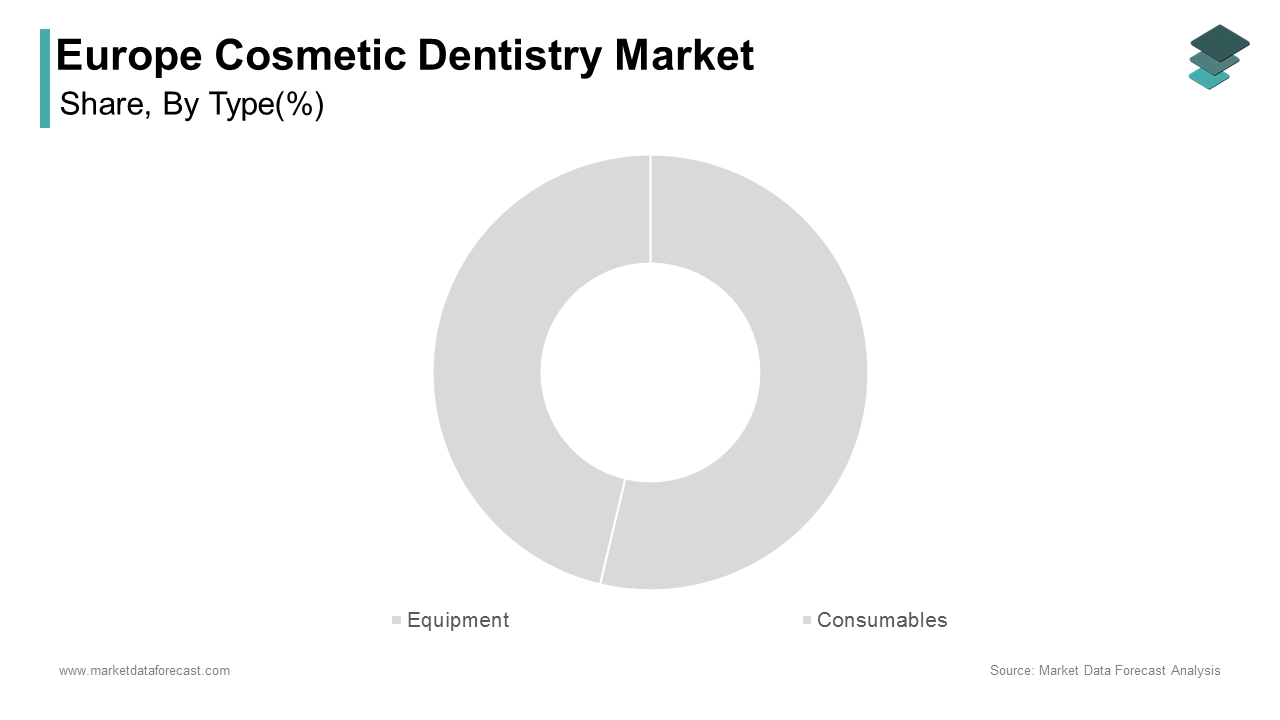
The consumables segment led the market by holding 60.5% of the European cosmetic dentistry market share in 2025. The dominance of the consumables segment in the European market is primarily driven by the recurring nature of aesthetic dental procedures that require single-use or patient-specific materials such as crowns, veneers, aligners, and whitening gels. Unlike capital equipment, which is purchased infrequently, consumables generate consistent demand as each patient case necessitates new restorative or orthodontic components. As per the European Federation of Dentists, clear aligner therapy volumes continued to rise in 2025 across major EU markets, with each treatment typically requiring multiple custom-fabricated aligners throughout the course of care. According to the European Academy of Esthetic Dentistry, material preferences in cosmetic prosthodontics have shifted toward lithium disilicate and zirconia due to superior aesthetics and biocompatibility, supporting multi‑million annual crown placements in the EU. As per the European Consumer Safety Network, professional in-office whitening remains a widely performed cosmetic procedure in Europe, with each session relying on single-use gel syringes and light activation kits to meet safety guidelines. According to the European Commission’s Medical Devices Regulation, custom dental prosthetics must be manufactured per patient under CE-certified workflows, reinforcing standardized clinical adoption. This procedural dependency on patient-specific single-use or bespoke materials secures consumables’ market dominance. The segment is expected to maintain its leadership over the forecast period as case volumes and material innovations sustain recurring demand.
The clear aligners segment is the fastest-growing sub-segment within the Europe cosmetic dentistry market and is anticipated to register a CAGR of 19.1% over the forecast period, owing to the rising demand among adults and adolescents for discreet orthodontic correction combined with digital treatment planning that enhances predictability and access. According to the European Consumer Organisation, adults increasingly prefer clear aligners over traditional braces for workplace appropriateness and aesthetic discretion. As per the European Academy of Paediatric Dentistry, teen adoption of aligners has increased across EU member states alongside greater awareness of psychosocial benefits. According to Fraunhofer research groups working on digital dentistry, intraoral scanning and virtual treatment simulation have reduced overall chair time for orthodontic workflows through streamlined planning and appliance iteration. As per Sweden’s Public Dental Service communications, public programmes in 2025 began offering targeted subsidies for adolescents with moderate malocclusion under clinician supervision. According to Align Technology’s regional disclosures, Europe added hundreds of thousands of new aligner patients in 2025, indicating robust category momentum. With direct-to-consumer models increasingly operating under dentist-supervised telehealth frameworks compliant with EU medical device rules, this segment is transforming orthodontics from a clinical necessity to a mainstream aesthetic wellness choice. The clear aligners segment is expected to expand rapidly over the forecast period as digital workflows and consumer preferences continue to align.
By End User Insights
The solo dental practices segment accounted for 56.5% of the regional market share in 2025. The leading position of the solo dental practices segment in the European cosmetic dentistry market is driven by the continent’s tradition of independent dental entrepreneurship and patient preference for long term relationships with individual clinicians. Across countries like Germany, Italy, and Sweden, most dentists operate as sole proprietors, often integrating cosmetic services into comprehensive care models. According to the European Federation of Dentists, a majority of patients seeking cosmetic dentistry choose their existing general dentist over specialized clinics due to an established rapport and holistic oral health understanding. As per national frameworks in France and Spain, restrictions on corporate ownership of dental clinics preserve the solo model and local professional autonomy. According to the European Dental Association, the adoption of CAD/CAM systems in independent practices has grown, enabling in-house crown and veneer fabrication and reducing lab dependency. As per Eurofound’s research on professional services, cosmetic dentistry aligns with revenue diversification needs for solo practitioners, contributing materially to private income and offsetting stagnating public reimbursement rates. This combination of cultural preference, regulatory support, and technological enablement ensures solo practices remain the primary delivery channel for cosmetic dentistry across Europe. The segment is expected to sustain its dominance over the forecast period, supported by patient loyalty and expanding digital capabilities.
The dental service organizations and group practices segment is the fastest-growing end-user segment in the Europe cosmetic dentistry market and is expected to progress at a CAGR of 16.04% over the forecast period, owing to economies of scale, centralized marketing, and the ability to offer integrated multidisciplinary aesthetic services that solo practitioners may not replicate at the same scale. According to European DSO industry associations, leading group practices in the UK, Netherlands, and Switzerland operate clinics with full digital workflows, including intraoral scanners, 3D printers, and dental lasers, as these technologies benefit from aggregated purchasing power. As per public statements from prominent networks such as MyDentist and Qunomedical, national brand visibility and online booking platforms have increased patient acquisition for cosmetic services. According to the European Consumer Organisation, younger urban patients prefer providers that offer transparent pricing and digital communication, trends that favour DSO models. As per Germany’s 2023 amendment to the Dentist Act, limited corporate practice structures were clarified, which facilitates expansion while maintaining clinical oversight. As patient expectations shift toward convenience and integrated care, DSOs are redefining cosmetic dentistry delivery in Europe’s urban centers. The segment is expected to expand significantly over the forecast period as networks scale standardized cosmetic offerings and financing options.
REGIONAL ANALYSIS
Germany Cosmetic Dentistry Market Analysis
Germany held the top position in the European cosmetic dentistry market in 2025 with a 21.7% share. The leading position of Germany in the European market can be credited to high disposable income, strong dental health awareness, and a dense network of technologically advanced solo practices. According to the German Dental Association, Germany has a large base of practicing dentists, with a significant proportion operating independent practices that increasingly integrate cosmetic services. As per the Federal Statistical Office, private dental care utilization and out-of-pocket spending on aesthetic procedures have risen in recent years. According to the Fraunhofer Institute, digital workflows such as smile design and same‑day CAD/CAM restorations are widely adopted in cosmetic settings. Regulatory clarity supports growth as Germany’s Medical Devices Act aligns with EU MDR, ensuring CE‑certified materials are used safely. As per Eurostat, consumer expenditure on elective dental services has grown alongside disposable incomes. Germany’s combination of affluence, expertise, and infrastructure solidifies its leadership position. Germany is expected to maintain its dominance in cosmetic dentistry innovation and service provision over the next few years.
United Kingdom Cosmetic Dentistry Market Analysis
The United Kingdom held a substantial share of the European cosmetic dentistry market in 2025. The growth of the UK in the European market is driven by a heavily privatized dental landscape, strong social emphasis on appearance, and concentration of specialized clinics in major cities. According to the UK Office for National Statistics, private financing dominates adult dental care, with cosmetic procedures largely funded out of pocket. As per the General Dental Council, dedicated cosmetic clinics are concentrated in London and other urban hubs, reflecting high urban demand. According to the British Dental Association, consultations for aesthetic procedures such as veneers have increased, influenced by social media visibility. Clear aligner adoption is notably high, with major brands reporting strong case initiations across the UK. Furthermore, the Care Quality Commission enforces evidence‑based advertising standards for dental providers, building consumer trust. This ecosystem of private financing, aesthetic awareness, and regulatory oversight positions the UK as Europe’s most mature cosmetic dentistry market. The UK is expected to sustain strong growth in private cosmetic dentistry services in the coming years.
France Cosmetic Dentistry Market Analysis
France captured a prominent share of the European cosmetic dentistry market in 2025. Its growth is propelled by cultural appreciation for aesthetics, strong dental literacy, and integration of cosmetic services into mainstream practice. According to France’s National Health Insurance Fund, many dentists in France offer cosmetic services, with whitening and bonding frequently included in routine consultations. As per the French Dental Association, adult demand for aesthetic dental care is high compared with neighboring Southern European markets. INSEE reports rising consumer spending on dental aesthetics in recent years. Regulatory support is robust—the French Agency for Health Product Safety maintains public listings of CE‑certified whitening products to ensure safety. Moreover, referral frameworks like “Dentiste Conseil” allow patients to access aesthetic specialists within public systems with co‑payments. France’s fusion of cultural value and clinical integration ensures sustained vitality in the cosmetic dentistry market. France is expected to remain a pivotal market for aesthetic dentistry in Southern Europe over the next few years.
Italy Cosmetic Dentistry Market Analysis
Italy is predicted to record a healthy CAGR in the European cosmetic dentistry market during the forecast period. The design sensibility, artistry, and medical tourism are propelling the Italian market growth. Italian dentists are renowned for biomimetic restorations that replicate natural tooth morphology and translucency. According to ISTAT, patient preferences increasingly emphasize natural appearance outcomes in cosmetic dental treatments. As per the Italian Society of Esthetic Dentistry, high‑strength, esthetic materials like zirconia and lithium disilicate are widely used for crowns and veneers due to their optical properties. The Italian Ministry of Tourism reports that international dental tourism contributes to cosmetic case volumes, with many patients seeking veneers or comprehensive rehabilitation. Cities like Milan, Florence, and Rome host specialized clinics offering multilingual services and concierge‑style care. Additionally, Italian dental labs are recognized internationally for craftsmanship, exporting custom prosthetics to numerous countries. This blend of artistic heritage, service excellence, and tourism infrastructure positions Italy as a premium aesthetic dentistry destination. Italy is expected to strengthen its role as a premium destination for aesthetic dentistry linked to tourism in the near term.
Sweden Cosmetic Dentistry Market Analysis
Sweden is projected to account for a notable share of the European market during the forecast period, owing to the preventive care integration and sustainability. The country views dental appearance as a component of psychosocial health, particularly for youth. According to the Swedish Public Dental Service, aesthetic interventions (e.g., bonding for developmental defects and early orthodontic alignment) receive partial public support for young patients under national oral health guidelines. As per the Swedish National Board of Health and Welfare, a substantial proportion of adolescents receive cosmetic‑adjacent care during routine visits. Statistics Sweden reports rising demand for private aesthetic procedures among working‑age adults. According to the Swedish Dental Association, digital workflows are widely adopted across clinics. Furthermore, Sweden promotes sustainability in dental care through reporting requirements on materials and waste, encouraging biodegradable impression materials and mercury‑free restorations. This fusion of public health foresight, private innovation, and environmental consciousness positions Sweden as a forward‑looking model in Europe’s cosmetic dentistry landscape. Sweden is expected to expand its role in sustainable and preventive‑focused cosmetic dentistry over the next few years.
COMPETITION OVERVIEW
Competition in the Europe cosmetic dentistry market is characterized by a dynamic interplay between global technology leaders, specialized material innovators, and local clinical providers operating within a stringent regulatory and ethical framework. Unlike unregulated wellness markets, cosmetic dentistry in Europe is firmly anchored in medical device legislation, requiring CE certification for all materials and clear professional accountability for practitioners. This environment favours established companies with proven clinical evidence, robust quality management systems, and deep integration into dental education. Innovation competition centers on digital precision biomimetic aesthetics and minimally invasive protocols rather than price. While global players dominate equipment and consumables, local dental labs and solo practitioners retain influence through craftsmanship and patient relationships. The rise of DSOs is introducing scale-based competition, particularly in urban centers, where bundled services and transparent pricing appeal to younger demographics. However, fragmentation persists due to national variations in training reimbursement and advertising laws. Ultimately, competitive advantage hinges on scientific credibility, clinical support, and the ability to deliver natural, reproducible results that align with Europe’s holistic view of oral health and personal well-being.
KEY MARKET PLAYERS
A few major players of the Europe cosmetic dentistry market include
- Straumann Group
- Dentsply Sirona
- Ivoclar Vivadent
- Nobel Biocare
- 3M
- Danaher Corporation (Envista)
- GC Europe
- Coltene Group
- Henry Schein
- Septodont
Top Strategies Used by the Key Market Participants
Key players in the Europe cosmetic dentistry market pursue integrated strategies centered on digital workflow integration, clinician education, regulatory compliance, and aesthetic innovation. Companies invest heavily in end-to-end digital ecosystems that combine intraoral scanning, AI-driven design, and chair-side fabrication to enhance predictability and reduce treatment time. Strategic partnerships with dental associations, universities, and professional academies build clinical trust and accelerate the adoption of new techniques. Product development focuses on biomimetic materials that replicate natural tooth optics while meeting EU Medical Devices Regulation standards for biocompatibility and traceability. Marketing emphasizes evidence-based outcomes rather than vanity, aligning with European ethical advertising norms. Additionally, firms are expanding training platforms, including virtual reality simulations and live workshops, to address the shortage of specialized cosmetic dentistry skills. Geographic customization is evident with region-specific shade guides and language-tailored digital interfaces. These multifaceted approaches position leading companies not merely as suppliers but as clinical partners in delivering safe, natural anconfidence-enhancingng dental aesthetics across Europe.
Leading Players in the Europe Cosmetic Dentistry Market
- Dentsply Sirona Inc is a global leader in dental technologies with a strong footprint in the Europe cosmetic dentistry market through its advanced imaging systems, CAD CAM restorations, and aesthetic consumables. The company contributes significantly to global digital dentistry standards by offering integrated workflows that enhance precision in veneers, crowns, and smile design. In 2025, Dentsply Sirona launched its upgraded CEREC Primescan Connect platform across Europe featurinAI-powereded shade matching and same-day zirconia restorations. It also partnered with dental schools in Germany and the UK to train clinicians on digital aesthetic protocols. These initiatives reinforce its role as an enabler of predictable, minimally invasive cosmetic dentistry aligned with European clinical and regulatory expectations.
- Align Technology Inc maintains a prominent position in the Europe cosmetic dentistry market as the pioneer and leading provider of clear aligner systems under the Invisalign brand. The company has transformed orthodontic aesthetics by offering discreet, effective and digitally planned treatment accessible to teens and adults. In 2025, Align expanded its European clinical support network by certifying over 12000 dentists in smile design integration and launched Invisalign Lite for minor anterior corrections in response to rising demand for affordable aesthetic alignment. It also collaborated with the European Academy of Esthetic Dentistry to develop standardized outcome reporting guidelines. These actions strengthen its ecosystem of training technology and trust, solidifying its leadership in the fastest-growing cosmetic dentistry segment.
- Ivoclar Vivadent AG is a Switzerland-based innovator in dental materials, renowned for its high esthetic restorative solutions, including IPS e.max lithium disilicate and shade matching technologies widely adopted across Europe. The company contributes globally by setting benchmarks in biomimetic aesthetics and biocompatibility for crowns, veneers, and bonding. In late 2025, Ivoclar introduced its new IPS Nature line featuring enhanced translucency and fluorescence that replicates natural tooth optics under varying light conditions. It also launched a pan-European digital shade calibration program providing clinics with spectrophotometer training to reduce remake rates. By merging material science with clinical education Ivoclar empowers dentists to deliver natural-looking, durable results that meet Europe’s exacting aesthetic and regulatory standards.
MARKET SEGMENTATION
This research report on the Europe cosmetic dentistry market has been segmented and sub-segmented based on type, end user, and region.
By Type
- Equipment
- Consumables
By End User
- Solo Practices
- DSO/Group Practices
- Others
By Region
- UK
- France
- Spain
- Germany
- Italy
- Russia
- Sweden
- Denmark
- Switzerland
- Netherlands
- Turkey
- Czech Republic
- Rest of Europe