- Product Description Description
- Table of Contents TOC
- List of Table & Figure LOT
- Get Free Sample PDF Sample PDF
Market Size, 2025
$48.72 BnMarket Estimate, 2026
$50.85 BnMarket Forecast, 2034
$70.06 BnCAGR, 2026–2034
4.34%Europe Critical Infrastructure Protection Market Size, Growth, Trends & Forecast (2025–2034)
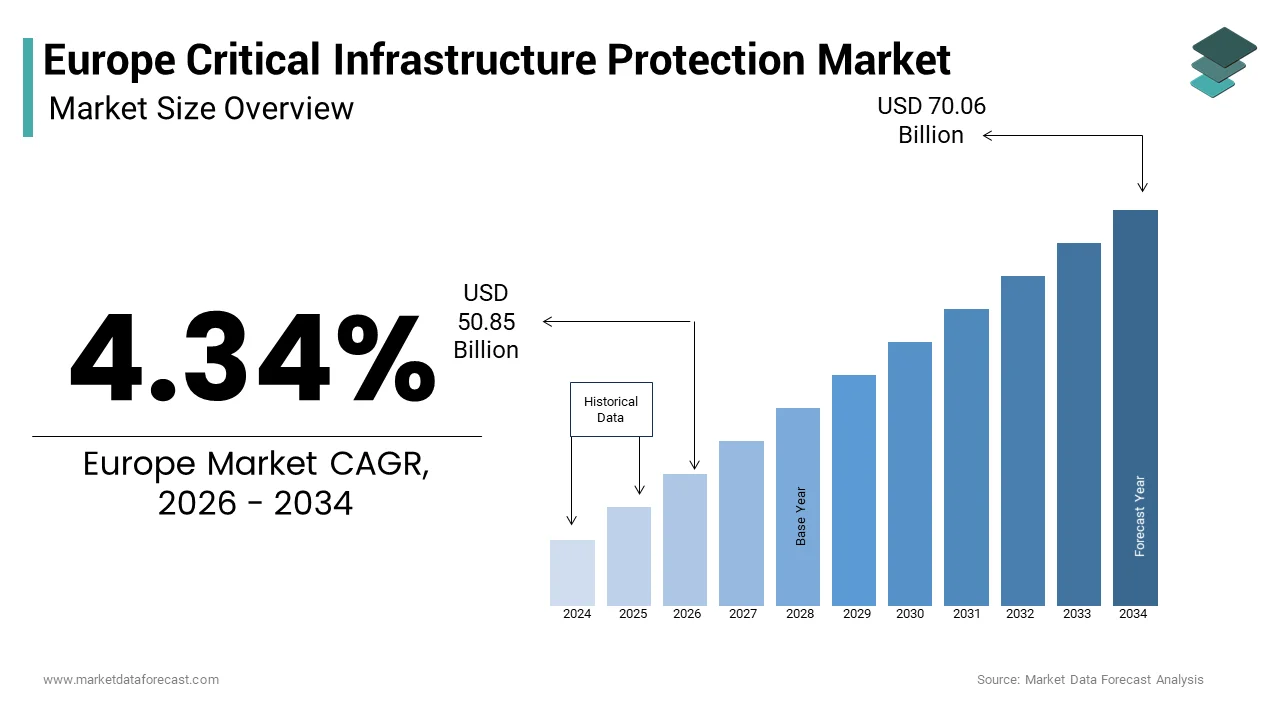
The Europe critical infrastructure protection market size was valued at USD 48.72 billion in 2025, is anticipated to reach USD 50.85 billion in 2026, and is expected to expand up to USD 70.06 billion by 2034, registering a compound annual growth rate (CAGR) of 4.34% during the forecast period from 2026 to 2034. Driven by mandatory EU-wide regulatory frameworks like the NIS2 and CER Directives, escalating cyber-physical threats, hybrid attacks, and the imperative to secure vital utilities, the European market is transitioning from a compliance exercise into a core strategic security pillar.
Key Executive Metrics (At-a-Glance)
- 2025 Base Valuation: USD 48.72 Billion
- 2026 Current Valuation: USD 50.85 Billion
- 2034 Forecast Valuation: USD 70.06 Billion
- Compound Annual Growth Rate (CAGR): 4.34% (2026–2034)
- Dominant Type Segment: Solutions Segment (capturing 61.7% of the market share in 2025, fueled by foundational compliance tech like SIEM and IDS)
- Fastest-Growing Type Segment: Services Segment (exhibiting a robust CAGR of 14.2% driven by specialized cyber-physical talent shortages)
- Dominant Security Segment: Cyber Security Segment (holding the largest share in 2025 due to digital threat convergence and IT/OT integration)
- Fastest-Growing Security Segment: Physical Safety & Security Segment (projected at a 12.8% CAGR driven by coordinated hybrid threats combining cyber and physical breaches)
- Dominant End-Use Segment: Energy & Power Segment (accounting for 36.4% market share in 2025 as a primary state-sponsored and criminal target)
- Fastest-Growing End-Use Segment: IT & Telecom Segment (estimated at a 15.1% CAGR following critical entity designations under NIS2)
- Dominant Country: Germany (market leader capturing 22.5% share anchored by its heavy industrial output, dense power grids, and rigorous BSI enforcement)
Core Market Drivers
- Mandatory Regulatory Compliance: Strict legal obligations under the EU’s NIS2 and CER Directives expanding protected entities and mandating strict risk management.
- Escalating Cyber-Physical Attacks: Increasing frequency of advanced attacks bridging IT and operational technology (OT) to disrupt physical infrastructure operations.
Primary Market Restraints & Challenges
- Fragmented National Implementation: Varied member-state transpositions of EU directives creating complex, multi-jurisdictional compliance burdens.
- Skills Shortage & Legacy OT Systems: Acute scarcity of specialized cyber-physical talent alongside obsolete, unpatchable industrial control systems.
Europe Critical Infrastructure Protection Market Segmentation Breakdown
| Segment Category | Leading Sub-Segment | Fastest-Growing Sub-Segment |
|---|---|---|
| By Type | Solutions (dominant capital expenditure backbone for compliance and monitoring infrastructure) | Services (rapid growth propelled by managed security solutions and deep skills gaps) |
| By Security | Cyber Security (largest pillar addressing continuous IT/OT digital threat convergence) | Physical Safety & Security (surging via hybrid threat mitigation and integrated security operations centers) |
| By End-Use | Energy & Power (leading economic lifeblood sector requiring continuous grid asset protection) | IT & Telecom (fastest growth driven by centralized data center and cloud infrastructure regulations) |
| By Country | Germany & France (Germany leads in dense industrial output; France via nuclear and state-led sovereignty) | Italy & Netherlands (expansion driven by coastal exposure, hybrid threats, and digital logistics hubs) |
Major Industry Players Profiled
Key global technology leaders and security contractors shaping the European critical infrastructure protection market include Thales Group S.A., Siemens AG, Palo Alto Networks Inc., BAE Systems PLC, Lockheed Martin Corporation, Honeywell International Inc., Fortinet, Inc., Airbus SE, Hexagon AB, Johnson Controls International PLC, and Cisco Systems, Inc.
Europe Critical Infrastructure Protection Market Size
The Europe critical infrastructure protection market size was valued at USD 48.72 billion in 2025 and is anticipated to reach USD 50.85 billion in 2026 to USD 70.06 billion in 2034, growing at a CAGR of 4.34% during the forecast period from 2026 to 2034.
Current Introduction of the Europe Critical Infrastructure Protection Market
Critical Infrastructure Protection (CIP) is a concept and national program dedicated to securing the physical and virtual assets, systems, and networks that are so vital to a nation that their incapacitation or destruction would have a debilitating impact on national security, the economy, or public health and safety. This includes sectors formally designated under the EU’s NIS2 Directive and the European Critical Entities Resilience Directive, such as energy grids, water utilities, transportation networks, digital service providers, and healthcare facilities. The market’s current urgency is defined by an unprecedented convergence of threats. The European Union Agency for Cybersecurity indicates a rise in the volume of reported significant incidents affecting critical infrastructure, while simultaneously noting a decrease in the overall impact of these disruptions. Furthermore, as per Europol’s 2025 Threat Assessment, there has been a marked rise in hybrid threats that combine cyber-attacks with physical sabotage or disinformation campaigns. This complex and evolving risk landscape has transformed critical infrastructure protection from a compliance exercise into a core strategic imperative for both public authorities and private operators across the continent.
MARKET DRIVERS
Mandatory Regulatory Frameworks Under the EU’s NIS2 and CER Directives
The imposition of stringent and legally binding regulatory requirements through the Network and Information Security Directive 2 (NIS2) and the Critical Entities Resilience (CER) Directive fuels the growth of the Europe critical infrastructure protection market. These frameworks have dramatically expanded the scope of protected entities and the depth of security obligations. NIS2 alone extends coverage to over two hundred thousand organizations across the EU, an increase from its predecessor, and mandates specific technical and organizational measures for risk management, incident reporting, and business continuity. As per the European Commission, member states were required to transpose these directives into national law by October 2024, creating an immediate and non discretionary demand for compliance solutions. This regulatory wave forces operators of essential services to invest in comprehensive security programs, including advanced threat detection systems, robust access controls, and resilient backup architectures. The introduction of strict legal liability for non-compliance, which includes significant fines based on global turnover and, crucially, personal accountability for company management, has established regulatory adherence as a primary catalyst for market growth in cybersecurity services.
Escalating Frequency and Sophistication of Cyber Physical Attacks
The alarming escalation in the frequency, sophistication, and real world impact of cyber physical attacks targeting European infrastructure further boosts the expansion of the Europe critical infrastructure protection market. Adversaries are no longer content with data theft. They now seek to disrupt or destroy physical operations. A stark example is the 2024 attack on a major German chemical plant, where a ransomware intrusion was used to disable safety systems, creating a potential for catastrophic environmental disaster. According to the European Union Agency for Cybersecurity, the operational technology and industrial control systems sectors faced a substantial surge in cyberattacks, driven by intensifying geopolitical conflicts and increased targeting of critical infrastructure. These incidents demonstrate that a breach in the IT network can have direct, dangerous consequences in the physical world. This new reality has shattered the traditional air gap between IT and OT security, compelling infrastructure operators to deploy integrated security solutions that can monitor, detect, and respond to threats across both domains. The tangible risk of operational shutdown, environmental damage, and loss of life has made investment in holistic cyber physical protection a matter of existential necessity.
MARKET RESTRAINTS
Fragmented National Implementation of EU Directives
The fragmented and inconsistent implementation of EU-wide directives like NIS2 and CER across individual member states hampers the growth of the Europe critical infrastructure protection market. The EU provides a common framework, but since countries must transpose the rules into their own laws, variations exist in enforcement, authorities, and technical requirements. For a multinational operator managing infrastructure in multiple countries, this creates a complex and costly compliance burden. They must navigate a patchwork of different regulatory expectations, reporting formats, and audit procedures, which increases administrative overhead and the risk of non compliance. Inconsistent adoption of European cybersecurity frameworks across various nations leads to a complex regulatory environment with varying oversight and enforcement measures. This lack of true harmonization stifles the development of standardized, pan European security solutions and forces companies to adopt a country by country approach, which is inefficient and dilutes the overall effectiveness of the EU’s collective security posture.
Acute Shortage of Specialized Cyber Physical Security Talent
A severe shortage of professionals with the specialized skills required to secure complex cyber physical systems hinders the expansion of the Europe critical infrastructure protection market. Protecting critical infrastructure demands a unique interdisciplinary expertise that blends deep knowledge of traditional IT cybersecurity with an understanding of industrial control systems, engineering processes, and physical security protocols. This talent pool is extremely limited. A growing disparity between the demand for technical security expertise and the available workforce is particularly visible in sectors managing industrial and critical infrastructure. This scarcity drives up labor costs to prohibitive levels and leaves many critical infrastructure operators without the internal expertise to properly configure, manage, and monitor their security systems. The result is a reliance on external consultants, which can be costly and unsustainable, or worse, a situation where sophisticated security tools are deployed but not effectively utilized, creating a false sense of security and leaving critical vulnerabilities unaddressed.
MARKET OPPORTUNITIES
Integration of Artificial Intelligence for Predictive Threat Intelligence
The application of artificial intelligence and machine learning to develop predictive threat intelligence platforms for critical infrastructure paves the way for new opportunities for the Europe critical infrastructure protection market. Traditional security systems are reactive, alerting operators only after a threat has been detected. AI driven platforms can analyze vast datasets from network traffic, system logs, open source intelligence, and geopolitical feeds to identify subtle patterns and anomalies that signal an impending attack. For instance, an AI system could correlate unusual network scanning activity from a specific region with a spike in social media chatter about a local utility, predicting a high probability of a targeted campaign. Collaborative European initiatives are increasingly prioritizing the use of advanced machine learning to anticipate and neutralize risks to vital public services. This shift from reactive defense to proactive prediction would allow operators to pre emptively harden their systems, allocate resources more effectively, and significantly reduce their attack surface, representing a quantum leap in resilience.
Development of Sovereign European Security Technology Ecosystems
The geopolitical climate uncovers new paths to build a sovereign European ecosystem for CIP technologies, which is anticipated to drive the expansion of the Europe critical infrastructure protection market. In response to concerns over reliance on non EU vendors for sensitive security hardware and software, the European Commission has prioritized the development of trusted, homegrown alternatives. This initiative is supported by funding mechanisms like the Digital Europe Programme and the European Defence Fund. The goal is to create a complete stack of European solutions, from secure operating systems and network monitoring tools to hardware security modules. Substantial regional investment is fostering a network of local startups and research groups dedicated to building independent and resilient security infrastructures. This push for technological autonomy not only addresses national security concerns but also fosters a vibrant domestic industry, creating high value jobs and ensuring that the security of Europe’s most vital assets is under its own control, free from external political or supply chain risks.
MARKET CHALLENGES
Legacy Operational Technology Systems with Inherent Security Vulnerabilities
The widespread presence of legacy operational technology (OT) systems degrades the growth of the Europe critical infrastructure protection market. These systems were never designed with cybersecurity in mind. Much of Europe’s critical infrastructure, from power substations to water treatment plants, relies on industrial control systems that are decades old. These systems often run on obsolete, unsupported software, lack basic authentication mechanisms, and cannot be patched without risking a shutdown of the entire process. European power grid operators are increasingly concerned that many of their critical control systems rely on outdated technology that no longer receives essential security updates from manufacturers. Securing these systems is exceptionally difficult. Traditional IT security tools are incompatible, and physical upgrades are prohibitively expensive and disruptive. This creates a vast, vulnerable attack surface that is difficult to defend, forcing operators into a constant state of risk management rather than true security.
Complexity of Public Private Partnership and Information Sharing
Effective CIP requires seamless collaboration and real time information sharing between public authorities and private sector operators, a process fraught with complexity and mistrust that constrains the expansion of the Europe critical infrastructure protection market. Private companies are often reluctant to share details of security breaches or vulnerabilities due to fears of reputational damage, regulatory penalties, or competitive disadvantage. Conversely, government agencies may be hesitant to share classified threat intelligence with commercial entities. This information asymmetry creates dangerous blind spots. European cybersecurity authorities observe that private companies frequently hesitate to report digital security breaches, even though specialized national response teams are available to assist them. Establishing trusted channels for bidirectional information flow is technically and legally challenging, requiring clear frameworks for data anonymization, liability protection, and mutual benefit. The collective defense of European critical infrastructure will continue to be disjointed and suboptimal until these cultural and procedural hurdles are overcome.
REPORT COVERAGE
| REPORT METRIC | DETAILS |
| Market Size Available | 2025 to 2034 |
| Base Year | 2025 |
| Forecast Period | 2026 to 2034 |
| CAGR | 4.34% |
| Segments Covered | By Type, Security, End-User, and Region. |
| Various Analyses Covered | Global, Regional, an, Country-Level Analysis, Segment-Level Analysis; DROC, PESTLE Analysis; Porter’s Five Forces Analysis; Competitive Landscape; Analyst Overview of Investment Opportunities |
| Regions Covered | UK, France, Spain, Germany, Italy, Russia, Sweden, Denmark, Switzerland, Netherlands, Turkey, the Czech Republic, and the Rest of Europe |
| Market Leaders Profiled | BAE Systems PLC, Lockheed Martin Corporation, Palo Alto Networks Inc, Honeywell International Inc., Thales Group S.A., Fortinet, Inc., Airbus SE, Hexagon AB, Johnson Controls International PLC, Siemens AG, Cisco Systems, Inc. |
SEGMENTAL ANALYSIS
By Type Insights
The solutions segment led the Europe critical infrastructure protection market and captured a 61.7% share in 2025. The leading position of the solutions segment is attributed to the foundational need for robust, integrated technology platforms that can provide continuous, automated defense against a relentless threat landscape. One more reason for growth here is the regulatory mandate from the EU’s NIS2 and CER Directives, which require operators to implement specific technical measures such as intrusion detection systems, security information and event management (SIEM) platforms, and access control systems. These are not optional enhancements but core compliance requirements. As per the European Commission, the implementation of updated cybersecurity regulations has generated a swift and extensive need for uniform security technologies and protocols across a substantially expanded, multi-sector, and vast array of newly recognized entities. The capital expenditure on these hardware and software solutions forms the bedrock of any critical infrastructure protection program, providing the essential tools for monitoring, detection, and prevention. This non-discretionary, regulation fueled investment ensures that the solutions segment remains the primary engine of the market.
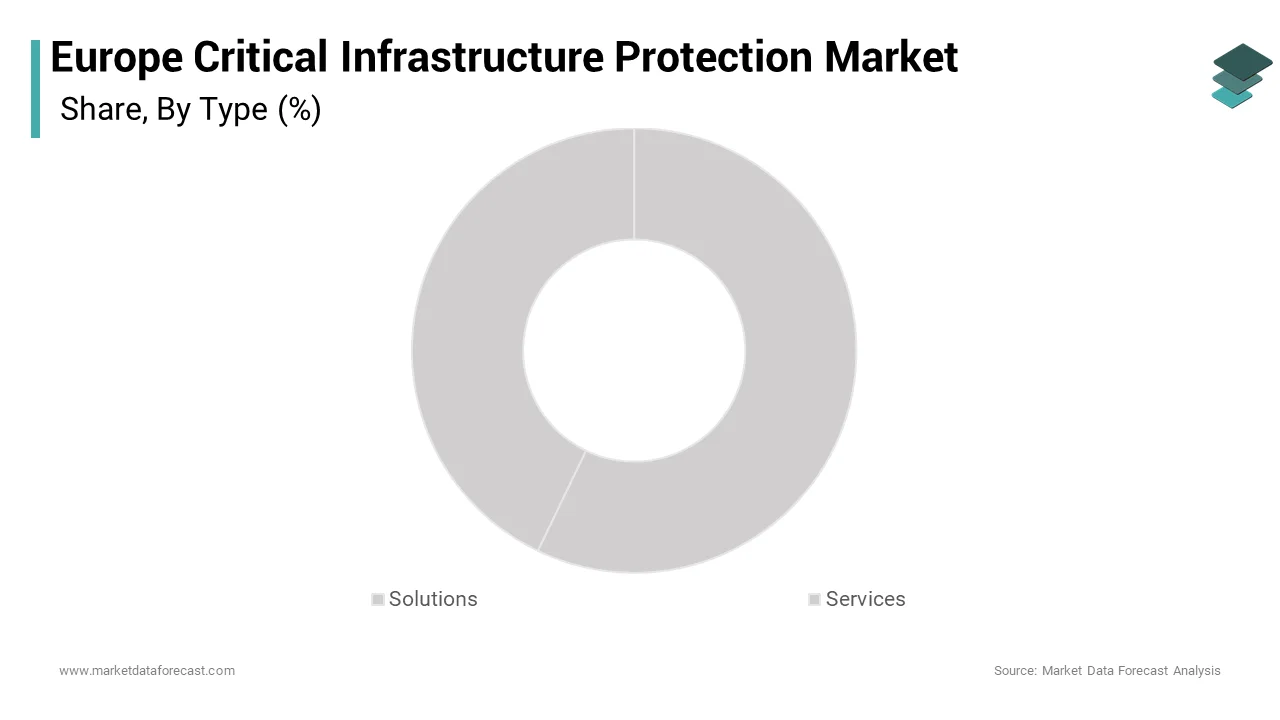
The services segment is expected to exhibit a noteworthy CAGR of 14.2% over the forecast period. The rapid expansion of the services segment is propelled by a direct response to the acute shortage of specialized in house talent capable of managing the complex, integrated security ecosystems now required. The obligation to adopt new systems often outpaces an organization's capacity to properly implement and maintain them. This gap has created a booming market for managed security services, consulting, and incident response. A key factor is the increasing sophistication of attacks; a simple software installation is insufficient. European critical infrastructure operators are increasingly relying on external partners to manage security functions, driven by internal skill shortages rather than a, majority of operations being outsourced. This trend reflects a shift towards specialized service providers in response to a growing digital threat landscape. This trend is further amplified by the need for continuous compliance auditing and risk assessments mandated by NIS2, which require ongoing expert support. The shift from a product centric to a service centric model reflects the market’s maturation, where the value lies not just in the technology but in the expert human intelligence that operates it.
By Security Insights
The cyber security segment was the largest segment within the Europe critical infrastructure protection market by holding a substantial share in 2025. The prominence of the cyber security segment is credited to the primary nature of the contemporary threat landscape, which is overwhelmingly digital. The convergence of IT and OT networks has created a vast new attack surface, and adversaries are exploiting this with increasing success. An additional driver is the explicit and detailed cyber security requirements embedded within the EU’s NIS2 Directive, which mandates specific measures for network segmentation, vulnerability management, and incident reporting. Europol's 2025 assessments identify rapidly evolving cyberattacks as a major threat endangering European Union security, with malicious activity, including ransomware, increasingly targeting critical infrastructure. This statistic underscores why cyber security is not just a segment but the central pillar of the entire protection strategy. The financial and operational consequences of a successful cyber intrusion, ranging from ransomware-induced shutdowns to the sabotage of industrial processes, have made cyber defense the top priority for every operator, driving massive and sustained investment in this domain.
The physical safety and security segment is predicted to witness the highest CAGR of 12.8% from 2026 to 2034 due to the rise of hybrid threats that deliberately combine cyber attacks with physical actions to maximize disruption. A cyber intrusion might disable alarm systems or unlock access points, creating an opportunity for a physical breach to cause direct damage. This new reality has shattered the traditional silo between cyber and physical security. Consequently, there is a major push to integrate physical security systems, such as advanced video surveillance with AI analytics, perimeter intrusion detection, and biometric access control, with cyber security operations centers. European regulatory bodies are shifting toward mandatory integration of digital and physical security for critical infrastructure, driven by directives prioritizing a unified, cross-functional approach to crisis management. This approach reflects a trend toward synchronizing cyber and physical defenses, rather than relying solely on individual technical standards. This integration is driving demand for modern, intelligent physical security solutions that can act as both a deterrent and a last line of defense in a coordinated attack scenario.
By End Use Insights
The energy and power segment dominated the Europe critical infrastructure protection market by accounting for a 36.4% share in 2025. The supremacy of the energy and power segment is driven by the sector’s status as the lifeblood of the modern economy and its high profile as a target for state sponsored and criminal actors. Further support for this segment comes from the sector’s complete dependence on interconnected digital control systems to manage the generation, transmission, and distribution of electricity and gas. A successful attack can have cascading effects, plunging entire regions into darkness and halting all other economic activity. The EU’s NIS2 Directive explicitly identifies energy as a high priority sector, imposing the strictest security obligations. According to the European Network of Transmission System Operators for Electricity, members have experienced a significant escalation in targeted cyber attempts aimed at critical grid control systems and operational technologies. This constant state of siege necessitates continuous, massive investment in both cyber and physical protection, making energy and power the single most intensive and consistent consumer of security technologies and services.
The IT and telecom segment is estimated to register the fastest CAGR of 15.1% over the forecast period. The swift growth of the IT and telecom segment is fuelled by a direct result of the sector’s formal designation as a critical entity under the NIS2 Directive, a recognition of its foundational role in the digital economy. Telecom networks and cloud data centers are the backbone upon which all other digital services, including those in finance, healthcare, and government, depend. An attack on this infrastructure can have a ripple effect across the entire economy. A further key driver is the need to protect the massive, centralized data centers that house the EU’s digital assets. According to European data protection authorities, centralized cloud infrastructure often hosts vast amounts of personal information, rendering these large-scale storage hubs a primary target for security threats and requiring rigorous protection measures. This has triggered a wave of investment in securing these facilities, not just from a cyber perspective but also with advanced physical security to guard against sabotage, creating a powerful new demand stream that is growing faster than any other sector.
COUNTRY ANALYSIS
Germany Critical Infrastructure Protection Market Analysis
Germany was the top performer in the Europe critical infrastructure protection market by capturing a 22.5% share in 2025. The leading position of the Germany market is attributed to its dense network of critical industrial assets, including the continent’s largest energy grid, a world leading chemical industry, and a highly automated manufacturing base. The German market is characterized by a proactive and stringent regulatory approach, with the Federal Office for Information Security (BSI) being one of the most active national agencies in enforcing the EU’s NIS2 Directive. A key driver is the nation’s heavy reliance on its industrial base. According to the German Engineering Federation, a significant portion of the nation's economic output and industrial production relies heavily on the stability and security of critical infrastructure sectors, such as energy supply and advanced machinery networks. This economic reality, combined with a high threat perception following several high profile attacks on its chemical and energy sectors, has created a deep and resilient demand for the most advanced and comprehensive protection solutions available.
France Critical Infrastructure Protection Market Analysis
France was the next prominent country in the Europe critical infrastructure protection market and occupied a 18.3% share in 2025. The expansion of the French market is supported by its strong state led approach to national security, with critical infrastructure protection being a top strategic priority for the government. A major factor is the country’s extensive nuclear energy program, which operates several reactors and provides a portion of its electricity. The security of these facilities is a matter of national sovereignty, driving massive investment in both cyber and physical protection. The French National Agency for the Security of Information Systems (ANSSI) has increased the intensity of security auditing and monitoring for critical operators to align with the stricter cybersecurity obligations of the NIS2 Directive. This top down, security first culture, combined with a large and diverse critical infrastructure portfolio spanning energy, transport, and defense, ensures France remains a powerhouse of security spending and innovation.
United Kingdom Critical Infrastructure Protection Market Analysis
The United Kingdom holds a significant position in the Europe critical infrastructure protection market owing to its maturity and its world class cybersecurity ecosystem, centered in London. Moreover, a key growth enabler is the country’s extensive and aging physical infrastructure, including its national rail network and water utilities, which are increasingly being targeted by sophisticated threat actors. The National Cyber Security Centre (NCSC) plays a pivotal role, providing direct support and guidance to critical national infrastructure operators. According to the 2025 UK National Risk Register, cyber disruptions targeting essential national infrastructure are categorized among the most severe, high-impact risks facing the country. This official recognition, coupled with a highly developed private security industry, creates a dynamic market that is quick to adopt new technologies and services to counter an evolving threat landscape, making the UK a key bellwether for the rest of Europe.
Italy Critical Infrastructure Protection Market Analysis
Italy experienced a steady expansion in the Europe critical infrastructure protection market due to its long and vulnerable coastline, which hosts critical port infrastructure and undersea telecommunications cables, and its position as a major entry point for European energy supplies via pipelines from North Africa. This geographical exposure makes its infrastructure a prime target for hybrid threats. A key factor is the government’s recent establishment of a dedicated National Cybersecurity Agency, which has been given sweeping powers to enforce the NIS2 Directive across a wide range of sectors. According to Italy's National Cybersecurity Agency (ACN), the number of confirmed, severe cyber-attacks against critical infrastructures and public administration saw a sharp, substantial increase in 2024, confirming a systemic emergency that highlights the urgent need for enhanced digital protection. This combination of geographic vulnerability and a newly empowered regulatory body is driving a rapid and comprehensive upgrade of the nation’s protective capabilities.
Netherlands Critical Infrastructure Protection Market Analysis
The Netherlands is anticipated to grow notably in the Europe critical infrastructure protection market over the forecast period owing to its role as a major European logistics and digital hub, home to the Port of Rotterdam, the continent’s largest, and a dense concentration of international data centers. This strategic importance makes its infrastructure a high value target. A major driver is the country’s forward looking “Digital Resilience” strategy, which mandates a holistic, public private approach to security. The National Cyber Security Centre Netherlands works in close partnership with industry through its “Shield” program, which facilitates real time threat intelligence sharing. A substantial majority of designated critical operators in the Netherlands engage in the national public-private partnership framework for cyber resilience and information sharing, overseen by the Ministry of Justice and Security. This culture of cooperation, combined with its critical role in European trade and data flows, creates a sophisticated and highly active market for integrated protection solutions.
COMPETITIVE LANDSCAPE
The competitive landscape of the Europe critical infrastructure protection market is characterized by a dynamic interplay between global cybersecurity giants, specialized industrial automation vendors, and national defense contractors. At the top, multinational corporations like Thales, Palo Alto Networks, and Siemens leverage their scale, broad portfolios, and deep regulatory expertise to serve large, pan European operators. They compete on the depth of their integrated solutions and their ability to provide end to end security across both IT and OT domains. Alongside them, a tier of specialized firms focuses on niche areas like OT threat detection or physical perimeter security, often partnering with the larger players. The market is highly regulated and relationship driven, with long sales cycles and a premium placed on trust, proven resilience, and compliance with EU sovereignty requirements. Competition is intense but centered on technological integration, regulatory alignment, and the ability to deliver a unified defense against increasingly sophisticated hybrid threats.
KEY MARKET PLAYERS
A few of the market players in the Europe critical infrastructure protection market
- BAE Systems PLC
- Lockheed Martin Corporation
- Palo Alto Networks Inc
- Honeywell International Inc.
- Thales Group S.A.
- Fortinet, Inc.
- Airbus SE
- Hexagon AB
- Johnson Controls International PLC
- Siemens AG
- Cisco Systems, Inc.
Top Players In The Market
- Thales Group is a global leader in aerospace, defense, and security with a formidable presence in the European critical infrastructure protection market. The company provides an integrated portfolio of cyber and physical security solutions, including advanced encryption, secure communications, and critical system resilience services for energy, transport, and government sectors. To strengthen its position, Thales has been actively developing sovereign European cybersecurity capabilities.
- Siemens Energy AG plays a pivotal role in the European critical infrastructure protection landscape by securing the operational technology that underpins the continent’s power grid. The company offers specialized industrial cybersecurity solutions, such as its Spectrum Power control systems with embedded security features, designed to protect substations and power plants from cyber physical threats. In a strategic move to enhance its market leadership, Siemens Energy established a dedicated European OT Security Center of Excellence in Germany. This center provides threat intelligence, incident response, and security training tailored to the unique challenges of the energy sector, directly addressing the industry’s most pressing security needs.
- Palo Alto Networks is a dominant force in the European cybersecurity market, with its critical infrastructure protection offerings focused on securing the IT and network layers of essential services. Its Cortex XDR and Prisma Cloud platforms are widely adopted by IT and telecom operators to meet the compliance mandates of the NIS2 Directive. To solidify its foothold, Palo Alto Networks launched its “Critical Infrastructure Defense” framework. This framework provides pre validated security architectures and playbooks specifically designed for European energy, water, and healthcare entities, enabling them to rapidly deploy a Zero Trust security model aligned with EU regulatory expectations.
Top Strategies Used By The Key Market Participants
Key players in the Europe critical infrastructure protection market are primarily deploying three core strategies to secure their competitive advantage. First, they are developing and offering integrated cyber physical security platforms that unify IT, OT, and physical security data into a single pane of glass for holistic situational awareness. Second, they are building sovereign European security capabilities, including local data centers and R&D facilities, to address national security concerns and comply with data residency requirements. Third, they are creating industry specific compliance frameworks and managed services that directly map to the technical and organizational measures mandated by the EU’s NIS2 and CER Directives, thereby simplifying the path to regulatory adherence for their customers.
MARKET SEGMENTATION
This research report on the Europe Critical Infrastructure Protection Market is segmented and sub-segmented into the following categories.
By Type
- Solutions
- Services
By Security
- Cyber Security
- Network Access Controls & Firewalls
- Threat Intelligence
- Encryption
- Other Cyber Security Types
- Physical Safety & Security
- Video Surveillance Systems
- Perimeter Intrusion Detection Systems
- Physical Identity & Access Control Systems
- Screening & Scanning
- Other Physical Safety & Security Types
By End Use
- Government & Defense
- Energy & Power
- BFSI
- IT & Telecom
- Transport & Logistics
- Oil & Gas
- Other End Use
By Country
- UK
- France
- Spain
- Germany
- Italy
- Russia
- Sweden
- Denmark
- Switzerland
- Netherlands
- Turkey
- Czech Republic
- Rest of Europe