- Product Description Description
- Table of Contents TOC
- List of Table & Figure LOT
- Get Free Sample PDF Sample PDF
Market Size, 2025
$2.93 BnMarket Estimate, 2026
$3.18 BnMarket Forecast, 2034
$6.18 BnCAGR, 2026–2034
8.67%Europe Crushers Market Report Summary
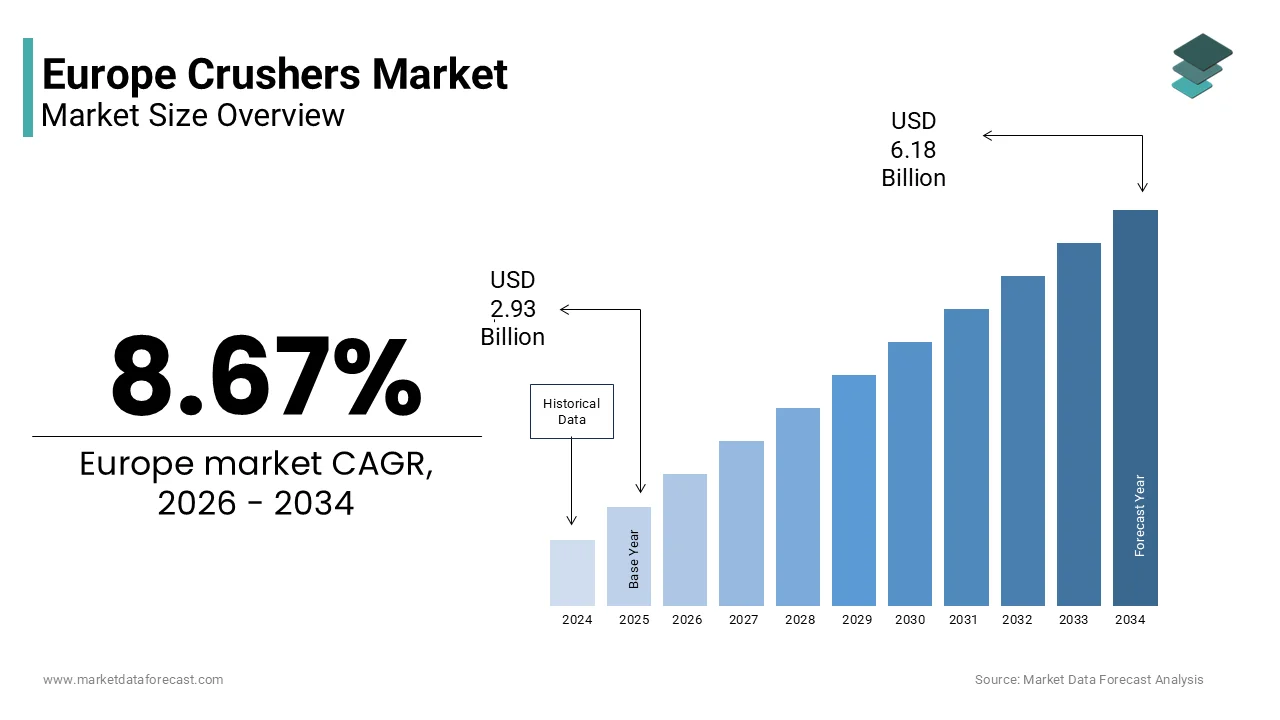
The Europe crushers market was valued at USD 2.93 billion in 2025 and is estimated to reach USD 3.18 billion in 2026, further projected to reach USD 6.18 billion by 2034, growing at a CAGR of 8.67% during the forecast period. Market growth is primarily driven by rising infrastructure development activities, increasing investments in construction and demolition projects, and expanding mining operations across Europe. Growing emphasis on recycling construction waste, adoption of energy efficient crushing technologies, and demand for high capacity stationary and mobile crushers are further accelerating market expansion. Technological advancements such as automation, remote monitoring, and fuel efficient diesel powered systems are also contributing to improved operational efficiency and productivity in the region.
Key Market Trends
- Rising demand for jaw crushers due to their operational efficiency, durability, and suitability for primary crushing applications in mining and construction.
- Increasing adoption of diesel powered stationary crushers supported by their high power output and suitability for large scale infrastructure and quarrying operations.
- Growing focus on construction and demolition waste recycling aligned with Europe’s circular economy and sustainability initiatives.
- Integration of automation, IoT enabled monitoring systems, and predictive maintenance technologies to enhance crusher performance and reduce downtime.
- Expansion of urban redevelopment and transportation infrastructure projects across major European economies driving equipment demand.
Segmental Insights
- Based on type, the jaw crushers segment accounted for 34.2% of the Europe crushers market share in 2025. The segment’s dominance is attributed to its high reliability, cost effectiveness, and capability to handle hard and abrasive materials in primary crushing operations.
- Based on power source, the diesel powered stationary crushers segment held a 52.4% share of the Europe crushers market in 2025. This dominance is driven by strong demand from mining sites, quarries, and large infrastructure projects where consistent power supply and high throughput capacity are critical.
- Based on application, the construction and demolition segment led the market with a 48.7% share in 2025. Growth of this segment is supported by increasing infrastructure renovation, road expansion projects, and the need for efficient material recycling solutions across Europe.
Regional Insights
- The Europe crushers market is experiencing steady expansion supported by infrastructure modernization, mining sector investments, and regulatory support for sustainable material processing. Western Europe remains a mature market driven by technological adoption and large scale infrastructure projects, while Eastern Europe is witnessing accelerated growth due to expanding industrial and construction activities.
Competitive Landscape
The Europe crushers market is moderately consolidated with strong competition among global and regional manufacturers. Leading companies are focusing on product innovation, automation integration, fuel efficiency improvements, and strategic partnerships to strengthen their regional presence. Key players operating in the Europe crushers market include Metso Corporation, Sandvik AB, Terex Corporation, FLSmidth and Co. A S, Thyssenkrupp AG, Astec Industries Inc., Weir Group PLC, McCloskey International, Kleemann GmbH, and Powerscreen.
 Download Free Sample Report
Europe Crushers Market Size
The Europe crushers market size was valued at USD 2.93 billion in 2025 and is projected to reach USD 6.18 billion by 2034 from USD 3.18 billion in 2026, growing at a CAGR of 8.67%.
A crushers is a heavy-duty machine designed to reduce large rocks, ores, or waste materials into smaller, more manageable pieces like gravel, sand, or rock dust. They are essential in mining, infrastructure projects, and recycling to prepare raw materials for further processing or transport. These machines, ranging from jaw and cone crusherss to impact and mobile crushing units, are critical enablers of material circularity and infrastructure development across the continent. Unlike generic industrial equipment, crusherss in Europe are increasingly designed for low emissions, noise suppression, and integration with digital monitoring systems to comply with stringent environmental regulations. According to the sources, the construction sector remains the largest contributor to waste in the European Union, consistently accounting for more than a third of the region's total waste output and sustaining a significant need for processing technology. Furthermore, as per research, a vast majority of construction and demolition debris in the European Union is successfully diverted from landfills through recovery processes, a trend that relies heavily on the use of specialized industrial equipment for material sorting and processing. The market’s evolution is also shaped by the EU’s Green Deal objectives, which prioritize resource efficiency and secondary raw material use. Consequently, modern crusherss are no longer mere processing tools but strategic assets in Europe’s transition toward a low carbon, circular economy.
MARKET DRIVERS
Escalating Construction and Demolition Waste Recycling Mandates
The European Union’s legally binding targets for construction and demolition waste recovery have become a main force contributing to the growth of the Europe crushers market. EU regulations require member states to manage, recycle, or reuse a high proportion of non-hazardous construction and demolition waste, with many countries already exceeding this target using advanced processing methods. Several Northern European nations, including Germany and Belgium, demonstrate high circularity rates in construction, driven by sophisticated, widespread on-site and mobile processing of materials, frequently exceeding EU performance averages. These crusherss transform rubble into reusable aggregates for road bases, concrete production, and landscaping, reducing reliance on virgin quarrying. The use of recycled aggregates in the EU is increasing, with specific member states showing significant progress in substituting natural aggregates with recycled materials in construction. This shift is reinforced by national policies. For instance, France has implemented legislation aiming to significantly increase the use of recycled materials in public procurement, setting mandatory minimum targets for the inclusion of secondary resources in infrastructure projects. As urban renewal accelerates in cities like Milan and Warsaw, contractors increasingly rely on compact tracked crusherss that can operate within confined spaces while meeting strict noise and dust limits. This regulatory and operational imperative ensures consistent demand for efficient, compliant crushing solutions throughout Europe.
Expansion of Urban Infrastructure Renewal Projects
Large-scale rehabilitation is currently underway for the region’s aging urban infrastructure, which is fuelling the expansion of the Europe crushers market. As a result, there is an increased demand for crusherss that can process in situ demolition debris into reusable materials. The European Investment Bank Group is prioritizing record levels of financing for sustainable, low-carbon urban transport and infrastructure as part of its climate bank commitments, focusing on major metropolitan, rail, and energy network projects across Europe. These initiatives often involve the dismantling of obsolete bridges, tunnels, and buildings, generating millions of tons of concrete and masonry that must be processed on site to minimize haulage costs and emissions. Driven by tightening EU environmental regulations and sustainability targets, European public works contracts increasingly include requirements for onsite construction waste management, which is driving demand for on-site, mobile crushing and screening equipment. For example, the Grand Paris Express project employs comprehensive, large-scale sustainable waste management strategies, prioritizing the recycling and reuse of excavated materials for landscaping, backfilling quarries, and producing raw materials for local development projects. Similarly, Swedish transport authorities mandate stringent sustainability standards for road construction, encouraging the reuse of asphalt in hot or cold mix production to minimize waste. This trend toward localized, closed loop material management not only reduces landfill dependency but also aligns with municipal sustainability goals, making crusherss indispensable tools in Europe’s urban transformation agenda.
MARKET RESTRAINTS
Stringent Noise and Emission Regulations in Urban Zones
Increasingly rigorous environmental controls governing noise output and particulate emissions, particularly in densely populated areas, are constraining the growth of the Europe crushers market. These regulations create mounting constraints on the crushers manufacturers in the region. The EU Environmental Noise Directive obliges member states to develop action plans for areas where noise exposure exceeds specified decibel thresholds, a level commonly surpassed by typical on-site crushing machinery. Based on reports from the European Environment Agency, a significant portion of the European population is exposed to detrimental noise levels, leading many cities to implement restrictive operational times and noise-reduction measures for construction equipment. Additionally, EU Non-Road Mobile Machinery regulations mandate strict Stage V emission standards for diesel-powered crusherss, forcing the inclusion of advanced exhaust after-treatment technologies that significantly raise the manufacturing cost of the machines. These compliance measures limit the operational flexibility of older crushers models and raise barriers to entry for smaller demolition firms lacking capital for upgrades. Stricter emission standards have accelerated the modernization of construction equipment, leading to the accelerated retirement of older, non-compliant machinery from rental fleets. These regulations advance public health and environmental goals. However, they simultaneously constrain market accessibility and inflate total cost of ownership, acting as a structural restraint on equipment deployment.
High Capital Expenditure and Financing Barriers for SMEs
Small and medium sized enterprises encounter significant financial hurdles in acquiring modern crushing equipment, which inhibits the expansion of the Europe crushers market. These enterprises constitute the majority of demolition and recycling contractors in the region. SMEs comprise nearly all construction firms in the EU. However, many struggle to finance expensive, high-capacity machinery, which limits their access to specialized equipment. The EIB Group has heavily invested in green, sustainable machinery financing; however, SMEs sometimes encounter, or perceive, barriers regarding collateral and approval times when accessing these funds through intermediaries. High interest rates have contributed to a trend among demolition contractors of delaying the procurement of heavy equipment, such as crusherss, resulting in tighter financing conditions for machinery. This capital constraint forces many firms to rely on aging machinery that fails to meet current emission or efficiency standards, reducing their competitiveness in public tenders that prioritize sustainability credentials. Moreover, the shift toward electric and hybrid crusherss, while environmentally beneficial, further exacerbates affordability gaps, as these models carry a premium over diesel counterparts. Bridging the financial gap through subsidies or leasing is crucial to stop the financial burden from stalling technology adoption in Europe's decentralized recycling sector.
MARKET OPPORTUNITIES
Integration of Crusherss in Circular Aggregates Supply Chains
The formalization of circular aggregates markets across the region paves the way for crushers manufacturers to embed their equipment within certified secondary material value chains, which is predicted to drive the growth of the Europe crushers market. The European Committee for Standardization maintains EN 13242 as a key standard for regulating the quality of recycled aggregates for use in unbound road and civil engineering applications. According to the European Aggregates Association, recycled aggregates constitute a growing, yet still relatively small, percentage of total construction aggregate production, with Germany and the Netherlands being among the top producers in Europe. Crusherss equipped with real time particle size analyzers and moisture sensors are essential to consistently produce material meeting these standards. Companies like Sandvik and Metso have responded by integrating AI driven control systems that auto adjust rotor speed and chamber settings to maintain gradation accuracy. Furthermore, the EU’s Level(s) framework for sustainable building now awards credits for projects using verified recycled content, incentivizing contractors to invest in precision crushing technology. This convergence of standardization, certification, and green building policy is transforming crusherss from mere processing units into quality assurance nodes within a regulated circular economy, opening new revenue streams through performance based service contracts and data analytics.
Electrification of Mobile Crushing Units for Low Emission Zones
The proliferation of urban low emission zones across the region is accelerating the adoption of electric and hybrid mobile crusherss, and thereby provides fresh prospects for the expansion of the Europe crushers market. This shift is creating a high growth niche for technologically advanced manufacturers. European cities are rapidly expanding the number of low-emission zones, with a significant increase in zones planned to be operational by 2025, often restricting older, higher-polluting diesel vehicles and machinery. In response, OEMs have launched battery powered crusherss capable of full day operation on a single charge. Volvo Construction Equipment continues to deploy electric equipment in major European cities, showcasing significant operational cost savings and emission reductions in field tests compared to conventional diesel machinery. The European Battery Alliance and similar industry bodies report that battery energy density for industrial applications is rising, allowing for increased performance and operational efficiency in electrified machinery. Municipalities are further incentivizing this shift. The French government, as part of its efforts to decarbonize construction sites, has introduced financial incentives to encourage the adoption of electric machinery, with supporting policies targeting the reduction of diesel usage in urban areas. The EU's Fit for 55 package sets a comprehensive target to reduce greenhouse gas emissions by 2030, which drives the adoption of stricter emissions standards for various sectors, including the electrification or cleaner fuel usage of non-road machinery. Electrified crusherss are poised to capture an expanding share of urban demolition and roadwork contracts, particularly in Scandinavia and the Benelux region where grid reliability supports consistent charging infrastructure.
MARKET CHALLENGES
Fragmented Permitting Processes for Mobile Crushing Operations
The deployment of mobile crusherss in the region is frequently delayed by inconsistent and protracted permitting procedures across jurisdictions, which challenges the growth of the Europe crushers market. This is the case despite strong policy support for recycling. The EU promotes circular economy principles, yet individual member states retain authority over local zoning, noise, and waste handling permits. Consequently, this creates significant operational friction. Permitting times for temporary mobile crushing sites vary significantly across European nations, with some countries operating under faster, more streamlined processes while others require longer, multi-stage, or decentralized approvals, creating operational challenges for cross-border contractors. In Germany, mobile crushing operators face a complex, fragmented permitting process requiring independent environmental audits and multiple, separate assessments for environmental and traffic impacts. A significant portion of urban recycling projects in Germany faces substantial delays in implementation due to bureaucratic hurdles and slow permitting processes, particularly in the urban mining sector. This administrative fragmentation not only increases project costs but also discourages investment in flexible mobile crushing fleets that could otherwise enhance regional recycling capacity. Until harmonized EU level guidelines streamline approvals for temporary recycling operations, this procedural inconsistency will remain a persistent challenge to market fluidity.
Volatility in Scrap Metal and Aggregate Pricing
The economic viability of crushing operations in Europe is increasingly undermined by sharp fluctuations in the market value of recycled outputs, particularly crushed concrete and reclaimed rebar. This holds back the expansion of the Europe crushers market. European scrap steel prices are experiencing downward pressure driven by a slowdown in global manufacturing and a significant reduction in demand from major international importers. Simultaneously, the market value for recycled construction aggregates in Southern Europe is softening as the availability of primary raw materials stabilizes and construction activity in the region fluctuates. These price swings compress margins for demolition contractors who rely on resale revenue to offset crushing costs. Waste processing firms are facing tighter profit margins and increased financial risk because the market price for recovered materials is becoming more volatile compared to fixed operational costs. This uncertainty discourages long term investment in high capacity crusherss, especially in regions like Greece and Portugal where secondary material markets remain underdeveloped. Moreover, the absence of standardized pricing mechanisms or futures contracts for recycled aggregates leaves operators exposed to spot market risks. Price volatility will keep threatening the financial viability of European crushing operations until reliable valuation methods or public procurement guarantees stabilize the market.
REPORT COVERAGE
| REPORT METRIC | DETAILS |
| Market Size Available | 2025 to 2034 |
| Base Year | 2025 |
| Forecast Period | 2026 to 2034 |
| CAGR | 8.67% |
| Segments Covered | By Size, Type, End Use, Application, Power Source, and Region |
| Various Analyses Covered | Global, Regional, & Country Level Analysis; Segment-Level Analysis; DROC, PESTLE Analysis; Porter’s Five Forces Analysis; Competitive Landscape; Analyst Overview of Investment Opportunities |
| Regions Covered | UK, France, Spain, Germany, Italy, Russia, Sweden, Denmark, Switzerland, Netherlands, Turkey, and the Czech Republic |
| Market Leaders Profiled | Metso Corporation, Sandvik AB, Terex Corporation, FLSmidth & Co. A/S, Thyssenkrupp AG, Astec Industries Inc., Weir Group PLC, McCloskey International, Kleemann GmbH, and Powerscreen |
SEGMENTAL ANALYSIS
By Type Insights
The jaw crusherss segment held the majority share of 34.2% of the Europe crushers market in 2025. The supremacy of the segment is attributed to its robust design, reliability in primary crushing applications, and suitability for processing hard and abrasive materials such as granite, basalt, and reinforced concrete. In the construction and demolition sector, jaw crusherss are the first stage in most recycling circuits, capable of reducing boulders or structural debris. The European Aggregates Association indicates that stationary recycling plants in Germany and France heavily rely on primary reduction equipment, such as jaw crusherss, to process construction and demolition waste. Additionally, their mechanical simplicity, featuring a fixed and movable jaw plate actuated by an eccentric shaft, makes them easier to operate and repair in remote or resource constrained sites. Data from German industry associations indicates that a significant majority of mineral construction waste is recycled into secondary materials, with crusherss serving as a foundational technology in the recovery chain. Their adaptability to both stationary and mobile configurations further enhances their appeal across diverse operational environments, from urban renovation zones to rural quarrying sites.
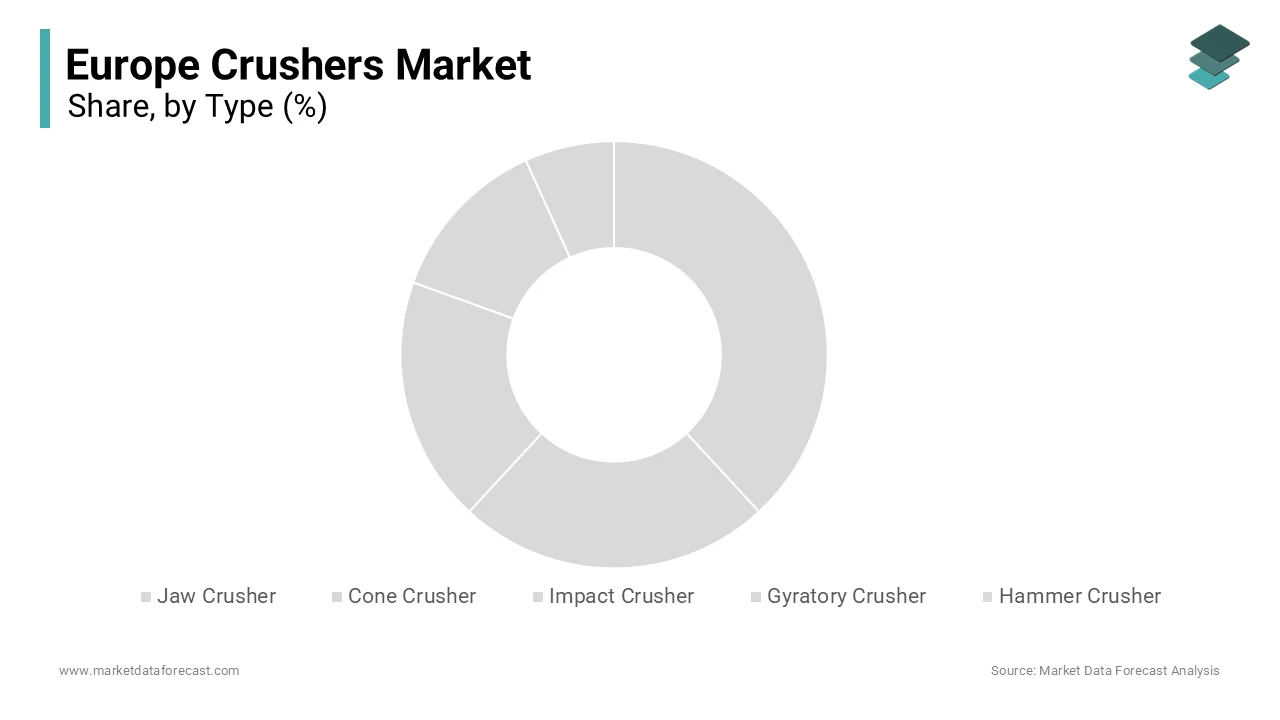
The impact crusherss segment is expected to exhibit a noteworthy CAGR of 6.8% from 2026 to 2034 due to its superior ability to produce uniformly shaped, cubical aggregates ideal for high grade asphalt and concrete applications. Unlike jaw or cone crusherss that generate flaky particles, impact crusherss use high velocity rotor hammers to fracture material along natural cleavage lines, yielding products with better compaction and bonding properties. The European Committee for Standardization’s EN 13242 specification for recycled aggregates explicitly favors cubical particle geometry, giving impact crusherss a technical edge in certified recycling operations. In Scandinavia and the Benelux region, strict durability standards for road base layers are increasingly driving the adoption of high-quality angular aggregate materials to ensure long-term pavement performance. Furthermore, modern horizontal shaft impact crusherss have been optimized for processing demolition concrete with embedded rebar, incorporating magnetic separators and wear resistant blow bars made from chrome alloy steel. Sandvik mobile impact crushers sales have seen a positive trend in Southern Europe, driven by increased recycling and construction activity in regions experiencing rapid infrastructure redevelopment. This combination of product quality, regulatory alignment, and application versatility positions impact crusherss as the high growth engine of the European crushing landscape.
By Power Source Insights
The diesel-powered stationary crusherss segment dominated the Europe crushers market and accounted for a 52.4% share in 2025. The dominance of the segment is driven by the operational realities of large scale quarrying and fixed recycling facilities where grid connectivity is either unavailable or cost prohibitive. In Eastern Europe, where mining and aggregate production remain central to regional economies, diesel units provide the high torque and continuous power needed for 24-hour operations. Many, but not a vast majority of, active quarries in Central Europe utilize diesel-driven primary crushing equipment, particularly in mobile applications, due to operational flexibility and mobility requirements rather than rural grid unreliability. Additionally, stationary diesel systems benefit from decades of engineering refinement, offering proven reliability and lower upfront costs compared to electric alternatives. Industrial crushing equipment, including heavy machinery, is known for a long, durable service life, making it a viable long-term capital investment when properly maintained. Although emission regulations are tightening, many operators retrofit existing units with Stage V compliant engines rather than replace entire systems, preserving sunk investments. This inertia, combined with infrastructure limitations in peripheral regions, ensures diesel stationary crusherss remain the backbone of Europe’s primary material processing infrastructure.
The electric portable crusherss segment is predicted to witness the highest CAGR of 9.3 % during the forecast period owing to the convergence of urban environmental policies, technological advancements in battery systems, and demand for flexible on site recycling. European cities are increasingly implementing stricter emission regulations in city centers, forcing a shift toward zero-emission machinery and powering the transition away from diesel equipment in construction. Volvo Construction Equipment continues to expand its electric product portfolio by introducing new battery-powered, low-noise equipment designed to operate in sensitive, high-density residential areas. Falling lithium iron phosphate (LFP) battery prices are improving the competitiveness and reducing the total cost of ownership for electric-powered industrial machinery. In Amsterdam, municipal contracts for canal bank restoration now mandate electric crushing equipment, while Paris offers fast track permitting for zero emission demolition fleets. These policy incentives, coupled with declining battery prices and rising diesel fuel costs make electric portables increasingly viable for SMEs. Their mobility allows rapid redeployment across multiple urban sites, maximizing asset utilization while complying with green city mandates, thereby driving unprecedented adoption momentum.
By Application Insights
The construction and demolition application segment led the Europe crushers market and captured a share of 48.7% in 2025. The prominence of the segment is credited to the continent’s massive output of structural debris and the legal imperative to recycle it. Eurostat data indicates that construction and demolition waste constitutes a massive percentage of total EU waste, with Germany being one of the largest producers of such waste in the region. Crusherss are indispensable in converting this waste into reusable aggregates for road subbases, pipe bedding, and non structural concrete. The European Union requires member states to achieve a high rate of recovery for construction and demolition waste, a target that was legally required to be met by 2020 and which several nations have achieved, though methods vary from recycling to backfilling. Major urban renewal programs, such as Barcelona’s Superblock initiative and Berlin’s housing retrofit drive, generate consistent feedstock for mobile crushing units operating directly at demolition sites. The European Demolition Association notes that many of its members are increasingly adopting on-site crushing and processing techniques as part of a trend toward improved sustainability, waste minimization, and to avoid high landfill disposal costs, which are rising in several European countries. This regulatory and economic ecosystem ensures that construction and demolition remains the primary driver of crushers deployment across the region.
The environmental application segment is estimated to register the fastest CAGR of 7.9% over the forecast period. The swift growth of the segment is propelled by Europe’s intensifying focus on remediating contaminated land, managing disaster debris, and supporting circular economy initiatives beyond traditional construction. Crusherss are increasingly deployed in brownfield redevelopment projects to process soil mixed with concrete, brick, and light metals for safe reuse. Following the 2023 floods in Slovenia and the 2024 wildfire season in Greece, emergency response teams heavily employed specialized heavy machinery, including excavators, to clear massive amounts of debris and create temporary access routes, with debris management being a critical part of the cleanup and recovery process. The European Environment Agency highlights that a significant number of contaminated sites are currently undergoing remediation across Europe, with soil remediation techniques frequently requiring the mechanical reduction of material size to enable effective treatment. Additionally, crusherss are integral to electronic waste and end of life vehicle recycling streams, where they liberate metals from composite housings. Umicore operates advanced recycling facilities that process various industrial waste streams, including complex, non-ferrous materials, utilizing metallurgical processes to recover valuable metals, with a strong focus on enhancing recycling capacity for automotive battery components. Through funding initiatives like Horizon Europe, the EU is investing heavily in environmental research and remediation technologies, promoting the use of innovative, sustainable, and efficient machinery to manage soil and waste, extending the application of such equipment beyond traditional material processing.
REGIONAL ANALYSIS
Germany Crusher Market Analysis
Germany dominated the Europe crusher market and accounted for a 23.8% share in 2025. The supremacy of the segment is propelled by a sophisticated transition toward circular economy principles where advanced crushing technology is essential for processing construction and demolition waste into reusable aggregates. German engineering firms like Kleemann and ThyssenKrupp set global standards for mobile jaw and impact crushers that offer high fuel efficiency and low emissions. Germany maintains a exceptionally high circularity rate for building materials, fostering a consistent market for machinery that can efficiently process mineral waste into reusable construction aggregates. The government has implemented strict regulations on landfill usage forcing contractors to adopt on site recycling solutions that reduce transport costs and carbon footprints. Significant long-term federal commitments to transport networks are sustaining demand for heavy-duty crushing equipment, despite short-term fluctuations in annual spending growth. The integration of digital monitoring systems allows operators to optimize performance in real time reducing downtime and maintenance costs. This combination of regulatory pressure technological innovation and strong industrial activity ensures Germany remains the primary engine for market growth and equipment sophistication in Europe.
Russia Crusher Market Analysis
Russia was the next prominent country in the European crusher market and captured a 18.5% share in 2025. The growth of the segment is driven by its vast mining sector and extensive infrastructure development needs. The region is known for a heavy reliance on large scale stationary crushers for extracting iron ore copper and gold which are critical to the national economy. Domestic manufacturers and international suppliers operating within the region focus on rugged equipment capable of withstanding extreme climatic conditions and abrasive materials. The Russian extractive industry is currently navigating a period of output stabilization and reorientation toward new trade partners, impacting the procurement cycles for large-scale primary crushing infrastructure. The government has launched ambitious road and rail connectivity programs to link remote resource rich regions with industrial centers creating significant demand for mobile crushing units. Despite international sanctions the domestic industry has adapted by increasing local production of wear parts and developing partnerships with Asian suppliers to maintain operational continuity. The sheer volume of material moved in open pit mines ensures that Russia remains a high volume market for heavy duty crushing solutions. This resilience and scale make Russia a critical component of the overall European market dynamics despite geopolitical complexities.
United Kingdom Crusher Market Analysis
The United Kingdom is also a major part of the Europe crusher market and demonstrates a unique focus on compact and mobile crushers for urban environments. The market status is heavily influenced by stringent environmental laws and high landfill taxes which compel construction firms to recycle debris on site rather than transporting it to distant facilities. British cities face space constraints that favor smaller track mounted crushers and screeners that can navigate narrow streets and operate with minimal noise and dust emissions. The French non-residential building market is currently experiencing a period of contraction, with activity levels dampened by economic uncertainty and tighter financing conditions for new projects. The government has committed billions to housing projects and renewable energy infrastructure such as wind farms which require substantial amounts of processed aggregates. Local dealers offer extensive rental fleets allowing contractors to access the latest technology without large capital outlays fostering a dynamic replacement cycle. The emphasis on sustainability has also led to the adoption of electric and hybrid drive crushers that align with national net zero targets. This blend of regulatory strictness urban density and green initiatives positions the UK as a key market for innovative and environmentally friendly crushing technologies.
France Crusher Market Analysis
France experienced a steady growth in the European crusher market owing to a steady stream of public works projects and a strong demand for high quality aggregates. The market status is defined by the central role of large construction groups like Vinci and Eiffage who invest heavily in modernizing their fleets to improve efficiency and reduce operational costs. French regulations promote the use of recycled materials in road construction creating a dual market for both primary quarrying and secondary recycling crushers. The French non-residential building market is currently experiencing a period of contraction, with activity levels dampened by economic uncertainty and tighter financing conditions for new projects. The government has allocated significant funds for the renovation of nuclear power plants and high speed rail networks ensuring long term demand for crushing equipment. Domestic manufacturers like Terex Finlay have a strong presence offering tailored solutions for the specific geological conditions found across different French regions. The trend toward electrification is gaining momentum with several pilot projects deploying electric powered crushers in quarries to reduce diesel consumption. This stable investment climate and focus on infrastructure renewal ensure France remains a vital and consistent contributor to the European market volume.
Italy Crusher Market Analysis
Italy is anticipated to expand in the European market during the forecast period. The market status is unique due to the presence of world famous Carrara marble quarries which require highly specialized wire saws and primary jaw crushers capable of handling massive blocks of valuable stone. Italian manufacturers like Prinoth and Tesmec are renowned for producing compact and agile tracked crushers that excel in the steep and uneven terrain typical of Italian quarries. The construction sector in Italy is undergoing a revival supported by the National Recovery and Resilience Plan which includes billions for seismic retrofitting and sustainable building projects. Data shows that the export of Italian processed stone remains strong driving domestic demand for efficient secondary and tertiary crushing units to produce precise aggregate sizes. The emphasis on design and aesthetics in Italian architecture requires crushers that can produce cubical products with minimal fines enhancing the value of the final material. Strong support from regional authorities for modernizing quarrying practices to meet environmental standards has accelerated the replacement of older machinery. This focus on high value stone processing and infrastructure recovery positions Italy as a specialized and resilient market within the broader European context.
COMPETITIVE LANDSCAPE
The competition in the Europe crushers market is marked by a blend of global industrial leaders and agile regional specialists competing on technology sustainability and service excellence. Established firms leverage decades of engineering heritage and integrated digital platforms to offer end to end crushing solutions while smaller players differentiate through niche applications such as heritage building deconstruction or hazardous waste processing. Intense rivalry is evident in the race toward electrification with companies rapidly launching battery powered mobile units to access urban low emission zones. Regulatory compliance particularly around noise emissions and particulate control serves as both a barrier and a differentiator shaping product design and deployment strategies. Service capabilities including remote diagnostics rapid parts delivery and operator training have become critical battlegrounds as customers prioritize lifecycle value over initial purchase price. Additionally the push for circularity has elevated the importance of output quality driving innovation in particle shape control and real time gradation monitoring. This dynamic environment fosters continuous advancement but also pressures margins compelling participants to balance scale with specialization and global reach with local responsiveness.
KEY MARKET PLAYERS
Some of the notable key players in the Europe crushers market are
- Metso Corporation
- Sandvik AB
- Terex Corporation
- FLSmidth & Co. A/S
- Thyssenkrupp AG
- Astec Industries, Inc.
- Weir Group PLC
- McCloskey International
- Kleemann GmbH
- Powerscreen
Top Players in the Market
- Sandvik AB is a globally influential engineering group with deep roots in mining and construction equipment, playing a pivotal role in advancing crushing technology across Europe. The company integrates digitalization and sustainability into its crushers portfolio, offering intelligent solutions that optimize performance and reduce environmental impact. In 2025 Sandvik launched its next generation QH441 mobile cone crushers featuring automated chamber adjustment and real time wear monitoring, enhancing productivity in recycling and quarrying operations. It also expanded its service footprint in Southern Europe with new parts distribution centers in Spain and Italy to support rapid maintenance. Through partnerships with European research institutions, Sandvik continues to pioneer low emission crushing systems aligned with EU Green Deal objectives, reinforcing its global reputation for innovation and reliability in heavy machinery.
- Metso Outotec Corporation stands as a key architect of sustainable mineral processing and aggregates solutions, with significant influence across the European crushers landscape. The company emphasizes circularity by designing crusherss that maximize material recovery and minimize energy use. In 2024 Metso introduced its Lokotrack Urban series—ultra quiet electric mobile crusherss tailored for city demolition projects under strict noise and emission limits. It also enhanced its Metrics digital platform to provide predictive analytics for crushers performance, enabling remote diagnostics and optimized maintenance scheduling. By aligning its R&D with EU sustainability directives and expanding training programs for operators in Eastern Europe, Metso strengthens its position as a trusted partner in responsible resource management worldwide.
- Terex Corporation contributes significantly to the Europe crushers market through its versatile range of portable and stationary crushing equipment tailored for construction and recycling applications. The company focuses on modularity and ease of transport, enabling contractors to deploy units rapidly across diverse job sites. In 2025 Terex upgraded its Finlay I 140 jaw crushers with an integrated pre screen and enhanced fuel efficiency systems to meet Stage V emission standards. It also launched a dedicated customer support hub in the Netherlands offering virtual commissioning and operator training via augmented reality. By prioritizing operational flexibility, compliance, and digital enablement, Terex reinforces its global standing as a responsive and adaptive provider of material processing solutions.
Top Strategies Used by the Key Market Participants
Key players in the Europe crushers market pursue several strategic initiatives to sustain competitive advantage. First they invest heavily in electrification and hybrid powertrains to comply with urban low emission zone regulations and reduce total cost of ownership. Second they embed digital intelligence through IoT sensors and cloud based analytics to enable predictive maintenance and remote performance optimization. Third they expand localized service networks including spare parts depots and certified technician training centers to enhance uptime and customer retention. Fourth they develop modular and compact crushers designs suited for confined urban demolition sites and temporary recycling operations. Fifth they align product development with EU circular economy mandates by optimizing output quality for certified recycled aggregates. These strategies collectively ensure responsiveness to regulatory shifts technological demands and evolving customer expectations across diverse European markets.
MARKET SEGMENTATION
This research report on the European crushers market has been segmented and sub-segmented based on categories.
By Size
- Small
- Medium
- Large
- Portable
- Stationary
By Type
- Jaw Crusher
- Cone Crusher
- Impact Crusher
- Gyratory Crusher
- Hammer Crusher
By End Use
- Infrastructure
- Mining
- Quarrying
- Waste Management
- Manufacturing
By Application
- Construction
- Mining
- Demolition
- Recycling
- Aggregate Production
By Power Source
- Electric
- Diesel
- Hybrid
- Hydraulic
- Pneumatic
By Country
- UK
- France
- Spain
- Germany
- Italy
- Russia
- Sweden
- Denmark
- Switzerland
- Netherlands
- Turkey
- Czech Republic
- Rest of Europe