- Product Description Description
- Table of Contents TOC
- List of Table & Figure LOT
- Get Free Sample PDF Sample PDF
Market Size, 2025
$7.12 BnMarket Estimate, 2026
$8.34 BnMarket Forecast, 2034
$29.25 BnCAGR, 2026–2034
16.99%Executive Summary: Europe Customer Experience Management Market
- Market Scope: Comprehensive regional analysis of the European customer experience management (CEM) market covering software solutions, cloud deployment models, touchpoint channels, enterprise segments, and regulatory compliance frameworks.
- Market Valuation: Valued at USD 7.12 billion (2025), estimated at USD 8.34 billion (2026), and projected to reach USD 29.25 billion by 2034, registering a robust CAGR of 16.99% (2026–2034).
- Primary Growth Drivers: Stringent EU regulatory frameworks like the Digital Services Act mandating structured feedback mechanisms, rising consumer demand for hyper-personalized omnichannel interactions, and Financial Conduct Authority Consumer Duty rules. Key opportunities are backed by sovereign cloud solutions and AI-powered journey orchestration.
Key Market Segment Metrics (2026–2034)
| Category | Leading Segment (2025 Position) | Fastest-Growing / Opportunity Segment |
|---|---|---|
| By Component / Offering | Solutions Segment (held significant market share in 2025 due to regulatory mandates for formalized feedback) | Cloud Deployment Model (projected to grow at a strong CAGR of 14.2% across forecast terms) |
| By Channel & Enterprise | Web Channel (captured 38.2% market share in 2025) & Large Enterprises (dominant due to DSA requirements) | AI-Powered Journey Orchestration & Sovereign Cloud CX Integration |
| By Region / Country | Germany (led regionally with a 22.3% share in 2025) & United Kingdom (17.2% share) | Broader European Economic Area (expanding via GDPR-compliant sovereign cloud adoption) |
Major Market Players & Market Structure
Market Structure: Highly competitive European enterprise software and CX landscape featuring global technology leaders competing intensely on EU Sovereign Cloud offerings, explainable AI compliance (EU AI Act), and regulatory partnership models.
Key Companies: Adobe Inc., Salesforce Inc., SAP SE, Oracle Corporation, Microsoft Corporation, IBM Corporation, Qualtrics International Inc., Zendesk Inc., Genesys Telecommunications Laboratories Inc., NICE Inc., SAS Institute Inc., Contentsquare SAS, Freshworks Inc., Zoho Corporation, Pegasystems Inc., and Medallia.
Europe Customer Experience Management Market Size
The Europe Customer Experience Management Market is projected to grow from USD 7.12 billion in 2025 to USD 8.34 billion in 2026 and reach USD 29.25 billion by 2034, registering a CAGR of 16.99% from 2026 to 2034.
The customer experience management is an integrated software platform and analytical frameworks that enable organizations to capture, orchestrate, and optimize interactions across physical, digital, and hybrid customer touchpoints. The urgency to adopt such systems stems from heightened consumer expectations and institutional mandates for ethical data use. Simultaneously, the European Commission’s 2023 Digital Services Act requires large online platforms to implement transparent user feedback mechanisms and redress systems. Additionally, the European Consumer Organisation reported that some of the service complaints in 2024 originated from inconsistent experiences across channels, such as mobile apps, call centers, and in-store interactions. These dynamics position customer experience management not as a luxury but as a compliance and retention necessity within Europe’s increasingly empowered and privacy-aware consumer landscape.
MAREKT DRIVERS
Rising Consumer Expectations for Hyperpersonalized and Seamless Interactions
European consumers now demand contextual relevance and continuity across every brand interaction, regardless of channel or device, which is accelerating the growth of the European customer experience management market. This expectation is particularly acute in sectors like banking and telecommunications, where customers interact through an average of 4.2 touchpoints per resolution journey, as documented by the European Banking Authority. For example, a major Nordic retailer implemented a dynamic journey orchestration engine that increased first contact resolution by 37% and reduced customer effort scores by 29% within six months.
Regulatory Pressure to Institutionalize Customer Feedback and Redress Mechanisms
European Union legislation is compelling companies to embed structured customer experience management into their operational DNA. The regulatory efforts to institutionalize customer feedback and redress mechanisms are additionally accelerating the growth of the European customer experience management market. The Digital Services Act mandates that very large online platforms establish accessible complaint handling systems and publish quarterly transparency reports on user feedback resolution, as confirmed by the European Commission’s implementation guidelines issued in January 2024. Similarly, the Revised Payment Services Directive requires financial institutions to monitor and act on payment journey friction points using real-time analytics. In Germany, the Federal Office of Consumer Protection now audits experience data as part of sectoral compliance reviews, while France’s DGCCRF has fined 3 major utilities since 2023 for failing to demonstrate closed-loop feedback processes. These regulatory interventions transform customer experience from a marketing function into a legal obligation, thereby accelerating investment in certified experience management platforms that provide audit trails, ls sentiment tracking, and automated escalation workflows aligned with EU consumer rights frameworks.
MARKET RESTRAINTS
Stringent Data Privacy Regulations Limiting Behavioral Analytics and Personalization
The General Data Protection Regulation and complementary national laws impose strict constraints on the collection, processing, and storage of personal data, thereby restricting the depth of customer insights available for experience personalization. The stringent data privacy regulations limiting behavioral analytics and personalization are restraining the growth of the European customer experience management market. This opt-out rate cripples the effectiveness of journey analytics that rely on persistent identifiers. Moreover, the European Court of Justice’s 2023 ruling in the C 460 22 case invalidated several third-party tracking mechanisms previously used for cross-channel attribution. A survey by the European Customer Experience Association revealed that some experience professionals cite data fragmentation due to privacy compliance as their top operational barrier.
Fragmented Technology Landscapes and Legacy System Incompatibility
Many European enterprises operate on siloed legacy systems that lack the APIs or data structures necessary to integrate with modern cloud native customer experience platforms. This factor is additionally hampering the growth of the European customer experience management market. This technological debt forces firms to maintain parallel data flows or conduct manual exports, undermining the accuracy and timeliness of experience insights. For instance, a major Portuguese bank reported a 48-hour delay in routing high-risk customer complaints to resolution teams due to batch-based data synchronization between its legacy telephony system and new experience platform. Migration costs further deter upgrades, with average replacement budgets exceeding 12 million euros for multinational insurers, as per the survey.
MARKET OPPORTUNITIES
Integration of Generative AI for Real-Time Empathetic Agent Support
The emergence of large language models trained on European linguistic and cultural norms to enhance human agent performance through real-time coaching and response generation is significantly boosting the growth of the European customer experience management market. Telefónica and Allianz demonstrated that AI-assisted agents reduced average handling time by 22% while increasing customer satisfaction scores by 18 points by suggesting contextually appropriate empathetic phrasing and next best actions. Unlike rule-based scripts, generative AI interprets emotional cues from voice tone or chat text and adapts responses accordingly, a capability particularly valued in high-stress interactions such as insurance claims or service outages. The European AI Office’s 2024 draft guidelines explicitly permit such assistive use cases, provided human oversight is maintained, and bias testing is documented. This regulatory clarity enables rapid deployment of AIco-pilots that augment rather than replace human judgment, aligning technological innovation with Europe’s human-centric AI principles.
Expansion of Experience Management into Physical Retail and Service Environments
As digital saturation plateaus, European brands are turning to in-person experiences as a key differentiator, with 74% of consumers stating they prefer to resolve complex issues face to face. The expansion of experience management into physical retail and service environments is creating new opportunities for the growth of the European customer experience management market. This shift creates demand for integrated platforms that capture feedback from physical touchpoints, including in-store interactions, kiosks, and service appointments. Technologies such as post-visit SMS surveys beacon beacon-triggered mobile feedback, and staff wearable sentiment trackers are gaining traction. For example, IKEA’s pilot in the Netherlands uses tablet-based checkout feedback linked to an associate performance dashboard, resulting in an improvement in staff responsiveness scores. Similarly, Deutsche Bahn has embedded experience sensors in ticket counters that trigger manager alerts when wait times exceed thresholds. These innovations bridge the offline-online divide and generate holistic journey maps previously impossible to construct.
MARKET CHALLENGES
Lack of Standardized Metrics and Benchmarking Frameworks Across Sectors
Despite widespread adoption of experience management tools, European organizations struggle to compare performance due to the absence of sector-specific or regionally harmonized key performance indicators. This factor is likely to pose a challenge for the growth of the European customer experience management market. Others rely on proprietary metrics like Customer Effort Score or Emotional Satisfaction Index, making cross-industry learning and regulatory benchmarking nearly impossible. This fragmentation impedes best practice sharing and obscures true performance gaps. The European Commission’s 2023 proposal for a Common Customer Experience Indicator remains stalled in parliamentary review, leaving firms to navigate a patchwork of national and sectoral expectations.
Talent Shortage in Experience Data Science and Ethical AI Governance
The shortage of professionals skilled in both customer experience analytics and responsible AI implementation is additionally inhibiting the growth of the European customer experience management market. This gap is exacerbated by stringent requirements for AI explainability under the EU AI Act, which mandates that high-risk experience systems, such as automated complaint classifiers, provide human human-interpretable rationale for decisions. Companies report difficulty recruiting staff who can both build predictive churn models and document bias mitigation protocols to regulatory standards. A 2024 survey by the European Customer Experience Association found that firms delay AI deployment due to insufficient in-house governance expertise.
REPORT COVERAGE
| REPORT METRIC | DETAILS |
| Market Size Available | 2025 to 2034 |
| Base Year | 2025 |
| Forecast Period | 2026 to 2034 |
| Segments Covered | By Component, Organization Size, Touchpoint, and Region. |
| Various Analyses Covered | Global, Regional, and Country-Level Analysis, Segment-Level Analysis, Drivers, Restraints, Opportunities, Challenges; PESTLE Analysis; Porter’s Five Forces Analysis, Competitive Landscape, Analyst Overview of Investment Opportunities |
| Countries Covered | UK, France, Spain, Germany, Italy, Russia, Sweden, Denmark, Switzerland, Netherlands, Turkey, Czech Republic, Rest of Europe |
| Market Leaders Profiled | Adobe Inc., Salesforce, Inc., SAP SE, Oracle Corporation, Microsoft Corporation, IBM Corporation, Qualtrics International Inc., Zendesk, Inc., Genesys Telecommunications Laboratories, Inc., NICE Ltd., Medallia, Inc., Sprinklr, Inc., Verint Systems Inc., Talkdesk, Inc., HubSpot, Inc., Freshworks Inc., Zoho Corporation, Pegasystems Inc., SAS Institute Inc., Contentsquare SAS |
SEGMENTAL ANALYSIS
By Component Insights
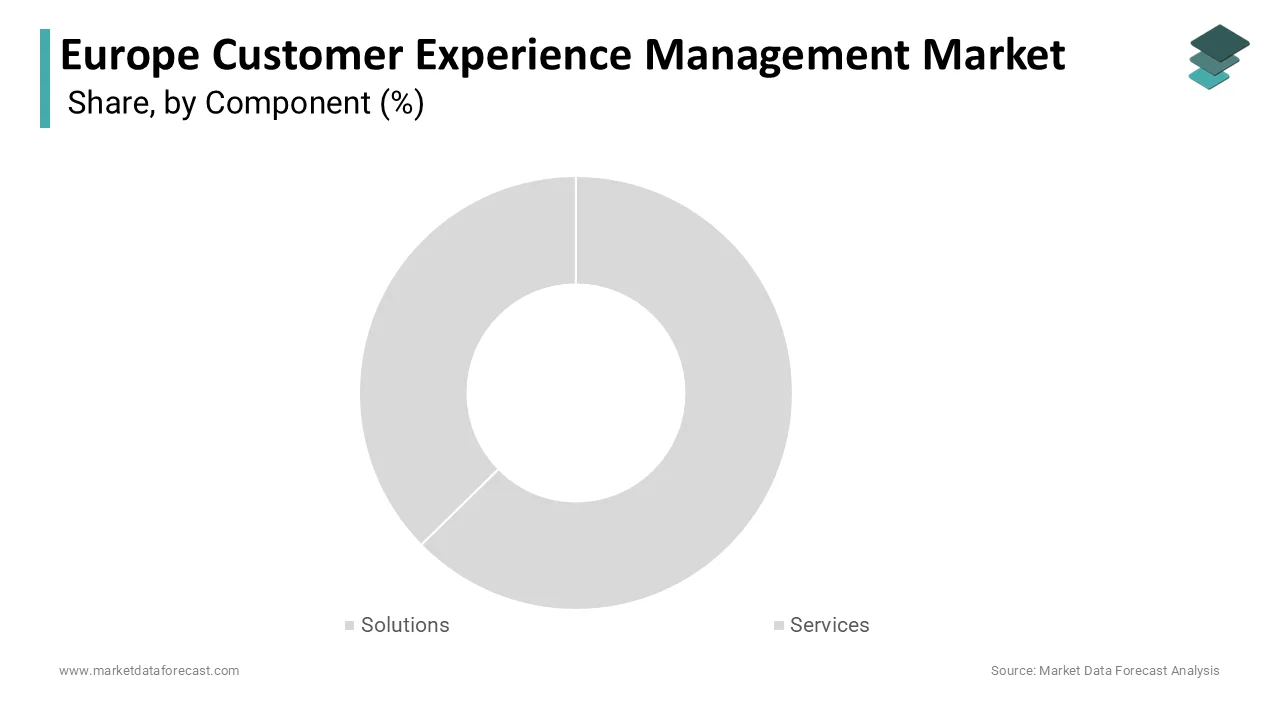
The solutions segment accounted in holding a significant share of the European customer experience management market in 2025. European Union regulations, such as the Digital Services Act and sector-specific consumer directives, compel organizations to implement formalized systems for collecting and responding to user feedback. The European Commission’s 2024 enforcement guidance explicitly requires very large online platforms to deploy real-time sentiment analysis and complaint categorization engines. As a result, companies have prioritized purchasing integrated experience platforms that provide audit-ready data trails, sentiment scoring, and automated escalation workflows. European consumers increasingly expect contextual relevance during interactions with brands.
The cloud deployment segment is likely to grow at the fastest CAGR of 14.2% from 2025 to 2033. European governments and regulated industries are migrating customer experience workloads to secure cloud environments to enhance agility and compliance. The European Commission’s Cloud First policy mandates that all new public sector digital services be cloud native by 2025, as confirmed in its 2024 Digital Europe Implementation Report. Simultaneously, the European Central Bank’s 2023 cloud guidelines for financial institutions have standardized security and data residency requirements, enabling banks to adopt cloud-based experience platforms without regulatory risk. In France, large insurers now run their voice of customer programs on sovereign cloud infrastructures offered by OVHcloud and Orange Business Services. Cloud providers are embedding GDPR compliant analytics directly into experience platforms through techniques like differential privacy, federated learning, and on-device processing. Microsoft’s European Azure regions now offer built-in data localization and automated consent management features that satisfy Article 30 GDPR requirements. Similarly, Salesforce’s EU Sovereign Cloud ensures all customer data from ingestion to analysis remains within EU borders with encrypted processing. These innovations resolve long-standing privacy concerns that previously limited cloud adoption.
By Organization Size Insights
The large enterprises segment accounted in holding a significant share of the European customer experience management market in 2025. Large enterprises face disproportionate regulatory pressure to demonstrate robust customer redress mechanisms under EU frameworks. The Digital Services Act classifies organizations with over 45 million monthly EU users as very large online platforms subject to mandatory experience monitoring and transparency reporting. As of 2024, this includes 23 European headquartered firms across e-commerce media and finance, as per the European Commission’s official designation list. These entities must implement enterprise-grade experience platforms capable of processing millions of interactions daily with full auditability. Large enterprises operate across dozens of countries with diverse languages, cultures, and service expectations, on sophisticated orchestration platforms.
The small and medium enterprises segment is likely to witness the fastest CAGR of 16.8% throughout the forecast period. Cloud native experience platforms now offer SME tailored pricing with entry plans starting at 99 euros per month and modular feature sets that scale with business growth. Companies like Qualtrics and Medallia have launched SME editions that include essential capabilities such as ppost-interactionsurveys,, journey mapping, and basic sentiment analysis without requiring data science teams. These solutions integrate directly with common SME tools like Sho, Pify, Zoho, and Microsoft 365, reducing implementation barriers. SMEs face unprecedented churn risk as digital platforms empower local consumers to compare and switch providers instantly. In response, SMEs are adopting lightweight experience tools to monitor reviews, manage feedback, and personalize loyalty offers.
By Touchpoint Insights
The web channel segment held 38.2% of the European customer experience management market share in 2025. For most European businesses, the website serves as the central point for product discovery, account management, support, and transaction completion. In 2024, 82% of European consumers initiated service requests through brand websites before escalating to phone or chat, as per recent studies. This makes the web experience for both revenue and retention. Advanced platforms now embed session replay heatmaps and on-page feedback widgets to diagnose friction in real time. The direct link between web experience and commercial outcomes ensures sustained investment in web-centric experience tools. European accessibility directives mandate that public sector and large private sector websites comply with WCAG 2.1 standards by 2025. Non-compliance carries fines of up to 4% of annual turnover in countries like France and Germany. Experience management platforms help organizations monitor accessibility issues, such as missing alt text, color contrast errors, and navigation barriers, through automated audits. Additionally, the Digital Services Act requires clear complaint submission paths on all commercial websites, prompting brands to embed feedback forms directly into service pages.
The social media segment is expected to register the fastest CAGR of 19.3% from 2025 to 2033. European consumers are increasingly initiating customer service interactions via social messaging apps rather than traditional channels. In 2024, adults aged 18 to 34 in Western Europe contacted brands through Instagram Direct or WhatsApp for support, as per a Meta-commissioned study validated by the European Interactive Advertising Association. These conversations often involve multimedia, such as photo-based product complaints or video demonstrations of malfunctioning devices. Experience platforms now integrate with social APIs to capture sentiment, analyze intent, and route issues to appropriate agents while preserving context.
COUNTRY LEVEL ANALYSIS
Germany Customer Experience Management Market Analysis
Germany was the largest contributor by capturing 22.3% of the European customer experience management market share in 2025. This drives corporations like Siemens, Bosch, and Deutsche Bahn to invest heavily in enterprise-grade experience platforms that integrate with industrial IoT systems and service networks. Additionally, Germany’s Federal Network Agency enforces strict transparency rules requiring real-time complaint tracking and public reporting for telecoms, energy, and transport sectors. The country also hosts the European headquarters of major experience vendors, including SAP and Software AG, which develop GDPR native solutions tested in the German regulatory environment before pan-European rollout.
United Kingdom Customer Experience Management Market Analysis
The United Kingdom was ranked second by holding 17.2% of the European customer experience management market in 2024. London serves as Europe’s financial hub with over 200 major banks, insurers, and fintechs subject to the Financial Conduct Authority’s 2023 Consumer Duty rules that mandate proactive identification of customer harm through experience data. This has triggered widespread adoption of journey analytics and real-time intervention engines across the sector. Additionally, the UK’s Competition and Markets Authority actively investigates customer friction points in digital markets, compelling firms like Amazon, Google, and Meta to implement advanced experience monitoring. These regulatory and technological dynamics ensure the UK remains a high-intensity adoption market despite post-Brexit divergence.
France Customer Experience Management Market Analysis
The French customer experience management market growth is likely to be driven by digital sovereignty initiatives, strong public sector digitization, and consumer rights enforcement. France’s Digital Republic Act requires all public services to implement user feedback loops with measurable improvement targets, driving adoption of experience platforms across health, care, transport, and education. Simultaneously, the Directorate General for Competition, Consumer Affairs, and Fraud Control has intensified audits of private sector complaint handling w with eight major fines issued in 2024, one for inadequate redress systems. French enterprises are also prioritizing sovereign cloud solutions with OVHcloud and Thales offering experience management stacks that guarantee data residency and algorithmic transparency. Companies like Orange and L’Oréal have become global benchmarks for ethical AI in customer service, publishing detailed impact assessments, as required by the French AI Strategy.
COMPETITIVE LANDSCAPE
Competition in the European customer experience management market is intensifying as global vendors, local specialists, and cloud hyperscalers vie for dominance in a landscape defined by regulatory complexity and cultural diversity. Leading firms differentiate through certified data sovereignty, ethical AI governance, and deep integration with European digital identity frameworks such as eIDAS. The market is witnessing consolidation as larger players acquire conversational AI and privacy engineering startups to enhance their compliance capabilities. At the same time, open standards initiatives like the European Data Interoperability Framework are pressuring vendors to adopt modular architectures that prevent vendor lock-in. Talent in regulatory technology, ethical data science, and multilingual natural language processing has become a critical competitive asset. Unlike other regions, nsere feature richness drives aadoptionEurope, legal adherence, brand trust, and cross-border scalability determine market leadership. This environment rewards companies that combine technical innovation with institutional credibility and public policy alignment.
KEY MARKET PLAYERS
Some of the companies that are playing a dominating role in the global europe customer experience management market include
- Adobe Inc.
- Salesforce, Inc.
- SAP SE
- Oracle Corporation
- Microsoft Corporation
- IBM Corporation
- Qualtrics International Inc.
- Zendesk, Inc.
- Genesys Telecommunications Laboratories, Inc.
- NICE Ltd.
- Medallia, Inc.
- Sprinklr, Inc.
- Verint Systems Inc.
- Talkdesk, Inc.
- HubSpot, Inc.
- Freshworks Inc.
- Zoho Corporation
- Pegasystems Inc.
- SAS Institute Inc.
- Contentsquare SAS
TOP LEADING PLAYERS IN THE MARKET
- Qualtrics is a global leader in experience management with a strong footprint across European enterprises in financial services, retail, and public sectors. The company provides an integrated platform that unifies customer, er employee, and product experience data into actionable intelligence. Qualtrics contributes to global standards through its XM Institut, which publishes evidence-based frameworks adopted by regulators and corporations worldwide. Qualtrics launched its European Sovereign Cloud environment hosted on Microsoft Azure regions in Germany and France, ensuring full data residency and compliance with GDPR and the EU AI Act. This infrastructure enhancement strengthens its ability to serve highly regulated industries while reinforcing trust in ethical data handling across the region.
- Medallia is a prominent player in the European customer experience management market, offering real-time feedback ingestion, journey analytics, cs dandAI-driven insight engines tailored to European linguistic and regulatory contexts. The company plays a critical role in advancing conversational intelligence through its integration with regional messaging platforms like WhatsApp and Threema. Medallia actively collaborates with European data protection authorities to ensure its AI models meet transparency and bias mitigation requirements. Recently, the company introduced a multilingual sentiment analysis engine trained on 24 European languages, including regional dialects, such as Catalan and Flemish. This innovation enables brands to detect nuanced emotional cues across diverse markets, thereby deepening engagement and compliance in complex linguistic environments.
- Salesforce leverages its Service Cloud and Customer 360 platform to deliver end-to-end experience orchestration across Europe’s digital and physical touchpoints. The company’s global ecosystem of partners and developers enables rapid customization for sector-specific workflows in banking, healthcare, and utilities. Salesforce contributes to the European market by embedding ethical AI principles into its Einstein analytics suite with explainable recommendation engines that satisfy EU regulatory expectations. Salesforce expanded its EU Sovereign Cloud offering to include experience data processing exclusively within European borders with automated consent management aligned with GDPR Article 30. This move ensures that even multinational deployments maintain full regulatory adherence while delivering personalized experiences at scale.
TOP STRATEGIES USED BY THE KEY MARKET PARTICIPANTS
Key players in the European customer experience management market are investing in sovereign cloud infrastructures to ensure data residency and compliance with GDPR and the EU AI Act. They are developing multilingual and culturally adaptive AI models that accurately interpret sentiment across Europe’s diverse linguistic landscape. Companies are embedding explainable artificial intelligence features to provide a transparent rationale for automated decisions satisfying regulatory scrutiny. Strategic partnerships with national regulators and consumer protection agencies help align product roadmaps with evolving policy requirements.
MARKET SEGMENTATION
This research report on the europe customer experience management market is segmented and sub-segmented into the following categories.
By Component
- Solutions
- Services
By Organization Size
- Large Enterprises
- Small & Medium Enterprises (SMEs)
By Touchpoint
- Web
- Mobile Apps
- Contact Centers
- Social Media
- Others
By Country
- Germany
- United Kingdom
- France
- Italy
- Spain
- Rest of Europe