- Product Description Description
- Table of Contents TOC
- List of Table & Figure LOT
- Get Free Sample PDF Sample PDF
Market Size, 2025
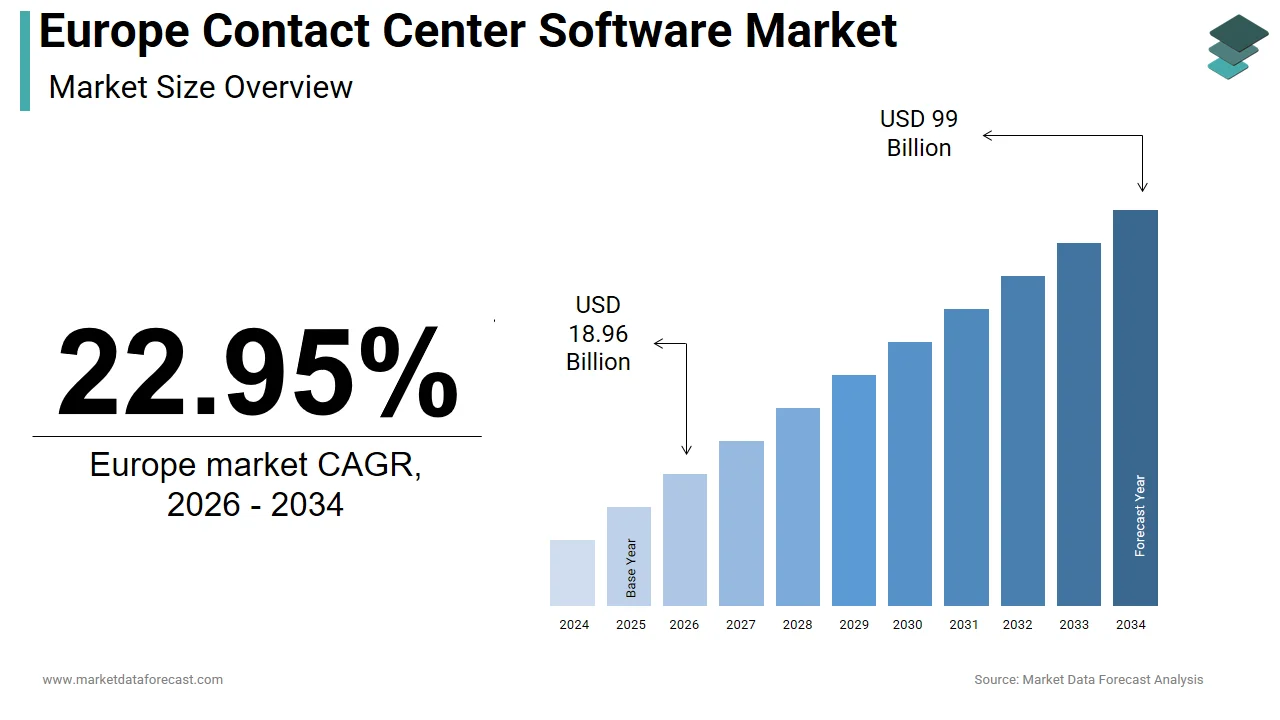
$15.42 BnMarket Estimate, 2026
$18.96 BnMarket Forecast, 2034
$99 BnCAGR, 2026–2034
22.95%Europe Contact Center Software Market Size
The Europe contact center software market was valued at USD 15.42 billion in 2025, is estimated to reach USD 18.96 billion in 2026, and is projected to reach USD 99 billion by 2034, growing at a CAGR of 22.95% from 2026 to 2034.
Contact center software in Europe encompasses integrated platforms that manage multichannel customer interactions through cloud-based or on-premise deployments, including voice, email, chat, social media, and messaging apps. These solutions leverage artificial intelligence, real-time analytics, workforce optimization, and omnichannel routing to enhance service efficiency, compliance, and customer experience. The European market is uniquely shaped by stringent data protection mandates under the General Data Protection Regulation and the ePrivacy Directive, which require that customer data remain within the European Economic Area and that call recordings obtain explicit consent. According to a third-party survey from 2022, nearly three-quarters of organizations are held to data residency requirements, highlighting a significant trend in the EU market due to GDPR considerations. As per Eurostat data for 2023, 60.5% of large EU enterprises reported using Customer Relationship Management (CRM) software to manage client interactions, reflecting a growing adoption of such platforms. Apart from these, the Digital Services Act has intensified accountability for response times and transparency in automated decision-making, pushing organizations toward compliant, auditable software architectures. European contact centers are moving beyond standard CRM software; contemporary platforms in the region now heavily integrate AI-powered sentiment analysis, real-time assistance for agents, and robust regulatory logging to meet stringent local demands for enhanced customer experience, operational strength, and legal compliance.
MARKET DRIVERS
Stringent Data Privacy and Consent Management Requirements
European regulatory frameworks are a primary driver of the Europe contact center software market. This compels organizations to implement platforms that enforce granular data governance and user consent protocols. The General Data Protection Regulation mandates that personal data, including call recordings, chat logs, and customer profiles, be processed lawfully, stored only as long as necessary, and protected against unauthorized access. According to the Spanish Data Protection Agency (AEPD) Annual Report, there was a 43 percent rise in complaints in 2023 compared to the previous year, emphasizing increased data privacy concerns. In response, enterprises are migrating to contact center solutions with built-in data residency controls, automatic redaction of sensitive information, and dynamic consent capture interfaces. Under GDPR, organizations must obtain explicit consent for recording calls and have the technical capacity to delete recordings upon a valid customer request to exercise their "right to be forgotten. Similarly, France's data protection authority (CNIL) emphasizes the importance of transparency for any AI system processing personal data, including voice analytics. These legal imperatives transform contact center software from a productivity tool into a compliance infrastructure.
Rising Demand for AI-Enhanced Agent Support and Self-Service
European businesses are increasingly deploying AI to address labor shortages and elevate service quality amid rising customer expectations fuels the expansion of the Europe contact center software market. The European Union faces a shortfall of customer service professionals, which prompts firms to augment human agents with real-time AI assistance. Modern platforms now offer features such as live sentiment analysis, next best action suggestions, and automated knowledge retrieval during calls, which reduces average handling time. Concurrently, intelligent virtual agents are handling routine inquiries with growing sophistication. Consumer acceptance is also rising. This dual push from workforce constraints and service efficiency is accelerating investment in AI native contact center platforms that balance automation with human oversight, particularly in regulated industries where accuracy and auditability remain paramount.
MARKET RESTRAINTS
Fragmented National Telecommunications and Compliance Regimes
Divergent national regulations governing voice communications, recording consent, and telephony infrastructure complicate standardized deployments, which restrain the growth of the Europe contact center software market. Member states add country-specific stipulations that modify software configuration, building upon the baseline established by the General Data Protection Regulation. According to research, a number of EU countries maintain distinct rules on lawful interception and emergency call routing that impact contact center telephony setups. These inconsistencies force vendors to maintain multiple compliance modules, which increases development costs and delays time to market. This regulatory patchwork not only inflates operational complexity but also deters smaller vendors from cross-border expansion, which ultimately limits innovation and choice in the market.
Integration Complexity with Legacy CRM and Enterprise Systems
Many European organizations, particularly in banking, insurance, and public services, operate on decades-old customer relationship management and back office systems that lack modern APIs or cloud compatibility, creating significant barriers to the Europe contact center software market. According to studies, many large enterprises in the EU still rely on on-premises legacy applications developed, many built on proprietary databases or mainframe architectures. Integrating real-time interaction data from modern contact center platforms into these systems often requires custom middleware, manual data synchronization, or costly re-engineering. Furthermore, public sector entities face additional hurdles. These technical debt challenges increase implementation timelines by several months and raise the total cost of ownership, as per sources. Integration challenges will continue to hinder software adoption until legacy systems are modernized.
MARKET OPPORTUNITIES
Expansion of Cloud Native Solutions for Public Sector Digitization
The public sector in the region offers a new opportunity for the Europe contact center software market. This is because governments are accelerating digital service delivery under the EU Digital Decade targets. National and municipal agencies are modernizing citizen support through cloud-based platforms that offer scalability, multilingual support, and accessibility compliance. The German Federal Employment Agency has implemented AI tools, such as an internal helpdesk capable of handling up to 90% of routine inquiries, to reduce backlogs and improve efficiency. Similarly, France's "France Services" initiative aims to ensure citizens have easy access to public services through thousands of local, unified access points, and generally adheres to EU-wide regulations like GDPR and accessibility standards. The increasing emphasis among public entities on delivering a positive citizen experience, while simultaneously meeting regulatory requirements, drives the demand for sovereign, secure, and interoperable contact center solutions.
Adoption of Conversational AI in Regulated Financial Services
Financial institutions in the region are increasingly leveraging advanced conversational AI to enhance compliance, reduce fraud, and improve customer engagement while adhering to strict regulatory oversight, which generates fresh prospects for the expansion of the Europe contact center software market. These systems flag anomalies such as inconsistent account knowledge or stress indicators, triggering compliance workflows without disrupting service. Apart from these, the Payment Services Directive 2 mandates strong customer authentication, which AI agents now facilitate through dynamic step-up verification during digital interactions. Contact center software that embeds compliance directly into conversational workflows is becoming indispensable as financial firms strive to balance innovation with regulatory rigor.
MARKET CHALLENGES
Persistent Skills Gap in AI and Cloud Platform Management
The acute shortage of professionals skilled in configuring, managing, and optimizing AI-driven cloud platforms challenges the growth of the Europe contact center software market. While demand for advanced features like real-time transcription, sentiment analysis, and predictive routing surges, the talent pool remains insufficient to support deployment and maintenance. According to research, many contact center managers in the EU reported difficulty hiring staff with expertise in cloud telephony and AI analytics. This gap is particularly severe in Southern and Eastern Europe, where digital upskilling programs lag behind Western counterparts. Moreover, ongoing platform updates from vendors require continuous learning, yet a share of enterprises lack formal training partnerships, as per sources. Organizations may not fully leverage their software or meet expected returns on technology adoption without specific funding for workforce development and vendor-driven enablement initiatives.
Evolving Consumer Expectations for Seamless Cross-Channel Journeys
European consumers increasingly expect consistent, context-aware service across voice, chat, email, and social media, and meeting this demand slows down the expansion of the Europe contact center software market. Fragmented data silos between marketing, sales, and service systems often prevent agents from accessing prior interaction history, leading to disjointed experiences. Apart from these, the rise of messaging apps like WhatsApp and Telegram requires integration with non-traditional channels that many legacy platforms do not support natively. Meeting these expectations demands sophisticated journey orchestration engines, real-time data synchronization, and identity resolution capabilities that remain costly and complex to implement. The strategic risk to brand loyalty and operational efficiency increases as consumer tolerance for friction declines, which emphasizes the necessity of seamless omnichannel operations.
REPORT COVERAGE
| REPORT METRIC | DETAILS |
| Market Size Available | 2025 to 2034 |
| Base Year | 2025 |
| Forecast Period | 2026 to 2034 |
| Segments Covered | By Solution, Service, Deployment, Enterprise Size, En-use, and Region. |
| Various Analyses Covered | Global, Regional and Country-Level Analysis, Segment-Level Analysis, Drivers, Restraints, Opportunities, Challenges; PESTLE Analysis; Porter’s Five Forces Analysis, Competitive Landscape, Analyst Overview of Investment Opportunities |
| Countries Covered | UK, France, Spain, Germany, Italy, Russia, Sweden, Denmark, Switzerland, Netherlands, Turkey, Czech Republic, and the Rest of Europe. |
| Market Leaders Profiled | ALE International, Altivon, Amazon Web Services, Inc., Ameyo, Amtelco, Aspect Software, Avaya Inc., Avoxi, Cisco Systems, Inc., Enghouse Interactive Inc., Exotel Techcom Pvt. Ltd., Five9, Inc., Genesys, NICE Ltd, Microsoft Corporation, SAP SE, Spok, Inc., Talkdesk, Inc., Twilio Inc., UiPath, Unify Inc., and VCC Live. |
SEGMENTAL ANALYSIS
By Solution Insights
The reporting and analytics segment held the leading share of 22.5% of the Europe contact center software market in 2024. The dominance of the reporting and analytics segment is because of the critical need for real-time performance visibility, regulatory compliance, and data-driven decision making across highly scrutinized service environments. European enterprises are mandated under the Digital Services Act to monitor and report on response times, resolution rates, and automated decision transparency, necessitating advanced analytics engines. Apart from these, the rise of AI-powered sentiment analysis has transformed analytics from retrospective reporting to predictive intervention. Public sector digitization further fuels demand. Regulatory demands have turned customer experience into a formal metric, moving it beyond a simple differentiator. Consequently, reporting and analytics functions have become indispensable as the central nervous system of contemporary European contact centers.
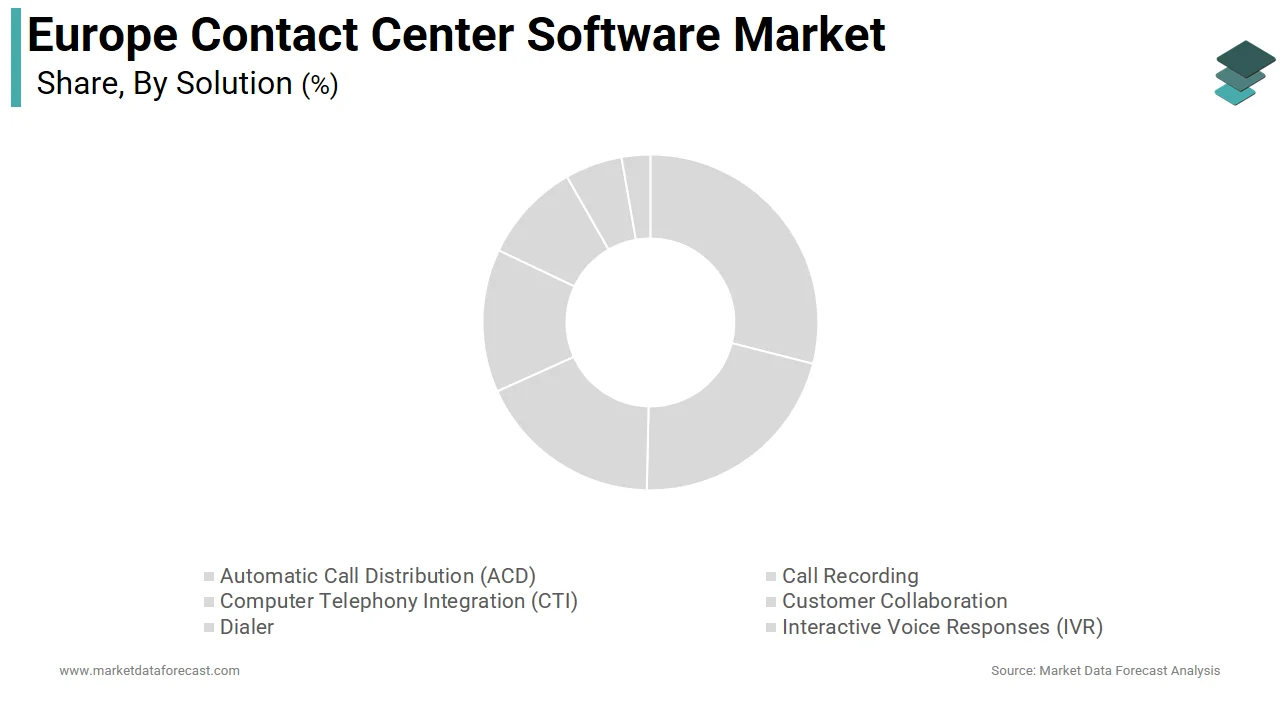
The customer collaboration segment is expected to exhibit a noteworthy CAGR of 18.4% from 2026 to 2034. The rapid growth of the customer collaboration segment is driven by the shift toward co-created service experiences via video, screen sharing, digital whiteboards, and secure document exchange, features increasingly expected in complex service domains like banking, insurance, and technical support. Regulatory alignment also supports adoption. Furthermore, the rise of remote work has normalized visual interaction. As per sources, a share of EU service professionals now use collaboration tools daily, raising consumer expectations for similar capabilities in customer service. This convergence of regulatory acceptance, behavioral change, and service complexity positions customer collaboration as the most dynamic frontier in European contact center innovation.
By Service Insights
The support and maintenance segment remained the largest share of the Europe contact center software services market and captured 38.2% share in 2024. The dominance of the support and maintenance segment is attributed to the operational reality that contact center platforms require continuous updates, security patching, performance tuning, and compliance alignment in a rapidly evolving regulatory and technological landscape. The General Data Protection Regulation and the Cyber Resilience Act mandate regular vulnerability assessments and audit logging, tasks that most enterprises outsource to specialized vendors. According to studies, many organizations rely on vendor-managed support to ensure uninterrupted service during peak periods such as tax season or holiday sales. Apart from these, the integration of AI models necessitates ongoing monitoring for bias drift and accuracy decay. Public sector contracts further institutionalize this dependency. These regulatory, technical, and operational imperatives make support and maintenance not an optional add-on but a core component of service continuity and compliance in Europe.
The managed services segment is predicted to witness the highest CAGR of 20.1% from 2026 to 2034 due to the increasing preference among European enterprises, particularly in mid-market and public sectors, to outsource end-to-end contact center operations to specialized providers who guarantee compliance, scalability, and expertise. As per studies, a portion of national and regional agencies use managed contact center services for citizen inquiries, citing cost predictability and access to multilingual AI agents as key benefits. In the private sector, labor shortages exacerbate this trend. Apart from these, managed service providers invest heavily in sovereign cloud infrastructure. This combination of talent scarcity, regulatory complexity, and performance accountability is reshaping service delivery across the continent.
By End Use Insights
The BFSI segment led the Europe contact center software market by occupying 29.8% share in 2024. Industry’s high regulatory burden, complex product portfolios, and zero tolerance for service errors have significantly contributed to the expansion of the BFSI segment in the regional market. Financial institutions must comply with the Payment Services Directive 2, Markets in Financial Instruments Directive, and Anti Money Laundering directives, all of which require detailed interaction logging, consent management, and real-time fraud monitoring, functions embedded in modern contact center platforms. Apart from these, the rise of open banking has increased customer inquiries about data sharing and third-party access, necessitating AI-driven agent assistance to ensure accurate explanations. The sector also leads in omnichannel adoption. Europe's BFSI sector, driven by stringent precision and compliance standards essential for customer trust, stands as the most rigorous and sophisticated adopter of contact center software.
The healthcare segment is estimated to register the fastest CAGR of 21.7% from 2026 to 2034. The swift growth of the healthcare segment is propelled by digital health initiatives, aging demographics, and post-pandemic demand for remote patient engagement. National health services across Germany, France, and the UK are deploying multilingual contact centers to manage appointment scheduling, prescription refills, and chronic disease follow-ups, reducing in-person administrative burden. According to a study, a share of Europeans aged 65 and older now use digital channels for non-emergency health inquiries, an increase since 2021. Regulatory frameworks support this shift. Apart from these, platforms must comply with strict medical data handling rules under the General Data Protection Regulation and the upcoming European Health Data Space, driving demand for certified, audit-ready solutions. As healthcare systems prioritize efficiency, equity, and continuity of care, contact center software is becoming an essential public health infrastructure.
COUNTRY LEVEL ANALYSIS
Germany Contact Center Software Market Analysis
Germany dominated the Europe contact center software market and accounted for 23.3% in 2024. The prominence of Germany is primarily driven by its dense concentration of multinational corporations in automotive, finance, and industrial sectors, all of which operate high-volume, multilingual service operations requiring advanced compliance and analytics capabilities. German data protection laws, among the strictest in the EU, mandate granular consent management and data minimization, accelerating adoption of GDPR native platforms. Apart from these, the public sector is digitizing rapidly. The country’s strong vocational training system also produces a skilled workforce capable of managing complex deployments. Germany stands as the central pillar of Europe's contact center software ecosystem, due to a combination of strong industrial demand, strict regulatory enforcement, and significant public investment in digital infrastructure.
United Kingdom Contact Center Software Market Analysis
The United Kingdom is the next prominent region in the Europe contact center software market by capturing 19.6% in 2024. Despite Brexit, the UK maintains a strong demand due to its mature financial services, insurance, and public sector operations. HM Revenue and Customs operates one of Europe’s largest contact centers, processing millions of annual inquiries through a cloud-based platform with real-time fraud detection and accessibility features. The UK also hosts a vibrant ecosystem of contact center software vendors and system integrators. Strong regulatory frameworks, advanced service offerings, and significant innovation capacity ensure the UK is a central hub for advanced contact center technologies.
France Contact Center Software Market Analysis
France emerged as the fastest-growing country in the European contact center software market in 2025. The growth of France is fuelled by its centralized public service model and strong financial sector, both undergoing major digital transformation. The "France Services" initiative has established over 2,800 local one-stop shops across the country to bring public administration closer to citizens. According to sources, a share of large enterprises now requires contact center vendors to provide data residency within national borders. The government has allocated funds to modernize public digital services, including contact infrastructure. These top-down digitization efforts, combined with strict data governance, ensure France’s continued prominence in the regional market.
Netherlands Contact Center Software Market Analysis
The Netherlands is moderately growing in the Europe contact center software market due to its role as a European hub for multinational headquarters and shared service centers. A portion of Fortune 500 companies operating in Europe run their EMEA contact operations from Dutch locations by leveraging the nation’s multilingual workforce and digital infrastructure. The Dutch Data Protection Authority enforces strict rules on automated decision-making, requiring contact center AI systems to provide clear explanations and opt-out mechanisms. Apart from these, the Netherlands leads in accessibility compliance. Its favorable business environment, straightforward regulations, and significant digital capabilities position the Netherlands as a prototyping lab for the latest in contact center innovation.
Spain Contact Center Software Market Analysis
Spain is predicted to expand in the Europe contact center software during the forecast period, owing to a large domestic telecom and banking sector, coupled with growing public sector digitization. Telefónica and BBVA operate some of Europe’s most advanced multilingual contact centers, serving both local and Latin American markets with AI-driven routing and real-time translation. According to the Spanish Data Protection Agency's 2023 activity report, complaints regarding data protection violations, particularly unwanted advertising, increased significantly, with fines totaling nearly €30 million. Apart from these, Spain’s high youth unemployment has spurred investment in contact center training academies, producing a skilled workforce for both domestic and outsourced operations. Spain is growing into a crucial hub within Southern Europe's service ecosystem, propelled by widespread private adoption, government investment, and its extensive linguistic reach.
COMPETITIVE LANDSCAPE
The Europe contact center software market features intense competition among global cloud vendors, regional specialists, and legacy on-premises providers transitioning to digital models. Competition is defined less by price and more by compliance credibility, data sovereignty architecture, and vertical domain expertise. Global players like Genesys and NICE leverage sovereign cloud deployments and deep regulatory integrations to serve large enterprises in highly scrutinized sectors such as banking and public services. Meanwhile, European-born vendors differentiate through native language support, local compliance certifications, and partnerships with national telecom operators. The market also sees growing pressure from AI native startups offering specialized modules for sentiment analysis or agent assist, though scale remains a barrier. Fragmentation across national data and telephony regulations complicates standardization, favoring vendors with modular, adaptable platforms. Overall, success hinges on the ability to balance innovation with legal adherence, ensuring that every customer interaction meets both service and regulatory expectations in Europe’s complex digital landscape.
KEY MARKET PLAYERS
Some of the companies that are playing a dominating role in the Europe contact center software market include
- ALE International
- Altivon
- Amazon Web Services, Inc.
- Ameyo
- Amtelco
- Aspect Software
- Avaya Inc.
- Avoxi
- Cisco Systems, Inc.
- Enghouse Interactive Inc.
- Exotel Techcom Pvt. Ltd.
- Five9, Inc.
- Genesys
- NICE Ltd
- Microsoft Corporation
- SAP SE
- Spok, Inc.
- Talkdesk, Inc.
- Twilio Inc.
- UiPath
- Unify Inc
- VCC Live
TOP PLAYERS IN THE EUROPE CONTACT CENTER SOFTWARE MARKET
- Genesys is a global leader in cloud contact center solutions with a strong presence across Europe, serving enterprises in banking, telecommunications, and public services. The company’s Cloud and Engage platforms offer AI-driven routing, real-time analytics, and workforce engagement management tailored to EU data sovereignty requirements. Genesys has strengthened its European position by establishing sovereign cloud regions in Germany and France in partnership with Microsoft Azure, ensuring customer data remains within the European Economic Area. Its active participation in the European Contact Centre and Customer Service Association further reinforces its alignment with regional compliance and service excellence standards.
- NICE Ltd plays a pivotal role in the Europe contact center software market through its CXone cloud platform and Enlighten AI suite, which deliver advanced analytics, automation, and compliance capabilities. The company caters extensively to regulated sectors such as finance and healthcare, where auditability and transparency are critical. NICE has reinforced its European footprint by achieving ISO 27001 and SOC 2 Type II certifications for its Dublin and Amsterdam cloud nodes, addressing stringent data governance expectations. Besides, NICE collaborates with European universities on ethical AI research, ensuring its models adhere to the EU AI Act’s high-risk system guidelines. These initiatives solidify its reputation as a trusted partner for secure, intelligent customer engagement.
- Five9 Inc has rapidly expanded its influence in the Europe contact center software market by offering a scalable, API first cloud platform that integrates seamlessly with European CRM ecosystems like SAP and Salesforce. The company focuses on mid-market and enterprise clients in retail, insurance, and public sector domains, emphasizing ease of deployment and multilingual support. Five9 strengthened its regional presence in 2024 by opening a dedicated data residency zone in Switzerland, enabling Swiss and German clients to meet strict national data localization laws. It also launched an AI-powered agent assist feature trained on European consumer behavior patterns to improve first contact resolution.
TOP STRATEGIES USED BY THE KEY MARKET PARTICIPANTS
Key players in the Europe contact center software market prioritize data sovereignty, regulatory alignment, and vertical specialization to differentiate their offerings. They establish sovereign cloud infrastructure within EU borders to ensure compliance with the General Data Protection Regulation and national data residency laws. Companies embed real-time consent management, audit logging, and explainable AI features to meet requirements under the Digital Services Act and the EU AI Act. Strategic partnerships with local system integrators and telecom providers facilitate seamless deployment in complex enterprise environments. Investment in multilingual and accessibility compliant interfaces addresses Europe’s linguistic and inclusivity mandates. Furthermore, vendors offer industry-specific workflows for BFSI, healthcare, and public services, combining domain expertise with technical robustness to deliver compliant, high-performance customer engagement solutions tailored to European operational realities.
MARKET SEGMENTATION
This research report on the Europe contact center software market has been segmented and sub-segmented into the following categories.
By Solution
- Automatic Call Distribution (ACD)
- Call Recording
- Computer Telephony Integration (CTI)
- Customer Collaboration
- Dialer
- Interactive Voice Responses (IVR)
- Reporting & Analytics
- Workforce Optimization
- Others
By Service
- Integration & Deployment
- Support & Maintenance
- Training & Consulting
- Managed Services
By Deployment
- Hosted
- On-premise
By Enterprise Size
- Large Enterprise
- Small & Medium Enterprise
By End Use
- BFSI
- Consumer Goods & Retail
- Government
- Healthcare
- IT & Telecom
- Travel & Hospitality
- Others
By Country
- United Kingdom
- France
- Spain
- Germany
- Italy
- Russia
- Sweden
- Denmark
- Switzerland
- Netherlands
- Rest of Europe