- Product Description Description
- Table of Contents TOC
- List of Table & Figure LOT
- Get Free Sample PDF Sample PDF
Market Size, 2025
$96.28 BnMarket Estimate, 2026
$108.80 BnMarket Forecast, 2034
$289.23 BnCAGR, 2026–2034
13%Europe Managed Services Market Report Summary
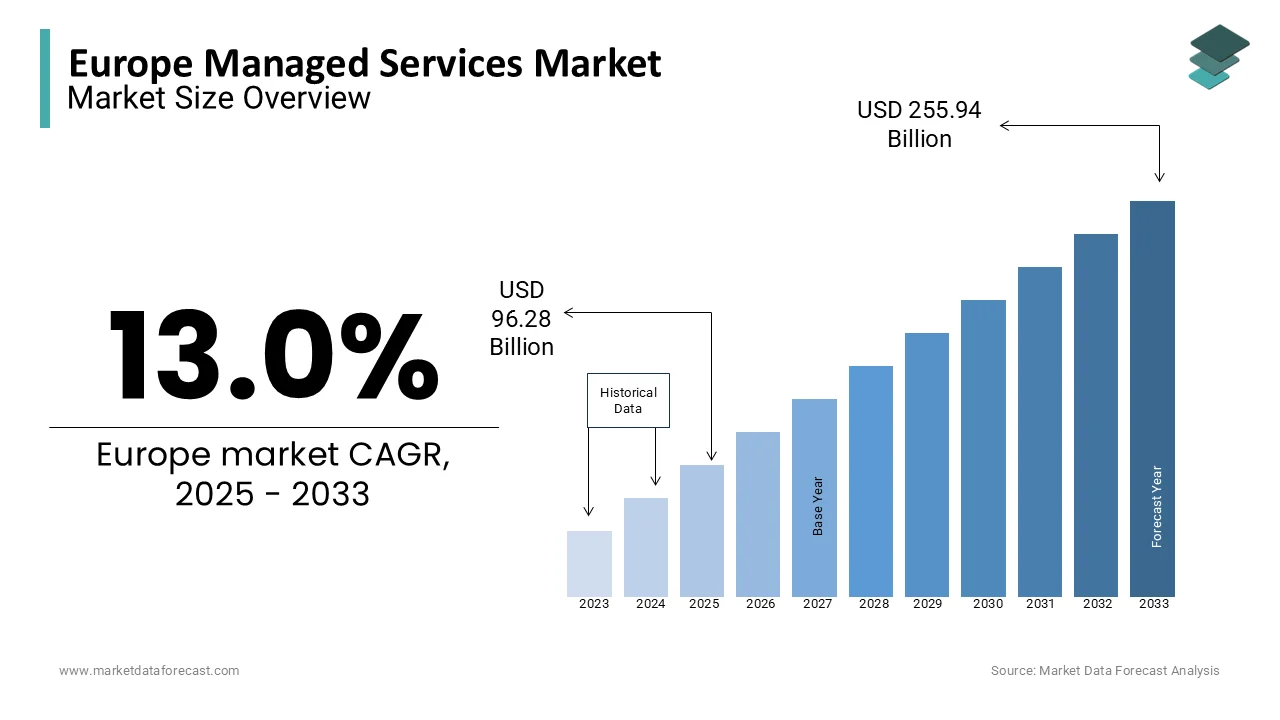
The Europe managed services market was valued at USD 96.28 billion in 2025, is estimated to reach USD 108.80 billion in 2026, and is projected to reach USD 289.23 billion by 2034, growing at a CAGR of 13% from 2026 to 2034. Market growth is driven by increasing demand for outsourced IT services, rising complexity of enterprise IT environments, and growing adoption of cloud computing across industries. Managed services enable organizations to enhance operational efficiency, reduce costs, and focus on core business functions while outsourcing IT management. The expansion of digital transformation initiatives, increasing cybersecurity concerns, and growing reliance on data-driven technologies are further accelerating the demand for managed services across Europe.
Key Market Trends
- Increasing adoption of cloud-based managed services across enterprises.
- Rising demand for managed security services due to growing cyber threats.
- Growing trend of outsourcing IT operations to improve efficiency and reduce costs.
- Expansion of digital transformation initiatives across industries.
- Increasing integration of automation, AI, and analytics in managed service offerings.
Segmental Insights
- Based on deployment model, the cloud deployment segment dominated the Europe managed services market by capturing 54.3% share in 2025, driven by scalability, flexibility, and cost advantages.
- Based on service type, the managed security services segment held the largest share of 32.1% in 2025, supported by rising cybersecurity threats and increasing regulatory requirements.
- Based on enterprise size, the large enterprises segment led the market in 2025, driven by higher IT spending and the need for complex IT infrastructure management.
Regional Insights
The Europe managed services market is witnessing strong growth across major countries due to increasing digitalization, cloud adoption, and cybersecurity requirements.
- Germany led the regional market in 2025 with 23.4% share, supported by strong enterprise demand and advanced industrial infrastructure.
- The United Kingdom is experiencing significant growth driven by its mature financial services sector and early adoption of cloud-native technologies.
- France is expected to hold a notable share during the forecast period due to strong government support for digital sovereignty and a growing ecosystem of enterprises and startups.
Competitive Landscape
The Europe managed services market is highly competitive, with the presence of global IT service providers and regional technology firms. Market participants are focusing on expanding service portfolios, enhancing cybersecurity capabilities, and integrating advanced technologies such as AI and automation into managed services. Strategic partnerships, mergers and acquisitions, and investments in cloud infrastructure are shaping competitive dynamics across the region.
Prominent companies operating in the Europe managed services market include IBM Corporation, Fujitsu Limited, Capgemini SE, Atos SE, and Accenture plc.
Europe Managed Services Market Size
The Europe managed services market was worth USD 96.28 billion in 2025. The European market is projected to reach USD 289.23 billion by 2034 from USD 108.80 billion in 2026, growing with a CAGR of 13% from 2026 to 2034.
The managed services are a sophisticated ecosystem, where organizations outsource the ongoing administration, maintenance, and optimization of their IT infrastructure and business processes to third-party specialists. As per data from Eurostat, digitalization levels across European enterprises have reached a critical threshold, with 92% of companies now utilizing cloud computing services, thereby necessitating specialized external management. The European Union Agency for Cybersecurity notes that cyber incidents targeting European entities increased by 38% in the last-year, driving the urgent adoption of managed security services. Furthermore, the European Commission indicates that small and medium-sized enterprises constitute 99% of all businesses in the EU, yet many lack the internal resources to manage complex digital transformations independently. Meanwhile, the International Data Corporation observes that the average age of IT professionals in Western Europe is rising, creating a demographic gap that managed service providers fill through access to younger, specialized talent pools.
MARKET DRIVERS
Acute Shortage of Specialized In-House IT Talent
The severe deficit of skilled technology professionals in the labor market is due to the adoption of managed services, which is attributed to boosting the growth of Europe managed services market. Organizations across the continent struggle to recruit and retain experts in emerging fields, such as artificial intelligence, cloud architecture, and advanced cybersecurity, forcing them to seek external partnerships. As per the European Centre for the Development of Vocational Training, the ICT sector in Europe faces a shortfall of approximately 1 million specialists, a gap that continues to widen despite increased university enrollments. This scarcity drives up salary expectations, making it financially prohibitive for many firms to build comprehensive internal teams in high-cost regions like Switzerland and Scandinavia. Consequently, businesses turn to managed service providers who possess established talent pools and continuous training programs to ensure access to cutting-edge expertise. The ability of these providers to offer 24/7 coverage with diverse skill sets becomes a decisive factor for business continuity. Furthermore, the rapid evolution of technology means that internal staff often require constant upskilling, a burden that outsourced partners absorb efficiently.
Escalating Complexity of Cybersecurity Threat Landscapes
The increasing sophistication and frequency of cyberattacks serve as a powerful driver compelling European organizations to delegate security management to specialized providers, which is escalating the growth of Europe managed services market. The threat has evolved beyond simple malware to include state-sponsored attacks, ransomware gangs, and complex supply chain compromises that require constant vigilance and advanced tooling. As per the European Union Agency for Cybersecurity, the cost of cybercrime to the European economy is projected to exceed 10 billion euros annually, prompting boards to prioritize robust defense mechanisms. Managing these threats internally demands significant investment in next-generation firewalls, threat intelligence feeds, and security operation centers, which is often beyond the budget of mid-market companies. Data from the Ponemon Institute reveals that the average time to identify and contain a data breach in Europe is 212 days when handled internally, whereas managed security service providers reduce this timeline significantly through automated monitoring. Providers offer economies of scale by spreading the cost of advanced security technologies across multiple clients, making enterprise-grade protection accessible. This convergence of high stakes, regulatory compliance, and technical complexity makes managed security services an indispensable component of modern European IT strategy.
MARKET RESTRAINTS
Persistent Concerns Regarding Data Sovereignty and Privacy
The stringent data privacy regulations and lingering concerns about data sovereignty act as a significant restraint on the broader adoption of managed services, restricting the growth of Europe managed services market. The General Data Protection Regulation imposes rigorous requirements on how personal data is processed, stored, and transferred, creating complex compliance hurdles for organizations considering outsourcing. As per the European Data Protection Board, cross-border data transfers remain a contentious legal issue, with several high-profile rulings invalidating previous frameworks and causing uncertainty for multinational managed service providers. Many European enterprises, particularly in the public sector and healthcare, hesitate to entrust sensitive data to third parties due to fears of losing direct control over compliance adherence. The requirement for data to remain within specific national borders or the European Economic Area limits the pool of eligible providers and often increases costs due to the need for localized infrastructure. Additionally, the complexity of defining liability in the event of a breach within a shared responsibility model creates legal friction during contract negotiations. These regulatory and perceptual barriers slow down decision-making processes and force organizations to maintain certain functions in-house, thereby capping the potential growth rate of the managed services market in highly regulated verticals.
High Initial Transition Costs and Integration Complexities
The substantial upfront investment required for transitioning to a managed services model and the technical complexities of integrating legacy systems are also hampering the growth of Europe managed services market. Migrating from an in-house operational model to an outsourced one involves detailed auditing, process re-engineering, and the deployment of new management tools, all of which incur high initial costs. As per analysis from Gartner, the average cost of migrating enterprise workloads to a managed service environment can range from 500000 to 2 million euros, depending on the scale and complexity of the existing infrastructure. Many European companies, especially those with decades-old mainframe systems and fragmented IT landscapes, face daunting challenges in achieving seamless integration without disrupting critical business operations. The fear of vendor lock-in further complicates matters, as organizations worry about the difficulty and expense of switching providers or bringing services back in-house later. Small and medium-sized enterprises often lack the capital reserves to fund these transition phases, leading them to postpone or abandon outsourcing initiatives. This financial and technical friction acts as a dampener on market expansion among traditional industries that are slower to adapt to new operational paradigms.
MARKET OPPORTUNITIES
Expansion of Edge Computing and IoT Management Services
The proliferation of Internet of Things devices and the shift toward edge computing to offer specialized infrastructure management are likely to promote new opportunities for the growth of Europe managed services market. As industries deploy thousands of connected sensors and devices for real-time data processing, the need to manage distributed edge nodes becomes critical for operational efficiency. As per the survey, the number of connected IoT devices in Europe is expected to surpass 1.5 billion by 2027, creating a massive install base that requires remote monitoring, maintenance, and security updates. Traditional centralized cloud management is insufficient for these decentralized assets, opening a lucrative niche for providers who can offer low-latency edge management solutions. Managed service providers can capitalize on this by offering bundled services that include hardware provisioning, software orchestration, and predictive maintenance for edge environments. The ability to manage hybrid architectures that seamlessly integrate on-premise edge nodes with public cloud resources adds significant value for enterprise clients. Furthermore, the rollout of 5G networks across Europe accelerates this trend, enabling new use cases in healthcare and transportation that rely on managed connectivity.
Adoption of AI-Driven Operations and Autonomous Healing
The integration of artificial intelligence and machine learning into IT operations to revolutionize service delivery through autonomy and predictive capabilities is likely to level up the growth of Europe managed services market. Clients are increasingly seeking partners who can leverage AI to anticipate failures, automate routine tasks, and self-heal infrastructure issues before they impact business continuity. As per research from Forrester, organizations that implement AIOps within their managed services framework report a 40% reduction in incident resolution times and a 30% decrease in operational costs. This shift allows providers to move from reactive support models to proactive assurance, delivering higher value and stronger service level agreements. Data from the European Artificial Intelligence Alliance indicates that European enterprises plan to increase their investment in AI-driven IT management tools over the next two years. Managed service providers can develop proprietary algorithms to analyze vast amounts of telemetry data, identifying patterns that human operators might miss. This capability is particularly valuable for managing complex multi-cloud environments where manual oversight is impractical. Additionally, the use of generative AI for automating customer support interactions and generating code for infrastructure-as-code templates enhances efficiency.
MARKET CHALLENGES
Navigating Fragmented Regulatory Landscapes Across Nations
The challenge of navigating a fragmented regulatory landscape across diverse European nations poses a significant operational hurdle for managed service providers aiming for pan-regional scalability, which is expected to hinder the growth of Europe managed services market. While the European Union provides overarching frameworks, individual member states often enforce specific national laws regarding data localization, labor practices, and industry-specific compliance that complicate standardized service delivery. As per the European Commission, discrepancies in the implementation of the NIS2 Directive across different countries create a patchwork of security requirements that providers must meticulously adhere to for each jurisdiction. This fragmentation forces providers to maintain distinct compliance protocols and legal teams for various markets, increasing operational overhead and slowing down deployment speeds. The lack of harmonization in digital taxation and procurement rules further exacerbates the complexity, making it difficult to offer uniform pricing and service packages. Providers must constantly monitor legislative changes in dozens of countries to avoid penalties and reputational damage. T
Risks Associated with Vendor Lock-In and Dependency
The inherent risk of vendor lock-in and excessive dependency on a single managed service provider that undermines client confidence and strategic flexibility is also impeding the growth of Europe managed services market. As organizations increasingly entrust their core IT functions and data to external partners, the technical and contractual barriers to switching vendors or repatriating services become prohibitively high. As per a study by the Cloud Security Alliance, 52% of European enterprises express concern about being trapped in proprietary ecosystems that prevent them from leveraging best-of-breed solutions or negotiating better terms. This dependency creates a power imbalance where the provider may increase prices or reduce service quality without fear of immediate churn. Data from the European Digital SME Alliance highlights that migration costs and data egress fees are the primary factors deterring companies from changing providers, effectively locking them into suboptimal arrangements. The lack of standardization in APIs and management interfaces across different providers further entrenches this issue, making interoperability difficult. In the event of a provider failure or bankruptcy, clients face existential risks to their business continuity. This fear of entrapment leads some organizations to limit the scope of their outsourcing engagements or adopt a multi-vendor strategy that increases management complexity.
REPORT COVERAGE
| REPORT METRIC | DETAILS |
| Market Size Available | 2025 to 2034 |
| Base Year | 2025 |
| Forecast Period | 2026 to 2034 |
| Segments Covered | By Deployment Model, Service Type, Enterprise Size, End-User Vertical, and Country. |
| Various Analyses Covered | Global, Regional, and Country-Level Analysis, Segment-Level Analysis, Drivers, Restraints, Opportunities, Challenges; PESTLE Analysis; Porter’s Five Forces Analysis, Competitive Landscape, Analyst Overview of Investment Opportunities |
| Countries Covered | UK, France, Spain, Germany, Italy, Russia, Sweden, Denmark, Switzerland, Netherlands, Turkey, Czech Republic, and the Rest of Europe. |
| Market Leaders Profiled | IBM Corporation, Fujitsu Limited, Capgemini SE, Atos SE, Accenture plc, and Others. |
SEGMENTAL ANALYSIS
By Deployment Model Insights
The cloud deployment model segment was the largest by holding 54.3% of the Europe managed services market share in 2025, with the aggressive migration strategies of European enterprises seeking scalability and operational flexibility without the burden of physical infrastructure maintenance. As per data from Eurostat, 41% of enterprises in the European Union utilized cloud computing services for hosting their databases or software applications in recent years, creating a massive installed base requiring ongoing oversight. The economic advantage of the operational expenditure model inherent in cloud services, which allows companies to align IT spending directly with business output rather than sinking capital into depreciating hardware, is another attribute escalating the growth of the segment. Statistics from the International Data Corporation indicate that cloud infrastructure spending in Western Europe grew by 18% annually, outpacing traditional on-premises investment significantly. Furthermore, the ability of cloud-based managed services to facilitate remote work capabilities has become indispensable, a trend solidified by the permanent shift toward hybrid working models in major economies like Germany and the United Kingdom.
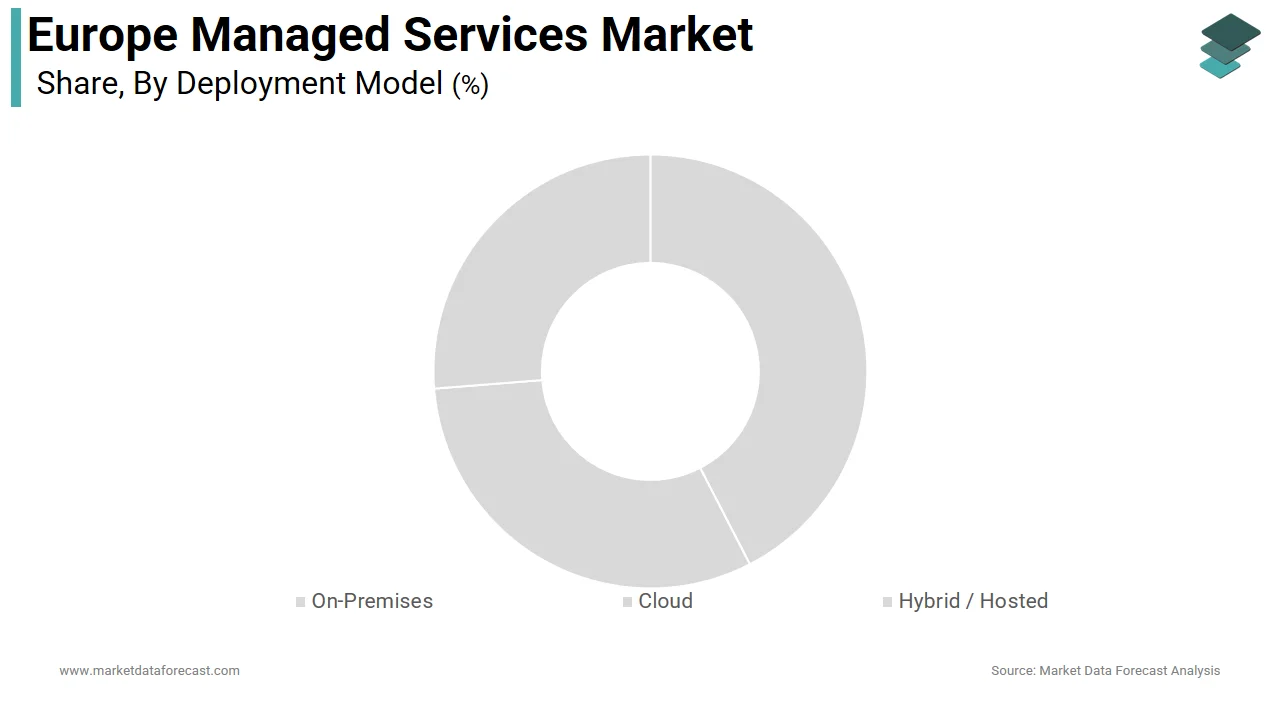
The hybrid and hosted deployment segment is expanding at a CAGR of 12.8% throughout the forecast period, owing to the pragmatic need for organizations to balance the innovation speed of the public cloud with the security and control of private infrastructure. The regulatory requirement for data sovereignty in highly regulated industries, such as finance and healthcare, is anticipated to boost the growth of the segment. As per reports from the European Banking Authority, over 60% of financial institutions in Europe are adopting hybrid architectures to comply with strict data residency laws while leveraging cloud analytics. Data from Gartner reveals that 75% of large European enterprises will adopt a hybrid cloud strategy by 2025 to manage their diverse application portfolios effectively. Managed service providers are increasingly offering unified management planes that seamlessly orchestrate workflows across these disparate environments, reducing complexity for clients. The ability to burst into the public cloud during high-demand periods while maintaining core operations privately offers a strategic advantage that pure cloud or pure on-premises models lack, driving robust adoption rates.
By Service Type Insights
The managed security services segment held 32.1% of the Europe managed services market share in 2025 by escalating frequency and sophistication of cyber threats targeting European infrastructure, which has made external expertise a necessity rather than a luxury. The severe shortage of skilled cybersecurity professionals across the continent is forcing organizations to outsource their defense mechanisms to specialized providers who possess advanced tools and talent. As per data from the European Union Agency for Cybersecurity, ransomware attacks in Europe increased by 45% in the last year alone, compelling boards to prioritize comprehensive security monitoring and incident response. The complexity of managing security across multi-cloud environments further necessitates expert intervention, as internal teams often struggle to maintain visibility and control. Consequently, managed security has become the cornerstone of IT outsourcing strategies by ensuring compliance and resilience against an evolving threat landscape.
The managed data center services segment is anticipated to grow at a CAGR of 11.5% from 2026 to 2034, with the increasing complexity of modern data center environments and the strategic shift toward colocation and edge computing facilities to support low-latency applications. The explosion of data volumes generated by Internet of Things devices and artificial intelligence workloads requires specialized environmental controls, power management, and connectivity that exceed the capabilities of traditional server rooms. As per data from the International Data Corporation, the global datasphere is expected to reach 175 zettabytes by 2025, with Europe contributing a significant portion, necessitating professional management of storage and processing assets. Managed service providers offer economies of scale in implementing these eco-friendly practices, making them attractive partners for companies striving to meet net-zero goals.
By Enterprise Size Insights
The large enterprises segment was the largest by accounting for a dominant share of the Europe managed services market in 2025, with the sheer scale and complexity of their IT infrastructures, which require comprehensive, round-the-clock management that internal teams cannot adequately provide. The extensive digital transformation initiatives undertaken by multinational corporations headquartered in Europe involve the integration of disparate systems, cloud migrations, and global network optimization. The need for risk mitigation and business continuity planning, where large organizations leverage managed services to ensure high availability and rapid disaster recovery across multiple geographies, is escalating the growth of the segment. Furthermore, the regulatory burden on large entities regarding data protection and industry-specific compliance necessitates specialized expertise that managed service providers deliver through dedicated account teams and advanced governance frameworks. Their ability to negotiate volume-based contracts and access premium support tiers further cements their position as the primary revenue source for the market.
The small and medium enterprises segment is projected to expand at a CAGR of 13.2% throughout the forecast period, owing to the increasing recognition among smaller businesses that managed services offer access to enterprise-grade technology and expertise at an affordable cost. As per reports from the European Digital SME Alliance, 70% of small businesses in Europe plan to increase their IT outsourcing spend in the next two years to bridge the skills gap and enhance operational efficiency. The rising threat of cyberattacks targeting smaller organizations, which are often perceived as softer targets due to weaker defenses, is also driving up the growth of the segment. The subscription-based pricing models offered by managed service providers align perfectly with the cash flow constraints of SMEs by enabling them to scale services up or down based on business needs. Additionally, government initiatives across Europe promoting digitalization among SMEs are providing subsidies and support, further accelerating the adoption of managed IT solutions in this vibrant sector.
COUNTRY LEVEL ANALYSIS
Germany Managed Services Market Analysis
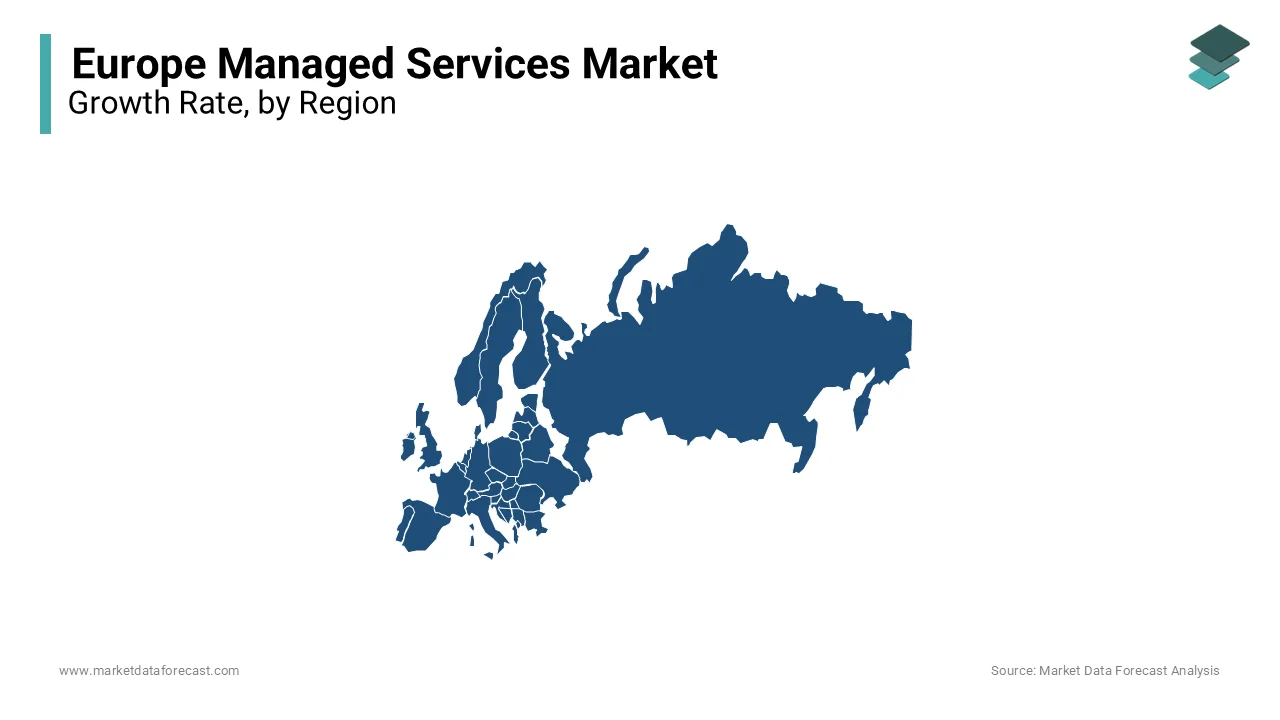
Germany was the largest contributor in the Europe managed services market in 2025 by holding 23.4% of the share in 2025 with its robust industrial base and aggressive pursuit of Industry 4.0 initiatives. The strong preference for high-quality, reliable IT operations that support the country's manufacturing and automotive sectors is a major factor prompting the growth of the market in this country. The need for operational technology and information technology convergence, where managed service providers play a pivotal role in securing and optimizing smart factory environments. The stringent data privacy culture in Germany also drives demand for local, compliant managed security services that adhere to rigorous national standards. Statistics from the Federal Statistical Office indicate that over 50% of German companies have increased their outsourcing activities to focus on core competencies amidst a severe shortage of IT specialists. Furthermore, the government's push for digital sovereignty encourages the adoption of hybrid managed solutions that keep critical data within national borders.
United Kingdom Managed Services Market Analysis
The United Kingdom managed services market growth is driven by its mature financial services sector and early adoption of cloud-native technologies. The concentration of global banking and insurance headquarters in London, which necessitates world-class managed security and compliance services to protect vast amounts of sensitive financial data, is expected to grow in the coming years. The post-Brexit landscape has prompted many organizations to re-evaluate their IT strategies, leading to increased outsourcing to mitigate operational risks and access global talent pools. Additionally, the thriving startup ecosystem in cities like Manchester and Cambridge drives demand for scalable managed services that allow young companies to grow rapidly without heavy infrastructure investments.
France Managed Services Market Analysis
France managed services market growth is likely to grow with a strong government backing for digital sovereignty and a vibrant ecosystem of large corporations and innovative startups. The strategic emphasis on maintaining control over data infrastructure, while leveraging external expertise for operational efficiency, is elevating the growth of the market in France. The “Cloud au Centre" strategy launched by the French government, which encourages the adoption of trusted cloud and managed services that comply with national security requirements. The presence of major aerospace, defense, and energy conglomerates creates a steady demand for specialized managed services that can handle complex, mission-critical systems. Statistics from INSEE indicate that digital transformation projects in French enterprises have accelerated, with 60% of CEOs prioritizing IT outsourcing to address skill shortages. Furthermore, the growing focus on green IT and sustainable data centers aligns with France's environmental goals, prompting organizations to seek managed providers who can offer energy-efficient solutions.
Netherlands Managed Services Market Analysis
The Netherlands managed services market is growing lucratively with an exceptional digital infrastructure and role as a gateway to the broader European continent. The country's advanced fiber optic network and connectivity scores attract multinational corporations to establish their European IT headquarters and rely on local managed service providers for optimal performance. As per data from the Netherlands Enterprise Agency, the ICT sector is one of the strongest in Europe, with managed services playing a crucial role in supporting the logistics, agriculture, and tech industries. The Dutch proficiency in English and progressive regulatory approach facilitated seamless cross-border service delivery by appealing to global clients. Additionally, the focus on circular economy and sustainability drives demand for managed services that help organizations monitor and reduce their digital carbon footprint.
Sweden Managed Services Market Analysis
Sweden managed services market growth is driven by its advanced digitalization levels and leadership in telecommunications and gaming industries. The presence of global telecom giants and a thriving startup scene that pushes the boundaries of network management and cloud innovation, requiring sophisticated external support, is prompting the growth of the market. As per data from the Swedish Agency for Economic and Regional Growth, the IT and telecom sector is a cornerstone of the Swedish economy, with managed services essential for maintaining the reliability of critical digital infrastructure. The strong emphasis on work-life balance and remote work in Sweden drives demand for secure, cloud-based managed solutions that enable flexible working arrangements. Statistics from Statistics Sweden indicate that nearly all enterprises in the country utilize digital tools, with a high propensity to outsource non-core IT functions to focus on innovation.
COMPETITIVE LANDSCAPE
The competition in the Europe managed services market is intensely fierce, characterized by the presence of global giants alongside strong regional specialists and agile niche providers. Dominant players leverage their scale and broad portfolios to offer end-to-end transformation services, while smaller firms compete on deep vertical expertise and personalized customer care. The market witnesses constant rivalry based on technological innovation, service quality, and the ability to deliver measurable business outcomes rather than just cost savings. Providers are increasingly differentiating themselves through advanced artificial intelligence capabilities and automated healing processes that minimize downtime and improve operational resilience. The push for digital sovereignty in Europe has intensified competition among vendors offering compliant sovereign cloud and data management solutions. Consolidation activities remain frequent as large entities acquire smaller innovators to fill capability gaps and enter new geographic markets rapidly. Price pressure from sophisticated procurement teams forces all participants to continuously optimize their delivery models and demonstrate clear return on investment.
KEY MARKET PLAYERS
The leading companies operating in the Europe application lifecycle management market include:
- IBM Corporation
- Fujitsu Limited
- Capgemini SE
- Atos SE
- Accenture plc
TOP PLAYERS IN THE MARKET
- International Business Machines Corporation stands as a global titan in the managed services sector with a profound impact on the European landscape through its hybrid cloud and artificial intelligence capabilities. The company helps European enterprises modernize legacy systems while ensuring robust security and operational efficiency across diverse industries. Its global contribution is defined by pioneering open-source technologies and setting standards for enterprise AI governance. Recent actions to strengthen its position include the expansion of its Red Hat consulting practices across Germany and France to accelerate hybrid cloud adoption. The firm has also launched specialized sustainability services to help clients meet stringent European environmental regulations.
- Accenture plc operates as a leading professional services company that seamlessly integrates strategy consulting with advanced managed services delivery across Europe. The Irish headquartered giant leverages its vast global network to provide tailored solutions that drive digital transformation for major European corporations and public sector entities. Its contribution to the global market is marked by its ability to scale agile methodologies and cloud native architectures for multinational clients. To bolster its European presence, Accenture has recently acquired numerous boutique firms specializing in cybersecurity and data analytics to enhance its service portfolio. The company established innovation hubs in Madrid and Milan to foster local talent and co-create solutions with clients. Furthermore, it committed significant resources to upskilling its European workforce in artificial intelligence and sustainable technology practices. These initiatives demonstrate its dedication to remaining at the forefront of technological evolution while addressing specific regional needs and regulatory requirements effectively.
- Atos SE is a European-born global leader in digital transformation and managed services with deep roots in the continental market. The French corporation plays a critical role in securing the digital sovereignty of Europe by providing high-performance computing and managed security services to government and industrial clients. Its global influence stems from its expertise in managing mission-critical infrastructure for some of the world's largest organizations. Recent efforts to solidify its market position involve the strategic restructuring of its business units to focus on high-growth areas like big data and cybersecurity. Atos has also partnered with major hyperscalers to offer sovereign cloud solutions that comply with strict European data residency laws. The company continues to invest in green data center technologies to align with the European Green Deal objectives. These actions highlight its commitment to delivering secure, sustainable, and innovative managed services that cater to the unique demands of the European digital economy.
TOP STRATEGIES USED BY KEY MARKET PARTICIPANTS
Key players in the Europe managed services market primarily employ strategic acquisitions of niche technology firms to rapidly expand their capabilities in emerging fields such as artificial intelligence and cybersecurity. Companies heavily invest in developing proprietary automation platforms and artificial intelligence-driven operations tools to enhance service efficiency and reduce manual intervention for clients. Another major strategy involves forming deep strategic alliances with major public cloud providers to offer optimized multi-cloud management services that ensure seamless integration and cost control. Firms also focus on vertical specialization by creating industry-specific solution bundles for sectors like finance and healthcare to address unique regulatory and operational challenges. Additionally, participants prioritize sustainability initiatives by offering green managed services that help clients reduce their carbon footprint and meet environmental goals. These combined approaches enable market leaders to differentiate their offerings and build long-term client relationships.
MARKET SEGMENTATION
This research report on the Europe managed services market is segmented and sub-segmented into the following categories.
By Deployment Model
- On-Premises
- Cloud
- Hybrid / Hosted
By Service Type
- Managed Data Centre
- Managed Security
- Managed Network
- Managed Communication and Collaboration
- Managed Infrastructure and Hosting
- Managed Mobility
- Managed Cloud and Application
- Managed Workplace / Service Desk
By Enterprise Size
- Small and Medium Enterprises
- Large Enterprises
By End-User Vertical
- BFSI
- Manufacturing
- Healthcare and Life Sciences
- Retail and E-Commerce
- Government and Public Sector
- IT and Telecom
- Energy and Utilities
- Rest of End-User Verticals
By Country
- UK
- France
- Spain
- Germany
- Italy
- Russia
- Sweden
- Denmark
- Switzerland
- Netherlands
- Turkey
- Czech Republic
- Rest of Europe