- Product Description Description
- Table of Contents TOC
- List of Table & Figure LOT
- Get Free Sample PDF Sample PDF
Market Size, 2025
$40 BnMarket Estimate, 2026
$43.52 BnMarket Forecast, 2034
$85.45 BnCAGR, 2026–2034
8.80%Europe Cloud Infrastructure Services Market Report Summary
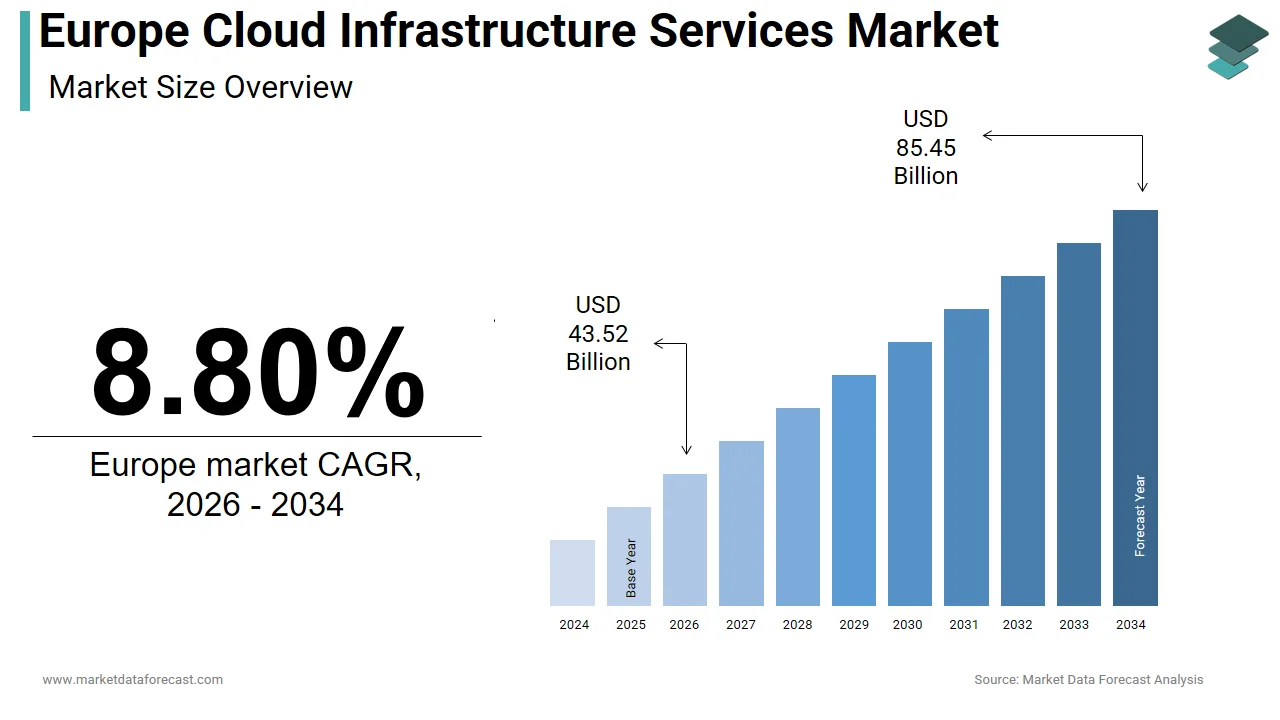
The Europe cloud infrastructure services market was valued at USD 40 billion in 2025, is estimated to reach USD 43.52 billion in 2026, and is projected to reach USD 85.45 billion by 2034, growing at a CAGR of 8.80% from 2026 to 2034. Market growth is driven by increasing digital transformation across industries, rising adoption of cloud-based solutions, and growing demand for scalable and cost-efficient IT infrastructure. Enterprises across Europe are increasingly leveraging cloud services to enhance operational efficiency, enable remote work environments, and support data-driven decision-making. Additionally, advancements in artificial intelligence, big data analytics, and edge computing are further accelerating the adoption of cloud infrastructure services across the region.
Key Market Trends
- Increasing adoption of cloud-based solutions for digital transformation initiatives.
- Rising demand for scalable and cost-efficient IT infrastructure across enterprises.
- Growing integration of AI, big data analytics, and cloud computing technologies.
- Expansion of hybrid and multi-cloud strategies among organizations.
- Increasing focus on data security, compliance, and digital sovereignty in cloud deployments.
Segmental Insights
- Based on service model, the software as a service (SaaS) segment dominated the Europe cloud infrastructure services market by accounting for 40.6% share in 2025, driven by its ease of deployment and wide adoption across industries.
- Based on deployment type, the public cloud segment led the market by capturing 46.3% share in 2025, supported by its cost-effectiveness, scalability, and flexibility for enterprises.
Regional Insights
The Europe cloud infrastructure services market is witnessing strong growth across major economies, supported by increasing cloud adoption and digital transformation initiatives.
- The United Kingdom led the regional market in 2025 with 27.6% share, driven by a strong digital ecosystem and high adoption of cloud technologies across enterprises.
- Germany ranked second with 23.5% share in 2025, supported by its strong industrial base and increasing adoption of cloud solutions in manufacturing and enterprise sectors.
- France holds a significant position in the market due to strong government initiatives focused on digital sovereignty and investments in local cloud infrastructure capabilities.
Competitive Landscape
The Europe cloud infrastructure services market is highly competitive, with the presence of global technology providers and regional cloud service companies. Market participants are focusing on expanding cloud offerings, enhancing data security, and supporting hybrid and multi-cloud environments. Strategic partnerships, investments in data centers, and innovation in cloud technologies are shaping competitive dynamics across the region.
Prominent companies operating in the Europe cloud infrastructure services market include Amazon Web Services, Microsoft Corporation, Google Cloud Platform, IBM Cloud, Oracle Cloud, Alibaba Cloud, Salesforce, DigitalOcean, and Linode.
Europe Cloud Infrastructure Services Market Size
The Europe cloud infrastructure services market was valued at USD 40 billion in 2025, is estimated to reach USD 43.52 billion in 2026, and is projected to reach USD 85.45 billion by 2034, growing at a CAGR of 8.80% from 2026 to 2034.
Cloud infrastructure services are the physical and virtual components, such as servers, storage, and networking, delivered as on-demand resources over the internet. This ecosystem enables organizations to deploy scalable IT infrastructure without substantial capital expenditure on physical hardware while maintaining operational agility. As per Eurostat data from 2025, 52.7% of EU enterprises utilized paid cloud computing services, representing a substantial increase of 7.5% age points from 2023. Adoption rates vary significantly by company size, with large businesses reaching 84.7%, while medium and small enterprises recorded adoption rates of 66.8% and 49.3%, respectively. Finland leads regional adoption at 79.2%, followed by Italy at 75.6% and Malta at 74.9%. The regulatory environment shaped by the General Data Protection Regulation establishes stringent requirements for data processing and cross-border transfers, influencing infrastructure deployment strategies. According to the PwC EMEA Cloud Business Survey 2025, the symbiotic relationship between AI and cloud is deepening, with 86% of business leaders citing agentic AI capabilities as a decisive factor in selecting cloud providers, although only 29% of organizations are currently scaling these AI implementations. The market operates within a complex framework of digital sovereignty initiatives, including the Gaia X project, which seeks to establish European-controlled cloud ecosystems. Energy consumption considerations also shape infrastructure decisions as data centers account for significant electricity usage within the European Union, according to Borderstep Institute research commissioned by the European Commission.
MARKET DRIVERS
Accelerated digital transformation initiatives fueled by artificial intelligence integration demands
The proliferation of artificial intelligence and machine learning applications across European enterprises drives the growth of the Europe cloud infrastructure services market. This trend has created unprecedented demand for scalable cloud infrastructure capable of supporting intensive computational workloads. European businesses increasingly recognize that legacy on-premises systems cannot deliver the elasticity required for training large language models or processing real-time data streams. A study indicates that a portion of technology leaders consider leveraging agentic AI capabilities a key factor when selecting cloud providers, demonstrating how innovation priorities directly influence infrastructure procurement. Large enterprises with substantial digital transformation budgets drive this trend, allocating resources toward cloud native architectures that enable rapid experimentation and deployment. Organizations in the manufacturing, healthcare, and financial services sectors particularly benefit from cloud-enabled AI applications that enhance predictive maintenance, patient diagnostics, and fraud detection capabilities. The demand for low-latency inference environments further accelerates investment in distributed cloud infrastructure positioned closer to end users. European companies are pursuing competitive differentiation through intelligent automation, driving a need for robust, flexible, and secure cloud foundations. Consequently, market opportunities will continue to expand throughout the forecast period.
Hybrid and multi-cloud adoption strategies are enhancing operational resilience and vendor independence.
European organizations are increasingly implementing hybrid and multi-cloud architectures, which further propels the expansion of the Europe cloud infrastructure services market. They use these systems to balance performance requirements, regulatory compliance, and cost optimization across diverse workloads. According to the PwC EMEA Cloud Business Survey 2025, a significant majority of organizations are reevaluating their strategies to focus on infrastructure expansion, incorporating sovereign and trusted cloud models. This approach enables businesses to maintain sensitive data within jurisdictionally compliant environments while leveraging public cloud capabilities for less critical applications. Hybrid models prove particularly valuable for industries such as banking and healthcare, where data residency mandates intersect with innovation imperatives. European enterprises report that distributing workloads across multiple platforms enhances system availability and reduces exposure to single-point failures. The adoption of cloud orchestration tools further simplifies management complexity, enabling seamless integration between private and public environments. According to research, large European enterprises are prioritizing hybrid and multi-cloud environments to maintain operational control while leveraging global provider services. This strategic diversification supports business continuity objectives and facilitates gradual migration from legacy infrastructure without disrupting operational workflows. Regulatory frameworks are evolvin,g and technological capabilities are advancing. These factors will sustain growth in infrastructure services and drive the demand for interoperable cloud environments across the region.
MARKET RESTRAINTS
Stringent data sovereignty regulations are creating compliance complexity and deployment constraints.
The European Union's comprehensive data protection framework, including the General Data Protection Regulation and emerging legislation such as the Data Act, imposes rigorous requirements on cloud infrastructure providers, which restricts the growth of the European cloud infrastructure services market. These requirements are regarding data localization, processing, transparency, and cross-border transfers. Recent findings from digital transformation monitoring show that while a high percentage of large enterprises have adopted cloud services, small and medium-sized businesses are still working toward meeting European digital intensity targets. Enterprises must implement sophisticated governance mechanisms to ensure personal data remains within approved geographical boundaries, which can limit architectural flexibility and increase infrastructure costs. The requirement for data processing agreements under Article 28 of GDPR adds contractual complexity to cloud procurement processes, according to Deloitte's analysis of EU cloud regulations. Organizations operating across multiple member states face additional challenges in navigating divergent national interpretations of European legislation. Recent years have marked a significant shift in the regulatory landscape as new frameworks for data governance and digital competition have been introduced to define how information is managed and protected across the region. Small and medium enterprises with limited legal and technical resources struggle to implement compliant cloud architectures, potentially delaying digital transformation initiatives. The emergence of sovereign cloud initiatives while addressing sovereignty concerns also fragments the market and may reduce economies of scale for infrastructure providers. Organizations must allocate substantial resources to compliance monitoring and infrastructure adaptation as regulatory frameworks continue to evolve. Consequently, this can constrain investment in innovation and limit the pace of cloud adoption across certain sectors.
Escalating cybersecurity threats are undermining trust in cloud infrastructure adoptio.n
The intensifying sophistication of cyber attacks targeting cloud environments is a significant restraint on the expansion of the European cloud infrastructure services market. This is because organizations weigh the benefits of cloud migration against potential security vulnerabilities. According to a study, current cybersecurity reports indicate that diverse and converging threat groups continue to target digital infrastructure through a variety of sophisticated methods, with ransomware and supply chain compromises remaining among the most impactful risks. The report analyzed 4875 incidents between July 2024 and June 2025, emphasizing the persistent risk environment confronting cloud adopters. A substantial portion of cybersecurity incidents specifically target the availability of services, leading to significant concerns regarding the continuity of essential digital operations. Public sector institutions face particular exposure, with a significant majority of European Union government entities remaining highly vulnerable to cyber threats, according to research. The convergence of geopolitical tensions and digital dependency amplifies risks as nation-state actors increasingly target critical infrastructure, including cloud platforms. Research indicates that the compromise of third-party service providers is a growing systemic risk that can lead to cascading failures across interconnected digital ecosystems. Organizations must invest substantially in security controls, monitoring capabilities, and incident response frameworks to mitigate these risks, which increases the total cost of ownership for cloud infrastructure. The skills shortage in cybersecurity further complicates defense efforts as qualified professionals remain scarce across the European labor market. These security considerations can delay cloud adoption decisions, particularly among risk-averse industries such as finance and healthcare, where data breaches carry severe regulatory and reputational consequences.
By End User Insights
The Large Enterprises segment was the largest segment in the Europe cloud infrastructure services market and held a 62.5% share in 2025. Substantial information technology budgets, complex operational requirements, and strategic prioritization of digital transformation initiatives across multinational operations are attributed to the supremacy of this segment. European corporations leverage cloud infrastructure to enhance scalability, improve operational efficiency, and manage vast data volumes generated by diverse business units and geographic regions. The integration of artificial intelligence and machine learning capabilities within cloud platforms supports advanced analytics use cases, including predictive maintenance, customer personalization, and fraud detection, which deliver measurable business value. According to a study, large enterprises demonstrate higher cloud adoption maturity, enabling them to realize greater return on investment from infrastructure modernization initiatives. European organizations are pursuing competitive differentiation through intelligent automation, which requires robust, flexible, and secure cloud foundations. Consequently, infrastructure services demand will continue to expand among large enterprise customers throughout the forecast period.
The Small and Medium Enterprises segment is anticipated to witness the fastest CAGR of 17.5% between 2026 and 2034. This swift growth of the segment is fuelled by the increasing recognition that cloud adoption enables smaller organizations to access enterprise-grade capabilities without substantial capital investment in physical infrastructure. European SMEs increasingly leverage cloud platforms to enhance operational agility, support remote work frameworks, and compete effectively with larger rivals through digital innovation. European Union-funded initiatives, including CloudCamp4SMEs, provide training and certification support that addresses skills gaps and accelerates technology adoption among smaller organizations. European small and medium enterprises are actively pursuing digital transformation initiatives. Consequently, the demand for simplified, secure, and scalable cloud infrastructure will sustain robust growth throughout the forecast period.
MARKET OPPORTUNITIES
Sustainability mandates driving innovation in green cloud infrastructure and energy-efficient data centers.
Cloud infrastructure providers that prioritize environmental sustainability and energy efficiency face substantial opportunities in the Europe cloud infrastructure services market. This is driven by the European Union's commitment to climate neutrality by 2050. According to Borderstep Institute research commissioned by the European Commission, initiatives to improve data center energy efficiency and promote renewable energy adoption align with broader policy objectives under the Energy Efficiency Directive. Organizations increasingly select cloud partners based on environmental performance metrics, creating competitive differentiation for providers operating carbon-neutral facilities. According to Digital Europe analysis, data centers serve as powerful enablers of Europe's twin transition by supporting decarbonization efforts across other economic sectors through intelligent resource management. The European Commission's exploration of mandatory sustainability indicators for data centers, including energy consumption and circular economy performance, establishes clear benchmarks for infrastructure development according to Euractiv reporting. Cloud providers investing in advanced cooling technologies, waste heat recovery systems, and renewable energy procurement can capture growing demand from environmentally conscious enterprises. The integration of artificial intelligence for optimizing energy usage in cloud environments further enhances efficiency gains while reducing operational costs. As corporate sustainability reporting requirements expand under the Corporate Sustainability Reporting Directive, organizations will seek transparent metrics on the environmental impact of their cloud infrastructure. Providers that demonstrate measurable progress toward net-zero operations while maintaining performance standards will gain preferential access to procurement decisions across public and private sectors. This convergence of regulatory pressure and market preference positions green cloud infrastructure as a high-growth segment within the European market landscape.
Edge computing expansion, enabling low-latency applications and localized data processing
The proliferation of Internet of Things devices and real-time analytics requirements creates potential prospects for edge cloud infrastructure, which is likely to promote the growth of the Europe cloud infrastructure services market. This infrastructure processes data closer to its source rather than relying solely on centralized data centers. European industrial enterprises leveraging Industry 4.0 initiatives benefit from edge-enabled predictive maintenance and quality control systems that require immediate data processing capabilities. The deployment of edge nodes also supports data sovereignty objectives by keeping sensitive information within national boundaries while still accessing cloud-scale analytics, according to industry observations. According to the PwC EMEA Cloud Business Survey 2025, organizations prioritizing the digitization of core operational platforms represent a key growth segment for edge infrastructure services. The integration of 5G networks across European markets further accelerates edge adoption by providing the connectivity foundation for distributed computing architectures. According to technology analysis, edge cloud solutions enable compliance with sector-specific regulations in healthcare and finance by processing personal data locally before transmitting aggregated insights to central systems. Small and medium enterprises gain access to advanced computing capabilities without substantial capital investment through edge as a service models. The convergence of artificial intelligence and edge computing creates opportunities for intelligent applications that operate autonomously in remote or resource-constrained environments. As European organizations pursue digital transformation initiatives requiring real-time decision making, the demand for distributed cloud infrastructure will expand market opportunities beyond traditional data center deployments. Providers that establish robust edge ecosystems with seamless integration to central cloud platforms will capture value from this emerging architectural paradigm.
MARKET CHALLENGES
A critical shortage of cloud and cybersecurity skills is constraining implementation capacity.
Securing qualified professionals with expertise in cloud architecture, security, and operations remains a challenge for the Europe cloud infrastructure services market. This impedes organizations' ability to fully leverage deployed technologies. According to ENISA Foresight 2030 research, skill shortage ranks among the top ten emerging cybersecurity threats expected to impact the European Union by 2030, reflecting the strategic importance of workforce development. The rapid evolution of cloud technologies, including artificial intelligence integration and multi-cloud management, requires continuous learning that existing training programs struggle to deliver at scale. Recent surveys suggest that a minority of organizations feel their current staff has the necessary expertise to fully leverage advanced intelligence technologies, revealing a widespread need for upskilling. Small and medium enterprises face particular difficulties attracting and retaining cloud talent due to compensation competition from larger corporations and technology vendors. According to the ECSO Cybersecurity Market Analysis, underinvestment in security infrastructures often stems from limited knowledge about cyber threats and effective mitigation strategies, exacerbating vulnerability across the ecosystem. The shortage extends beyond technical roles to include governance compliance and strategic planning positions essential for successful cloud adoption. Organizations must allocate substantial resources to upskilling initiatives and external consulting services, which increases the total cost of ownership and delays project timelines. According to industry observations, the gap between cloud maturity levels is widening as organizations with established talent pools accelerate adoption while others struggle to build foundational capabilities. Addressing this challenge requires coordinated efforts between educational institutions, industry associations, and government agencies to develop standardized curricula and certification pathways. Until workforce capacity aligns with technological ambition, the European cloud infrastructure market will experience suboptimal utilization of deployed resources and slower realization of anticipated business benefits.
Geopolitical tensions are influencing cross-border data flows and infrastructure investment decisions
E.scalating geopolitical uncertainties create complex hurdles for the European cloud infrastructure services market. Participants must navigate evolving trade policies, sanctions regimes, and strategic technology competition. According to research, the period from 2023 to 2025 witnessed increased focus on data sovereignty as nations seek to reduce dependency on non-European technology providers amid international tensions. Organizations operating across multiple jurisdictions face difficulties ensuring consistent compliance with divergent regulatory requirements influenced by geopolitical considerations. According to research, managing geopolitical cyber risks while maintaining GDPR compliance requires sophisticated governance frameworks that many enterprises lack. The emergence of technology decoupling trends affects supply chains for cloud infrastructure components, including semiconductors and networking equipment, potentially increasing costs and delaying deployments. According to sources, geopolitically driven cyber warfare increasingly targets critical infrastructure, including cloud platforms, creating additional operational risks for service providers. European enterprises must evaluate cloud partners based not only on technical capabilities but also on geopolitical alignment and supply chain resilience, which complicates procurement decisions. According to multiple studies, the dominance of American hyperscalers in the European market raises strategic questions about long term data control and regulatory autonomy. Organizations seeking to balance innovation access with sovereignty concerns often adopt complex multi-vendor strategies that increase management overhead and integration complexity. The uncertainty surrounding future trade agreements and technology export controls creates hesitation in long term infrastructure commitments, potentially slowing market growth. Cloud infrastructure providers must develop agile strategies to accommodate shifting policy environments as geopolitical dynamics continue evolving. These strategies are crucial for maintaining service quality and customer trust across the European region.
REPORT COVERAGE
| REPORT METRIC | DETAILS |
| Market Size Available | 2025 to 2034 |
| Base Year | 2025 |
| Forecast Period | 2026 to 2034 |
| Segments Covered | By Service Model, Deployment Type, End User, Industry Vertical, and Country. |
| Various Analyses Covered | Global, Regional, and Country-Level Analysis, Segment-Level Analysis, Drivers, Restraints, Opportunities, Challenges; PESTLE Analysis; Porter’s Five Forces Analysis, Competitive Landscape, Analyst Overview of Investment Opportunities |
| Countries Covered | UK, France, Spain, Germany, Italy, Russia, Sweden, Denmark, Switzerland, Netherlands, Turkey, Czech Republic, and the Rest of Europe. |
| Market Leaders Profiled | Amazon Web Services, Microsoft Corporation, Google Cloud Platform, IBM Cloud (US), Oracle Cloud, Alibaba Cloud, Salesforce, DigitalOcean, Linode |
SEGMENTAL ANALYSIS
By Service Model Insights
The Software as a Service segment maintained dominance in the Europe cloud infrastructure services market and accounted for a 40.6% share in 2025. This dominance of the segment is driven by the model's inherent accessibility and reduced implementation complexity, which appeals to organizations across all enterprise sizes. European businesses increasingly prioritize subscription-based software delivery that eliminates capital expenditure on licenses and infrastructure while ensuring continuous updates and security patches. The regulatory environment shaped by the General Data Protection Regulation further favors SaaS providers who embed compliance controls directly into their platforms, reducing the governance burden on client organizations. Small and medium enterprises particularly benefit from SaaS solutions as they gain access to enterprise-grade capabilities without substantial upfront investment, according to Eurostat enterprise digitalization data. The integration of artificial intelligence features within SaaS applications has created additional value propositions, driving renewal rates and expansion spending. The predictable operational expenditure model of SaaS aligns with financial planning requirements for European organizations pursuing digital transformation. Additionally, it enables rapid scalability to meet fluctuating demand patterns.
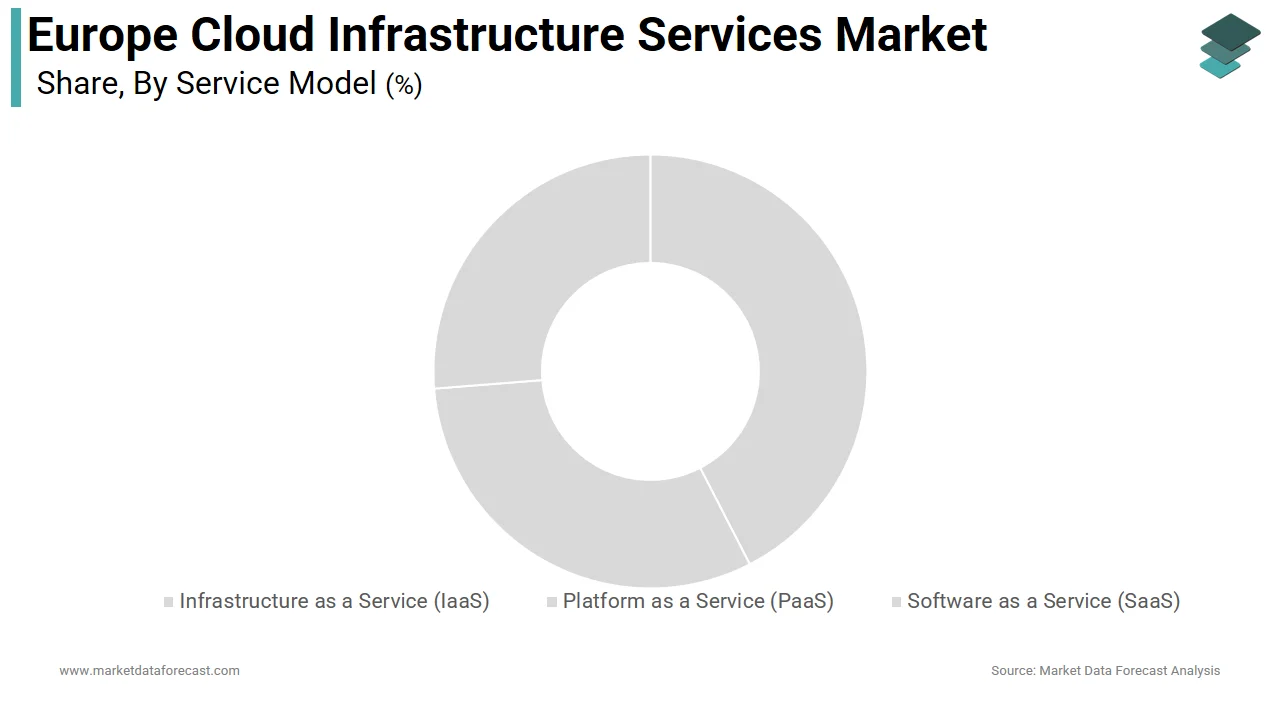
The Platform as a Service segment is predicted to witness the highest CAGR of 19.1 % from 2026 to 2034 due to the increasing developer demand for managed runtime environments that accelerate application development while maintaining compliance with European data sovereignty requirements. Organizations deploying machine learning models and containerized microservices require sophisticated orchestration capabilities that PaaS platforms deliver through integrated toolchains and automated scaling mechanisms. According to the PwC EMEA Cloud Business Survey 2025, the convergence of artificial intelligence development and cloud native architectures has elevated PaaS adoption as enterprises seek to reduce time to market for intelligent applications. European technology startups particularly leverage PaaS environments to access advanced computing resources without managing underlying infrastructure, enabling innovation at reduced operational risk. The emergence of sovereign PaaS offerings that guarantee data residency within European borders addresses regulatory concerns while preserving development agility, according to research. The demand for platform services that support continuous integration and continuous deployment (CI/CD) pipelines will sustain robust growth throughout the forecast period. This is driven by organizations modernizing legacy applications through cloud-native refactoring.
By Deployment Type Insights
In 2025, the Public Cloud deployment segment led the Europe cloud infrastructure services market and captured a 46.3% share. Factors such as the model's inherent cost efficiency and elastic scalability enable organizations to align infrastructure spending with actual consumption patterns, which supports this leading position of the segment. European enterprises increasingly leverage public cloud platforms to access cutting-edge capabilities, including artificial intelligence, machine learning, and advanced analytics, without substantial capital investment in specialized hardware. The maturity of public cloud security controls and compliance certifications has alleviated historical concerns about data protection, enabling broader adoption across regulated sectors, including financial services and healthcare. According to a study, enterprise digitalization provides the flexibility to rapidly provision resources, supports business continuity objectives, and facilitates experimentation with emerging technologies. European organizations are pursuing digital transformation initiatives by accessing hyperscale infrastructure through public cloud partnerships. This approach accelerates innovation while reducing time to value for strategic technology investments.
The Hybrid Cloud deployment segment is estimated to register the fastest CAGR of 18.7% over the forecast period, owing to organizational strategies to balance operational flexibility with regulatory compliance by distributing workloads across private and public environments based on sensitivity and performance requirements. European enterprises, particularly in banking, healthcare, and the public sector, prioritize hybrid architectures that enable sensitive data to remain within jurisdictionally compliant infrastructure while leveraging public cloud capabilities for less critical applications. According to sources, the ability to maintain control over mission-critical systems while accessing innovation from global providers represents a strategic advantage for organizations navigating complex regulatory landscapes. The emergence of sovereign cloud initiatives, including Gaia X, further supports hybrid adoption by establishing interoperable frameworks that facilitate workload portability across environments. According to research, hybrid models enable organizations to meet data residency mandates without sacrificing access to advanced analytics and artificial intelligence capabilities. European regulatory frameworks are continuing to evolve, driving demand for flexible deployment architectures that accommodate shifting compliance requirements. Consequently, this will sustain robust growth in hybrid cloud infrastructure services.
COUNTRY-LEVEL ANALYSIS
United Kingdom Cloud Infrastructure Services Market Analysis
The United Kingdom remained the top performer in the Europe cloud infrastructure services sector and accounted for a 27.6% share in 2025. Moreover, the demand for these services in the UK is driven by advanced digital infrastructure, a robust financial services sector, and early adoption of cloud technologies across public and private organizations. British enterprises leverage cloud platforms to enhance operational resilience, support innovation in artificial intelligence, and maintain competitive positioning within global markets. The United Kingdom's regulatory framework, while navigating post Brexit considerations, continues to align with European data protection standards, enabling seamless cross-border service delivery. According to studies, British organizations prioritize cloud adoption to support digital transformation initiatives, including modernization of legacy systems and deployment of intelligent automation capabilities. The concentration of technology talent, research institutions, and innovation hubs within London and other major cities further strengthens the UK's position as a regional cloud infrastructure leader. British enterprises are increasingly pursuing international expansion and digital innovation. Consequently, the demand for scalable, secure, and compliant cloud infrastructure will sustain market leadership throughout the forecast period.
Germany Cloud Infrastructure Services Market Analysis
Germany was the second largest country in the Europe cloud infrastructure services market and captured a share of 23.5% in 2025. This expansion of the German market is propelled by the nation's robust industrial base, including automotive manufacturing and engineering sectors that increasingly leverage cloud platforms for Industry 4.0 initiatives and digital supply chain optimization. German enterprises prioritize data sovereignty and regulatory compliance, driving demand for sovereign cloud solutions that guarantee data residency within European borders. According to sources, Germany's leadership in the Gaia X initiative demonstrates a commitment to establishing European-controlled cloud ecosystems that balance innovation with strategic autonomy. The federal government's digital strategy, including substantial investments in artificial intelligence and cloud infrastructure, supports continued market expansion across public and private sectors. According to research, German organizations increasingly adopt hybrid cloud architectures to maintain control over sensitive industrial data while accessing advanced analytics capabilities from global providers. The concentration of technology talent, research institutions, and manufacturing expertise within Germany further strengthens its position as a regional cloud infrastructure leader. German enterprises are pursuing digital transformation and international competitiveness. Due to this, the demand for secure, compliant, and scalable cloud infrastructure will sustain robust growth throughout the forecast period.
France Cloud Infrastructure Services Market Analysis
France maintains a significant position within the Europe cloud infrastructure services market due to strong government commitment to digital sovereignty and strategic investments in local cloud capabilities. French enterprises increasingly adopt cloud platforms to enhance operational efficiency, support innovation in artificial intelligence, and maintain competitive positioning within European and global markets. According to research, France's Bleu platform initiative, backed by Orange and Capgemini, demonstrates a commitment to establishing European controlled cloud infrastructure that addresses data residency and regulatory compliance requirements. The French government's digital transformation agenda, including substantial investments in public sector cloud adoption, supports continued market expansion across healthcare, education, and administrative services. According to studies, French organizations prioritize cloud solutions that integrate seamlessly with existing enterprise systems while meeting stringent data protection standards under the General Data Protection Regulation. The concentration of technology talent, research institutions and innovation hubs within Paris and other major cities further strengthens France's position as a regional cloud infrastructure contributor. The demand for secure, compliant, and scalable cloud infrastructure is rising as French enterprises pursue digital innovation and international expansion. This demand will sustain robust growth throughout the forecast period.
Italy Cloud Infrastructure Services Market Analysis
Italy grew steadily in the Europe cloud infrastructure services market, owing to national initiatives to accelerate digital transformation, particularly among small and medium enterprises. Italian organizations increasingly leverage cloud platforms to enhance operational agility, support remote work frameworks, and compete effectively within European and global markets. Italian small and medium enterprises particularly benefit from cloud solutions that provide enterprise-grade capabilities without substantial capital investment in physical infrastructure. According to sources, enterprise digitalization statistics show that cloud adoption among Italian businesses continues to expand as awareness of operational benefits and regulatory compliance capabilities increases. The concentration of manufacturing expertise, design innovation, and tourism services within Italy creates diverse use cases for cloud infrastructure, including supply chain optimization, customer engagement, and data analytics. Italian enterprises are pursuing digital transformation and international competitiveness. Consequently, the demand for secure, compliant, and scalable cloud infrastructure will sustain robust growth throughout the forecast period.
Spain Cloud Infrastructure Services Market Analysis
Spain is an emerging market for cloud infrastructure services in Europe and is likely to grow significantly during the forecast period due to substantial investments by hyperscale providers, including commitments exceeding EUR 33 billion to expand data center capacity and cloud service availability across the Iberian Peninsula. Spanish enterprises increasingly leverage cloud platforms to enhance operational efficiency, support innovation in tourism, financial services, and renewable energy sectors, while maintaining compliance with European data protection standards. According to sources, Spain's favorable renewable energy profile and competitive land costs attract infrastructure investments that support sustainable cloud operations aligned with European climate objectives. The Spanish government's digital agenda, including initiatives to modernize public administration and support small business digitalization, further accelerates cloud adoption across the economy. According to research, Spanish organizations prioritize cloud solutions that enable rapid scalability to accommodate seasonal demand fluctuations, particularly within tourism and retail sectors. The concentration of technology talent, research institutions and innovation hubs within Madrid, Barcelona and other major cities strengthens Spain's position as an emerging cloud infrastructure destination. Spanish enterprises are pursuing digital transformation and international expansion. Consequently, the demand for secure, compliant, and scalable cloud infrastructure will sustain robust growth throughout the forecast period.
COMPETITIVE LANDSCAPE
The Europe cloud infrastructure services market features intense competition among global hyperscalers and regional providers who vie for enterprise contracts through differentiated value propositions. United States-based companies, including Amazon Web Services, Microsoft Azure, and Google Cloud Platform, dominate market activity through extensive infrastructure investments and advanced service portfolios. European providers such as OVHcloud and IONOS compete by emphasizing data sovereignty and local regulatory expertise, which resonates with public sector and privacy-conscious customers. Regulatory frameworks, including the General Data Protection Regulation and emerging digital sovereignty legislation, shape competitive dynamics by creating compliance advantages for providers with European-controlled infrastructure. Innovation in artificial intelligence and sustainable operations serves as a key battleground where providers differentiate through specialized capabilities and environmental commitments. The convergence of geopolitical considerations and technology decoupling trends further influences competitive positioning as organizations evaluate cloud partners based on strategic alignment and supply chain resilience. Market participants continuously adapt their strategies to address evolving customer requirements while navigating complex regulatory landscapes and maintaining service quality across diverse European jurisdictions.
KEY MARKET PLAYERS
The leading companies operating in the Europe cloud infrastructure services market include:
- Amazon Web Services
- Microsoft Corporation
- Google Cloud Platform
- IBM Cloud
- Oracle Cloud
- Alibaba Cloud
- Salesforce
- DigitalOcean
- Linode
TOP PLAYERS IN THE MARKET
- Amazon Web Services maintains a pivotal role in the global cloud infrastructure landscape by delivering comprehensive compute, storage, and networking capabilities to enterprises worldwide. Within Europe, the company actively addresses digital sovereignty requirements through dedicated sovereign cloud initiatives that ensure data residency and operational control within European boundaries. Recent strategic actions include a substantial commitment to invest in the AWS European Sovereign Cloud with initial operations launching in Brandenburg, Germany. This investment supports local economic development while enabling public sector and regulated industry customers to meet stringent compliance mandates. AWS continues to expand its European footprint through partnerships with regional technology providers and workforce development programs that strengthen its market position and customer trust across the continent.
- Microsoft Corporation leverages its Azure platform to deliver integrated cloud solutions that power digital transformation initiatives across global enterprises and public institutions. In Europe, the company prioritizes data sovereignty and sustainability through infrastructure investments that align with regional regulatory frameworks and climate objectives. Microsoft recently announced plans to increase European data center capacity over two years while establishing a new data center region in Western Denmark to support growing demand for AI and cloud services. The company's commitment to operate cloud infrastructure with 100 % carbon free energy and its collaboration with European partners reinforce its leadership position. Microsoft's focus on sovereign cloud capabilities and local talent development strengthens its ability to serve diverse customer needs across the European market.
- Google Cloud Platform contributes significantly to the global cloud infrastructure market through its advanced artificial intelligence capabilities and planet-scale network architecture. Within Europe, the company emphasizes digital sovereignty by offering specialized solutions, including Data Boundary Dedicated and Air Gapped deployments that provide customers with enhanced control over their data. The company also committed a substantial amount to expand cloud infrastructure in Germany, supporting new data center facilities and renewable energy integration. These strategic initiatives demonstrate Google Cloud's dedication to meeting European regulatory requirements while accelerating innovation in artificial intelligence and sustainable computing across the region.
TOP STRATEGIES USED BY KEY MARKET PARTICIPANTS
Key participants in the Europe cloud infrastructure services market employ sovereign cloud development as a primary strategy to address data residency and regulatory compliance requirements. Companies invest heavily in local data center infrastructure to ensure operational autonomy and build trust with public sector and regulated industry customers. Sustainability commitments represent another critical approach as providers align infrastructure operations with European climate objectives through renewable energy procurement and innovative cooling technologies. Artificial intelligence integration serves as a competitive differentiator with providers embedding machine learning capabilities directly into cloud platforms to accelerate customer innovation. Strategic partnerships with regional technology firms and educational institutions enable market participants to develop local talent pools and customize solutions for European business needs. Multi-cloud interoperability frameworks allow providers to offer flexible deployment options that balance performance, cost, and compliance considerations for diverse enterprise workloads.
EUROPE CLOUD INFRASTRUCTURE SERVICES MARKET NEWS
- In May 2024, Amazon Web Services announced a €7.8 billion investment into the AWS European Sovereign Cloud in Germany. This initiative is anticipated to enable AWS to offer enhanced data sovereignty controls and strengthen the Europe Cloud infrastructure services Market presence.
- In March 2026, Amazon declared a €33.7 billion investment to expand data center infrastructure in Spain. This commitment is anticipated to allow Amazon to increase cloud computing capacity and strengthen the Europe Cloud infrastructure services Market presence.
- In November 2025, Google Cloud launched its first Sovereign Cloud Hub in Munich, Germany. This facility is anticipated to enable Google Cloud to provide hands-on sovereign cloud demonstrations and strengthen the Europe Cloud infrastructure services Market presence.
- In November 2025, Google announced a €5.5 billion investment to expand cloud infrastructure in Germany. This investment is anticipated to allow Google to develop new data center facilities and strengthen the Europe Cloud infrastructure services Market presence.
- In December 2025, Microsoft announced plans for a new datacenter region in Western Denmark. This expansion is anticipated to enable Microsoft to meet growing European digital demand and strengthen the Europe Cloud infrastructure services Market presence.
MARKET SEGMENTATION
This research report on the Europe cloud infrastructure services market has been segmented and sub-segmented into the following categories.
By Service Model
- Infrastructure as a Service (IaaS)
- Platform as a Service (PaaS)
- Software as a Service (SaaS)
By Deployment Type
- Public Cloud
- Private Cloud
- Hybrid Cloud
By End User
- Small and Medium Enterprises
- Large Enterprises
- Government
By Industry Vertical
- IT and Telecommunications
- Healthcare
- Retail
By Country
- United Kingdom
- France
- Spain
- Germany
- Italy
- Russia
- Sweden
- Denmark
- Switzerland
- Netherlands
- Rest of Europe