- Product Description Description
- Table of Contents TOC
- List of Table & Figure LOT
- Get Free Sample PDF Sample PDF
Market Size, 2025
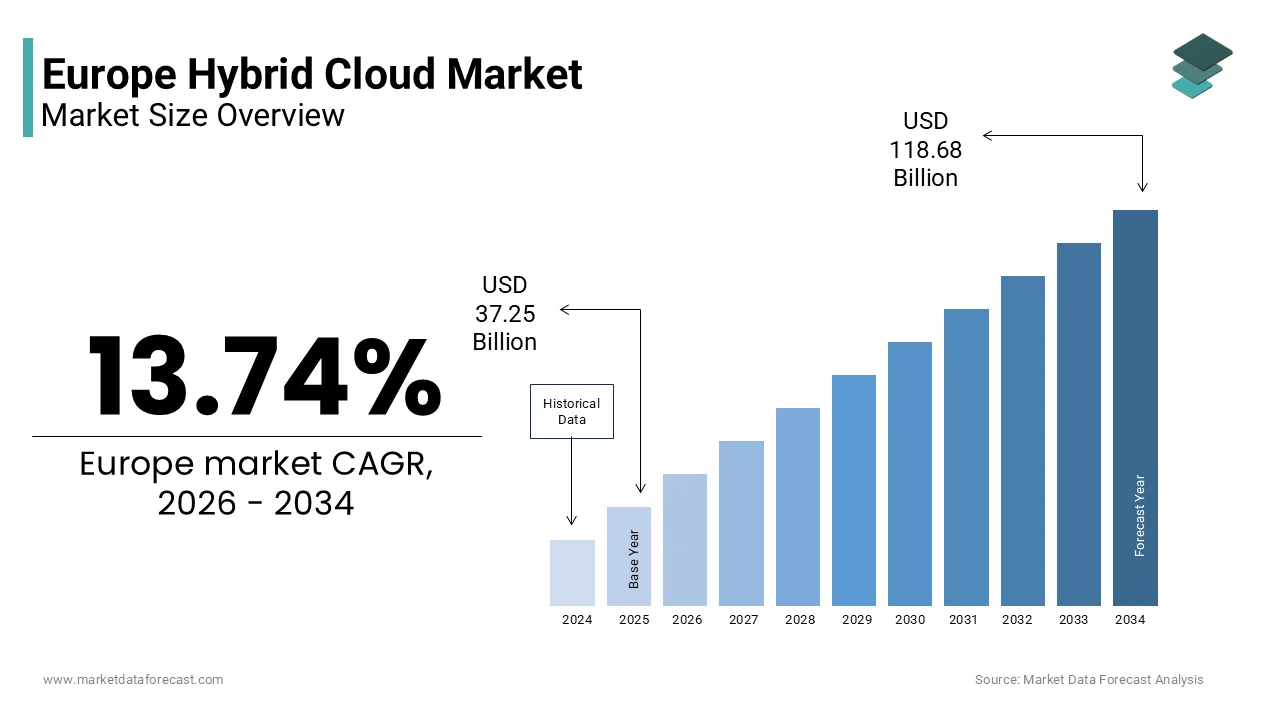
$37.25 BnMarket Estimate, 2026
$42.37 BnMarket Forecast, 2034
$118.68 BnCAGR, 2026–2034
13.74%Europe Hybrid Cloud Market Report Summary
The Europe hybrid cloud market was valued at USD 37.25 billion in 2025, is estimated to reach USD 42.37 billion in 2026, and is projected to reach USD 118.68 billion by 2034, growing at a CAGR of 13.74% during the forecast period. The growth of the Europe hybrid cloud market is driven by the increasing adoption of multi cloud strategies, rising demand for flexible IT infrastructure, and growing digital transformation initiatives across enterprises. Hybrid cloud environments combine private and public cloud platforms, allowing organizations to optimize data management, improve scalability, and maintain regulatory compliance. The increasing need for secure data storage, advanced analytics capabilities, and efficient workload management is further supporting the expansion of hybrid cloud adoption across Europe.
Key Market Trends
- Increasing adoption of hybrid cloud environments to balance data security, scalability, and operational flexibility.
- Growing implementation of multi cloud strategies by enterprises to improve performance and reduce dependency on single cloud providers.
- Rising demand for advanced data analytics, artificial intelligence, and machine learning workloads hosted on hybrid cloud infrastructure.
- Expansion of enterprise digital transformation initiatives that require scalable and flexible IT platforms.
- Increasing investments in cloud data centers and network infrastructure across European countries.
Segmental Insights
- Based on component, the solution segment held the largest share of the Europe hybrid cloud market and accounted for 58.3% of the regional market share in 2025. Hybrid cloud solutions enable organizations to integrate on premises infrastructure with public and private cloud platforms, improving operational efficiency and data management capabilities.
- Based on service model, the infrastructure as a service segment dominated the Europe hybrid cloud market and captured 45.3% of the regional market share in 2025. Infrastructure as a service platforms provide scalable computing resources, storage, and networking capabilities that support enterprise applications and digital workloads.
Regional Insights
- The Europe hybrid cloud market is experiencing strong growth across several countries due to increasing enterprise cloud adoption and expanding digital transformation strategies.
- Germany accounted for the largest share of the Europe hybrid cloud market and held 24.3% of the regional market share in 2025. The country’s strong industrial base, advanced IT infrastructure, and growing investments in cloud computing technologies are key factors supporting market growth.
- Other European countries are also witnessing rising adoption of hybrid cloud platforms driven by increasing demand for scalable IT infrastructure, data security requirements, and enterprise cloud migration initiatives.
Competitive Landscape
The Europe hybrid cloud market is highly competitive with the presence of global cloud service providers, enterprise software companies, and infrastructure solution vendors. Companies are focusing on expanding hybrid cloud platforms, improving interoperability between public and private cloud systems, and integrating advanced technologies such as artificial intelligence and data analytics. Strategic partnerships, cloud infrastructure investments, and expansion of managed cloud services are helping companies strengthen their presence in the European hybrid cloud ecosystem. Prominent players in the Europe hybrid cloud market include Amazon Web Services, Inc. (Amazon.com, Inc.), Microsoft Corporation, Google LLC, IBM Corporation, Oracle Corporation, SAP SE, Salesforce, Inc., Dell Technologies, Inc., Equinix, Inc., and Nutanix, Inc.
Europe Hybrid Cloud Market Size
The Europe hybrid cloud market size was valued at USD 37.25 billion in 2025 and is projected to reach USD 118.68 billion by 2034 from USD 42.37 billion in 2026, growing at a CAGR of 13.74%.
The hybrid cloud is a computing environment that strategically orchestrates workloads across private on-premises infrastructure and public cloud services by enabling seamless data portability and unified management. According to Eurostat, 41% of enterprises in the European Union utilized cloud computing services in 2024, with a significant portion adopting multi-cloud or hybrid strategies to mitigate vendor lock-in risks. Furthermore, the General Data Protection Regulation mandates strict control over personal data, compelling many organizations to keep sensitive information on-premises while leveraging public clouds for less workloads. As per the Body of European Regulators for Electronic Communications, the fragmentation of data laws across member states necessitates a hybrid approach that can adapt to local jurisdictional nuances.
MARKET DRIVERS
Stringent Data Sovereignty Regulations and GDPR Compliance
The imperative to adhere to stringent data sovereignty regulations and the General Data Protection Regulation, compelling organizations to adopt architectures that offer granular control over data location. Unlike regions with more unified federal data laws, Europe's complex patchwork of national regulations alongside EU-wide mandates requires businesses to keep specific categories of sensitive data within defined geographic boundaries or on-premises. According to the European Data Protection Board, fines for non-compliance with GDPR can reach up to 4% of global annual turnover, creating a powerful financial incentive for companies to avoid storing critical data exclusively in public clouds where jurisdictional control might be ambiguous. This regulatory pressure drives the adoption of hybrid models, where sensitive customer data resides in private clouds or local data centers, while non-sensitive workloads leverage the elasticity of public cloud providers. Furthermore, sector-specific regulations in finance and healthcare, such as the revised Payment Services Directive, mandate strict data localization, reinforcing the need for a split architecture.
Optimization of Legacy Infrastructure and Cost Efficiency
The strategic need to optimize legacy infrastructure investments, while achieving cost efficiency, among established industrial and financial institutions is also prompting the growth of Europe hybrid cloud market. Many European enterprises possess substantial capital invested in on-premises data centers and mainframe systems that are fully depreciated yet highly reliable for core operations. Migrating these entire estates to the public cloud would incur prohibitive costs and introduce unnecessary latency for certain applications. Hybrid cloud architectures allow these entities to integrate their existing on-premises assets with public cloud services by enabling them to burst into the public cloud during peak demand periods while maintaining steady-state workloads locally. Furthermore, the ability to run latency-sensitive applications on-premises while utilizing public cloud resources for analytics and development accelerates time-to-market without disrupting core business processes.
MARKET RESTRAINTS
Complexity of Integration and Management Across Heterogeneous Environments
The inherent complexity of integrating and managing heterogeneous environments, often deterring organizations from fully realizing the potential of hybrid architectures is restraining the growth of Europe hybrid cloud market. Constructing a cohesive hybrid cloud requires the seamless orchestration of diverse technologies, including legacy on-premises systems, private cloud platforms, and multiple public cloud providers, each with distinct APIs, security protocols, and management consoles. According to the European Telecommunications Standards Institute, the lack of universal standardization in cloud interfaces leads to significant interoperability issues, forcing IT teams to develop custom connectors and middleware that increase deployment time and operational risk. The difficulty in maintaining consistent security policies and identity management across these fragmented environments further exacerbates the challenge by creating potential vulnerabilities. Furthermore, the shortage of skilled professionals capable of managing such complex multi-domain architectures limits the speed of implementation.
Concerns Over Data Security and Visibility in Distributed Architectures
The persistent concerns over data security and the lack of unified visibility in distributed hybrid architectures serve, particularly among highly regulated sectors is additionally impeding the growth of Europe hybrid cloud market. The distribution of data and applications across on-premises and multiple public cloud environments significantly expands the attack surface by making it difficult for security teams to monitor threats and enforce consistent policies effectively. According to the European Union Agency for Cybersecurity, cyberattacks targeting cloud infrastructure in Europe increased by 45% in 2024, with hybrid environments being particularly vulnerable due to inconsistent security configurations between domains. The inability to maintain a single pane of glass for monitoring logs, access controls, and threat detection across disparate platforms creates blind spots that malicious actors can exploit. The shared responsibility model of public cloud providers often leads to confusion regarding who is liable for specific security layers, complicating compliance audits. The complexity of securing hybrid environments has led to a rise in misconfiguration incidents, which remain the leading cause of cloud data breaches. These security apprehensions force many conservative enterprises to delay or scale back their hybrid cloud initiatives.
MARKET OPPORTUNITIES
Adoption of Edge Computing for Low-Latency Industrial Applications
The rapid adoption of edge computing in conjunction with hybrid cloud architectures for supporting low-latency industrial applications and Internet of Things deployments is solely to create new opportunities for the growth of Europe hybrid cloud market. As European industries embrace Industry 4.0, there is a growing need to process vast amounts of data generated by sensors and machines in real time, which cannotbe achieved by sending all data to a centralized public cloud. According to the International Society of Automation, over 40% of European manufacturing facilities are deploying edge nodes to handle immediate data processing while relying on hybrid cloud backends for long-term storage and advanced analytic. This synergy allows organizations to keep latency-sensitive workloads at the edge or on-premises while leveraging the infinite scale of the public cloud for machine learning model training and big data aggregation. Data from the 5G Infrastructure Public Private Partnership indicates that the rollout of 5G networks in Europe will accelerate edge computing adoption, with the hybrid cloud serving as the essential orchestration layer to manage these distributed resources efficiently. Furthermore, sectors such as autonomous transportation and smart cities require the instantaneous decision-making capabilities that only an edge-hybrid model can provide.
Development of Sovereign Cloud Solutions and Federated Data Spaces
The development of sovereign cloud solutions and federated data spaces by addressing the critical need for digital sovereignty and trust among European enterprises is also to promote new opportunities for the growth of Europe hybrid cloud market in coming years. Initiatives like Gaia-X aim to create a secure and federated data infrastructure that allows organizations to share data across borders while maintaining strict control over access and usage policies. According to the Gaia-X Association, over 400 organizations have joined the initiative to build a compliant ecosystem that integrates private and public cloud resources under a common set of European rules and standards. Furthermore, the establishment of common European data spaces in sectors like health, energy, and manufacturing relies on hybrid architectures to connect isolated data silos securely. As per the European Commission, these data spaces will require robust hybrid cloud frameworks to facilitate secure data exchange without compromising sovereignty.
MARKET CHALLENGES
Acute Shortage of Skilled Cloud Architects and DevOps Professionals
The acute shortage of skilled cloud architects and DevOps professionals, severely limiting the ability of organizations to design, deploy, and maintain complex hybrid environments effectively. The acute shortage of skilled cloud architects is ascribed to hamper the growth of Europe hybrid cloud market. Managing a hybrid cloud requires a unique blend of skills encompassing on-premises infrastructure, multiple public cloud platforms, networking, security, and automation tools, a combination that is rare in the current labor market. According to the European Centre for the Development of Vocational Training, the EU faces a deficit of over 1 million ICT professionals, with cloud specialists being among the most difficult roles to fill. This talent gap forces many companies to rely on external consultants, driving up implementation costs and delaying project timelines. Furthermore, the rapid evolution of cloud technologies means that existing staff require continuous upskilling, which many organizations struggle to support financially and logistically. The lack of internal expertise is cited as a primary reason for the failure of 30% of hybrid cloud initiatives in Europe.
Risks of Vendor Lock-in and Interoperability Fragmentation
The persistent risks of vendor lock-in and interoperability fragmentation, as organizations struggle to maintain true portability and flexibility across different cloud environments. The risk of vendor lock-in and interoperability fragmentation is inhibiting the growth of the Europe hybrid cloud market. Despite the promise of hybrid cloud, many public cloud providers utilize proprietary APIs, data formats, and management tools that make it difficult and costly to migrate workloads to other platforms or back on-premises. According to the Open Cloud Computing Interface working group, the lack of widespread adoption of open standards results in significant technical debt for enterprises that find themselves trapped within a single vendor's ecosystem. This fragmentation also complicates the implementation of consistent security and governance policies, as each vendor has its own unique set of controls and compliance certifications. Furthermore, the complexity of integrating legacy on-premises systems with evolving public cloud services often leads to brittle architectures that are difficult to update.
REPORT COVERAGE
| REPORT METRIC | DETAILS |
| Market Size Available | 2025 to 2034 |
| Base Year | 2025 |
| Forecast Period | 2026 to 2034 |
| CAGR | 13.74% |
| Segments Covered | By Component, Enterprise Size, Service Model, Industry Vertical, and Region |
| Various Analyses Covered | Global, Regional, & Country Level Analysis; Segment-Level Analysis; DROC, PESTLE Analysis; Porter’s Five Forces Analysis; Competitive Landscape; Analyst Overview of Investment Opportunities |
| Regions Covered | UK, France, Spain, Germany, Italy, Russia, Sweden, Denmark, Switzerland, Netherlands, Turkey, and the Czech Republic |
| Market Leaders Profiled | Amazon Web Services, Inc. (Amazon.com, Inc.), Microsoft Corporation, Google LLC, IBM Corporation, Oracle Corporation, SAP SE, Salesforce, Inc., Dell Technologies, Inc., Equinix, Inc., and Nutanix, Inc |
SEGMENTAL ANALYSIS
By Component Insights
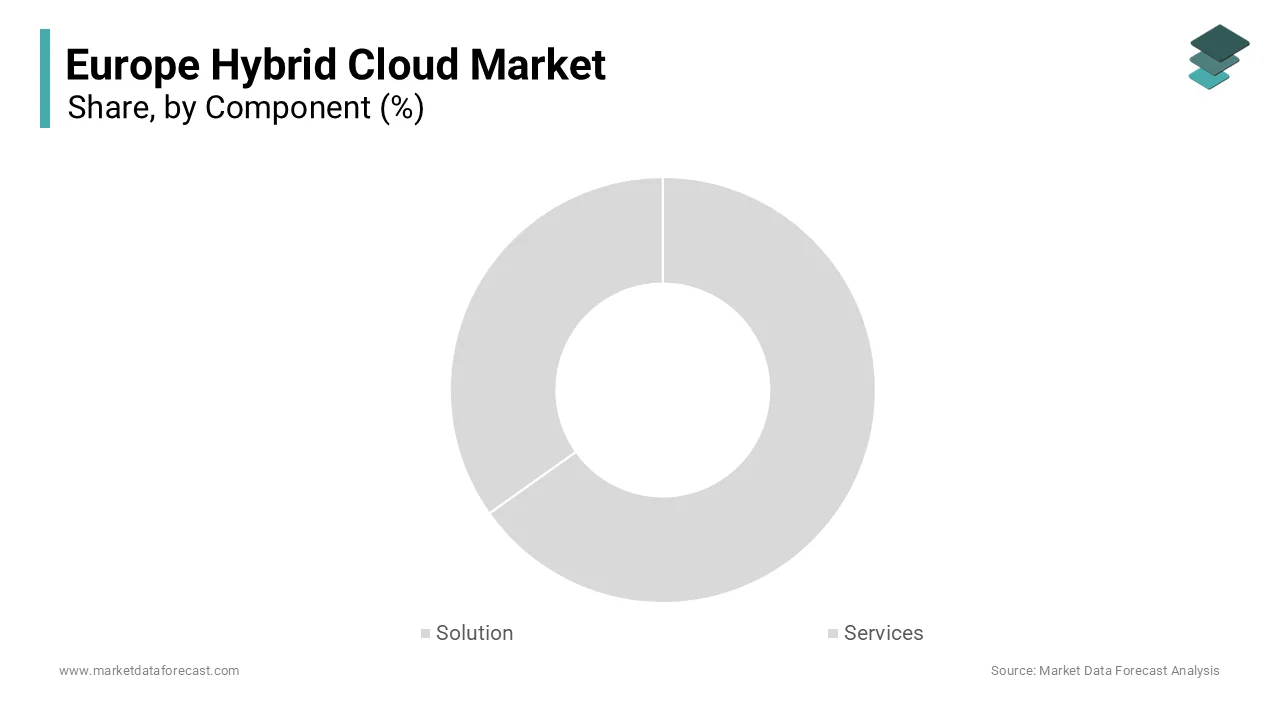
The solution segment was the largest by occupying 58.3% of the Europe hybrid cloud market share in 2025. The growth of the segment is likely to grow with the robust software platforms that can unify management across disparate on-premises and public cloud environments. European enterprises prioritize acquiring comprehensive hybrid cloud suites that offer seamless orchestration, automated workload placement, and integrated security policies to navigate the complex regulatory. The urgent need to address data sovereignty concerns mandated by the General Data Protection Regulation, which requires sophisticated software capabilities to ensure data residency compliance while leveraging public cloud scalability.
Data from the European Commission indicates that the push for digital sovereignty under initiatives like Gaia-X has accelerated the procurement of sovereign-ready hybrid cloud solutions that guarantee data remains within European jurisdictional boundaries. Furthermore, the rise of multi-cloud strategies among European firms necessitates advanced management consoles capable of abstracting the complexity of underlying infrastructure from various providers.
As per the Body of European Regulators for Electronic Communications, the fragmentation of national data laws across member states forces organizations to invest heavily in flexible software solutions that can adapt to local legal requirements without architectural overhaul.
The services segment is projected to expand at a fastest CAGR of 14.2% from 2026 to 2034 owing to the increasing complexity of hybrid cloud deployments and the acute shortage of internal expertise required to design, migrate, and manage these intricate environments. The widespread skills gap in the European IT labor market, forcing organizations to rely heavily on external partners for their hybrid cloud journeys.
As per the European Centre for the Development of Vocational Training, the EU faces a deficit of ICT professionals, with cloud architects being among the hardest roles to fill, creating a massive addressable market for professional services. Furthermore, the strategic shift towards outcome-based consumption models encourages businesses to outsource the operational burden of hybrid cloud management to specialized providers.
By Service Model Insights
The infrastructure as a service segment was the largest by occupying 45.3% of the Europe hybrid cloud market share in 2025 with the foundational role IaaS plays in enabling the hybrid model itself, providing the scalable compute, storage, and networking resources that complement on-premises data centers. European organizations primarily adopt hybrid clouds to extend their existing infrastructure capacity without the capital expenditure of building new physical data centers by making IaaS the natural entry point.
According to Eurostat, the utilization of cloud computing for hosting enterprise databases and computing-intensive tasks has grown significantly, with IaaS being the preferred model for such workloads due to its flexibility and cost-efficiency. Furthermore, the ability to deploy virtual machines and storage volumes in specific geographic regions helps organizations meet data residency requirements while benefiting from public cloud economics.
The Platform as a Service segment is swiftly emerging at a fastest CAGR of 16.8% throughout the forecast period owing to the accelerating adoption of cloud-native development practices and the need for developers to build, test, and deploy applications rapidly across hybrid environments.
The primary catalyst is the shift towards microservices architectures and containerization, which rely heavily on PaaS offerings to manage the underlying complexity of orchestration and runtime environments. The ability of PaaS to provide a consistent development experience across on-premises and public cloud boundaries removes friction for development teams and enables true hybrid agility.
Data from the Cloud Native Computing Foundation shows that the adoption of Kubernetes and container technologies in Europe has doubled since 2023, driving significant demand for managed PaaS solutions that simplify their operation. Furthermore, the integration of AI and machine learning tools into PaaS offerings allows developers to embed intelligent features into applications easily, fostering innovation.
The rapid acceleration of cloud-native development methodologies and the widespread adoption of microservices architectures stand as the primary engines driving the exceptional growth rate of the Platform as a Service segment.
REGIONAL ANALYSIS
Germany Hybrid Cloud Market Analysis
Germany was the largest contributor of the Europe hybrid cloud market by holding 24.3% of the share in 2025. The highly industrialized economy with a strong emphasis on Industry 4.0, which drives immense demand for hybrid cloud solutions to connect legacy manufacturing systems with modern digital platforms. The stringent data privacy culture and rigorous adherence to GDPR, which compels German enterprises to keep sensitive industrial and customer data on-premises, while leveraging public clouds for less critical workloads. The presence of major automotive and chemical giants necessitates robust hybrid architectures that can handle massive data volumes from IoT sensors while ensuring intellectual property protection. Furthermore, the government's push for digital sovereignty and support for initiatives like Gaia-X reinforces the preference for hybrid models that offer greater control.
United Kingdom Hybrid Cloud Market Analysis
The United Kingdom was positioned second with 19.9% of the Europe hybrid cloud market share in 2025 for fintech and digital services that rely heavily on flexible cloud architectures. The need for financial institutions to balance innovation with strict regulatory requirements from the Prudential Regulation Authority, often resulting in hybrid deployments where core banking systems remain on-premises while customer-facing apps run in the public cloud. Furthermore, the concentration of hyperscale data centers in London and surrounding regions provides the necessary infrastructure backbone for robust hybrid connectivity. The government's focus on becoming a global science and technology superpower fosters an environment conducive to advanced cloud adoption.
France Hybrid Cloud Market Analysis
France hybrid cloud market is esteemed to grow at fastest CAGR in next coming years. The growth of the market is driven by the influenced by the "France 2030" investment plan, which prioritizes the development of trusted cloud solutions and the modernization of public sector IT through hybrid architectures. According to the French Government's investment agency, over 1.5 billion euros have been dedicated to supporting cloud innovation projects that align with national security and economic interests, driving significant public sector adoption. French organizations, particularly in the defense, energy, and healthcare sectors, are increasingly adopting hybrid clouds to ensure data remains within national borders while accessing global cloud capabilities. The regulatory environment, guided by ANSSI, encourages the use of SecNumCloud qualified providers, many of whom offer hybrid solutions that meet these strict standards. Furthermore, the growing demand for cloud services among SMEs, supported by government subsidies, expands the market base. The presence of major domestic telecom operators offering hybrid cloud services further stimulates competition and adoption.
Netherlands Hybrid Cloud Market Analysis
The Netherlands hybrid cloud market growth is likely to grow with the hub and logistical gateway for Europe. The presence of major internet exchange points and a high concentration of colocation facilities that serve as the digital entry point for the continent, facilitating low-latency hybrid connections. The logistics and port of Rotterdam sectors also drive demand for hybrid clouds to support real-time supply chain visibility and automated terminal operations. Additionally, the strong presence of multinational corporations headquartered in the Netherlands fosters a culture of early technology adoption. This strategic importance as a digital nexus ensures the Netherlands remains a vital and high-value market.
Sweden Hybrid Cloud Market Analysis
Sweden hybrid cloud market growth is likely to grow with the digitalization and home to major technology innovators. The presence of global telecom and gaming giants that require sophisticated hybrid cloud architectures to manage massive global user bases and data streams, while maintaining low latency for Nordic users. The Swedish government's proactive stance on digitalization and its support for green tech initiatives encourage operators to use hybrid clouds for energy-efficient operations. The collaboration between academia, industry, and government in Sweden fosters a unique ecosystem where hybrid cloud research is quickly translated into commercial applications. Furthermore, the early deployment of 5G networks provides a real-world laboratory for edge-hybrid cloud integrations.
COMPETITIVE LANDSCAPE
The competition in the Europe hybrid cloud market is intense and characterized by a rivalry between global hyperscalers and specialized regional providers who compete on compliance capabilities and technological integration. Large multinational corporations leverage their extensive global infrastructure and broad service portfolios to offer comprehensive hybrid solutions that appeal to large enterprises seeking scalability. Price competition is moderate as buyers prioritize data security regulatory compliance and operational consistency over initial cost savings given the sensitive nature of hybrid deployments. Innovation speed and the ability to demonstrate clear pathways to digital sovereignty are becoming key differentiators in this rapidly evolving sector.
KEY MARKET PLAYERS
Some of the notable key players in the Europe hybrid cloud market are
- Amazon Web Services, Inc. (Amazon.com, Inc.)
- Microsoft Corporation
- Google LLC
- IBM Corporation
- Oracle Corporation
- SAP SE
- Salesforce, Inc.
- Dell Technologies, Inc.
- Equinix, Inc.
- Nutanix, Inc.
Top Players in the Market
- International Business Machines Corporation stands as a pivotal force in the Europe hybrid cloud market by leveraging its Red Hat acquisition to deliver open source solutions that enable seamless workload portability. The company contributes globally through its IBM Cloud Paks which allow enterprises to build and manage applications across any cloud environment while maintaining strict data governance. IBM recently strengthened its European position by expanding its network of sovereign cloud regions to address specific data residency requirements mandated by local regulations. Their strategic focus includes integrating artificial intelligence capabilities into hybrid platforms to automate operations and enhance security postures for clients. IBM continues to partner with major European telecommunications providers to deploy edge computing solutions that extend hybrid cloud reach.
- Microsoft Corporation operates as a leading innovator in the Europe hybrid cloud market by offering the Azure Arc platform which extends Azure management and services to any infrastructure. The firm influences the global sector by providing unified governance tools that allow organizations to control resources across on premises data centers and multi cloud environments from a single interface. Microsoft has recently accelerated its strategy by launching dedicated sovereign cloud offerings in Germany and France to ensure customer data remains within national borders under local legal jurisdiction. Their commitment to sustainability is evident through new carbon negative data center designs that support hybrid workloads with minimal environmental impact. The company also focuses on securing hybrid identities and protecting distributed applications against evolving cyber threats.
- Amazon Web Services Inc maintains a significant presence in the Europe hybrid cloud market through its Outposts and VMware Cloud on AWS solutions which bring native cloud services to customer facilities. The company contributes globally by setting standards for hybrid infrastructure that delivers consistent performance and operational models across different locations. AWS recently focused on strengthening its position by investing heavily in new local zones and wavelength edges throughout Europe to support low latency applications for automotive and manufacturing industries. Their approach involves developing specialized industry clouds that cater to regulated sectors such as finance and healthcare with built in compliance controls. The firm also invests in training programs to upskill the European workforce on hybrid cloud architectures and best practices.
Top Strategies Used by Key Market Participants
Key players in the Europe hybrid cloud market primarily focus on developing sovereign cloud solutions that guarantee data residency and comply with strict European Union regulations regarding data privacy and security. Companies are increasingly investing in edge computing capabilities to extend hybrid cloud services closer to end users and support real time processing for industrial applications. Strategic partnerships with local telecommunications providers and system integrators are essential to build robust networks and offer managed services tailored to specific regional needs. Vendors are also prioritizing the integration of artificial intelligence and machine learning tools into their hybrid platforms to automate management tasks and optimize resource utilization efficiently. Furthermore, market participants are expanding their open source ecosystems to prevent vendor lock in and ensure seamless interoperability between diverse cloud environments. These collective strategies aim to drive trust and adoption while addressing the unique regulatory and technical challenges of the European landscape.
MARKET SEGMENTATION
This research report on the European hybrid cloud market has been segmented and sub-segmented based on categories.
By Component
- Solution
- Services
By Enterprise Size
- Small & Medium-sized Enterprises
- Large Enterprises
By Service Model
- Software as a Service (SaaS)
- Infrastructure as a Service (IaaS)
- Platform as a Service (PaaS)
By Industry Vertical
- BFSI
- IT & Telecom
- Healthcare
- Retail
- Government
- Media & Entertainment
- Transportation & Logistics
- Manufacturing
- Others
By Country
- UK
- France
- Spain
- Germany
- Italy
- Russia
- Sweden
- Denmark
- Switzerland
- Netherlands
- Turkey
- Czech Republic
- Rest of Europe