- Product Description Description
- Table of Contents TOC
- List of Table & Figure LOT
- Get Free Sample PDF Sample PDF
Market Size, 2025
$78.98 BnMarket Estimate, 2026
$95.57 BnMarket Forecast, 2034
$439.12 BnCAGR, 2026–2034
21%Executive Summary: Global Hybrid Cloud Market
- Market Scope: Comprehensive global hybrid cloud market analysis covering component categories, service models, regional leadership frameworks, and enterprise digital transformation trends.
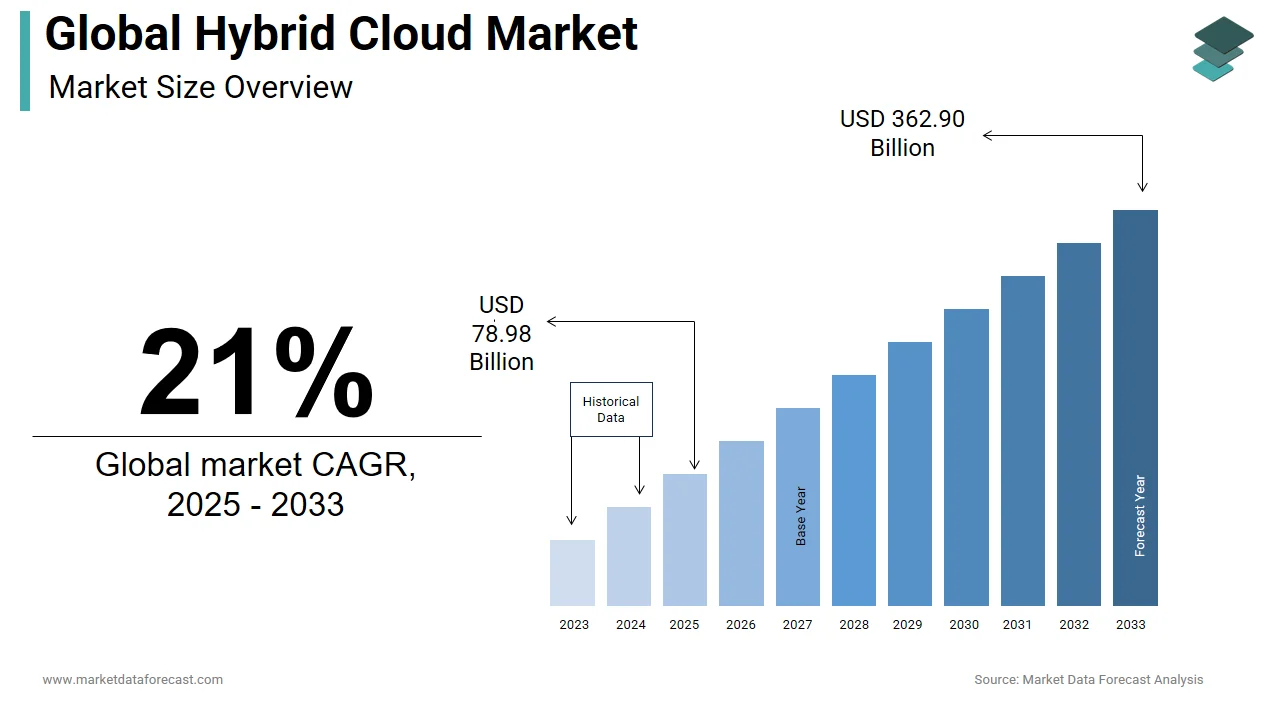
- Market Valuation: Valued at USD 78.98 billion (2025), estimated at USD 95.57 billion (2026), and projected to reach USD 439.12 billion by 2034, registering an exceptional CAGR of 21% (2026–2034).
- Primary Growth Drivers: Stringent data sovereignty regulations mandating architectural flexibility, legacy system modernization requiring phased migrations, convergence of edge computing, separation of AI training and inference, and demand for unified management to address skills gaps.
Key Market Segment Metrics (2026–2034)
| Category | Leading Segment (Base Position) | Fastest-Growing Segment |
|---|---|---|
| By Component | Solutions (accounted for 33.4% of market share in 2025 across enterprise workloads) | Professional and Managed Services (projected to grow at the fastest CAGR of 18.7%) |
| By Service Type & Model | Cloud Management Services (led with 39.2% share) and Infrastructure as a Service (IaaS) | Orchestration Services (CAGR of 22.4%) and Platform as a Service (PaaS) (CAGR of 24.8%) |
| By Architecture & Workload | Multi-Environment Virtualization and Traditional Enterprise Application Migration | AI Model Training-Inference Separation and Distributed Edge-Cloud Workloads |
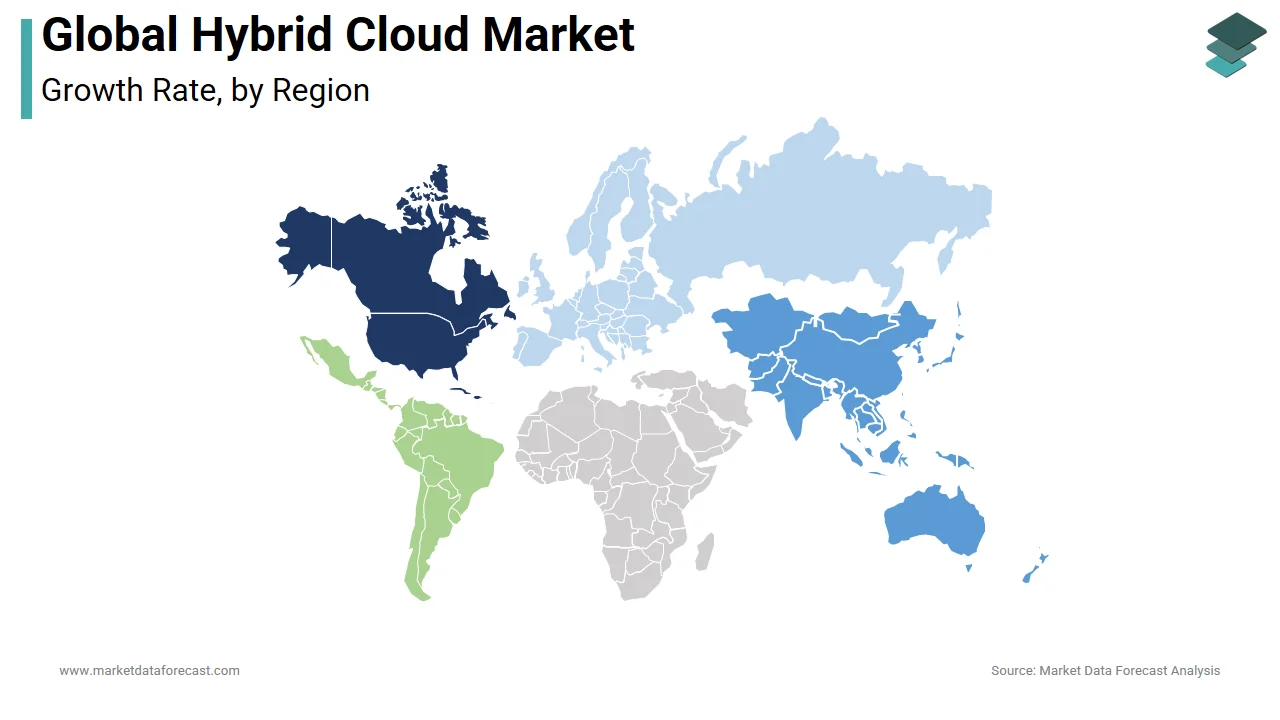
| By Region / Country | North America (held the largest regional share at 41.2% in 2025) | Asia-Pacific (expected to register the fastest CAGR driven by cloud modernization initiatives) |
Major Market Players & Market Structure
Market Structure: Highly competitive global cloud computing and infrastructure landscape featuring major hyper-scalers and software providers focusing on hybrid management platforms, vendor-neutral Kubernetes portability, and localized hybrid cloud solutions.
Key Companies: IBM, Microsoft, Cisco Systems, Amazon Web Services, Oracle, Google, VMware, Alibaba, Equinix, Rackspace, NetApp, Atos, Fujitsu, CenturyLink, HPE, DXC, RightScale, Micro Focus, NTT Communications, Red Hat, Dell EMC, Citrix, Pure Storage, Unitas Global, and Quest Software.
Global Hybrid Cloud Market Size
The global hybrid cloud market size was valued at USD 78.98 billion in 2025 and is expected to grow from USD 95.57 billion in 2026 to USD 439.12 billion by 2034, at a CAGR of 21% from 2026 to 2034.
The hybrid cloud is an integrated computing environment that combines on-premises private infrastructure with public cloud services through standardized orchestration and data portability layers, enabling unified management across heterogeneous environments. This architectural paradigm allows organizations to maintain sensitive workloads within controlled boundaries, while leveraging elastic public resources for variable demand scenarios without sacrificing operational coherence. The National Institute of Standards and Technology defines hybrid cloud as a composition of two or more distinct infrastructures bound by technology enabling application and data portability, which has become the de facto standard for digital transformation initiatives globally. This reality transforms hybrid cloud from a deliberate architecture choice to an emergent condition requiring governance frameworks addressing security, cost, and performance across distributed resources.
MARKET DRIVERS
Data Sovereignty Regulations Mandate Architectural Flexibility
The global proliferation of data residency and privacy regulations compels organizations to adopt hybrid architectures that enable granular control over data placement, while maintaining access to public cloud innovation capabilities. The data sovereignty regulations mandate architectural flexibility, accelerating the growth of the hybrid cloud market. China’s Personal Information Protection Law requires information infrastructure operators to store data domestically, yet permits overseas processing for commercial functions, creating mandatory hybrid configurations for multinational corporations serving China. Financial regulators, including Singapore MAS and Australia APRA, mandate that customer financial records remain within national borders, while allowing analytical workloads to leverage international AI services through anonymization and aggregation techniques only achievable through hybrid orchestration. These regulatory divergences make uniform public cloud strategies legally untenable for global enterprises transforming hybrid architecture from technical preference to compliance necessity. Organizations face penalties averaging 4% of global revenue under GDPR for noncompliance, making hybrid investment economically rational despite added complexity, as the alternative is market exclusion or regulatory sanction.
Legacy System Modernization Requires Phased Migration Approaches
Enterprises operating decades-old mission systems cannot execute big bang cloud migrations, necessitating hybrid architectures as transitional scaffolding enabling gradual transformation without business disruption. Legacy system modernization requires phased migration approaches and is also promoting the growth of the hybrid cloud market. Mainframe-dependent industries, including banking and insurance, process transactions through COBOL codebases exceeding 30 years in age, with embedded business logic undocumented and irreplaceable without extensive reverse engineering efforts. Hybrid cloud enables these organizations to extend legacy systems through API wrappers and data synchronization layers connecting mainframes to modern cloud native applications without immediate core system replacement. This coexistence model reduces migration risk by preserving proven transaction processing while innovating at edges, where customer experience differentiation occurs. As technical debt accumulates across industries, hybrid architectures provide an escape valve enabling incremental modernization aligned with business cycles rather than forcing disruptive transformations that jeopardize operational continuity and stakeholder confidence during transition periods.
MARKET RESTRAINTS
Network Latency and Bandwidth Constraints Limit Performance Integration
The physical limitations of network infrastructure create fundamental barriers to seamless hybrid cloud integration, causing performance degradation that undermines unified architecture promises for latency-sensitive applications. The network latency and bandwidth constraints are hindering the growth of the hybrid cloud market. The average enterprise WAN latency between on-premises data centers and public cloud regions ranges from 15 to 45 milliseconds depending on geographic proximity, which exceeds tolerance thresholds for real-time database synchronization and high-frequency trading applications requiring sub-millisecond response times. Manufacturing execution systems and industrial IoT platforms generating continuous telemetry streams cannot tolerate intermittent connectivity or variable bandwidth, causing production line stoppages when cloud dependencies fail during network outages averaging 4.2 hours annually, according to the Survey. Content delivery and video processing workloads requiring sustained multi-gigabit throughput face congestion during peak hours, degrading user experience below acceptable service level agreements. These physical constraints force architects to maintain redundant on-premises capacity, defeating cloud elasticity benefits, or accept performance compromises, undermining business case justification. Until edge computing matures and dedicated connectivity becomes economically viable beyond tier one markets, network physics will persistently restrain hybrid cloud applicability for performance-critical use cases regardless of software orchestration sophistication.
Skills Gap and Organizational Silos Impede Unified Operations
The specialized expertise required to manage hybrid environments exceeds available talent pools, creating operational hurdles that prevent organizations from realizing theoretical efficiency gains, which is additionally impeding the growth of the hybrid cloud market. Traditional IT operations teams trained on VMware and Windows Server lack Kubernetes and Terraform competencies necessary for cloud automation, while cloud native engineers often misunderstand legacy networking and storage protocols, causing integration failures during deployment. This human capital deficit creates a hard ceiling on hybrid adoption velocity regardless of technology availability, as organizations cannot staff operations centers capable of managing distributed complexity. Without accelerated skills development or simplified abstraction layers reducing expertise requirements, talent scarcity is likely to hinder the growth of the market.
MARKET OPPORTUNITIES
Edge Computing Convergence Creates Distributed Hybrid Architectures
The proliferation of edge computing nodes extends hybrid cloud paradigms beyond traditional data center and public cloud dyad, creating three-tier architectures that address latency and bandwidth constraints, while maintaining centralized governance. This factor is likely to promote new opportunities for the expansion of the hybrid cloud market. According to IDC Worldwide Edge Spending Guide, global edge infrastructure investment reached 261 billion dollars in 2024, growing 15% annually as manufacturing, retail, and telecommunications sectors deploy local processing capacity for real-time analytics and autonomous operations. Retailers, including Walmart and Target, have implemented edge cloud platforms in 4500 stores processing point-of-sale transactions and inventory analytics locally, while synchronizing aggregated insights to central clouds, reducing WAN bandwidth consumption by 70%, according to the study. This architectural evolution transforms hybrid cloud from a two-location model to a continuum spanning devices, edge nodes, regional data centers, and hyperscale clouds, requiring new orchestration frameworks managing workload placement across four tiers dynamically. Vendors offering unified management planes spanning this continuum capture value from increased complexity while solving performance problems that restrained traditional hybrid adoption.
AI Model Training and Inference Separation Drives Specialized Hybrid Designs
Artificial intelligence workloads create natural hybrid cloud segmentation, where resource-intensive training occurs in public clouds, while latency-sensitive inference executes on premises or at edge locations, optimizing cost and performance simultaneously. AI model training and inference separation with advanced designs is also to elevate the growth of the hybrid cloud market. According to the study, training frontier language models requires clusters of 10000 GPUs consuming 5 megawatts continuously for months, representing capital expenditure exceeding 200 million dollars, impractical for most enterprises to replicate privately, yet inference serving requires sub-100-millisecond response times incompatible with round-trip cloud latency for real-time applications. Healthcare providers train diagnostic imaging models on HIPAA-compliant cloud GPU clusters, then deploy lightweight inference containers to hospital PACS systems, avoiding patient data egress, while delivering real-time clinical decision support. This workload bifurcation creates structured hybrid demand driven by AI economics rather than legacy constraints, ensuring sustained growth as generative AI adoption accelerates across industries. Vendors offering specialized AI orchestration tools automating training and inference workflows capture disproportionate value from this emerging pattern as organizations seek to balance innovation access with operational and regulatory constraints unique to AI deployment.
MARKET CHALLENGES
Security Posture Fragmentation Increases Attack Surface Complexity
Managing consistent security policies across heterogeneous hybrid environments creates visibility gaps and configuration drift that exponentially increase vulnerability exposure compared to homogeneous deployments. The security posture fragmentation poses a major challenge for the growth of the hybrid cloud market. According to the report, hybrid cloud breaches averaged 5.29 million dollars in damages, representing a 22% premium over single-environment incidents due to extended detection times averaging 277 days versus 204 days for pure cloud or on-premises breaches. The hybrid environments contain misconfigured storage buckets or overly permissive IAM roles traceable to manual policy translation errors between cloud provider formats and on-premises Active Directory structures. Compliance auditing compounds complexity as SOC 2 and ISO 27001 assessments must verify controls across multiple platforms with different evidence collection mechanisms, increasing audit duration by 60%, according to the study. Zero trust architectures promise unified security, yet practical implementation requires agent deployment across diverse operating systems and legacy platforms lacking modern API support, creating coverage gaps.
Cost Visibility and Optimization Complexity Undermine Financial Governance
The distributed nature of hybrid cloud spending across multiple vendors, billing systems, and allocation models creates opacity, preventing accurate total cost of ownership calculations and optimization decisions. The cost visibility and optimization complexity undermine financial governance and also inhibit the growth of the hybrid cloud market. The hidden hybrid cloud costs, including data egress fees, API calls, and cross-region transfers, add to total spending, yet remain invisible in standard vendor invoices, requiring specialized tooling to identify and optimize. Reserved instance commitments made during peak demand periods become stranded assets when workloads migrate between environments during optimization cycles, wasting 35% of prepaid capacity, according to the study. Finance teams struggle to reconcile cloud variable expenses with traditional capital budgeting cycles, creating friction between IT agility goals and corporate financial governance requirements. Tagging inconsistencies across environments prevent accurate business unit attribution, undermining showback and chargeback mechanisms essential for accountability.
REPORT COVERAGE
| REPORT METRIC | DETAILS |
| Market Size Available | 2025 to 2034 |
| Base Year | 2025 |
| Forecast Period | 2026 to 2034 |
| Segments Covered | By Component, Service Type, Service Mode, Organization Type, Vertical, and Region. |
| Various Analyses Covered | Global, Regional, and Country-Level Analysis, Segment-Level Analysis, Drivers, Restraints, Opportunities, Challenges; PESTLE Analysis; Porter’s Five Forces Analysis, Competitive Landscape, Analyst Overview of Investment Opportunities |
| Countries Covered | North America, Europe, APAC, Latin America, Middle East & Africa |
| Market Leaders Profiled | IBM, Microsoft, Cisco Systems, Amazon Web Services, Oracle, Google, VMware, Alibaba, Equinix, Rackspace, NetApp, Atos, Fujitsu, CenturyLink, HPE, DXC, RightScale, Micro Focus, NTT Communications, Red Hat, Dell EMC, Citrix, Pure Storage, Unitas Global, and Quest Software and Others. |
SEGMENTAL ANALYSIS
By Component Insights
The solution segment was the largest by accounting for 33.4% of the hybrid cloud market share in 2025, with organizations requiring unified software stacks to manage distributed infrastructure as cohesive environments rather than disparate silos. These platforms enable single pane of glass visibility across AWS, Azure, and on-premises data centers by reducing operational complexity that would otherwise require separate toolchains for each environment. The shift toward Kubernetes as a universal orchestration standard has further entrenched solution dominance, as container platforms inherently span boundaries, making them de facto hybrid enablers regardless of underlying compute substrate.
SEGMENTAL ANALYSIS
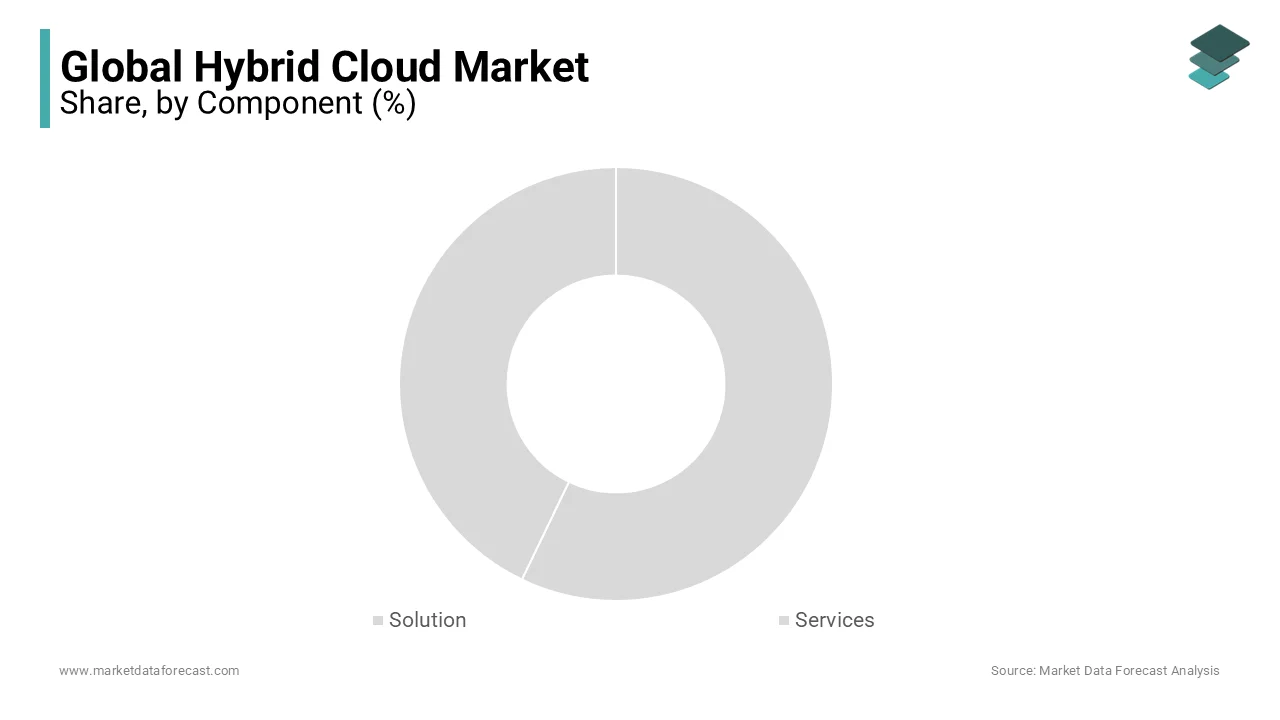
The professional and managed services segment is likely to register the fastest CAGR of 18.7% from 2026 to 2034, as organizations confront severe talent shortages preventing effective hybrid cloud operations despite successful technology procurement. According to the report, the global shortage of cloud-skilled professionals reached 4.3 million positions, with hybrid expertise commanding 35% salary premiums over single cloud specializations. This deficit forces organizations to outsource design, migration, and ongoing operations to specialized service providers who possess cross-platform certifications and accumulated implementation experience unavailable internally. Accenture and Infosys reported 42% year-over-year growth in hybrid cloud managed services contracts during 2024, as clients shifted from project-based engagements to outcome-based partnerships guaranteeing SLA performance without permanent headcount commitments. As per the study, 68% of enterprises now use third-party managed services for at least one hybrid cloud function compared to 45% three years ago, reflecting a structural shift toward consumption models aligning costs with actual usage rather than fixed staffing expenses. The intricate nature of hybrid cloud migrations generates multiyear service engagements extending far beyond initial deployment, as organizations navigate legacy integration and workload optimization challenges.
By Service Type Insights
The cloud management services segment was the largest by accounting for 39.2% of the hybrid cloud market share in 2025. Many enterprises cite unified monitoring and governance as top priority when selecting hybrid cloud partners, reflecting recognition that visibility gaps directly correlate with outage frequency and security incidents. The proliferation of microservices and containerized applications has amplified management complexity, with typical enterprises now operating 15000 containers across hybrid environments, according to the study. Compliance automation features embedded in management platforms address regulatory requirements spanning multiple jurisdictions, reducing audit preparation time by 60%, according to the survey. This operational indispensability ensures cloud management maintains service type dominance, as organizations recognize that infrastructure investment without corresponding management capability delivers negative returns through increased downtime and security exposure outweighing agility benefits. Financial governance requirements drive sustained demand for cloud management, as organizations struggle to control distributed spending across multiple billing systems and allocation models.
The orchestration services segment is likely to grow at the fastest CAGR of 22.4% during the forecast period. According to Survey 2024, 78% of enterprises now operate Kubernetes clusters across three or more environments, creating urgent demand for orchestration expertise enabling consistent deployment patterns regardless of underlying infrastructure differences. The emergence of GitOps workflows treating infrastructure declarations as version-controlled artifacts requires cultural transformation and toolchain integration that traditional IT operations teams cannot execute without guided enablement services. Regulatory requirements mandating reproducible environments for audit trails further compel orchestration adoption as manual processes cannot demonstrate deterministic compliance. This emergence of technical necessity and compliance mandate creates structural growth drivers ensuring orchestration services outpace other categories, as organizations recognize that hybrid flexibility depends fundamentally on automation maturity rather than connectivity alone.
By Service Model Insights
The Infrastructure as a Service segment accounted for a prominent share of the hybrid cloud market, with higher-level services depending on creating base layer demand that scales linearly with digital transformation initiatives. AWS Outposts, Azure Stack, and Google Anthos collectively generated 18 billion dollars in hybrid IaaS revenue during 2024, as per the study. Manufacturing and healthcare sectors particularly favor IaaS models for latency-sensitive and regulated workloads requiring physical proximity to users or data sources that pure public cloud cannot satisfy, as per the research. The persistence of virtual machine-based architectures with enterprise workloads still running on VMs rather than containers, according to the Datadog State of Virtualization report, ensures IaaS relevance despite containerization trends. This foundational positioning guarantees IaaS maintains service model leadership as organizations recognize that advanced capabilities depend on a reliable infrastructure layer functioning correctly across hybrid boundaries.
The platform as a service segment is likely to witness the fastest CAGR of 24.8% during the forecast period as organizations prioritize developer velocity and application innovation over infrastructure management, recognizing that abstracting operational complexity enables faster feature delivery and competitive differentiation. Azure App Service, AWS Elastic Beanstalk, and Google Cloud Run collectively added 45000 new enterprise customers in 2024, reflecting a shift toward serverless and managed runtime environments that eliminate patching, scaling, and configuration overhead, according to the study. The rise of AI-assisted coding tools, including GitHub Copilot and Amazon CodeWhisperer, integrates natively with PaaS platforms, amplifying productivity gains through seamless deployment pipelines unavailable in IaaS environments, according to the survey. Talent scarcity further drives PaaS adoption as developers prefer working on business logic rather than infrastructure maintenance, making PaaS-enabled roles easier to staff, according to the report.
REGIONAL ANALYSIS
North America Hybrid Cloud Market Analysis
North America was the largest contributor in the global hybrid cloud market by holding 41.2% of the share in 2025, with the hyperscaler infrastructure and government digital transformation initiatives. According to the study, federal agencies migrated 68% of eligible systems to authorized hybrid cloud environments by the end of 2024, driven by the Federal Cloud Computing Strategy mandating hybrid approaches for classified and sensitive unclassified workloads requiring FedRAMP High authorization. Major US enterprises spent a combined 95 billion dollars on hybrid infrastructure during 2024, with digital investment satellite accounts reflecting private sector alignment with government-led modernization patterns, as per the study. AWS and Azure operate 45 availability zones across North America, providing regional redundancy and low-latency access by enabling hybrid architectures meeting data residency requirements for financial services and healthcare sectors, according to the study. However, state-level privacy legislation fragmentation, including California CCPA and Virginia CDPA, creates compliance complexity, slowing interstate hybrid deployments compared to a federally harmonized European framework.
Europe Hybrid Cloud Market Analysis
Europe hybrid cloud market was ranked second by holding 28.3% of the share in 2025, with the sovereignty-first adoption patterns differing fundamentally from commercially driven approaches dominating other regions. France’s Bleu cloud initiative, partnering Microsoft with Capgemini and Orange, achieved SecNumCloud certification in 2024 by enabling government ministries to deploy hybrid architectures meeting ANSSI's highest security standards, while accessing Azure services according to official press releases. Nordic countries lead per capita hybrid spending with Sweden and Finland, allocating 95 euros per citizen annually for public sector cloud modernization. However, stringent GDPR enforcement creates headwinds as Ireland's DPC and France's CNIL have blocked several US cloud provider data transfer mechanisms, delaying hybrid deployments until adequate safeguards are implemented. This tension between sovereignty ambitions and practical capability gaps produces a distinctive market where compliance certification competes with technical performance, as a success factor creating opportunities for vendors specializing in EU-compliant architectures aligned with regulatory priorities rather than pure feature parity with global leaders.
Asia Pacific Hybrid Cloud Market Analysis
Asia Pacific hybrid cloud market growth is expected to grow at the fastest CAGR in the coming years, with the extreme heterogeneity between China’s state-directed infrastructure and Japan’s open consortium approach. Alibaba Cloud and Huawei Cloud collectively serve 78% of Chinese enterprise hybrid deployments, reflecting domestic vendor dominance reinforced by cybersecurity law requiring data localization and technology stack vetting, as per the study. Japan maintains the most developed open hybrid ecosystem in the region, with NTT DOCOMO, KDDI, and SoftBank participating in a multi-vendor interoperability consortium by enabling workload portability across providers, according to Japan Cloud Association whitepapers. South Korea’s K Cloud Platform allocated 1.8 trillion won in 2024 for public sector hybrid infrastructure supporting AI and big data initiatives, according to the studies. However, geopolitical tensions create bifurcated supply chains with ASEAN nations increasingly diversifying away from Chinese vendors for infrastructure, reshaping competitive dynamics. This diversity prevents unified regional strategies requiring country-specific approaches balancing global platform capabilities with local regulatory environments and governance preferences distinct from Western countries.
Latin America Hybrid Cloud Market Analysis
Latin America hybrid cloud market growth is steadily growing with the presence of the largest contributors like Brazil and Mexico, where federal digitalization initiatives create structured demand despite broader economic volatility. Mexico’s National Digital Strategy 2024 allocated 28 billion pesos for hybrid cloud modernization targeting health, education, and security sectors, with data residency requirements mandating domestic hosting for citizen information, according to the study. Chile’s Digital Transformation Law requires all public agencies to adopt hybrid cloud by 2026, creating an 850 million dollar addressable market, according to the survey. Colombia and Argentina show emerging potential with banking and retail sectors adopting hybrid for regulatory compliance and scalability, yet currency instability and import restrictions periodically disrupt equipment supply chains, delaying deployments. Fraud prevention in financial services creates niche demand, as banks require secure hybrid connectivity for core banking systems that pure public cloud cannot satisfy under Central Bank circulars. This combination of government mandate pull and sector-specific compliance push produces selective opportunity concentrated in the largest economies requiring localized partnership strategies navigating complex procurement regulations and financing constraints distinct from developed market patterns.
Middle East and Africa Hybrid Cloud Market Analysis
Middle East and Africa hybrid cloud market growth is likely to grow with the extreme concentration in Gulf Cooperation Council states pursuing digital economy transitions through advanced sovereign cloud investment. United Arab Emirates’ Federal Entity Cloud Policy mandates hybrid architecture for all government entities by 2025, with Abu Dhabi’s TAMM platform and Dubai’s Smart Government initiatives serving as reference implementations processing 250 million transactions annually, according to the report. South Africa maintains the most developed African hybrid ecosystem, with MTN Business and Dimension Data deploying sovereign platforms serving financial services and mining sectors requiring POPIA compliance, according to Companies and Intellectual Property Commission filings. African cloud imports are suppressed by political and currency instability, limiting advanced infrastructure to wealthy nodes and requiring localized, segmented strategies.
COMPETITIVE LANDSCAPE
Competition in the hybrid cloud market intensifies as hyperscalers face pressure from open-source platforms and specialized vendors challenging proprietary lock-in through portability and standards compliance. Incumbent advantage stems from integrated service portfolios and global infrastructure, yet newcomers disrupt through vendor neutrality and lower total cost of ownership, appealing to organizations prioritizing flexibility over feature depth. Competitive differentiation increasingly centers on AI enablement and sovereign compliance rather than raw infrastructure performance, as organizations seek platforms supporting emerging workloads within regulatory constraints. Vendor consolidation accelerates through strategic acquisitions as larger players absorb orchestration and security specialists to fill capability gaps in multi-cloud management and FinOps. Geographic fragmentation creates distinct competitive arenas with Western vendors dominating North America and Europe while Asian suppliers gain traction in emerging markets through government-supported digital sovereignty initiatives. Success ultimately requires balancing technological breadth with ecosystem openness, as no single vendor delivers a complete hybrid solution independently, making partnership strategies as important as product capabilities.
KEY MARKET PLAYERS
The leading companies operating in the global hybrid cloud market include:
- IBM
- Microsoft
- Cisco Systems
- Amazon Web Services
- Oracle
- VMware
- Alibaba
- Equinix
- Rackspace
- NetApp
- Atos
- Fujitsu
- CenturyLink
- HPE
- DXC
- RightScale
- Micro Focus
- NTT Communications
- Red Hat
- Dell EMC
- Citrix
- Pure Storage
- Unitas Global
- Quest Software
TOP PLAYERS IN THE MARKET
- Microsoft dominates hybrid cloud through Azure Arc and Azure Stack HCI by enabling consistent management across on-premises, edge, and multi-cloud environments with unified security and governance. The company strengthened its position by launching Azure Local in late 2024, integrating validated hardware partners with cloud-connected infrastructure by simplifying deployment for mid-range enterprises lacking dedicated cloud operations teams. This innovation extends Azure services to disconnected scenarios, addressing air-gapped and low connectivity requirements common in manufacturing and government sectors. Microsoft continues expanding sovereign cloud partnerships with local operators in the EU and Asia, ensuring data residency compliance while maintaining service parity. Their integrated approach combining identity, security, and management creates vendor consolidation benefits, reducing complexity for organizations operating heterogeneous environments. Deep integration with Microsoft ecosystems turns hybrid cloud into application modernization and AI workflows across distributed environments.
- Amazon Web Services contributes significantly to hybrid cloud through Outposts and ECS Anywhere, extending AWS native services to customer premises, enabling consistent developer experience across environments without rearchitecting applications. The company recently introduced AWS Dedicated Local Zones in early 2025, providing single-tenant infrastructure within metropolitan areas addressing latency-sensitive workloads requiring physical proximity, while maintaining AWS API compatibility. AWS strengthens market position through a comprehensive partner ecosystem, including Dell, HPE, and Lenovo validated configurations by reducing integration risk for enterprises standardizing on specific hardware vendors. Their focus on container and serverless portability enables workload mobility without lock-in concerns, appealing to organizations prioritizing flexibility over vendor consolidation. Strategic investments in satellite connectivity through Project Kuiper extend hybrid reach to remote locations underserved by terrestrial networks, creating new addressable markets in mining, maritime, and rural healthcare sectors.
- Red Hat advances hybrid cloud through OpenShift Kubernetes platform, providing consistent application runtime across any infrastructure, enabling true workload portability independent of underlying compute substrate. Red Hat’s vendor-neutral positioning appeals to organizations avoiding hyperscaler lock-in while requiring enterprise-grade support and certification absent from community distributions. Strategic partnerships with all major cloud providers and hardware vendors ensure broad compatibility, making OpenShift de facto standard for regulated industries requiring auditability and long-term stability. Their subscription model aligns costs with consumption rather than infrastructure ownership, appealing to finance teams managing variable cloud spending. Focus on developer experience and GitOps workflows accelerates adoption among cloud native teams transitioning from pure public to hybrid architectures. This open source credibility combined with enterprise support creates a defensible niche between hyperscalers and legacy virtualization vendors, capturing organizations prioritizing portability and standards compliance over proprietary feature depth.
TOP STRATEGIES USED BY KEY MARKET PARTICIPANTS
Key players pursue vertical integration, acquiring specialized orchestration and security vendors to offer end-to-end hybrid solutions, reducing customer vendor management complexity and capturing more project value. Companies increasingly develop sovereign cloud partnerships with local operators addressing data residency requirements, while maintaining global service consistency, creating regulatory-compliant entry points in restricted areas. Vendors expand managed service offerings, assuming operational responsibilities to address skills gaps preventing effective hybrid adoption among resource-constrained enterprises. Strategic focus shifts toward AI workload optimization, providing specialized GPU scheduling and model lifecycle management across hybrid environments, capturing emerging demand from generative AI adoption. Partnerships with hardware validators create certified reference architectures reducing integration risk and accelerating deployment timelines for risk-averse buyers. Geographic expansion through local data center builds and edge node deployments extends hybrid reach to underserved regions, creating first-mover advantages ahead of competitors relying solely on centralized cloud regions.
MARKET SEGMENTATION
This research report on the global hybrid cloud market has been segmented and sub-segmented based on the component, service type, service model, organisation type, vertical, and region.
By Component
- Solution
- Services
By Service Type
- Disaster recovery
- Hybrid hosting
- Cloud management & orchestration
By Service Model
- Infrastructure
- Platform
- Software
By Organisation Type
- Large
- Medium
- Small-scale
By Vertical
- Banking
- Telecommunications
- Healthcare
- Media management, etc.
By Region
- North America
- Europe
- Asia Pacific
- Latin America
- Middle East & Africa