- Product Description Description
- Table of Contents TOC
- List of Table & Figure LOT
- Get Free Sample PDF Sample PDF
Market Size, 2025
$59.38 BnMarket Estimate, 2026
$67.50 BnMarket Forecast, 2034
$188.27 BnCAGR, 2026–2034
13.68%Europe IT Managed Services Market Size, Growth, Trends & Forecast (2026–2034)
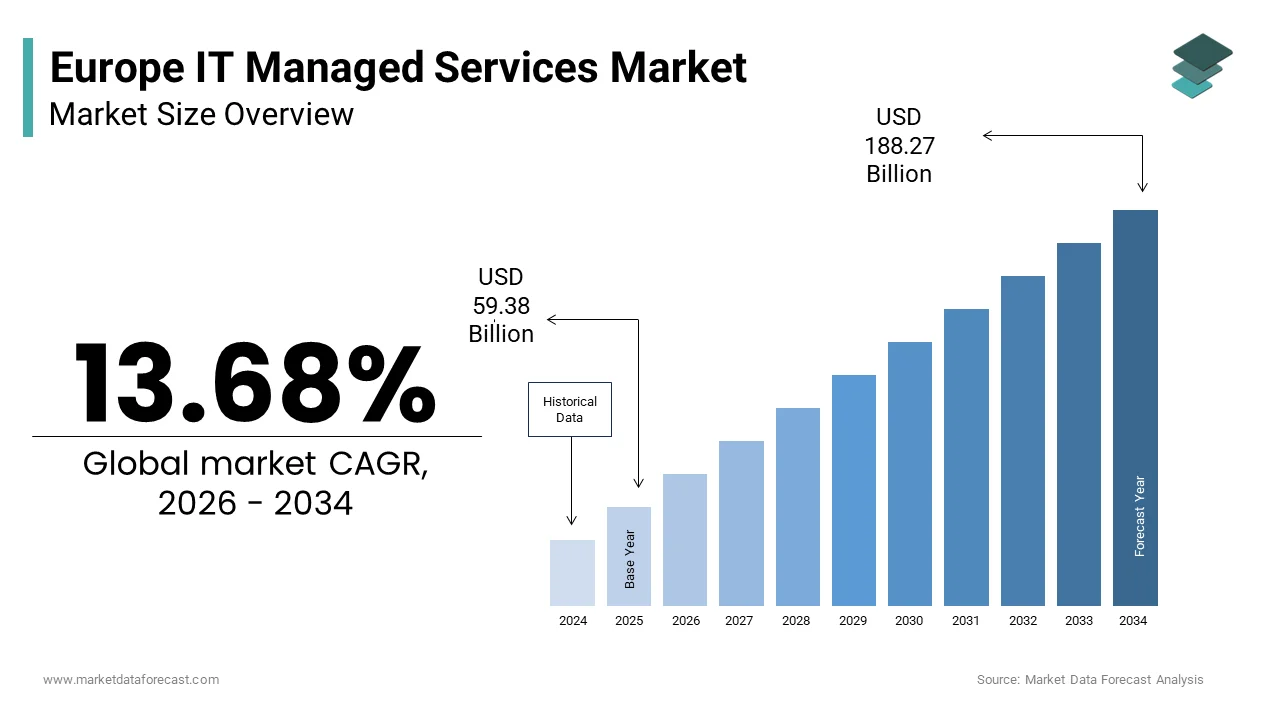
The Europe IT managed services market size was valued at USD 59.38 billion in 2025, is anticipated to reach USD 67.50 billion in 2026, and is projected to scale up to USD 188.27 billion by 2034, registering a compound annual growth rate (CAGR) of 13.68% during the forecast period from 2026 to 2034. Driven by the acute shortage of in-house cybersecurity expertise, accelerated migration to hybrid and multi-cloud environments, and strict data sovereignty regulations, the IT managed services industry continues to expand steadily across the European continent.
Key Executive Metrics (At-a-Glance)
- 2025 Base Valuation: USD 59.38 Billion
- 2026 Current Valuation: USD 67.50 Billion
- 2034 Forecast Valuation: USD 188.27 Billion
- Compound Annual Growth Rate (CAGR): 13.68% (2026–2034)
- Dominant Deployment Model Segment: Hybrid/Hosted (holding the highest share in 2025, balancing legacy infrastructure with modern cloud agility)
- Fastest-Growing Deployment Model Segment: Cloud Deployment (anticipated to record a CAGR of 15.1% during the forecast period)
- Dominant Service Type Segment: Managed Data Centre (leading share in 2025, serving as the backbone for critical enterprise operations)
- Fastest-Growing Service Type Segment: Managed Security (anticipated to witness the fastest CAGR of 15.5% over the forecast period)
- Dominant End-User Vertical Segment: BFSI (dominated by accounting for the leading share in 2025, driven by rigorous regulations)
- Fastest-Growing End-User Vertical Segment: Healthcare and Life Sciences (predicted to witness a promising CAGR of 16.2% during the forecast period)
- Dominant Region: Germany (holding the dominant position in 2025 with the leading share of the regional market)
Core Market Drivers
- Acute Shortage of In-House Cybersecurity Expertise: Severe deficit of qualified security professionals driving organizations toward managed security service providers for elite talent and 24/7 monitoring.
- Accelerated Migration to Hybrid and Multi-Cloud Environments: Widespread adoption of complex hybrid architectures creating an intricate infrastructure landscape that requires specialized orchestration and multi-vendor management.
Primary Market Restraints & Challenges
- Stringent Data Sovereignty and Regulatory Compliance Burdens: Complex web of GDPR and local data protection regulations requiring localized data centers and increasing operational costs.
- Persistent Concerns Over Loss of Control and Vendor Lock-In: Apprehension among business leaders regarding loss of direct infrastructure control and dependency on single providers.
- Escalating Sophistication of Cyber Threats and Ransomware: Evolving threat landscape targeting service providers as gateways to clients, demanding continuous investment in advanced defenses.
Europe IT Managed Services Market Segmentation Breakdown
| Segment Category | Leading Sub-Segment (2025 Base) | Fastest-Growing Sub-Segment (2026–2034) |
|---|---|---|
| By Deployment Model | Hybrid/Hosted (highest share, balancing legacy infrastructure with strict data sovereignty rules) | Cloud Deployment (15.1% CAGR driven by digital transformation and operational expenditure models) |
| By Service Type | Managed Data Centre (leading share, ensuring reliability, security, and high availability) | Managed Security (15.5% CAGR driven by escalating cyber threats and skills shortages) |
| By End-User Vertical | BFSI (leading share, driven by massive scale, rigorous regulatory requirements, and digital operations) | Healthcare and Life Sciences (16.2% CAGR driven by electronic records and telemedicine expansion) |
Major Industry Players Profiled
Key enterprises shaping the competitive Europe IT managed services market include IBM Corporation, Accenture plc, Capgemini SE, Atos SE, Fujitsu Limited, NTT DATA Corporation, Hewlett-Packard Enterprise, DXC Technology Company, Tata Consultancy Services Limited, Infosys Limited, Wipro Limited, Cognizant Technology Solutions Corporation, Orange Business Services, BT Group plc, and Telefonaktiebolaget LM Ericsson.
Europe IT Managed Services Market Size
The Europe IT managed services market size was calculated to be USD 59.38 billion in 2025 and is anticipated to be worth USD 188.27 billion by 2034, from USD 67.50 billion in 2026, growing at a CAGR of 13.68% during the forecast period.
IT managed services comprise the strategic outsourcing of information technology operations, maintenance, and support functions to third-party providers who assume responsibility for ensuring system reliability, security, and performance. This ecosystem encompasses network management, cloud infrastructure oversight, cybersecurity monitoring, data backup, and help desk support, serving as a critical enabler for digital transformation across the continent. The operational landscape is defined by a highly regulated environment where data sovereignty and compliance are paramount. According to Eurostat, enterprises across the European Union with ten or more employees have widely adopted cloud computing services, which are creating complex hybrid infrastructures that require specialized management. As per the European Commission, the General Data Protection Regulation imposes strict obligations on data processing, compelling organizations to seek partners with certified security protocols and localized data centers. According to the European Centre for the Development of Vocational Training, many employers report difficulties in finding staff with adequate digital skills, which drives reliance on managed service providers to bridge the expertise gap. The market functions not merely as a cost-saving mechanism but as a strategic imperative for maintaining operational resilience amidst evolving cyber threats and rapid technological obsolescence.
MARKET DRIVERS
Acute Shortage of In-House Cybersecurity Expertise
The severe deficit of qualified cybersecurity professionals within the regional labor pool that leaves organizations vulnerable to sophisticated digital threats is one of the major factors driving the growth of the Europe IT managed services market. As per ENISA, the European Union Agency for Cybersecurity, the continent faces a significant shortfall of skilled security analysts, which is making it difficult for most enterprises to build and maintain robust internal security operations centers. This scarcity is compounded by the escalating complexity of attack vectors, including ransomware and state-sponsored intrusions, which require continuous monitoring and advanced threat intelligence that internal teams often lack. Consequently, businesses are increasingly turning to managed security service providers who offer access to elite talent pools, proprietary threat detection tools, and round-the-clock incident response capabilities. The regulatory pressure to report breaches within strict timelines under the General Data Protection Regulation further incentivizes outsourcing, as providers guarantee compliance and rapid mitigation. Small and medium enterprises, which rarely have the budget to hire dedicated security chiefs, find these services essential for survival.
Accelerated Migration to Hybrid and Multi-Cloud Environments
The growth of the Europe IT managed services market is attributed to the widespread adoption of hybrid and multi-cloud architectures by European enterprises, which creates an intricate infrastructure landscape that is too complex for traditional internal IT departments to manage efficiently. According to Flexera’s State of the Cloud Report, most European organizations utilize a mix of public and private cloud services alongside on-premises legacy systems to optimize performance and cost. This fragmentation necessitates sophisticated orchestration, continuous integration, and seamless data synchronization across disparate platforms, tasks that require specialized expertise in various cloud ecosystems such as AWS, Azure, and Google Cloud. Managing latency, ensuring consistent security policies, and optimizing spending across multiple vendors demand a level of agility and technical depth that few internal teams possess. Managed service providers offer unified management consoles and automated workflows that simplify this complexity, which is providing a single pane of glass for visibility and control.
MARKET RESTRAINTS
Stringent Data Sovereignty and Regulatory Compliance Burdens
The complex web of data protection regulations and sovereignty requirements across European nations is impeding the growth of the Europe IT managed services market. As per the European Data Protection Board, the enforcement of the General Data Protection Regulation mandates that personal data of EU citizens must remain within specific geographic boundaries, which is complicating the delivery of global managed services that rely on centralized offshore support centers. Providers must establish localized data centers and hire domestic staff to ensure compliance, which significantly increases operational costs and reduces economies of scale. The varying interpretations of these laws by different national authorities create a fragmented regulatory landscape where a solution compliant in one country may not suffice in another. Additionally, the upcoming European Cloud Services Certification scheme introduces another layer of scrutiny, requiring rigorous audits of supply chains and sub-processors.
Persistent Concerns Over Loss of Control and Vendor Lock-In
A major impediment to market growth is the enduring apprehension among European business leaders regarding the loss of direct control over critical IT infrastructure and the risk of vendor lock-in. As per a survey by the Chartered Institute of Management Accountants, many Chief Information Officers cite the fear of dependency on a single provider as a primary barrier to expanding managed service contracts. Organizations worry that migrating core functions to an external partner may result in reduced visibility into operations, slower response times during crises, and difficulties in switching providers due to proprietary technologies or complex contract terms. This concern is particularly acute in highly regulated sectors like finance and healthcare, where accountability for data breaches ultimately rests with the organization, not the vendor. The perceived risk of being trapped in long-term contracts with inflexible pricing models discourages companies from fully embracing the managed services model. Furthermore, cultural misalignment between the client and provider can lead to communication breakdowns and service dissatisfaction. These barriers cause many firms to retain key IT functions in-house or adopt a limited scope of outsourcing, restricting the total addressable market for comprehensive managed service solutions.
MARKET OPPORTUNITIES
Integration of Artificial Intelligence for Proactive Operations
The emergence of artificial intelligence and machine learning technologies offers a promising opportunity in the Europe IT managed services market. As per Gartner, organizations leveraging AI-driven IT operations can reduce downtime and resolve incidents faster through automated root cause analysis. European providers can differentiate themselves by embedding AI algorithms into their platforms to predict hardware failures, detect anomalous network traffic, and automate routine maintenance tasks before they impact business continuity. This capability allows providers to offer higher service level agreements and value-added insights that go beyond simple uptime guarantees. The ability to analyse large volumes of telemetry data in real time enables optimization of resource allocation and energy consumption, aligning with European sustainability goals. AI-powered chatbots and virtual agents can also enhance user experience by resolving common help desk queries instantly. By positioning themselves as innovators who harness AI to drive efficiency and resilience, managed service providers can command premium pricing and strengthen client relationships.
Expansion of Managed Security Services for SMEs
The growing sophistication of cyber threats targeting small and medium enterprises creates a lucrative opportunity for the Europe IT managed services market. As per Eurostat, SMEs constitute the overwhelming majority of businesses in the European Union, yet many lack the resources to implement robust cybersecurity measures, making them prime targets for attackers. Managed service providers can develop scalable, subscription-based security packages that offer enterprise-grade protection, including endpoint detection, firewall management, and employee training, at accessible price points. The introduction of the NIS2 Directive, which expands cybersecurity obligations to more entities, further drives demand as SMEs seek compliant solutions to avoid penalties. Providers who bundle these security services with general IT management create a compelling one-stop-shop value proposition. Leveraging centralized security operations centers to serve multiple SME clients allows providers to achieve economies of scale while delivering high-quality protection. Capturing this vast market requires tailored marketing and simplified service catalogs, but the growth potential is substantial given the universal nature of cyber threats.
MARKET CHALLENGES
Escalating Sophistication of Cyber Threats and Ransomware
The European IT managed services market faces the formidable challenge of keeping pace with the rapidly evolving sophistication of cyber threats, particularly ransomware attacks that target service providers as gateways to their clients. As per ENISA, ransomware incidents in Europe have increased significantly, with attackers employing double extortion tactics that encrypt data and threaten to leak sensitive information if ransoms are not paid. Managed service providers are becoming primary targets because compromising one provider can grant access to hundreds of downstream clients. This reality forces providers to continuously invest in advanced defense mechanisms, threat intelligence feeds, and incident response teams, driving up operational costs. The shortage of skilled security professionals further complicates the ability to defend against novel attack vectors. Providers must balance robust security with seamless user access, which is a difficult equilibrium to maintain.
Complexity of Integrating Legacy Systems with Modern Cloud Solutions
A significant challenge confronting the Europe IT managed services market is the difficulty of integrating aging legacy systems with modern cloud-native applications within client environments. As per IDC, many European enterprises still rely on mainframe computers and on-premises databases that are decades old, containing critical business logic and data that cannot be easily migrated or replaced. Managed service providers must possess expertise in both obsolete technologies and contemporary cloud platforms to create hybrid architectures that function seamlessly. This dual competency requirement strains talent resources and increases service delivery complexity, often leading to longer implementation timelines and higher costs. The lack of standardization in legacy interfaces complicates automation efforts, forcing providers to rely on manual interventions that reduce efficiency. Ensuring data consistency and security across disparate systems requires sophisticated middleware and custom coding, which can be fragile and difficult to maintain. The resistance of some clients to modernizing their core systems perpetuates technical debt, trapping providers in a cycle of managing fragile integrations. Overcoming this hurdle requires significant investment in specialized skills and innovative integration tools, posing a persistent operational challenge.
REPORT COVERAGE
| REPORT METRIC | DETAILS |
| Market Size Available | 2025 to 2034 |
| Base Year | 2025 |
| Forecast Period | 2026 to 2034 |
| CAGR | 13.68% |
| Segments Covered | By Deployment Model, Service Type, End User Vertical, And Region |
| Various Analyses Covered | Global, Regional & Country Level Analysis; Segment-Level Analysis; DROC, PESTLE Analysis; Porter’s Five Forces Analysis; Competitive Landscape; Analyst Overview of Investment Opportunities |
| Regions Covered | UK, France, Spain, Germany, Italy, Russia, Sweden, Denmark, Switzerland, Netherlands, Turkey, and the Czech Republic |
| Market Leaders Profiled | IBM Corporation, Accenture plc, Capgemini SE, Atos SE, Fujitsu Limited, NTT DATA Corporation, Hewlett Packard Enterprise, DXC Technology Company, Tata Consultancy Services Limited, Infosys Limited, Wipro Limited, Cognizant Technology Solutions Corporation, Orange Business Services, BT Group plc, Telefonaktiebolaget LM Ericsson |
SEGMENTAL ANALYSIS
By Deployment Model Insights
The hybrid/hosted segment accounted for the highest share of the Europe IT managed services market in 2025. The dominance of the hybrid segment in the European market is driven by the need for organizations to balance legacy infrastructure with modern cloud agility. The dominance of the hybrid model segment in the European market can be credited to Europe’s stringent regulatory environment mandating strict data sovereignty and residency controls for sensitive information. As per the European Data Protection Board, the General Data Protection Regulation requires that personal data of EU citizens be processed within specific geographic boundaries, which is compelling many organizations to keep critical databases on-premises while leveraging public cloud for less sensitive workloads. Financial institutions and healthcare providers particularly rely on this mixed approach to ensure compliance while benefiting from cloud scalability. National laws in countries such as Germany and France often impose additional compliance layers that favor local hosting solutions. This regulatory fragmentation across member states makes a pure cloud strategy risky for multinationals, which is cementing the hybrid model as the standard for secure operations across the continent.
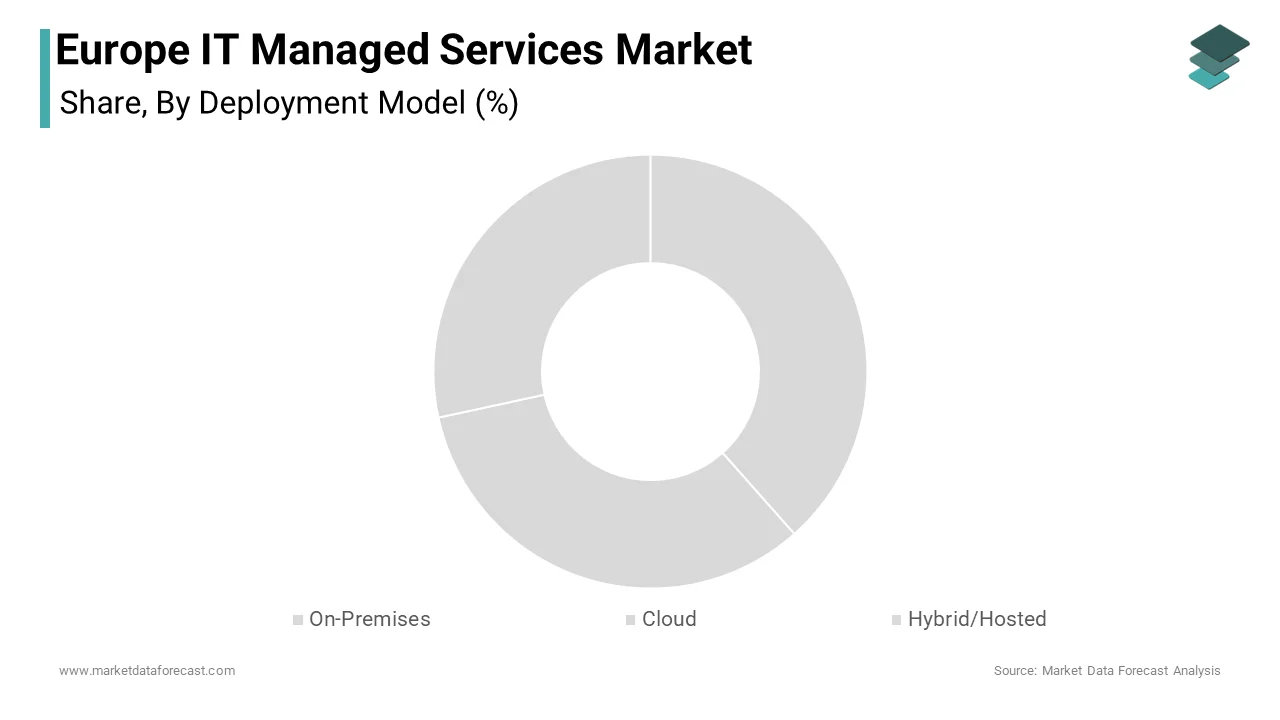
The cloud deployment segment is anticipated to record a CAGR of 15.1% in the European IT managed services market during the forecast period, owing to the digital transformation initiatives and the preference for operational expenditure models among European businesses. The strategic financial shift from capital expenditure to operational expenditure that allows companies to align IT costs directly with usage and revenue is further boosting the expansion of the cloud segment in the European market. As per Eurostat, most enterprises in the European Union now utilize cloud computing services, with SMEs leading adoption due to the low barrier to entry. The ability to scale resources instantly without purchasing hardware provides agility in responding to market fluctuations. The pay-as-you-go pricing model eliminates over-provisioning risks, while rapid deployment capabilities enable faster product launches. This flexibility and efficiency make the cloud the fastest-growing deployment option for forward-looking organizations.
By Service Type Insights
The managed data centre segment led the market by holding the leading share of the European market in 2025. The managed data centers serve as the backbone for European enterprise operations by ensuring reliability, security, and efficiency of critical infrastructure. The dominance of managed data centre services segment in the regional market is further driven by the requirement for high availability and business continuity across industries such as finance, telecommunications, and energy. As per the European Network and Information Security Agency, downtime costs for large enterprises can be extremely high, making redundant power supplies, cooling systems, and network connectivity essential. Providers maintain tier three and tier four data centres that guarantee 99.99% uptime through rigorous monitoring and proactive maintenance. Geographically dispersed facilities ensure resilience against natural disasters or localized failures. The increasing frequency of extreme weather events in Europe further underscores the need for professionally managed environments.
The managed security segment is anticipated to witness the fastest CAGR of 15.5% over the forecast period in this regional market, owing to the escalating cyber threats, the shortage of skilled security professionals in the region, and the dramatic rise in cyberattacks targeting European organizations, including ransomware, phishing, and state-sponsored intrusions. As per ENISA, reported security incidents in the EU have increased significantly, with attackers employing advanced techniques that bypass traditional defences. The financial and reputational damage from breaches has made cybersecurity a top priority for boardrooms. Organizations realize that static defences are insufficient, necessitating continuous monitoring, threat hunting, and incident response capabilities that only specialized providers can deliver. The overwhelming volume of alerts generated by modern tools makes outsourced security operations centers essential, ensuring demand for comprehensive managed security solutions continues to surge.
By End-User Vertical Insights
The BFSI segment dominated the market by accounting for the leading share of the European market in 2025. The growth of the BFSI segment in the European market is attributed to its massive scale, rigorous regulatory requirements, and the critical nature of its digital operations. This sector relies heavily on managed services to maintain stability and trust in the financial system. The strict regulatory framework governing financial institutions in Europe that mandates robust IT governance, data protection, and operational resilience is further propelling the expansion of the BFSI segment in the European market. As per the European Banking Authority, banks and insurers must comply with directives such as PSD2 and DORA that require continuous monitoring, detailed reporting, and fail-safe infrastructure. Non-compliance risks massive fines and loss of licensing, compelling institutions to partner with managed service providers specializing in regulatory adherence. These providers deliver audited environments, encrypted data handling, and documented processes that satisfy supervisory authorities. The need for real-time fraud detection and anti-money laundering systems further drives demand for advanced managed security and analytics services. Navigating multiple national regulations within the EU makes external expertise indispensable, ensuring BFSI remains the largest consumer of IT managed services in the region.
The healthcare and life sciences segment is predicted to witness a promising CAGR of 16.2% during the forecast period in the European market, owing to the digitization of patient records, the rise of telemedicine, and the critical need for data security in life-saving applications. The widespread adoption of electronic health records and the expansion of telemedicine services across Europe are further contributing to the growth of the healthcare and life sciences segment in the regional market. As per the European Commission, the European Health Data Space initiative aims to facilitate secure health data exchange, requiring robust IT infrastructure and management. Hospitals and clinics are transitioning from paper-based systems to digital platforms that enable remote consultations, real-time patient monitoring, and collaborative care. This generates vast amounts of sensitive data that must be securely stored, backed up, and accessed reliably. Managed service providers deliver scalable storage and high-performance computing to support medical imaging and genomic sequencing applications. The pandemic accelerated the acceptance of virtual care, creating a permanent shift in healthcare delivery. Ensuring 24/7 availability of these systems is critical for patient safety, driving healthcare organizations to outsource IT management to experts. This systemic digitization ensures healthcare emerges as the fastest-growing vertical in the European IT managed services market.
REGIONAL ANALYSIS
Germany IT Managed Services Market Analysis
Germany held the dominant position in the European IT managed services market in 2025 with the leading share of the regional market. Germany has the status of an industrial powerhouse of the continent, and its rigorous approach to data privacy. The strong manufacturing base, undergoing Industry 4.0 transformation that demands highly reliable and secure IT infrastructure, is further boosting the dominance of Germany in the European market. According to Statista, Germany is recognized as a major contributor to European IT services expenditure, reflecting the willingness of its corporate sector to invest in quality and compliance. The presence of numerous global headquarters and a dense network of small and medium enterprises known as the Mittelstand creates a diverse and resilient demand for managed services. German companies place a premium on data sovereignty, often preferring local providers who can guarantee that data remains within national borders in accordance with strict interpretations of the General Data Protection Regulation. The ongoing modernization of the automotive, chemical, and engineering sectors drives demand for hybrid cloud management and specialized industrial IoT support. Furthermore, the shortage of IT specialists in Germany is particularly acute, forcing organizations to outsource critical functions to bridge the skills gap. This combination of economic strength, regulatory strictness, and technological ambition ensures Germany maintains its dominant position.
United Kingdom IT Managed Services Market Analysis
The United Kingdom accounted for a promising share of the Europe IT managed services market in 2025. The growth of the UK in the European market can be credited to its mature digital economy, vibrant fintech sector, and London's status as a global technology hub. The nation benefits from a high level of cloud adoption and a proactive approach to digital transformation across both public and private sectors. As per reports from TechUK, the UK creative and technology industries are identified as major drivers of IT services demand, utilizing managed solutions to support agile development and rapid scaling. The financial services cluster in the City of London generates immense demand for high-end managed security and data centre services to protect against sophisticated cyber threats. Post-Brexit dynamics have encouraged many firms to dual-source their IT management to ensure continuity and compliance with both UK and EU regulations. The UK government's push for digital public services has also created significant opportunities for managed service providers in the public sector. Additionally, the country boasts a rich ecosystem of innovative startups and scale-ups that rely on managed cloud services to compete globally without heavy infrastructure investment. The convergence of financial might, technological innovation, and supportive policy frameworks secures the UK's position as a critical pillar of the European market.
France IT Managed Services Market Analysis
France is anticipated to account for a prominent CAGR in the Europe IT managed services market over the forecast period, owing to strong government support for digital sovereignty, a thriving aerospace and luxury goods sector, and a strategic push to reduce reliance on non-European technology providers. The "Cloud au Centre" strategy that encourages the adoption of trusted cloud and managed services that guarantee data residency is driving the French market growth. According to data from the French Ministry of Economy, public funding is allocated to support the digitalization of small and medium enterprises, driving uptake of managed IT solutions. French corporations in the defense, energy, and transportation sectors require highly secure and customized managed services to protect sensitive intellectual property and critical infrastructure. The emphasis on national champions has fostered the growth of domestic managed service providers who offer tailored solutions aligned with local cultural and regulatory nuances. Paris has emerged as a key hub for data centres and cloud regions, attracting international providers to establish a local presence. The growing startup scene in Station F and other incubators further fuels demand for flexible and scalable managed services. The blend of state-led initiatives, industrial depth, and entrepreneurial energy cements France's role as a top-tier market.
Netherlands IT Managed Services Market Analysis
The Netherlands is expected to exhibit a healthy CAGR in the Europe IT managed services market over the forecast period, owing to its exceptional digital infrastructure, high English proficiency, and role as the primary digital gateway to continental Europe. According to data from the Netherlands Enterprise Agency, the logistics, trade, and agricultural sectors are noted for leveraging advanced managed services to support complex supply chain operations and precision farming technologies. The progressive regulatory environment and early adoption of cloud technologies make the Netherlands a testing ground for new managed service offerings. Dutch organizations prioritize sustainability, driving demand for green managed data centres powered by renewable energy. The high density of international headquarters in Amsterdam and Rotterdam creates a steady stream of demand for cross-border managed IT support and compliance services. The country's robust fiber optic network and fifth-generation coverage further enhance the viability of cloud-first strategies. This unique combination of connectivity, openness, and strategic location secures the Netherlands a leading position in the regional hierarchy.
Sweden IT Managed Services Market Analysis
Sweden is estimated to account for a notable share of the Europe IT managed services market over the forecast period due to its advanced digital society, high internet penetration, and commitment to innovation, which makes it a fertile ground for cutting-edge IT managed services. Sweden is home to several global technology giants and has a culture that embraces digital solutions and remote work. As per Statistics Sweden, the population is widely recognized for regular internet usage, and the workforce expects seamless digital experiences from their employers. Swedish enterprises in the telecommunications, gaming, and clean tech sectors are heavy users of managed cloud and security services to support their global operations and protect valuable intellectual property. The strong emphasis on sustainability drives the adoption of energy-efficient managed data centres and carbon-neutral IT practices. The government's proactive digitalization policies encourage the use of e-identification and digital public services, creating a stable baseline of demand. Stockholm has become a hotspot for unicorns and tech startups that rely entirely on managed services to scale rapidly without building internal IT departments. The alignment of cultural values with technological capability positions Sweden as a key player in the northern European market and a model for future-oriented IT management.
COMPETITION OVERVIEW
The competition within the Europe IT managed services market is intense and characterized by a rivalry between global technology giants, strong regional champions, and specialized niche providers. Large multinational corporations leverage their extensive resources and broad service portfolios to offer end-to-end solutions, while European native firms differentiate themselves through deep local knowledge and strict adherence to data sovereignty laws. The market sees frequent mergers and acquisitions as companies seek to fill capability gaps in cybersecurity and cloud management quickly. Differentiation increasingly depends on the ability to deliver sustainable IT operations, integrate advanced artificial intelligence for proactive maintenance, and guarantee compliance with evolving regulations like the General Data Protection Regulation. Price competition remains fierce, particularly in commoditized areas such as basic infrastructure monitoring, forcing providers to move up the value chain. The shortage of skilled IT professionals has intensified the war for talent, making retention strategies a critical competitive factor. Customers demand higher levels of customization and transparency, leading to a shift from standard contracts to outcome-based service models. This dynamic environment requires continuous innovation and strategic agility to maintain market relevance and capture growth opportunities.
KEY MARKET PLAYERS
A few major players of the Europe IT managed services market include
- IBM Corporation
- Accenture plc
- Capgemini SE
- Atos SE
- Fujitsu Limited
- NTT DATA Corporation
- Hewlett-Packard Enterprise
- DXC Technology Company
- Tata Consultancy Services Limited
- Infosys Limited
- Wipro Limited
- Cognizant Technology Solutions Corporation
- Orange Business Services
- BT Group plc
- Telefonaktiebolaget LM Ericsson
Top Strategies Used by Key Market Participants
Key players in the Europe IT managed services market primarily focus on developing sovereign cloud solutions to address strict data privacy regulations and ensure data residency within European borders. Companies are aggressively acquiring specialized cybersecurity firms to enhance their managed security service portfolios and combat sophisticated ransomware threats. Another major strategy involves investing heavily in artificial intelligence and automation tools to optimize IT operations and reduce response times for incident resolution. Providers are forming strategic alliances with hyperscale cloud vendors to offer hybrid multi-cloud management services that provide flexibility and scalability. Firms are also prioritizing sustainability by building green data centers and offering carbon-neutral IT services to meet corporate environmental goals. There is a significant push toward expanding edge computing capabilities to support low-latency applications in manufacturing and logistics. Finally, companies are focusing on upskilling their workforce to bridge the critical talent gap in cloud and security technologies across the region.
Leading Players in the Europe IT Managed Services Market
- International Business Machines Corporation stands as a preeminent force in the Europe IT managed services market by delivering hybrid cloud and artificial intelligence solutions that drive digital transformation globally. The company contributes significantly to the global landscape through its Red Hat OpenShift platform, which enables seamless application management across diverse environments. IBM recently strengthened its European position by expanding its network of local data centers to ensure strict compliance with European data sovereignty regulations. The firm actively invests in quantum computing research and ethical AI frameworks to offer future-proof managed services to enterprise clients. Strategic partnerships with major European telecommunications providers have enhanced its ability to deliver integrated edge computing solutions. IBM focuses on sustainability by helping clients optimize energy consumption in their IT operations through advanced analytics. These initiatives solidify its reputation as a trusted partner for complex infrastructure management and innovation in the region.
- Accenture plc operates as a leading global professional services company with a profound impact on the Europe IT managed services sector through its comprehensive cloud and security offerings. The group drives global change by helping organizations modernize their legacy systems and adopt agile operating models at scale. Accenture has recently accelerated its growth in Europe by acquiring specialized cybersecurity firms to bolster its managed security service capabilities against evolving threats. The company leverages its myNav green cloud accelerator to help clients design sustainable IT architectures that align with European environmental goals. Its deep industry expertise in banking, manufacturing, and healthcare allows for tailored managed services that address specific regulatory challenges. Accenture continues to invest heavily in upskilling its workforce in cloud technologies and automation tools to meet rising demand. These strategic moves reinforce its status as a critical enabler of business resilience and technological advancement across the continent.
- Atos SE is a European leader in digital transformation with a dominant presence in the regional IT managed services market serving public and private sectors alike. The company contributes to the global market by providing high-performance computing solutions and secure cloud services tailored for mission-critical operations. Atos recently strengthened its market position by launching sovereign cloud offerings that guarantee data residency and protection under European laws. The firm is pioneering the development of exascale supercomputers to support advanced scientific research and industrial innovation. Its focus on zero carbon emissions has led to the creation of highly energy-efficient data centers that appeal to environmentally conscious clients. Atos actively collaborates with European governments to secure critical infrastructure against cyberattacks through its advanced security operations centers. These efforts establish Atos as a guardian of digital sovereignty and a key driver of technological independence in Europe.
MARKET SEGMENTATION
This research report on the Europe IT managed services market has been segmented and sub-segmented based on deployment model, service type, end user vertical & region.
By Deployment Model
- On-Premises
- Cloud
- Hybrid/Hosted
By Service Type
- Managed Data Centre
- Managed Security
- Others
By End User Vertical
- BFSI
- Manufacturing
- Others
By Region
- UK
- France
- Spain
- Germany
- Italy
- Russia
- Sweden
- Denmark
- Switzerland
- Netherlands
- Turkey
- Czech Republic
- Rest of Europe