- Product Description Description
- Table of Contents TOC
- List of Table & Figure LOT
- Get Free Sample PDF Sample PDF
Market Size, 2025
$7.44 BnMarket Estimate, 2026
$9.20 BnMarket Forecast, 2034
$50.23 BnCAGR, 2026–2034
23.64%Europe Cloud Migration Services Market Summary
Europe’s cloud migration services market is expanding rapidly, driven by accelerated digital transformation mandates, sovereign cloud adoption, and the modernization of legacy IT estates across public-sector institutions and large enterprises. Growth is shaped by EU policy frameworks such as the Digital Decade Programme, Cyber Resilience Act, and Gaia-X, which mandate cloud-ready public services, security-by-design migration, and sovereign data hosting. Demand is further reinforced by rising cybersecurity requirements, AI workload readiness, and hybrid-multi-cloud adoption, while challenges persist around legacy technical debt, fragmented regulatory interpretation across EU member states, and shortages of cloud-security-certified professionals.
Market Growth & Size
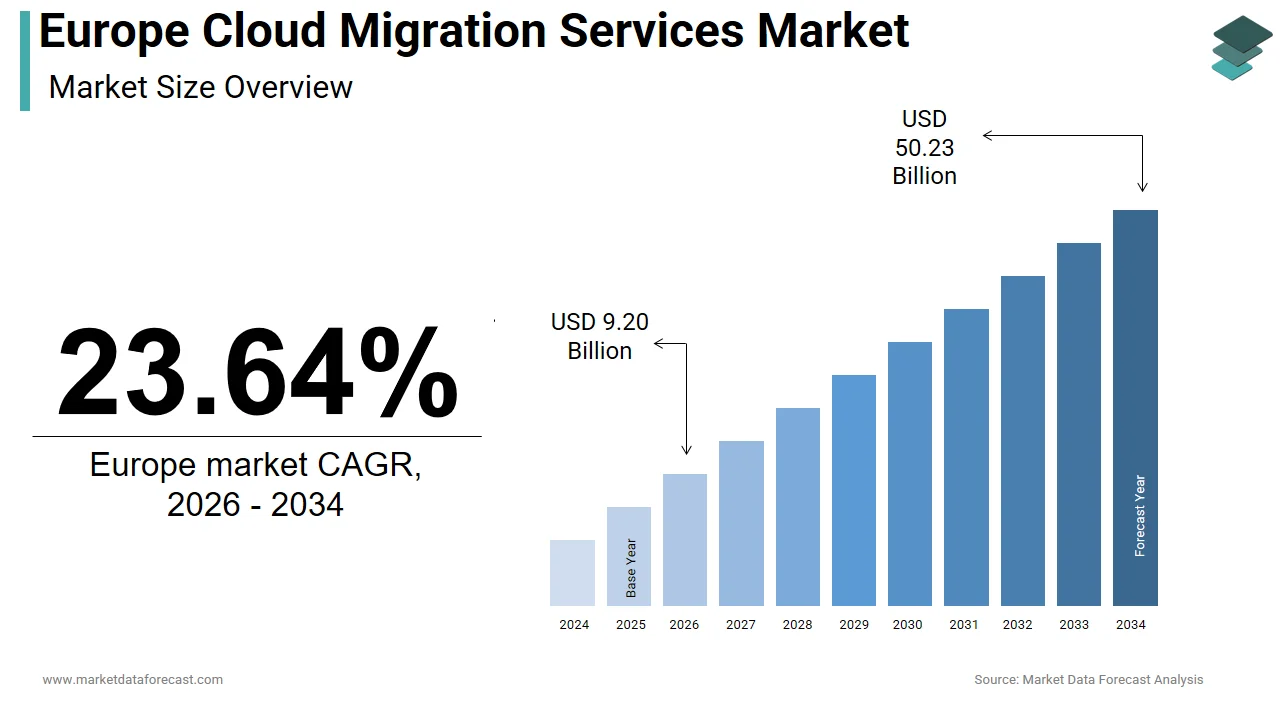
- Strong Expansion: The Europe cloud migration services market was valued at USD 7.44 billion in 2025, is projected to reach USD 9.20 billion in 2026, and is expected to reach USD 50.23 billion by 2034, growing at a CAGR of 23.64% from 2026 to 2034. Growth is fueled by sovereign cloud initiatives, large-scale public-sector modernization programs, and enterprise migration of mission-critical workloads to compliant, secure cloud environments.
- Key Segments: Services, including assessment, refactoring, compliance validation, and post-migration optimization, currently dominate due to the consultative nature of migration engagements, while automated migration solutions and toolkits are witnessing strong growth as standardized workloads and regulatory-aligned cloud frameworks scale across Europe.
Drivers & Trends
- Policy-Driven Digital Transformation: EU-level mandates such as the Digital Decade Compass, European Interoperability Framework, and national Cloud-First strategies are accelerating migration across ministries, health systems, financial institutions, and critical infrastructure operators.
- Cybersecurity & Data Sovereignty Requirements: Increasing enforcement of data residency, cross-border transfer controls, and sovereign cloud certification is making expert-led migration essential for regulatory assurance, not just technical transition.
- Sovereign Cloud Expansion: Rapid growth in Gaia-X-aligned national cloud ecosystems is driving demand for local migration partners with country-specific compliance expertise and EU-certified infrastructure access.
- AI-Ready Migration Architectures: Organizations increasingly integrate AI workload readiness, MLOps capability, and data-governance pipelines into migration roadmaps, transforming cloud migration into a foundation for next-generation digital transformation.
Key Players & Ecosystem
- Local & Global Technology Leaders: The ecosystem includes major global service providers and hyperscalers, IBM, SAP, Microsoft, Google Cloud, AWS, HPE, Accenture, NTT Data, Wipro, Vodafone — alongside European consulting firms and sovereign-cloud migration specialists.
- Ecosystem strength is reinforced by public-sector modernization programs, EuroHPC research workloads, telecom digitalization initiatives, and GAIA-X sovereign cloud deployments, which collectively expand migration demand across industries and government domains.
Challenges
- Legacy Technical Debt: Aging mainframe architectures, non-containerized workloads, and fragmented legacy estates significantly increase refactoring effort, cost, and migration timelines.
- Fragmented National Compliance Interpretation: Differing country-level implementations of cloud and data regulations create complex, multi-jurisdictional compliance requirements for cross-border migration projects.
- Talent Shortage: Europe faces a scarcity of specialists with combined expertise in cloud security, GDPR implementation, ENISA controls, and sovereign-cloud architecture, leading to project delays and dependence on expensive external consultants.
- Hybrid & Multi-Cloud Complexity: Increasing adoption of multi-cloud and hybrid models introduces integration, orchestration, and governance challenges that extend beyond traditional lift-and-shift migration approaches.
Europe Cloud Migration Services Market Size
The Europe cloud migration services market was valued at USD 7.44 billion in 2025. The regional market is projected to grow from USD 9.20 billion in 2026 to reach USD 50.23 billion by 2034, exhibiting a compound annual growth rate (CAGR) of 23.64% from 2026 to 2034.
Cloud migration services are the strategic planning, execution, and optimization of moving applications, data, and infrastructure from on-premises or legacy environments to public, private, or hybrid cloud platforms. This transition is not merely technical but deeply organizational, involving security architecture modernization, compliance alignment, and workforce enablement. According to the European Commission, over 78% of large enterprises and 42% of small and medium enterprises in the EU utilized cloud computing services in 2023, reflecting a foundational shift in digital operations. The EU’s Digital Decade Policy Programme mandates that all key public services be cloud-enabled by 2030, accelerating institutional demand for structured migration services. Furthermore, the EU Cyber Resilience Act, introduced in 2023, requires embedded security in digital products, heightening the need for expert-led secure migration. In this context, cloud migration services have evolved from infrastructure relocation to a strategic enabler of regulatory compliance, digital sovereignty, and operational resilience.
MARKET DRIVERS
Mandatory Digital Transformation Under EU Policy Frameworks
European institutions are legally compelled to adopt cloud technologies through a series of binding policy instruments that directly stimulate demand for professional migration services, driving the growth of Europe cloud migration services market. According to the European Commission’s Digital Decade Compass, all member states must ensure that 100% of major public services are available online and cloud-ready by 2030, with interim milestones already in force. The European Interoperability Framework requires cross-border public administrations to adopt cloud-based digital service infrastructures enabling seamless data exchange with a mandate driving over 120 national migration projects across justice, health, and taxation sectors, as documented by the Publications Office of the EU. Simultaneously, the Corporate Sustainability Reporting Directive obligates 50000 large and listed companies to digitize environmental and governance data systems by 2025, necessitating migration to compliant cloud platforms. Germany’s Federal Office of Administration reported that 94% of its 2800 legacy applications are scheduled for cloud migration by 2026 under the “Cloud First” policy. France’s Interministerial Directorate for Digital Affairs allocated 1.2 billion euros in 2023 specifically for sovereign cloud migration in defense and social security.
Rising Cybersecurity and Data Sovereignty Requirements
The intensifying emphasis on data residency, cybersecurity, and algorithmic accountability has made expert-led cloud migration essential rather than discretionary, which is also greatly influencing the growth of Europe cloud migration services market. According to the European Union Agency for Cybersecurity, over 67% of European enterprises delayed cloud adoption in 2022 due to concerns about cross-border data flows and inadequate control over infrastructure. The EU’s Gaia X initiative now requires all public sector cloud deployments to use certified sovereign platforms with auditable data sovereignty guarantees, a standard that necessitates specialized migration expertise. In 2023, Sweden’s Data Protection Authority fined a healthcare provider 18 million euros for storing patient records on a non-EU cloud without proper safeguards, underscoring enforcement rigor. The Cyber Resilience Act further mandates that all digital products, including migrated applications, undergo security by design validation, a process requiring forensic assessment during migration. As a result, organizations increasingly engage third-party migration specialists not just for technical lift but for regulatory assurance.
MARKET RESTRAINTS
Legacy System Obsolescence and Technical Debt Accumulation
The aging and fragmented nature of legacy IT systems that resist straightforward migration is restricting the growth of Europe cloud migration services market. According to the European Central Bank, over 40% of core banking applications in EU financial institutions still run on COBOL-based mainframes, with some systems dating back to the 1980s, technologies incompatible with modern cloud architectures. In Germany, the Federal Office for Information Security documented that 22000 legacy applications across federal agencies lack API support or containerization readiness, requiring costly refactoring before migration. These technical constraints inflate migration timelines by 3 to 5 times and increase costs by up to 300% compared to greenfield deployments, as per the European Software Institute.
Fragmented Cloud Compliance Landscapes Across Member States
Despite EU-level harmonization efforts, national variations in data protection, cloud security, and sector-specific regulations create significant complexity for cross-border cloud migration projects. The fragmented cloud compliance landscapes across member states are additionally hampering the growth of Europe cloud migration services market. According to the European Data Protection Board, 19 member states have issued supplementary national guidelines interpreting the GDPR’s cloud provisions differently, particularly regarding sub-processor transparency and data localization. In healthcare, France’s Health Data Hub requires all migrated health data to reside exclusively in certified sovereign clouds, while Germany permits EU-based hyperscalers under strict BSI oversight. The European Insurance and Occupational Pensions Authority noted that insurance firms operating in three or more EU countries must comply with up to seven distinct cloud audit frameworks, increasing compliance overhead by 40% as per its 2023 sector report. Additionally, countries like Poland and Hungary impose local data mirroring requirements that conflict with hyperscaler architectures. This regulatory patchwork forces migration service providers to maintain country-specific compliance playbooks and legal review processes, inflating delivery costs and delaying timelines.
MARKET OPPORTUNITIES
Expansion of Sovereign Cloud Ecosystems and Local Partnerships
The rapid development of sovereign cloud infrastructures and the demand for localized migration expertise are creating new opportunities for the growth of Europe cloud management services market. According to the European Commission, 24 member states have launched national or regional sovereign cloud initiatives under the Gaia X framework with combined public investment exceeding 8.5 billion euros through 2027. These ecosystems, such as France’s ANDSSI-certified cloud, Germany’s Catena-X, and Sweden’s NEBULA, require migration partners with native language capabilities, local data center access, and compliance with national security certifications. In 2023, Capgemini and Atos jointly executed over 300 sovereign cloud migration projects for French ministries using EU-based infrastructure exclusively, as confirmed by the French General Directorate for Enterprise. Similarly, Spain’s Ministry of Economic Affairs awarded 120 million euros in 2024 to domestic IT firms for migrating judicial records to the national Alhambra Cloud. The European High Performance Computing Joint Undertaking also mandates that all EuroHPC AI workloads use EU-hosted cloud platforms, driving migration demand in research.
Integration of AI Readiness into Cloud Migration Engagements
The emergence of cloud migration and artificial intelligence strategy as European organizations seek to modernize infrastructure, while building AI capabilities, is expected to leverage the growth of Europe cloud migration services market. According to the European Centre for the Development of Vocational Training, large EU enterprises now require that cloud migration roadmaps include AI workload readiness assessments covering data pipelines, GPU access, and MLOps integration. The EU’s AI Act classifies many enterprise AI systems as high risk, mandating full data provenance and model auditability requirements that can only be met on properly architected cloud platforms. In 2023, Siemens partnered with Google Cloud to migrate 1500 industrial applications to a sovereign EU region, while simultaneously deploying Vertex AI for predictive maintenance, a dual-track engagement now replicated across manufacturing. The European Health Data Space pilot mandated that all participating hospitals migrate to GAIA-X-aligned clouds with embedded federated learning infrastructure as documented by the European Medicines Agency. This strategic bundling transforms migration from a cost center to a catalyst for next-generation digital transformation.
MARKET CHALLENGES
Shortage of Cloud Security and Compliance Certified Professionals
The acute scarcity of professionals skilled in both cloud engineering and EU regulatory compliance is one of the challenges for the growth of Europe cloud migration services market. According to the European Cybersecurity Competence Centre, there is a deficit of over 340,000 cybersecurity specialists in the EU, with fewer than 12% holding certifications in both cloud architecture and GDPR implementation. The European Union Agency for Cybersecurity reported that some of the migration projects in 2023 experienced delays due to a lack of staff trained in ENISA’s Cloud Security Controls or the EU Cloud Code of Conduct. Vocational training lags significantly, where the European Centre for the Development of Vocational Training noted that fewer than 1500 professionals annually graduate with combined cloud and legal tech competencies. This talent gap forces organizations to rely on expensive external consultants or accept compliance shortcuts that risk regulatory penalties.
Complexity of Multi-Cloud and Hybrid Environment Management
The growing preference for multi-cloud and hybrid deployments introduces significant operational and architectural complexity that challenges standard migration methodologies, which is also degrading the growth of Europe cloud migration services market. The European Space Agency documented that its hybrid migration involving AWS, Azure, and a sovereign French cloud required 14 different identity federation protocols and three data sovereignty monitoring layers, increasing integration costs by 45%. In healthcare, Germany’s National Research Data Infrastructure reported that cross-cloud data harmonization for clinical trials added 9 to 12 months to migration timelines due to inconsistent API standards and audit log formats. Furthermore, the EU’s Data Governance Act encourages data sharing across clouds but lacks technical interoperability mandates, creating siloed environments. Migration service providers must now design not just for lift but for ongoing cross-platform orchestration governance and cost control, a capability still nascent in the European services landscape.
REPORT COVERAGE
| REPORT METRIC | DETAILS |
| Market Size Available | 2025 to 2034 |
| Base Year | 2025 |
| Forecast Period | 2026 to 2034 |
| Segments Covered | By Platform, Enterprise Size, Deployment, End-use Industry, and Country. |
| Various Analyses Covered | Global, Regional, and Country-Level Analysis, Segment-Level Analysis, Drivers, Restraints, Opportunities, Challenges; PESTLE Analysis; Porter’s Five Forces Analysis, Competitive Landscape, Analyst Overview of Investment Opportunities |
| Countries Covered | UK, France, Spain, Germany, Italy, Russia, Sweden, Denmark, Switzerland, Netherlands, Turkey, Czech Republic, and the Rest of Europe. |
| Market Leaders Profiled | IBM Corporation, SAP SE, Google Cloud, Amazon Web Services, Inc. (Amazon.com, Inc.), Microsoft Corporation, Hewlett Packard Enterprise Company, Accenture PLC, NTT Data Corporation, Wipro Limited, Vodafone Group Plc, and Others. |
SEGMENTAL ANALYSIS
By Platform Insights
The services segment accounted for a dominant share of the Europe cloud migration services market in 2025, with the inherently consultative and customized nature of cloud migration, which requires strategic assessment, legacy application refactoring, security configuration compliance validation, and post migration optimization tasks that cannot be fully automated or productized. The EU’s Digital Decade targets have further institutionalized demand; Germany’s Federal Cloud Strategy mandates that all federal agencies use certified migration service providers for sovereign cloud transitions. Unlike standardized software tools, migration services address context-specific regulatory, technical, and operational complexities, making them the indispensable core of Europe’s cloud transformation journey.
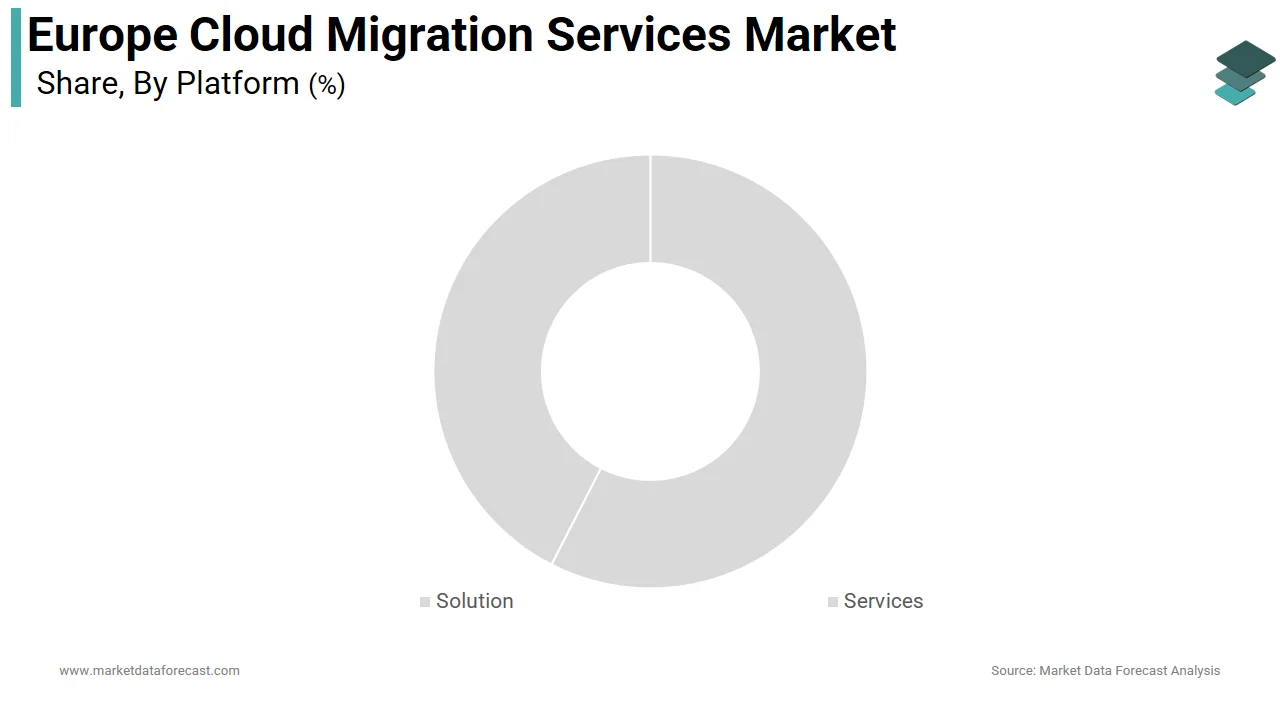
The solution segment is likely to expand at a CAGR of 21.3% from 2026 to 2034, with the rising adoption of automated migration toolkits that streamline assessment, dependency mapping, data transfer, and validation for standardized workloads like ERP databases and virtual machines. Microsoft’s Azure Migrate and AWS Migration Hub now support native EU data residency, with processing confined to Dublin, Frankfurt, and Paris regions as verified by their European public policy offices. Additionally, vendors like Druva and CloudEndure offer EU-hosted SaaS platforms with built-in GDPR logging and encryption key management, aligning with ENISA’s cloud security baseline. As regulatory frameworks mature and migration patterns become standardized, solution-based approaches are gaining traction for mid-complexity scenarios by enabling faster, lower-risk transitions at scale.
By Enterprise Size Insights
The large enterprises segment was the largest by capturing a dominant share of the Europe cloud migration services market in 2025, with their complex legacy estates, stringent regulatory obligations, and strategic imperatives to modernize at scale. Over 85% of EU-based Fortune 500 companies have active multi-year cloud migration programs driven by mandates such as the Corporate Sustainability Reporting Directive, which requires integrated digital data systems by 2025, as per the study. Financial institutions alone operate an average of 1200 legacy applications, each with core banking systems, now undergoing phased migration to sovereign cloud environments under DORA compliance timelines. Similarly, France’s CAC 40 firms are mandated under the national Cloud First policy to migrate 70% of workloads by 2026.
The small and medium enterprises segment is likely to grow at an anticipated CAGR of 23.7% throughout the forecast period, with the simplified cloud offerings, national digital vouchers, and rising cyber threats that push SMEs toward managed cloud environments. The EU’s Digital Europe Programme has disbursed over 380 million euros in SME digital transition vouchers since 2022, enabling cloud migration support in 24 member states as confirmed by the European Commission. In Italy, the National Recovery and Resilience Plan allocated 1.1 billion euros for SME digitization, with over 28000 businesses claiming subsidies for cloud migration in 2023 alone, according to the Italian Ministry of Economic Development. Spain’s Kit Digital scheme provided up to 12000 euros per SME for cloud adoption, resulting in 150000 migration projects in 2023 as documented by Red.es.
By End-use Industry Insights
The IT and telecommunications sector held 28.3% of the Europe cloud migration services market share in 2024, with the industry’s dual role as both a user and enabler of cloud infrastructure, with telecom operators migrating legacy OSS/BSS systems and IT service providers modernizing client-facing platforms. European telecom carriers are decommissioning 2G/3G networks by 2025, as mandated by the European Electronic Communications Code, requiring full migration of customer data and billing systems to cloud native architectures. Deutsche Telekom reported migrating 18 million customer records to Google Cloud’s sovereign EU region in 2023 while maintaining real-time service continuity. Similarly, IT consultancies like Capgemini and Atos execute thousands of client migrations annually, often bundling their own cloud platforms. The European Commission’s Secure Cloud for Europe initiative has further accelerated adoption by certifying telecom-grade cloud environments for cross-sector use.
The healthcare sector segment is likely to grow with the expected CAGR of 25.4% from 2025 to 2033, with the European Health Data Space regulation, which mandates secure interoperable cloud infrastructure for cross-border health data exchange by 2028. Hospitals and research institutions must now migrate electronic health records, imaging archives, and genomic datasets to GAIA-X-aligned platforms with strict pseudonymization and audit trails. Germany’s Medical Informatics Initiative connected 32 university hospitals to a federated cloud environment, enabling AI-driven clinical research while complying with BSI security standards. With aging populations, rising chronic disease burdens, and AI integration, healthcare’s digital urgency is transforming cloud migration from an infrastructure upgrade to a public health imperative.
COUNTRY-LEVEL ANALYSIS
Germany Cloud Migration Services Market Analysis
Germany was the top performer of the Europe cloud migration services market by holding 24.3% of the share in 2024, with its advanced industrial base, stringent data protection laws, and proactive public sector digitalization. The Federal Cloud Strategy mandates that all federal agencies migrate to certified sovereign cloud environments by 2026, with over 2800 legacy applications already in transition, as documented by the Federal Office of Administration. The GAIA-X node in Berlin provides a trusted data infrastructure for cross-company collaboration in automotive and manufacturing. Additionally, the country’s robust cybersecurity framework, enforced by the BSI, requires third-party validation for all cloud migrations in critical sectors. These regulatory, technical, and industrial drivers position Germany as Europe’s most sophisticated and high-value cloud migration market.
United Kingdom Cloud Migration Services Market Analysis
The United Kingdom was positioned second by capturing 19.2% of the Europe cloud management services market share in 2024. Despite Brexit, the UK maintains strong cloud migration momentum through its National Cyber Strategy and proactive adoption of international cloud standards. The National Health Service is migrating over 55 million patient records to Microsoft Azure’s UK sovereign cloud, under the Secure Data Environment framework, as confirmed by NHS Digital in 2023. The Financial Conduct Authority mandates that all tier one banks achieve DORA equivalent resilience by 2025, requiring comprehensive cloud migration of core systems. In 2023, the UK’s Digital Markets Unit approved accelerated cloud adoption pathways for SMEs, reducing compliance barriers. London remains Europe’s leading hub for cloud service providers, with AWS, Google, and Oracle operating multiple availability zones compliant with UK GDPR. The country’s blend of regulatory clarity, technical talent, and financial sector demand ensures its continued prominence in the European cloud migration landscape.
France Cloud Migration Services Market Analysis
France cloud management services market growth is likely to grow with the centralized national cloud strategy, strong defense of digital sovereignty, and aggressive public sector modernization. The Cloud Souverain initiative has allocated 3.2 billion euros to build certified EU-based cloud infrastructure with migration services exclusively awarded to domestic firms like Atos, Thales, and OVHcloud, as documented by the Interministerial Directorate for Digital Affairs. In 2023, France migrated 67 million health records to its sovereign health cloud and initiated the migration of all judicial systems to the Andra Cloud platform. The ANSSI cybersecurity agency requires all operators of vital importance to use approved migration partners, ensuring high-value institutional contracts. Additionally, France’s Tech Nation program provides subsidized migration services to 15000 startups annually. This fusion of state-led infrastructure policy, security mandates, and innovation support creates a uniquely protected and dynamic market for cloud migration services.
Netherlands Cloud Migration Services Market Analysis
The Netherlands cloud migration services market growth is likely to grow with the world-class digital infrastructure, neutrality in data governance, and leadership in cross-border data exchange. Amsterdam hosts the largest internet exchange in Europe and serves as a primary region for AWS, Azure, and Google Cloud with sovereign EU processing capabilities. The Port of Rotterdam Authority migrated its entire logistics data ecosystem to a hybrid cloud in 2023 by enabling real-time cargo tracking across 500 partners. The Netherlands also hosts the European Medicines Agency and Eurojust, both of which have executed complex sovereign cloud migrations, setting benchmarks for regulatory compliance.
Sweden Cloud Migration Services Market Analysis
Sweden cloud migration services market growth is likely to grow with its advanced digital society, robust public trust, and commitment to green IT to drive cloud migration. Over 98% of Swedish public services are already online, and the government’s Cloud Strategy 2024 requires all agencies to migrate to environmentally certified cloud platforms powered by renewable energy, as confirmed by the Swedish Civil Contingencies Agency. Swedish enterprises like Spotify and Klarna pioneered cloud native architecture,s now being emulated by traditional industries. Sweden’s Electricity Certificate System ensures that all data centers use 100% renewable power, aligning cloud migration with national climate goals.
COMPETITIVE LANDSCAPE
The Europe cloud migration services market features intense competition among global hyperscalers and specialized regional providers. Dominant players such as Amazon Web Services, Microsoft, and Google Cloud leverage their extensive technological resources and established cloud ecosystems to attract large-scale enterprise clients. Simultaneously, European firms and boutique consultancies differentiate themselves through deep regulatory expertise, localized support, and industry-specific migration frameworks. Regulatory complexity, including GDPR and emerging EU digital sovereignty mandates, creates both barriers and opportunities shaping competitive dynamics. Innovation in automation, security, and sustainability further intensifies rivalry as vendors strive to deliver faster, seamless, and compliant migration experiences. Customers increasingly demand hybrid and multi-cloud strategies, prompting providers to enhance interoperability and governance capabilities.
KEY MARKET PLAYERS
The leading companies operating in the Europe cloud migration services market include:
- IBM Corporation
- SAP SE
- Google Cloud
- Amazon Web Services, Inc. (Amazon.com, Inc.)
- Microsoft Corporation
- Hewlett-Packard Enterprise Company
- Accenture PLC
- NTT Data Corporation
- Wipro Limited
- Vodafone Group Plc
TOP PLAYERS IN THE MARKET
- Amazon Web Services maintains a strong presence in the Europe cloud migration services market through its extensive infrastructure and tailored migration solutions. The company supports European enterprises in transitioning legacy systems to cloud environments with tools like AWS Migration Hub and Application Discovery Service. Recently, AWS expanded its European data centers, including new facilities in Spain and Switzerland, to address regional data sovereignty requirements. It also launched localized professional services in collaboration with European system integrators to accelerate digital transformation for public and private sector clients across the region.
- Microsoft plays a pivotal role in the Europe cloud migration services market by offering Azure-based migration frameworks that emphasize security compliance and hybrid flexibility. The company actively partners with European governments and enterprises to modernize IT infrastructure through Azure Arc and Azure Migrate. In recent months, Microsoft enhanced its European footprint by opening new cloud regions in Germany and Italy. It also introduced sustainability-focused migration tools aligned with EU environmental regulations and deepened alliances with local consulting firms to deliver end-to-end cloud adoption services.
- Google Cloud contributes significantly to the Europe cloud migration services market by providing scalable migration pathways powered by Anthos and Migrate for Compute Engine. The company focuses on enabling data-driven transformations for the European financial, healthcare, and manufacturing sectors. It also launched industry-specific migration accelerators and increased investment in local talent through cloud skills initiatives across major European cities.
TOP STRATEGIES USED BY THE KEY MARKET PARTICIPANTS
Key players in the Europe cloud migration services market primarily adopt strategies centered on expanding regional data infrastructure, enhancing compliance with European data protection laws, and forging strategic partnerships with local system integrators. They prioritize developing sovereign cloud solutions that align with the European Union’s digital sovereignty agenda. Investments in artificial intelligence-driven migration tools and automation platforms enable faster workload transitions. Companies also focus on sustainability by optimizing energy-efficient cloud architectures. Additionally, they conduct targeted acquisitions of niche European cloud consultancies to bolster localized service delivery and deepen customer relationships across diverse industry verticals.
MARKET SEGMENTATION
This research report on the Europe cloud migration services market has been segmented and sub-segmented into the following categories.
By Platform
- Solution
- Infrastructure Migration
- Platform Migration
- Human Resource
- Application Migration
- Storage Migration
- Services
- Managed
- Professional
By Enterprise Size
- Large Enterprises
- Small and Medium Enterprises
By Deployment
- Private
- Public
- Hybrid
By End-use Industry
- IT & Telecommunications
- BFSI
- Healthcare
- Government & Public Sector
- Manufacturing
- Automotive
- Retail & Consumer Goods
- Media & Entertainment
- Other End-use Industry
By Country
- United Kingdom
- France
- Spain
- Germany
- Italy
- Russia
- Sweden
- Denmark
- Switzerland
- Netherlands
- Rest of Europe