- Product Description Description
- Table of Contents TOC
- List of Table & Figure LOT
- Get Free Sample PDF Sample PDF
Market Size, 2025
$41.12 BnMarket Estimate, 2026
$46.97 BnMarket Forecast, 2034
$77.57 BnCAGR, 2026–2034
6.47%Europe Server Market Report Summary
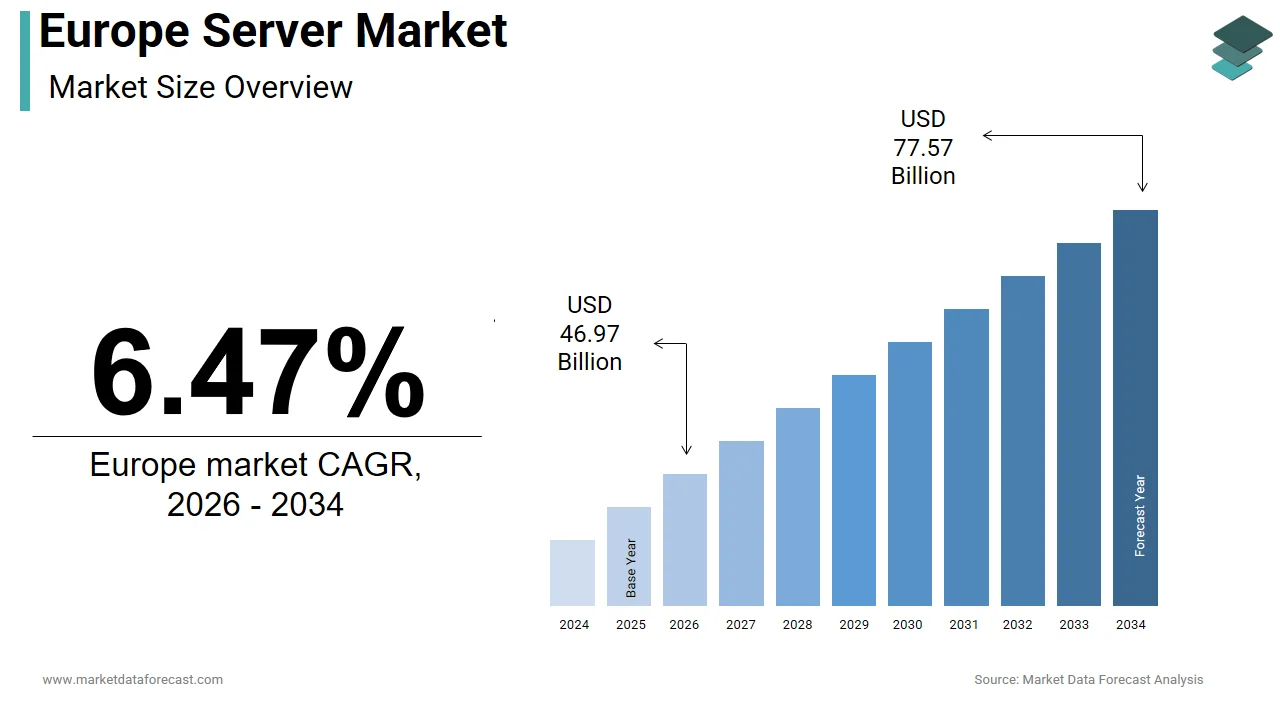
The Europe server market was valued at USD 41.12 billion in 2025 and is expected to reach USD 77.57 billion by 2034, exhibiting a CAGR of 6.47% from 2026 to 2034. Market growth is driven by accelerated cloud adoption across enterprises, rising demand for AI-optimized compute infrastructure, and expanding data center capacity influenced by digital sovereignty and sustainability mandates across Europe.
Key Market Trends
- Growing enterprise migration toward hybrid and multi-cloud environments supported by scalable rack and blade server deployments.
- Increasing demand for GPU-accelerated and high-density server architectures as AI, machine learning, and analytics workloads expand.
- Rapid emergence of sovereign cloud initiatives in major EU economies, fueling domestic server procurement and data-residency-compliant infrastructure build-outs.
- Strong policy momentum toward energy-efficient and climate-neutral data centers is driving adoption of next-generation low-power server systems.
Segmental Insights
- Based on server type, the rack servers segment held the largest share in 2024, supported by widespread deployment in hyperscale, colocation, and enterprise data centers. Their standardized architecture, high compute density, and compatibility with energy-efficient layouts make them the preferred choice across Western and Central Europe.
- Based on processor architecture, the x86 segment dominated the Europe server market in 2024, driven by its extensive software ecosystem, enterprise workload compatibility, and broad adoption across public and private cloud platforms. Continuous performance-per-watt improvements reinforce its leadership across data center modernization cycles.
- Based on vertical, IT and telecommunications accounted for the largest share in 2024, reflecting strong investment in 5G networks, cloud services, and digital infrastructure. Hyperscalers and telecom operators continue to expand server fleets to meet growing network virtualization and edge computing requirements.
Regional Insights
- The Europe server market continues to expand across major economies due to sovereign cloud policies, AI infrastructure programs, and accelerated digital transformation across industries.
- Germany led the regional market in 2024, supported by its industrial digitalization initiatives, expansive hyperscale presence, and strict energy-efficiency compliance that drives frequent server refresh cycles.
- The United Kingdom ranked second, driven by its financial services sector, growing AI infrastructure investments, and strong cloud region concentration across London and surrounding hubs.
- France is emerging as a key market with strong sovereign cloud commitments, public sector digitalization programs, and expanding AI compute requirements across aerospace and life sciences.
- The Netherlands continues to grow as a strategic European data gateway, supported by dense fiber connectivity, major internet exchange points, and stringent sustainability programs promoting new server deployment.
Competitive Landscape
The Europe server market is moderately consolidated, with leading vendors competing on energy efficiency, high-performance configurations, and compliance with EU data governance frameworks. Server providers increasingly integrate AI-focused architectures, sovereign cloud-aligned platforms, and green computing innovations. Local partnerships with data center operators, telecom players, and government agencies play a pivotal role in strengthening regional market presence.
Major companies operating in the Europe server market include Dell Inc., Hewlett Packard Enterprise Development LP, Nvidia Corporation, IBM Corporation, Hitachi Vantara LLC, Inspur, Lenovo, Super Micro Computer Inc., Cisco Systems Inc., and Fujitsu.
Europe Server Market Size
The Europe server market was valued at USD 44.12 billion in 2025, is estimated to reach USD 46.97 billion in 2026, and is projected to reach USD 77.57 billion by 2034, growing at a CAGR of 6.47% from 2026 to 2034.
A server is a hardware infrastructure designed to manage network resources, store data, and support computational workloads across on-premises, colocation, and cloud environments. As digital transformation accelerates across industries, servers have become foundational to data processing, artificial intelligence deployment, and enterprise applications. Europe’s data center landscape is evolving rapidly, influenced by stringent regulatory frameworks and growing data residency requirements. According to the European Data Centre Association, Europe hosted more than 5,000 operational data centers as of early 2024, with Germany, France, and the United Kingdom accounting for a significant share of total capacity. As per the European Union’s Digital Decade initiative, the bloc aims to achieve climate‑neutral and highly energy‑efficient data centers by 2030, which signals strong institutional support for sustainable digital infrastructure expansion. As per OECD reports, cross‑border data flows across Europe and globally have grown substantially in recent years, which reflects heightened reliance on scalable server ecosystems. These developments underscore a structural shift toward high‑performance, energy‑efficient, and secure server deployment models across the region.
MARKET DRIVERS
Enterprise Cloud Migration Intensifies Demand for Scalable Server Infrastructure
European enterprises are increasingly migrating mission-critical workloads to hybrid and multi-cloud environments, which is driving sustained demand for scalable and resilient server hardware and the European server market growth. According to the European Commission, 60% of large enterprises in the EU had adopted cloud computing services by 2023, up from 41% in 2021, which indicates rapid growth in digital infrastructure. This transition necessitates high‑density rack and blade servers capable of supporting dynamic resource allocation, low‑latency access, and seamless integration with cloud orchestration platforms. Financial services, healthcare, and logistics sectors are leading this shift, with Germany reporting strong momentum in private cloud deployments. The need for operational agility, coupled with regulatory mandates like the EU’s Data Governance Act, compels organizations to invest in localized server infrastructure that ensures data sovereignty without compromising scalability. Furthermore, edge computing adoption in manufacturing and smart city initiatives is creating additional demand for micro data center server solutions. As per Fraunhofer Institute research, a majority of German industrial firms plan to deploy edge servers within the next two years to support real‑time analytics and automation, which is reinforcing the pivotal role of server infrastructure in enabling Europe’s digital industrial base.
Sovereign Cloud Initiatives Fuel Regional Server Procurement
The emergence of sovereign cloud frameworks across Europe is a pivotal demand catalyst for localized server deployment, which is further boosting the server market expansion in Europe. Driven by concerns over data security, geopolitical dependencies, and compliance with the EU’s General Data Protection Regulation, several member states have launched sovereign cloud strategies that prioritize domestically controlled infrastructure. France’s Gaia X initiative and Germany’s Catena Cloud exemplify this trend, with both programs mandating that sensitive public and private sector data reside on servers physically located within national borders. According to the French National Cybersecurity Agency, France has actively promoted sovereign cloud adoption in the public sector between 2022 and 2024, which is stimulating procurement of locally manufactured and assembled servers. Similarly, the Netherlands and Sweden have enacted national data sovereignty policies that require critical infrastructure operators to utilize EU‑based server hardware. As per Statistics Netherlands, investments in Dutch data centers increased significantly in 2023 compared to the previous year, which reflects stronger demand for domestic server capacity. These initiatives not only reduce reliance on non‑European technology vendors but also spur partnerships between local server integrators and European chip designers, fostering a more autonomous digital supply chain aligned with the EU’s strategic autonomy objectives.
MARKET RESTRAINTS
Stringent Energy Efficiency Regulations Constrain Legacy Server Deployments
The European Union’s aggressive climate policy framework imposes significant operational and design constraints on server hardware, particularly legacy systems with suboptimal power usage effectiveness, which is impeding the European server market growth. As per the Energy Efficiency Directive, revised in 2023, the EU requires new data center infrastructure to meet strict efficiency standards with Power Usage Effectiveness (PUE) targets set close to 1.3 by 2026, which is effectively phasing out older server models that exceed this threshold. According to the European Environment Agency, data centers consumed about 2.7% of the EU’s total electricity demand in 2023, with servers representing the majority share of that load. This regulatory pressure forces organizations to delay server refresh cycles or incur substantial retrofitting costs to meet compliance standards. Moreover, the EU’s Ecodesign for Energy‑Related Products and Energy Information Regulation, effective from 2025, will require server manufacturers to disclose detailed energy performance and repairability metrics, increasing development complexity and time to market. As per the International Energy Agency, a significant portion of existing server installations in Southern and Eastern Europe remains incompatible with upcoming efficiency benchmarks, which is creating financial and logistical hurdles for small and medium enterprises lacking capital for rapid hardware upgrades. These regulatory mandates, while environmentally imperative, introduce notable cost and compatibility barriers that temper near‑term server market expansion.
Geopolitical Supply Chain Fragmentation Limits Component Availability
The rising pressure from fragmented global semiconductor and component supply chains, exacerbated by geopolitical tensions and export controls, is further hindering the server market growth in Europe. Unlike regions with vertically integrated electronics manufacturing, Europe continues to rely heavily on imports for advanced server components, including processors, memory modules, and power management systems, with dependency levels exceeding 80% according to industry reports. Recent export restrictions imposed by the United States on advanced computing chips have indirectly constrained European access to high‑performance server processors, particularly those used in artificial intelligence workloads. Additionally, China’s dominance in rare earth materials and printed circuit board assembly has introduced procurement vulnerabilities, with lead times for key server components lengthening significantly in 2023. As per the European Chips Act, launched in 2023, the EU aims to bolster domestic semiconductor capacity. Meanwhile, logistical bottlenecks at major European ports and customs delays under the Union Customs Code have further slowed hardware deliveries. As per a 2024 survey by the Confederation of European Data Centre Operators, a majority of European colocation providers reported project delays due to component shortages, which are directly impacting server deployment timelines and capacity planning. This supply‑side fragility undermines the region’s ability to meet surging infrastructure demand in a timely and cost‑efficient manner.
MARKET OPPORTUNITIES
Expansion of AI Workloads Creates Demand for Specialized Server Architectures
The rapid adoption of generative artificial intelligence across European enterprises is catalysing demand for high-performance computing servers equipped with accelerated processing units, which is a promising opportunity for the European server market. Financial institutions in London and Zurich are deploying large language model inference servers to enhance customer service automation, while automotive manufacturers in Stuttgart and Turin utilize AI training servers for autonomous driving simulations. For instance, enterprise spending on AI infrastructure in Europe grew significantly in 2024, with a majority of budgets allocated to GPU‑based servers that demand advanced thermal management, high‑bandwidth interconnects, and multi‑terabyte memory configurations. As per the European High Performance Computing Joint Undertaking, Europe is investing in next‑generation supercomputing and AI factories with multiple exascale‑class systems planned by 2027 that will require thousands of nodes of cutting‑edge server hardware. According to national regulatory initiatives, AI regulatory sandboxes enable controlled deployment of AI systems under compliance monitoring, accelerating real‑world validation for AI server environments. AI server shipments to German institutions increased notably in 2023, which is supporting real‑time analytics and advanced model training across universities and labs. This shift diversifies server product portfolios and positions Europe as a testing ground for secure, ethical, and efficient AI computing infrastructure aligned with the EU AI Act’s risk‑based framework.
Public Sector Digitalization Drives Edge Server Deployment in Smart City Projects
Europe’s ambitious smart city and digital government agendas are unlocking new server deployment avenues at the network edge, which is another noteworthy opportunity for the European server market. Municipalities across the region are installing edge servers to process real-time data from traffic sensors, environmental monitors, and public safety cameras, reducing latency and ensuring data residency. According to the European Urban Initiative, cities across Europe are increasingly adopting localized server nodes to support urban analytics and citizen service applications. In Barcelona, smart waste and parking systems are integrated with edge computing infrastructure, which is enabling real-time data processing and dynamic resource allocation. As per the Nordic Smart Government roadmap, Finland and Denmark are advancing digital service infrastructure with milestones set for broader adoption of edge-based systems by 2026. According to the Finnish Transport and Communications Agency, Finland has been actively expanding digital connectivity and infrastructure. To support these initiatives, the EU’s Digital Europe Programme continues to provide significant funding with hundreds of millions of euros allocated to edge computing and digital infrastructure projects in 2024. By decentralizing compute resources, European governments are not only enhancing service responsiveness but also building a resilient, distributed server footprint that aligns with digital sovereignty and sustainability goals.
MARKET CHALLENGES
Workforce Shortage in Data Center Operations Hampers Server Utilization Efficiency
A critical yet often overlooked challenge in Europe’s server ecosystem is the acute shortage of skilled professionals capable of managing modern server infrastructure. As server architectures grow more complex with the integration of heterogeneous computing, liquid cooling, and autonomous management software, the demand for specialized technical expertise has surged. According to the European Centre for the Development of Vocational Training, the EU is projected to face a significant shortage of skilled data center technicians by 2025, with Germany and France representing a substantial share of this gap. This shortage directly impacts server deployment speed, maintenance quality, and energy optimization efforts. Staffing constraints have led to operational delays in new server installations across major hubs such as Dublin. Moreover, the rapid evolution of server firmware and security protocols requires continuous upskilling, yet formal training programs remain limited across Southern and Eastern Europe. According to the European Institute of Innovation and Technology, fewer than 20% of European engineering graduates possess hands-on experience with advanced server technologies such as virtualization or hardware telemetry systems. Without a coordinated workforce development strategy, Europe risks underutilizing its server investments and compromising the reliability of its digital backbone.
Recycling and End-of-Life Management of Server Hardware Remains Underdeveloped
Europe’s circular economy ambitions face significant headwinds in the server hardware segment due to inadequate end-of-life management frameworks, which is another major challenge to the European market growth. Despite the EU’s Waste Electrical and Electronic Equipment Directive, less than 35% of retired servers are formally recycled, as per the European Environment Agency’s 2024 assessment. The complexity of server components, including soldered memory, proprietary connectors, and mixed material chassis, complicates disassembly and material recovery. Many organizations resort to data sanitization followed by landfill disposal or informal resale and undermining environmental objectives and creating data security risks. According to the European Environment Agency, recycling practices across member states remain fragmented, with Northern Europe achieving recovery rates above 50% while Southern regions continue to lag significantly behind. As per the European Court of Auditors, only a small share of public sector procurements includes contractual clauses for vendor-managed recycling, highlighting gaps in circular economy adoption. The lack of economic incentives for refurbishment and component reuse further disincentivizes sustainable approaches. Without harmonized regulations and certified recycling ecosystems, Europe’s server market will continue to contribute disproportionately to e-waste streams, which contradicts the European Green Deal’s zero pollution action plan and limits the sustainability credentials of its digital transformation.
REPORT COVERAGE
| REPORT METRIC | DETAILS |
| Market Size Available | 2025 to 2034 |
| Base Year | 2025 |
| Forecast Period | 2026 to 2034 |
| Segments Covered | By Server Type, Processor, Environment Type, Vertical, and County. |
| Various Analyses Covered | Global, Regional, and Country-Level Analysis, Segment-Level Analysis, Drivers, Restraints, Opportunities, Challenges; PESTLE Analysis; Porter’s Five Forces Analysis, Competitive Landscape, Analyst Overview of Investment Opportunities |
| Countries Covered | UK, France, Spain, Germany, Italy, Russia, Sweden, Denmark, Switzerland, Netherlands, Turkey, Czech Republic, and the Rest of Europe. |
| Market Leaders Profiled | Dell, Inc., Hewlett Packard Enterprise Development LP, Nvidia Corporation, IBM Corporation, Hitachi Vantara, LLC., Inspur, Lenovo, Super Micro Computer, Inc., Cisco Systems, Inc., Fujitsu, and Others. |
SEGMENTAL ANALYSIS
By Server Type Insights
The rack servers segment commanded the highest share of 65.5% of the Europe server market in 2024. The dominating position of the rack servers segment in the European market is driven by their optimal balance of density, scalability, and energy efficiency in data center environments. As per the European Data Centre Association, rack-based architectures dominate new data center deployments in Western Europe, driven by cloud service expansion and enterprise hybrid infrastructure modernization. Their standardized form factor enables seamless integration with hot aisle–cold aisle cooling layouts and modular power distribution systems, aligning with the EU’s energy efficiency mandates. Additionally, rack servers support heterogeneous workloads, which makes them indispensable for multi-tenant colocation facilities. According to the German Federal Ministry for Economic Affairs and Climate Action, rack server installations in German data centers have shown strong year-on-year growth, reflecting widespread adoption in industrial and public cloud settings. This versatility, combined with vendor support for remote management and firmware security updates, solidifies rack servers as the backbone of Europe’s digital infrastructure.
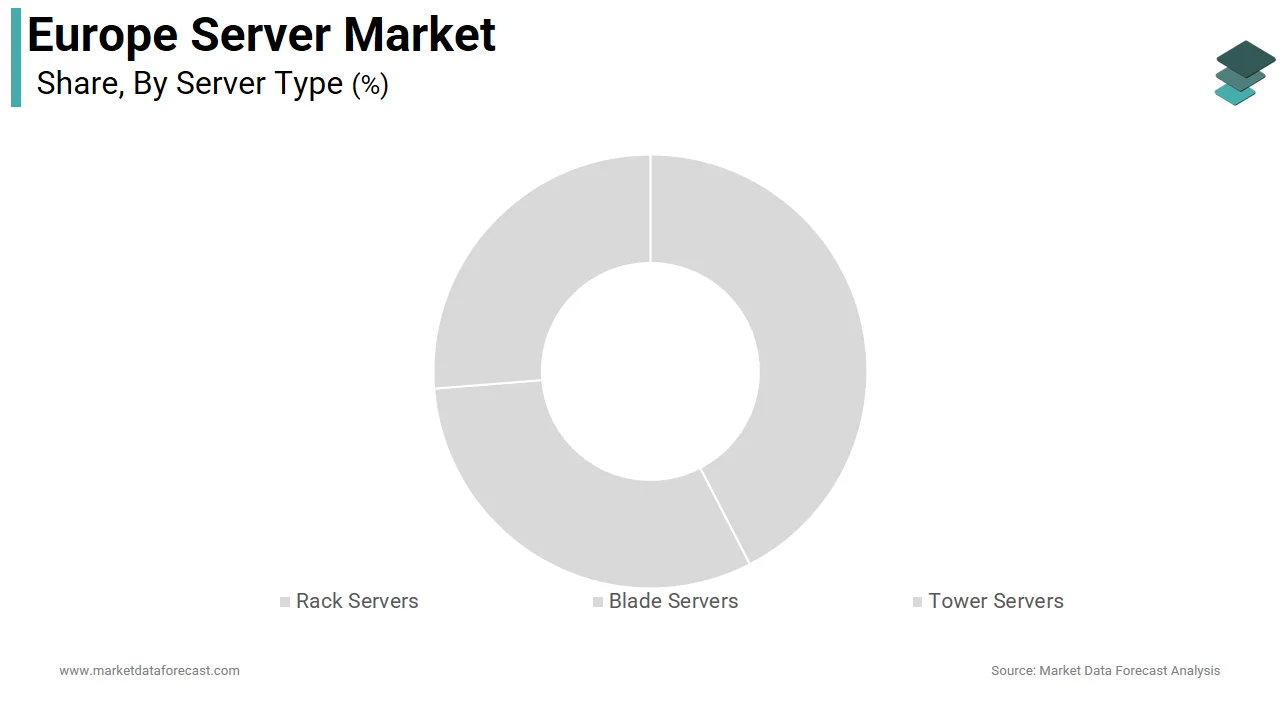
The blade servers segment is predicted to witness a CAGR of 11.2% over the forecast period in the European server market. The renewed demand for ultra-compact high-throughput computing in edge AI and telecommunications infrastructure is majorly driving the blade servers segment in the European market. Unlike previous generations, modern blade platforms integrate liquid cooling support and PCIe Gen5 backplanes, enabling deployment in 5G edge data centers and industrial IoT gateways where space and thermal constraints are acute. The Nordic countries and Germany are leading this adoption with telecom operators like Deutsche Telekom and Telenor deploying blade server racks in base station facilities to support low-latency AI inference for autonomous logistics and smart manufacturing. Blade systems offer up to 40% greater compute density per rack unit compared to conventional rack servers, a critical advantage in micro data centers.
By Processor Architecture Insights
The x86 architecture segment had the most dominating share of the European server market in 2025 due to its decades of software ecosystem maturity, broad operating system support, and extensive vendor optimization for enterprise workloads. Nearly all major European cloud platforms run x86 fleets due to compatibility with legacy business applications and mainstream virtualization stacks. As per industry benchmarks, the architecture’s performance per watt has improved significantly with Intel’s and AMD’s latest generations delivering notable energy efficiency gains compared to earlier models, aligning with EU data center efficiency targets. According to the Fraunhofer Institute for Reliability and Microintegration, x86 servers continue to dominate shipments to German enterprises, reflecting their widespread adoption. This deep integration into Europe’s digital infrastructure makes x86 the default choice for scalability, support, and interoperability.
The non-x86 server architectures segment is estimated to grow at a promising CAGR of 13.3% over the forecast period. The sovereign computing ambitions, AI-specific workloads, and energy-conscious edge deployments are a few of the factors contributing to the growth of the non-x86 server architecture segment in the European market. The European High Performance Computing Joint Undertaking has allocated over 1.1 billion euros to develop and deploy European-designed processors like the ARM-based A64FX and RISC-V-based Vega for exascale systems. These efforts aim to reduce dependency on non-European chip vendors while optimizing for power efficiency in climate-neutral data centers. Countries like Finland and Portugal are piloting RISC-V server clusters for public administration tasks, leveraging open-source firmware for enhanced security audits.
By Vertical Insights
The IT and telecommunications segment occupied 33.8% of the regional market share in 024. The domination of the IT and telecommunications segment in the European market is driven by the sector’s dual role as both infrastructure provider and primary consumer of scalable compute resources. Hyperscalers, managed service providers, and telecom operators continuously expand server fleets to support cloud services, 5G core networks, and content delivery networks. According to GSMA Intelligence, European telecom capital expenditures on data infrastructure reached tens of billions of euros in 2023, with a significant share directed toward server hardware investments. The rise of network function virtualization and multi-access edge computing further intensifies server demand. Countries like the Netherlands and Ireland have become high-density server deployment hubs. The vertical’s scale, technical agility, and infrastructure ownership cement its position as the market’s primary engine.
The healthcare segment is the fastest-growing segment in the Europe server market and is anticipated to witness a CAGR of 13.4% over the forecast period, owing to the digitalization of medical records, AI-powered diagnostic imaging, and real-time patient monitoring systems that demand secure, localized server infrastructure. Hospitals and research centers are increasingly deploying on-premises or edge servers to process sensitive health data in compliance with the EU’s Health Data Space framework and GDPR. According to the German Federal Ministry of Health, the Hospital Future Act has allocated billions of euros to modernize IT infrastructure, with a significant portion directed toward server and storage upgrades. As per the UK’s NHS Digital Transformation Strategy, on-site server deployment is mandated for AI-driven radiology and genomics applications to ensure data sovereignty and low-latency access.
COUNTRY-LEVEL ANALYSIS
Germany Server Market Analysis
Germany stood as the largest server market in Europe and accounted for 21.5% of the regional market share in 2024. The dominance of Germany in the European market is driven by its industrial base, digital sovereignty policies, and advanced data center ecosystem. Germany hosts a significant number of large-scale data centers, concentrated in Frankfurt, which serves as Europe’s primary internet exchange hub. According to the German Data Center Association, server hardware investments in 2023 amounted to several billion euros, driven by strong demand from automotive, manufacturing, and public cloud sectors. The federal government’s GAIA-X initiative has spurred procurement of locally managed server infrastructure, particularly for AI and industrial IoT. As per Germany’s Building Energy Act, strict energy efficiency laws mandate the use of high-efficiency servers with low Power Usage Effectiveness, accelerating refresh cycles. Major investments by hyperscalers, including Google’s multi-billion-euro data center expansion in Berlin, underscore Germany’s strategic importance. The convergence of industrial digitalization, regulatory rigor, and energy transition goals solidifies its leadership position.
United Kingdom Server Market Analysis
The United Kingdom held the second-largest share of the Europe server market in 2025. The growth of the UK in the European server market is attributed to London’s status as a global financial and digital hub. Despite Brexit, the UK remains a preferred location for cloud regions with AWS, Microsoft, and Oracle operating multiple availability zones. According to the UK Data Service, server deployments in UK data centers have shown notable growth in 2023, primarily to support financial services and AI research. As per the National AI Strategy, billions of pounds have been allocated to build sovereign AI infrastructure, including dedicated server clusters at leading institutions such as the Alan Turing Institute and Cambridge University. Furthermore, the UK’s NCSC Cyber Assessment Framework mandates on-premise server deployment for critical infrastructure operators, driving demand in defense and energy sectors. London’s extensive fiber connectivity and stable power grid continue to attract hyperscaler investment, ensuring sustained server market growth despite broader economic uncertainties.
France Server Market Analysis
France is anticipated to account for a promising share of the European server market over the forecast period. The aggressive digital sovereignty initiatives and public sector modernization are fuelling the French server market growth. The country’s Catena Cloud and GAIA X participation have mandated localized server procurement for government and regulated industries. According to the French Directorate for Digital Affairs, France has made substantial public investments in sovereign server infrastructure, amounting to over a billion euros in 2023. Paris and Marseille are emerging as key data center corridors, with Marseille serving as a major subsea cable landing point for Africa and Asia, necessitating edge server deployment. As per the French National Research Agency, AI server farms in Toulouse and Lyon are being funded to support aerospace and life sciences applications. Moreover, France’s strict environmental regulations under the Anti-Waste for a Circular Economy Law require server vendors to offer take-back and recycling programs, influencing procurement decisions. These policy-driven dynamics make France a unique blend of strategic autonomy and technological ambition.
Netherlands Server Market Analysis
The Netherlands is predicted to showcase a prominent CAGR in the European server market over the forecast period. The status of the Netherlands as a digital gateway between North America and continental Europe is one of the key factors driving the market growth in the Netherlands. Amsterdam hosts one of the world’s largest internet exchanges and a significant number of data centers, serving as a critical node for hyperscalers. According to Statistics Netherlands, data center electricity consumption rose sharply in 2023, reflecting massive server deployments. As per the Dutch government’s National Growth Fund, billions of euros have been allocated to expand sustainable data infrastructure with strict requirements for energy-efficient servers and waste heat reuse. Companies like Microsoft and Digital Realty have announced commitments to climate-neutral server operations in the Netherlands by 2026. Additionally, the country’s advanced fiber network and stable regulatory environment attract cross-border enterprise server hosting. This combination of connectivity policy and sustainability leadership positions the Netherlands as a pivotal market for next-generation server deployment.
Sweden Server Market Analysis
Sweden is expected to hold a notable share of the Europe server market during the forecast period, owing to its renewable energy abundance and data center-friendly climate. Over 98% of Sweden’s electricity comes from low-carbon sources, making it highly attractive for energy-intensive server operations. According to the Swedish Energy Agency, data center power demand has continued to grow, with server farms in Stockholm and Falun benefiting from hydro and nuclear power. As per the Royal Institute of Technology, Sweden’s cold climate enables year-round free cooling, significantly reducing server cooling costs. Sweden is also a leader in green server initiatives, with companies like Northvolt exploring battery backup integration for server resilience. Furthermore, its participation in the Nordic Data Center Alliance promotes cross-border server resource pooling for public sector AI projects. These environmental and collaborative advantages allow Sweden to punch above its population weight in the European server landscape.
COMPETITIVE LANDSCAPE
Competition in the Europe server market is intensifying as global vendors adapt to region-specific regulatory, economic, and technological demands. Unlike other regions where price or scale dominates differentiation, European competitiveness hinges on compliance with data governance, energy efficiency, and circular economy mandates. Major players are not only competing on hardware performance but also on the ability to integrate with sovereign cloud frameworks and support hybrid deployment models. Local partnerships with system integrators, telecom operators, and public agencies have become critical entry points. Simultaneously, the rise of AI and edge computing is fragmenting demand, compelling vendors to offer specialized rather than standardized solutions. This dynamic environment rewards agility, regulatory alignment, and long-term sustainability commitments over traditional volume-driven strategies, reshaping vendor positioning across Western Central and Northern Europe.
KEY MARKET PLAYERS
The leading companies operating in the Europe server market include:
- Dell, Inc.
- Hewlett Packard Enterprise Development LP
- Nvidia Corporation
- IBM Corporation
- Hitachi Vantara, LLC.
- Inspur
- Lenovo
- Super Micro Computer, Inc.
- Cisco Systems, Inc.
- Fujitsu
TOP PLAYERS IN THE MARKET
- Lenovo has established a strong footprint in the Europe server market through its ThinkSystem portfolio, which emphasizes energy efficiency, security, and hybrid cloud readiness. The company actively collaborates with European cloud providers and system integrators to deliver tailored infrastructure solutions for both public and private sectors. In early 2024, Lenovo expanded its partnership with Deutsche Telekom to deploy AI-optimized servers supporting Germany’s national AI initiative. It also launched a regional sustainability program in the Netherlands focused on server hardware recycling and circular design. These initiatives reinforce Lenovo’s commitment to aligning with EU digital sovereignty and green transition objectives while enhancing its service delivery capabilities across Western and Central Europe.
- Hewlett Packard Enterprise plays a pivotal role in Europe’s server landscape by offering high-performance computing and mission-critical systems tailored for regulated industries. The company has deepened its engagement with European governments through its sovereign cloud infrastructure solutions, ensuring data residency and compliance with GDPR. In 2024, HPE announced a strategic collaboration with France’s Atos to co-develop secure server platforms under the Gaia X framework. It also introduced its GreenLake for Private Cloud Modernization suite across Nordic countries, integrating metered consumption with on-premises server deployment. These moves underscore HPE’s focus on flexible consumption models and trusted local data management, positioning it as a preferred infrastructure partner for Europe’s digital autonomy agenda.
- Dell Technologies maintains a robust presence in the Europe server market with its PowerEdge systems, widely adopted in the enterprise, healthcare, and education sectors. The company emphasizes edge-to-core to cloud integration, supporting digital transformation across diverse European industries. In 2024, Dell opened a new server configuration and logistics hub in Poland to accelerate delivery timelines for Central and Eastern Europe. It also enhanced its APEX as a service offering with localized data management features compliant with EU cybersecurity regulations. Furthermore, Dell partnered with Swedish research institutions to deploy AI-ready server clusters for sustainable manufacturing projects. These actions reflect Dell’s strategy of combining localized operations with scalable infrastructure solutions to meet evolving European data governance and innovation requirements.
TOP STRATEGIES USED BY THE KEY MARKET PARTICIPANTS
Key players in the Europe server market are prioritizing localized data center partnerships to comply with stringent EU data sovereignty laws. They are investing heavily in energy-efficient server designs to meet the bloc’s climate neutrality targets. Companies are expanding their service portfolios to offer consumption-based pricing aligned with European enterprise budgeting models. Strategic collaborations with national cloud initiatives such as Gaia X and Catena Cloud are being leveraged to secure public sector contracts. Additionally, firms are establishing regional hardware configuration centers to reduce supply chain latency and improve deployment speed across diverse European markets.
MARKET SEGMENTATION
This research report on the Europe server market has been segmented and sub-segmented into the following categories.
By Server Type
- Rack Servers
- Blade Servers
- Tower Servers
By Processor
- x86
- Non x84
By Environment Type
- Cloud Servers
- AI Servers
- Edge Servers
By Vertical
- BFSI
- IT & Telecom
- Healthcare
- Government
- Energy & Utilities
- Others
By Country
- United Kingdom
- France
- Spain
- Germany
- Italy
- Russia
- Sweden
- Denmark
- Switzerland
- Netherlands
- Rest of Europe