- Product Description Description
- Table of Contents TOC
- List of Table & Figure LOT
- Get Free Sample PDF Sample PDF
Market Size, 2025
$10.21 BnMarket Estimate, 2026
$11.87 BnMarket Forecast, 2034
$39.45 BnCAGR, 2026–2034
16.2%Executive Summary: Europe Modular Data Center Market
- Market Scope: Comprehensive European modular data center industry analysis covering solution types, application segments, regional country leadership frameworks, strategic corporate developments, and competitive landscapes.
- Market Valuation: Valued at USD 10.21 billion (2025), estimated at USD 11.87 billion (2026), and projected to reach USD 39.45 billion by 2034, registering a strong CAGR of 16.2% (2026–2034).
- Primary Growth Drivers: Urgent need for rapid digital infrastructure deployment, EU sustainability mandates for energy efficiency, accelerating edge computing demand for AI/5G, reduced construction timelines, and lower capital expenditure. Restraints include supply chain constraints for critical components and cross-border regulatory complexities.
Key Market Segment Metrics (2026–2034)
| Category | Leading Segment / Country (Position) | Fastest-Growing Segment |
|---|---|---|
| By Solution Type | Prefabricated modular units (dominate due to speed of deployment and energy efficiency advantages) | All-in-one modular data center configurations featuring integrated liquid cooling |
| By Application | Enterprise and colocation modular deployments supporting mainstream workloads | Edge computing deployments (fastest-growing application fueled by autonomous vehicles, smart cities, and industrial IoT) |
| By Region / Country | Germany (led regional market with a 28.5% share in 2025, followed by the United Kingdom) | Nordic countries and key secondary European hubs leveraging natural cooling and green tech investments |
Major Market Players & Market Structure
Market Structure: Highly competitive European digital infrastructure ecosystem driven by strategic partnerships, liquid cooling product innovations, AI-ready infrastructure development, and localized manufacturing expansion to mitigate supply chain risks.
Key Companies: Schneider Electric SE, Vertiv Holdings Co., Huawei Technologies Co., Ltd., Dell Technologies Inc., IBM Corporation, Rittal GmbH & Co. KG, Eaton Corporation plc, ABB Ltd., Siemens AG, and Canovate Group.
Europe Modular Data Center Market Size
The Europe Modular Data Center Market is projected to grow from USD 10.21 billion in 2025 to USD 11.87 billion in 2026 and reach USD 39.45 billion by 2034, registering a CAGR of 16.20% from 2026 to 2034.
Modular data centers are prefabricated, scalable units that integrate power cooling, computing, and security infrastructure into standardized enclosures deployable indoors or outdoors with significantly reduced construction timelines. Unlike traditional brick-and-mortar facilities, these systems offer plug-and-play IT capacity in weeks rather than years, aligning with urgent digital demands. Data centre electricity consumption in the European Union has risen in recent years and accounting for a growing share of total EU power use. According to the European Environment Agency, data centres are responsible for substantial CO₂‑equivalent emissions, which is prompting stricter energy‑efficiency mandates under the EU Code of Conduct for Data Centres. The European Commission’s Digital Decade Policy Programme targets the deployment of climate‑neutral, which is highly secure edge nodes by 2030 to support AI and 5G services. Furthermore, the European Data Act requires data infrastructure to enable portability and interoperability, which is reinforcing demand for flexible modular architectures. These regulatory, technological, and environmental imperatives position modular data centres not as temporary solutions but as strategic assets in Europe’s digital sovereignty and sustainability roadmap.
MARKET DRIVERS
Accelerated Deployment Needs for Edge Computing and 5G Infrastructure
The growth of the European modular data center market is driven by the rapid rollout of 5G networks and edge computing applications that require low‑latency, localized compute. According to the European 5G Observatory, EU member states continued expanding 5G infrastructure through 2023–2025, with regulators tracking base station deployments and edge nodes across the bloc to support emerging services. As per the Bundesnetzagentur’s Telecommunications Annual Report 2023, Germany prioritized investment in 5G and fiber rollout, which indicates the need for proximate compute to meet application latency targets. For instance, Vodafone has expanded its edge footprint in Spain with plans to reach 100 edge data centers, while European vendors have scaled prefabricated capacity to meet accelerated deployment demand. The EuroHPC Joint Undertaking introduced an AI Factories pillar in 2025 to launch calls to host AI‑optimized supercomputing and experimental platforms that complement sovereign edge capacity near research and industrial sites. This convergence of telecom expansion, public digital services, and industrial automation creates an urgent and sustained demand for rapidly deployable, secure, and efficient edge infrastructure.
Stringent EU Regulations on Energy Efficiency and Carbon Neutrality
The rapidly evolving EU climate and energy‑efficiency policy framework is supporting the expansion of the European modular data center market. According to the European Commission’s recast Energy Efficiency Directive, operators must report key performance indicators to an EU database from 2025/2025, with an EU‑wide scheme adopted to rate data center sustainability. As per the Joint Research Centre’s EU Code of Conduct best practices (2023–2025), modular designs can achieve low PUE through optimized cooling, high‑density layouts, and integrated energy management. For instance, Nordic climates enable efficient free‑air cooling and seasonal reductions in energy intensity, supporting lower PUE ranges under best‑practice configurations. Additionally, the EU Taxonomy for Sustainable Activities classifies qualifying data centers as environmentally sustainable investments, unlocking green financing. These regulatory and financial levers make modular data centers a preferred path to compliance within Europe’s decarbonization agenda without asserting a single mandatory PUE threshold.
MARKET RESTRAINTS
Limited Availability of Suitable Land and Urban Zoning Restrictions
The limited availability of suitable land and restrictive urban zoning in dense city regions are one of the major restraints to the modular data center market growth in Europe. Metropolitan authorities in the Paris Region have tightened permitting and environmental scrutiny for data center projects, extending timelines for large‑scale IT infrastructure. As per municipal policy in Amsterdam, preparatory decisions adopted in late 2023 restrict new data centers in the municipality, which reflects grid capacity constraints and spatial scarcity. According to industry and legal briefings in Germany and France, grid connection capacity, consenting procedures, and environmental impact requirements contribute to prolonged lead times. These spatial and infrastructural bottlenecks force operators to seek remote locations and undermining the low‑latency rationale for edge deployments.
Supply Chain Volatility for Critical Power and Cooling Components
The supply chain disruptions and component shortages are hampering the European modular data center market growth. According to the European Commission’s Critical Raw Materials Act materials briefings, Europe remains dependent on imports of key inputs for power electronics and electrification. As per Wood Mackenzie and industry trade coverage in 2025, high‑power transformer lead times have risen sharply, with averages surpassing two years in some markets due to capacity constraints and input cost pressures. Semiconductor shortages have delayed delivery of intelligent cooling controllers, complicating commissioning timelines for precision cooling systems. For instance, a majority of data center builds have faced ongoing project disruptions from equipment bottlenecks and inflationary pressures. Until Europe builds resilient regional supply chains for these mission‑critical components, modular deployment timelines will remain vulnerable to global market shocks.
MARKET OPPORTUNITIES
Expansion of Sovereign Cloud and Government Digital Infrastructure Programs
The growing adoption of sovereign cloud and government digital infrastructure programs is a significant opportunity for the European modular data center market. According to European Defence Agency initiatives, EU‑funded studies and projects are advancing cloud and modular capabilities for secure defense data spaces and decision support. Germany continues to resource Gaia‑X data spaces and sovereign cloud nodes through federal competitions and project funding, while EU institutions push for trusted, interoperable infrastructure. According to the European Health Data Space regulation, health authorities must comply with mandatory interoperability, security, and data‑sharing requirements, and catalysing demand for secure local processing capabilities. With national digital identity and AI programs funded under Digital Europe, the public sector is emerging as a high‑trust, high‑compliance vector for modular infrastructure aligned with EU data sovereignty goals.
Integration of Renewable Energy and On-Site Power Generation
The development of renewable energy integration offers another promising avenue for the European modular data center market expansion. According to IRENA’s Renewable Power Generation Costs in 2023, the global weighted average LCOE for utility‑scale solar fell 12% year‑on‑year, with cost declines supporting hybrid microgrids. Aper the Danish Energy Agency and IEA reporting, Denmark’s power system continues to raise wind and solar shares with supportive techno‑economic data for storage and grid integration. Industry deployments across the Nordics and continental Europe are pairing modular data centers with on‑site renewables and batteries to achieve periods of 24/7 carbon‑free operation. The EU’s Net‑Zero Industry Act establishes measures to scale net‑zero technologies and encourages demand via public procurement, providing regulatory momentum for low‑carbon data infrastructure. Factory‑built modular units, with standardized power interfaces, are uniquely suited for plug‑and‑play integration with solar, wind, and emerging hydrogen systems.
MARKET CHALLENGES
Cybersecurity and Physical Security Vulnerabilities in Distributed Deployments
The absence of harmonized enforcement and robust security‑by‑design is primarily challenging the European modular data center market at the edge. According to ENISA’s Threat Landscape 2023, ransomware, supply‑chain attacks, and exploitation of unmanaged systems remain elevated, highlighting the risks of distributed, remotely managed assets. As per ETSI security conference proceedings and standards activity, industry stakeholders emphasize stronger baselines for secure remote management and resilience in outdoor deployments. Physical hardening frameworks and certifications (e.g., TSI.STANDARD by TÜV NORD) underscore the need for comprehensive protection layers beyond basic access control. Regulatory guidance from EU data protection bodies reiterates obligations around encryption, data residency, and governance in third‑party managed modules. Until robust security frameworks become mandatory, distributed modular assets will remain high‑risk nodes in Europe’s critical digital infrastructure.
Thermal Management LimitationsHigh-Densitysity Warm-Climatemate Regions
The growing instability due to thermal management limitations is also challenging the expansion of the European modular data center market. According to Copernicus’ European State of the Climate 2023, Europe experienced widespread heat stress and record temperatures, and constrained free cooling potential in Southern regions. As per regional industry coverage, high‑density deployments in Mediterranean climates face GPU throttling risks without advanced liquid or evaporative systems. According to the European Commission’s Joint Research Centre, best‑practice cooling measures and efficiency frameworks yet retrofits remain common, where ambient temperatures and power densities exceed air‑cooling capabilities. These thermal constraints limit the applicability of standard modular units in warm climates or AI‑intensive scenarios without significant redesign and capital upgrades.
REPORT COVERAGE
| REPORT METRIC | DETAILS |
| Market Size Available | 2025 to 2034 |
| Base Year | 2025 |
| Forecast Period | 2026 to 2034 |
| Segments Covered | By Component, Enterprise Size, and Region. |
| Various Analyses Covered | Global, Regional and Country-Level Analysis, Segment-Level Analysis, Drivers, Restraints, Opportunities, Challenges; PESTLE Analysis; Porter’s Five Forces Analysis, Competitive Landscape, Analyst Overview of Investment Opportunities |
| Countries Covered | UK, France, Spain, Germany, Italy, Russia, Sweden, Denmark, Switzerland, Netherlands, Turkey, Czech Republic, Rest of Europe |
| Market Leaders Profiled | IBM Corporation, Huawei Technologies Co., Ltd., Dell Technologies Inc., Hewlett Packard Enterprise (HPE), Cisco Systems, Inc., Schneider Electric SE, Vertiv Holdings Co., Rittal GmbH & Co. KG, Eaton Corporation plc, AST Modular, CommScope Holding Company, Inc., BladeRoom Group Ltd., Cannon Technologies Ltd., Flexenclosure AB, PCX Corporation, Johnson Controls International plc, Baselayer Technology, LLC, Silent-Aire (part of Johnson Controls), Stulz GmbH, ABB Ltd. |
SEGMENTAL ANALYSIS
By Component Insights
The solution segment accounted for 66.5% of the European market share in 2025. The dominance of the solution segment in this European market is attributed to the capital‑intensive nature of modular infrastructure, where hardware constitutes the primary investment. According to the German Federal Ministry for Digital and Transport, public sector modular deployments allocate the majority of budgets to physical solution components to ensure rapid commissioning and regulatory compliance. For instance, modular units have been procured widely across multiple European countries, with solution costs typically exceeding seven figures per unit before service contracts. According to the European Commission’s Digital Europe Programme, funded edge infrastructure must utilize certified hardware meeting EU cybersecurity and energy efficiency requirements, which is reinforcing standardized solution adoption. Factory‑tested integration reduces on‑site commissioning risks, a critical factor in remote or time‑constrained projects. This segment is expected to sustain dominance over the forecast period as predictable performance, compliance, and integrated hardware designs continue to drive investment.
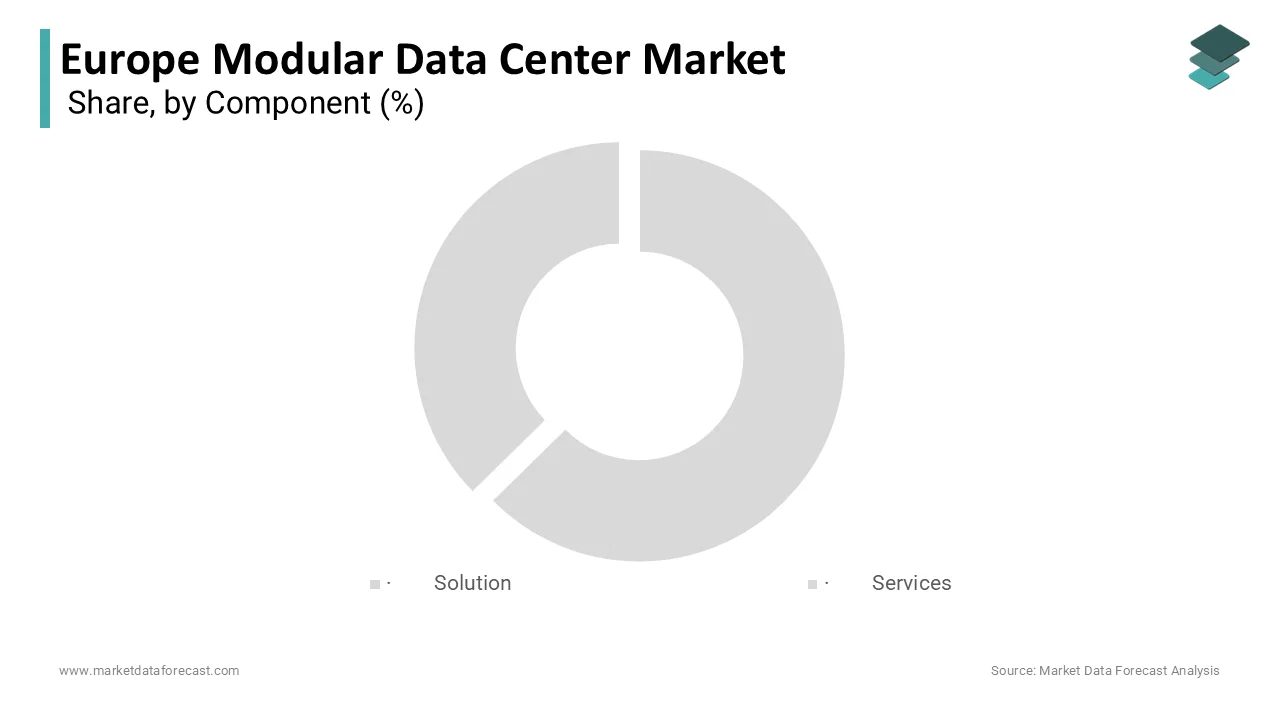
The service segment is a promising segment and is likely to grow at a CAGR of 16.3% over the forecast period in the European market due to the increasing complexity of distributed edge environments and demand for managed operations from non‑IT organizations. According to European ICT service associations, municipalities and industrial firms increasingly bundle remote monitoring, managed security, and predictive maintenance with modular data center deployments. As per the Swedish Energy Agency, continuous AI‑driven tuning of cooling and power systems in service‑integrated setups can improve energy performance relative to static configurations. According to the EU Cyber Resilience Act, continuous vulnerability management and incident response obligations for critical infrastructure are accelerating outsourcing to certified service providers. For instance, “modular data center as a service” offerings with SLA‑backed uptime and carbon reporting are expanding across public and private sectors. This segment is expected to expand rapidly over the forecast period as organizations prioritize operational simplicity, regulatory assurance, and OPEX‑based models.
By Enterprise Size Insights
The large enterprises segment occupied 74.7% of the European modular data center market share in 2025. The leading position of the large enterprises segment in this European market is attributed to scale, digital intensity, and regulatory obligations across multinational corporations, telecom operators, and public institutions. According to Eurostat’s Business ICT indicators, large organizations account for the majority of advanced infrastructure deployments, including modular edges for 5G and AI workloads. For instance, dozens of modular edge units were installed across multiple European countries to support low‑latency services. According to the European Commission’s Digital Operational Resilience Act, large financial institutions are required to maintain geographically dispersed recovery capabilities, often supported by modular backup data centers. Modular nodes at plants process real‑time vision and automation data to meet security and latency requirements. This segment is expected to remain dominant over the forecast period as capital strength, technical expertise, and regulatory compliance continue to favor large‑scale deployments.
The small and medium enterprises segment is anticipated to exhibit a CAGR of 18.7% over the forecast period in the European market. The rise of government incentives, cloud‑edge partnerships, and modular data center‑as‑a‑service models tailored to limited budgets is favouring the growth of the SME segment in this European market. According to national digital investment programs, grants and tax credits have supported SME adoption of compact modular units for healthcare and manufacturing use cases. As per SME‑focused offerings from European cloud providers, bundled hardware and managed services with fixed monthly pricing have lowered entry barriers. According to the European Institute of Innovation and Technology, modular edge infrastructure reduces data processing latency substantially, enabling new AI‑driven services and local analytics. For instance, SMEs report improved resilience and compliance when outsourcing operations to certified providers. This segment is expected to expand robustly over the forecast period as affordability, policy support, and performance needs unlock broader SME transformation.
COUNTRY LEVEL ANALYSIS
Germany Modular Data Center Market Analysis
Germany dominated the European modular data center market in 2025 by occupying 26.2% of the European market share. The leading position of Germany in the European market can be credited to its advanced industrial base, stringent data sovereignty laws, and aggressive 5G deployment. According to the German Engineering Federation, over 120 modular edge units were installed by automotive and machinery manufacturers in 2023 to support real‑time AI quality control and predictive maintenance. As per Deutsche Telekom, the operator manages more than 200 modular sites across its network to meet industrial private‑5G latency requirements near 10 milliseconds. According to the Federal Ministry for Digital and Transport, €280 million was allocated in 2023 under GAIA‑X to fund sovereign modular infrastructure for public and critical services. As per national energy‑efficiency guidance, operators accelerate the adoption of liquid‑cooled modular units targeting PUE values close to 1.2. Germany is expected to remain Europe’s modular data center nucleus over the next few years.
United Kingdom Modular Data Center Market Analysis
The United Kingdom held a substantial share of the European modular data center market in 2025. According to NHS England, multiple modular data center units were deployed in 2023 to process genomic and diagnostic imaging data locally, supporting GDPR‑aligned workflows and reducing cloud dependency. As per the Bank of England’s operational resilience policies, major banks are required to implement geographically resilient backup sites by the mid‑2020s, driving adoption of modular disaster‑recovery facilities. According to Vodafone and BT disclosures, dozens of modular edge sites were installed to support smart‑city and low‑latency services in urban hubs. As per the National Cyber Security Center, modular data center security guidance issued in 2023 strengthened trust in pre‑certified designs. The UK is expected to remain a critical hub for modular deployment in the coming years.
France Modular Data Center Market Analysis
France captured a notable position in the European modular data center market in 2025. According to the France 2030 investment plan, €450 million was allocated to sovereign cloud infrastructure, with over one hundred modular units deployed in 2023 for defense, research, and public administration. As per Orange, a nationwide edge footprint includes numerous modular data centers supporting smart‑grid and autonomous‑vehicle trials. According to ADEME, a high share of new modular deployments integrated free‑cooling and renewable‑energy interfaces in 2023, aligning with the national pathway toward carbon‑neutral data centers by 2035. As per ANSSI, a certified list of hardened modular designs is maintained for sensitive government use. France is expected to remain a leader in secure and sustainable modular infrastructure over the next few years.
Sweden Modular Data Center Market Analysis
Sweden maintained a significant role in the European modular data center market in 2025. According to the Swedish Energy Agency, many new modular units achieved low PUE levels through free‑air cooling, leveraging the country’s favorable climate and renewable‑power mix. As per Ericsson and Volvo Cars, modular edge sites were deployed to support 5G vehicle‑to‑everything applications and factory analytics in 2023. According to Swedish government communications, the “Green Data Centre” framework offers permitting facilitation and fiscal incentives for facilities using predominantly renewable energy. As per Nordic digital‑resilience programs, sovereign‑cloud pilots increasingly use modular architectures to keep sensitive data within national borders. Sweden is expected to strengthen its sustainability‑driven leadership in Northern Europe’s modular ecosystem in the coming years.
Netherlands Modular Data Center Market Analysis
The Netherlands remained an important participant in the European modular data center market in 2025. According to Schiphol Airport, modular units have been deployed to support real‑time baggage and cargo analytics, improving processing efficiency across critical operations. As per the Port of Rotterdam, modular edge sites underpin autonomous equipment control and vessel‑traffic systems requiring very low latency. According to the Dutch National Growth Fund, €200 million was allocated in 2023 to sustainable digital infrastructure, including wind‑powered modular data centers. As per Dutch industry reports, circular design leadership includes modular units using high shares of recycled steel and fully demountable components. The Netherlands is expected to sustain its upward trajectory in modular data center adoption over the next few years.
COMPETITIVE LANDSCAPE
Competition European modular data center market is defined by a mix of global infrastructure giants, European technology integrators, and specialized engineering firms vying for influence across public telecom and industrial sectors. The landscape is shaped less by price and more by compliance with EU regulations, energy performance certifications, and sovereign data handling capabilities. Companies like Schneider E, LECTR IC Vertiv, and Atos competend-to-endend to end solutions that combine hardware, software, and services into secure, rapidly deployable units. Differentiation hinges on the ability to neutralize design, permitting fast pathways and integrated edge cloud management. While large vendors dominate national and hyperscaler projects, niche players thrive in hardened defense or rural edge applications. High entry barriers, including industrial certification, supply chain, control, and local service networks, favor incumbents with proven European references and policy engagement. This environment fosters innovation but demands deep regulatory fluency and commitment to Europe’s dual digital and green transition.
KEY MARKET PLAYERS
Some of the companies that are playing a dominating role in the European modular data center market include
- IBM Corporation
- Huawei Technologies Co., Ltd.
- Dell Technologies Inc.
- Hewlett Packard Enterprise (HPE)
- Cisco Systems, Inc.
- Schneider Electric SE
- Vertiv Holdings Co.
- Rittal GmbH & Co. KG
- Eaton Corporation plc
- AST Modular
- CommScope Holding Company, Inc.
- BladeRoom Group Ltd.
- Cannon Technologies Ltd.
- Flexenclosure AB
- PCX Corporation
- Johnson Controls International plc
- Baselayer Technology, LLC
- Silent-Aire (part of Johnson Controls)
- Stulz GmbH
- ABB Ltd.
TOP LEADING PLAYERS IN THE MARKET
- Schneider Electric SE is a global leader in energy management and automation with a commanding presence in the European modular data center market. The company contributes to the global landscape through its EcoStruxure IT architecture, which integrates power cooling and monitor-pre-engineered modular solutions deployable in under 12 weeks. In Europe, Schneider has delivered hundreds of modular units to telecom operators, public agencies, and industrial clients requiring energy-efficient infrastructure. Rec, the company strengthened its position by launching the Micro Data Center XC Series in 023, featuring inlit hium-ion thermal optimization compliant with EU Ecodesign standards. It also partnered with Orange to deploy 5G edge modular sites across France and Spain. These actions reinforce Schneider Electric’s role as a trusted enabler of ap is secure,e and s, sustainable digital infrastructure across the continent.
- VeCo.iv Co is a major global provider of critical digital infrastructure with deep expertise in modular data center solutions tailored for European regulatory and climate conditions. The company’s global contribution includes scalable prefabricated systems that support edge cloud and enterprise deployments with high density and efficiency. Inpe Vertiv has supplied modular units to the hype, RSCaleromsand, and defense requiring hardened and rapidly deployable capacity. In 2023, Vertiv introduced its SmartAisle 2 solution with integrated liquid cooling designed for AI workloads in warm climates like Southern Europe. It also collaborated with Deutsche Telekom to standardize edge modular designs across Germany. These initiatives underscore Vertiv’s thermal resiliencer regulatory, alignment, and telecom partnership to meet Europe’s distributed computing demands.
- Atos SE is a European digital transformation leader offering sovereign modular data center solutions that prioritize cybers, data, and computing. The company plays a pivotal role in the global market by advancing secure edge infrastructure for the public sector and critical industries under its Decarbonized and Sovereign Data Center initiative. I, Euos, have deployed modular units for healthcare, defense, and research institutions requiring GDPR compliANSSI-certifiedertified environments. In 2025, Atos launched its “Modular Edge as a Service” offering, bundling hardware management, carbon tracking into a single operational expenditure model for SMEs. It also integrated its BullSequana servers into modular enclosures optimized for AI at the edge. These moves position Atos as a key architect of Europe’s trust climate-neutral digital backbone.
TOP STRATEGIES USED BY THE KEY MARKET PARTICIPANTS
Key players in the European modular data center market focus on regulatory alignment by designing solutions that comply with EU energy efficiency, cybersecurity, and data sovereignty mandates. They emphasize rapid deployment through factory integratiopre-certificationcation to meet tight 5G and edge timelines. Strategic partnerships with telecom op, operators l go, and cloud providers ensure sector-ssector-specsector-specificpanies invest in thermal, including liquid and free a,ir cooling, to address warm climate challenges. Additionally, they shift toward service-based models offering modular data center as a service with managed op, sustainabilityreportingrg and fixed pricing to attract public sector and SME customers.
MARKET SEGMENTATION
This research report on the europe modular data center market is segmented and sub-segmented into the following categories. or ies
By Component
- Solution
- Services
By Enterprise Size
- Large Enterprises
- Small & Medium Enterprises (SMEs)
By Country
- Germany
- United Kingdom
- France
- Sweden
- Netherlands
- Rest of Europe