- Product Description Description
- Table of Contents TOC
- List of Table & Figure LOT
- Get Free Sample PDF Sample PDF
Market Size, 2025
$4.85 BnMarket Estimate, 2026
$5.82 BnMarket Forecast, 2034
$24.97 BnCAGR, 2026–2034
19.97%Europe Edge Data Center Market Report Summary
The Europe edge data center market was valued at USD 4.85 billion in 2025, is estimated to reach USD 5.82 billion in 2026, and is projected to grow to USD 24.97 billion by 2034, expanding at a robust CAGR of 19.97% from 2026 to 2034. Market expansion is driven by the rapid rollout of 5G standalone networks, industrial digitalization initiatives, and the rising need for low-latency, localized data processing. Edge data centers are increasingly positioned as critical infrastructure supporting real-time applications across telecom, manufacturing, healthcare, and transportation.
Key Market Trends
- Accelerated deployment of 5G SA networks embedding edge compute as a native network layer
- Growing adoption of on-premise industrial edge nodes under EU smart factory programs
- Shift toward distributed, small-to-medium edge facilities in urban and industrial locations
- Rising demand for managed services and remote monitoring for geographically dispersed sites
- Increasing emphasis on data sovereignty, cybersecurity, and sustainability compliance
Segmental Insights
-
Based on component:
-
The solutions segment dominated the market in 2025, supported by demand for integrated, ruggedized hardware and edge-optimized software stacks compliant with EU cybersecurity and data-sovereignty regulations.
-
The services segment is the fastest growing, driven by the operational complexity of managing distributed micro facilities and regulatory requirements under DORA and cybersecurity frameworks.
-
-
Based on facility type:
-
Small and medium facilities held the largest share due to their suitability for deployment in telecom sites, factories, transport hubs, and dense urban environments.
-
Large edge facilities are growing rapidly as metropolitan aggregation hubs supporting hybrid edge-to-cloud architectures.
-
-
Based on industry:
-
IT & telecom led the market with 48.4% share, reflecting edge’s role as a foundational network layer for 5G and fiber infrastructure.
-
Healthcare is expected to register the fastest CAGR, driven by real-time diagnostics, telemedicine, and strict data-localization requirements.
-
Regional Insights
The Europe edge data center market is witnessing strong momentum across both core and emerging economies, supported by digital-infrastructure investment and regulatory alignment.
- Germany dominated the market with 26.2% share, backed by industrial digitalization, private 5G adoption, and a strong domestic industrial-edge ecosystem.
- The United Kingdom ranked second, supported by telecom-led edge deployments, AI strategy funding, and data-sovereignty priorities post-Brexit.
- France benefits from its sovereign cloud strategy, industrial 5G rollout, and healthcare digitization initiatives.
Competitive Landscape
The Europe edge data center market features a multi-layered competitive environment combining global IT vendors, telecom operators, industrial automation firms, and specialized edge infrastructure providers. Competition centers on solution integration, regulatory compliance, sustainability credentials, and deployment speed rather than scale alone. Telecom operators increasingly act as ecosystem orchestrators, while vendors differentiate through certified 5G edge stacks, sovereign cloud alignment, and AI-driven remote management. Regulatory fragmentation across member states elevates the importance of compliance engineering, creating high entry barriers and favoring players with deep regional expertise.
Key players operating in the market include Acromove, American Tower Corporation, AtlasEdge Data Centres, Dell Technologies, Hewlett Packard Enterprise, Vertiv, Zenlayer, EdgeConneX, Proximity Data Centres (nLighten), and others.
Europe Edge Data Center Market Size
The Europe edge data center market was valued at USD 4.85 billion in 2025, is estimated to reach USD 5.82 billion in 2026, and is projected to reach USD 24.97 billion by 2034, growing at a CAGR of 19.97% from 2026 to 2034.
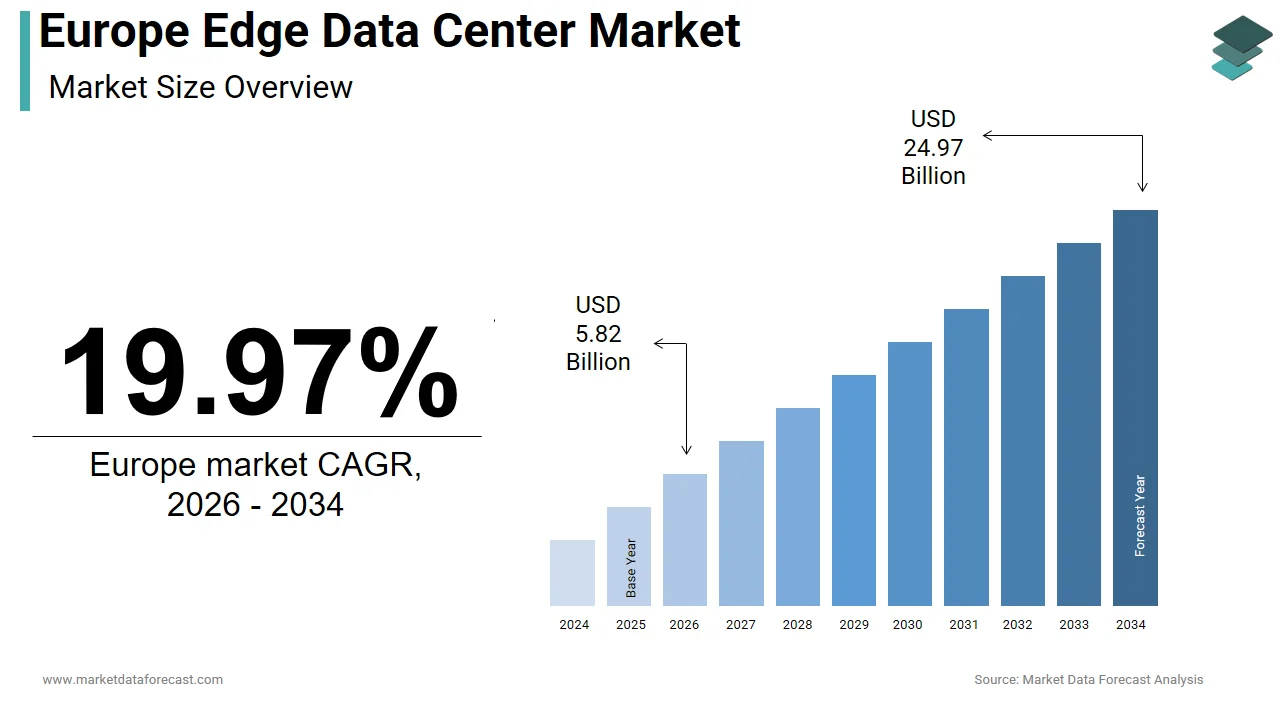
Edge data centers are computing facilities positioned in close physical proximity to end users and data sources to minimize latency and enable real-time data processing. Unlike traditional hyperscale facilities concentrated in major hubs, edge infrastructure is deployed at the network periphery to support applications demanding sub-10 millisecond response times. This architectural shift is being propelled by the proliferation of latency-sensitive use cases such as autonomous vehicle coordination, industrial IoT monitoring, and immersive telemedicine. According to the European Telecommunications Standards Institute, a notable portion of European mobile network operators had activated 5G standalone networks with edge compute integration by the end of 2024, which is creating native demand for localized infrastructure. As per the European Environment Agency, a substantial percentage of the continent’s population now resides in urban areas with densities exceeding 1500 persons per square kilometer, which is intensifying the need for decentralized computing to manage data deluge without overburdening core networks. Regulation increasingly compels data localization, further anchoring edge deployment within national boundaries. These converging technical, regulatory, and demographic forces define the strategic rationale for edge data centers beyond conventional capacity metrics.
MARKET DRIVERS
Proliferation of 5G Standalone Networks Creates Native Demand for Edge Compute
The rollout of 5G standalone networks across Europe has embedded edge computing as a foundational layer of next-generation telecom architecture, which is directly catalyzing infrastructure deployment and is driving the growth of the edge data center market in Europe. Unlike non-standalone 5G, which relies on legacy 4G cores, standalone networks utilize cloud native cores that can be distributed to the edge to enable network slicing ultra ultra-reliable low latency communication, and precise time synchronization. According to the Global Mobile Suppliers Association (GSA), more than 115 operators across 52 countries or territories had invested in public 5G Standalone (5G SA) networks by mid-2023. The International Telecommunication Union’s IMT-2020 standard sets a 1 ms user-plane latency target (and a control-plane latency of 20 ms) for ultra-reliable low-latency communications, which is relevant to applications such as remote robotic surgery. For example, a latency of 1 ms is cited as critical in providing haptic feedback to a surgeon via a mobile connection. The regulatory environment in Germany shows increasing interest in industrial 5G private networks, and market commentary notes Germany’s leadership in private 5G adoption due to the industrial demand and spectrum allocations. Collectively, these technical, regulatory, and demographic forces define the strategic rationale for edge-data-centre deployment beyond conventional capacity metrics.
Industrial Digitalization Under EU Smart Factory Initiatives Fuels On-Premise Edge Adoption
The aggressive industrial digital transformation agenda of Europe is compelling manufacturers to deploy edge data centers directly within production environments to enable real-time analytics and autonomous control, which is further boosting the edge data center market expansion in Europe. According to the European Commission’s program for digitalisation in industry, 75 % of EU companies are expected to use cloud computing, big data analysis, or artificial intelligence by 2030. These applications generate large volumes of sensor data per hour that cannot be efficiently routed to centralized clouds due to bandwidth constraints and latency sensitivity. According to the International Energy Agency, respondents estimated that about 13% of unplanned downtime can be reduced through efficiency measures, which underscores the value of localised compute. The convergence of productivity imperatives, regulatory compliance, and data-sovereignty concerns solidifies industrial edge infrastructure as a structural growth vector and contributes to the edge data center market expansion in Europe.
MARKET RESTRAINTS
Stringent Urban Zoning and Environmental Permitting Delays Deployment
The deployment of edge data centers in Europe faces significant regulatory headwinds due to stringent municipal zoning laws and environmental impact assessments, particularly in densely populated urban cores where latency reduction is most critical, which is one of the major restraints to the growth of this regional market. Unlike standardized telecom cabinets, edge facilities often exceed local thresholds for noise heat emission or electrical load, triggering complex permitting processes. According to the European Urban Knowledge Network, a survey of major European cities revealed that many require full environmental-impact assessments for any facility drawing more than 50 kilowatts of continuous power. These applications generate terabytes of sensor data per hour that cannot be efficiently routed to centralized clouds due to bandwidth constraints and latency sensitivity. For example, a proposed edge-site near the business district faced a lengthy administrative review in Paris due to concerns over transformer hum and visual impact. Similarly, Amsterdam’s sustainability code mandates that all new electrical infrastructure demonstrate carbon neutrality over its lifecycle, which effectively requires on-site renewable integration that complicates micro-facility design. Collectively, these localized regulatory barriers fragment the market and inflate soft costs, which are significantly slowing time-to-revenue and restraining the market growth in Europe.
Limited Availability of Skilled Technicians for Distributed Maintenance
The geographically dispersed nature of edge data centers across Europe exacerbates operational challenges due to a chronic shortage of qualified field technicians capable of maintaining advanced IT and cooling systems in remote or non-traditional locations, which is further impeding the growth of the European market. Unlike hyperscale facilities that employ in-house engineering teams, edge nodes often rely on third-party service providers for hardware replacement, firmware updates, and thermal management. According to Cedefop’s Labour & Skills Shortage Index in January 2025, many ICT technician occupations in Europe are experiencing intense shortages, with numerous Member States ranked at level 4. For instance, studies project that between 2018 and 2030, there will be around 673,000 job openings in ICT technician positions in Poland due to growth and workforce exits, highlighting availability pressures. This scarcity forces operators to dispatch technicians from central hubs, increasing mean time to repair, which is a critical metric for edge sites supporting autonomous systems, where ENISA implementation guidance notes acceptable downtime for high-criticality systems is “up to 2 hours” per month. Compounding the issue, the European Qualifications Framework lacks standardized certification for edge-specific competencies such as modular power distribution or remote-hands protocols, which is creating inconsistency in service quality.
MARKET OPPORTUNITIES
Railway and Port Digitalization Programs Offer High-Impact Edge Nodes
The strategic infrastructure modernization initiatives of Europe in transportation corridors present a high-value opportunity for edge data center deployment due to the convergence of data-intensive regulatory mandates and physical real estate availability. The Shift2Rail programme is driving digitalisation of Europe’s railways with an estimated €18 billion investment planned between 2028 and 2034 to support rail system innovation. These systems require localized compute to process data from track-side sensors and train telemetry with stringent latency requirements. Likewise, digital rail initiatives under the European Union Agency for Railways emphasise integration of advanced digital and automatic train operations (ATO/GoA) to boost reliability and capacity. These captive use cases offer long-term anchor tenancy, reduced site acquisition complexity, and alignment with EU cohesion funding streams, which are creating a durable pipeline beyond speculative urban builds and propelling the growth of the European edge data center market.
Rural Healthcare Modernization Drives Edge Adoption in Underserved Regions
The Digital Europe Programme of the European Commission is accelerating the deployment of edge data centers in rural and peri-urban healthcare settings to enable latency-sensitive telemedicine and diagnostic imaging services where broadband backhaul is limited. Under Directive 2011/24/EU on cross-border healthcare, EU Member States must support continuity of care across borders via digital health services. According to the European Commission’s 2024 eHealth Indicator Study, the EU-27 average for the thematic layer “access technology and coverage” reached 80 % in 2023. These applications, such as on-site AI analysis of medical imaging, generate large volumes of sensor and image data requiring localized compute due to latency and bandwidth constraints. The convergence of publicly-funded health-digitization mandates, strict data-residency requirements, and growing digital-health adoption creates a non-discretionary demand vector perfectly aligned with edge-data-centre capabilities.
MARKET CHALLENGES
Thermal Management Complexity in Dense Urban Micro Sites
The physical constraints of urban edge deployments in Europe intensify thermal-management challenges due to limited space for conventional air-cooling and rising ambient temperatures from climate change, which is a major obstacle to regional market growth. Many edge cabinets are installed in basements, street cabinets, or repurposed utility closets where airflow is restricted and heat-dissipation capacity is marginal. According to the European Environment Agency, European land temperatures have increased by about 2.2 °C to 2.3 °C over recent decades. Liquid-cooling is often impractical due to plumbing requirements and municipal restrictions on water usage. Therefore, operators must resort to more expensive alternatives and thereby increase capital expenditure for micro-facilities. Without standardized thermal-design guidelines for micro edge facilities, reliability risk will persist, especially as power densities exceed 30 kW per rack.
Fragmented Data Sovereignty Requirements Across Member States
The absence of harmonized data residency interpretations across European Union member states creates operational complexity for pan-European edge data center operators who must navigate divergent national implementations of the General Data Protection Regulation, which is further challenging the European edge data center market expansion. While the GDPR provides a common framework, its application to real-time data processing varies significantly. For example, Germany’s Federal Data Protection Act (BDSG) places stricter requirements on biometric data processing than some other Member States. According to the European Data Protection Board (EDPB) Annual Report 2024, strengthening effective and consistent application of data-protection law remains a key priority in its strategy for 2024–2027. This regulatory patchwork forces operators to duplicate infrastructure across borders even in contiguous service areas, which is undermining architectural efficiency and increasing capital intensity. Consequently, operators face increased cost and complexity, which can erode the economic rationale for continental-scale edge-data-centre networks.
REPORT COVERAGE
| REPORT METRIC | DETAILS |
| Market Size Available | 2025 to 2034 |
| Base Year | 2025 |
| Forecast Period | 2026 to 2034 |
| Segments Covered | By Component, Facility Type, Industry, and County. |
| Various Analyses Covered | Global, Regional, and Country-Level Analysis, Segment-Level Analysis, Drivers, Restraints, Opportunities, Challenges; PESTLE Analysis; Porter’s Five Forces Analysis, Competitive Landscape, Analyst Overview of Investment Opportunities |
| Countries Covered | UK, France, Spain, Germany, Italy, Russia, Sweden, Denmark, Switzerland, Netherlands, Turkey, Czech Republic, and the Rest of Europe. |
| Market Leaders Profiled | Acromove Inc., American Tower Corporation, AtlasEdge Data Centres, DartPoints, Dell Technologies, DXN, Hewlett Packard Enterprise, Open Access Data Centres (WIOCC Group), Proximity Data Centres (nLighten), Vertiv Holdings Co., Zenlayer Inc., EdgeConneX Inc., and Others. |
SEGMENTAL ANALYSIS
By Component Insights
The solutions segment captured the most significant share of the European edge data center market in 2025. The growth of the solutions segment in the European market is attributed to the foundational requirement for physical and virtual infrastructure to enable distributed computing at the network edge. The solutions segment thrives due to the non-negotiable need for purpose-built hardware and edge-optimized software stacks that can operate reliably in constrained environments. Edge deployments demand ruggedized servers, modular power systems, and lightweight virtualization layers capable of functioning with intermittent connectivity. According to ETSI, many European private 5G network implementations increasingly rely on integrated edge solution stacks from single vendors to ensure compatibility and reduce integration risk. Industrial use cases further amplify this need as Siemens has reported that a large proportion of European manufacturers favour turnkey edge-appliance solutions with pre-certified hardware and embedded analytics software to avoid custom engineering. Additionally, the EU’s Cyber Resilience Act mandates that hardware and software products with digital elements must incorporate security-by-design and other cybersecurity features and thereby increasing demand for certified integrated solutions. Vendors have responded by offering hardened edge appliances with pre-loaded containerised applications to address the combination of regulatory and operational requirements, which is majorly driving the dominance of the solutions segment in the European market.
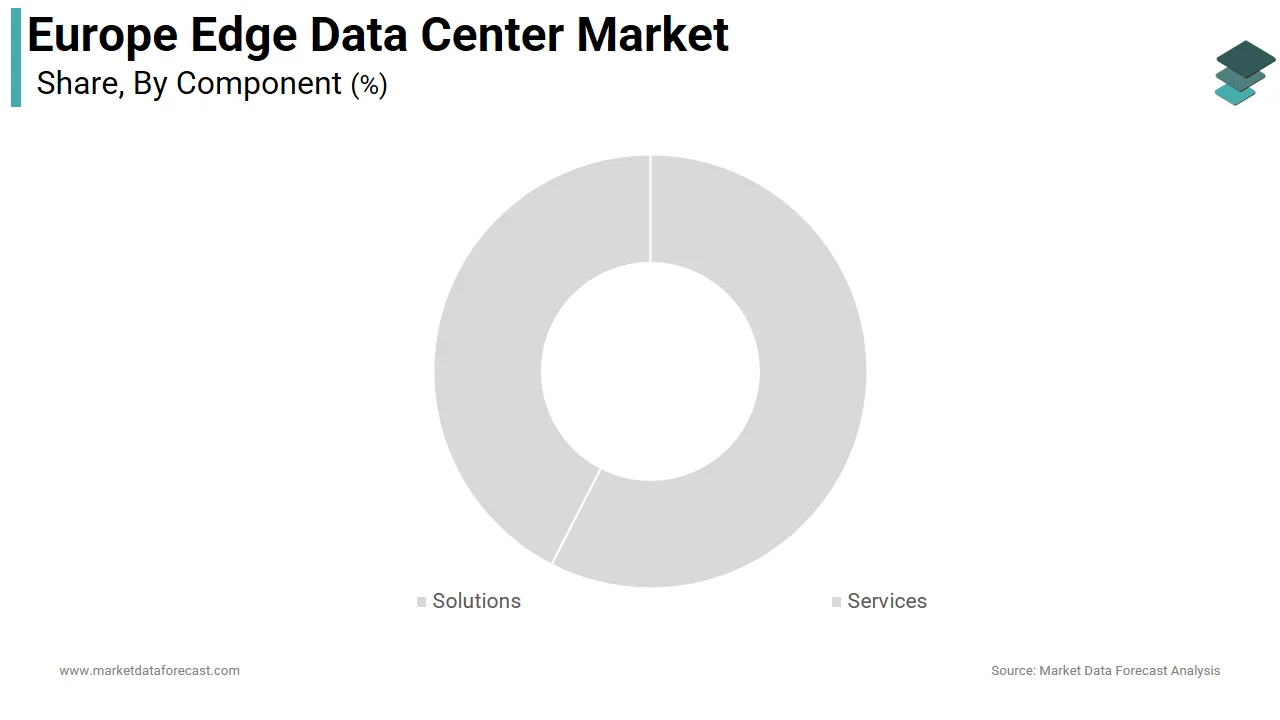
The services segment is the fastest-growing component in the Europe edge data center market and is projected to expand at a CAGR of 25.5% over the forecast period due to the rising operational intricacies of managing geographically dispersed micro facilities across diverse regulatory and environmental conditions. Unlike centralized data centers, edge nodes often lack on-site IT staff, necessitating managed services for remote monitoring, firmware updates, and predictive maintenance. In 2024, BT announced a pan-European edge managed service for a major logistics client, leveraging AI-driven anomaly detection to help preempt hardware failures. Similarly, as per the European Data Centre Association, a growing proportion of edge-operators now outsource at least one critical operational function. The EU’s Digital Operational Resilience Act also places new obligations on operators in sectors such as finance and energy to maintain robust controls over third-party IT providers, thereby creating sustained demand for certified managed and professional services. This convergence of technical necessity and regulatory compliance is driving the expansion of the services segment in the European edge data center market.
By Facility Type Insights
The small and medium facility segment dominated the market by holding the largest share of the European market in 2025. The growth of the small and medium facility management segment is driven by the architectural logic of edge computing that prioritizes proximity over scale. Small and medium edge facilities typically ranging from 50 to 500 square meters are ideally suited for deployment in cell towers, transport hubs, retail stores, and factory floors, which is where physical closeness to end users or sensors is paramount. According to the International Telecommunication Union, certain applications require extremely low latency to function effectively. In Germany, the Federal government has documented that 5G infrastructure coverage has reached about 92% of the country, which is reinforcing the readiness for localised network deployment. Similarly, the European Railway Agency mandates real-time trackside data processing for its European Rail Traffic Management System, which favours edge-based cabinets along rail corridors rather than relying solely on centralised clouds. Urban density further reinforces this trend. According to Eurostat, more than two-thirds of the EU population live in urban areas, many of which face land scarcity and zoning rules that favour compact modular units over large builds. This alignment between application requirements, urban constraints, and regulatory mandates is significant to the dominance of the small and medium facility segment in the European market.
The large edge facility segment is predicted to witness a CAGR of 29.5% over the forecast period in the European market, owing to the emergence of metropolitan aggregation points that serve as regional edge hubs consolidating traffic from dozens of micro sites. Telecom operators such as Orange and Deutsche Telekom are repurposing legacy central offices in secondary cities into large edge facilities to support distributed cloud regions for hyperscalers. In recent years, Microsoft has expanded its edge-computing infrastructure across Europe, including new deployments intended to bring cloud and AI workloads closer to end users in key metropolitan areas. The European Commission’s Digital Europe Programme provides substantial funding to advance Europe’s digital infrastructure and sovereignty, which is supporting projects to reuse public-sector facilities for cloud or edge-computing use. These large-scale edge nodes help balance geographic proximity to users with economies of scale, and present a hybrid model that spans between hyperscale data centres and small micro-edge deployments and driving the growth of the large segment in the European market.
By Industry Insights
The IT and telecom segment occupied 48.4% of the European market share in 2024. The leading position of the IT and telecom segment in the European market is attributed to the native integration of edge as a network layer rather than an add-on application. Telecom operators and cloud providers are the primary architects of edge infrastructure in Europe as they embed compute directly into their 5G and fiber network evolution strategies. Unlike other industries that adopt edge to enhance existing processes, IT and telecom entities build edge as a core service offering. According to GSMA Intelligence research, European mobile operators are significantly expanding the deployment of multi-access edge computing nodes due to the enterprise demand for low-latency and distributed infrastructure. The European Commission’s Gigabit Society target, which mandates full 5G coverage in all urban areas and major transport corridors by 2025, further compels this build-out. Additionally, hyperscalers such as AWS and Google Cloud are partnering with local telcos to deploy regional edge zones across Europe. This foundational role of edge infrastructure ensures that IT and telecommunications remain a primary demand engine in the digital-infrastructure ecosystem and is driving the dominance of the IT and telecom segment in the European market.
The healthcare segment is anticipated to register the fastest CAGR of 36.6% over the forecast period in the European market, owing to the regulatory mandates for real-time diagnostics data sovereignty and rural care equity. The EU’s Cross-Border Health Care Directive encourages member states to enable digital healthcare services across borders rather than mandating diagnostic infrastructure in all public hospitals by 2026. Centralised cloud processing may struggle for time-critical applications such as acute stroke diagnosis from CT scans, where imaging and analysis need to be completed very rapidly. Some hospitals in Sweden have adopted local edge-computing nodes to support AI-powered radiology within rural clinics, which retain data locally in line with General Data Protection Regulation (GDPR) requirements. In France, national health-insurance initiatives are exploring the conversion of remote-facility diagnostics suites equipped for edge computing. The convergence of clinical urgency, regulatory compliance, and public funding creates a strong adoption momentum for distributed and near-edge infrastructure, which is propelling the growth of the healthcare segment in the European edge data center market.
COUNTRY LEVEL ANALYSIS
Germany Edge Data Center Market Analysis
Germany commanded the leading share of 26.2% of the regional market in 2024. The dominance of Germany in the European market is majorly driven by the confluence of industrial digitalization, mandates dense urban infrastructure, and a proactive 5G policy. Germany’s Industrial Strategy 2030 targets full digitisation of manufacturing, building on its strong industrial base. According to industry data, Germany’s telecommunications sector invested around €13.6 billion in 2023, with a significant portion directed towards 5G and private network infrastructure. While many large factories are deploying private 5G networks that in turn require on-site edge compute. The federal Bundesnetzagentur (Federal Network Agency) has called for streamlining permitting for digital and network infrastructure. Germany hosts advanced industrial-edge ecosystems, with native vendors such as Siemens, Bosch, and SAP offering integrated industrial-edge platforms. This blend of policy support, industrial demand, and domestic technological capability is propelling the dominance of Germany in the European edge data center market.
United Kingdom Edge Data Center Market Analysis
The United Kingdom held the second-largest share of the European edge data center market in 2024. The growth of the UK is driven by a mature telecom regulatory framework that incentivizes infrastructure sharing and edge service innovation. BT and Vodafone have deployed many multi-access edge computing sites across major UK cities and transport corridors under the UK’s Shared Rural Network (SRN) initiative. The government’s National AI Strategy allocates hundreds of millions of pounds toward establishing sovereign AI-inference hubs at the edge, with a number already operational in cities such as Manchester, Edinburgh, and Bristol. The UK’s departure from the EU has also increased interest in data-localisation as financial-services firms are growing more attentive to keeping real-time data processing within national borders. This combination of regulatory clarity, public investment, and post-Brexit data-sovereignty concerns creates a fertile environment for continued edge-infrastructure expansion in the UK.
France Edge Data Center Market Analysis
France is projected to hold a prominent share of the Europe edge data center market over the forecast period, owing to its national cloud sovereignty agenda and aggressive 5G rollout in industrial zones. The France Relance recovery plan is supporting the development of trusted cloud and edge infrastructure under France’s sovereign cloud strategy with public funding aimed at enhancing regional digital capability and data sovereignty. Telecom regulator ARCEP is encouraging the deployment of private and industrial 5G networks and trials for enterprise use-cases, which is enabling factories and other verticals to access edge compute capability within network deployments. In parallel, France’s healthcare system is accelerating the digitisation of diagnostics and aims to enhance infrastructure in hospitals and remote clinics with low-latency compute and local data retention. Together, the alignment of government policy, industrial demand, and telecom ecosystem creates a strong tailwind for edge-infrastructure expansion in France.
Italy Edge Data Center Market Analysis
Italy is expected to account for a notable share of the Europe edge data center market during the forecast period, owing to the urgent grid modernization, smart city initiatives, and port digitalization. Italy’s national recovery plan under Mission 1 allocates significant funding to digitalisation, innovation, and competitiveness, including infrastructure for the production, energy, and transport sectors. The plan supports the deployment of edge-computing nodes in sectors such as energy substations and port logistics, as part of modernising critical infrastructure and enabling real-time applications. In parallel, regulatory reforms are underway to simplify zoning and permitting for edge and network infrastructure in utility corridors and urban deployments. Telecom operators and cloud providers are collaborating to roll out edge sites in major urban and transport hubs, which is supported by EU cohesion and digital transition funds. This coordinated public-private focus on infrastructure modernisation positions Italy as a rising southern hub for edge computing in Europe.
Sweden Edge Data Center Market Analysis
Sweden is estimated to hold a prominent position in the Europe edge data center market during the forecast period. The integration of edge computing with renewable energy and sustainable design in Sweden is majorly fuelling the market growth in this country. Sweden’s infrastructure policy sets ambitious climate goals, under which new edge deployments increasingly incorporate sustainability standards such as carbon neutrality in operation. For example, a demonstration project in Luleå uses a fuel-cell-powered data centre whose waste heat is fed into the local district-heating network. Meanwhile, Sweden’s industrial ecosystem, including companies like Northvolt and Hybrit, is pushing for fossil-free manufacturing, thereby creating demand for localised AI-inference at production facilities. With advanced decarbonised energy resources, robust industrial demand, and edge-infrastructure innovation working in tandem, Sweden stands out as a model for sustainable edge-deployment in Europe.
COMPETITIVE LANDSCAPE
The Europe edge data center market features a multifaceted competitive landscape blending global technology vendors, European industrial automation leaders, and specialized infrastructure providers. Competition centers on solution integration, reliability, regulatory alignment, and deployment speed rather than price alone. Major players differentiate through certified 5G industrial edge stacks, sovereign cloud partnerships, and sustainability credentials compliant with the EU taxonomy. Unlike hyperscale markets, where scale dictates advantageous edge competition rewards agility, local presence, and cross-vertical expertise. Telecom operators often act as both customers and channel partners, creating complex ecosystem dynamics. Regulatory fragmentation across member states further elevates the importance of compliance engineering and policy navigation capabilities. New entrants face high barriers due to certification requirements and entrenched vendor relationships in critical sectors such as energy transport and healthcare. Yet demand diversity across urban, rural, and industrial settings allows niche players to thrive alongside global giants, fostering a dynamic but consolidated contest where technical credibility and ecosystem integration determine success.
KEY MARKET PLAYERS
Some of the companies that are playing a dominating role in the Europe edge data center market include
- Acromove Inc. (U.S.)
- American Tower Corporation (U.S.)
- AtlasEdge Data Centres
- DartPoints
- Dell Technologies
- DXN
- Hewlett-Packard Enterprise
- Open Access Data Centres (WIOCC Group)
- Proximity Data Centres (nLighten)
- Vertiv Holdings Co
- Zenlayer Inc.
- EdgeConneX Inc.
TOP PLAYERS IN THE MARKET
- Dell Technologies is a pivotal contributor to the Europe edge data center market through its portfolio of ruggedized PowerEdge XE and XR server lines engineered for harsh edge environments. The company collaborates extensively with European telecom operators and industrial automation firms to deliver validated edge reference architectures that integrate compute, storage, and AI acceleration in compact form factors. In early 2025, Dell launched its Edge Management Solution, enabling centralized orchestration of distributed infrastructure across thousands of sites. It also partnered with Ericsson and Nokia to certify joint 5G edge stacks for smart manufacturing and transport use cases. By embedding zero-trust security and remote lifecycle management into its hardware, Dell strengthens operational resilience and regulatory compliance across EU member states, reinforcing its global leadership in enterprise edge infrastructure.
- Hewlett Packard Enterprise drives edge adoption in Europe through its Edgeline and ProLiant MicroServer platforms, tailored for space-constrained industrial and telecom deployments. The company actively participates in EU-funded initiatives such as the 5G PPP and AI4EU to co-develop sovereign edge solutions compliant with data governance standards. In 2024, HPE expanded its GreenLake for Edge-to-Cloud offering across Germany, France, and the Netherlands, enabling consumption-based provisioning of edge infrastructure with built-in sustainability metrics. It also established an Edge Innovation Lab in Munich focused on co-engineering with automotive and energy sector clients. Through tight integration of hardware silicon and as a service delivery, HPE enhances deployment speed and total cost predictability, positioning itself as a strategic partner in Europe’s distributed computing transformation.
- Vertiv plays a critical role in the Europe edge data center market by providing integrated power, thermal, and monitoring solutions for micro facilities in telecom and industrial settings. The company’s SmartAisle and Liebert ITA2 systems are widely deployed in edge cabinets across urban corridors and transport infrastructure. In 2024, Vertiv introduced its Edge Ecosystem Platform, featuring modular power distribution and AI-driven thermal tuning specifically designed for 5G base stations and smart factory nodes. It also formed a strategic alliance with Deutsche Telekom to co-develop standardized edge shelter designs compliant with German technical regulations. By focusing on infrastructure reliability, energy efficiency, and rapid deployment, Vertiv addresses core operational challenges in Europe’s fragmented edge landscape and extends its global influence in distributed critical infrastructure.
TOP STRATEGIES USED BY THE KEY MARKET PARTICIPANTS
Key players in the Europe edge data center market prioritize co-development of standardized reference architectures with telecom and industrial partners to accelerate solution validation and deployment. They integrate as service consumption models, such as infrastructure leasing and managed operations, to reduce upfront capital barriers for enterprise customers. Companies invest in localized R and D hubs to align hardware and software with EU regulatory requirements, including data sovereignty, cybersecurity, and environmental standards. They also pursue strategic alliances with national operators and public agencies to access infrastructure corridors and public funding streams. Additionally, they embed AI-driven remote management and predictive maintenance capabilities to address the operational complexity of geographically dispersed micro sites, ensuring uptime and regulatory compliance across diverse jurisdictions.
MARKET SEGMENTATION
This research report on the Europe edge data center market has been segmented and sub-segmented into the following categories.
By Component
- Solutions
- DCIM
- Power
- Cooling
- Network Equipment
- IT Racks and Enclosures
- Services
By Facility Type
- Small & Medium Facility
- Large Facility
By Industry
- IT & Telecom
- BFSI
- Gaming & Entertainment
- Government
- Healthcare
- Manufacturing
- Others (Transportation, Energy & Utilities)
By Country
- United Kingdom
- France
- Spain
- Germany
- Italy
- Russia
- Sweden
- Denmark
- Switzerland
- Netherlands
- Rest of Europe