- Product Description Description
- Table of Contents TOC
- List of Table & Figure LOT
- Get Free Sample PDF Sample PDF
Market Size, 2025
$13.31 BnMarket Estimate, 2026
$15.84 BnMarket Forecast, 2034
$63.69 BnCAGR, 2026–2034
19%Europe Cloud ERP Market Report Summary
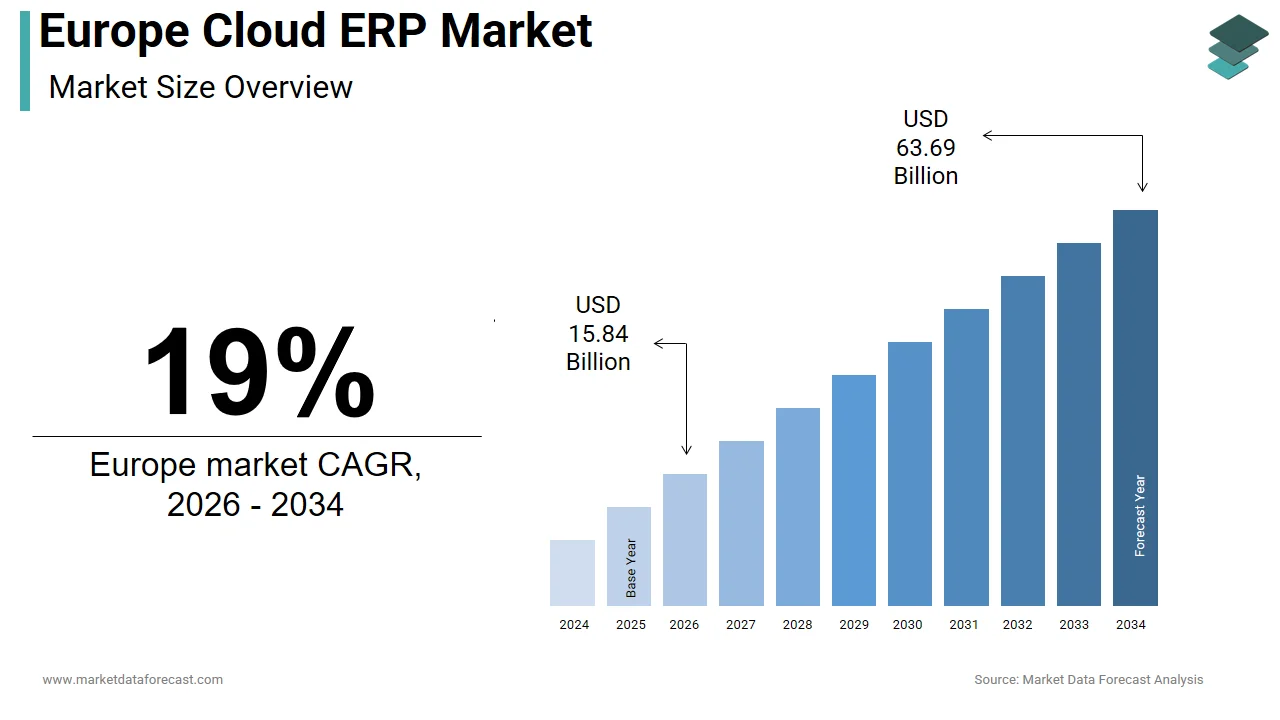
The Europe cloud ERP market was valued at USD 13.31 billion in 2025, is estimated to reach USD 15.84 billion in 2026, and is projected to reach USD 63.69 billion by 2034, growing at a CAGR of 19% from 2026 to 2034. Market growth is driven by the increasing adoption of cloud-based enterprise solutions, rising demand for real-time data access, and the need for integrated business process management across organizations. Cloud ERP solutions enable businesses to streamline operations, enhance scalability, and reduce IT infrastructure costs. The growing trend of digital transformation, increasing adoption among small and medium enterprises, and integration of advanced technologies such as AI and analytics are further accelerating the expansion of the cloud ERP market across Europe.
Key Market Trends
- Increasing adoption of cloud-based enterprise resource planning solutions.
- Rising demand for real-time data access and integrated business operations.
- Growing adoption of ERP solutions among small and medium enterprises (SMEs).
- Expansion of AI, analytics, and automation in ERP platforms.
- Increasing focus on compliance, security, and data-driven decision-making.
Segmental Insights
- Based on business function, the finance and accounting segment dominated the Europe cloud ERP market by capturing 38.2% share in 2025, driven by the need for financial transparency and regulatory compliance.
- Based on organization size, the large enterprises segment led the market by accounting for 59.1% share in 2025, supported by higher IT spending and large-scale digital transformation initiatives.
- Based on vertical, the manufacturing segment held the largest share in 2025, driven by the need for efficient supply chain management, production planning, and operational optimization.
Regional Insights
The Europe cloud ERP market is witnessing strong growth across major countries due to increasing enterprise digitalization and adoption of cloud technologies.
-
Germany led the regional market in 2025 with 28.48% share, supported by its strong industrial base and early adoption of enterprise software solutions.
-
The United Kingdom ranked second with 19.7% share in 2025, driven by a mature IT ecosystem and strong adoption of cloud-based enterprise applications.
-
France holds a significant position in the market due to its strong public administration and manufacturing sectors, which drive demand for compliant and scalable ERP solutions.
Competitive Landscape
The Europe cloud ERP market is highly competitive, with the presence of global enterprise software providers and regional solution vendors. Market players are focusing on enhancing cloud capabilities, integrating advanced analytics and AI features, and expanding industry-specific ERP solutions. Strategic partnerships, product innovation, and investments in cloud infrastructure are shaping competitive dynamics across the region.
Prominent companies operating in the Europe cloud ERP market include ACUMATICA, INC., Epicor Software Corp, Infor Inc., Microsoft Corp, Oracle Corp, Sage Group Plc, SAP SE, SYSPRO Proprietary Ltd, Unit4 Group Holding BV, and Workday Inc.
Europe Cloud ERP Market Size
The size of the Europe cloud ERP market was worth USD 13.31 billion in 2025. The regional market is anticipated to grow at a CAGR of 19% from 2026 to 2034 and be worth USD 63.69 billion by 2034 from USD 15.84 billion in 2026.
Cloud ERP (Enterprise Resource Planning) is a type of enterprise software that allows organisations to manage their core business processes, such as finance, HR, supply chain, and sales, through a single, integrated platform hosted on the internet. These systems facilitate real-time data access and streamline operations for diverse industries ranging from manufacturing to retail. The adoption landscape is heavily influenced by the region's dense small and medium enterprise sector, which constitutes 99% of all businesses, according to the European Commission. Digital intensity varies significantly across member states, with northern nations leading the transformation. Eurostat indicates that 45.2% of enterprises in the European Union purchased cloud computing services in 2023, an increase from 41% in 2021. By 2025, this adoption rate further climbed to 52.7%, with adoption significantly higher among large enterprises (84.7%) compared to small businesses (49.3%). This shift is driven by the need for scalability and reduced infrastructure costs. The regulatory environment plays a crucial role in shaping deployment strategies. Organizations prioritize solutions that align with local data protection laws while ensuring seamless cross-border functionality. The market is not merely about software migration but represents a fundamental change in operational architecture. Businesses seek agility to respond to economic fluctuations and supply chain disruptions. As digital sovereignty becomes a priority, the demand for localized data centers increases. This ecosystem supports innovation through integrated modules for finance and human resources. The transition reflects a broader commitment to modernizing industrial capabilities within the region. Furthermore, the European Digital Strategy aims to ensure that by 2030, all key public services are available online. This governmental push creates a conducive environment for private sector adoption of enterprise resource planning tools. Consequently, the infrastructure supporting these digital frameworks continues to expand rapidly across the union.
MARKET DRIVERS
Government-led Digital Transformation Initiatives Accelerate Adoption
Public sector mandates across the region are compelling organizations to modernize their technological infrastructure, which directly fuels the growth of the Europe cloud ERP market. The European Union has established rigorous digital targets that require businesses to enhance their operational transparency and efficiency. These regulations necessitate robust data handling capabilities that on-premises systems often struggle to provide efficiently. Governments are incentivizing digital upgrades through grants and tax benefits, which lowers the barrier to entry for smaller firms. For instance, the Digital Europe Programme allocates billions of euros to support digital capacity building across member states. This financial backing encourages companies to transition from legacy systems to flexible cloud-based architectures. The push for interoperability between public and private sectors further necessitates standardized software solutions. Companies must ensure their financial and operational data can be shared securely with regulatory bodies. This requirement drives the selection of compliant cloud ERP vendors who understand local legal frameworks. The cumulative effect of these policies creates a sustained demand cycle. Organizations view compliance not just as an obligation but as a competitive advantage. Consequently, the market experiences consistent growth driven by regulatory necessity rather than optional upgrades. This structural shift ensures long term stability for cloud ERP providers operating within the region.
Rising Prevalence of Remote Work Models Drives Flexibility Needs
The structural shift towards distributed workforces has fundamentally altered how European companies manage their internal processes and resources, which further contributes to the expansion of the Europe cloud ERP market. Post-pandemic data shows that a portion of workers in the European Union engaged in telework. This dispersion requires management tools that are accessible from any location without compromising security or performance. Cloud enterprise resource planning systems provide the necessary infrastructure to support decentralized teams effectively. Employees need real-time access to inventory and financial data regardless of their physical office presence. Traditional software tied to specific hardware limits operational continuity in a hybrid work environment. Organizations are prioritizing solutions that enable seamless collaboration across different time zones and countries. The demand for mobile accessibility has surged as managers require oversight while traveling or working from home. Vendors are responding by enhancing user interfaces for mobile devices and ensuring offline capabilities. This trend is particularly strong in service-oriented sectors where workforce mobility is high. The ability to scale user licenses up or down based on remote staff fluctuations is another critical factor. Companies avoid the capital expenditure of physical servers, which aligns with the variable nature of remote work arrangements. As remote work becomes a permanent fixture, the reliance on cloud-based management tools solidifies. This behavioral change ensures that flexibility remains a primary purchasing criterion for decision makers.
MARKET RESTRAINTS
Stringent Data Privacy Regulations Create Compliance Complexities
The General Data Protection Regulation imposes rigorous standards on how personal data is stored and processed, which acts as a significant barrier for some organizations within the Europe cloud ERP market. Non-compliance can result in fines. This financial risk makes companies hesitant to migrate sensitive information to external cloud servers. Many enterprises fear losing direct control over data sovereignty when utilizing third-party providers. The complexity of ensuring that cloud vendors adhere to every local nuance of privacy law slows down adoption rates. Organizations must conduct extensive audits before signing contracts, which increases the time and cost of implementation. Some industries, such as healthcare and finance, face even stricter rules regarding data residency. These sectors often prefer keeping critical data on premise to mitigate perceived risks. The fragmentation of laws across different European nations adds another layer of difficulty for multinational corporations. A solution compliant in Germany might require adjustments to meet standards in France. This lack of uniformity forces vendors to maintain multiple configurations, which drives up prices. Consequently, smaller businesses may find compliant cloud enterprise resource planning solutions prohibitively expensive. The fear of data breaches, coupled with heavy penalties, creates a cautious approach among IT leaders. This regulatory landscape necessitates continuous monitoring and adaptation, which strains internal resources.
Integration Challenges with Existing Legacy Infrastructure Hinder Migration
Many established European companies operate on decades-old software systems that are deeply embedded in their daily workflows, and thereby impede the expansion of the Europe cloud ERP market. Replacing these entrenched systems with modern cloud enterprise resource planning solutions involves significant technical risk and operational disruption. The financial burden leaves limited resources available for innovation and cloud migration projects. The process of transferring historical data from old formats to new cloud architectures is often prone to errors. Downtime during the transition phase can lead to substantial revenue loss, which discourages leadership from approving upgrades. Customizations made to old systems over the years are difficult to replicate in standardized cloud environments. Employees resist change when familiar tools are replaced, requiring extensive retraining programs. The lack of skilled personnel who understand both legacy code and modern cloud platforms exacerbates the issue. Integration APIs may not function correctly with outdated hardware, causing performance bottlenecks. Companies worry about business continuity during the migration period, which can last several months. This inertia keeps many organizations tied to inefficient on-premises solutions despite the known benefits of cloud technology. The technical debt accumulated over the years creates a formidable wall against modernization efforts. Overcoming these hurdles requires careful planning and significant investment, which many firms delay indefinitely.
MARKET OPPORTUNITIES
Integration of Artificial Intelligence Enhances Predictive Capabilities
The convergence of artificial intelligence with cloud enterprise resource planning opens new avenues for operational efficiency and strategic decision making, which is likely to propel the growth of the Europe cloud ERP market. Machine learning algorithms can analyze vast datasets to forecast demand and optimize inventory levels automatically. The technological advancement allows European businesses to move from reactive management to a proactive strategy. Automated processes reduce manual errors in accounting and human resources departments significantly. Predictive maintenance features help manufacturing firms prevent equipment failures before they occur. The ability to process unstructured data provides deeper insights into customer behavior and market trends. Vendors are increasingly offering intelligent assistants that help users navigate complex software interfaces. This reduces the learning curve and improves overall user adoption rates within organizations. Smart analytics enable real-time adjustments to supply chain disruptions, which is crucial in volatile markets. Companies can simulate various business scenarios to assess potential risks and outcomes accurately. The competitive advantage gained through data-driven insights justifies the investment in advanced cloud solutions. As AI technology matures, the cost of implementation is expected to decrease. This accessibility will allow smaller enterprises to leverage powerful tools previously reserved for large corporations. The synergy between AI and cloud ERP represents a transformative opportunity for the region.
Expansion into Emerging Economies Within Eastern Europe
Western European markets are becoming saturated, pushing vendors to seek growth in Eastern European regions, which is expected to provide fresh prospects for the expansion of the Europe cloud ERP market. Countries like Poland and Romania are experiencing rapid digitalization and economic growth, according to sources. These emerging economies have a growing base of small and medium enterprises seeking modern management tools. The cost of labor and operations in these regions is lower, which attracts foreign direct investment. Multinational corporations setting up offices here require standardized cloud enterprise resource planning systems. Local businesses are also upgrading from manual processes to digital solutions to compete globally. Government initiatives in these nations are improving internet infrastructure and digital literacy rates. The penetration of cloud services is lower compared to Western Europe, indicating significant room for growth. Vendors can offer localized versions of their software to meet specific regional needs. Currency fluctuations and economic volatility in these areas create a need for robust financial planning tools. The younger workforce in Eastern Europe is more adaptable to new technologies than older demographics. This demographic dividend facilitates faster adoption of innovative software solutions. Strategic partnerships with local distributors can help navigate cultural and linguistic barriers. Tapping into this underserved market segment offers a high return on investment for providers. The expansion strategy diversifies revenue streams and reduces dependence on mature markets.
MARKET CHALLENGES
Escalating Cybersecurity Threats Target Cloud Infrastructure
The centralized nature of cloud enterprise resource planning systems makes them attractive targets for malicious actors and cybercriminals, which poses a serious challenge to the Europe cloud ERP market. Data breaches can expose sensitive financial and personal information, leading to severe reputational damage. According to research, the number of reported security incidents in the European Union increased in the last year. Ransomware attacks specifically targeting enterprise software have become more sophisticated and frequent. Companies must invest heavily in security protocols to protect their cloud environments from unauthorized access. The shared responsibility model often causes confusion regarding who is liable for specific security measures. Clients assume the provider handles everything while providers expect clients to manage user access controls. This gap in understanding creates vulnerabilities that hackers exploit to gain entry into systems. The cost of recovering from a cyberattack includes not just technical fixes but also legal fees and fines. Business operations can halt completely during a security incident, causing massive financial losses. Trust is difficult to regain once a breach occurs, which affects customer loyalty significantly. Vendors are under pressure to continuously update their defense mechanisms against evolving threats. The complexity of securing multi-tenant environments adds another layer of difficulty for providers. Ensuring end-to-end encryption without compromising performance remains a technical hurdle. This persistent threat landscape requires constant vigilance and resource allocation from all stakeholders.
Shortage of Skilled Professionals to Manage Cloud Systems
There is a critical lack of qualified personnel capable of implementing and maintaining complex cloud enterprise resource planning solutions. This shortage holds back the expansion of the Europe cloud ERP market. The European Commission emphasizes that there is a shortage of ICT specialists across the union. This gap limits the ability of companies to fully utilize the features of their purchased software. Without expert management, cloud systems may be configured incorrectly, leading to inefficiencies and security risks. Training existing staff requires time and money, which strains operational budgets significantly. Universities and training programs are struggling to keep pace with the rapid evolution of cloud technologies. The talent competition is fierce, with large tech firms offering higher salaries than traditional industries. Small and medium enterprises find it particularly difficult to attract and retain skilled IT managers. This scarcity drives up the cost of consulting services needed for implementation and support. Projects often face delays because qualified experts are unavailable to start work immediately. The reliance on external vendors for management reduces internal control over critical business processes. Knowledge transfer becomes problematic when external consultants leave the project after deployment. Companies risk vendor lock-in if they lack internal expertise to switch providers later. Addressing this workforce deficit requires coordinated efforts between industry and educational institutions. Until the skill gap is closed, adoption rates may remain below potential levels.
REPORT COVERAGE
| REPORT METRIC | DETAILS |
| Market Size Available | 2025 to 2034 |
| Base Year | 2025 |
| Forecast Period | 2026 to 2034 |
| Segments Covered | By Business Function, Organization Size, Vertical, and Country. |
| Various Analyses Covered | Global, Regional, and Country-Level Analysis, Segment-Level Analysis, Drivers, Restraints, Opportunities, Challenges; PESTLE Analysis; Porter’s Five Forces Analysis, Competitive Landscape, Analyst Overview of Investment Opportunities |
| Countries Covered | UK, France, Spain, Germany, Italy, Russia, Sweden, Denmark, Switzerland, Netherlands, Turkey, Czech Republic, and the Rest of Europe. |
| Market Leaders Profiled | Acumatica, Inc., Epicor Software Corp., Infor Inc., Microsoft Corp., Oracle Corp., Sage Group Plc, SAP SE, SYSPRO Proprietary Ltd., Unit4 Group Holding BV, Workday Inc., and Others. |
SEGMENT ANALYSIS
By Business Function Insights
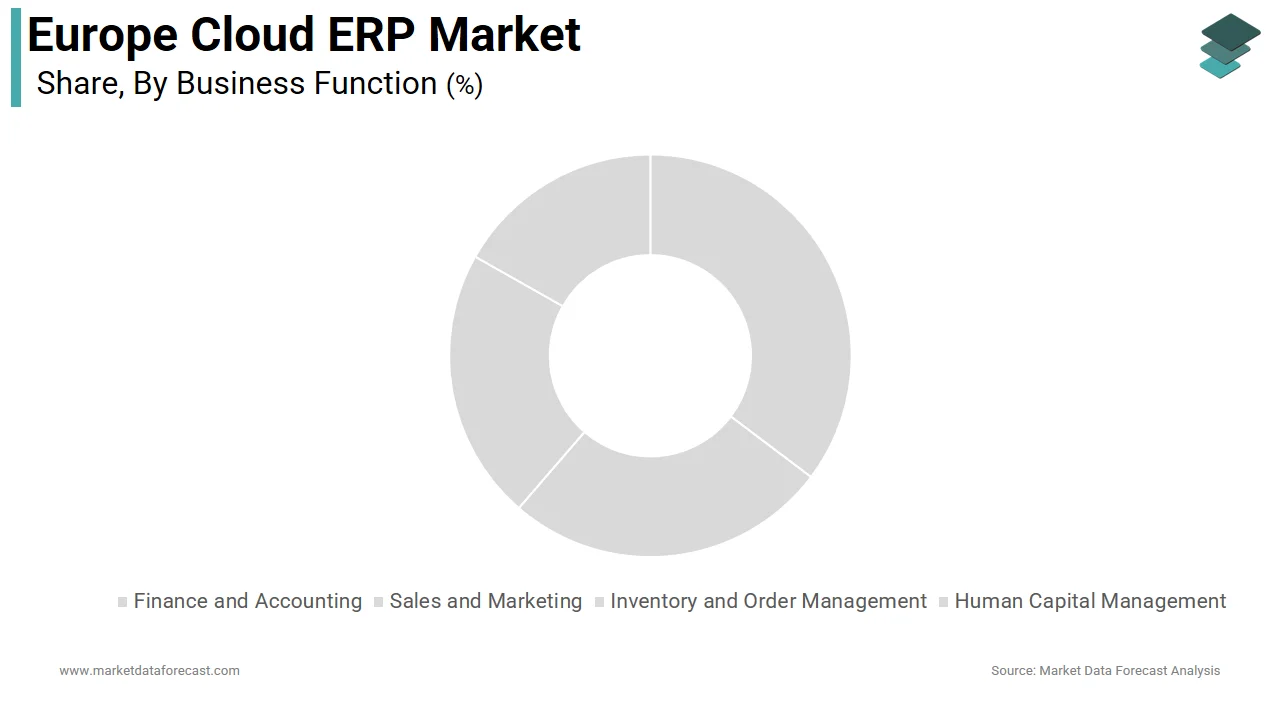
The finance and accounting segment was the largest segment in the Europe Cloud ERP Market and occupied a share of 38.2% in 2025. This position of the segment is due to the fundamental role financial management plays in organizational governance and regulatory compliance. European enterprises prioritize accurate financial reporting to meet stringent standards set by the European Central Bank and national authorities. The integration of real-time consolidation capabilities within cloud platforms enables multinational corporations to manage cross-border transactions efficiently. Cloud-based finance modules provide seamless integration with tax calculation engines that adapt to varying national VAT regulations across member states. The ability to generate audit-ready reports with minimal human intervention reduces compliance costs significantly. Organizations also benefit from predictive cash flow analytics that support strategic decision-making during economic volatility. The centralized nature of cloud finance systems facilitates transparency across subsidiaries, which aligns with growing investor expectations for ESG disclosures. Furthermore, the subscription-based pricing model allows companies to scale financial modules according to sources. This flexibility, combined with robust security protocols, makes finance and accounting the preferred entry point for cloud ERP adoption. As digital transformation deepens, the demand for intelligent financial automation continues to reinforce this segment's market leadership. The complex regulatory landscape across European nations necessitates sophisticated financial management capabilities that cloud ERP systems uniquely provide. Cloud platforms offer automated compliance workflows that adapt to evolving directives such as the Corporate Sustainability Reporting Directive. Organizations leveraging these systems report a reduction in compliance-related operational costs, according to PwC research. The ability to configure role-based access controls ensures that sensitive financial data remains protected while enabling authorized personnel to perform necessary functions. Real-time reconciliation features minimize discrepancies during intercompany settlements, which is critical for groups operating across multiple jurisdictions. Cloud vendors invest heavily in maintaining up-to-date tax libraries that reflect changes in national legislation, reducing the burden on internal IT teams. According to sources, enterprises using cloud finance modules achieve month-end closing processes faster than those relying on legacy systems. This efficiency gain translates into improved liquidity management and more agile strategic planning. The integration of artificial intelligence for anomaly detection further strengthens financial governance by flagging irregular transactions before they escalate. As regulatory scrutiny intensifies, the value proposition of compliant cloud finance solutions becomes increasingly compelling for European organizations.
The human capital management segment is likely to experience the fastest CAGR of 23.9% from 2026 to 2034, owing to the evolving priorities of European organizations in managing distributed workforces and enhancing employee experience. The post pandemic shift toward hybrid work models has increased demand for cloud-based HR platforms that support remote onboarding and performance tracking. According to a study, a notable portion of enterprises in the European Union utilized cloud computing for human resource functions in 2023. Modern HCM modules integrate talent acquisition, learning management, and compensation planning into unified workflows that improve operational efficiency. The ability to analyze workforce data through predictive analytics enables proactive retention strategies and skills gap identification. The scalability of cloud platforms allows companies to adjust user licenses based on seasonal hiring patterns without infrastructure constraints. Furthermore, the integration of artificial intelligence for resume screening and interview scheduling reduces time to hire significantly. As European labor markets become more competitive, the strategic value of sophisticated human capital management tools continues to rise. This trend positions HCM as the fastest-growing business function segment within the Europe Cloud ERP Market. European governments and enterprises are investing heavily in digital tools to modernize human resource management and improve workforce productivity. Cloud-based HCM platforms enable seamless integration with national social security systems and pension providers, which simplifies administrative processes. The ability to manage multi-language and multi-currency payroll across borders is particularly valuable for multinational organizations operating within the European Union. Real-time analytics dashboards provide leaders with insights into workforce demographics, turnover trends, and training effectiveness. This data-driven approach supports more informed decisions regarding talent development and organizational design. The mobile accessibility of cloud HCM systems empowers employees to update personal information, request leave, and access payslips from any location. As the European labor landscape faces demographic challenges, including aging populations and skills shortages, the strategic importance of effective human capital management intensifies. Cloud ERP vendors respond by embedding advanced features such as skills mapping and career pathing tools that support long term workforce planning. This convergence of regulatory requirements, operational needs, and employee expectations fuels the rapid expansion of the HCM segment.
By Organization Size Insights
In 2025, the large enterprises segment led the Europe cloud ERP market and captured a 59.1% share. The dominance of this segment is attributed to the complex operational requirements of multinational corporations that necessitate comprehensive enterprise resource planning capabilities. Large organizations typically manage numerous subsidiaries across different countries, which demands standardized processes and consolidated reporting frameworks. Cloud ERP systems provide the scalability to handle high transaction volumes while maintaining data integrity across diverse business units. The ability to configure role-based permissions ensures that sensitive information remains accessible only to authorized personnel across global teams. Large enterprises also benefit from advanced analytics modules that support strategic decision-making through predictive modeling and scenario planning. The subscription-based pricing model allows these organizations to align technology costs with revenue cycles while avoiding substantial upfront capital expenditure. Furthermore, the integration capabilities of cloud ERP enable seamless connectivity with existing legacy systems during phased migration approaches. As large enterprises continue to pursue digital transformation initiatives, the demand for robust cloud-based management platforms reinforces this segment's market leadership. The ongoing need for operational agility in volatile economic conditions further strengthens the value proposition of enterprise-grade cloud ERP solutions. The international growth ambitions of European corporations drive substantial investment in cloud ERP systems that support cross-border operations. Cloud platforms provide the necessary infrastructure to manage multi-currency transactions, multi-language interfaces, and region-specific compliance requirements from a centralized dashboard. The ability to rapidly deploy standardized processes across newly acquired subsidiaries accelerates post-merger integration and reduces operational friction. Advanced security features, including end-to-end encryption and multi-factor authentication, address concerns regarding data protection in diverse regulatory environments. The scalability of cloud infrastructure allows organizations to adjust resources based on seasonal demand fluctuations without compromising performance. Furthermore, the integration of artificial intelligence for demand forecasting supports more accurate inventory planning across global distribution networks. As European large enterprises navigate geopolitical uncertainties and supply chain disruptions, the strategic value of flexible cloud-based management systems becomes increasingly apparent. This convergence of expansion objectives, operational requirements, and technological capabilities sustains the dominant position of large enterprises within the Europe Cloud ERP Market.
The small and medium enterprises segment is on the rise and is expected to be the fastest-growing segment in the market by witnessing a CAGR of 20.6% during the forecast period due to the increasing accessibility of cloud ERP solutions tailored to the unique needs of smaller organizations. The subscription-based pricing model eliminates substantial upfront capital expenditure, which aligns with the financial constraints typical of SMEs. Modern cloud platforms offer modular configurations that allow SMEs to start with core functionality and expand capabilities as their operations mature. The reduced need for dedicated IT infrastructure lowers the total cost of ownership while providing enterprise-grade features previously accessible only to large corporations. The ability to access management tools from any location supports the growing trend of remote work among smaller organizations. Furthermore, cloud vendors increasingly offer industry-specific templates that accelerate deployment for sectors such as retail, manufacturing, and professional services. As digital transformation becomes essential for competitive survival, the adoption of cloud ERP among European SMEs continues to accelerate. This trajectory positions the SME segment as the fastest-growing component of the Europe Cloud ERP Market. European policy initiatives aimed at enhancing digital competitiveness among smaller businesses significantly influence cloud ERP adoption rates. According to sources, a substantial amount has been allocated to support digital transformation projects for small and medium enterprises through 2027. These funding mechanisms reduce financial barriers and encourage SMEs to invest in modern management platforms. Cloud vendors respond by offering simplified onboarding processes and dedicated support channels tailored to organizations with limited IT resources. The integration of artificial intelligence for automated bookkeeping and inventory forecasting enables smaller organizations to compete more effectively with larger rivals. Mobile accessibility allows business owners to monitor operations and make decisions while traveling or managing multiple locations. Furthermore, the scalability of cloud infrastructure allows growing businesses to expand capabilities without disruptive system migrations. As European SMEs face increasing pressure to digitize operations and enhance customer experiences, the strategic value of accessible cloud ERP solutions becomes increasingly compelling. This convergence of policy support technological accessibility and competitive necessity drives the rapid expansion of the SME segment within the Europe Cloud ERP Market.
By Vertical Insights
The manufacturing segment held the majority share of the Europe Cloud ERP Market in 2025 because of substantial adoption across industrial enterprises. Manufacturing organizations prioritize cloud ERP solutions to enhance production efficiency and supply chain visibility. The integration of real-time data analytics enables manufacturers to optimize inventory levels, reduce waste, and improve equipment utilization. Cloud platforms facilitate seamless connectivity between shop floor systems and enterprise management tools, which support Industry 4.0 initiatives. The ability to monitor production metrics from remote locations enhances operational flexibility and supports distributed manufacturing models. Furthermore, the scalability of cloud infrastructure allows organizations to adjust computing resources based on production cycles without substantial capital expenditure. The integration of artificial intelligence for quality control and demand forecasting supports more responsive supply chain management. As European manufacturers navigate global competition and sustainability requirements, the strategic value of intelligent cloud-based management systems becomes increasingly apparent. This convergence of operational needs, technological capabilities, and regulatory pressures reinforces the dominant position of the manufacturing vertical within the Europe Cloud ERP Market. The increasing complexity of global supply chains has elevated the importance of integrated management platforms for European manufacturers. Cloud ERP systems provide the visibility and agility required to respond to these challenges through real-time inventory tracking and supplier collaboration tools. The ability to simulate various scenarios supports more informed decision-making during periods of volatility. Advanced analytics modules enable predictive demand planning, which reduces excess inventory and minimizes stockouts. Furthermore, the integration of Internet of Things sensors with cloud ERP facilitates real-time monitoring of equipment status and production metrics. This connectivity supports proactive maintenance scheduling and quality control processes that enhance overall operational efficiency. As European manufacturers pursue sustainability goals, the ability to track carbon footprints and material provenance through cloud platforms becomes increasingly valuable. The convergence of resilience requirements, technological capabilities, and regulatory expectations sustains the leadership position of the manufacturing vertical within the Europe Cloud ERP Market.
The healthcare segment is expected to exhibit a noteworthy CAGR of 21.7% between 2026 and 2034. This rapid growth of the segment is fuelled by the increasing digitalization of European healthcare systems and the growing demand for integrated management platforms. Cloud ERP solutions enable healthcare providers to streamline administrative processes, manage patient data securely, and optimize resource allocation. Cloud platforms facilitate compliance with stringent data protection regulations while enabling seamless information exchange between care providers. The integration of artificial intelligence for predictive analytics supports proactive patient care and operational planning. The scalability of cloud infrastructure allows providers to adjust resources based on seasonal demand fluctuations without compromising service quality. Furthermore, the mobile accessibility of cloud ERP enables clinical staff to access critical information from any location within healthcare facilities. As European healthcare systems face demographic pressures and budget constraints, the strategic value of efficient management platforms becomes increasingly compelling. This convergence of regulatory requirements, operational needs, and technological capabilities positions healthcare as the fastest-growing vertical within the Europe Cloud ERP Market. The implementation of European health data interoperability frameworks significantly influences cloud ERP adoption among healthcare providers. Cloud platforms provide the necessary infrastructure to meet these requirements while maintaining patient privacy and data security. The ability to connect electronic health records with financial and operational systems supports more holistic care delivery models. Advanced analytics modules enable population health management and resource optimization, which improves both clinical outcomes and operational efficiency. Furthermore, the integration of telehealth capabilities with core ERP functions supports the growing demand for remote care services. As European healthcare systems transition toward value-based care models, the strategic importance of integrated management platforms intensifies. This convergence of regulatory mandates, technological capabilities, and care delivery innovations drives the rapid expansion of the healthcare vertical within the Europe Cloud ERP Market.
COUNTRY-LEVEL ANALYSIS
Germany Cloud ERP Market Analysis
Germany dominated the Europe Cloud ERP Market and occupied a 28.48% share in 2025. The nation's industrial strength and manufacturing excellence create substantial demand for integrated enterprise resource planning solutions. German enterprises prioritize operational efficiency and regulatory compliance, which cloud platforms deliver through automated workflows and real-time analytics. The country's Mittelstand companies benefit from modular cloud solutions that scale with business growth while maintaining data sovereignty. Industry 4.0 initiatives further accelerate adoption as manufacturers seek interconnected systems for production monitoring and supply chain visibility. The strong presence of local vendors combined with global providers ensures competitive pricing and localized support. Furthermore, the German government's digital strategy allocates significant funding for small and medium enterprise technology upgrades. This policy support, combined with a robust internet infrastructure, creates a favorable environment for cloud ERP expansion. As European supply chains become more complex, German companies leverage cloud platforms for cross-border collaboration and compliance management. The convergence of industrial expertise, technological capability, and regulatory alignment sustains Germany's leadership position within the regional market.
United Kingdom Cloud ERP Market Analysis
The United Kingdom was the second largest country in the Europe cloud ERP market and accounted for a 19.7% share in 2025. Moreover, the nation's advanced financial services sector and technology ecosystem create strong demand for sophisticated enterprise management platforms. British organizations prioritize agility and data-driven decision-making, which cloud ERP solutions enable through integrated analytics and mobile accessibility. The post Brexit regulatory environment has increased the need for flexible systems that adapt to evolving compliance requirements across multiple jurisdictions. London's status as a global financial hub drives adoption among banks and insurance companies seeking real-time risk management and reporting capabilities. The thriving startup culture encourages experimentation with modular cloud platforms that support rapid scaling and international expansion. Furthermore, the UK government's digital transformation programs provide incentives for public sector organizations to modernize their technology infrastructure. This policy support, combined with strong venture capital availability, fuels innovation in cloud-based management solutions. British companies are navigating global economic uncertainties. Consequently, the strategic value of scalable cloud ERP systems becomes increasingly compelling for maintaining competitive advantage.
France Cloud ERP Market Analysis
France plays a key role in the Europe Cloud ERP Market. The country's robust public administration and manufacturing base drive substantial demand for compliant enterprise resource planning solutions. French organizations prioritize data sovereignty and regulatory alignment, which local cloud providers deliver through GDPR compliant architectures and French-language support. The government's France 2030 investment plan allocates significant resources for industrial digitalization, which accelerates cloud ERP adoption among manufacturing firms. Paris-based multinational corporations leverage cloud platforms for centralized management of European operations while maintaining local compliance. The strong presence of mid-market software vendors provides tailored solutions for sectors such as luxury goods, aerospace, and agriculture. Furthermore, France's commitment to technological sovereignty encourages partnerships between domestic cloud providers and enterprise software developers. This ecosystem supports innovation in areas such as artificial intelligence integration and sustainable supply chain management. French enterprises are pursuing international growth and expanding into new markets with the help of flexible cloud-based systems. These platforms allow them to grow seamlessly while maintaining regulatory compliance.
Italy Cloud ERP Market Analysis
Italy witnessed a consistent growth in the Europe Cloud ERP Market. The nation's diverse manufacturing sector and extensive small and medium enterprise base create significant opportunities for cloud-based enterprise resource planning adoption. Italian organizations prioritize cost efficiency and operational flexibility, which cloud platforms deliver through subscription pricing and scalable architectures. The government's National Recovery and Resilience Plan allocates substantial funding for digital transformation, which accelerates cloud ERP adoption among traditional manufacturers. Family-owned businesses leverage modular cloud solutions to modernize operations while preserving institutional knowledge. The strong design and fashion industries drive demand for integrated systems that manage complex supply chains and seasonal production cycles. Furthermore, Italy's strategic location within Mediterranean trade routes increases the need for cloud platforms that support multi-currency and multi-language operations. This geographic advantage, combined with growing digital literacy among business leaders, creates favorable conditions for market expansion. Italian enterprises are increasingly embracing Industry 4.0 technologies. By integrating cloud ERP with Internet of Things sensors, they can enable predictive maintenance and quality control.
Spain Cloud ERP Market Analysis
Spain is likely to expand notably in the Europe Cloud ERP Market over the forecast period. The nation's vibrant tourism sector and expanding retail industry create unique demand for flexible enterprise resource planning solutions. Spanish organizations prioritize customer experience and operational agility, which cloud platforms enable through real-time inventory management and mobile accessibility. The government's Digital Spain strategy provides incentives for small businesses to modernize their technology infrastructure. Hospitality companies leverage cloud ERP to manage seasonal demand fluctuations and multi-location operations across coastal and urban destinations. The growing e-commerce sector drives the adoption of integrated platforms that connect online and offline sales channels. Furthermore, Spain's position as a gateway to Latin American markets increases demand for cloud solutions that support international expansion. This strategic advantage, combined with improving broadband infrastructure, creates favorable conditions for market growth. Cloud ERP enables Spanish enterprises to track environmental metrics and supply chain transparency as they pursue sustainability goals. This technology aligns with evolving consumer expectations.
COMPETITIVE LANDSCAPE
The Europe Cloud ERP Market features intense competition among global technology leaders and regional specialists who vie for enterprise client engagements. Established vendors leverage their extensive product portfolios and global support networks to secure large multinational contracts while emerging players differentiate through industry-specific functionality and localized compliance capabilities. Price competition remains moderate as organizations prioritize total cost of ownership and long-term partnership value over initial licensing expenses. Innovation cycles accelerate as providers integrate artificial intelligence, machine learning, and advanced analytics to enhance decision support and process automation. Strategic acquisitions enable market participants to expand their geographic reach and functional breadth while addressing talent shortages in specialized implementation roles. Customer retention strategies focus on continuous value delivery through regular platform enhancements and proactive support services. The regulatory environment influences competitive dynamics as organizations evaluate vendors based on data residency capabilities and compliance certifications. Partnerships with consulting firms and technology integrators create ecosystems that facilitate complex implementations and change management. Differentiation increasingly depends on industry expertise, sustainability features, and user experience rather than core functional capabilities alone. This competitive landscape drives continuous innovation and value creation for European organizations seeking to modernize their enterprise technology infrastructure.
KEY MARKET PLAYERS
The leading companies operating in the Europe cloud ERP market include:
- ACUMATICA, INC
- Epicor Software Corp
- Infor Inc
- Microsoft Corp
- Oracle Corp
- Sage Group Plc
- SAP SE
- SYSPRO Proprietary Ltd
- Unit4 Group Holding BV
- Workday Inc
TOP PLAYERS IN THE MARKET
- SAP SE maintains a prominent position in the Europe Cloud ERP Market through its comprehensive S/4HANA Cloud platform that serves diverse industries across the region. The German-headquartered company contributes significantly to the global market by providing integrated solutions for finance, supply chain, and human resources management. SAP recently strengthened its European presence through strategic partnerships with local system integrators and enhanced data center capabilities to ensure compliance with regional data protection regulations. The company's commitment to artificial intelligence integration enables predictive analytics and automated workflows that improve operational efficiency for enterprise clients. SAP continues to invest in industry-specific templates that accelerate deployment for manufacturing, retail, and public sector organizations. Its focus on sustainability modules helps European companies meet environmental reporting requirements while optimizing resource utilization. The company's extensive partner ecosystem facilitates localized support and customization, which addresses the unique needs of European businesses. SAP's ongoing innovation in cloud native architectures ensures scalability and security for multinational corporations operating across diverse regulatory environments.
- Oracle Corporation plays a vital role in the Europe Cloud ERP Market through its Fusion Cloud ERP suite that delivers comprehensive financial and operational management capabilities. The American technology giant contributes to the global market by offering modular solutions that integrate with existing enterprise systems while supporting cloud migration strategies. Oracle recently expanded its European infrastructure through new cloud regions that ensure data residency compliance and low-latency access for regional clients. The company's investment in machine learning enhances forecasting accuracy and process automation for finance and supply chain functions. Oracle's industry clouds address specific requirements for healthcare, public sector, and financial services organizations across Europe. Its commitment to open standards facilitates integration with third-party applications and legacy systems, which reduces implementation complexity. Oracle's strong partner network provides localized expertise and support that accelerates adoption among mid-market enterprises. The company's focus on security and compliance aligns with European regulatory expectations, which builds trust among risk-sensitive organizations.
- Microsoft Corporation influences the Europe Cloud ERP Market through its Dynamics 365 platform that combines enterprise resource planning with customer relationship management capabilities. The American software leader contributes to the global market by leveraging its Azure cloud infrastructure to deliver scalable and secure solutions for diverse industries. Microsoft recently enhanced its European offerings through AI-powered features that improve user productivity and decision-making across finance and operations modules. The company's integration with Microsoft 365 and Power Platform enables seamless workflows that reduce training requirements and increase adoption rates. Microsoft's commitment to data sovereignty through local cloud regions addresses European regulatory concerns while maintaining global connectivity. Its industry-specific solutions support manufacturing, retail, and professional services organizations with tailored functionality. Microsoft's extensive partner ecosystem provides implementation expertise and localized support that accelerates time to value for enterprise clients. The company's focus on continuous innovation ensures that European organizations benefit from emerging technologies such as generative AI and advanced analytics.
TOP STRATEGIES USED BY THE KEY MARKET PARTICIPANTS
Key players in the Europe Cloud ERP Market employ several strategic approaches to strengthen their competitive position. Companies prioritize artificial intelligence integration to enhance predictive analytics and process automation, which improves operational efficiency for clients. Strategic partnerships with local system integrators enable customized implementations that address regional regulatory requirements and industry-specific needs. Providers invest in data center expansion across European regions to ensure compliance with data sovereignty regulations while maintaining low-latency access. Vertical-specific solution development allows vendors to deliver tailored functionality for manufacturing, healthcare, and public sector organizations. Subscription-based pricing models reduce upfront costs and enable scalable adoption among small and medium enterprises. Continuous platform innovation through regular updates ensures clients benefit from emerging technologies without disruptive migrations. Focus on user experience improvements through intuitive interfaces and mobile accessibility increases adoption rates and user satisfaction. Commitment to sustainability modules helps organizations meet environmental reporting requirements and optimize resource utilization. These strategies collectively enable market participants to address diverse client needs while maintaining competitive advantage in the evolving European landscape.
MARKET SEGMENTATION
This research report on the Europe cloud ERP market has been segmented and sub-segmented into the following categories.
By Business Function
- Finance and Accounting
- Sales and Marketing
- Inventory and Order Management
- Human Capital Management
- Others
By Organization Size
- Large Enterprises
- Small and Medium Enterprises (SMEs)
By Vertical
- Manufacturing
- IT and Telecom
- BFSI
- Healthcare
- Retail
- Government
- Aerospace and Defense
- Others
By Country
- United Kingdom
- France
- Spain
- Germany
- Italy
- Russia
- Sweden
- Denmark
- Switzerland
- Netherlands
- Rest of Europe