- Product Description Description
- Table of Contents TOC
- List of Table & Figure LOT
- Get Free Sample PDF Sample PDF
Market Size, 2025
$405.39 BnMarket Estimate, 2026
$518.90 BnMarket Forecast, 2034
$3,739.06 BnCAGR, 2026–2034
28%Europe Digital Transformation Market Report Summary
The Europe digital transformation market was valued at USD 405.39 billion in 2025, is estimated to reach USD 518.90 billion in 2026, and is projected to reach USD 3,739.06 billion by 2034, growing at a CAGR of 28% from 2026 to 2034. Market growth is driven by the rapid adoption of advanced digital technologies, increasing demand for cloud computing and data analytics solutions, and growing investments in digital infrastructure across industries. Digital transformation enables organizations to improve operational efficiency, enhance customer experiences, and drive innovation through technologies such as cloud computing, artificial intelligence, big data, and the Internet of Things (IoT). Government initiatives supporting digital economies, the expansion of smart infrastructure, and the increasing adoption of enterprise digital platforms are further accelerating market growth across Europe.
Key Market Trends
- Increasing adoption of cloud computing, artificial intelligence, and big data analytics technologies.
- Rising demand for automation and digital platforms across enterprises.
- Expansion of smart cities, digital infrastructure, and connected technologies.
- Growing investments in enterprise digital solutions and cloud-based services.
- Increasing focus on digital sovereignty, cybersecurity, and data governance frameworks.
Segmental Insights
- Based on solution, the cloud computing segment dominated the Europe digital transformation market by holding 34.2% share in 2025, driven by widespread adoption of scalable cloud platforms for enterprise applications and digital services.
- Based on deployment, the hosted deployment segment accounted for a dominant share in 2025, supported by increasing adoption of cloud-based infrastructure and managed services among enterprises.
- Based on end use, the BFSI segment led the market by capturing 28.3% share in 2025, driven by the rapid digitization of banking services, fintech innovation, and the growing adoption of digital financial platforms.
Regional Insights
The Europe digital transformation market is experiencing strong growth across major countries due to expanding digital infrastructure, enterprise modernization, and government-led digital initiatives.
- Germany was the top performer in the regional market in 2025 with 24.3% share, driven by strong industrial digitization, advanced manufacturing technologies, and widespread adoption of Industry 4.0 solutions.
- The United Kingdom ranked second with 19.3% share in 2025, supported by a robust digital economy, fintech innovation, and widespread enterprise digital adoption.
- France is witnessing strong market growth due to its focus on digital sovereignty and large-scale public sector modernization programs such as France 2030, which aims to accelerate digitalization across healthcare, education, and public administration.
Competitive Landscape
The Europe digital transformation market is characterized by strong competition among global technology companies, consulting firms, and enterprise software providers. Market participants are focusing on developing advanced digital platforms, integrating artificial intelligence and automation technologies, and expanding cloud infrastructure services. Strategic partnerships, digital consulting services, and investments in innovation are shaping competitive dynamics across the region.
Prominent companies operating in the Europe digital transformation market include Accenture plc, Adobe Systems Inc., Broadcom, Inc., Cisco Systems, Inc., Dell EMC, Dempton Consulting Group, Atos SE, Google Inc., Siemens AG, Happiest Minds, Hewlett Packard Enterprise Co., International Business Machines Corporation, Kellton Tech Solutions Ltd., Microsoft Corporation, Salesforce, Inc., SAP SE, and TIBCO Software.
Europe Digital Transformation Market Size
The Europe digital transformation market was valued at USD 405.39 billion in 2025. The European market is estimated to reach USD 3,739.06 billion by 2034 from USD 518.90 billion in 2026, rising at a CAGR of 28% from 2026 to 2034.
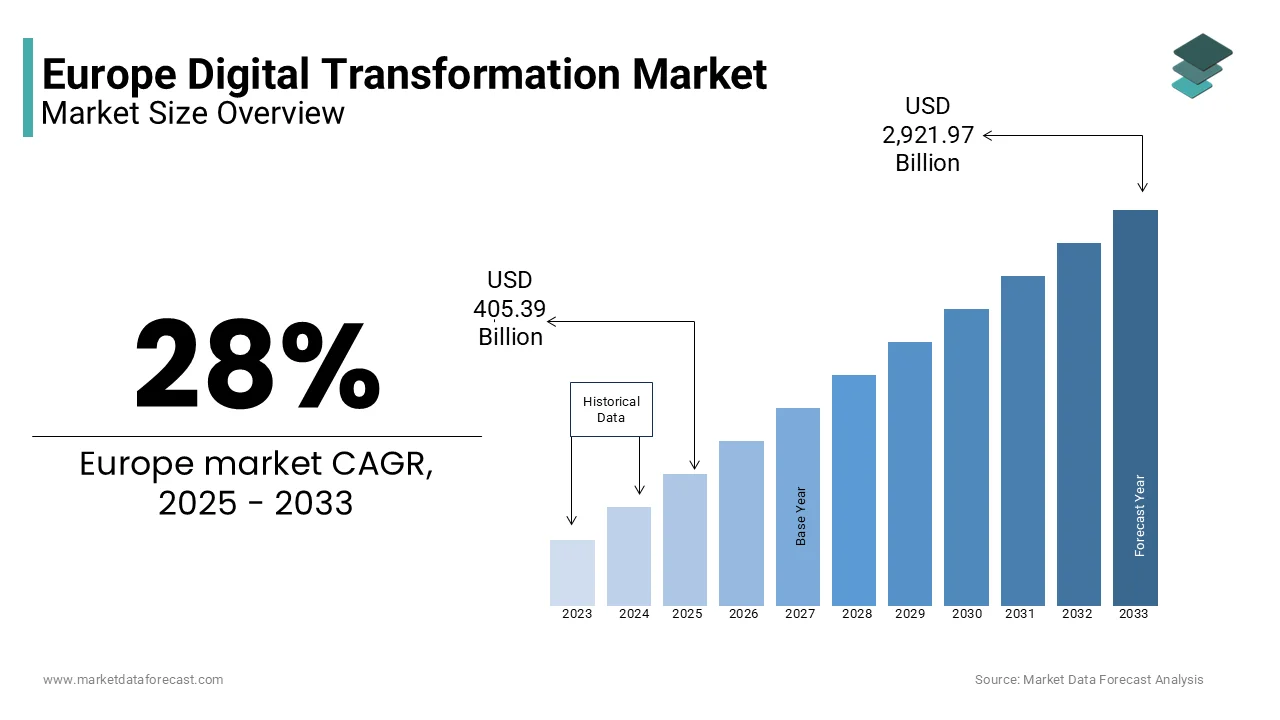
The digital transformation is an integration of digital technologies into all areas of business and public sector operations, fundamentally altering how organizations deliver value to stakeholders. The region is currently navigating a unique trajectory defined by stringent regulatory frameworks and a strong emphasis on digital sovereignty. As per Eurostat data from 2023, approximately 92% of enterprises in the European Union with 10 or more persons employed had internet access, but only 41% utilized cloud computing services for advanced data processing. The European Commission notes that over 80% of projects funded under the Recovery and Resilience Facility include specific digital components aimed at green and digital transitions. Furthermore, the General Data Protection Regulation continues to shape the architectural design of digital solutions, mandating privacy by default, which influences global technology standards. The market is not merely about technology acquisition but involves a cultural shift toward data-driven decision-making and automated workflows. Governments across the continent are pushing for a decade of digital transformation to ensure competitiveness against global peers.
MARKET DRIVERS
Mandates for Operational Efficiency Amidst Economic Volatility
The urgent need for organizations to achieve operational efficiency and cost optimization in the face of persistent economic volatility and high energy costs is a primary factor bolstering the growth of the Europe digital transformation market. European businesses are under immense pressure to streamline processes and reduce overheads to maintain profitability in a stagnant growth environment. According to a study by McKinsey and Company, European firms that successfully implemented end-to-end digital transformations reported a 20 to 30% reduction in operational costs within the first two years of deployment. This financial imperative drives the adoption of robotic process automation and AI-driven supply chain management tools that minimize waste and optimize resource allocation. The energy crisis exacerbated by geopolitical tensions has further accelerated the digitization of energy management systems, allowing industrial players to monitor and reduce consumption in real time. Companies are leveraging predictive maintenance solutions to prevent costly equipment failures and extend asset lifecycles. The ability to rapidly scale operations up or down based on market demand through cloud native architectures provides a competitive edge that traditional, rigid systems cannot offer.
Regulatory Push for Digital Sovereignty and Security Standards
The robust regulatory framework established by the European Union, which mandates higher standards for cybersecurity data protection and digital sovereignty, is eventually propelling the growth of Europe digital transformation market. Legislation, such as the Digital Operational Resilience Act and the Cybersecurity Act, compels financial institutions and infrastructure operators to upgrade their digital defenses and ensure business continuity against cyber threats. As per the European Union Agency for Cybersecurity, the number of significant cyber incidents reported across member states increased by 38% in 2023, prompting stricter compliance requirements. These regulations force organizations to invest heavily in secure cloud environments and zero-trust architectures to avoid severe penalties and reputational damage. The European Commission has allocated over 7 billion euros under the Digital Europe Programme to support the deployment of advanced digital capacities across the continent. This funding acts as a powerful incentive for public sector bodies and small to medium enterprises to embark on transformation journeys. Furthermore, the requirement for interoperable digital identities and seamless cross-border data flows drives the modernization of legacy IT systems. Organizations are proactively aligning their digital strategies with these regulatory mandates to future-proof their operations and gain trust in a highly regulated market.
MARKET RESTRAINTS
Acute Shortage of Advanced Digital Skills and Talent
The severe scarcity of professionals possessing advanced skills in emerging technologies, such as artificial intelligence, cybersecurity, and data science, is one of the major restraining factors for the growth of the Europe digital transformation market. Despite high unemployment rates in some sectors, the tech industry faces a talent gap that slows down implementation timelines and increases project costs. According to the European Centre for the Development of Vocational Training, the European Union faces a deficit of a million digital specialists, a number that is projected to grow if current training trends do not accelerate. This shortage forces companies to compete fiercely for a limited pool of experts, driving up salary expectations and straining budgets for small and medium-sized enterprises. Many transformation initiatives stall or fail because organizations lack the internal expertise to manage complex cloud migrations or develop custom AI algorithms. The reliance on external consultants often leads to knowledge transfer gaps where internal teams remain dependent on third parties for ongoing maintenance. Educational institutions struggle to update curricula fast enough to match the rapid pace of technological change, exacerbating the skills mismatch.
Complexity of Integrating Legacy Infrastructure with Modern Systems
The immense technical difficulty and financial burden associated with integrating modern digital solutions with entrenched legacy infrastructure are additionally hindering the growth of Europe digital transformation market. Decades of incremental IT investments have resulted in fragmented landscapes of outdated mainframes and siloed databases that are incompatible with contemporary cloud native applications. As per research by Gartner, many European enterprises report that legacy system complexity is the primary obstacle to accelerating their digital transformation roadmaps. The process of migrating data from these archaic systems without disrupting critical business operations requires meticulous planning and substantial capital investment, which many organizations hesitate to commit. The risk of data loss or system downtime during migration creates a culture of caution where leaders prefer to maintain the status quo rather than risk operational failure. Furthermore, the lack of standardized application programming interfaces in older systems necessitates the development of custom connectors, which increases technical debt and maintenance costs. Industries such as banking and insurance in countries like Germany and Italy are particularly affected due to their long history of using proprietary core banking systems. The inability to achieve seamless interoperability between old and new technologies limits the realization of real-time data analytics and agile service delivery.
MARKET OPPORTUNITIES
Expansion of Green Digital Solutions for Sustainability Goals
The emergence of digital technologies with sustainability initiatives to meet the aggressive climate targets set by the European Green Deal is one of the major factors to enhance new opportunities for the growth of Europe digital transformation market. Organizations are increasingly seeking digital tools to measure, monitor, and reduce their carbon footprints, creating a new avenue for technology providers. According to the European Environment Agency, digital solutions have the potential to reduce global greenhouse gas emissions by up to 15% by 2030 through optimized logistics, smart grids, and energy-efficient building management. This alignment creates a massive demand for Internet of Things sensors and AI platforms that enable real-time environmental monitoring and resource optimization. The European Commission has introduced the Green Digital Coalition to encourage tech companies to commit to climate-neutral data centers and sustainable software practices. Enterprises are leveraging digital twins to simulate and improve the energy efficiency of manufacturing processes before physical implementation. The rise of ESG reporting requirements forces companies to adopt sophisticated data management systems that can accurately track and verify sustainability metrics across complex supply chains. Startups focusing on circular economy platforms that facilitate resource sharing and waste reduction are attracting significant venture capital.
Democratization of Artificial Intelligence for Small and Medium Enterprises
The democratization of artificial intelligence tools, which allows small and medium-sized enterprises to access advanced capabilities previously reserved for large corporations, is greatly influencing the growth of Europe digital transformation market. The emergence of low-code and no-code platforms and AI as a service models lowers the barrier to entry, enabling smaller players to automate tasks and derive insights from their data. Cloud providers are launching pre-trained AI models tailored for specific industries such as retail, agriculture, and tourism, which simplifies deployment and reduces customization costs. This shift empowers SMEs to enhance customer experiences through personalized marketing chatbots and optimize inventory management using predictive analytics. The European Union has launched specific funding initiatives under the Digital Innovation Hubs network to support SMEs in experimenting with AI technologies. These hubs provide access to testing facilities and expert guidance, helping smaller firms overcome initial hesitation and skill gaps. The ability for SMEs to compete on innovation levels with larger rivals fosters a more dynamic and competitive economic environment.
MARKET CHALLENGES
Navigating Fragmented Data Governance and Privacy Regulations
The complexity of navigating fragmented data governance laws and varying interpretations of privacy regulations across different member states is a key challenge for the growth of Europe digital transformation market. While the General Data Protection Regulation provides a unified framework, national authorities often enforce additional local requirements regarding data residency and cross-border transfers, which complicates pan-European digital strategies. According to analysis by Deloitte, multinational corporations operating in Europe must comply with over 20 distinct sets of data localization rules, which increases compliance costs by an estimated 25% compared to domestic operations. Organizations struggle to establish consistent data governance policies that satisfy all jurisdictional mandates, leading to delays in project rollouts. The uncertainty surrounding the implementation of new regulations like the Data Governance Act adds another layer of legal risk that discourages aggressive data monetization strategies. Companies must invest heavily in legal counsel and compliance officers to interpret evolving rules and avoid hefty fines. The lack of harmonized standards for data interoperability between public and private sectors further stifles innovation in areas like smart cities and e-health.
Escalating Cybersecurity Threats Targeting Digital Assets
The escalating sophistication of cyberattacks that specifically target the expanded attack surfaces created by rapid digital transformation initiatives is also impeding the growth of Europe digital transformation market. As organizations migrate more functions to the cloud and connect more devices to the internet, they expose themselves to a wider range of vulnerabilities that malicious actors are eager to exploit. The integration of third-party software and supply chain partners introduces additional risks where a breach in one vendor can compromise the entire network. The shortage of cybersecurity professionals exacerbates the problem, leaving many transformed systems inadequately monitored and defended. High-profile breaches have eroded consumer trust, making organizations hesitant to fully embrace digital channels for sensitive transactions. The cost of remediation and regulatory penalties following a successful attack can be devastating, potentially wiping out the financial gains achieved through transformation. Companies are forced to divert significant portions of their digital budgets toward defensive measures rather than innovation. The constant evolution of threat vectors requires continuous updates to security protocols, which strains IT resources.
REPORT COVERAGE
| REPORT METRIC | DETAILS |
| Market Size Available | 2025 to 2034 |
| Base Year | 2025 |
| Forecast Period | 2026 to 2034 |
| Segments Covered | By Solution, Service, Deployment, Enterprise Size, End-use, and Country |
| Various Analyses Covered | Global, Regional, and Country-Level Analysis, Segment-Level Analysis, Drivers, Restraints, Opportunities, Challenges; PESTLE Analysis; Porter’s Five Forces Analysis, Competitive Landscape, Analyst Overview of Investment Opportunities |
| Countries Covered | UK, France, Spain, Germany, Italy, Russia, Sweden, Denmark, Switzerland, Netherlands, Turkey, Czech Republic, and the Rest of Europe. |
| Market Leaders Profiled | Accenture plc, Adobe Systems Inc., Broadcom, Inc., Cisco Systems, Inc., Dell EMC, Dempton Consulting Group, Atos SE, Google Inc., Siemens AG, Happiest Minds, Hewlett Packard Enterprise Co., International Business Machines Corporation, Kellton Tech Solutions Ltd., Microsoft Corporation, Salesforce, Inc., SAP SE, and TIBCO Software. |
SEGMENTAL ANALYSIS
By Solution Insights
The Cloud Computing segment was the largest by holding 34.2% of the Europe Digital Transformation Market share in 2025, with the fundamental shift of European enterprises toward flexible and scalable infrastructure models that reduce capital expenditure on physical hardware. The urgent need for operational agility, which cloud platforms provide by allowing organizations to deploy applications and scale resources instantly based on demand fluctuations. According to Eurostat, over 41% of enterprises in the European Union utilize cloud computing services, with adoption rates exceeding 60% among large corporations seeking to modernize their IT estates. Also, the strategic push for digital sovereignty and compliance with strict data regulations has spurred the growth of local and sovereign cloud providers offering GDPR compliant environments. Data from the European Commission indicates that public sector bodies are increasingly migrating critical workloads to certified cloud infrastructures to ensure data residency within EU borders. Furthermore, the rise of hybrid cloud architectures allows businesses to balance security requirements with the innovation speed of public clouds. The ability to support remote workforces and enable seamless collaboration across borders has also cemented cloud computing as the backbone of digital transformation strategies.

The artificial Intelligence segment is anticipated to witness the fastest CAGR of 28.5% throughout the forecast period, owing to the widespread recognition of AI as a competitive advantage and operational efficiency across all industries. The increasing availability of generative AI tools and machine learning platforms enables businesses to automate complex decision-making processes and personalize customer interactions at scale. This factor is also boosting the growth of Europe digital transformation market. According to a study by the European Association of Artificial Intelligence, over 55% of European companies plan to integrate generative AI into their core operations by 2025 to enhance productivity and innovation capabilities. Data from the Digital Europe Programme reveals that billions of euros have been allocated to support AI research hubs and testing facilities across member states, encouraging rapid adoption. Industries such as manufacturing and healthcare are leveraging AI for predictive maintenance and diagnostic accuracy, respectively, creating high demand for specialized algorithms. The ability of AI to extract actionable insights from vast datasets transforms raw information into strategic assets.
By Deployment Insights
The hosted deployment segment was expected to hold a dominant share of Europe Digital Transformation Market in 2025, with the overwhelming preference of European organizations for subscription-based models that offer lower upfront costs and reduced management overhead. The first key driver is the economic advantage of shifting from capital-intensive on-premise investments to operational expenditure models, which improves cash flow and financial flexibility for businesses of all sizes. The enhanced scalability and accessibility provided by hosted environments, which allow employees to access applications and data from any location securely, contribute to escalating the growth of the Europe digital transformation market. Furthermore, hosted providers often include advanced security features and automatic updates as part of their service packages, reducing the burden on internal IT teams. The ability to rapidly deploy new services without lengthy procurement cycles accelerates time to value for digital initiatives.
The on-premise segment is projected to register the fastest CAGR of 4.8% from 2026 to 2034, with the specific security and regulatory requirements in sensitive sectors. The stringent data sovereignty mandates in sectors like defense, banking, and government, where national regulations require data to remain within physically secured local servers under direct organizational control. The concern over long term cost predictability and vendor lock-in associated with hosted models, which leads some large enterprises to retain or even expand their private infrastructure. Advances in hyper-converged infrastructure have also made on-premises solutions more manageable and efficient, reducing the traditional operational burdens.
By End-Use Insights
The BFSI segment was the largest by holding 28.3% of the Europe Digital Transformation Market share in 2025, with the sector's need to modernize legacy systems, comply with evolving regulations, and meet rising customer expectations for seamless digital experiences. Institutions are deploying advanced analytics and AI to offer personalized financial products and automate claims processing, thereby improving customer satisfaction and reducing operational costs. The shift toward open banking has been further transformed by mandating API integration and data sharing, which requires robust digital infrastructures. The high value of transactions and the sensitivity of customer data necessitate continuous investment in state-of-the-art digital solutions.
The manufacturing segment is likely to register the fastest CAGR of 22.3% from 2026 to 2033 with the urgent transition toward Industry 4.0 principles, which emphasize smart factories, interconnected supply chains, and data-driven production processes. The need to optimize energy consumption and resource efficiency in light of rising utility costs and sustainability targets set by the European Green Deal. The demand for supply chain visibility and agility to mitigate disruptions caused by geopolitical tensions and global logistics is also expected to leverage the growth of the segment. Automation through robotics and AI-driven quality control systems is also gaining traction to address labor shortages and improve product consistency. The integration of additive manufacturing and predictive maintenance further enhances operational efficiency and reduces downtime.
COUNTRY-LEVEL ANALYSIS
Germany Digital Transformation Market Analysis
Germany digital transformation market was the top performer by capturing 24.3% of the market share in 2025 with its robust manufacturing base and strong commitment to Industry 4.0. The aggressive modernization of industrial processes, where small and medium-sized enterprises are increasingly adopting smart factory technologies to maintain global competitiveness. The country serves as a hub for developing and testing advanced IoT and AI solutions specifically designed for high-precision engineering and automated production lines. The presence of leading technology providers and research institutes fosters a collaborative ecosystem that accelerates the deployment of cutting-edge digital tools. Government initiatives like the SME Digitalization Bonus provide financial incentives for smaller firms to invest in cloud computing and cybersecurity measures. The strong emphasis on data protection and sovereignty influences the preference for local cloud providers and secure infrastructure solutions.
United Kingdom Digital Transformation Market Analysis
The United Kingdom digital transformation market was positioned second by holding 19.3% of the market share in 2025, with a dominant financial services sector and vibrant tech startup ecosystem. The heavily influenced by the early adoption of open banking and advanced fintech solutions, which have forced traditional institutions to undergo rapid digital overhauls. The UK government's proactive stance on regulating artificial intelligence and promoting digital skills has created a favorable environment for innovation. London remains a global center for tech talent, attracting significant venture capital investment into AI and cloud native startups. The exit from the European Union has prompted many organizations to rebuild their digital infrastructures to ensure compliance with both UK and EU regulations, driving additional project volumes. The strong focus on service sector digitization, including retail and professional services, further boosts market activity.
France Digital Transformation Market Analysis
France digital transformation market growth is driven by its strong emphasis on digital sovereignty and public sector modernization. The ambitious government programs like France 2030, which allocate billions of euros to accelerate the digitization of healthcare education and administration. According to data from the French Government Digital Agency, over 80% of public services are now available online, driving massive demand for secure cloud and identity management solutions. The push for sovereign cloud infrastructure has led to significant investments in local data centers and partnerships with European technology providers to reduce dependency on non-EU giants. The French aerospace and luxury goods industries are also leveraging digital twins and blockchain for supply chain transparency and anti-counterfeiting measures. Regulatory support for green IT encourages organizations to adopt energy-efficient digital solutions, aligning with national climate goals. The presence of major global tech companies establishing R&D centers in Paris further stimulates innovation and knowledge transfer.
Netherlands Digital Transformation Market Analysis
The Netherlands digital transformation market is growing with its advanced digital connectivity and leadership in logistics digitization. The defined by exceptionally high internet penetration rates and a proactive approach to implementing smart city and port technologies. The Port of Rotterdam serves as a global benchmark for digital transformation, utilizing AI and IoT to optimize cargo handling and reduce emissions through its Portbase platform. Dutch companies are early adopters of cloud native architectures and agile methodologies, enabling rapid deployment of new digital services. The government's strong support for cross-border data flows and digital trade facilitates the expansion of e-commerce and digital logistics platforms. The concentration of multinational headquarters in Amsterdam drives demand for enterprise-grade collaboration and cybersecurity solutions.
Sweden Digital Transformation Market Analysis
Sweden digital transformation market growth is likely to grow with a birthplace for global tech unicorns and a leader in integrating sustainability with digital technologies. The strong national commitment to becoming carbon neutral, which drives industries to adopt digital tools for energy monitoring and resource optimization. Swedish banks and retailers are pioneers in cashless transactions and personalized AI-driven customer experiences, setting high standards for digital engagement. The thriving startup scene in Stockholm attracts global attention and investment, fostering innovation in areas like clean tech and health tech. The cultural acceptance of new technologies and high trust in digital systems accelerate the adoption rate of emerging solutions.
COMPETITIVE LANDSCAPE
The competition within the Europe Digital Transformation Market is characterized by an intense rivalry between global technology giants, established regional system integrators, and agile niche startups vying for dominance in a rapidly evolving sector. Incumbent players leverage their vast resources and deep industry expertise to secure large-scale contracts, while smaller firms compete on specialization and flexibility in addressing specific customer pain points. The market landscape is fragmented yet consolidating as major entities acquire innovative startups to enhance their solution offerings and accelerate time to market. Differentiation increasingly relies on the ability to provide sovereign cloud solutions that comply with strict European data protection regulations and offer enhanced security features. Price competition exists but is often secondary to the value proposition of integrated platforms that deliver measurable business outcomes and sustainability benefits. The push for ethical artificial intelligence and transparent algorithms forces competitors to adhere to high standards of governance and responsibility.
KEY MARKET PLAYERS
The leading companies operating in the Europe digital transformation market include:
- Accenture plc
- Adobe Systems Inc.
- Broadcom, Inc.
- Cisco Systems, Inc.
- Dell EMC
- Dempton Consulting Group
- Atos SE
- Google Inc.
- Siemens AG
- Happiest Minds
- Hewlett-Packard Enterprise Co.
- International Business Machines Corporation
- Kellton Tech Solutions Ltd.
- Microsoft Corporation
- Salesforce, Inc.
- SAP SE
- TIBCO Software
TOP PLAYERS IN THE MARKET
- SAP SE operates as a global leader in enterprise application software and plays a pivotal role in the Europe Digital Transformation Market by enabling organizations to streamline operations and gain real-time insights. The company contributes globally by providing comprehensive cloud-based ERP solutions that integrate artificial intelligence and machine learning capabilities. Recently, SAP has intensified its focus on sustainability by launching the Green Ledger, which helps businesses track and report their carbon emissions accurately. The firm actively collaborates with European industries to modernize legacy systems through its Rise with SAP program, ensuring a smooth transition to intelligent enterprises. These strategic initiatives allow the company to drive significant value for customers while maintaining its leadership in the global enterprise software landscape.
- Siemens AG stands as a powerhouse in industrial digitalization and is a key driver of the Europe Digital Transformation Market through its advanced automation and IoT solutions. The company contributes globally by bridging the physical and digital worlds with its Industrial Edge platform and digital twin technologies that optimize manufacturing processes. Recent actions include the expansion of its Xcelerator portfolio, which offers an open digital business platform designed to accelerate digital transformation across various sectors. Siemens actively invests in AI-driven analytics to enhance predictive maintenance and energy efficiency for industrial clients. The firm also partners with startups and technology providers to foster an ecosystem of innovation that addresses complex industrial challenges.
- Atos SE is a prominent European information technology services company that significantly influences the Europe Digital Transformation Market through its expertise in cloud computing, cybersecurity, and high-performance computing. The company contributes globally by delivering tailored digital solutions that help organizations navigate complex technological landscapes and achieve operational excellence. Recently, Atos has strengthened its market position by advancing its sovereign cloud offerings to meet the growing demand for data residency and security within Europe. The firm actively develops quantum computing capabilities and integrates them into its service portfolio to prepare clients for future technological shifts. Atos also focuses on decarbonizing digital services by committing to net-zero emissions and helping customers reduce their environmental footprint. These efforts demonstrate its dedication to providing secure, sustainable, and innovative digital transformation services that empower businesses to thrive in a rapidly evolving global economy.
TOP STRATEGIES USED BY KEY MARKET PARTICIPANTS
Key players in the Europe Digital Transformation Market primarily employ strategic acquisitions to rapidly expand their technological portfolios and gain access to specialized skills in areas like artificial intelligence and cybersecurity. Companies frequently invest heavily in research and development to innovate proprietary platforms that offer seamless integration of cloud data analytics and IoT capabilities. Another dominant strategy involves forming extensive ecosystems and partnerships with startups and academic institutions to foster co-innovation and accelerate the deployment of cutting-edge solutions. Manufacturers are increasingly focusing on sustainability by embedding green technologies into their digital offerings to help clients meet environmental regulatory requirements. Localization of services serves as a critical approach where firms establish sovereign cloud infrastructures to ensure data compliance and build trust with European clients. Furthermore, participants prioritize upskilling workforces through comprehensive training programs to address the acute shortage of digital talent.
MARKET SEGMENTATION
This research report on the Europe digital transformation market is segmented and sub-segmented into the following categories.
By Solution
- Big Data & Analytics
- Artificial Intelligence (AI)
- Cyber Security
- Cloud Computing
- Mobility
- Social Media
- Others (Internet-of-Things (IoT), Blockchain, Business Intelligence)
By Service
- Professional Services
- Implementation & Integration
By Deployment
- Hosted
- On-premise
By Enterprise Size
- Large Enterprise
- Small & Medium Enterprise
By End-use
- BFSI
- Government
- Healthcare
- IT & Telecom
- Manufacturing
- Retail
- Others (Education, Media & Entertainment, Transportation, Travel & Hospitality)
By Country
- UK
- France
- Spain
- Germany
- Italy
- Russia
- Sweden
- Denmark
- Switzerland
- Netherlands
- Turkey
- Czech Republic
- Rest of Europe