- Product Description Description
- Table of Contents TOC
- List of Table & Figure LOT
- Get Free Sample PDF Sample PDF
Market Size, 2025
$14.07 BnMarket Estimate, 2026
$15.91 BnMarket Forecast, 2034
$42.47 BnCAGR, 2026–2034
13.06%Europe Business Intelligence Software Market Report Summary
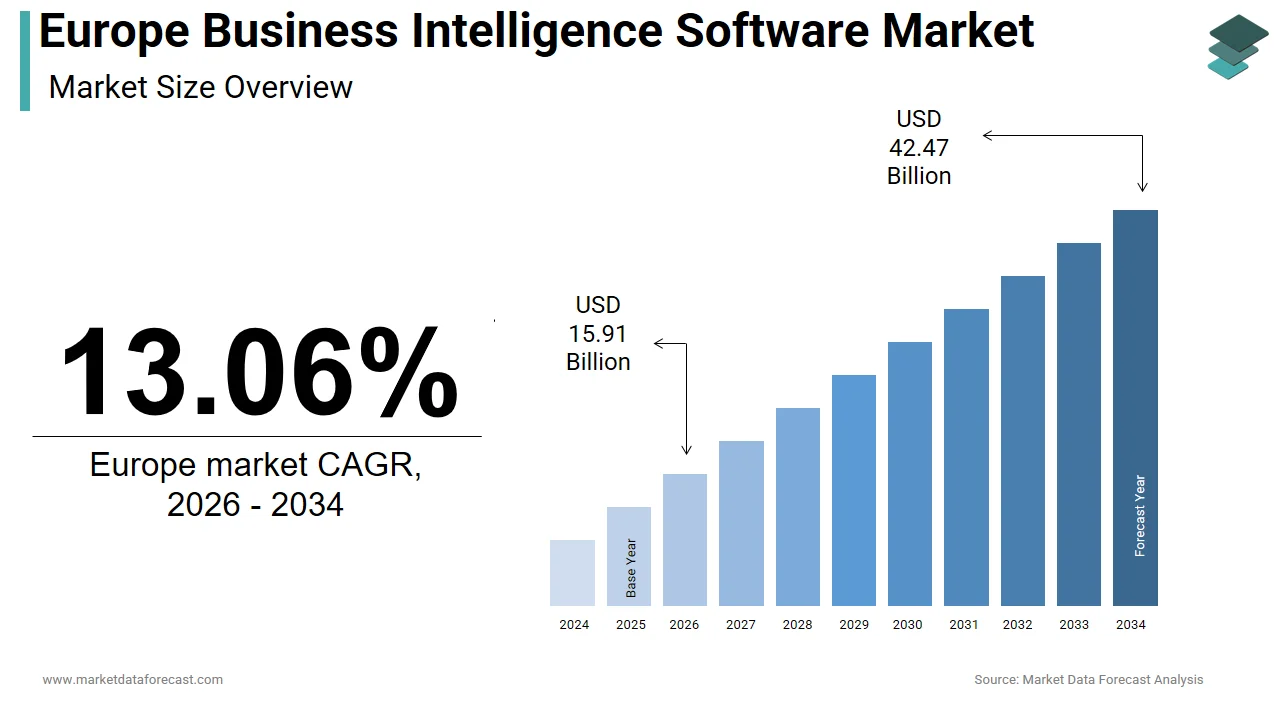
The Europe business intelligence (BI) software market was valued at USD 14.07 billion in 2025, is expected to reach USD 15.91 billion in 2026, and is projected to reach USD 42.47 billion by 2034, growing at a strong CAGR of 13.06% from 2026 to 2034. Market growth is driven by increasing enterprise data volumes, rising demand for real-time analytics, and accelerating digital transformation across industries. Organizations across Europe are investing in advanced BI platforms to improve decision-making, optimize operations, and enhance competitive advantage. The integration of artificial intelligence, machine learning, and cloud-native analytics capabilities is further fueling market expansion.
Key Market Trends
- Rising adoption of cloud-native and SaaS-based BI platforms.
- Increasing integration of AI-driven analytics and predictive modeling tools.
- Growing demand for self-service and embedded analytics solutions.
- Expansion of data visualization and dashboarding capabilities.
- Strengthening focus on data governance, security, and regulatory compliance.
Segmental Insights
- Based on technology, the cloud business intelligence segment dominated the market in 2025, driven by scalability, cost efficiency, and ease of integration with enterprise systems.
- Based on deployment mode, the cloud-based deployment segment led the market by capturing 61.6% share in 2025, supported by widespread enterprise migration to hybrid and multi-cloud environments.
- Based on application, the reporting and analytics segment held the largest share of 35.1% in 2025, driven by increasing demand for performance tracking, KPI monitoring, and strategic business insights.
Regional Insights
The Europe business intelligence software market is witnessing rapid growth across major economies, supported by strong enterprise IT spending, digital transformation initiatives, and expanding data-driven cultures.
- Germany led the regional market in 2025, driven by strong industrial digitization, advanced manufacturing analytics, and robust enterprise software adoption.
- The United Kingdom ranked second in 2025, supported by its strong financial services sector, technology ecosystem, and widespread adoption of data analytics tools.
- France is expected to register the fastest CAGR from 2026 to 2034, driven by government-backed digital transformation programs and increasing adoption of AI-powered analytics platforms.
Competitive Landscape
The Europe business intelligence software market is characterized by intense competition among global enterprise software providers and analytics platform developers. Market players are focusing on enhancing cloud capabilities, integrating AI-driven features, and expanding embedded analytics offerings. Strategic partnerships, acquisitions, and innovation in data visualization technologies are shaping competitive dynamics across the region.
Prominent companies operating in the Europe business intelligence software market include Microsoft Corporation, Tableau, Qlik Technologies, SAP SE, IBM, Oracle, SAS Institute, MicroStrategy, Sisense Ltd, and TIBCO.
Europe Business Intelligence Software Market Size
The Europe business intelligence software market reached USD 14.07 billion in 2025, is expected to grow to USD 15.91 billion in 2026, and is anticipated to touch USD 42.47 billion by 2034, at a CAGR of 13.06% from 2026 to 2034.
Business Intelligence (BI) software is a category of application software designed to retrieve, analyze, transform, and report data to help organizations make more informed, data-driven decisions. Unlike generic analytics applications, business intelligence or BI software in Europe is increasingly defined by its compliance with regional data governance frameworks, including the General Data Protection Regulation and the Digital Markets Act. Large organizations across the European Union have achieved near-universal basic digital integration, with a significant majority now utilizing specialized software to extract strategic insights from their data. While the adoption of data analytics is growing across the European market, it remains most prevalent among larger corporations that leverage their internal transaction records to optimize business operations. Most European businesses currently prioritize internal data sources for their analytical needs, with the integration of external market signals and environmental data still representing an emerging practice rather than a standard one. This evolution has shifted BI from static dashboards toward real-time embedded analytics and natural language querying. National digitalization agendas in countries like Estonia and Denmark have further accelerated cloud native BI deployment, particularly among public sector agencies and small and medium enterprises. The convergence of artificial intelligence data sovereignty requirements and cross-border interoperability standards now shapes the functional architecture and vendor landscape of the Europe business intelligence software market.
MARKET DRIVERS
Stringent Data Privacy Regulations Drive Demand for On-Premise and Sovereign Cloud BI Solutions
The region’s regulatory environment, particularly the General Data Protection Regulation, has fundamentally reshaped how businesses procure and deploy BI software. This is fuelling the growth of the Europe business intelligence software market. According to sources, a notable number of GDPR related fines were issued between 2018 and 2025, with data localization and unauthorized third-party processing among the most common violations. In response, organizations, especially in finance, healthcare, and public administration, are prioritizing BI platforms that guarantee data residency and auditability. Large, publicly traded companies are increasingly favoring on-premise or sovereign cloud deployments for business intelligence to maintain control over sensitive data. Regional initiatives and certification frameworks are driving the adoption of localized infrastructure, enabling software vendors to offer compliant analytics environments. Data protection authorities are requiring public entities to utilize locally hosted solutions for processing citizen data. A clear shift is occurring toward regional data hosting, reducing reliance on cross-border cloud providers for sensitive analytics. This trend reflects a strategic preference for localized data management to comply with evolving privacy regulations and maintain sovereignty. These constraints have spurred innovation in containerized BI architectures that decouple computation from storage, allowing analytics without raw data replication. Consequently, demand is shifting away from global public cloud-only models toward hybrid and regionally governed alternatives that align with Europe’s digital autonomy ambitions.
Proliferation of Real-Time Operational Decision Making Across Manufacturing and Logistics
The integration of business intelligence into live operational workflows is accelerating across the region’s industrial sectors, which propels the expansion of the Europe business intelligence software market. In these sectors, latency directly impacts efficiency and sustainability. Manufacturing processes across the European Union require significant energy, making the use of real-time analytics essential for optimizing resource efficiency. Frameworks encouraging advanced industrial digitalization in specific regions suggest a shift towards continuous performance monitoring with high-frequency data updates. The integration of embedded business intelligence directly into production lines enables immediate monitoring of throughput, yield, and energy consumption, allowing for enhanced visibility by floor managers. Logistics providers are increasingly adopting business intelligence tools to dynamically adjust shipment routes based on factors like traffic, weather, and customs, aiming to improve delivery efficiency. Retailers like Carrefour and Tesco leverage the point of sale integrated BI to adjust inventory allocation within hours of demand shifts. This operationalization of analytics, moving beyond retrospective reporting to prescriptive intervention, is redefining BI as a core component of industrial and commercial execution systems rather than a back-office function.
MARKET RESTRAINTS
Fragmented Data Governance Standards Across Member States Increase Implementation Complexity
National interpretations of data handling create significant barriers to standardized BI deployment and hamper the growth of the Europe business intelligence market. This is despite EU-level regulations. National data protection authorities within Europe often interpret and enforce privacy regulations differently regarding the handling of employee information. Requirements for consent documentation, data anonymization standards, and cross-border data movements can vary significantly between countries, creating complex compliance landscapes for organizations operating across multiple jurisdictions. These discrepancies force enterprises to configure multiple instances of the same BI platform with country-specific access controls and audit trails. Vendors face similar challenges in achieving certification, as national supervisory authorities often reject mutual recognition of compliance attestations. This regulatory fragmentation not only inflates the total cost of ownership but also delays time to insight, particularly for pan-European sales or supply chain analytics initiatives requiring harmonized data models.
Persistent Shortage of Skilled Data Literacy Talent Limits Effective Utilization
The full potential of business intelligence software remains unrealized in many European organizations due to a critical gap in analytical competencies, which impedes the expansion of the Europe business intelligence software market. Many workers across European regions are developing proficiency in fundamental data tasks, such as interpreting charts or validating information, at varying rates. The integration of data science concepts into educational curricula has progressed at different speeds across different European regions, contributing to variations in workforce skill levels. Some mid-sized businesses in specific European regions frequently utilize external expertise for routine reporting tasks due to a need for increased internal capability with self-service tools. Even in digitally advanced markets like Finland and the Netherlands, line managers often misinterpret confidence intervals or correlation coefficients, leading to flawed strategic choices. Natural language tools and automated insights are available, yet deep contextual understanding is still required. The return on BI investments will remain limited across the continent unless coordinated efforts are made to upskill the workforce via corporate programs and national digital academies.
MARKET OPPORTUNITIES
Expansion of AI Augmented Analytics in Public Sector Service Delivery
European governments are increasingly embedding business intelligence into citizen-facing services to enhance responsiveness and fiscal transparency, which provides new opportunities for the growth of the Europe business intelligence software market. Many European nations are increasingly incorporating artificial intelligence-driven analytics into public sector operations to improve efficiency in areas such as social services, healthcare, and administrative processes. Data interoperability frameworks in certain countries allow for near-instantaneous analysis of information across both public and private sectors, improving the speed of anomaly detection. Predictive modeling is being utilized to optimize the allocation of home care resources based on population and health data, which can result in reduced wait times. Strategic funding initiatives within Europe are targeting the development of secure data infrastructures and collaborative environments to support the implementation of business intelligence tools across governmental agencies. These initiatives create a fertile ground for vendors offering explainable AI dashboards, role-based access, and audit trails compliant with public procurement rules. Public sector trust in algorithms is creating a space to test next-gen BI, ensuring a balance between automated efficiency and accountability.
Integration of Sustainability Metrics into Enterprise Performance Management
Integrating sustainability into strategic performance measurement systems offers fresh prospects for the Europe business intelligence software market. New environmental, social, and governance reporting mandates for a large number of companies within the EU are driving increased demand for business intelligence systems capable of tracking non-financial performance indicators. The requirement to report on emissions, water usage, and supply chain due diligence necessitates the development of auditable data pipelines. This shift has broadened the role of business intelligence tools, moving them beyond traditional revenue analysis to include compliance, sustainability reporting, and reputation management. Organizations are increasingly using data analytics platforms to aggregate emission and resource data from widespread facilities and suppliers to track progress against sustainability targets. Large firms are integrating sustainability metrics directly into their executive dashboards to monitor performance. Vendors are responding with pre-built ESG data models, automatic assurance workflows, and benchmarking against regional industry peers. This convergence of regulatory obligation and stakeholder expectation positions sustainability analytics as a major growth vector for the Europe business intelligence software market.
MARKET CHALLENGES
Vendor Lock-In Risks Due to Proprietary Data Formats and Workflow Embedding
Deeply integrated BI platforms raise vendor lock-in risks, particularly when proprietary data and visualization tools are embedded in daily workflows, which challenges the growth of the Europe business intelligence software market. Many mid-market firms face substantial technical debt when attempting to modernize legacy business intelligence tools, driven by complex, undocumented dependencies and custom scripts. Major vendors often use closed formats for calculated fields, data pipelines, and dashboard layouts, making extraction and reimplementation costly and error-prone. For example, Microsoft Power BI’s tight coupling with Azure Active Directory and Dataverse creates switching barriers for organizations seeking multi-cloud neutrality. Similarly, Tableau’s visualization grammar, while powerful, is not natively compatible with open standards like Vega Lite, forcing rebuilds during platform transitions. The European Commission's Interoperable Europe Act is designed to reduce technical barriers by promoting shared standards and, in some cases, mandatory assessments for public sector data systems, though full enforcement is still in its early stages. Enterprises face high risks by locking their primary analytics into a single supplier before industry-wide semantic standardization is achieved.
Escalating Cybersecurity Threats Targeting Analytical Data Lakes
The consolidation of enterprise data into centralized BI repositories has made them high-value targets for cyber adversaries, which further limits the expansion of the Europe business intelligence software market. Cybersecurity threats against data warehousing and analytics environments have increased significantly, with ransomware actors specifically targeting historical sales, customer, and supply chain data. Data breaches involving large volumes of aggregated consumer behavior data have resulted in substantial regulatory fines due to unsecured business intelligence (BI) sandboxes. Organizational exposure is frequently heightened by granting excessive access to self-service analytics tools without implementing row-level security or query throttling measures. Penetration testing indicates that a notable portion of BI deployments are susceptible to privilege escalation through SQL injections in ad hoc reporting modules. Vendors supply encryption and MFA, but the shared responsibility model still leaves significant configuration gaps in hybrid setups. Protecting data as intellectual property necessitates integrating security into the DNA of BI workflows, moving away from reactive, bolt-on measures.
REPORT COVERAGE
| REPORT METRIC | DETAILS |
| Market Size Available | 2025 to 2034 |
| Base Year | 2025 |
| Forecast Period | 2026 to 2034 |
| Segments Covered | By Technology, Deployment Mode, Organization Size, Application, Industry Vertical, and Country. |
| Various Analyses Covered | Global, Regional, and Country-Level Analysis, Segment-Level Analysis, Drivers, Restraints, Opportunities, Challenges; PESTLE Analysis; Porter’s Five Forces Analysis, Competitive Landscape, Analyst Overview of Investment Opportunities |
| Countries Covered | UK, France, Spain, Germany, Italy, Russia, Sweden, Denmark, Switzerland, Netherlands, Turkey, Czech Republic, and the Rest of Europe. |
| Market Leaders Profiled | Microsoft Corporation, Tableau, Qlik Technologies, SAP SE, IBM, Oracle, SAS Institute, MicroStrategy, Sisense Ltd., TIBCO, and Others. |
SEGMENTAL ANALYSIS
By Technology Insights
The cloud business intelligence segment was the largest segment in the Europe business intelligence software market by accounting for a substantial share in 2025. The dominance of the cloud business intelligence segment is driven by the widespread migration of enterprise data infrastructure to cloud environments across Europe. European enterprises are rapidly adopting major cloud platforms for core operations, with large companies leading and small-to-medium businesses showing strong growth. This foundational shift enables seamless integration with cloud native BI tools that offer elastic scalability, automatic updates, and lower upfront capital expenditure. Additionally, the European Union is actively fostering a trusted cloud market, certifying providers to meet strict data sovereignty and security standards for the public sector. These developments have made cloud-based analytics not only technically feasible but also politically and legally viable across diverse national contexts from Finland to Portugal. One more reason for growth here is the acceleration of real-time collaborative decision-making. Cloud BI platforms uniquely support concurrent access, version control, and embedded commenting, features essential for distributed teams operating across time zones. Financial services firms in Luxembourg and insurance companies in Ireland have mandated cloud analytics for regulatory stress testing due to audit trail transparency. This convergence of infrastructure readiness, collaboration needs, and regulatory alignment solidifies Cloud BI’s leadership.
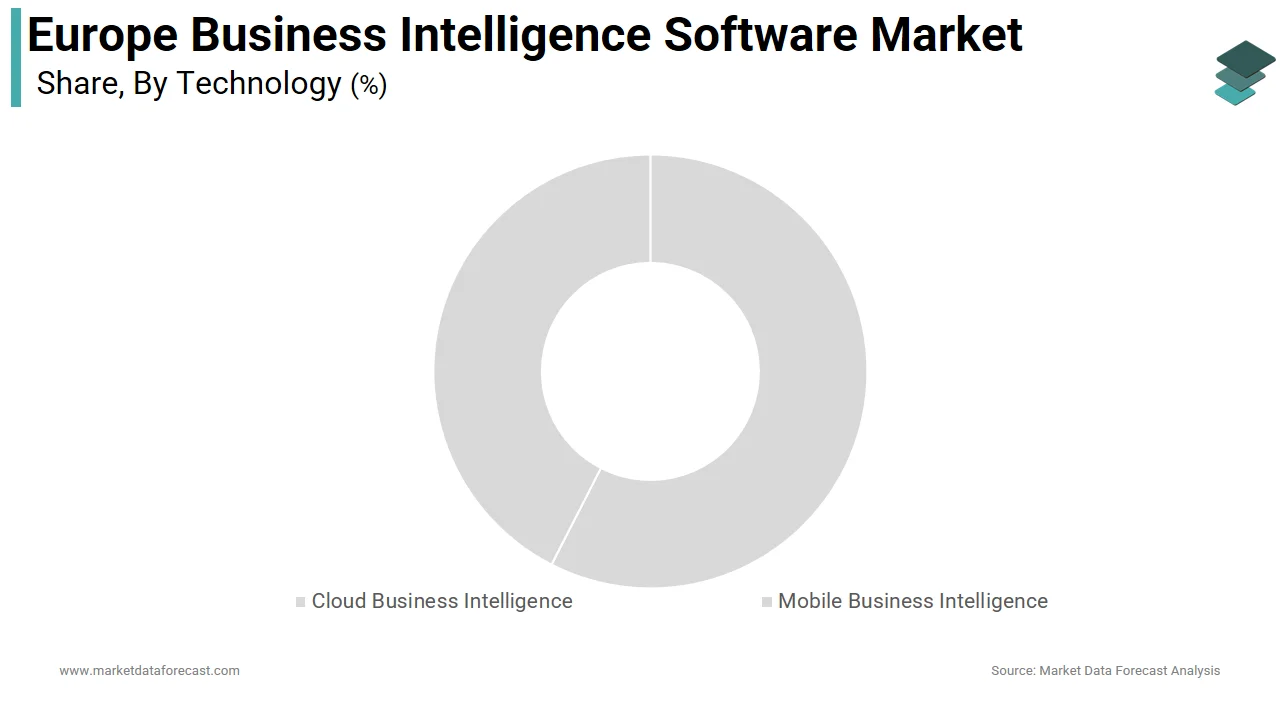
The mobile business intelligence segment is on the rise and is expected to be the fastest-growing segment in the market by witnessing a CAGR of 12.4% between 2026 and 2034 due to the institutionalization of hybrid and remote work across Europe. Eurofound research indicates that the shift toward flexible working arrangements continues to grow across the EU, increasing the demand for mobile access to work-related data and performance metrics. Sales executives in the automotive and pharmaceutical sectors increasingly rely on mobile dashboards to review territory performance during client visits without returning to office systems. SAP’s internal data highlights a significant increase in European customer adoption of mobile business intelligence solutions, driven by a growing preference for accessing reporting tools through mobile devices. An added boost for this segment is the rise of field-based operational roles in logistics and utilities. Digitalization in logistics, particularly in Central and Western Europe, has led to widespread adoption of mobile business intelligence tools among frontline workers to manage delivery speed, fuel efficiency, and real-time customer feedback. Similarly, energy distributors like Enel and E.ON deploy mobile analytics to field technicians for predictive maintenance alerts derived from grid sensor data. These use cases transform mobile BI from a convenience feature into a productivity necessity, accelerating adoption beyond executive users to operational staff across the continent.
By Deployment Mode Insights
The cloud-based deployment segment led the Europe business intelligence software market by capturing a 61.6% share in 2025. The leading position of the cloud-based deployment segment is attributed to the EU’s coordinated push toward digital sovereignty-compliant cloud infrastructure. European cloud initiatives are establishing certification frameworks to align service providers with strict data governance, residency, and auditability requirements. Regional providers are emerging as options for hosting sensitive data, as public sector projects increasingly favor certified, compliant cloud environments to strengthen digital sovereignty and trust. This framework resolves earlier concerns about reliance on non-EU hyperscalers and enables secure cloud adoption even in defense and healthcare. Further support for this segment comes from cost optimization for mid-market firms. Small and medium enterprises in Europe often cite capital constraints as a major barrier to implementing digital investments. Adopting cloud-based business intelligence tools removes the requirement for hardware procurement and dedicated IT personnel. Cloud-based solutions can reduce the total cost of ownership over several years. For further details, explore insights on the European Central Bank's website. Dutch manufacturing cooperatives and Italian fashion houses now subscribe to monthly BI services rather than maintaining legacy servers. This financial accessibility, combined with regulatory assurance, has made cloud deployment the default choice for new implementations across most industries.
The cloud-based segment is also the fastest-growing deployment mode, with a projected CAGR of 11.8% during the forecast period, owing to the integration of artificial intelligence services native to cloud platforms. Microsoft Azure and Google Cloud now offer pre-built machine learning models for demand forecasting, churn prediction, and anomaly detection that can be directly connected to BI pipelines without data movement. Utilities are adopting cloud-based artificial intelligence combined with business intelligence to improve early fault detection and reduce unexpected service interruptions. Replicating these AI capabilities on-premise is challenging due to high computational demands and the frequency of model updates. New regulatory frameworks are also mandating increased data interoperability and portability across digital services. Cloud BI vendors have responded by adopting open APIs and standard data formats like Parquet and Arrow, enabling easier data exchange between applications. This regulatory alignment reduces vendor lock-in fears and encourages migration from legacy on-premise systems. Companies in Belgium and Austria are actively decommissioning decade-old Cognos and BusinessObjects installations in favor of modular cloud analytics stacks that comply with the new data sharing obligations.
By Application Insights
The reporting and analytics segment dominated the Europe business intelligence software market by holding a 35.1% share in 2025. The supremacy of the reporting and analytics segment is credited to its foundational role in regulatory compliance and operational oversight. Also helping this segment is the extensive reporting obligations imposed by EU legislation. New regulatory frameworks are increasing the volume of detailed environmental, social, and governance metrics that organizations must disclose annually. Reporting requirements necessitate the compilation of a high volume of distinct data points for each cycle, driving the use of automated workflows to manage these obligations. Furthermore, financial service regulations are intensifying, requiring granular transaction reporting with near real-time accuracy. The overall trend shows a shift toward more comprehensive, auditable, and timely data reporting across different sectors. Banks in Frankfurt and Paris now run nightly BI jobs to validate trade data before submission to ESMA. This regulatory burden transforms reporting from a periodic activity into a continuous operational function. In addition, this segment is helped by the democratization of self-service reporting among non-technical users. Standardized templates governed by centralized data models ensure consistency while empowering local decision-making. Retail chains use this approach to generate daily sales and inventory reports across thousands of stores. The combination of regulatory necessity and user empowerment cements Reporting and Analytics as the most widely adopted BI application.
The predictive analytics segment is expected to exhibit a noteworthy CAGR of 14.2% between 2026 and 2034. The rapid expansion of this segment is propelled by the integration of predictive models into core business processes to enhance resilience. Many large manufacturers are increasingly adopting predictive analytics to forecast energy demand and refine their carbon offset strategies within emission trading systems. Companies are leveraging data to dynamically adjust production schedules based on the real-time carbon intensity of the grid, which helps reduce direct emissions. A new factor pushing this segment is the advancement of explainable AI frameworks compliant with EU AI Act requirements. The European Laboratory for Learning and Intelligent Systems developed open source libraries that generate human-interpretable justifications for predictive outputs, enabling safe deployment in high-stakes domains. Hospitals in the Netherlands use these models to predict patient readmission risk. This trust, enabling transparency, removes a major adoption barrier and accelerates predictive analytics across healthcare finance and public services where accountability is non-negotiable.
COUNTRY-LEVEL ANALYSIS
Germany Business Intelligence Software Market Analysis
Germany was the top performer of the Europe business intelligence software market by holding 22.3% of the share in 2024, owing to the hosting of SAP's global headquarters in Walldorf, which anchors Europe's analytics ecosystem and drives domestic adoption across manufacturing and automotive sectors. Eurostat data confirms 15.3% of all EU enterprises utilized business intelligence software in 2023, with German industrial firms demonstrating above-average implementation rates, particularly for predictive maintenance and supply chain analytics applications. Germany's manufacturing sector accounts for approximately 20% of the national GDP, creating substantial demand for production analytics solutions. The German Federal Ministry for Economic Affairs and Climate Action allocated 3.2 billion euros for digitalization initiatives in 2024, including significant funding for industrial data platforms. German enterprises prioritize data sovereignty requirements, driving adoption of on-premises and hybrid cloud analytics deployments. The country's vocational training system produces approximately 45,000 data analytics professionals annually, supporting implementation capacity.
United Kingdom Business Intelligence Software Market Analysis
The United Kingdom was positioned second with 18.9% of the Europe business intelligence market share in 2024, with strong financial services adoption and public sector digital transformation initiatives. UK enterprises demonstrate particularly robust uptake in banking and insurance sectors, where 83% of financial institutions have deployed Power BI, according to industry surveys. The National Health Service has implemented analytics platforms across 84% of acute hospital trusts, creating substantial public sector demand. London's status as Europe's fintech capital concentrates analytics innovation with over 2100 data analytics startups operating in the metropolitan area, as per the study. The UK's departure from the European Union accelerated domestic data localization requirements, driving investment in sovereign analytics infrastructure.
France Business Intelligence Software Market Analysis
France business intelligence market is projected to register the fastest CAGR from 2026 to 2034, with the adoption driven by national digital sovereignty policies and industrial modernization programs. The French government's France 2030 investment plan allocated 5.4 billion euros specifically for industrial digitalization, including analytics infrastructure development across aerospace, automotive, and luxury goods manufacturing sectors. French enterprises reported 10% artificial intelligence adoption rates with analytics platforms serving as foundational infrastructure for these implementations. The French show particular strength in retail analytics, with major fashion and luxury brands implementing real-time customer analytics platforms across omnichannel operations.
Netherlands Business Intelligence Software Market Analysis
The Netherlands business intelligence market is eventually growing with the exceptional data infrastructure maturity and cross-border data flow capabilities. Dutch enterprises lead European adoption of integrated analytics platforms, with 67% of organizations employing over 250 staff members utilizing advanced business intelligence solutions. Amsterdam serves as the European headquarters for multiple global analytics vendors, creating concentrated expertise in data visualization and self-service analytics development. Dutch enterprises prioritize sustainability analytics, with 83% of publicly listed companies implementing environmental, social, and governance reporting platforms.
Italy Business Intelligence Software Market Analysis
Italy business intelligence market is maturing with accelerating adoption, particularly among larger enterprises and export-oriented manufacturing firms. Italian enterprises reported 8% artificial intelligence adoption rates in 2024, according to the ISTAT national statistics bureau, data reflecting gradual digital transformation progress. Italian fashion and design manufacturers demonstrate strong analytics adoption for supply chain optimization, with some luxury goods exporters implementing demand forecasting platforms. Cloud computing adoption among Italian enterprises tripled from 23% in 2018 to 61% in 2023, according to Eurostat data, creating an infrastructure foundation for analytics deployment. Milan has emerged as Italy's analytics innovation hub with over 120 specialized analytics consultancies operating in the metropolitan area. The country's manufacturing sector accounts for 16.1% of GDP, creating substantial industrial analytics opportunities in predictive maintenance applications.
COMPETITIVE LANDSCAPE
Competition in the Europe business intelligence software market is defined by a strategic tension between global hyperscalers and regionally attuned vendors. Large technology firms leverage ecosystem lock-in and economies of scale but face scrutiny over data jurisdiction and algorithmic transparency. In contrast, European-born or Europe-focused providers emphasize data sovereignty, explainable AI, and compliance with evolving regulatory frameworks such as the Data Act and AI Act. The market is further segmented by deployment preferences, with cloud-based solutions gaining ground, yet on-premises installations persist in defense and critical infrastructure sectors. Innovation is increasingly centered on embedded analytics, sustainability reporting, and real-time operational intelligence rather than static dashboards. Pricing models are shifting toward consumption-based and outcome-oriented structures, particularly in public sector contracts. This dynamic creates a multi-tiered competitive environment where technical capability must be balanced with legal trust and cultural alignment to succeed across diverse national markets.
KEY MARKET PLAYERS
The leading companies operating in the Europe business intelligence software market include:
- Microsoft Corporation
- Tableau
- Qlik Technologies
- SAP SE
- IBM
- Oracle
- SAS Institute
- MicroStrategy
- Sisense Ltd
- TIBCO
TOP PLAYERS IN THE MARKET
- SAP SE, headquartered in Germany, is a cornerstone of enterprise analytics in Europe with its SAP Analytics Cloud platform serving as a unified environment for planning, reporting, and predictive analytics. The company leverages its deep integration with ERP and S/4HANA systems to offer contextual insights across finance, supply chain, and human resources. In recent years, SAP has strengthened its European footprint by aligning its data processing infrastructure with Gaia X standards, ensuring compliance with EU data sovereignty requirements. It has also launched industry-specific BI accelerators for automotive, healthcare, and public sector clients, enhancing time to value. These initiatives reinforce SAP’s role as a trusted provider of secure, scalable analytics for large enterprises and public institutions across the continent and globally.
- Microsoft’s Power BI has become a dominant force in the European business intelligence landscape due to its seamless integration with Microsoft 365, Azure, and Teams ecosystems. The company has invested heavily in localized data centers across France, Germany, and Switzerland, enabling customers to meet GDPR and national cloud residency mandates. Recent enhancements include AI-driven natural language querying, multilingual dashboard support, and embedded analytics for ISV partners. Microsoft has also collaborated with European universities to train developers on Power BI through its Learn platform, expanding the talent pool. These actions have cemented its position as a preferred choice for mid-market firms and public agencies seeking user-friendly yet compliant analytics solutions with global scalability.
- Qlik, a Swedish-born analytics firm now operating globally, maintains a strong influence in Europe through its associative data engine that enables users to explore complex datasets without predefined queries. The company has prioritized data governance and transparency by embedding data lineage and bias detection features aligned with the EU AI Act. Qlik recently expanded its sovereign cloud offerings in partnership with Deutsche Telekom and Orange, allowing European clients to deploy analytics within certified national infrastructures. It also launched sustainability analytics templates to help organizations track ESG metrics under the Corporate Sustainability Reporting Directive. These strategic moves position Qlik as a leader in ethical, explainable, and regulation-ready business intelligence across both private and public sectors in Europe.
TOP STRATEGIES USED BY THE KEY MARKET PARTICIPANTS
Key players in the Europe business intelligence software market are intensifying investments in sovereign cloud infrastructure to comply with data residency mandates under GDPR and the Digital Markets Act. They are embedding artificial intelligence capabilities such as natural language processing and automated insight generation while ensuring alignment with the EU AI Act’s transparency requirements. Vendors are developing industry-specific analytics templates for finance, healthcare, manufacturing, and public administration to accelerate deployment and demonstrate regulatory relevance. Strategic partnerships with European telecom providers and national cloud initiatives like Gaia X enable localized data handling without compromising scalability. Additionally, companies are expanding training programs and certification pathways to address the region’s data literacy gap and foster ecosystem loyalty among developers and analysts.
MARKET SEGMENTATION
This research report on the Europe business intelligence software market has been segmented and sub-segmented into the following categories.
By Technology
- Cloud Business Intelligence
- Mobile Business Intelligence
By Deployment Mode
- On-Premises
- Cloud-Based
By Organization Size
- Small and Medium Enterprises
- Large Enterprises
By Application Analysis
- Research
- Therapeutic
By Industry Vertical
- Reporting and Analytics
- Dashboard Management
- Data Mining
- Performance Management
- Predictive Analytics
By Country
- United Kingdom
- France
- Spain
- Germany
- Italy
- Russia
- Sweden
- Denmark
- Switzerland
- Netherlands
- Rest of Europe