- Product Description Description
- Table of Contents TOC
- List of Table & Figure LOT
- Get Free Sample PDF Sample PDF
Market Size, 2025
$9.52 BnMarket Estimate, 2026
$10.58 BnMarket Forecast, 2034
$24.63 BnCAGR, 2026–2034
11.14%Europe Social Business Intelligence Market Report Summary
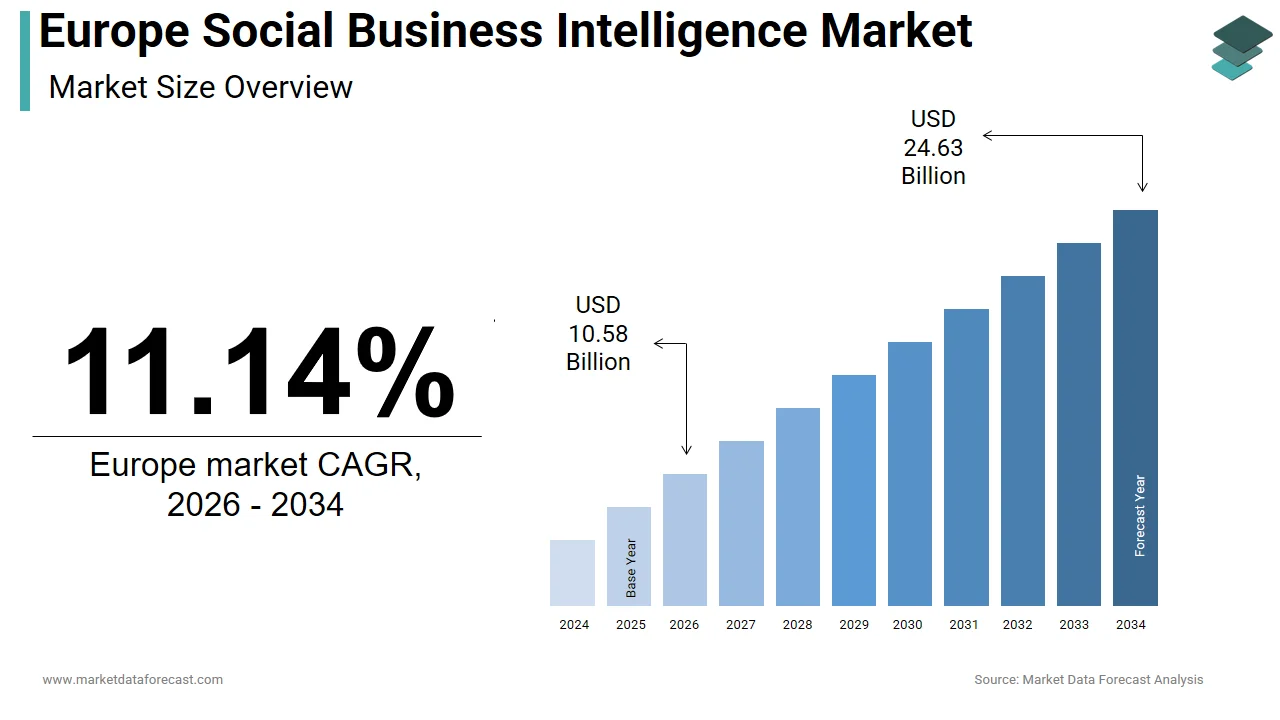
The Europe social business intelligence market was valued at USD 9.52 billion in 2025, is projected to reach USD 10.58 billion in 2026, and is anticipated to grow to USD 24.63 billion by 2034, expanding at a CAGR of 11.14% from 2026 to 2034. Market growth is driven by the rising importance of real-time consumer sentiment analysis, expanding digital engagement across platforms, and increasing enterprise reliance on social data for strategic decision-making. Organizations are adopting social business intelligence tools to monitor brand reputation, detect market trends, support product innovation, and manage regulatory compliance. The region’s high digital literacy, strong regulatory framework, and growing emphasis on ethical AI further support sustained market expansion.
Key Market Trends
- Growing demand for real-time brand risk monitoring to manage reputational threats and crisis situations.
- Rapid expansion of multilingual AI-powered sentiment analysis to address Europe’s linguistic diversity.
- Increasing integration of social intelligence with ESG and sustainability reporting frameworks.
- Rising adoption of cloud-based and GAIA-X-compliant platforms to ensure data sovereignty.
- Growing use of social intelligence in public sector policy formulation and governance.
Segmental Insights
-
Based on component:
-
The solutions segment dominated the market in 2024 with a 63.1% share, driven by strong demand for scalable software platforms offering multilingual analytics, compliance features, and seamless enterprise integration.
-
-
Based on business function:
-
The sales and marketing segment led the market in 2024 with a 41.1% share, fueled by reliance on real-time consumer insights, campaign optimization, and influencer validation.
-
-
Based on end use:
-
The BFSI, retail, IT & telecom, media & entertainment, healthcare, and public sector segments are witnessing growing adoption as organizations leverage social intelligence for compliance, risk management, and customer engagement.
-
Regional Insights
The Europe social business intelligence market is witnessing strong growth across major economies, supported by advanced digital infrastructure, regulatory maturity, and increasing enterprise adoption of AI-driven analytics.
- United Kingdom dominated the market with a 24.3% share in 2024, driven by mature analytics adoption, strong academic-industry collaboration, and regulatory clarity.
- Germany followed closely with a 20.8% share, supported by industrial demand, data sovereignty initiatives, and strong public sector adoption.
- France remains a key market, driven by digital sovereignty policies, ethical AI development, and strong corporate demand in luxury and energy sectors.
The Europe social business intelligence market is characterized by a combination of global technology providers and European-origin vendors offering linguistically precise, regulation-compliant, and ethically aligned analytics solutions. Market participants focus on developing multilingual AI models, strengthening data governance frameworks, and expanding functionality beyond marketing into risk management, sustainability, and governance. Strategic alliances, continuous platform innovation, and investments in ethical AI are key factors shaping competitive dynamics. The market emphasizes insight quality, auditability, and regulatory compliance rather than volume-based data processing.
Prominent companies in the Europe social business intelligence market include Adobe, Inc., Brandwatch, HubSpot, Inc., Google LLC, Microsoft Corporation, Meltwater, IBM Corporation, Oracle Corporation, SAP SE, Salesforce, Inc., Sprinklr, Inc., SAS Institute Inc., and Talkwalker.
Europe Social Business Intelligence Market Size
The Europe social business intelligence market was worth USD 9.52 billion in 2025, is projected to reach USD 10.58 billion in 2026, and is anticipated to grow to USD 24.63 billion by 2034, expanding at a CAGR of 11.14% from 2026 to 2034.
Social business intelligence refers to the systematic collection, analysis, and interpretation of publicly available social media data to derive actionable insights about consumer sentiment, brand perception, market trends, and competitive dynamics. Unlike conventional business intelligence, which relies on internal transactional data, social business intelligence leverages unstructured data from platforms such as X LinkedIn, Instagram, and TikTok to understand real-time public discourse at scale. This capability has become indispensable for enterprises seeking to align product development, marketing strategies, and crisis response with evolving societal narratives. As of 2023, data cited in a March 2024 news article from the European Commission's Eurostat, 59% of individuals in the European Union (EU) reported participating in social networks. The report indicates a significant increase in social network use within the EU between 2015 and 2023. Moreover, the region’s high digital literacy, evidenced by a notable share of adults using the internet weekly, ensures that social conversations are both voluminous and representative of diverse socioeconomic groups. Regulatory frameworks like the Digital Services Act further shape this landscape by mandating greater transparency in data access, which paradoxically both constrains and refines the methodologies used by intelligence providers. As a result, European organizations are increasingly adopting ethically compliant and linguistically nuanced social intelligence tools to navigate a marketplace where public opinion shifts faster than traditional research cycles can capture.
MARKET DRIVERS
Heightened Demand for Real-Time Brand Risk Monitoring
Enterprises in the region are prioritizing real-time brand risk monitoring as reputational threats can escalate virally within hours across fragmented linguistic and cultural contexts, which boosts the expansion of the Europe social business intelligence market. Social business intelligence enables proactive detection of emerging crises such as product controversies, misinformation campaigns, or executive missteps by scanning sentiment anomalies across multiple platforms. The use of continuous social listening systems for early warning and crisis mitigation is a noted trend in reputation management industry analysis, with a significant number of large European firms adopting these systems to leverage the growing importance of real-time feedback. The urgency is amplified by the speed of digital discourse in markets like France and Germany, where a single viral post can trigger mainstream media coverage within hours. Financial institutions in particular have integrated social intelligence into compliance workflows. Furthermore, regulatory expectations under the EU’s Corporate Sustainability Reporting Directive compel firms to demonstrate ongoing stakeholder sentiment assessment, making social intelligence a compliance as much as a strategic asset. This convergence of reputational, financial, and regulatory pressures solidifies real-time monitoring as a non-optional layer of enterprise resilience.
Expansion of Multilingual AI-Powered Sentiment Analysis
The linguistic diversity of the region has caused significant advancements in multilingual natural language processing tailored to social business intelligence applications. This further drives the growth of the Europe social business intelligence market. Traditional English sentiment analysis models are insufficient for the European context because they cannot capture the nuanced approval, frustration, or irony present in the EU's 24 official languages and various regional dialects. In response, European intelligence providers have invested heavily in language-specific AI models that understand idiomatic phrasing, cultural references, and code switching. For example, Swedish brands use models trained on Nordic sarcasm markers while Italian deployments account for expressive intensifiers common in Mediterranean discourse. This localization directly improves analytical accuracy. Apart from these, the European Language Equality Project has funded open training datasets for under-resourced languages like Estonian and Maltese, enabling even smaller markets to benefit from high-fidelity analysis. These developments ensure that social intelligence in Europe is not merely translated but truly contextualized, reflecting how citizens actually communicate rather than how algorithms assume they do.
MARKET RESTRAINTS
Stringent Data Privacy Regulations Limit Data Accessibility
The region’s robust data protection regime constrains the scope and methodology of social business intelligence, despite its reliance on public data, which ultimately obstructs the expansion of the Europe social business intelligence market. The General Data Protection Regulation (GDPR) does not forbid the analysis of publicly posted content. However, its provisions regarding purpose limitation, data minimization, and user rights create operational uncertainty for intelligence vendors. According to the European Data Protection Board, national authorities stated in 2023 that social data, even when compiled, can be personal information if it allows indirect identification of an individual. This limitation reduces analytical granularity, particularly in tracking audience segmentation or influencer impact. Furthermore, the Digital Services Act mandates that very large online platforms restrict bulk data scraping through application programming interfaces, which previously enabled high-frequency sentiment tracking. Meta and X reduced or limited data access in the EU, as indicated in their 2024 transparency reports. Consequently, European firms receive less granular or delayed insights compared to counterparts in regions with looser data governance. A 2024 analysis showed that many social intelligence firms in the EU reported poorer data quality or completeness because of these limits.
Lack of Standardized Metrics Across Platforms Hinders Cross-Channel Analysis
The absence of uniform engagement and visibility metrics across social platforms impedes holistic brand performance assessment in the region’s fragmented digital ecosystem, which in turn hinders the growth of the Europe social business intelligence market. Each major platform defines and measures interactions differently. Instagram prioritizes saves and shares, TikTok emphasizes completion rate, while LinkedIn weights comments over likes, which makes apples-to-apples comparisons nearly impossible. As per research, many multinational brands struggle to consolidate social intelligence into a single performance dashboard due to incompatible metric taxonomies. This inconsistency is exacerbated by algorithmic opacity, where platforms rarely disclose how content visibility is determined, leading to misinterpretation of reach and influence. For instance, a post with high comment volume on X may signal controversy rather than endorsement, yet without contextual scoring systems, businesses often misread sentiment intensity. Consequently, enterprises must deploy additional verification layers such as third-party anomaly detection or manual qualitative review, increasing operational costs and slowing insight cycles. Social business intelligence in Europe will continue to be an inconsistent collection of partial truths, rather than a unified strategic tool, until common measurement standards for different platforms emerge.
MARKET OPPORTUNITIES
Integration with Enterprise Sustainability and ESG Reporting
Social BI is increasingly embedded into corporate sustainability and environmental, social, and governance reporting frameworks in the region as stakeholder capitalism gains regulatory and investor traction, which provides fresh prospects for the expansion of the Europe social business intelligence market. Under the EU Corporate Sustainability Reporting Directive, companies must disclose how they identify and respond to societal expectations, including those expressed digitally. Social listening provides auditable evidence of public sentiment on issues like carbon neutrality, supply chain ethics, or diversity, which can be quantified and trended over time. Moreover, energy utilities in Germany monitor public reaction to renewable transition plans on regional forums to preempt community resistance. The European Securities and Markets Authority has signalled that qualitative social data may soon supplement traditional ESG metrics in investor due diligence. This regulatory alignment transforms social intelligence from a marketing tool into a governance instrument, enabling companies to demonstrate responsive accountability in an era where license to operate is increasingly granted by public consent rather than regulatory approval alone.
Adoption in the Public Sector and Policy Formulation
European public institutions are leveraging social BI to enhance democratic responsiveness and evidence-based policymaking, which creates new opportunities for the growth of the Europe social business intelligence market. National governments and EU agencies now routinely analyze citizen discourse to gauge public reaction to legislation, public health initiatives, or infrastructure projects before and after rollout. As per the European Public Sector Innovation Monitor, many EU member states have institutionalized social listening units within ministries of health, transport, or interior affairs. The European Parliament’s Committee on Petitions has also piloted AI-driven analysis of citizen submissions cross-referenced with social discourse to identify emerging policy priorities. Importantly, these applications adhere to strict ethical protocols approved by national data protection authorities, ensuring anonymity and proportionality. This institutional adoption not only legitimizes social intelligence as a public good but also drives demand for secure, auditable, and bias-mitigated analytical platforms tailored to civic use cases, thereby expanding the market beyond commercial domains.
MARKET CHALLENGES
Persistent Algorithmic Bias in Sentiment Classification Models
Processing social BI tools in the region continues to exhibit algorithmic biases that distort insight accuracy, particularly for marginalized groups and non-mainstream viewpoints, and thereby challenges the expansion of the Europe social business intelligence market. This is the case despite advances in multilingual. Most sentiment models are trained on dominant language corpora and mainstream platform data, which underrepresent regional dialects, minority languages, and non-conformist opinions. As per a 2024 audit by the Algorithmic Justice League, Europe sentiment analysis systems misclassified posts from Roma communities in Romania and Sinti groups in Germany as negative or hostile more often than neutral statements due to linguistic markers misinterpreted as aggression. Similarly, models trained primarily on urban discourse struggle with rural idioms, leading to inaccurate rural sentiment readings in countries. This bias has real consequences. The European Union Agency for Fundamental Rights has warned that unchecked algorithmic bias in commercial intelligence tools could indirectly reinforce societal inequities by steering marketing investment away from underrepresented demographics. The absence of mandatory algorithmic transparency under current EU AI Act provisions means most enterprises are unaware of the distortions, despite some vendors offering fairness auditing. This lack of awareness undermines the reliability of their strategic decisions.
Fragmented Vendor Landscape Complicates Technology Integration
A highly fragmented vendor ecosystem comprising global SaaS providers, regional specialists, and open-source tools, each with incompatible data schemas, APIs, and compliance protocols, hampers the growth of the Europe social business intelligence market. This fragmentation forces enterprises to manage multiple disjointed platforms, often resulting in data silos and inconsistent insights. The challenge is compounded by varying adherence to EU data standards; some vendors store data in non-EU cloud zones, while others lack granular consent logging required under national interpretations of GDPR. Consequently, IT departments spend disproportionate resources on middleware development and validation rather than insight generation. In the financial sector, this fragmentation poses acute risks as inconsistent sentiment signals across tools can trigger conflicting trading or compliance alerts. Adoption of standardized interoperability remains in its early stages, despite initiatives such as the European Data Spaces framework that aim to promote it. Enterprises will continue to operate in a fragmented environment where the cost of integrating intelligence solutions often surpasses the value of the insights produced. This lack of a unified technical and ethical baseline hinders scalability and strategic coherence.
REPORT COVERAGE
| REPORT METRIC | DETAILS |
| Market Size Available | 2025 to 2034 |
| Base Year | 2025 |
| Forecast Period | 2026 to 2034 |
| Segments Covered | By Component, Business Function, End-use, Country. |
| Various Analyses Covered | Global, Regional, and Country-Level Analysis, Segment-Level Analysis, Drivers, Restraints, Opportunities, Challenges; PESTLE Analysis; Porter’s Five Forces Analysis, Competitive Landscape, Analyst Overview of Investment Opportunities |
| Countries Covered | UK, France, Spain, Germany, Italy, Russia, Sweden, Denmark, Switzerland, Netherlands, Turkey, Czech Republic, and the Rest of Europe. |
| Market Leaders Profiled | Adobe, Inc., Brandwatch, HubSpot, Inc., Google LLC, Microsoft Corporation, Meltwater, IBM Corporation, Oracle Corporation, SAP SE, Salesforce, Inc., Sprinklr, Inc., SAS Institute Inc., Talkwalker, and Others. |
SEGMENTAL ANALYSIS
By Component Insights
The solutions segment captured a leading share of 63.1% of the Europe social business intelligence market in 2024. The supremacy of the solutions segment is attributed to the foundational need for robust software platforms that can ingest, process, and visualize vast streams of unstructured social data in compliance with regional regulations. Enterprises across Europe increasingly prioritize scalable self-service dashboards that integrate natively with existing enterprise systems such as CRM and ERP. A further key driver of this segment is the maturation of cloud-based intelligence platforms offering pre-built connectors for major European social networks and support for multilingual natural language processing. As per sources, many large European firms now deploy social intelligence as a cloud-hosted software module rather than a custom-built system due to faster deployment and lower maintenance costs. Apart from these, the EU’s push for digital sovereignty has accelerated the adoption of solutions hosted on European cloud infrastructures, such as GAIA X-compliant providers, with many intelligence buyers prioritizing data residency guarantees as per studies. These platforms also embed compliance features like automated data anonymization and consent logging directly into workflows, reducing legal risk. The convergence of regulatory alignment, cloud scalability, and linguistic sophistication has cemented software solutions as the backbone of social business intelligence adoption across the region.
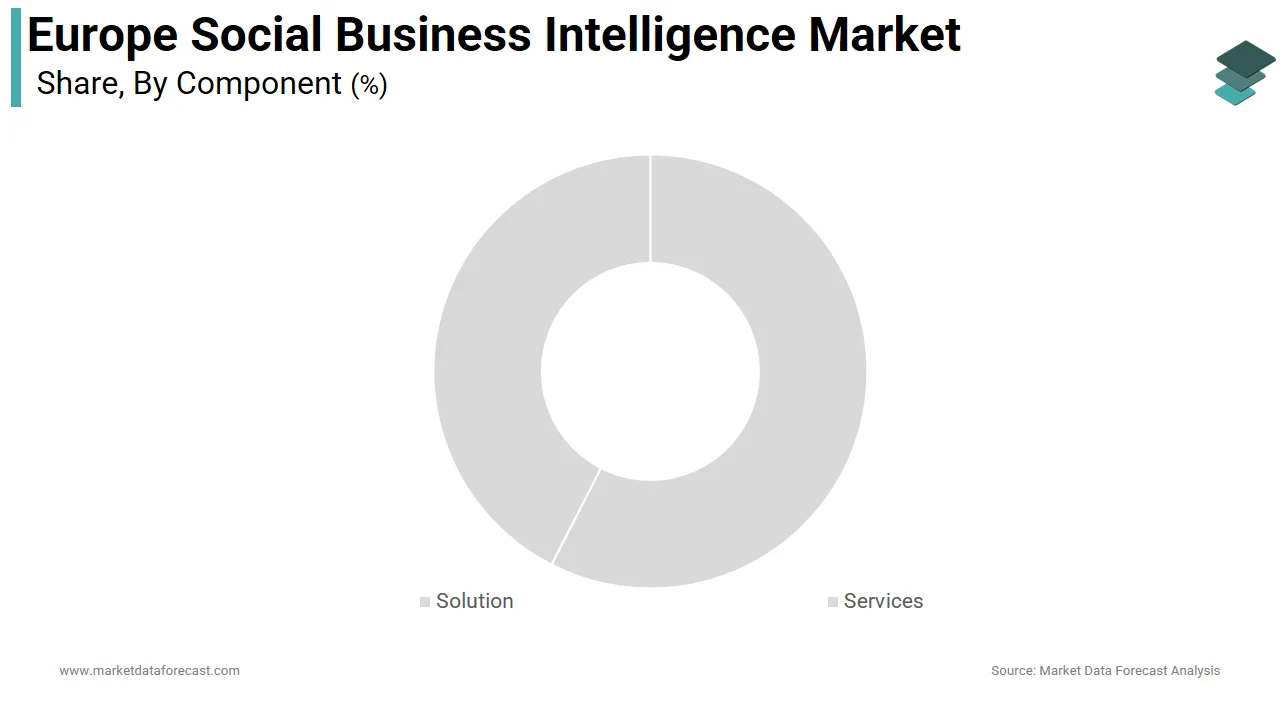
The services segment is predicted to witness the highest CAGR of 22.8% from 2026 to 2034. The swift expansion of the services segment is fuelled by the rising complexity of deploying and interpreting social intelligence in a fragmented regulatory and linguistic environment where off-the-shelf tools are insufficient. Organizations increasingly rely on specialized consulting implementation and managed services to tailor platforms to their sector-specific needs, from financial sentiment tracking in banking to crisis monitoring in public health. As per research, many enterprises using social intelligence engage external service providers for at least one critical function, such as model training, data validation, or insight operationalization. The demand is particularly strong in highly regulated industries where misinterpretation carries significant risk. Furthermore, the a shortage of in-house data science talent. Only a share of European firms report having dedicated social analytics teams compels reliance on external expertise. The market for business intelligence is evolving, with services now driving its development. This is because the value of intelligence has shifted from basic software access to contextual interpretation and actionable insights, as the focus moves from tactical reporting to strategic decision-making.
By Business Function Insights
In 2024, the sales and marketing segment led the Europe social business intelligence market and accounted for a 41.1% share. The dominance of the sales and marketing segment is propelled by the function’s direct reliance on real-time consumer insights to shape messaging campaign timing and influencer selection in an increasingly volatile digital landscape. Marketers use social intelligence to track campaign resonance, measure competitor share of voice, and detect emerging trends before they peak in mainstream media. The urgency is heightened by Europe’s diverse media consumption patterns, where a trend may explode on TikTok in Italy while remaining dormant in Sweden, requiring granular localized monitoring. Besides, the Digital Services Act’s transparency requirements have pushed brands to validate influencer authenticity using third-party intelligence tools, with many marketing teams conducting pre-engagement audience quality assessments. The integration of social insights into programmatic advertising platforms has further cemented this function’s lead, which enables dynamic bid adjustments based on real-time brand sentiment shifts. These operational and regulatory dynamics ensure that Sales and Marketing remain the primary engine of social business intelligence consumption across the continent.
The product development and innovation segment is estimated to register the fastest CAGR of 25.3% during the forecast period due to the shift toward customer-centric innovation, where unstructured social feedback serves as a continuous R&D input stream. Companies increasingly mine forums, review sites, and social comments to identify unmet needs, feature gaps, or usability frustrations long before they surface in formal surveys. For instance, a leading Dutch appliance manufacturer reduced its concept validation cycle to weeks by analyzing real-time reactions to competitor product launches on Reddit and Facebook Groups, as per research. The regulatory push for sustainable design under the EU Ecodesign Directive has further amplified this trend, with firms using sentiment analysis to assess public willingness to adopt refillable, modular, or repairable products. Moreover, open innovation initiatives demonstrate how social platforms are becoming co-creation spaces. This transformation positions social intelligence not as a post-launch evaluation tool but as a front-end innovation catalyst, which aligns product roadmaps with authentic user voice at unprecedented speed and scale.
COUNTRY LEVEL ANALYSIS
United Kingdom Social Business Intelligence Market Analysis
The United Kingdom was the largest player in the Europe social business intelligence market by accounting for a 24.3% share in 2024. The prominence of the UK market is primarily driven by mature digital infrastructure, advanced data analytics adoption, and a concentration of multinational headquarters requiring real-time global insight. UK enterprises were among the first in Europe to institutionalize social listening within corporate strategy units, with many FTSE 100 companies operating dedicated intelligence teams. The country benefits from strong academic industry collaboration with institutions like the Alan Turing Institute, developing bias-mitigated NLP models tailored to British and Commonwealth English dialects. Regulatory clarity under the UK GDPR allows for pragmatic interpretation of public data usage, enabling faster deployment than in more restrictive EU jurisdictions. Apart from these, London’s status as a global financial hub fuels demand in risk and compliance functions, with some UK banks using social intelligence for early detection of market manipulation or reputational threats. The convergence of talent regulatory pragmatism and strategic necessity solidifies the UK’s position as Europe’s intelligence nerve center.
Germany Social Business Intelligence Market Analysis
Germany followed closely in the Europe social business intelligence market and captured a 20.8% share in 2024. The demand for social BI in the German market is propelled by its industrial base’s demand for precision intelligence in manufacturing, automotive, and engineering sectors. German firms prioritize intelligence not for sentiment alone but for signal detection in technical discourse such as engineering forums, patent commentary, and B2B platform discussions. The country’s stringent data ethics framework has spurred the development of on-premises and GAIA X-compliant intelligence deployments, with a percentage of enterprises requiring data processing within national borders, according to sources. Furthermore, public sector adoption is robust, with agencies like the Robert Koch Institute using multilingual social monitoring for early disease outbreak detection. This fusion of industrial pragmatism, data sovereignty, and public health application creates a uniquely rigorous and high-value intelligence ecosystem that distinguishes Germany’s approach from more marketing-oriented markets.
France Social Business Intelligence Market Analysis
France is an attractive country in the European social business intelligence market, which is propelled by strong government support for digital sovereignty and a vibrant tech startup scene focused on ethical AI. Large corporations use intelligence platforms to monitor global brand perception across the luxury and energy sectors, where reputation directly impacts valuation. Apart from these, France’s centralized media landscape, where national discourse often originates on platforms like Twitter and LinkedIn, creates high signal density that enhances analytical yield. The combination of state-backed AI innovation, corporate sophistication, and concentrated public conversation makes France a high-impact intelligence environment despite its mid-sized market share.
Netherlands Social Business Intelligence Market Analysis
The Netherlands witnessed moderate growth in the Europe social business intelligence market due to its role as a European logistics and sustainability hub, driving unique intelligence use cases. Dutch multinationals like Philips, Unilever, and ASML leverage social intelligence not only for brand monitoring but for supply chain risk assessment and circular economy validation. The country’s advanced multilingual capabilities enable nuanced analysis of global discourse from a single operational base. Moreover, the Netherlands hosts several EU data infrastructure initiatives, including the European Health Data Space pilot, which incorporates social listening for public health trend detection. This convergence of sustainability logistics and linguistic agility positions the Netherlands as a high-value niche leader where intelligence informs not just marketing but systemic operational resilience.
Sweden Social Business Intelligence Market Analysis
Sweden is predicted to expand in the Europe social business intelligence market from 2025 to 2033, with growth fueled by its leadership in ethical technology and citizen-centric public services. Swedish firms prioritize transparency and fairness in AI-driven analytics, aligning with the country’s broader digital welfare model. As per research, many public sector agencies use social intelligence to evaluate citizen satisfaction with digital services and detect policy friction points in real time. In the private sector, companies like Spotify and Klarna deploy intelligence to understand user experience narratives beyond quantitative metrics, focusing on emotional tone and feature suggestion clusters. Sweden’s strong open data culture and high public trust in institutions enable more candid social discourse, which enhances data quality. Apart from these, the country’s early adoption of the EU AI Act’s transparency requirements has made Swedish vendors preferred partners for pan-European deployments requiring ethical compliance. This distinctive blend of public sector innovation, ethical rigor, and high-quality discourse cements Sweden’s disproportionate influence given its population size.
COMPETITIVE LANDSCAPE
Competition in the Europe social business intelligence market is defined by a blend of technological sophistication, regulatory acumen, and functional diversification. While global vendors compete on scale and integration depth, European-born players differentiate through linguistic precision, data sovereignty, and ethical AI design. The market features a dynamic interplay between established platforms and agile startups offering specialized modules for ESG crisis response or public sector use cases. Regulatory complexity acts as both a barrier and a catalyst, discouraging generic global tools while rewarding those engineered for European legal and cultural contexts. Innovation is increasingly measured not by volume of data but by quality of insight, actionability, and auditability. As social intelligence shifts from marketing support to strategic governance, the competitive edge lies in contextual accuracy, compliance robustness, and cross-functional utility. This environment fosters continuous product evolution and strategic alliances rather than price-based rivalry.
KEY MARKET PLAYERS
Some of the companies that are playing a dominating role in the Europe social business intelligence market include
- Adobe, Inc.
- Brandwatch
- HubSpot, Inc.
- Google LLC
- Microsoft Corporation
- Meltwater
- IBM Corporation
- Oracle Corporation
- SAP SE
- Salesforce, Inc.
- Sprinklr, Inc.
- SAS Institute Inc.
- Talkwalker
TOP PLAYERS IN THE MARKET
- Brandwatch is a leading European-origin social business intelligence platform known for its advanced natural language processing and multilingual sentiment analysis capabilities. Headquartered in the United Kingdom, the company serves global clients across finance, retail, and public sectors by transforming public social data into strategic insights. Brandwatch has strengthened its position through continuous innovation in ethical AI, including bias detection tools and GDPR compliant data pipelines. In recent years, it has enhanced its platform with real-time crisis detection modules and expanded support for Nordic and Eastern European languages. Its integration into Cision’s broader communications ecosystem has enabled seamless intelligence flow from social listening to PR and stakeholder engagement workflows, reinforcing its relevance across enterprise functions beyond marketing.
- Talkwalker, a Luxembourg-based global player, has established a strong footprint in Europe through its AI-powered social intelligence platform that combines image recognition, brand safety scoring, and predictive analytics. The company supports multinational clients with real-time monitoring across over 150 languages and integrates deeply with enterprise systems like Salesforce and Microsoft Teams. To reinforce its European leadership, Talkwalker launched a dedicated data residency option hosted on EU-based cloud infrastructure by ensuring full compliance with GDPR and the Digital Services Act. It also introduced a sustainability intelligence module that tracks ESG-related public sentiment, enabling firms to align with EU regulatory disclosures. These actions underscore its commitment to regulatory alignment and functional expansion beyond traditional brand monitoring.
- Meltwater, a global media intelligence provider with significant European operations, offers an integrated social business intelligence suite that spans earned, owned, and paid media analytics. The company has invested heavily in contextual AI that differentiates between sarcasm, neutral commentary, and genuine sentiment, particularly in Germanic and Romance languages. Meltwater recently expanded its European data science team in Berlin and Amsterdam to develop region-specific models for financial and healthcare compliance use cases. It also launched a partnership program with EU-based ESG consultancies to embed social sentiment metrics into corporate sustainability reports. By bridging media monitoring with strategic decision support across risk innovation and talent functions, Meltwater has evolved from a PR tool into an enterprise intelligence layer deeply embedded in Europe’s regulatory and operational landscape.
TOP STRATEGIES USED BY THE KEY MARKET PARTICIPANTS
Key players in the Europe social business intelligence market focus on regulatory-compliant data architecture by ensuring all processing adheres to GDPR and Digital Services Act mandates. They invest in multilingual and dialect-sensitive AI models to capture nuanced public sentiment across diverse European languages. Strategic partnerships with cloud providers and enterprise software vendors enable seamless integration into existing corporate tech stacks. Companies also expand their functional scope beyond marketing into risk, compliance, sustainability, and product innovation to increase enterprise relevance. Continuous development of ethical AI features, such as bias auditing, transparency logs, and synthetic data testing, reinforces trust and differentiation in a scrutinized regulatory environment.
MARKET SEGMENTATION
This research report on the Europe social business intelligence market has been segmented and sub-segmented into the following categories.
By Component
- Solution
- Services
By Business Function
- Finance
- Sales & Marketing
- Customer Service/Support
- Product Development/Innovation (R&D)
- Human Resources (HR)
- Other Business Function
By End Use
- BFSI
- Retail & E-commerce
- IT and Telecommunications
- Media & Entertainment
- Healthcare
- Government & Public Sector
By Country
- United Kingdom
- France
- Spain
- Germany
- Italy
- Russia
- Sweden
- Denmark
- Switzerland
- Netherlands
- Rest of Europe