Europe Data Analytics Market Size, Share, Trends & Growth Forecast Report Segmented By Type (Descriptive, Predictive, Augmented, Real-Time, Prescriptive Analytics), Solution, Application, Industry, And Country (UK, France, Spain, Germany, Italy, Russia, Sweden, Denmark, Switzerland, Netherlands, Turkey, Czech Republic & Rest Of Europe) - Industry Analysis From (2026 To 2034)
Market Size, 2025
$24.03 BnMarket Estimate, 2026
$29.91 BnMarket Forecast, 2034
$172.32 BnCAGR, 2026–2034
24.47%Europe Data Analytics Market Report Summary
The European data analytics market was valued at USD 24.03 billion in 2025, is estimated to reach USD 29.91 billion in 2026, and is projected to reach USD 172.32 billion by 2034, growing at a CAGR of 24.47% during the forecast period from 2026 to 2034. The growth of the European data analytics market is driven by the rapid digital transformation of enterprises, growing adoption of cloud-based analytics platforms, and increasing use of AI and machine learning for real-time insights. The proliferation of IoT devices, rising data volumes, and emphasis on data-driven decision-making across industries are further propelling market expansion across the region.
Key Market Trends
- Growing adoption of predictive and prescriptive analytics to optimise operational efficiency and forecasting accuracy.
- Integration of AI and machine learning in analytics platforms enhances automation and insight generation.
- Increasing shift toward cloud-based data analytics solutions due to scalability and cost-effectiveness.
- Rising demand for data governance, privacy, and compliance tools is in line with the EU’s data protection regulations.
- Expansion of industry-specific analytics applications across BFSI, manufacturing, and healthcare sectors.
Segmental Insights
- Based on type: The descriptive analytics segment dominated the European data analytics market, accounting for 34.4% share in 2025, supported by its widespread use in performance monitoring and business intelligence reporting.
- Based on solution: The data management segment led the market with a 38.1% share in 2025, driven by the growing demand for data integration, governance, and quality assurance solutions.
- Based on application: The supply chain management segment held the leading share of 31.4% in 2025, as organisations utilise analytics to enhance logistics, inventory optimisation, and forecasting accuracy.
- Based on industry: The BFSI segment was the most prominent in 2025, leveraging analytics for fraud detection, customer segmentation, risk modelling, and regulatory compliance.
Regional Insights
- Germany captured a 23.1% share of the European data analytics market in 2025, driven by strong industrial analytics initiatives and digital transformation policies.
- The United Kingdom is expanding rapidly due to advancements in financial analytics and AI-led automation in the services sector.
- France continues to grow with rising investments in smart manufacturing and enterprise data platforms.
- The Nordics are witnessing strong adoption of cloud-native analytics solutions, emphasising sustainability and data security.
- The Benelux region is emerging as a hub for innovation, supported by startups and technology partnerships focused on AI-driven analytics.
Competitive Landscape
The European data analytics market is highly competitive, featuring global technology leaders and specialised analytics providers. Companies are focusing on AI integration, strategic partnerships, and end-to-end analytics ecosystems to enhance market reach. Prominent players in the market include Microsoft, IBM, SAP SE, Oracle Corporation, SAS Institute Inc., Amazon Web Services (AWS), Google LLC, Teradata Corporation, Cloudera Inc., QlikTech International AB, Tableau Software (Salesforce), TIBCO Software Inc., MicroStrategy Inc., Alteryx Inc., and Zoho Corporation.
Europe Data Analytics Market Size
The Europe data analytics market size was calculated to be USD 24.03 billion in 2025 and is anticipated to be worth USD 172.32 billion by 2034, from USD 29.91 billion in 2026, growing at a CAGR of 24.47% during the forecast period.

Data analytics refers to the technologies, processes, and services that transform structured and unstructured data from enterprise systems, IoT devices, public databases, and digital interactions into actionable intelligence. Unlike narrow applications such as social listening, this domain spans descriptive, diagnostic, predictive, and prescriptive analytics deployed across finance, manufacturing, healthcare, and public administration. In 2026, the market is defined by a confluence of regulatory ambition, technological maturity, and strategic urgency. According to Eurostat data for 2025 (referencing 2023 usage), only 41% of large enterprises in the EU used AI technologies, which includes some forms of advanced data analytics. As per the 2026 State of the Digital Decade, just over half of Europeans (55.6%) have a basic level of digital skills, which generally indicates that the availability of ICT specialists remains low. Furthermore, the volume of data generated in Europe is projected to increase, driven by smart meters, connected vehicles, and industrial sensors. Europe is establishing a tightly governed data ecosystem through key legislative acts like the Data Governance Act and the European Data Act. Consequently, the European data analytics landscape is not merely a commercial arena but a policy-driven infrastructure for digital sovereignty and evidence-based governance.
MARKET DRIVERS
Mandatory Adoption of Data-Driven Compliance Frameworks Across Regulated Sectors
European financial institutions, healthcare providers, and energy utilities are increasingly compelled by regulatory mandates to implement advanced analytics for real-time risk monitoring and auditability, which drives the growth of the Europe data analytics market. The European Banking Authority’s guidelines on operational resilience and the Digital Operational Resilience Act (DORA) require banks to deploy robust anomaly detection systems and have processes for the timely detection and reporting of ICT-related incidents and anomalous activities, with specific timing requirements being risk-based and proportional to the nature of the operations. Also, the European Central Bank and European Banking Authority encourage the effective use of innovative technologies like predictive analytics in anti-money laundering workflows. Similarly, the European Medicines Agency expects pharmaceutical companies to use real-world evidence derived from diverse data sources, including electronic health records and patient registries, to support post-market surveillance. These regulatory imperatives transform analytics from an optional efficiency tool into a non-negotiable component of legal and operational continuity, forcing even conservative organizations to accelerate adoption and invest in explainable AI architectures that satisfy supervisory scrutiny.
Industrial Modernization Through the EU’s Digital Twin and Smart Manufacturing Initiatives
The European Union’s push toward Industry 5.0 has propelled the expansion of the Europe data analytics market. This has caused widespread deployment of data analytics in manufacturing through flagship programs like the Digital Twin Europe initiative. As per studies, many industrial sites operate digital twins that simulate production lines in real time using sensor data and predictive maintenance algorithms. These virtual replicas reduce unplanned downtime. Automotive and aerospace sectors lead adoption with companies like Siemens and Airbus embedding edge analytics directly into factory equipment to optimize energy use and quality control. This industrial digitization wave is not merely about automation but about creating closed-loop learning systems where every machine contributes to enterprise-wide intelligence. As a result, data analytics becomes the central nervous system of European manufacturing competitiveness.
MARKET RESTRAINTS
Fragmented Data Infrastructure and Lack of Cross-Border Interoperability
Technical and semantic fragmentation across national and sectoral boundaries impedes the growth of the Europe data analytics market. Public sector data alone is stored in distinct registries with incompatible formats and access protocols. As per a study, only a portion of cross-border public service pilots achieved full data interoperability due to divergent metadata standards and authentication mechanisms. In healthcare, the situation is more acute where patient records in France use SNOMED CT coding, while Germany relies on ICD-10-GM and Italy employs regional ontologies, making pan-European clinical analytics exceptionally complex. Even within private enterprises, legacy ERP systems from different vendors often cannot exchange data without costly middleware. This fragmentation inflates integration costs, delays time to insight, and discourages smaller organizations from pursuing advanced analytics. The complete potential of continental-scale analytics will not be achieved until the European Data Act's common data spaces reach technical harmonization via standardized APIs and semantic frameworks.
Persistent Shortage of Cross-Functional Data Talent with Domain Expertise
Deficit in professionals who can bridge technical execution and business context hinders the expansion of the Europe data analytics market. There is a shortfall of data specialists with combined skills in the statistics domain, knowledge, and ethical governance across the EU. This gap is especially severe in non-tech sectors such as agriculture, logistics, and public administration, where data scientists often lack understanding of operational workflows. Academic programs remain siloed, with computer science curricula rarely incorporating sector-specific case studies. Consequently, analytics initiatives frequently stall at the proof-of-concept stage, failing to transition into production. Europe will fail to maximize its analytics capabilities unless targeted reskilling pathways are established to embed data literacy into professional certifications across all disciplines.
MARKET OPPORTUNITIES
Expansion of Sovereign Cloud-Based Analytics Platforms Under GAIA X
The emergence of GAIA-X, a European initiative to build a federated and trustworthy data infrastructure, is setting new opportunities for the growth of the European data analytics market. This is creating a fertile ground for sovereign analytics solutions that prioritize data locality, transparency, and vendor neutrality. As per research, many core members, including SAP, Atos, and Deutsche Telekom, have deployed compliant cloud environments hosting analytics workloads that never leave EU jurisdiction. These platforms enable secure multi-party computation, allowing competitors in sectors like energy or mobility to collaboratively analyze market trends without exposing proprietary data. The model not only satisfies GDPR but also fosters data altruism as defined in the Data Governance Act. GAIA-X-aligned analytics stacks are becoming the indispensable infrastructure for sensitive European data across finance, defense, and healthcare, as digital sovereignty concerns make non-European cloud providers less viable due to external legal risks.
Integration of Environmental and Sustainability Metrics into Core Business Analytics
Integration of environmental and sustainability metrics into core business analytics provides fresh prospects for the expansion of the Europe data analytics market. The EU’s Corporate Sustainability Reporting Directive (CSRD) mandates that an estimated 50,000 companies will eventually disclose ESG metrics, with reporting obligations being phased in from 2025 to 2029, starting with the largest companies, which began data collection in 2025 for reports in 2026. In addition, analytics vendors are embedding sustainability ontologies and life cycle assessment models directly into their platforms. Moreover, the European Environment Agency has developed open data connectors that allow enterprises to benchmark emissions against sectoral averages. This regulatory push transforms sustainability from a compliance burden into a strategic analytics domain where data-driven decarbonization becomes a source of competitive differentiation and investor confidence.
MARKET CHALLENGES
Algorithmic Bias and Lack of Standardized Fairness Evaluation Frameworks
Concerns about algorithmic bias have intensified in the region, which hampers the growth of the Europe data analytics market. As per sources, a portion of automated hiring tools used by large EU employers exhibited gender or age-based disparities in candidate ranking due to training data imbalances. Europe, in contrast to the United States, has not established a unified technical standard for testing bias in commercial analytics systems. The AI Act requires risk assessments for high-impact applications, but it stops short of prescribing specific fairness metrics or validation protocols. This regulatory ambiguity leaves organizations exposed to reputational and legal risk, particularly in multilingual contexts where language models may favor dominant dialects. Equitable data-driven decision making will remain an aspiration, not a reality, unless mandatory fairness benchmarks and third-party certification mechanisms are implemented.
Escalating Cybersecurity Threats Targeting Analytical Data Pipelines
The centralization of enterprise intelligence in analytics platforms has made them prime targets for sophisticated cyberattacks seeking to manipulate or exfiltrate strategic insights, which holds back the expansion of the Europe data analytics market. According to research, numerous critical infrastructure operators reported attempted breaches of their data analytics environments. Attackers increasingly exploit vulnerabilities in open-source libraries and API integrations to inject false data or corrupt model training sets, a tactic known as adversarial machine learning. Current cybersecurity frameworks like NIS2 focus on perimeter defense but offer limited guidance on securing machine learning pipelines. The increasing autonomy and interconnectedness of analytics systems lead to a rapid expansion of potential security vulnerabilities. The reliability of data-driven strategies will remain vulnerable to digital subversion until robust zero-trust architectures and model integrity verification become standard.
REPORT COVERAGE
| REPORT METRIC | DETAILS |
| Market Size Available | 2025 to 2034 |
| Base Year | 2025 |
| Forecast Period | 2026 to 2034 |
| CAGR | 24.47% |
| Segments Covered | By Type, Solution, Application, Industry, and Region |
| Various Analyses Covered | Global, Regional & Country Level Analysis; Segment-Level Analysis; DROC, PESTLE Analysis; Porter’s Five Forces Analysis; Competitive Landscape; Analyst Overview of Investment Opportunities |
| Regions Covered | UK, France, Spain, Germany, Italy, Russia, Sweden, Denmark, Switzerland, Netherlands, Turkey, and the Czech Republic |
| Market Leaders Profiled | Microsoft, IBM, SAP SE, Oracle Corporation, SAS Institute Inc., Amazon Web Services (AWS), Google LLC, Teradata Corporation, Cloudera Inc., QlikTech International AB, Tableau Software (Salesforce), TIBCO Software Inc., MicroStrategy Inc., Alteryx Inc., Zoho Corporation |
SEGMENTAL ANALYSIS
By Type Insights
The descriptive analytics segment dominated the Europe data analytics market and accounted for a 34.4% share in 2025. The dominance of the descriptive analytics segment is mainly driven by its foundational role in converting raw operational data into intelligible historical summaries that inform routine business reviews. Nearly every enterprise, regardless of digital maturity, relies on dashboards showing sales trends, customer demographics, or system performance over time. Many large EU enterprises use descriptive reporting as a baseline for compliance and internal audits. The segment thrives because it requires minimal algorithmic complexity yet delivers immediate value through tools like Microsoft Power BI and SAP Analytics Cloud, which are deeply embedded in existing ERP ecosystems. Moreover, regulatory frameworks emphasize standardized historical disclosures on emissions, workforce composition, and supply chain metrics, tasks inherently descriptive in nature. This regulatory anchoring ensures sustained demand even as organizations explore more advanced analytics. The low barrier to adoption, combined with high interpretability, makes descriptive analytics the universal entry point into a data-driven culture across European institutions.
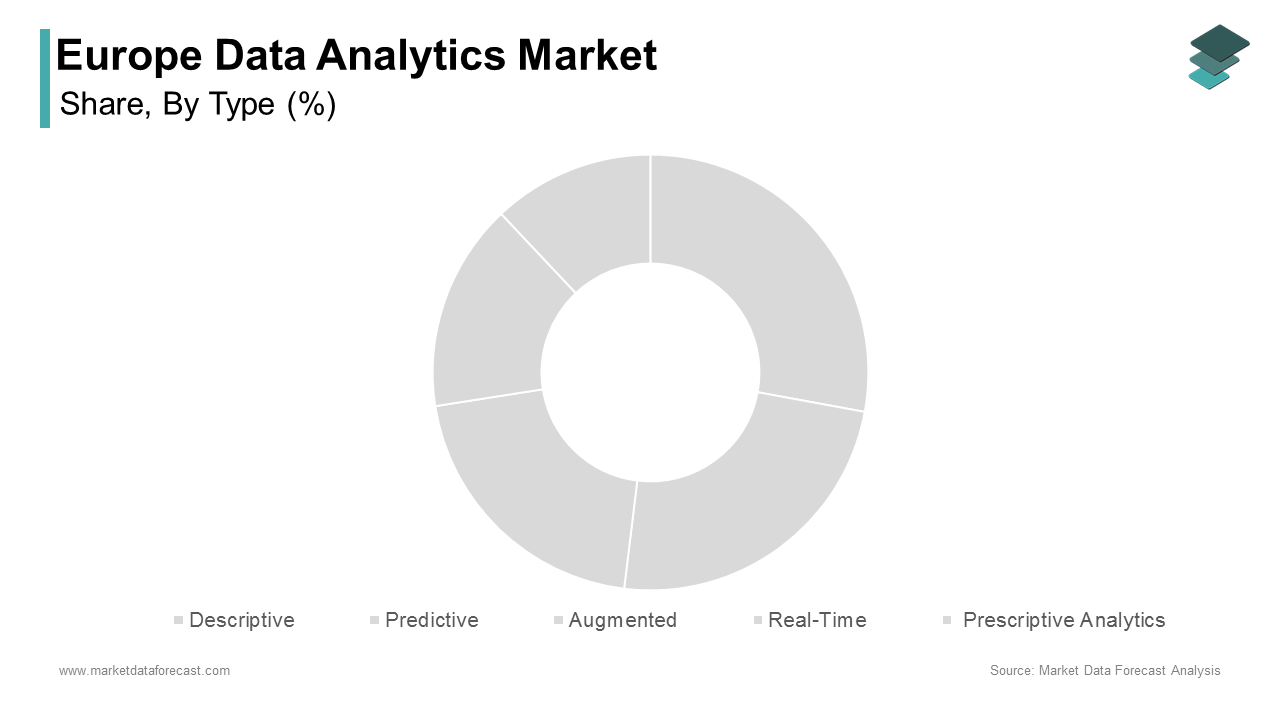
The augmented analytics segment is expected to exhibit a noteworthy CAGR of 26.4% from 2026 to 2034 due to the integration of natural language processing and machine learning into self-service platforms that democratize insight generation for non-technical users. Vendors like Qlik and Tableau have embedded automated insight detection that surfaces hidden correlations without user prompting, vital in multilingual environments where manual exploration is inefficient. Apart from these, the EU’s AI Pact encourages the adoption of explainable augmented systems that document how conclusions are reached, satisfying both business and compliance needs. In public administration, for instance, the Dutch municipalities use augmented platforms to auto-generate policy impact summaries from citizen feedback data, reducing analyst workload. This fusion of accessibility automation and accountability positions augmented analytics as the engine of Europe’s next wave of data literacy.
By Solution Insights
The data management segment led the Europe data analytics market and captured a 38.1% share in 2025. The foundational necessity of organizing, governing, and integrating data before any analytical value can be extracted has contributed to the growth of the data management segment. European enterprises operate under strict obligations from the General Data Protection Regulation and the Data Governance Act, which require precise data lineage consent tracking and purpose limitation, all functions native to modern data management platforms. Furthermore, the European Commission’s common European data spaces initiative mandates interoperable data sharing across sectors, necessitating robust data governance layers. Industries like banking and healthcare rely on centralized data fabrics to unify customer records across legacy systems while maintaining audit trails. The absence of a structured foundation would force advanced analytics to operate on data that is fragmented or non-compliant. Thus, data management is not a supporting function but the regulatory and operational bedrock of Europe’s entire analytics ecosystem.
The security intelligence segment is predicted to witness the highest CAGR of 23.7% between 2026 and 2034. The convergence of rising cyber threats and regulatory mandates requiring proactive threat detection within analytical environments propels the expansion of the security intelligence segment. In addition, organizations are deploying user and entity behavior analytics that detect anomalous access patterns such as unauthorized queries on sensitive HR or financial datasets. Industrial firms integrate security intelligence directly into their data lakes to flag exfiltration attempts in real time. Besides, the European Cyber Resilience Act requires vendors to embed security telemetry into analytics software by design. This regulatory and threat-driven urgency transforms security intelligence from an IT add-on into a core analytical capability essential for data integrity and strategic trust.
By Application Insights
The supply chain management segment held the leading share of 31.4% of the Europe data analytics market. The prominence of the supply chain management segment is due to acute pandemic pressures to enhance resilience, transparency, and sustainability across complex global networks. European manufacturers and retailers now use predictive and prescriptive analytics to simulate disruption scenarios, from port strikes to raw material shortages, and optimize inventory in real time. Automotive giants use analytics to track carbon emissions across thousands of logistics legs, ensuring compliance with the EU’s Green Deal. Furthermore, the Digital Product Passport initiative requires granular data on material origins and recycling potential, which can only be extracted through integrated analytics. Data-driven insights are now essential for modern supply chains, serving as a strategic differentiator in an era where JIT models are being replaced by JIC approaches to manage risk and where analytics directly affects profitability, service levels, and regulatory standing.
The human resource management segment is estimated to register the fastest CAGR of 21.9% during the forecast period, owing to the need to address chronic labour shortages and evolving workforce expectations through data-driven talent strategies. According to sources, millions of vacancies remained unfilled in the EU despite high unemployment in certain regions, highlighting a skills mismatch that analytics can help resolve. Companies use predictive attrition models to identify flight risks and intervene with personalized retention offers. In France and the Netherlands, DS HR analytics platforms analyze internal mobility patterns to recommend upskilling paths aligned with future business needs. Hybrid work models complicate traditional engagement metrics. Consequently, analytics now focus on gathering well-being signals and collaboration insights from digital footprints. This shift transforms HR from an administrative function into a strategic nerve center powered by real-time workforce intelligence.
By Industry Insights
The BFSI segment was the prominent segment in the Europe data analytics market in 2025. Financial institutions leverage analytics for real-time fraud detection, credit risk modeling, customer lifetime value prediction, and regulatory compliance. The European Central Bank’s Targeted Review of Internal Models requires banks to continuously validate risk algorithms using live market and behavioral data—a process impossible without advanced analytics infrastructure. As per research, a notable share of major insurers now use predictive models to assess climate-related asset risks in line with Solvency II updates. Apart from these, open banking under PSD2 has unleashed a flood of transactional data that fintechs and traditional banks alike analyze to offer hyper-personalized financial products. The sector’s high regulatory density, data richness, and zero tolerance for error make it the most analytics-intensive and mature vertical in Europe.
The healthcare segment is anticipated to witness the fastest CAGR of 25.2% from 2026 to 2034. The swift growth of the healthcare segment is fuelled by the operationalization of the European Health Data Space, which enables secure cross-border analysis of electronic health records, genomic data, and medical device outputs. Pharmaceutical companies employ real-world evidence platforms to monitor drug efficacy and adverse events beyond clinical trials, as an acceleration of post-market surveillance. Furthermore, the EU’s AI Act classifies clinical decision support as high-risk, spurring investment in certified, transparent models. The industry's move toward value-based care has made data analytics a crucial foundation for achieving precision medicine, managing population health, and ensuring sustainable healthcare systems.
REGIONAL ANALYSIS
Germany Data Analytics Market Analysis
Germany outperformed other regions in the Europe data analytics market and captured a 23.1% share in 2025. Its world-leading manufacturing base and national digitalization strategy have contributed to the dominance of the German market. According to studies, a portion of industrial firms in Germany now operate integrated data analytics platforms that connect shop floor sensors, enterprise resource planning, and supply chain systems. The country’s Industry 4.0 initiative has funded projects where predictive maintenance and digital twin analytics reduce downtime and energy use. Strong data protection laws and a culture of engineering precision favour solutions that emphasize transparency, auditability, and interoperability. Germany is driving Europe's data revolution by leveraging the GAIA-X sovereign cloud (based in Berlin and Frankfurt) not just for data consumption, but for establishing the ethical and technical standards across the continent, which supports its role as the undisputed engine of this industrial shift.
United Kingdom Data Analytics Market Analysis
The United Kingdom was the second-largest region in the Europe data analytics market and accounted for a 19.5% share in 2025. The growth of the UK market is driven by its global financial services sector and vibrant AI startup ecosystem. According to sources, London hosts numerous data analytics firms serving clients from banking to life sciences. British banks lead in real-time transaction monitoring with systems processing millions of events daily to comply with Financial Conduct Authority rules. The UK’s post-Brexit regulatory autonomy has enabled agile sandbox environments where firms test generative AI analytics under controlled supervision. Universities collaborate with industry on bias mitigation and causal inference, capabilities increasingly demanded by European clients. This blend of financial gravity, technological agility, and academic rigor ensures the UK remains a pivotal node in Europe’s analytics landscape despite geopolitical shifts.
France Data Analytics Market Analysis
France is another key region in the Europe data analytics market because of its emphasis on digital sovereignty and public sector digitization. According to the French Ministry of Digital Transition, over 65% of central government ministries now use centralized analytics platforms to monitor policy impact and citizen service delivery. The country’s strict data localization laws have spurred the growth of vendors like Atos and Dassault Systèmes, which offer analytics stacks fully hosted on French soil. The national health insurance system uses predictive models to detect fraudulent claims, saving a notable amount annually. Besides, France champions ethical AI through the CNIL’s algorithmic transparency charter, which requires public sector analytics to be auditable and contestable. This fusion of state prominence, technological autonomy, and civic accountability positions France as a unique model for responsible data governance in Europe.
Netherlands Data Analytics Market Analysis
The Netherlands witnessed a steady growth in the Europe data analytics market due to its role as Europe’s logistics gateway and leader in data interoperability. According to studies, a share of Dutch enterprises in transport and agri-food use real-time analytics to optimize routing, inventory, and sustainability metrics. The Port of Rotterdam, the largest in Europe, employs a city-scale digital twin that integrates ship traffic, weather, and customs data to predict barriers and reduce emissions. Dutch firms embed analytics into product ecosystems to offer outcome-based services. Moreover, the country’s progressive stance on data altruism under the Data Governance Act encourages companies to share anonymized datasets fothe r the public good. This culture of open yet secure data exchange makes the Netherlands a living lab for cross-sector analytics innovation with global relevance.
Sweden Data Analytics Market Analysis
Sweden is predicted to grow in the Europe data analytics market from 2026 to 2034 due to its integration of sustainability and human-centric design into data analytics. Many large Swedish firms link analytics directly to environmental key performance indicators such as carbon intensity and circularity rates. Companies like IKEA and Ericsson use prescriptive models to design low-impact supply chains and energy-efficient networks. The country leads Europe in adopting privacy-enhancing technologies like federated learning and differential privacy, which enable insights without raw data sharing. Public sector agencies use participatory analytics where citizens co-interpret on urban planning and education outcomes. This holistic approach, where analytics serves both planetary boundaries and human dignity, positions Sweden as a thought leader in the next evolution of responsible data use in Europe.
COMPETITION OVERVIEW
The Europe data analytics market features a dynamic interplay between global technology giants, European enterprise software leaders, and specialized niche innovators. Competition is not primarily price-driven but centers on compliance, depth of interoperability, and contextual intelligence. Global vendors leverage scale and AI innovation while European firms emphasize data sovereignty, linguistic precision, and alignment with industrial policy. The market is highly fragmented by sector, with banking, healthcare, and manufacturing each demanding tailored solutions. Regulatory complexity acts as both a barrier and a differentiator—vendors that proactively embed GDPR, Data Act, and AI Act requirements into their architecture gain trust and longevity. New entrants face high hurdles in certification integration and talent acquisition, yet thrive in verticals like sustainability analytics or public sector transparency. Overall, the competitive landscape rewards those who view analytics not as a standalone tool but as a governed strategic asset embedded in Europe’s vision of digital sovereignty and human-centric innovation.
KEY MARKET PLAYERS
A few major players of the Europe data analytics market include
- Microsoft
- IBM
- SAP SE
- Oracle Corporation
- SAS Institute Inc
- Amazon Web Services (AWS)
- Google LLC
- Teradata Corporation
- Cloudera Inc
- QlikTech International AB
- Tableau Software (Salesforce)
- TIBCO Software Inc
- MicroStrategy Inc
- Alteryx Inc
- Zoho Corporation
Top Strategies Used by the Key Market Participants
Key players in the Europe data analytics market pursue five core strategies to maintain a competitive advantage. First, they embed analytics directly into enterprise workflows through deep integration with ERP, CRM, and supply chain platforms. Second, they prioritize data sovereignty by establishing local cloud regions and aligning with GAIA X and EU data space standards. Third, they invest in augmented and generative AI to democratize insight generation for non-technical users while ensuring explainability. Fourth, they enhance security intelligence capabilities to protect analytical pipelines from adversarial attacks under NIS2 mandates. Fifth, they form strategic alliances with academic institutions, regulators, and industry consortia to co-develop ethical frameworks and sector-specific ontologies. These strategies reflect a market where technological excellence must coexist with regulatory adherence and societal trust.
Leading Players in the Market
SAP SE
SAP SE is a German multinational that plays a pivotal role in the Europe data analytics market through its integrated enterprise intelligence suite. The company offers end-to-end analytics solutions embedded within its ERP and cloud platforms, and real-time decision-making across finance, supply chain, and human resources. SAP has strengthened its position by enhancing SAP Datasphere with semantic layer capabilities that unify business and analytical data under a single governance framework. These initiatives reinforce SAP’s global dominance by aligning its analytics portfolio with Europe’s regulatory and industrial priorities.
Microsoft Corporation
Microsoft is a dominant force in the Europe data analytics landscape through its Azure cloud ecosystem and Power BI platform. The company enables organizations to build scalable analytics workflows with built-in compliance for GDPR and the EU Data Act. In recent years, Microsoft has expanded its European data residency offerings with new cloud regions in Switzerland and Spain, ensuring data never leaves the continent.
IBM Corporation
IBM contributes significantly to the Europe data analytics market through its hybrid cloud and AI-driven analytics solutions centered on Watsonx and Cloud Pak for Data. The company focuses on regulated industries such as banking, healthcare, and the public sector, where explainability and auditability are critical. It also partnered with leading European universities to advance federated learning for cross-border health research. IBM’s emphasis on trustworthy AI and open hybrid architecture positions it as a strategic partner for institutions seeking to balance innovation with compliance in complex data ecosystems globally.
MARKET SEGMENTATION
This research report on the Europe data analytics market has been segmented and sub-segmented based on type, solution, application, industry, and region.
By Type
- Descriptive
- Predictive
- Augmented
- Real-Time
- Prescriptive Analytics
By Solution
- Data Management
- Data Mining
- Security Intelligence
- Data Monitoring
By Application
- Supply Chain Management
- ERP
- Database Management
- HR Management
By Industry
- Healthcare
- IT & Telecom
- BFSI
- Education
- Manufacturing
By Region
- UK
- France
- Spain
- Germany
- Italy
- Russia
- Sweden
- Denmark
- Switzerland
- Netherlands
- Turkey
- Czech Republic
- Rest of Europe
This Report Addresses
- Europe data analytics market size, forecast (2025 to 2034), and CAGR (24.47%)
- Key drivers such as regulatory-led analytics adoption and Industry 5.0 digital transformation.
- Major restraints include a fragmented data infrastructure and a shortage of skilled data talent.
- Key opportunities in sovereign cloud analytics (GAIA-X) and ESG-driven analytics adoption.
- Main challenges like algorithmic bias and cybersecurity risks in analytics pipelines.
- Segmental insights by type, solution, application, industry, and region.
- Regional performance across Germany, the UK, France, the Netherlands, Sweden, and others.
- Competitive landscape and major players such as Microsoft, IBM, SAP, AWS, Google, Oracle, and others
Frequently Asked Questions
1. What is driving the growth of the data analytics market in Europe?
Key drivers include digital transformation across industries, rising cloud adoption, demand for data-driven insights, growth in IoT data, and increasing use of AI and machine learning.
2. Which industries are the major adopters of data analytics in Europe?
BFSI, Healthcare, Retail & E-commerce, Manufacturing, IT & Telecom, Government, and Transportation & Logistics are the primary sectors adopting data analytics.
3. What types of analytics solutions are used in the market?
Descriptive analytics, Predictive analytics, Diagnostic analytics, and Prescriptive analytics are commonly used solutions.
4. How is cloud technology influencing the data analytics market in Europe?
Cloud-based analytics enables easier scalability, real-time processing, reduced infrastructure costs, and remote data access, increasing adoption across businesses.
5. Which countries in Europe are leading the data analytics market?
Germany, the UK, France, and the Netherlands are the leading countries due to strong tech infrastructure and high enterprise digitization.
6. What challenges does the market face?
Challenges include data privacy concerns, a lack of skilled data professionals, integration complexities, and high implementation costs for advanced solutions.
7. What role does artificial intelligence play in data analytics?
AI enhances data analytics by enabling automated data processing, pattern recognition, predictive modeling, and real-time decision-making.
8. What deployment models are commonly used?
Both on-premise and cloud-based models are used, with cloud deployment rapidly increasing due to flexibility and lower operational costs.
9. Who are the key market players in the Europe data analytics market?
Microsoft, IBM, SAP SE, Oracle, SAS Institute, AWS, Google, Teradata, Qlik, Tableau (Salesforce), TIBCO, MicroStrategy, Alteryx, Zoho.
10. What is the future outlook of the Europe data analytics market?
The market is expected to grow significantly due to AI integration, digital transformation initiatives, increased investment in analytics platforms, and the expansion of cloud-based solutions across industries.
11. Which countries are leading the adoption of data analytics in Europe?
Germany, the UK, France, the Netherlands, and Sweden lead due to strong industrial bases, advanced digital infrastructure, government-led digital initiatives, and high enterprise IT spending.
12. How are European enterprises addressing the shortage of data professionals?
Companies are investing in reskilling programs, low-code analytics platforms, university partnerships, and automation tools like augmented analytics to reduce dependency on great technical skills.
13. Why is supply chain analytics gaining strong traction in Europe?
Post-pandemic disruptions, sustainability compliance, and the EU Digital Product Passport initiative push companies to use analytics for real-time visibility, risk forecasting, and emission tracking.
14. What are the key challenges companies face when implementing analytics solutions?
Major challenges include data interoperability issues, legacy IT systems, data quality gaps, a shortage of skilled analysts, and rising cybersecurity risks targeting analytics pipelines.
15. What role does AI play in accelerating data analytics usage in Europe?
AI enables automated insights, predictive modeling, anomaly detection, and natural language queryingmaking analytics more accessible to non-technical users across organizations.
Related Reports
Access the study in MULTIPLE FORMATS
Purchase options starting from
$ 2000
Didn’t find what you’re looking for?
TALK TO OUR ANALYST TEAM
Need something within your budget?
NO WORRIES! WE GOT YOU COVERED!
Call us on: +1 888 702 9696 (U.S Toll Free)
Write to us: sales@marketdataforecast.com