- Product Description Description
- Table of Contents TOC
- List of Table & Figure LOT
- Get Free Sample PDF Sample PDF
Market Size, 2025
$4.89 BnMarket Estimate, 2026
$5.86 BnMarket Forecast, 2034
$24.99 BnCAGR, 2026–2034
19.87%Europe Social Media Analytics Market Report Summary
The Europe social media analytics market was valued at USD 4.89 billion in 2025, is estimated to reach USD 5.86 billion in 2026, and is projected to reach USD 24.99 billion by 2034, growing at a strong CAGR of 19.87% from 2026 to 2034. The growth of the Europe social media analytics market is driven by the rapid digitalization of enterprises, increasing dependence on social platforms for brand engagement, and the rising use of AI-powered analytics for customer insights. Real-time sentiment tracking, influencer performance measurement, and competitive benchmarking are becoming essential for businesses across the region. The widespread adoption of cloud-based platforms, intuitive dashboards, and predictive analytics further supports market expansion across diverse industries.
Key Market Trends
- Rising adoption of AI- and ML-driven social media analytics to improve content optimization, consumer sentiment tracking, and campaign performance measurement.
- Increasing demand for social listening and sentiment analysis tools to strengthen brand reputation and customer experience.
- Strong shift toward cloud-based analytics platforms due to scalability, affordability, and enhanced data processing capabilities.
- Growth in omnichannel marketing strategies, elevating the importance of unified dashboards and cross-platform data visualization.
- Expanding use of influencer analytics as brands prioritize measurable ROI, audience authenticity, and campaign effectiveness.
Segmental Insights
- Based on deployment, the cloud-based segment held a dominant share of the Europe social media analytics market in 2024. Its strong position is attributed to lower infrastructure costs, remote accessibility, and the ability to scale analytics resources rapidly in line with growing data volumes.
- Based on enterprise type, the large enterprises segment accounted for the largest share in 2024. This dominance is driven by significant investments in AI-enabled analytics platforms, customer intelligence tools, and advanced marketing automation systems capable of processing high-volume social data.
- Based on function, the dashboard and visualization segment was the largest and captured 32.2% of the Europe social media analytics market in 2024. The segment’s growth is driven by the increasing need for visually intuitive, real-time analytics interfaces that simplify complex datasets and support fast decision-making.
- Based on end user, the retail sector segment held 28.3% market share in 2024, supported by its high use of social analytics for competitor tracking, personalized customer engagement, sentiment monitoring, and omnichannel performance analysis.
Regional Insights
The Europe social media analytics market is witnessing accelerated growth across major economies, supported by expanding digital infrastructure, increasing marketing technology adoption, and the growing need for real-time social insights across industries.
- Germany was the largest contributor, capturing 28.6% of the Europe social media analytics market share in 2024, driven by advanced enterprise analytics adoption and strong demand for marketing intelligence tools.
- The United Kingdom ranked second with 18.2% share, supported by its concentration of global financial institutions, media conglomerates, and a competitive digital marketing landscape.
- France is expected to grow steadily, supported by rising adoption of analytics across the public sector, cultural industries, and major consumer brands, reflecting the country’s emphasis on digital transformation and content-driven engagement.
Competitive Landscape
The Europe social media analytics market is characterized by the presence of leading global technology providers and specialized analytics companies with strong product portfolios and advanced AI capabilities. Market players are focusing on expanding multilingual sentiment analysis, enhancing real-time data processing, and integrating cross-platform analytics to meet rising enterprise demand. Strategic collaborations, product innovations, and acquisitions are strengthening their competitive edge across Europe’s evolving digital ecosystem.
Prominent companies in the Europe social media analytics market include IBM Corporation, Oracle Corporation, Sprout Social, Inc., Meltwater, Hootsuite Inc., NetBase Quid, Inc., Brandwatch, Digimind, Qualtrics, and Talkwalker Inc.
Europe Social Media Analytics Market Size
The Europe social media analytics market was valued at USD 4.89 billion in 2025, is estimated to reach USD 5.86 billion in 2026, and is projected to reach USD 24.99 billion by 2034, growing at a CAGR of 19.87% from 2026 to 2034.

The social media analytics are advanced software platforms and services designed to extract, interpret, and act upon user-generated content across major digital networks, including Facebook, Instagram, TikTok, X (formerly Twitter), and LinkedIn. These systems leverage natural language processing, machine learning, and real-time data streaming to decode consumer sentiment, track brand health, identify emerging trends, and support strategic decision making. According to Eurostat, over 85% of European enterprises with more than ten employees used social media for business purposes in 2024, underscoring deep digital entrenchment.
MARKET DRIVERS
Surge in Digital Consumer Engagement Fuels Demand for Real-Time Insight Generation
European consumers are spending unprecedented time on social platforms, generating immense volumes of behavioral and preference-based data that enterprises seek to harness. This is a major factor prompting the growth of the Europe social media analytics market. As per We Are Social, the average daily social media usage in Western Europe reached two hours and twenty-three minutes in 2024, with comparable increases across Southern and Eastern regions. This behavioral shift compels brands to deploy advanced analytics not merely for campaign measurement but for dynamic response mechanisms. Retail and fashion sectors now monitor live conversations during product launches to adjust inventory or messaging within hours. Traditional batch processing methods fail to capture fleeting sentiment shifts, making continuous monitoring indispensable.
Integration of Generative AI Opens New Frontiers in Predictive Consumer Intelligence
The generative artificial intelligence is redefining the capabilities of social media analytics by enabling predictive modeling beyond descriptive sentiment tracking, which is additionally enhancing the growth of the Europe social media analytics market. European technology adopters are leveraging large language models to simulate consumer reactions, forecast trend lifecycles, and generate synthetic personas for scenario planning. According to a 2024 assessment by the European Commission’s Joint Research Centre, generative AI adoption in enterprise analytics tools rose by 58% across Germany, France, and the Netherlands compared to the previous year. For example, automotive brands now use generative engines to anticipate regional backlash to advertising campaigns by analyzing historical discourse patterns across linguistic clusters. This evolution allows companies to move from reactive monitoring to proactive strategy formulation, reducing time to insight from days to minutes.
MARKET RESTRAINTS
Stringent Regulatory Environment Under GDPR Constrains Data Accessibility and Processing Scope
The European Union’s General Data Protection Regulation imposes rigorous constraints on how personal data, including public social media content, can be collected, stored, and analyzed. The stringent regulatory environment is hampering the growth of the Europe social media analytics market. As per the European Data Protection Board, over 2,600 GDPR related complaints were filed across EU member states in 2024 alone, with heightened enforcement scrutiny. Social media analytics vendors must navigate complex consent requirements even when processing publicly available posts if those posts contain personally identifiable information. Furthermore, cross-border data transfers, particularly involving non-EU cloud infrastructure that face additional hurdles following the Schrems II ruling, which invalidated the EU-US Privacy Shield. Consequently, analytics providers are compelled to localize data centers within Europe, increasing operational costs and limiting scalability.
Fragmented Linguistic and Cultural Landscape Complicates Cross-National Analytical Consistency
Europe’s diversity in languages, dialects, and socio-cultural norms presents a persistent obstacle to uniform social media analytics deployment. As per the European Language Equality Network, fewer commercial analytics tools in 2024 demonstrated robust performance across all major European languages, including less-resourced ones like Estonian, Maltese, or Irish. Moreover, cultural differences in expression, such as the reserved tone common in Nordic countries versus the emotive style prevalent in Southern Europe, further skew comparative metrics. Enterprises operating pan-European campaigns thus face inconsistent insights unless they invest in bespoke linguistic modules per market.
MARKET OPPORTUNITIES
Expansion of AI-Powered Crisis and Reputation Management Solutions
The increasing prioritization of real-time reputation defense mechanisms in response to viral misinformation, activist campaigns, and geopolitical sensitivities amplified through social channels is showcasing new opportunities for the growth of the Europe social media analytics market. The development of specialized analytics modules that combine anomaly detection, influencer mapping, and narrative tracing to preempt reputational damage is also elevating the growth of the market. The financial and pharmaceutical sectors are highly regulated and frequently targeted, which leads to adoption, with 81% of top-tier firms deploying AI-driven early warning systems. These systems scan millions of posts per hour to identify coordinated disinformation clusters or sentiment inflection points, enabling legal and PR teams to intervene before narratives solidify.
Growth of Public Sector and Policy Analytics for Democratic Engagement
The national and municipal governments across Europe are turning to social media analytics to enhance civic participation, monitor policy sentiment, and combat disinformation during elections. This factor is additionally fuelling the growth of the Europe social media analytics market. Unlike commercial applications, public sector use cases emphasize explainability, bias mitigation, and multilingual fairness are driving innovation in ethically aligned AI. This institutional demand is fostering partnerships between academia, civic tech startups, and established vendors by creating a niche but high-integrity segment that aligns with the EU’s broader digital sovereignty agenda and offers sustainable revenue diversification beyond traditional marketing clients.
MARKET CHALLENGES
Rising Sophistication of Bot-Generated and Synthetic Content Undermines Data Authenticity
The proliferation of automated accounts and AI-generated synthetic media on European social platforms is eroding the reliability of organic user signal extraction, which is restricting the growth of the Europe social media analytics market. According to a 2024 investigation by the Oxford Internet Institute, political and consumer-related discussions on major platforms in France, Italy, and Poland originated from coordinated inauthentic behavior networks. These bot-driven interactions mimic human patterns closely enough to evade basic detection algorithms, thereby distorting sentiment aggregates and trend forecasts. For brands, this means campaign performance metrics may reflect engineered engagement rather than genuine consumer interest. The problem is exacerbated by generative AI tools that produce hyper-realistic fake reviews and comments indistinguishable from authentic ones without forensic linguistic analysis.
Persistent Talent Shortage in Advanced Data Science Limits Full Utilization of Analytical Tools
The European organizations struggle to maximize their value due to a critical deficit in skilled personnel who can interpret complex outputs and translate them into business actions, which is a challenge for the growth of the social media analytics market. As per the European Centre for the Development of Vocational Training, there was a shortfall of over 350,000 data professionals with expertise in natural language processing and machine learning across the EU in 2024. This gap is especially acute in non-tech industries such as consumer goods, healthcare, and public administration, where domain knowledge must be fused with technical acumen. Consequently, many deployments remain confined to surface-level dashboards tracking likes, shares, and basic sentiment scores, missing deeper strategic signals.
REPORT COVERAGE
| REPORT METRIC | DETAILS |
| Market Size Available | 2025 to 2034 |
| Base Year | 2025 |
| Forecast Period | 2026 to 2034 |
| Segments Covered | Deployment, Enterprise Type, Function, Application, End User, Country. |
| Various Analyses Covered | Global, Regional and Country-Level Analysis, Segment-Level Analysis, Drivers, Restraints, Opportunities, Challenges; PESTLE Analysis; Porter’s Five Forces Analysis, Competitive Landscape, Analyst Overview of Investment Opportunities |
| Countries Covered | UK, France, Spain, Germany, Italy, Russia, Sweden, Denmark, Switzerland, Netherlands, Turkey, Czech Republic, and the Rest of Europe. |
| Market Leaders Profiled | IBM Corporation, Oracle Corporation, Sprout Social, Inc., Meltwater, Hootsuite Inc., NetBase Quid, Inc., Brandwatch, Digimind, Qualtrics, and Talkwalker Inc. |
SEGMENTAL ANALYSIS
By Deployment Insights
The cloud-based deployment segment accounted in holding a dominant share of the Europe social media analytics market in 2025 due to the scalability and cost efficiency that cloud platforms offer to organizations managing volatile data volumes from diverse social sources. As per the European Cloud Partnership, over 82% of European enterprises now operate hybrid or fully cloud-based data analytics environments, with social listening tools among the most frequently migrated workloads. The ability to integrate with other SaaS applications, such as CRM and marketing automation platforms, further enhances cloud appeal, allowing real-time data flow across customer touchpoints without complex middleware. Additionally, leading cloud providers have established GDPR compliant data centers across Frankfurt, Dublin, and Amsterdam, ensuring regulatory alignment while minimizing latency.
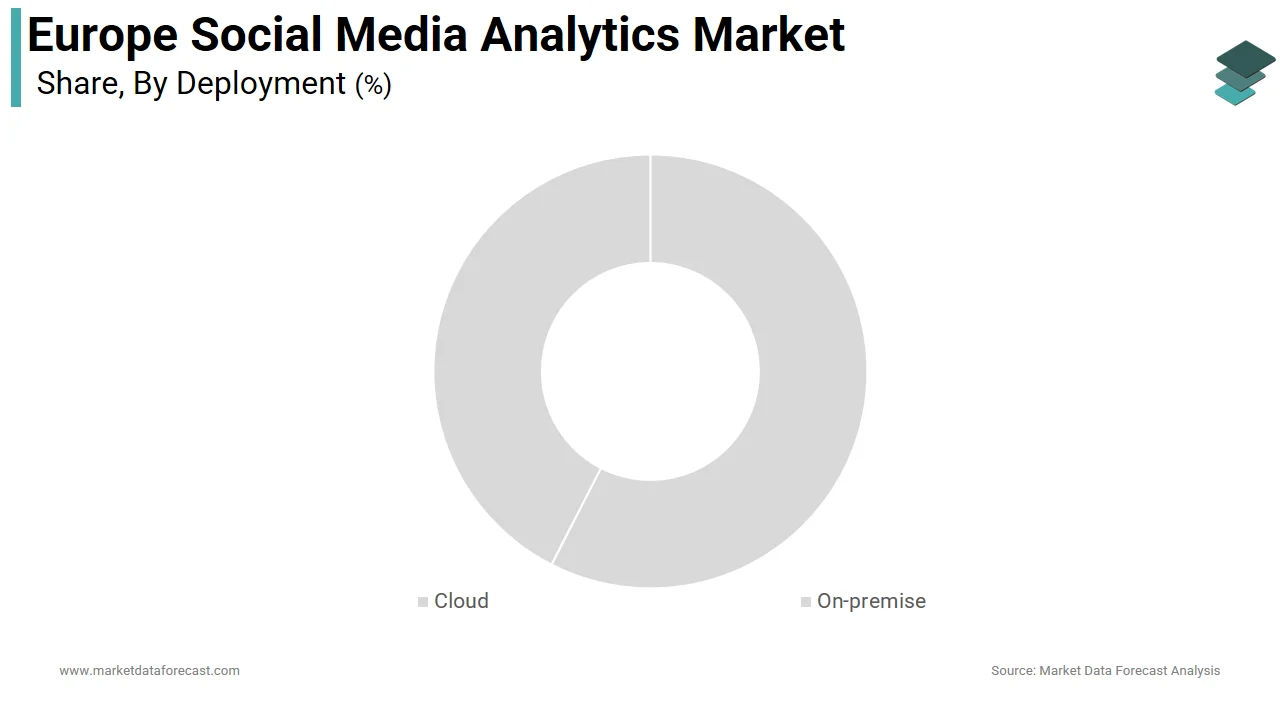
The cloud deployment segment is likely to grow with an anticipated CAGR of 19.3% from 2025 to 2033, with the convergence of edge computing capabilities and AI-powered analytics delivered as managed services. Vendors now offer pre-trained language models for European languages hosted directly on cloud platforms, reducing the technical barrier for non-technical teams. According to Eurostat, 69% of European businesses increased their cloud-based analytics spending in 2024, driven by the need for real-time responsiveness during volatile market conditions such as energy price shocks or supply chain disruptions. Moreover, the European Union’s GAIA X initiative has prominent trust in sovereign cloud ecosystems, enabling public and private sector entities to adopt analytics without data sovereignty concerns. These developments position cloud not just as an infrastructure layer but as an innovation enabler, reshaping how European organizations derive strategic value from social data.
By Enterprise Type Insights
The large enterprises segment was the largest by accounting for a significant share of the Europe social media analytics market in 2025, from extensive digital footprints, complex brand portfolios, and regulatory obligations that necessitate enterprise-grade monitoring. Multinational corporations in sectors like automotive, pharmaceuticals, and financial services operate across many areas requiring centralized dashboards that reconcile linguistic and cultural variance into unified strategic views. As per the European Corporate Governance Institute, some of Europe’s top 500 firms now embed social intelligence into executive risk committees to preempt reputational crises. These organizations also possess the budget to license premium platforms offering advanced features such as influencer authenticity scoring cross platform journey mapping, and compliance audit trails. Furthermore, large enterprises often maintain in-house data science teams capable of customizing analytics pipelines beyond out-of-the-box functionality. This technical maturity allows them to extract deeper insights, such as early signals of product defects or emerging competitor narratives, long before they trend publicly. The scale of their operations justifies investment in integrated analytics ecosystems that feed into broader enterprise intelligence platforms, making large enterprises the natural anchor clients for vendors.
The small and medium-sized enterprises segment is likely to grow at a CAGR of 22.1% between 2024 and 2030, as reported by the European SME Digital Transformation Monitor. This surge is driven by the democratization of analytics through low-code platforms and embedded AI assistants that require minimal technical expertise. Tools like Hootsuite Insights and Sprout Social now offer tiered pricing with pre-configured templates for sentiment tracking, campaign benchmarking, and competitor mention alerts tailored to local markets. E-commerce micro brands in particular rely on real-time feedback loops to refine product offerings and respond to viral moments, often achieving higher engagement ROI than larger competitors due to agility. Additionally, EU-funded digital vouchers under the Digital Europe Programme have subsidized analytics subscriptions for over 120,000 SMEs since 2023, lowering entry barriers.
By Function Insights
The dashboard and visualization functions segment was the largest and held 32.2% of the Europe social media analytics market share in 2024, owing to the enterprise priority of translating complex data streams into intuitive executive summaries that support rapid decision making. Modern dashboards go beyond static charts to offer interactive drill-downs, real-time alerting, and role-based views tailored to marketing, PR, compliance, and product teams. Vendors have responded by embedding natural language query interfaces, allowing non-technical users to ask questions like “show me negative mentions about delivery delays in Germany last week” and receive auto-generated visual responses. Moreover, regulatory bodies such as the UK Financial Conduct Authority now expect firms to demonstrate real-time monitoring capabilities during audits, making visual audit trails a compliance necessity, not just a convenience. This dual role as both a strategic and governance tool ensures the dashboard and visualization remain the functional cornerstone of social analytics deployments.
The sentiment analysis segment is likely to grow with an expected CAGR of 20.8% throughout the forecast period, with breakthroughs in multilingual emotion detection that move beyond positive, neutral negative to identify nuanced states such as frustration anticipation or trust. European vendors like MeaningCloud and Corti have developed models trained on region-specific corpora capturing sarcasm in Dutch irony in French, and indirect criticism in Finnish, capabilities absent in global platforms. According to the European Consumer Sentiment Observatory, brand crises in 2024 originated from misread emotional cues in social conversations, underscoring the cost of inaccuracy. In response, healthcare and utilities sectors now deploy sentiment engines to detect early signs of public anxiety around service changes or policy announcements, enabling proactive communication. Additionally, the European Medicines Agency has begun requiring pharmaceutical companies to submit social sentiment trends as part of pharmacovigilance reports for newly launched drugs.
By End User Insights
The retail sector segment held 28.3% of the Europe social media analytics market share in 2024. Retailers leverage these tools to track real-time reactions to product launches, manage influencer partnerships, and detect counterfeit listings that damage brand equity. Fast fashion giants like Zara and H&M monitor TikTok and Instagram daily to identify emerging micro trends and adjust production cycles within weeks, a practice now standard across mid-tier apparel brands. The rise of social commerce further blurs the line between conversation and transaction, with platforms like Instagram Shopping generating direct sales from user-generated content. Retailers also use competitive analysis modules to benchmark pricing sentiment and delivery complaints against rivals, enabling dynamic service improvements.
The healthcare sector is anticipated to register a CAGR of 24.5% from 2025 to 2033, with the urgent need to monitor public perception during health emergencies, vaccine rollouts, and drug safety events. According to the European Centre for Disease Prevention and Control, 17 national health ministries deployed AI-powered sentiment dashboards in 2024 to track vaccine hesitancy signals in real time, enabling targeted community interventions. Pharmaceutical companies also use analytics to comply with the EU’s updated pharmacovigilance guidelines, which require proactive monitoring of adverse event mentions outside clinical channels. Additionally, mental health startups leverage emotion analysis to identify at-risk individuals and trigger support workflows through strict ethical guardrails.
COUNTRY LEVEL ANALYSIS
Germany Social Media Analytics Market Analysis
Germany was the largest contributor of the Europe social media analytics market by capturing 28.6% of share in 2024 from a powerful industrial base that demands precision analytics for global brand management and supply chain communication. German automotive and engineering firms operate in over 150 countries yet maintain centralized social command centers in Munich and Stuttgart to ensure message consistency and rapid crisis response. The presence of native analytics innovators like SAP and Celonis further accelerates adoption through seamless integration with ERP and CRM systems. Moreover, Germany’s dual education system produces a steady pipeline of data-literate professionals skilled in both business logic and technical implementation.
United Kingdom Social Media Analytics Market Analysis
The United Kingdom was positioned second by holding 18.2% of the Europe social media analytics market owing to its concentration of global financial institutions and media conglomerates. British banks such as Barclays and HSBC use real-time sentiment tracking to comply with the Financial Conduct Authority’s Consumer Duty rules, which mandate proactive identification of customer harm signals in public discourse. Post Brexit, the UK has maintained GDPR alignment while introducing regulatory sandboxes that allow controlled experimentation with AI-driven analytics, fostering innovation without compromising privacy.
France Social Media Analytics Market Analysis
France social media analytics market growth is anticipated to grow with a distinctive emphasis on public sector and cultural industry applications. The country’s strict stance on digital sovereignty has spurred the growth of analytics providers like Talkwalker and Digimind, which offer EU-hosted infrastructure and French-language NLP engines trained on local media and political discourse. Additionally, France’s AI strategy includes €1.5 billion in public funding for ethical AI projects, many of which focus on bias mitigation in sentiment analysis for multilingual societies. This fusion of regulatory vision, industrial policy, and cultural specificity positions France as a unique laboratory for socially responsible analytics innovation.
Italy Social Media Analytics Market Analysis
Italy social media analytics market growth is driven by the dense network of small and medium enterprises in fashion, food, and tourism that increasingly rely on affordable analytics to compete globally. Family-owned brands in regions like Tuscany and Lombardy use hashtag analysis and visual recognition to track unauthorized use of their products and respond to user-generated content that drives seasonal demand. This grassroots digitalization wave makes Italy the fastest-growing major market in Southern Europe and a key indicator of analytics diffusion beyond metropolitan hubs.
COMPETITIVE LANDSCAPE
The Europe social media analytics market features intense competition among established global vendors and agile regional specialists. While international players leverage scale and cross-market data networks, European firms differentiate through linguistic precision, data sovereignty, and regulatory alignment. The absence of dominant monopolies fosters continuous innovation, particularly in ethical AI multilingual processing and real-time crisis response. Competition is increasingly defined not by data volume but by contextual intelligence, interpretability, and integration depth. Vendors compete on their ability to transform raw mentions into strategic foresight while adhering to strict privacy norms. Price sensitivity is moderate as enterprises prioritize accuracy, compliance, and support over cost. New entrants face high barriers due to technical complexity and trust requirements, yet niche players thrive by serving specific sectors or languages.
KEY MARKET PLAYERS
Some of the companies that are playing a dominating role in the Europe social media analytics market include
- IBM Corporation
- Oracle Corporation
- Sprout Social, Inc.
- Meltwater
- Hootsuite Inc.
- NetBase Quid, Inc.
- Brandwatch
- Digimind
- Qualtrics
- Talkwalker Inc.
TOP PLAYERS IN THE MARKET
- Talkwalker is a leading European social media analytics company headquartered in Luxembourg with a strong global footprint across North America and Asia. The company specializes in AI-powered consumer intelligence, offering real-time sentiment analysis, image recognition, and trend forecasting across millions of online sources. In recent years, Talkwalker has strengthened its position by launching Blue Silk, a generative AI engine that enables marketers to simulate campaign outcomes and extract strategic narratives from unstructured data. The company also deepened its integration with Microsoft Azure, ensuring GDPR compliant data processing for enterprise clients. These initiatives reflect Talkwalker’s commitment to combining linguistic precision with ethical AI to serve multinational brands seeking actionable insights in complex regulatory environments.
- Brandwatch is a UK-based analytics innovator known for its robust data collection infrastructure and advanced text analytics capabilities. The company serves clients in over 120 countries and has significantly expanded its global influence through strategic product evolution. It also launched a dedicated crisis detection module tailored for regulated industries such as finance and healthcare. By prioritizing explainable AI and audit-ready reporting, Brandwatch has positioned itself as a trusted partner for enterprises navigating compliance and brand safety challenges in volatile digital landscapes.
- Meltwater is a global leader in media and social intelligence with European operations centered in Norway and Germany. Originally focused on press clipping services, Meltwater has transformed into a comprehensive external intelligence platform integrating social listening, news monitoring, and influencer analytics. The company recently upgraded its Enriched Data Layer to include real-time emotion tagging and competitor benchmarking across 190 markets. In Europe, Meltwater has forged partnerships with academic institutions to refine bias detection in multilingual sentiment models. Its acquisition of AI startup Qlearsite further bolstered its people analytics capabilities, allowing HR and marketing teams to align employer branding with consumer perception. These moves underscore Meltwater’s strategy of converging internal and external data to deliver holistic business intelligence.
MARKET SEGMENTATION
This research report on the Europe social media analytics market has been segmented and sub-segmented into the following categories.
By Deployment
- Cloud
- On-premise
By Enterprise Type
- Large Enterprises
- Small and Medium-sized Enterprises
By Function
- Sentiment Analysis
- Competitive Analysis
- Hashtag Analysis
- Dashboard & Visualization
- Others (Clustering Analysis)
By Application
- Sales & Marketing Management
- Customer Experience Management
- Risk Management & Fraud Detection
- Others
By End User
- BFSI
- Media & Entertainment
- Retail
- IT & Telecom
- Healthcare
- Government
- Others (Travel & Hospitality, etc.)
By Country
- United Kingdom
- France
- Spain
- Germany
- Italy
- Russia
- Sweden
- Denmark
- Switzerland
- Netherlands
- Rest of Europe