- Product Description Description
- Table of Contents TOC
- List of Table & Figure LOT
- Get Free Sample PDF Sample PDF
Market Size, 2025
$372.39 MnMarket Estimate, 2026
$477.03 MnMarket Forecast, 2034
$3,458.89 MnCAGR, 2026–2034
28.1%Executive Summary: Europe Sports Analytics Market
- Market Scope: Comprehensive regional analysis of the European sports analytics market covering on-field and off-field applications, end-user verticals, national digital infrastructures, and GDPR compliance frameworks.
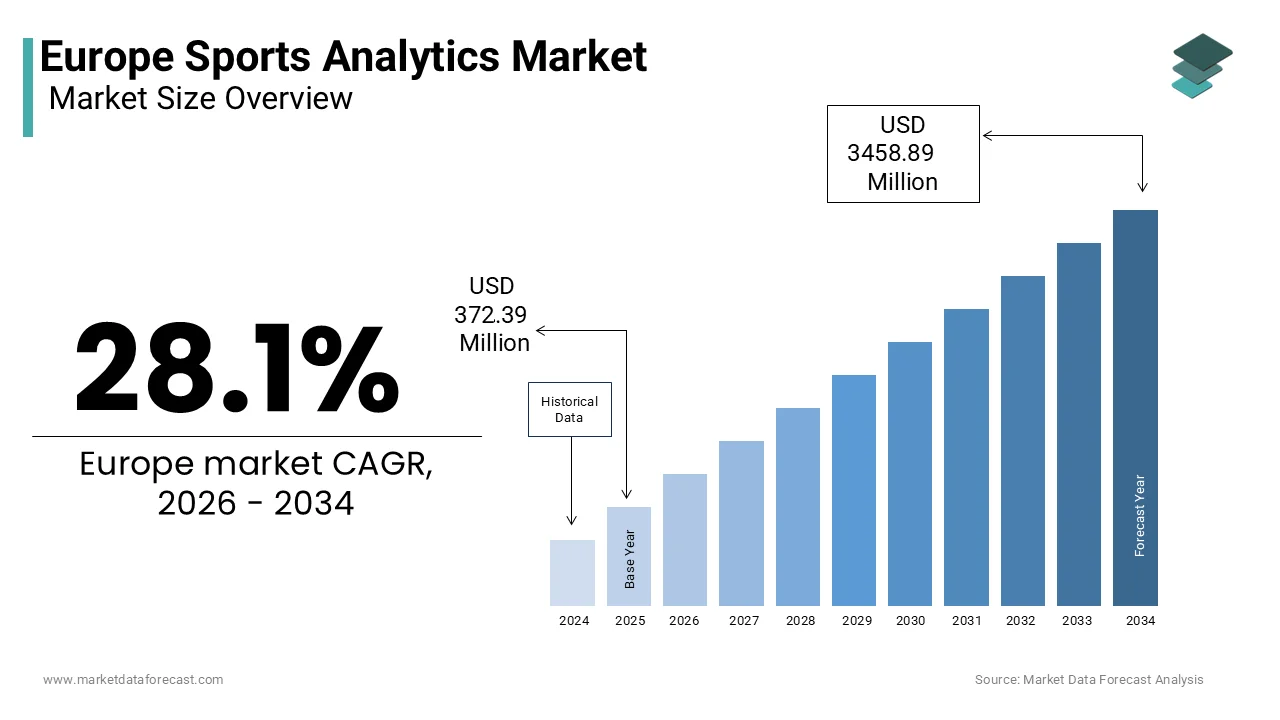
- Market Valuation: Valued at USD 372.39 million (2025), estimated at USD 477.03 million (2026), and projected to reach USD 3,458.89 million by 2034, registering a remarkable CAGR of 28.1% (2026–2034).
- Primary Growth Drivers: Institutionalization of performance tracking in elite football, UEFA-mandated officiating technologies, and rising broadcaster investments in fan engagement analytics. Key opportunities are boosted by AI-driven predictive injury models and second-screen betting data commercialization.
Key Market Segment Metrics (2026–2034)
| Category | Leading Segment (2025 Position) | Fastest-Growing Segment |
|---|---|---|
| By Analysis Type | On-Field Analysis (dominated with a 63.3% share in 2025 due to mandatory GPS and optical tracking in UEFA events) | Off-Field Analysis & Fan Engagement Analytics (projected growth supported by broadcasting demands) |
| By End User | Sports Teams & Clubs (accounted for 48.3% of end-use share in 2025) | Sports Betting Segment (anticipated to witness the fastest CAGR of 16.3% through forecast term) |
| By Region / Country | United Kingdom (led regionally with a 22.4% share in 2025) & Germany (19.1% share via Bundesliga and Fraunhofer protocols) | Spain (leveraging centralized Mediacoach platform) & Broader European National Federations |
Major Market Players & Market Structure
Market Structure: Highly competitive European sports tech and data analytics landscape featuring specialized software providers, tracking technology leaders, and official league partners competing intensely on GDPR-aligned cloud infrastructure and official data rights.
Key Companies: Sportradar Group AG, SAP SE, IBM Corporation, Catapult Sports, STATS Perform, Kinexon GmbH, Hudl, Opta Sports, SAS Institute Inc., Tableau Software, Zebra Technologies Corporation, Exasol AG, and Genius Sports.
Europe Sports Analytics Market Size
The europe sports analytics market was valued at USD 372.39 million in 2025, is expected to have a 28.1% CAGR from 2026 to 2034, and be worth USD 3458.89 million by 2034 from USD 477.03 million in 2026.
Sports analytics is the collection, processing, and interpretation of performance, biometric, tactical, and fan engagement data across professional and amateur sports ecosystems using advanced statistical modeling, artificial intelligence, and real-time tracking technologies. Sports analytics in Europe is shaped by region-specific regulatory frameworks such as the General Data Protection Regulation, which governs athlete and spectator data usage, and by the continent’s dense network of football academies, Olympic training centers, and elite leagues. Furthermore, the Union of European Football Associations mandated the use of semi-automated offside technology in all Champions League matches starting in 2023 by signaling institutional endorsement of analytics-driven officiating.
MARKET DRIVERS
Integration of Performance Analytics into Elite Football Development Pathways
The European football’s structured youth development infrastructure has become a primary driving factor for the growth of the European sports analytics market. All 56 Bundesliga and 2 Bundesliga clubs implemented standardized player tracking systems across their youth academies by 2025, monitoring over 12000 players annually for metrics such as sprint velocity, load tolerance, and positional entropy. Spain’s La Liga has also mandated the submission of biometric dashboards for all under-19 players in its youth competitions.
Rising Investment in Fan Engagement Technologies by Broadcasters and Stadium Operators
The broadcasters and venue managers leveraging data to personalize spectator experiences and maximize commercial yield are also driving the growth of Europe’s sports analytics market. As per the European Broadcasting Union, 78% of major sports rights holders in Europe incorporated real-time win probability and player impact metrics into live broadcasts during the 2025 football and rugby seasons. Stadium operators have followed suit, with the Allianz Arena in Munich deploying a dynamic pricing algorithm in 2025 that adjusted ticket costs based on opponent strength, weather, and historical attendance patterns. Similarly, the French Ligue 1 introduced a league-wide second-screen app in early 2025, thereby offering fans personalized heat maps and pass network visualizations, which achieved 2.1 million monthly active users by year's end, as confirmed by the league’s digital engagement audit. The European Stadium and Safety Management Association noted that 65 % of tier one stadiums now use Wi-Fi and beacon data to optimize concession flow and restroom staffing.
MARKET RESTRAINTS
Stringent Data Privacy Regulations Limiting Biometric Data Utilization
The General Data Protection Regulation imposes significant constraints on the collection and processing of athlete biometric and behavioral data, which is creating legal and operational friction for sports analytics providers. This factor is ascribed to limiting the growth of Europe’s sports analytics market. Under Article 9 of the GDPR, physiological data such as heart rate variability, sleep patterns, and GPS load metrics are classified as special category data, requiring explicit, informed consent and purpose limitation. Sports organizations in the EU faced formal compliance inquiries related to athlete data handling between 2022 and 2025. Furthermore, the Court of Justice of the European Union ruled in November 2023 that aggregated performance data derived from individual biometrics may still fall under GDPR scrutiny if re-identification is feasible.
Fragmentation of Data Standards Across Leagues and National Federations
The absence of unified data protocols across Europe’s diverse sporting landscape impedes interoperability and scalability of analytics solutions, hampering the growth of Europe’s sports analytics market. Football alone illustrates this challenge; the English Premier League uses OPTA event coding, La Liga relies on Mediacoach’s proprietary schema, and the Bundesliga employs a hybrid of InStat and custom metrics. This fragmentation forces software vendors to maintain multiple ingestion pipelines, raising integration costs by up to 35 % according to a Deloitte benchmark study of 18 European sports tech firms. Moreover, Olympic sports federations operate under entirely different frameworks, where the International Testing Agency reported in 2025 that only 11 of 32 European national anti-doping organizations used compatible performance monitoring formats, complicating longitudinal athlete health assessments. Even within countries, discrepancies persist.
MAKET OPPORTUNITIES
Expansion of Women’s Sports and Data Infrastructure Investment
The rapid professionalization of women’s sports across Europe is unlocking a new frontier for analytics deployment, which is driven by institutional mandates and commercial interest. All 55 member associations are committed to implementing performance tracking systems in their top-tier women’s leagues by 2025, with 38 already compliant by mid-2025. Similarly, the French Football Federation allocated 4.2 million euros in 2025 to equip Division 1 Féminine clubs with standardized data collection hardware. This structural uplift transforms women’s sports from a data-sparse domain into a high-growth analytics segment by offering vendors first-mover advantages in emerging datasets.
Adoption of Predictive Analytics in Grassroots Injury Prevention Programs
The public health initiatives are increasingly incorporating sports analytics to reduce youth sports injuries, which is creating Europe sports analytics market. According to the European Observatory on Health Systems and Policies, 19 EU member states launched national injury surveillance programs in 2025 that integrate wearable-derived load metrics with school-based sports participation records. Germany’s Federal Institute for Sports Science funded a nationwide rollout of the “SafePlay” analytics dashboard in 2025, used by over 12000 youth coaches to monitor acute to chronic workload ratios. The European Commission’s 2025 Sport and Health Strategy explicitly endorsed predictive analytics as a cost-effective tool for safeguarding young athletes.
MARKET CHALLENGES
Shortage of Cross-Disciplinary Talent Combining Sports Science and Data Engineering
The talent gap possesses the hybrid expertise required to translate athletic context into robust data models, which is hindering the growth of the European sports analytics market. According to the European University Sports Association, only 9 universities across the EU offered accredited postgraduate programs integrating sports science and data science as of 2025. Moreover, language and cultural barriers fragment the talent pool, with a French Ligue 1 club’s attempt to hire a German-based analyst failing in 2023 due to incompatible tactical terminology in data labeling.
Over-Reliance on Proprietary Black Box Algorithms Undermining Trust and Adoption
Many sports analytics vendors in Europe deploy opaque machine learning models whose decision logic cannot be audited by coaches or medical staff, breeding skepticism and resistance. This opacity becomes problematic under GDPR’s right to explanation. In 2023, a Spanish La Liga club terminated its contract with an analytics provider after players invoked Article 22 to challenge automated substitution recommendations. Furthermore, the European Club Association warned in its 2025 Technology Ethics Guidelines that non-transparent algorithms risk reinforcing confirmation bias if underlying assumptions remain hidden. Vendors like Stats Perform and Catapult have begun releasing model interpretability dashboards in response, but adoption remains inconsistent.
REPORT COVERAGE
| REPORT METRIC | DETAILS |
| Market Size Available | 2025 to 2034 |
| Base Year | 2025 |
| Forecast Period | 2026 to 2034 |
| Segments Covered | By Analysis Type, End-Use, and Region. |
| Various Analyses Covered | Global, Regional, and Country-Level Analysis, Segment-Level Analysis, Drivers, Restraints, Opportunities, Challenges; PESTLE Analysis; Porter’s Five Forces Analysis, Competitive Landscape, Analyst Overview of Investment Opportunities |
| Countries Covered | UK, France, Spain, Germany, Italy, Russia, Sweden, Denmark, Switzerland, Netherlands, Turkey, Czech Republic, and the Rest of Europe |
| Market Leaders Profiled | Sportradar Group AG, SAP SE, IBM Corporation, Catapult Sports, STATS Perform, Kinexon GmbH, Hudl, Opta Sports, SAS Institute Inc., Tableau Software, Zebra Technologies Corporation, Qualitas Global Services BV, ChyronHego Corporation, Exasol AG, Genius Sports |
SEGMENTAL ANALYSIS
By Analysis Type Insights
The on-field analysis segment dominated the European sports analytics market in 2025, with a 63.3% share, due 2025 to the deep institutionalization of performance tracking in elite training and match environments across football, rugby, and handball. According to the Union of European Football Associations, all clubs participating in UEFA club competitions were required to submit GPS and optical tracking data for every match starting in the 2023–2025 season, generating over 12000 hours of structured on-field datasets annually. Additionally, national Olympic committees have embedded on-field analytics into athlete development.
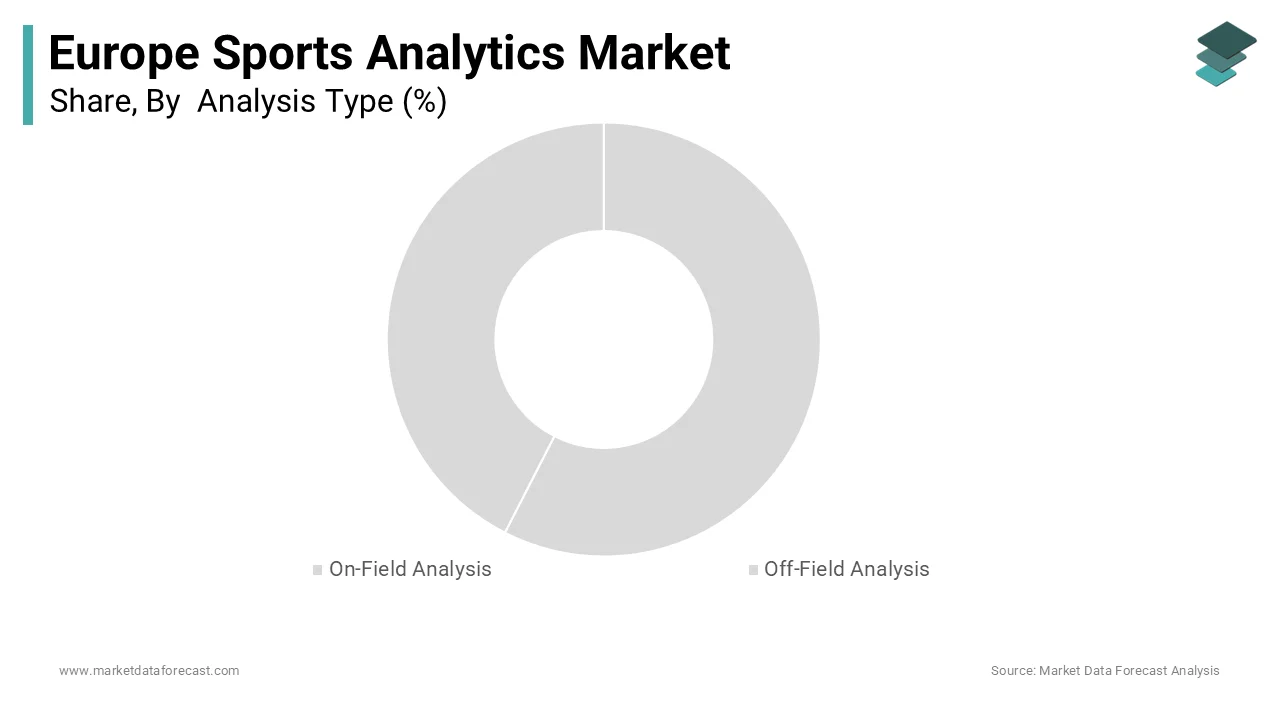
The off-field analysis segment is projected to expand at a CAGR of 14.8% throughout the forecast period with the commercialization of fan behavior and venue operations data. The broadcasters are investing heavily in off-field engagement metrics, where the European Broadcasting Union confirmed that major sports rights holders in Europe now license second-screen analytics, including attention duration and click-through rates to advertisers.
By End-Use Insights
The sports teams segment was the largest by accounting for 48.3% of Europe's sports analytics market share in 2025, with the direct operational dependency of clubs on data for talent acquisition, injury prevention, and tactical preparation. UEFA Champions League participating clubs employed dedicated analytics departments by 202,4, with average staff sizes increasing from 4.2 to 7.8 members between 2021 and 2025. Investment in proprietary tracking infrastructure is also significant.
The sports betting segment is projected to grow at a CAGR of 16.3% throughout the forecast period with the legalization of advanced in-play betting models and real-time data licensing across European jurisdictions. The licensed operators integrated expected goals and possession dominance metrics into their betting interfaces during the 2023–2025 La Liga season. Furthermore, the European Sports Security Association noted in 2025 that official data partnerships between leagues and betting firms grew by 41 % year on year by ensuring data integrity and revenue sharing. This symbiotic ecosystem between regulated betting and real-time analytics is redefining commercial sports data flows.
COUNTRY LEVEL ANALYSIS
United Kingdom Sports Analytics Market Analysis
The United Kingdom was the top performer in the European sports analytics market with a 22.4% share in 2025, with its mature football ecosystem, advanced broadcast infrastructure, and progressive regulatory stance on data commercialization. According to Ofcom, all Premier League matches in the 2023–2025 season featured at least three proprietary analytics overlays, including expected threat and pressure regains in domestic broadcasts, which is setting a regional benchmark. The UK Gambling Commission’s 2025 licensing data revealed that 37 betting operators held official data partnerships with British sports bodies, the highest in Europe. Additionally, institutions like Loughborough University and the Alan Turing Institute collaborate on sports AI research, with over 14 joint projects funded in 2025.
Germany Sports Analytics Market Analysis
Germany was positioned second by holding 19.1% Europe's sports analytics market share in 2025, with its engineering-driven approach to athlete performance and public investment in sports science. Bundesliga clubs used integrated GPS and video fusion platforms in 2025 with data feeds directly linked to medical and conditioning staff dashboards. Furthermore, the Fraunhofer Institute launched a sports data interoperability protocol in 2025, adopted by 23 national federations to standardize metric definitions.
France Sports Analytics Market Analysis
France's sports analytics market is expected to grow with significant growth opportunities throughout the forecast period, with its centralized sports governance and strategic focus on youth development analytics. All 42 elite football academies accredited under the “Pôle Espoirs” system implemented standardized load monitoring protocols in 2025 by tracking over 5000 adolescents for injury risk. Additionally, France’s regulatory clarity on athlete data, a that codified in the 2023 Sports Data Charter, has attracted analytics vendors seeking GDPR compliant testing grounds.
Spain Sports Analytics Market Analysis
Spain's sports analytics market growth is propelled by La Liga’s aggressive data monetization strategy and technological partnerships. All 20 top division clubs use the league’s centralized Mediacoach platform, which processes over 2 billion tracking events per season. Spain’s National Sports Council also funded a nationwide rollout of injury prediction dashboards to regional federations in 2025, covering over 800 amateur clubs. The integration of league-wide data infrastructure with commercial exploitation models positions Spain as a scalable analytics hub.
Italy Sports Analytics Market Analysis
Italy's sports analytics market growth is likely to be propelled by Serie A’s tactical analytics culture and rising investment in fan engagement technologies. The league’s partnership with AWS, expanded in early 2025, enabled real-time win probability models during broadcasts, increasing average viewer dwell time by 17 % as per AGCOM’s media consumption survey. Additionally, Italian clubs led Europe in social media sentiment integration, with Juventus and AC Milan using NLP tools to adjust communication strategies based on fan emotion analytics.
COMPETITIVE LANDSCAPE
The European sports analytics market features intense competition among global technology firms, specialized sports data providers, and emerging AI startups. Dominant players leverage official league partnerships and proprietary tracking infrastructure to create high entry barriers, while niche vendors differentiate through explainable AI or sport-specific biomechanical models. Competition is increasingly defined by compliance capabilities, as GDPR and national data laws demand localized data handling and athlete consent frameworks. The market is also bifurcating into two value chains: on-field performance analytics, dominated by wearable and video firms, and off-field commercial analytics led by betting and broadcast data specialists. Cross-border consolidation is accelerating, with larger firms acquiring computer vision and natural language processing startups to enhance real-time insight generation.
KEY MARKET PLAYERS
Some of the companies that are playing a dominating role in the europe sports analytics market include
- Sportradar Group AG
- SAP SE
- IBM Corporation
- Catapult Sports
- STATS Perform
- Kinexon GmbH
- Hudl
- Opta Sports
- SAS Institute Inc.
- Tableau Software
- Zebra Technologies Corporation
- Qualitas Global Services BV
- ChyronHego Corporation
- Exasol AG
- Genius Sports
TOP LEADING PLAYERS IN THE MARKET
- Stats Perform is a leading force in the European sports analytics market, delivering AI-powered performance and fan engagement solutions to over 1200 teams and leagues globally. The company combines optical tracking, event data, and predictive modeling to serve elite football clubs, broadcasters, and betting operators across Europe. It also expanded its official data partnerships with La Liga and the English Football League, reinforcing its role as a trusted data steward under GDPR. These initiatives strengthen its integration into both performance and commercial sports ecosystems across the continent.
- Catapult Sports is a prominent provider of wearable athlete monitoring systems widely adopted by European football, rugby, and Olympic sport organizations. Headquartered in Australia but with major operational hubs in London and Munich, the company supplies GPS and inertial sensor technology to over 70 % of Premier League and Bundesliga clubs. It also partnered with the German Olympic Sports Confederation to standardize workload metrics across national training centers, deepening its institutional footprint in high-performance sport.
- Sportradar plays a pivotal role in the European sports analytics market through its fusion of integrity services, betting data, and media intelligence. The Swiss-based company supplies official real-time data to over 900 sports federations and betting operators worldwide, with a strong presence in European football, basketball, and tennis. It also launched a fan engagement analytics suite for broadcasters, offering second-screen content driven by live win probability and player impact scores.
TOP STRATEGIES USED BY THE KEY MARKET PARTICIPANTS
Key players in the European sports analytics market focus on securing official data partnerships with leagues and federations to ensure exclusivity and regulatory compliance. They invest in GDPR aligned cloud infrastructure to address data sovereignty concerns across EU member states. Companies enhance product differentiation through AI-driven predictive models for injury risk and tactical outcomes. Strategic collaborations with broadcasters and betting operators unlock dual revenue streams from performance and commercial analytics. Additionally, they expand into grassroots and Olympic sports through public sector tenders, which is broadening market reach beyond elite clubs.
MARKET SEGMENTATION
This research report on the europe sports analytics market is segmented and sub-segmented into the following categories:
By Analysis Type
- On-Field Analysis
- Off-Field Analysis
By End-Use
- Sports Teams
- Sports Betting
- Others
By Country
- United Kingdom
- Germany
- France
- Spain
- Italy
- Rest of Europe