- Product Description Description
- Table of Contents TOC
- List of Table & Figure LOT
- Get Free Sample PDF Sample PDF
Market Size, 2025
$805.42 MnMarket Estimate, 2026
$913.35 MnMarket Forecast, 2034
$2497.71 MnCAGR, 2026–2034
13.4%Executive Summary: Europe Intelligent Document Processing Market
- Market Scope: Comprehensive European intelligent document processing (IDP) industry analysis covering functional application sectors, deployment models (cloud, on-premises), vertical end-use segments, regional leadership frameworks, strategic corporate developments, and competitive landscapes.
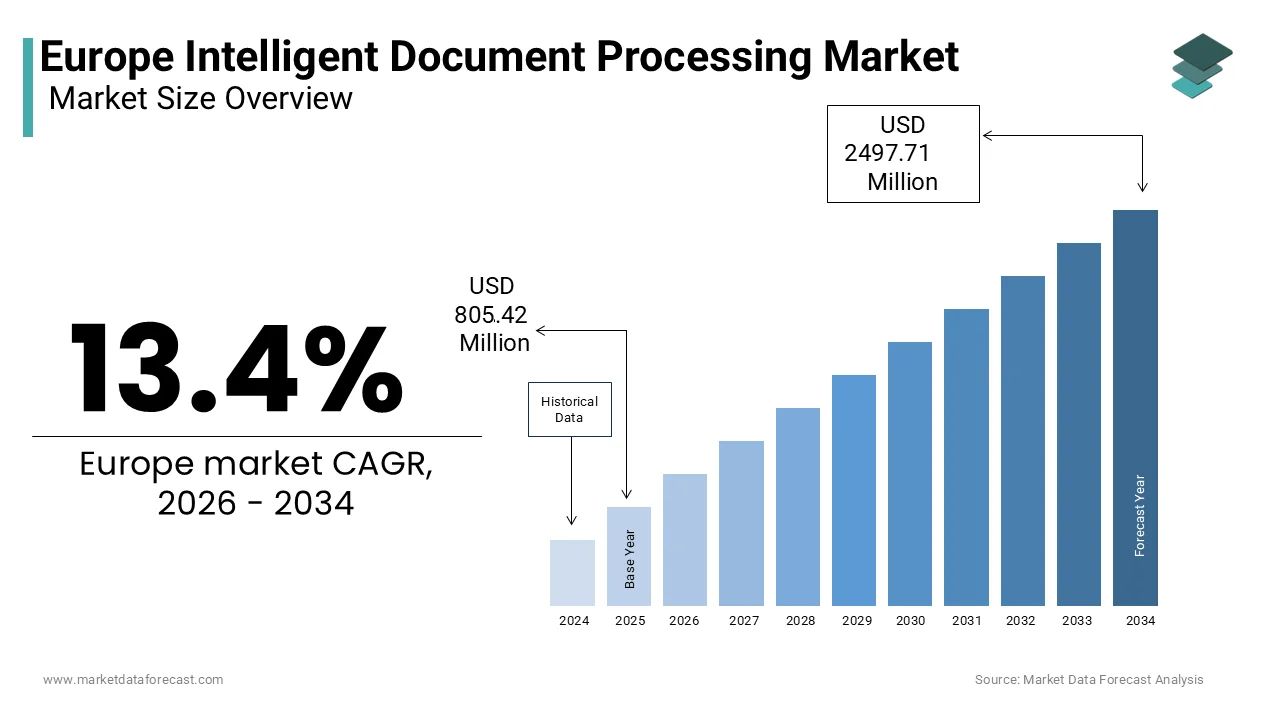
- Market Valuation: Valued at USD 805.42 million (2025), estimated at USD 913.35 million (2026), and projected to reach USD 2,497.71 million by 2034, registering a robust CAGR of 13.4% (2026–2034).
- Primary Growth Drivers: Stringent regulatory compliance under GDPR and EU MDR, administrative labor shortages, public sector digitalization initiatives allocating EU AI funds, euro-area invoice automation demands, and healthcare documentation burdens. Restraints include multilingual handwriting ambiguity, unstandardized vendor accuracy metrics, and data residency mandates.
Key Market Segment Metrics (2026–2034)
| Category | Leading Segment / Region (Position) | Fastest-Growing Segment |
|---|---|---|
| By Function & Deployment | Finance and Accounting (dominated with 38.1% share in 2025) & Cloud deployment (captured 62% market share via scalability) | Human Resources (predicted to witness the highest CAGR of 24.7% from 2025 to 2033 via hybrid work models) |
| By Vertical End-Use | Banking, Financial Services, and Insurance (BFSI led adoption with 35.7% share in 2025) | Healthcare and Life Sciences (fastest-growing vertical due to aging populations and digitized regulations) |
| By Region / Country | Germany (top performer accounting for 24.6% share in 2025) & United Kingdom (18.4% share) | France (identified as the fastest-growing region through state-led sovereign AI document processing initiatives) |
Major Market Players & Market Structure
Market Structure: Highly strategic European document intelligence ecosystem driven by generative AI contextual integration, sovereign cloud data residency compliance (hosted on German and French infrastructure), and pre-built industry templates for banking and public sectors.
Key Companies: ABBYY, Kofax Inc., UiPath Inc., Automation Anywhere Inc., Appian Corporation, Datamatics Global Services Limited, HCL Technologies Limited, Hyperscience, Rossum Ltd., Blue Prism Group PLC, EdgeVerve Systems Limited, Cognizant Technology Solutions Corporation, Microsoft Corporation, IBM, and WorkFusion Inc.
Europe Intelligent Document Processing Market Size
The europe intelligent document processing market was valued at USD 805.42 million in 2025 and is projected to reach USD 2497.71 million by 2034, increasing from USD 913.35 million in 2026, growing at a CAGR of 13.4% during the forecast period from 2026 to 2034.
Intelligent Document Processing (IDP) is a technology that uses AI, machine learning, and natural language processing (NLP) to automate the extraction, classification, and processing of data from various documents, including unstructured ones like contracts and emails. Unlike traditional optical character recognition, this market leverages natural language processing, machine learning, and contextual understanding to transform paper-based or digital documents into actionable structured data. This capability is increasingly vital across sectors burdened by legacy documentation workflows, including banking, insurance, healthcare, and public administration. According to sources, despite ongoing digitalisation efforts, many large European enterprises continue to manage core business processes using a mix of digital and traditional physical or scanned documents, indicating significant room for efficiency improvements. As per research, the persistence of administrative inefficiencies, particularly those related to document handling in sectors like finance, is widely acknowledged to incur substantial costs across the EU economy, prompting a continued push by European institutions for greater automation and digital integration. Driven by regulatory digitization mandates such as the EU Digital Identity Framework and rising labor costs, the market represents a convergence of compliance automation and operational resilience where intelligent systems not only reduce errors but also enable real-time decision making in complex regulatory environments.
MARKET DRIVERS
Stringent Regulatory Compliance and Audit Requirements Across Financial and Healthcare Sectors
European organizations face escalating pressure to maintain meticulous documentation for regulatory audits, particularly in highly supervised domains such as banking and healthcare, which directly fuels the growth of the Europe intelligent document processing market. The General Data Protection Regulation mandates strict records of processing activities, with non-compliance penalties reaching up to a small portion of global turnover, as per studies. In 2023, national supervisory authorities issued a high volume of fines totaling a significant amount, according to research. Concurrently, the European Banking Authority requires institutions to retain and retrieve transaction records for at least seven years with full traceability. This has led banks like BNP Paribas and ING to deploy AI-powered document understanding systems that auto-classify and redact sensitive data across millions of customer files. In healthcare, the EU Medical Device Regulation demands comprehensive documentation for every device lifecycle stage. Under the European Union Medical Device Regulation (MDR), tens of thousands of medical device applications were submitted to notified bodies, requiring validation of hundreds of pages of clinical and technical evidence. Intelligent document processing enables real-time compliance by extracting and cross-referencing data against regulatory templates, reducing manual review time. These regulatory imperatives transform document intelligence from an efficiency tool into a strategic risk mitigation necessity.
Persistent Labor Shortages and Rising Operational Costs in Administrative Functions
Region’s tightening labor landscape and escalating wage pressures in administrative roles are accelerating the expansion of the Europe intelligent document processing market. Research indicates that Europe’s historically low unemployment levels are contributing to persistent labor shortages across several occupational categories, including administrative and back-office functions. Administrative support roles are increasingly difficult to fill in many EU member states, which drives organizations to adopt automation and digital workflow tools to maintain operational continuity. Simultaneously, rising labor costs across the European business sector continue to pressure profit margins by prompting stronger investment in productivity-enhancing technologies. In response, large enterprises are automating document-intensive workflows to maintain service levels without proportional headcount growth. For example, public institutions in France have successfully implemented intelligent automation systems to streamline benefit processing, significantly reducing manual workload while maintaining high data accuracy rates. Similarly, according to research, Sweden’s tax administration has optimized its invoice management through automated verification solutions, achieving substantial reductions in processing time and improving overall administrative efficiency. These implementations are not merely cost-driven but address a fundamental mismatch between growing documentation volumes and shrinking availability of skilled administrative staff, which makes intelligent automation a critical enabler of operational continuity.
MARKET RESTRAINTS
Integration Limitations with Legacy Enterprise Systems and Fragmented IT Landscapes
Incompatibility with entrenched legacy infrastructure, particularly in the public sector and traditional industries, is a restraint on the Europe intelligent document processing market. Many European organizations operate on decades-old enterprise resource planning systems such as SAP ECC or custom mainframe applications that lack modern APIs or cloud native architecture. According to a study, many medium-sized enterprises reported that their core IT systems cannot natively support AI-driven document ingestion without costly middleware. Public institutions face even greater hurdles. As per the source, some EU member states still rely on paper-based or siloed digital systems for social benefit processing, delaying the integration of intelligent solutions. This fragmentation increases implementation complexity and total cost of ownership. Many organizations, recognizing automation's value, remain stuck in suboptimal manual workflows because they lack standardized interoperability frameworks or public funding for legacy modernization.
Data Privacy and Sovereignty Concerns Under EU Digital Governance Frameworks
Stringent data governance requirements limit where and how sensitive information can be processed, which constrains the expansion of the Europe intelligent document processing market. The EU’s Data Act and the Cyber Resilience Act mandate that personal and commercially sensitive data remain within approved jurisdictions unless specific safeguards are met. According to the European Data Protection Supervisor, over 40 percent of intelligent document processing vendors rely on cloud infrastructure hosted partially outside the European Economic Area, raising compliance risks. In May 2023, the Irish Data Protection Commission (DPC) fined the tech giant Meta a record €1.2 billion for using a U.S.-based data transfer mechanism (Standard Contractual Clauses) that transferred European user data to the U.S. without adequate transfer impact assessments or sufficient protection from U.S. intelligence agencies. These restrictions fragment the vendor landscape and increase costs. As per the study, sovereign AI document solutions cost more than global cloud equivalents due to limited scale and redundant security layers. Many organizations are choosing to delay the adoption of new technologies to prevent regulatory exposure until harmonized certification schemes, like the EU AI Act's conformity assessments, become fully operational.
MARKET OPPORTUNITIES
Expansion of AI-Enabled Document Workflows in Public Sector Digitalization Programs
The European public sector is setting up new opportunities for the growth of the Europe intelligent document processing market. This happens through large-scale digital government initiatives aimed at modernizing citizen services. The EU has allocated funds specifically for AI deployment in public administration, with document automation as a priority use case. Countries already process the majority of citizen interactions digitally, but Southern and Eastern European nations are now accelerating catch-up efforts. According to research, Italy’s national modernization agenda is investing heavily in automation within public administration, aiming to streamline document management processes across social security and tax departments while improving service delivery efficiency. As per sources, Spain is advancing digital transformation initiatives through AI-enabled document processing programs that integrate regional permit systems and significantly reduce administrative approval times, which reflects a broader shift toward intelligent public sector operations. These programs are not isolated. So, this institutional shift offers a scalable and replicable market for vendors capable of delivering secure, compliant, and multilingual solutions.
Convergence with Generative AI for Contextual Document Understanding and Decision Support
The integration of generative AI models with traditional IDP is opening new capabilities in contextual reasoning and automated decision making across European enterprises, which in turn creates fresh prospects for the expansion of the Europe intelligent document processing market. Unlike rule-based extraction, generative AI can interpret ambiguous language, infer intent, and draft responses based on document content. In legal services, firms use generative document assistants to analyze contract clauses and flag non-compliant terms against EU regulations, reducing review time. In insurance, Allianz has piloted a system that reads accident reports and medical records to auto-generate claim assessments with human-in-the-loop validation, achieving straight-through processing for standard cases. Increased specialization and compliance with the EU AI Act's transparency requirements will drive a convergence in document processing through the use of foundation models. This transition from data capture to cognitive augmentation will empower businesses to make decisions that are faster, more consistent, and auditable.
MARKET CHALLENGES
Ambiguity in Multilingual and Handwritten Document Interpretation Across European Jurisdictions
The continent’s linguistic diversity and the prevalence of non-standardized handwritten inputs, particularly in healthcare and legal domains, obstruct the growth of the Europe intelligent document processing market. The EU has several official languages and regional languages, many with limited digital corpora for training accurate AI models. The gap is critical in cross-border contexts. A medical discharge summary from Greece may contain mixed Greek and English terminology, while a notarized deed in Belgium could combine Dutch, French, and German. Handwriting adds another layer of complexity. In healthcare, this is acute. A portion of patient intake forms remains handwritten, as per sources. These variations degrade model performance, reduce automation rates, and increase reliance on human correction loops, weakening the business case for deployment, especially for small and medium enterprises lacking resources for custom model training.
Lack of Standardized Evaluation Metrics and Vendor Transparency in Performance Claims
Absence of uniform benchmarks to assess solution accuracy, reliability, and compliance makes procurement decisions highly subjective and risky, and this hampers the expansion of the Europe intelligent document processing market. Unlike sectors with established testing protocols, such as cybersecurity or medical devices, document AI vendors often cite proprietary or non-reproducible metrics without disclosing document types, error definitions, or testing conditions. According to studies, only a portion of vendor claims underwent third-party validation, and most evaluations used synthetic or English-only datasets irrelevant to European operational realities. This opacity is problematic under the EU AI Act, which requires high-risk systems to demonstrate robustness, yet provides no standardized methodology for document processing applications. Public sector buyers are especially vulnerable. Efforts to compare solutions or ensure accountability remain fragmented without industry-wide benchmarks, like those proposed by the European Committee for Standardization under CEN CENELEC JTC 21. This uncertainty slows adoption, particularly among risk-averse institutions that cannot verify whether promised automation levels are achievable in their specific multilingual and regulatory context.
REPORT COVERAGE
| REPORT METRIC | DETAILS |
| Market Size Available | 2025 to 2034 |
| Base Year | 2025 |
| Forecast Period | 2026 to 2034 |
| Segments Covered | By Function, Deployment Model, Industry, and Region. |
| Various Analyses Covered | Global, Regional, and Country-Level Analysis, Segment-Level Analysis, Drivers, Restraints, Opportunities, Challenges; PESTLE Analysis; Porter’s Five Forces Analysis, Competitive Landscape, Analyst Overview of Investment Opportunities |
| Countries Covered | UK, France, Spain, Germany, Italy, Russia, Sweden, Denmark, Switzerland, Netherlands, Turkey, Czech Republic, and the Rest of Europe |
| Market Leaders Profiled | ABBYY, Kofax Inc., UiPath Inc., Automation Anywhere Inc., Appian Corporation, Datamatics Global Services Limited, HCL Technologies Limited, IBM Corporation, OpenText Corporation, Parascript LLC, Hyland Software Inc., Celaton Limited, AntWorks Pte. Ltd., WorkFusion Inc., Hyperscience, Rossum Ltd., Blue Prism Group PLC, EdgeVerve Systems Limited (an Infosys company), Cognizant Technology Solutions Corporation, Microsoft Corporation |
SEGMENTAL ANALYSIS
By Function Insights
The finance and accounting segment continued to dominate the Europe intelligent document processing market by accounting for 38.1% share in 2025. The high volume of structured yet repetitive documentation, such as invoices, purchase orders, and bank statements that are ripe for automation, drives the growth of the finance and accounting segment. Moreover, the urgent need to comply with evolving financial regulations while managing cost pressures also fuels the growth of this segment. According to research, billions of invoices are processed annually in the euro area alone, with small and medium enterprises accounting for a portion of this volume. Manual processing costs some euros per invoice. Major banks have deployed AI-powered invoice matching systems that achieve straight-through processing rates, reducing payment delays and fraud risks. The convergence of regulatory mandates, cost efficiency imperatives, and the maturity of financial document templates makes this segment the most advanced and widely adopted use case across European enterprises.
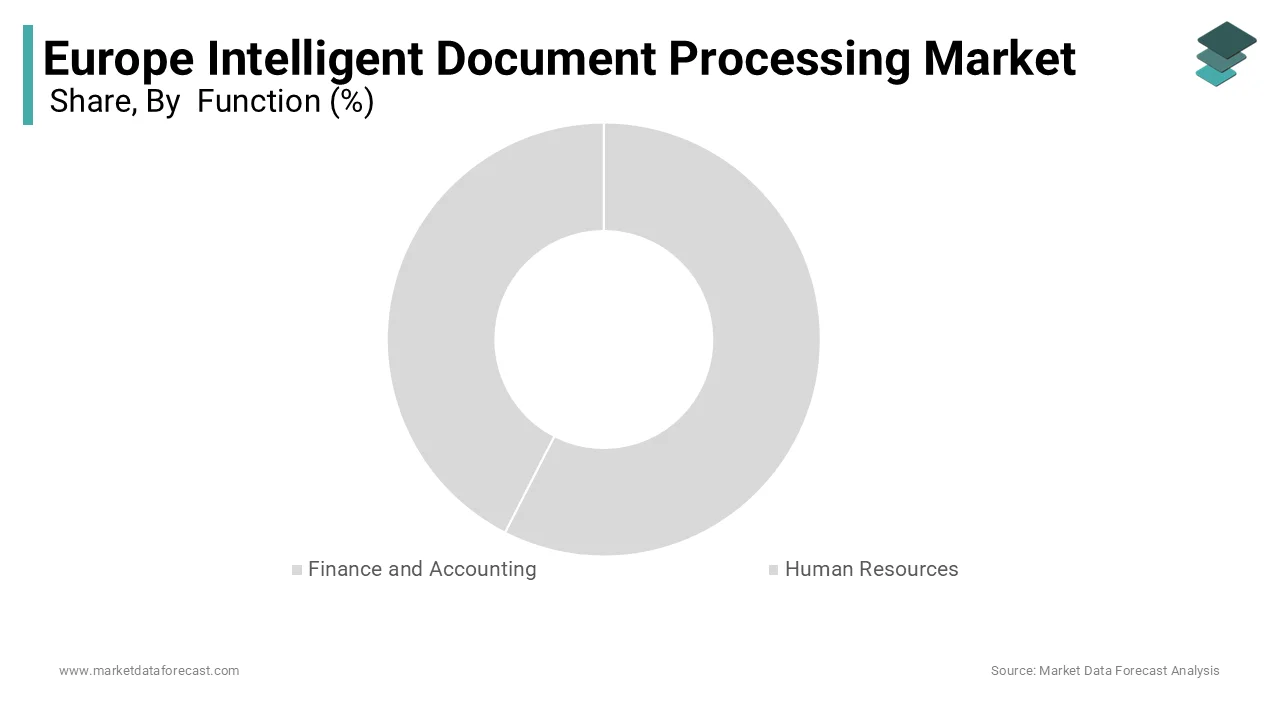
The human resources segment is predicted to witness the highest CAGR of 24.7% from 2025 to 2033 due to the surge in hybrid work models and tightening labor market conditions that demand faster, more accurate candidate and employee data handling. According to research, the EU recorded millions of job vacancies in 2023, with average time to fill roles exceeding several days in sectors like IT and healthcare. Intelligent document processing accelerates recruitment by parsing resumes, extracting skills, and matching them against job descriptions in seconds. Some of the companies use AI systems that reduce initial screening time while improving diversity through bias-mitigated parsing. Beyond hiring, onboarding automation is critical. These capabilities address both speed and compliance needs in a region with complex cross-border employment rules, making HR the most dynamically growing functional segment.
By Deployment Model Insights
The cloud segment captured the majority share of 62% of the Europe intelligent document processing market in 2025. The prominence of the cloud segment is attributed to its scalability, rapid implementation, and lower upfront investment compared to on-premises alternatives. European enterprises, particularly small and medium businesses, favor cloud solutions to avoid the burden of maintaining specialized AI infrastructure. According to studies, a share of EU companies with employees use cloud-based enterprise applications, with document processing among the top three use cases. The General Data Protection Regulation initially slowed cloud adoption,n but the emergence of EU sovereign cloud providers has restored confidence. These platforms guarantee data residency and comply with the EU Cloud Rulebook, which mandates transparency in data handling. Besides, cloud vendors offer continuous model updates. The combination of regulatory-aligned infrastructure, pay-as-you-go pricing, and automatic feature enhancements makes cloud the default choice for organizations seeking agile and compliant document automation.
On-premises segment is estimated to register the fastest CAGR of 19.3% during the forecast period, owing to heightened data sovereignty requirements in highly regulated sectors such as defense, public administration, and critical infrastructure. On-premises solutions are gaining ground where sensitive documents cannot leave internal networks, despite the overall dominance of cloud technology. This has spurred investments in private AI stacks. Moreover, banks have opted for on-premises models to comply. Driven by the EU AI Act’s high-risk classification for certain document applications and national security policies on on-premises deployment is growing as a necessary complement to cloud rather than a legacy alternative.
By Industry Insights
The banking, financial services, and insurance segment led the Europe intelligent document processing market and occupied 35.7% share in 2025. The growth of the banking, financial services, and insurance segment is because to its document-intensive operations, stringent compliance obligations, and high cost of manual errors. European banks process millions of loan applications, insurance claims, and KYC documents annually, each requiring verification against multiple regulatory frameworks. According to the source, financial institutions submitted a large number of customer due diligence records under anti-money laundering directives. Manual handling not only incurs costs but also exposes firms to regulatory penalties. In response, banks have deployed intelligent systems that extract data from passports, utility bills, and bank statements with a high degree of accuracy, enabling real-time risk scoring. Insurers use similar technology to auto-interpret medical reports and police records for claims adjudication, reducing settlement time from weeks to hours. The sector’s early digitization maturity, regulatory pressure, and direct link between document accuracy and financial risk solidify its position as the largest adopter.
The healthcare and life sciences segment is anticipated to witness the fastest CAGR of 6.1% from 2025 to 2033. The rapid expansion of the healthcare and life sciences segment is fueled by the urgent need to digitize vast volumes of unstructured clinical and administrative records while complying with strict privacy laws. According to studies, a share of patient data in Europe remains in paper or scanned PDF for, creating barriers in care coordination and research. Hospitals have implemented AI systems that read handwritten doctor notes, discharge summaries, and lab reports, converting them into structured EHR entries with accuracy. In clinical trials, pharmaceutical companies face immense documentation burdens. Intelligent processing reduces submission preparation time, accelerating drug approvals. Care complexity is rising due to aging populations, and regulations are becoming more digitized; consequently, this area is seeing the fastest increase in adoption.
COUNTRY LEVEL ANALYSIS
Germany Intelligent Document Processing Market Analysis
Germany was the top performer in the Europe intelligent document processing market and accounted for a 24.6% share in 2025. Factors such as its advanced industrial base, strong data protection culture, and government support for AI sovereignty have significantly contributed to the domination of Germany in the regional market. The country’s manufacturing and financial sectors generate immense documentation volumes with billions of invoices processed annually. Companies have integrated native document understanding into their enterprise suite, accelerating adoption across supply chains. Crucially, Germany enforces strict on-premises requirements for sensitive data under the Bundesdatenschutzgesetz, prompting local vendors to develop GDPR compliant AI models trained on German legal and technical corpora. This blend of regulatory rigor, technological capabilities, ty and public investment ensures Germany’s continued dominance in shaping the market’s trajectory.
United Kingdom Intelligent Document Processing Market Analysis
The United Kingdom was the second largest in the European intelligent document processing market by capturing 18.4% share in 202I. 's world-class financial, legal, and insurance sectors demand high precision document automation, fueling the growth of the United Kingdom. London hosts global law firms and international banks, many of which pioneered AI-based contract review and KYC automation. According to research, many top-tier firms use intelligent document systems to analyze lease agreements, merger documents, and compliance filings, reducing review time. Post Brexit, the UK has accelerated its own AI regulatory framework, which includes clear guidelines for document processing under the AI Regulation White Paper. Companies have developed sector-specific models trained on UK case law and financial regulations. Despite leaving the EU, the UK remains deeply integrated into European data flows through adequacy decisions, enabling cross-border document processing solutions that serve both markets.
France Intelligent Document Processing Market Analysis
France is the fastest-growing region in the Europe intelligent document processing market, with its emphasis on technological sovereignty and large-scale public sector digitization. As per studies, millions of administrative documents are processed annually by ministries ranging from tax declarations to social benefit applications. The state-led cloud provider offers sovereign AI document processing that guarantees data remains within French jurisdiction, complying with both GDPR and national security laws. Major banks have deployed these solutions to automate mortgage file allocation a achieve straight-through processing. The National Commission on Informatics and Liberty actively audits these deployments, ensuring algorithmic transparency. France’s coordinated approach, blending public investment, non-sovereign infrastructure, a nd regulatory oversight, creates a distinct yet influential market model.
Netherlands Intelligent Document Processing Market Analysis
The Netherlands expanded steadily in the Europe intelligent document processing market due to its position as a logistics and trade hub requiring multilingual document handling across global supply chains. The Port of Rotterdam alone processes millions of shipping documents annually, including bills of lading, customs declarations, and certificates of origin in multiple languages. Companies have implemented AI systems that auto-classify and extract data from invoices in Dutch, English, German French, achieving accuracy even with mixed language inputs. Crucially, the Netherlands hosts major EU data centers from Microsoft and Google that offer GDPR compliant document AI services serving the wider Benelux region. This combination of trade intensity, linguistic diversity, and digital governance makes the Netherlands a testbed for scalable multilingual document intelligence.
Sweden Intelligent Document Processing Market Analysis
Sweden is likely to grow in the Europe intelligent document processing market from 2025 to 2033 due to its digitally mature public sector and strong emphasis on sustainable automation. As per research, a share of citizen interactions are already digital, al, but legacy document backlogs remain in social services and immigration. The country’s green tech ethos extends to AI. Vendors emphasize energy-efficient model training and transparent algorithms aligned with Sweden’s AI Ethics Framework. In the private sector, companies like Ericsson and Volvo use document intelligence to automate sustainability reporting, extracting emissions data from supplier invoices and logistics records to comply with the EU Corporate Sustainability Reporting Directive. Sweden’s blend of public efficiency, digital trust, and sustainability alignment positions it as a forward-looking adopter, shaping ethical and purpose-driven automation standards.
COMPETITIVE LANDSCAPE
Competition in the Europe intelligent document processing market is characterized by a dynamic interplay between global technology giants, specialized AI vendors, and emerging startups. Large players like Microsoft and Google leverage their cloud infrastructure and ecosystem integration to offer scalable solutions, while niche firms such as ABBYY and Rossum focus on deep domain expertise in finance or logistics. European startups are gaining ground by emphasizing data sovereignty, multilingual support, and compliance with the EU AI Act’s transparency requirements. The market is highly innovation-driven with rapid adoption of generative AI transformer models and zero-shot learning to reduce dependency on labeled training data. However, fragmentation remains a challenge due to varying national regulations, ns language requirements,nts, and legacy IT systems. Differentiation increasingly hinges on accuracy in real-world scenarios, not just lab benchmarks, and the ability to deliver hybrid deployment models. This environment fosters both collaboration through partnerships and intense rivalry in vertical-specific use cases, making the competitive landscape fluid and technologically sophisticated.
KEY MARKET PLAYERS
Some of the companies that are playing a dominating role in the global europe intelligent document processing market include
- ABBYY
- Kofax Inc.
- UiPath Inc.
- Automation Anywhere Inc.
- Appian Corporation
- Datamatics Global Services Limited
- HCL Technologies Limited
- IBM Corporation
- OpenText Corporation
- Parascript LLC
- Hyland Software Inc.
- Celaton Limited
- AntWorks Pte. Ltd.
- WorkFusion Inc.
- Hyperscience
- Rossum Ltd.
- Blue Prism Group PLC
- EdgeVerve Systems Limited (an Infosys company)
- Cognizant Technology Solutions Corporation
- Microsoft Corporation
TOP LEADING PLAYERS IN THE MARKET
- ABBYY is a global leader in intelligent document processing with deep roots in Europe and a strong influence on worldwide document AI standards. The company provides advanced solutions for data capture, e-classification, and extraction used by financial institutions, government agencies, and logistics firms across the continent. Recently, ABBYY enhanced its Vantage platform with generative AI capabilities, enabling contextual understanding of complex contracts and multilingual forms. It also launched a sovereign cloud offering hosted on German and French infrastructure to comply with EU data residency requirements. These innovations reinforce ABBYY’s role in delivering secure, scalable, and regulation-aligned document intelligence to enterprises navigating Europe’s complex compliance landscape.
- Microsoft plays a pivotal role in the Europe intelligent document processing market through its Azure AI Document Intelligence service integrated into the broader Microsoft Cloud ecosystem. The company serves thousands of European enterprises, leveraging its native compatibility with Office 365, Dynamics 365, and Power Platform. It also partnered with European banks and public sector bodies to co-develop industry-specific document understanding templates. These actions strengthen Microsoft’s position as an enabler of enterprise-scale automation while ensuring alignment with regional regulatory and linguistic demands.
- UiPath drives adoption of intelligent document processing in Europe by embedding AI-powered document understanding into its end-to-end automation platform. The company serves a wide range of industries, including iinsurancemanufacturing, and public administration, with solutions that combine robotic process automation and machine learning. Recently, UiPath launched Document Understanding Cloud with on-premises fallback options to meet EU data sovereignty expectations. It also established an AI Center of Excellence in Amsterdam focused on training models on European legal and financial document formats. Through these initiatives, UiPath enables organizations to automate complex document-centric workflows while maintaining compliance and operational resilience across diverse regulatory environments.
TOP STRATEGIES USED BY THE KEY MARKET PARTICIPANTS
Key players in the Europe intelligent document processing market pursue several strategic imperatives to sustain competitive advantage. First, they prioritize regulatory alignment by offering sovereign cloud deployments and on-premises options that comply with GDPR and the EU AI Act. Second, they invest heavily in multilingual domain-specific model training to handle Europe’s linguistic and sectoral diversity. Third, they embed document intelligence into broader automation or enterprise ecosystems such as ERP or HR platforms to increase stickiness and value. Fourth, they form strategic alliances with local system integrators and public agencies to accelerate adoption in government and regulated industries. Finally, they integrate generative AI to move beyond extraction toward contextual reasoning and decision ssupsupportancing accuracy and user productivity across complex document workflows.
MARKET SEGMENTATION
This research report on the europe intelligent document processing market is segmented and sub-segmented into the following categories..
By Function
- Finance and Accounting
- Human Resources
- Others
By Deployment Model
- Cloud
- On-Premises
By Industry
- Banking, Financial Services, and Insurance (BFSI)
- Healthcare and Life Sciences
- Others
By Country
- Germany
- United Kingdom
- France
- Netherlands
- Sweden
- Rest of Europe