- Product Description Description
- Table of Contents TOC
- List of Table & Figure LOT
- Get Free Sample PDF Sample PDF
Global Embedded Analytics Market Size
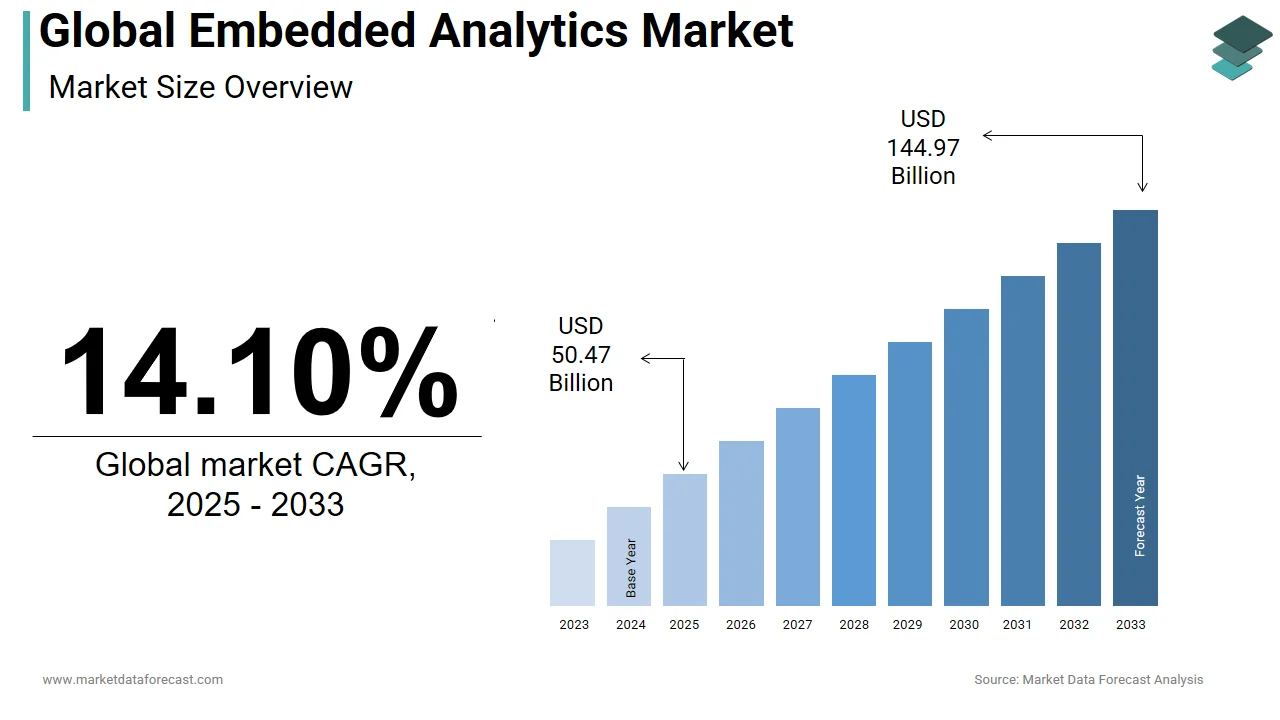
The global embedded analytics market was worth USD 44.23 billion in 2024. The global market is projected to extend USD 50.47 billion in 2025 and USD 144.97 billion by 2033, growing at a CAGR of 14.10% during the forecast period.
The objective of embedded analysis is to offer data analysis and greater accessibility of Business Intelligence to the various users of a company. Business intelligence or traditional analysis essentially aims to extract data and reach the basic level of analysis. However, these applications are rarely able to provide solutions to high-level analytical problems. Integrated analysis offers assistance in solving these problems because it analyzes large amounts of data from multiple domains and derives business-specific data from them. It is also offered as an integral part of most enterprise applications, such as enterprise resource planning (ERP) and customer relationship management (CRM), among others. Business intelligence refers to a sum of all independent systems, such as human processes and technologies, among others, which provide insight into data from several areas that have been collected and analyzed. These systems are primarily used for data analysis and include many different types of applications.
Embedded analytics, on the other hand, is also part of modern business applications and aims to provide specific information to support certain business actions or decisions. Today, Business Intelligence players such as Sisense and Tableau Software develop embedded analytical tools, and application developers integrate business applications. Then, the information is provided to end users.
In this competitive world, developing a high-performing workforce is a major challenge facing many organizations, and companies are, therefore, adopting integrated analysis in the form of workforce analyses. This helps the HR manager select the actions, such as the competitive compensation plan, the hiring decision, the training results, etc., that optimize turnover, expenses, and financial results.
MARKET TRENDS
In this globally competitive environment, organizations are moving towards an action research approach, which will give them a more accurate picture of everything from workload automation processes to customer management systems. Therefore, the organization monitors the company's strategic dynamics and performance through the systematic use of internal and external data and analytical methods.
Forward-thinking organizations are gradually spending money on programs that use data for all aspects of workforce description, talent management, and operational advancement. For example, in Italy, according to a survey conducted by Fluida, 71.8% of companies said that their employees always used the tools provided to track hours and absences. This enables the company to correlate human resource data with business results and perform predictive analytics.
For example, Deloitte is now analyzing travel data and other human performance data to help employees improve their energy levels, well-being, and business performance. All of the above factors should have a positive impact on performance monitoring tools, which, in turn, will help the growth of the global embedded analytics market.
MARKET DRIVERS
With self-service tools, companies can choose the data they want to analyze to create their own charts, helping them make the right decision. This increases the value of the product through competitive differentiation, which leads to more new customers. These factors should have a positive impact on the global embedded analytics market and stimulate demand.
However, the lack of product information and the high cost of implementation associated with strict government regulation are a few factors that could hinder the market during the forecast period.
REPORT COVERAGE
| REPORT METRIC | DETAILS |
| Market Size Available | 2024 to 2033 |
| Base Year | 2024 |
| Forecast Period | 2025 to 2033 |
| CAGR | 14.10% |
| Segments Covered | By Analytics Tool, Component, Business Function, Deployment Mode, Vertical, and Region |
|
Various Analyses Covered | Global, Regional & Country Level Analysis, Segment-Level Analysis, DROC, PESTLE Analysis, Porter’s Five Forces Analysis, Competitive Landscape, Analyst Overview on Investment Opportunities |
| Regions Covered | North America, Europe, APAC, Latin America, Middle East & Africa |
|
Market Leaders Profiled | IBM, SAP SE, SAS Institute, Sisense, Oracle Corporation, MicroStrategy Incorporated, TIBCO Software, Logi Analytics, Microsoft Corporation, Tableau Software, QlikTech International, Yellowfin International, OpenText Corporation, GoodData, and Others. |
REGIONAL ANALYSIS
The Asia-Pacific region is expected to experience the fastest growth in the professional services automation market. Due to the growth of IT companies, manufacturing industries, and service providers in this region, it is necessary to implement professional services to stand out from its competitors.
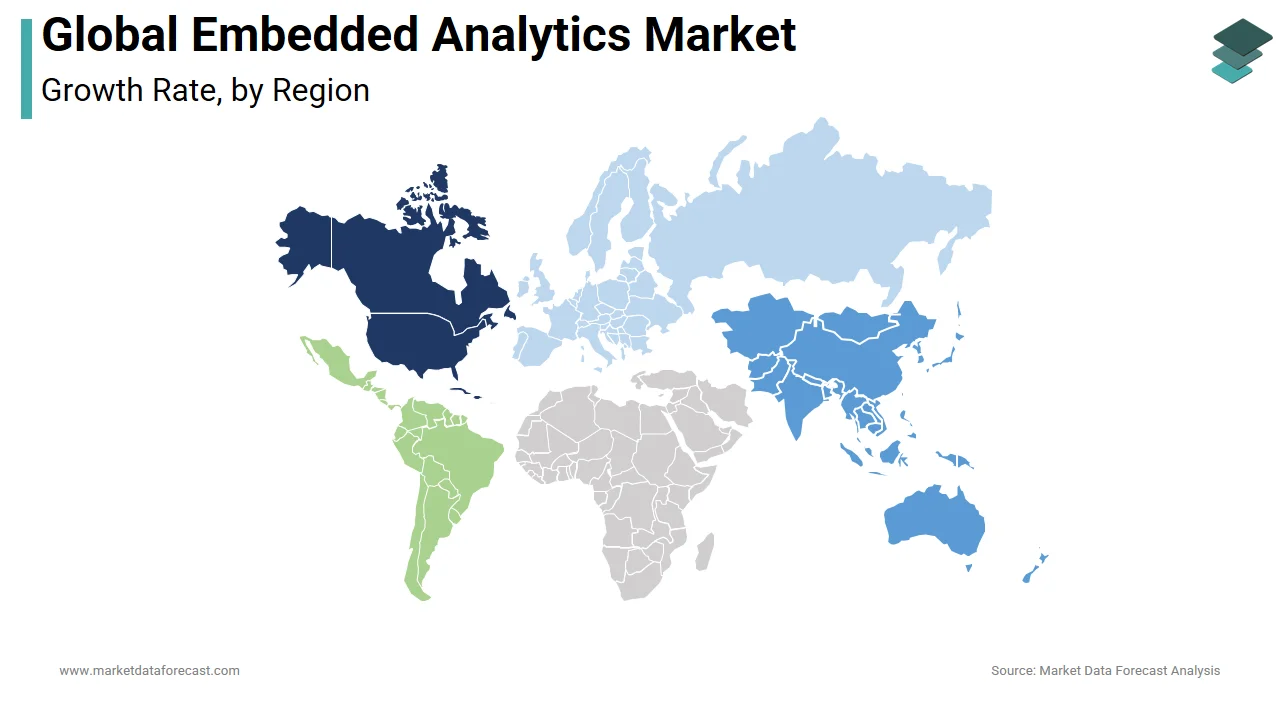
Furthermore, according to the China Mergers and Acquisitions Association, 58% of participating Chinese companies said their foreign challenge to business management was strategic alignment. In comparison, 34% said the performance of overseas assets was troublesome for them. Therefore, embedded analytics are capable of solving most of your business-related problems, and this should help this market grow. In addition, with India's ambitious "Make in India" plan, manufacturing companies should experience exponential growth. Therefore, integrated analysis is also expected to experience significant growth in this region, as it can guide strategic and operational decisions based on actual facts and figures.
KEY MARKET PLAYERS
The major players operating in the global embedded analytics market are IBM, SAP SE, SAS Institute, Sisense, Oracle Corporation, MicroStrategy Incorporated, TIBCO Software, Logi Analytics, Microsoft Corporation, Tableau Software, QlikTech International, Yellowfin International, OpenText Corporation, GoodData, and others.
RECENT MARKET DEVELOPMENTS
- In May 2017, Microsoft confirmed the launch of Power Business Intelligence (BI) Premium, which builds on the existing Power BI portfolio with a capacity-based licensing model that increases flexibility in terms of access, sharing, and content distribution. As part of the new offer, Power BI Embedded converges with the Power BI service to offer an API surface, a coherent set of capacities, and access to the latest functionalities.
- In June 2017, IBM introduced its cognitive solutions to assist financial institution professionals in monitoring and controlling their regulatory responsibilities. IBM’s Watson software can be deployed in the IBM cloud and was mainly developed to aid finance professionals in understanding regulatory requirements, better understanding financial crimes, and controlling financial risks with a novel approach.
- In July 2017, OpenText developed and introduced OpenText Magellan, a flexible AI and analytics platform that combines open-source machine learning technology with highly advanced analytics. With it, you can acquire, merge, manage, and analyze great data and content.
MARKET SEGMENTATION
The global market for embedded analytics is classified according to an analysis tool, component, implementation, business function, vertical, and region.
By Analytics
- Reports
- Self-Service Tools
- Control Panel
- Data Visualization
- Comparative Analysis
By Component
- Software
- Services
By Business Function
- IT
- Marketing and Sales
- Finance
- HR
- Production
By Deployment Mode
- On-Premises
- Cloud
By Vertical
- IT and Telecommunications
- BFSI
- Public Sector
- Retail
- Manufacturing
- Health
- Energy and Public Services
By Region
- North America
- The United States
- Canada
- Rest of North America
- Europe
- The United Kingdom
- Spain
- Germany
- Italy
- France
- Rest of Europe
- The Asia Pacific
- India
- Japan
- China
- Australia
- Singapore
- Malaysia
- South Korea
- New Zealand
- Southeast Asia
- Latin America
- Brazil
- Argentina
- Mexico
- Rest of LATAM
- The Middle East and Africa
- Saudi Arabia
- UAE
- Lebanon
- Jordan
- Cyprus