- Product Description Description
- Table of Contents TOC
- List of Table & Figure LOT
- Get Free Sample PDF Sample PDF
Market Size, 2025
$10.37 BnMarket Estimate, 2026
$13.05 BnMarket Forecast, 2034
$82.12 BnCAGR, 2026–2034
25.85%Europe Digital Transaction Management Market Summary
Europe’s digital transaction management market is expanding rapidly, driven by increasing adoption of paperless workflows, cross-border digital identity integration, and the transition toward legally compliant remote agreement execution across enterprises, financial institutions, real estate, healthcare, and public administration. Growth is reinforced by eIDAS-based electronic signature recognition, the rollout of the EU Digital Identity Wallet, and rising demand for tamper-evident audit trails and secure multi-party contracting workflows. The market is evolving from basic e-signature tools toward fully automated, identity-verified, and audit-ready digital agreement ecosystems, while challenges remain around legal enforceability across jurisdictions, interoperability barriers, and cybersecurity risks in remote signing environments.
Market Growth & Size
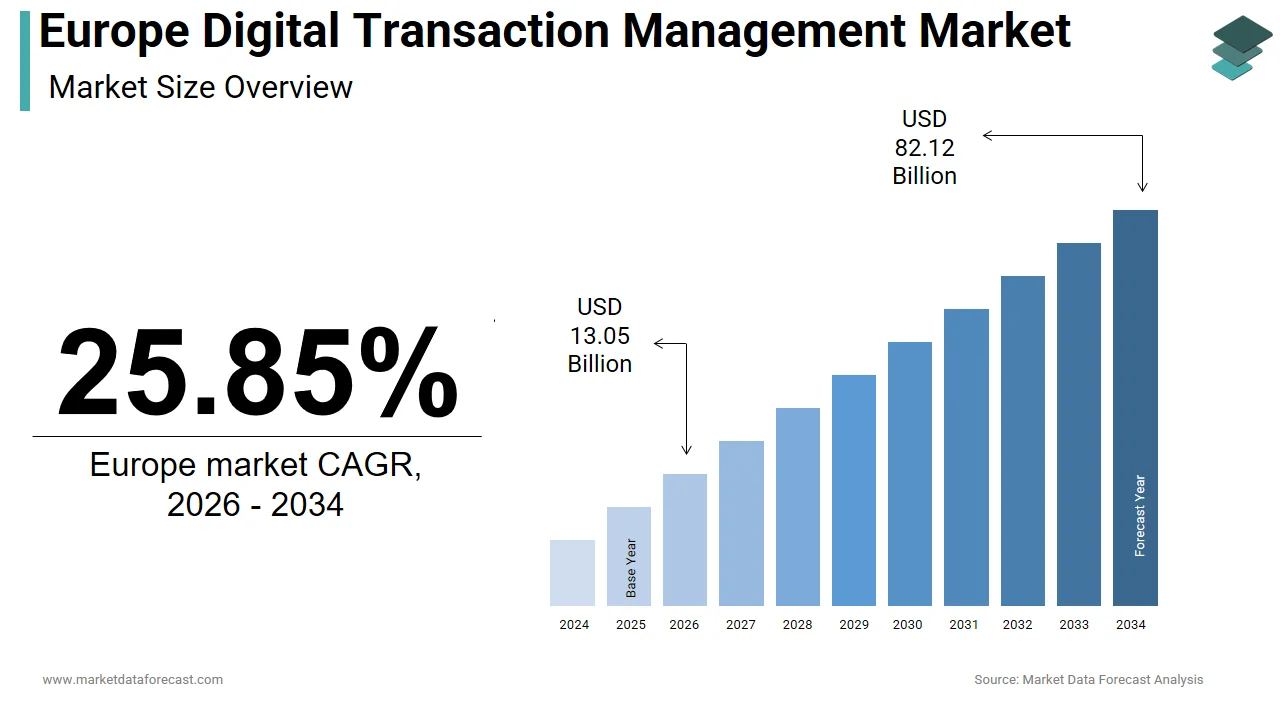
- Strong Expansion: The Europe digital transaction management market was valued at USD 10.37 billion in 2025, is estimated to reach USD 13.05 billion in 2026, and is projected to reach USD 82.12 billion by 2034, growing at a CAGR of 25.85% from 2026 to 2034. Growth is supported by enterprise digitization, regulatory mandates for electronic records, and widespread adoption of secure digital contracting across public and private sectors.
- Key Segments: Solutions including e-signing platforms, workflow automation, identity verification, and audit trail management currently dominate due to regulatory and operational necessity, while services and integration support are growing as organizations adopt cross-border, compliance-driven digital agreement ecosystems.
Drivers & Trends
- Paperless & Remote Process Mandates: EU Digital Single Market and national digitization programs are accelerating adoption of legally recognized electronic signatures, remote contracting, and digital public services, making digital transaction management a compliance requirement rather than a convenience tool.
- Security & Auditability in Financial & Legal Workflows: Banks, investment firms, and law practices increasingly deploy certified digital contracting platforms to meet expectations for fraud prevention, identity assurance, and immutable audit trails in high-value transactions.
- Cross-Border Digital Identity Integration: Growth in national eID schemes and interoperable identity frameworks is expanding cross-border recognition of digital agreements and strengthening trust in remote digital execution.
- ESG & Regulatory Reporting Workflows: The Corporate Sustainability Reporting Directive (CSRD) and EU Taxonomy are accelerating the adoption of digitally signed supplier and sustainability declarations, driving new use cases beyond traditional commercial contracting.
Key Players & Ecosystem
- Local & Global Technology Leaders: The ecosystem includes leading digital agreement and identity-trusted platform providers such as DocuSign, Adobe, OneSpan, ZorroSign, Signaturit, Nintex, and Namirial, alongside regional vendors aligned with national eID programs and public-sector digitization initiatives.
- Growth is reinforced by government e-service modernization, financial compliance transformation, real estate digitization, and cross-border identity interoperability pilots, which collectively expand adoption across industry verticals and public administration domains.
Challenges
- Fragmented Legal Interpretation of eIDAS: Varying national signature validation rules and qualified signature requirements create cross-border enforcement and interoperability friction, increasing implementation complexity for multinational organizations.
- Legal Enforceability Concerns: In certain jurisdictions, uncertainty around courtroom evidence admissibility and digital audit trail recognition continues to limit full digital adoption in complex, high-risk contractual agreements.
- Cybersecurity & Identity Spoofing Risks: Remote signing environments face exposure to identity fraud, credential compromise, and phishing-based attacks, driving the need for stronger authentication, liveness verification, and anomaly monitoring.
- Integration Gaps with Enterprise Systems: Lack of standardized interoperability with ERP, CRM, and legal management platforms creates operational silos and limits seamless end-to-end automation across enterprise workflows.
Europe Digital Transaction Management Market Size
The Europe digital transaction management market was valued at USD 10.37 billion in 2025, is estimated to reach USD 13.05 billion in 2026, and is projected to reach USD 82.12 billion by 2034, growing at a CAGR of 25.85% from 2026 to 2034.
Digital transaction management refers to cloud-based platforms that orchestrate the lifecycle of electronic agreements, from document preparation and secure routing to legally binding e signing, audit trail generation, and post execution archival, within a unified, compliant workflow. Unlike basic e signature tools, these systems integrate identity verification, workflow automation, and regulatory adherence to support complex multi party transactions across financial services, real estate, healthcare, and public administration. According to sources, large enterprises have increasingly adopted digital transaction platforms to manage contracts, a shift influenced by the need for effective remote execution and reliable legal frameworks. Besides, as per sources, many national electronic identification schemes are now designed to work across borders with various certified digital transaction platforms, facilitating the mutual recognition of electronic agreements. The Corporate Sustainability Reporting Directive further mandates tamper evident audit trails for sustainability declarations, expanding use beyond commercial contracts. With the EU Digital Identity Wallet rollout accelerating and remote work normalizing digital workflows, digital transaction management has evolved from a convenience tool to a foundational layer of Europe’s trusted digital economy.
MARKET DRIVERS
Mandates for Remote and Paperless Processes Under EU Digital Single Market Initiatives
The European Union’s strategic push toward a paperless, borderless digital economy has made digital transaction management essential for legal and administrative compliance across public and private sectors, which drives the growth of the Europe digital transaction management market. A specific regulation requires all member states to recognize qualified electronic signatures with the same legal effect as handwritten ones, driving adoption in notarization, property transfers, and public procurement. Several national land registries have integrated digital transaction platforms into property transfer processes, leading to reduced transaction finalization times. A majority of significant credit institutions use certified platforms for customer onboarding and loan agreements to comply with remote identification rules. Funding has been allocated for public administration digitization, with digital agreements as a fundamental element. This top down regulatory momentum transforms digital transaction management from an operational choice into a legal necessity across Europe’s institutional landscape.
Escalating Demand for Secure and Auditable Workflows in Financial and Legal Sectors
Financial institutions and legal firms across the region are rapidly adopting digital transaction management to meet heightened regulatory expectations for transparency, fraud prevention, and client verification in high value transactions, which propels the expansion of the Europe digital transaction management market. Investment firms are using digital contracting platforms to manage client agreements and improve audit processes, aligning with regulatory standards for documentation and oversight. Regulatory bodies are encouraging banks to adopt certified platforms that provide immutable audit trails for critical agreements, moving away from traditional email and PDF-based workflows. A notable majority of law firms in major European countries have integrated digital transaction systems for managing various legal documents, which emphasizes benefits such as reduced dispute risks and quicker transaction times. The overall commercial contract process has become significantly more efficient due to the adoption of these platforms. The combination of operational benefits and regulatory requirements is driving continued interest in digital contracting solutions within sectors that prioritize compliance and risk management.
MARKET RESTRAINTS
Fragmented National Interpretations of eIDAS and Qualified Signature Requirements
Divergent national implementations of the eIDAS Regulation create compliance uncertainty and technical friction for cross border digital transactions, Despite EU level harmonization, which restricts the growth of the Europe digital transaction management market. Several European Union member states maintain national requirements for qualified electronic signatures that exceed the established regional baseline. This fragmentation forces multinational corporations to maintain multiple signing workflows or face legal challenges in enforcement. Varying technical and procedural mandates across jurisdictions contribute to validity disputes during cross-border commercial interactions. Property transactions between member states frequently necessitate manual re-verification because national platforms often lack interoperability with foreign qualified certificates. A lack of complete technical and legal interoperability, particularly before the EU Digital Identity Wallet is fully rolled out, increases costs and complexity for businesses, and thus impedes the widespread and pan-European adoption of unified digital transaction management systems.
Persistent Concerns Over Long Term Legal Enforceability and Evidence Admissibility
Many European enterprises, particularly in civil law jurisdictions, remain cautious about the courtroom admissibility of digitally executed agreements, which hinders the expansion of the Europe digital transaction management market. This is due to evolving jurisprudence and inconsistent judicial precedent. Courts in some European regions have issued contradictory rulings regarding the validity of simple electronic signatures in high-value contracts, which creates legal uncertainty for companies utilizing digital practices. In many member states, civil procedure codes have not been updated to explicitly recognize digital audit trails as primary evidence, leading courts to apply traditional standards that may not fully accommodate electronic records. The absence of clear legal standards contributes to some financial institutions delaying the full adoption of digital processes for complex agreements like mortgages and syndicated loans. Qualified electronic signatures (QES) under eIDAS enjoy a strong legal presumption of validity, but their high cost and technical complexity often reserve them for high-risk transactions. Widespread adoption of digital contracts in sensitive areas will likely be limited until legal systems universally recognize electronic evidence and national legislation fully aligns with EU digital principles.
MARKET OPPORTUNITIES
Integration with EU Digital Identity Wallet for Seamless Cross Border Transactions
The imminent rollout of the EU Digital Identity Wallet offers a potential opportunity for digital transaction management platforms to enable frictionless and secure cross border agreements using sovereign digital credentials, which is expected to fuel the growth of the Europe digital transaction management market. National wallet implementations are being developed across all member states, with interoperability standards established under a common framework. These wallets will store qualified certificates, allowing citizens and businesses to sign contracts with the highest legal assurance across borders without third party intermediaries. Pilot programs in certain regions have successfully demonstrated end-to-end property purchases using wallet-authenticated signatures, which has significantly reduced the need for traditional notarization. Furthermore, several major banking institutions are integrating wallet-based signing processes for cross-border account opening and loan applications. Digital transaction platforms that embed wallet compatibility could serve as the foundational infrastructure for Europe’s trusted digital public sphere, potentially unlocking a large market for standardized, legally sound cross-jurisdictional agreements, in line with EU digital finance policies.
Expansion into ESG and Sustainability Compliance Contracting
The Corporate Sustainability Reporting Directive and EU Taxonomy are driving demand for digitally managed and auditable sustainability agreements between corporations and suppliers, which creates a new high value use case for digital transaction platforms. This ultimately provides new prospects for the Europe digital transaction management market. A notable trend involves a significant increase in the number of companies subject to mandatory third-party verification of their climate and social data, a process that necessitates legally binding assurances from their partners. Digital transaction systems provide tamper evident workflows for collecting, signing, and archiving these declarations with full chain of custody. A majority of large manufacturers have implemented digital programs designed to formalize supplier sustainability agreements, which often incorporate standardized environmental, social, and governance (ESG) clauses and geolocation verification capabilities within their platforms. Procurement standards have evolved to promote the use of digital contracts that include explicit sustainability commitments, utilizing these commitments as a factor in the overall scoring and selection process for bids. This convergence of regulatory disclosure, supply chain accountability, and legal enforceability positions digital transaction management as a critical enabler of Europe’s green transition, which transforms compliance from a reporting exercise into a contractually binding obligation.
MARKET CHALLENGES
Cybersecurity and Identity Spoofing Risks in Remote Signing Environments
The shift to fully remote digital transactions has amplified exposure to identity fraud, credential theft, and man in the middle attacks that compromise the integrity of electronic agreements, and negatively impact the growth of the Europe digital transaction management market. Phishing campaigns targeting electronic signature platforms have been observed to increase, with attackers using advanced impersonation techniques, including the use of synthetic media to mimic signers. In a specific instance, a real estate firm experienced a significant financial loss after a fraudulent digital mortgage agreement was executed. Furthermore, a considerable number of digital transaction platforms currently rely on two-factor authentication methods that are vulnerable to SIM swapping attacks. New regulations classify major platforms as essential services, mandating them to adopt stringent security measures; however, many organizations face challenges in meeting these requirements due to resource constraints. Widespread adoption of biometric liveness detection, certificate pinning, and real-time anomaly monitoring is necessary to overcome the current trust barrier posed by the risk of fraudulent digital transactions.
Lack of Standardized Interoperability Between Legacy Legal and ERP Systems
The absence of universal integration protocols between digital transaction platforms and core enterprise systems, such as legal matter management, ERP, and CRM software, creates operational silos that limit automation and data consistency. This hinders the expansion of the Europe digital transaction management market. Mid-sized businesses frequently use digital signing tools that function independently, often necessitating manual steps like data input and document handling following execution. This fragmentation increases error rates and delays. A notable percentage of agreements that are signed digitally require adjustments after the fact, sometimes due to discrepancies when interacting with common enterprise systems. While APIs exist, they are largely proprietary. Presently, a unified standard for exchanging contract information, similar to those found in the financial sector, has not been established by relevant standards bodies. As a result, legal and procurement teams cannot trigger downstream workflows, such as payment or compliance checks, automatically upon signature. The complete potential of digital transaction management as a system of record cannot be fully achieved in complex, multi-system enterprise environments until sector-specific interoperability frameworks are adopted.
REPORT COVERAGE
| REPORT METRIC | DETAILS |
| Market Size Available | 2025 to 2034 |
| Base Year | 2025 |
| Forecast Period | 2026 to 2034 |
| Segments Covered | By Component, Deployment Mode, Organisation Size, End-user Industry, and Country. |
| Various Analyses Covered | Global, Regional, and Country-Level Analysis, Segment-Level Analysis, Drivers, Restraints, Opportunities, Challenges; PESTLE Analysis; Porter’s Five Forces Analysis, Competitive Landscape, Analyst Overview of Investment Opportunities |
| Countries Covered | UK, France, Spain, Germany, Italy, Russia, Sweden, Denmark, Switzerland, Netherlands, Turkey, Czech Republic, and the Rest of Europe. |
| Market Leaders Profiled | DocuSign Inc., Adobe Inc., OneSpan Inc., ZorroSign Inc., Signaturit Solutions SL, Nintex Group Pty Ltd, Namirial SpA, and Others. |
SEGMENTAL ANALYSIS
By Component Insights
The solutions segment held the leading segment of the Europe digital transaction management market in 2025. The prominence of the solutions segment is driven by the foundational need for secure, compliant, and scalable platforms that handle document generation, e signing, workflow automation, and audit trail management. Organizations prioritize robust software over consulting or integration services because regulatory frameworks like eIDAS, GDPR, and MiFID II mandate specific technical capabilities, such as qualified electronic signature support, cryptographic integrity, and immutable logging, that only certified platforms can reliably deliver. The observation suggests a preference among enterprises for comprehensive, integrated platforms to handle digital transactions, likely de to a desire for simplified compliance management. This approach centralizes various steps within a single system, streamlining workflows and potentially reducing the complexity of managing multiple, disparate tools. Furthermore, there is an indication that funding bodies in the public sector are increasingly mandating the use of specific, pre-approved digital transaction solutions as a condition for project funding. This requirement points to a broader push for standardization and the assurance of certain security or regulatory prerequisites in government-funded digitization efforts. The rise of remote work further cemented this dominance. This regulatory, operational, and governance imperative ensures that solutions remain the core and largest component of the market.
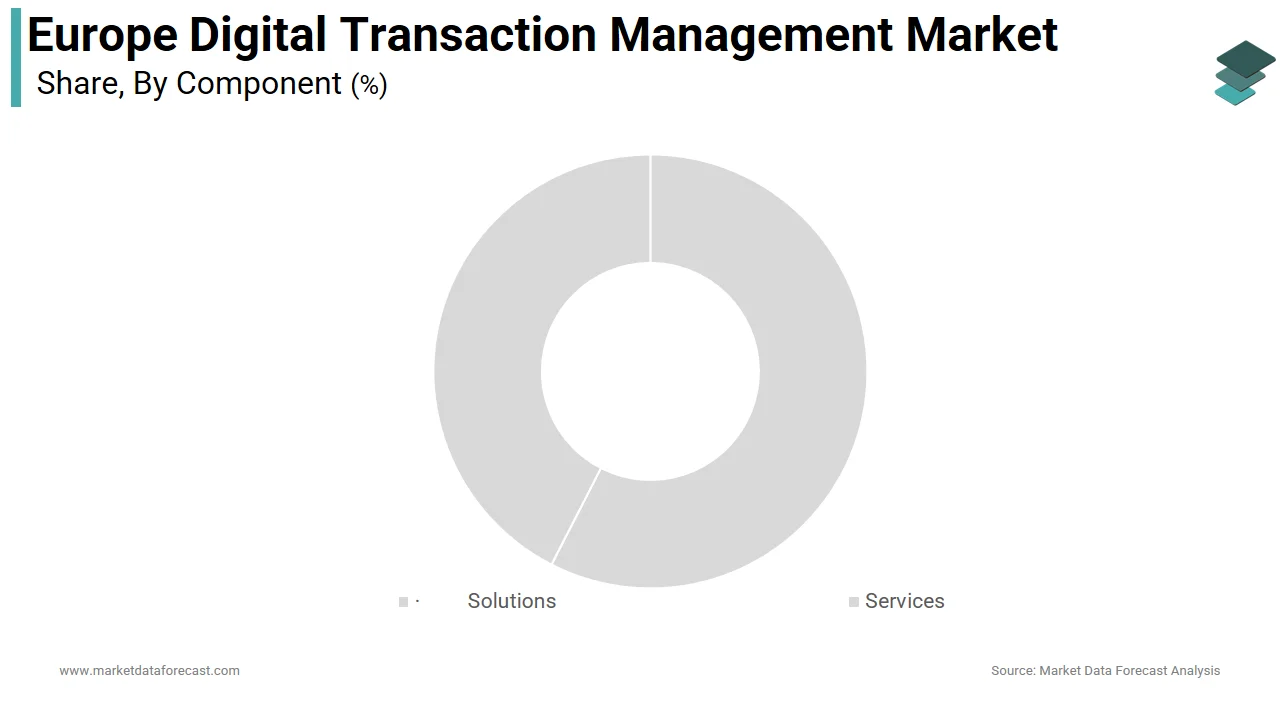
The services segment is on the rise and is expected to be the fastest growing segment in the market by witnessing a CAGR of 15 8% from 2025 to 2033 due to the increasing complexity of regulatory compliance, cross border interoperability, and enterprise system integration, which demand specialized implementation, training, and managed support. Many mid-sized enterprises do not possess the internal technical proficiency required to set up digital transaction processes that comply with regional electronic identification standards and cybersecurity regulations. This lack of specialized knowledge necessitates a dependency on third-party consultants to ensure operational alignment with legal requirements. Small businesses are increasingly utilizing support services to bridge the gap between digital signing platforms and their existing internal management systems. There is a visible shift toward integrating digital workflow tools with local enterprise resource planning and legal management infrastructures. Managed services for identity verification, audit trail validation, and long term evidentiary archiving are also gaining traction, particularly in BFSI and healthcare. With the EU Digital Identity Wallet rollout requiring custom adapter development for legacy platforms, the demand for specialized services is shifting from one time deployment to ongoing compliance orchestration—transforming services into a high value, recurring revenue stream.
By Deployment Mode Insights
The cloud segment led the Europe digital transaction management market by capturing a significant share in 2025. The supremacy of the cloud segment is attributed to its scalability, cost efficiency, and seamless compliance with evolving regulatory updates. Cloud platforms allow immediate access to digital workflows regardless of physical location, which is a key advantage in Europe's common hybrid work model. Certified cloud providers can offer inherent compliance features that manage data location, security, and international transfers, helping businesses lessen potential legal risks. The push for sovereign cloud solutions is increasing, with specific platforms accommodating digital transaction workloads for various industries, including automotive and finance. Besides, automatic updates ensure instant access to new eIDAS 2 0 features, such as EU Digital Identity Wallet integration, without costly on premise upgrades. This combination of agility, regulatory alignment, and operational simplicity makes cloud the default and dominant deployment model across European public and private institutions.
The on premise segment is expected to exhibit a noteworthy CAGR of 9.3% from 2025 to 2033 due to heightened data sovereignty demands in defense, critical infrastructure, and national public administration. A notable shift is occurring as numerous regions within the European Union are now requiring local or sovereign cloud hosting solutions for digital transaction systems that manage sensitive citizen information. In Germany, the Federal Office for Information Security requires all federal agencies to process electronic signatures within national data boundaries, prompting the Bundeswehr and tax authorities to deploy private instance platforms from vendors like T-Systems and IDnow. Similarly, specific defense contractors operating under certain national guidelines are expected to employ on-premise digital signing infrastructure to safeguard intellectual property within critical aerospace and nuclear domains. Furthermore, recent guidance from a major European financial authority encourages significant institutions to maintain on-premise fallback systems to ensure the continuity of critical agreements, particularly during potential cloud service interruptions. The segment is growing steadily, albeit from a smaller base, driven by critical requirements for strategic autonomy and cyber resilience that take precedence over convenience, particularly in environments demanding strict control over data.
By End User Industry Insights
The BFSI segment was the largest segment in the Europe digital transaction management market by capturing a share of 34.3% in 2024. The dominance of the BFSI segment is propelled by stringent regulatory mandates, high transaction volumes, and the critical need for fraud prevention in customer onboarding and lending. Significant financial institutions have adopted advanced digital transaction platforms to support regulatory obligations concerning remote customer identification. The implementation of these platforms involves the use of electronic signatures, particularly for high-risk accounts. Authorities have established requirements for investment firms to maintain secure, tamper-evident audit trails for client agreements, leading to updates in how internal workflows are managed. The use of qualified electronic signatures in specific loan agreement processes has been associated with a noticeable reduction in the time required to process those loans. The regulatory environment encourages the use of legally enforceable, secure, and auditable digital agreements, fostering the continued adoption of these platforms across the banking and investment sectors in Europe.
The healthcare and life sciences segment is predicted to witness the highest CAGR of 18.2% from 2025 to 2033. The rapid expansion of the healthcare and life sciences segment is fuelled by the EU’s digital health transformation agenda, which mandates secure electronic consent, clinical trial agreements, and cross border patient data sharing under strict GDPR and eIDAS frameworks. Several electronic health record systems now have a requirement for digitally signed patient consent before data can be accessed, and one major national platform processes a significant volume of signed consents each month. Furthermore, a large majority of advanced clinical trials utilize digital transaction platforms for both investigator agreements and patient consent, which has helped to shorten the overall approval timelines. The EU Health Data Space Regulation further requires tamper proof audit trails for all research data disclosures, compelling hospitals and biotech firms to adopt certified signing systems. Hence, the sector’s demand for legally sound, privacy preserving digital workflows positions it as the highest momentum vertical for digital transaction management innovation.
COUNTRY-LEVEL ANALYSIS
Germany Digital Transaction Management Market Analysis
Germany outperformed other countries in the Europe digital transaction management market by accounting for a 19.7% share in 2024. The dominance of the German market is driven by its advanced regulatory infrastructure, strong data protection culture, and leadership in digital public services. Several federal agencies use certified digital signing platforms for various services provided to citizens, including tax filings and procurement processes. The national eID system has been incorporated into numerous private and public workflows, such as property transfers and bank onboarding procedures. Furthermore, major banking institutions have implemented solutions for electronic signatures in contexts like mortgage and corporate lending operations. Germany’s stringent interpretation of GDPR and NIS2 further drives demand for sovereign, on premise deployments. With deep technical expertise, robust legal frameworks, and high citizen digital literacy, Germany serves as both a compliance benchmark and innovation hub for digital transaction management across the European Union.
United Kingdom Digital Transaction Management Market Analysis
The United Kingdom was the second-largest player in the European digital transaction management market by holding a 16.2% share in 2024. The growth of the UK market is propelled by its mature fintech ecosystem, common law flexibility, and aggressive digitization of legal and property processes. Electronic signatures have substantial legal standing in commercial agreements, fostering extensive utilization across the real estate, legal, and financial service industries. The majority of property deals currently incorporate digital signing practices, which can condense completion schedules significantly. Furthermore, a substantial percentage of financial institutions and payment providers employ certified systems for customer agreements, ensuring adherence to modern regulatory standards. Despite Brexit, the UK aligns closely with eIDAS principles through its UK eIDAS framework, ensuring cross border recognition with EU partners. With London as a global legal and financial center and strong support for legal tech innovation, the UK maintains a dynamic, high adoption environment that bridges European and global digital transaction standards.
France Digital Transaction Management Market Analysis
France is another key player in the Europe digital transaction management market because of state led digital sovereignty initiatives, mandatory e signing in public procurement, and robust national eID infrastructure. The digital transaction system experienced significant activity, handling numerous certified digital transactions which included a range of services such as tax declarations, university enrollments, and business licensing. Regulations now specify that contracts over a certain financial threshold must be signed electronically using platforms adhering to specific certifications, impacting a large volume of annual agreements. Major financial institutions implemented remote onboarding processes which align with digital identity regulations, with video notarization procedures integrated for high-value accounts. The country’s emphasis on technological independence further drives demand for locally hosted, auditable transaction systems. France’s fusion of public sector digitization, regulatory enforcement, and data sovereignty ensures its sustained leadership in secure digital agreement management.
Netherlands Digital Transaction Management Market Analysis
The Netherlands grew steadily in the Europe digital transaction management market owing to its role as a digital gateway for multinational corporations and advanced e government infrastructure. Citizen interactions with government services, such as business registration and healthcare consent, are predominantly managed through the national electronic identification scheme. This national identity system is designed to support qualified electronic signatures in line with regional digital standards. Property transactions have been fully digitized, enabling same-day closings via digital notarization. Major banks have adopted interoperable signing platforms that function internationally, which helps facilitate cross-border trade for multinational companies located in the country. The Netherlands, positioning Amsterdam as a central hub for legal technology startups, is an ideal "living lab" for testing scalable digital transaction workflows across different jurisdictions, especially given its strong alignment with established EU digital identity standards.
Spain Digital Transaction Management Market Analysis
Spain is predicted to expand in the Europe digital transaction management market from 2025 to 2033 due to rapid digitization of public services, high mobile penetration, and integration of digital signatures into everyday citizen interactions. Spain's Cl@ve electronic identification system facilitates hundreds of millions of digital transactions, covering various services such as tax filings, social security claims, and university applications. The requirement for digital signing in all investor agreements has encouraged its use within the financial sector. Most real estate transactions now use certified e-signing platforms, which streamlines a historically paper-intensive process. Government initiatives for the digitization of public administration include digital transaction management as a central objective. Spain's approach, characterized by widespread smartphone usage and high public trust in digital governance, effectively combines regulatory mandates with user-focused design principles, showcasing a successful mass market adoption model.
COMPETITIVE LANDSCAPE
The Europe digital transaction management market features intense competition between global technology leaders and specialized European vendors, all operating within a highly regulated environment where legal validity and data sovereignty are paramount. Incumbents like DocuSign leverage scale and global integrations, while regional players such as Signaturit and OneSpan compete through deep alignment with national eID schemes, local legal codes, and public sector digitization programs. Competition centers less on pricing and more on regulatory fluency—particularly adherence to eIDAS qualified signature standards, GDPR data handling, and NIS2 operational resilience mandates. The impending rollout of the EU Digital Identity Wallet is reshaping the landscape, favoring platforms that can natively authenticate using sovereign credentials without third party intermediaries. Interoperability remains a challenge, as legacy legal and ERP systems often lack standardized APIs, creating demand for specialized integration services. Success increasingly depends on the ability to balance global scalability with European regulatory specificity, ensuring that digital agreements are not only efficient but legally unassailable across all 27 member states.
KEY MARKET PLAYERS
The leading companies operating in the Europe digital transaction management market include:
- DocuSign Inc.
- Adobe Inc.
- OneSpan Inc
- ZorroSign Inc.
- Signaturit Solutions SL
- Nintex Group Pty Ltd
- Namirial SpA
TOP PLAYERS IN THE MARKET
- DocuSign Inc is a globally influential provider with deep integration across the Europe digital transaction management market, offering an end to end platform for e signing, agreement lifecycle management, and identity verification compliant with eIDAS and GDPR. The company serves major financial institutions, law firms, and public sector bodies in Germany, France, and the Nordics, where its Qualified Electronic Signature capabilities meet the highest EU legal standards. It also launched a dedicated compliance hub for European customers featuring pre configured workflows for MiFID II, AML, and Corporate Sustainability Reporting Directive requirements. By aligning its global architecture with Europe’s regulatory sovereignty agenda, DocuSign strengthens trust while exporting European compliance blueprints to international markets seeking robust digital contracting frameworks.
- OneSpan Inc holds a prominent position in the Europe digital transaction management market through its focus on high assurance, multi factor authenticated signing solutions tailored for banking, insurance, and government use cases. The company’s eSignLive platform is certified under eIDAS for qualified electronic signatures and integrates with national eID schemes like Germany’s AusweisApp and Belgium’s Itsme. It also achieved compliance with the EU’s NIS2 Directive for critical infrastructure operators, reinforcing its appeal in defense and finance. By prioritizing security, regulatory depth, and sovereign identity interoperability, OneSpan caters to Europe’s most risk sensitive sectors while leveraging its European success to shape global standards for high integrity digital agreements.
- Signaturit Solutions SL is a leading European native provider of digital transaction management, headquartered in Spain and widely adopted across Southern and Western Europe for its seamless integration with local legal frameworks and public administration systems. The company’s platform supports all eIDAS signature levels and is certified by national bodies including France’s ANSSI and Italy’s AgID. It also partnered with major Iberian banks to embed its signing workflow into mortgage and onboarding processes, reducing paper usage by over 90 percent. By combining local regulatory expertise with agile development and strong public sector relationships, Signaturit strengthens Europe’s digital sovereignty while serving as a model for regionally grounded, globally scalable transaction management innovation.
TOP STRATEGIES USED BY THE KEY MARKET PARTICIPANTS
Key players in the Europe digital transaction management market focus on achieving full compliance with eIDAS 2 0 and NIS2 cybersecurity requirements, integrating native support for the EU Digital Identity Wallet, developing industry specific workflows for BFSI and healthcare regulations, offering both cloud and sovereign on premise deployment options, and enhancing fraud detection through behavioral biometrics and AI powered transaction risk scoring.
MARKET SEGMENTATION
This research report on the Europe digital transaction management market has been segmented and sub-segmented into the following categories.
By Component
- Solutions
- Services
By Deployment Mode
- Cloud
- On-premise
- Hybrid
By Organization Size
- Small and Medium Enterprises (SMEs)
- Large Enterprises
By End-user Industry
- BFSI
- Healthcare and Life Sciences
- Retail and E-commerce
- IT and Telecommunication
- Government and Public Sector
- Real Estate and Construction
- Automotive and Mobility
By Country
- United Kingdom
- France
- Spain
- Germany
- Italy
- Russia
- Sweden
- Denmark
- Switzerland
- Netherlands
- Rest of Europe