- Product Description Description
- Table of Contents TOC
- List of Table & Figure LOT
- Get Free Sample PDF Sample PDF
Market Size, 2025
$7.27 BnMarket Estimate, 2026
$8.11 BnMarket Forecast, 2034
$19.46 BnCAGR, 2026–2034
11.56%Europe Real-Time Payments Market Report Summary
The Europe real-time payments market was valued at USD 7.27 billion in 2025, is estimated to reach USD 8.11 billion in 2026, and is projected to reach USD 19.46 billion by 2034, growing at a CAGR of 11.56% from 2026 to 2034. Market growth is driven by the increasing demand for instant payment solutions, rising digital transaction volumes, and strong regulatory support for faster payment systems across Europe. Real-time payments enable immediate fund transfers, enhanced customer experience, and improved cash flow management for businesses. The expansion of SEPA Instant Credit Transfer, growing fintech innovation, and increasing adoption of mobile and digital banking platforms are further accelerating market growth.
Key Market Trends
- Increasing adoption of instant and real-time payment solutions.
- Growth of SEPA Instant Credit Transfer across Europe.
- Rising demand for fast, secure, and seamless digital transactions.
- Expansion of mobile banking and fintech ecosystems.
- Increasing focus on cashless economies and digital financial inclusion.
Segmental Insights
- Based on type of payment, the person-to-person (P2P) segment dominated the Europe real-time payments market by capturing 58.2% share in 2025, driven by widespread use of instant transfers among consumers.
- The person-to-business (P2B) segment is expected to register the fastest CAGR of 26.4% from 2026 to 2034, supported by increasing merchant adoption and integration with digital commerce platforms.
Regional Insights
The Europe real-time payments market is witnessing strong growth across key countries due to regulatory support, fintech innovation, and increasing digital payment adoption.
- The United Kingdom led the regional market in 2025 with 24.3% share, supported by advanced payment infrastructure and widespread adoption of faster payment systems.
- Sweden followed with 18.4% share in 2025, driven by its highly digital and cashless economy.
- The Netherlands holds a notable position due to its successful transition to SEPA Instant and strong banking infrastructure.
Competitive Landscape
The Europe real-time payments market is highly competitive, with the presence of global payment solution providers, fintech companies, and financial institutions. Market players are focusing on enhancing payment speed, security, and interoperability while expanding their digital payment ecosystems. Strategic partnerships, platform innovation, and regulatory alignment are shaping competitive dynamics across the region.
Prominent companies operating in the Europe real-time payments market include ACI Worldwide Inc., FIS Global, Fiserv Inc., PayPal Holdings Inc., Temenos AG, Mastercard Inc., and VISA Inc.
Europe Real-Time Payments Market Size
The Europe real-time payments market was worth USD 7.27 billion in 2025. The European market is expected to reach USD 19.46 billion by 2034 from USD 8.11 billion in 2026, rising at a CAGR of 11.56% from 2026 to 2034.

Real-time payments (RTP) are electronic fund transfers that allow for the immediate transfer of money between bank accounts, with funds typically cleared and settled within seconds. This domain extends beyond simple transaction speed to encompass a complex network of clearing houses, payment service providers, and regulatory frameworks that enable seamless value exchange across the continent. The region stands at a critical juncture where the Single Euro Payments Area (SEPA) Instant Credit Transfer scheme serves as the backbone for cross-border and domestic immediacy. As per the European Payments Council and ECB, approximately 62 percent of payment service providers (PSPs) in the euro area were reachable for instant payments in early 2024, a figure set to reach 100% by 2025 due to the mandatory Instant Payments Regulation (IPR). Furthermore, Eurostat data indicates that 67 percent of individuals in the European Union used internet banking in 2024 (rising to 72% among internet users), creating a digital-first consumer base that demands immediate settlement capabilities. The European Central Bank noted that cash usage for point-of-sale transactions dropped to 52 percent in 2024 (down from 59% in 2022), reflecting a societal shift toward digital immediacy. This market functions as the nervous system of the modern European economy, facilitating not only person-to-person transfers but also enabling real-time supply chain financing, instant payroll, and dynamic e-commerce settlements, thereby redefining liquidity management and consumer expectations in a hyper-connected digital society.
MARKET DRIVERS
Regulatory Mandates Compelling Universal Instant Payment Adoption
The implementation of stringent regulatory mandates compelling universal adoption acts as the primary factor propelling the Europe Real-Time Payments Market forward. The European Union has moved beyond voluntary guidelines to enforceable legislation, specifically the regulation requiring all payment service providers offering credit transfers to also provide instant payment services in euros. This legislative push eliminates the optionality that previously allowed banks to delay infrastructure upgrades, forcing a comprehensive modernization of the entire payments landscape. According to the European Parliament, the new rules mandate that transaction fees for instant payments must not exceed those of standard credit transfers, removing the cost barrier that historically stifled consumer and merchant uptake. The regulation also requires providers to verify payee identities to prevent fraud, thereby increasing trust in the system. Multiple studies indicate that a vast majority of financial institutions are currently upgrading their internal systems to align with new legal requirements for immediate payment processing. Furthermore, the requirement to handle cross-border instant payments within the SEPA zone ensures that the benefits of immediacy are not confined to domestic borders. Data from the European Central Bank shows a notable rise in the volume of immediate credit transfers, a trend directly linked to the proactive measures taken by banks to modernize their infrastructure ahead of upcoming regulatory deadlines. This top-down regulatory pressure ensures that real-time payments transition from a premium niche service to a ubiquitous utility across the continent.
Surging Consumer Expectation for Immediate Digital Liquidity and Convenience
Consumer demand for immediate digital liquidity and seamless convenience is surging. This is a critical demand-side driver for the expansion of the Europe real-time payments market. Modern European consumers, accustomed to the immediacy of digital communications and on-demand services, increasingly view delayed fund availability as an unacceptable friction in their financial lives. This behavioral shift is particularly pronounced among younger demographics who utilize peer-to-peer payment apps for splitting bills, reimbursing friends, and managing household expenses in real time. Research indicates that a high proportion of European banking customers view the availability of immediate payment services as a critical factor in their choice of financial provider. The rise of the gig economy further amplifies this demand, as freelancers and contract workers require immediate access to earnings rather than waiting for traditional multi-day settlement cycles. Consumer advocacy groups observe that a significant majority of online shoppers favor retailers capable of processing returns and refunds instantly, prompting more merchants to adopt real-time settlement solutions. The psychological comfort of seeing funds arrive instantly reduces anxiety and enhances the overall user experience, fostering greater engagement with digital banking platforms. A study suggests that financial institutions offering real-time transaction features have seen a measurable rise in the frequency with which customers interact with their mobile banking platforms. This ground-up pressure from end-users forces banks and fintechs to prioritize speed and reliability, making real-time payments a cornerstone of customer retention strategies in a saturated market.
MARKET RESTRAINTS
Persistent Legacy Infrastructure and Integration Complexities
Persistent legacy infrastructure and the profound complexities associated with integrating modern real-time protocols with decades-old banking systems constitute a significant hurdle to the Europe Real-Time Payments Market. Many established European financial institutions operate on core banking platforms developed in the 1980s and 1990s, which were designed for batch processing rather than the continuous, low-latency throughput required for instant settlements. Upgrading these monolithic architectures to support ISO 20022 messaging standards and real-time clearing involves massive capital expenditure, extensive testing, and significant operational risk. Multiple studies indicate that a significant portion of European financial institutions are hindered by the costs of maintaining aging infrastructure, which complicates the rapid deployment of modern real-time transaction capabilities. The fragmentation of technology stacks across different countries and even within individual banking groups exacerbates the challenge, as each node in the payment chain must be upgraded simultaneously to ensure end-to-end immediacy. A study suggests that a substantial number of real-time payment initiatives in Europe encounter delays as organizations work to integrate new transaction systems with their existing security and regulatory monitoring frameworks. Furthermore, the need to maintain parallel running of old and new systems during the transition phase doubles the operational burden and cost. Regulatory bodies in the European banking sector observe that while the initial costs of updating systems can be high for smaller institutions, regional mandates are ensuring that all financial providers participate in the transition to real-time payments to achieve universal market coverage.
Heightened Security Concerns and Irreversibility of Instant Transactions
Heightened security concerns regarding the irreversibility of instant transactions remain a hindering point for the unrestricted growth of the Europe Real-Time Payments Market. Unlike traditional credit transfers, which allow a window of time for recall and dispute resolution, real-time payments settle immediately and are final, leaving virtually no time for intervention once a fraudulent transaction is initiated. This characteristic makes the system an attractive target for social engineering scams, phishing attacks, and authorized push payment fraud, where victims are manipulated into sending money instantly to criminals. The European Union Agency for Cybersecurity has noted a rise in fraudulent activities targeting rapid transaction systems, as bad actors attempt to exploit the speed of modern payment rails for illegal financial transfers. The fear of such irreversible losses makes both consumers and corporations hesitant to adopt higher transaction limits or use the service for large-value transfers. Surveys within the business community indicate that a significant number of organizations remain cautious about adopting real-time payments for large supplier settlements due to concerns over the security and finality of such transactions. Additionally, the regulatory requirement for banks to reimburse victims of certain types of fraud adds financial liability that institutions are keen to avoid, leading some to implement restrictive controls that dampen usage. Regional payment authorities note that while protection levels have varied across borders, new standardized security requirements are being implemented to create a more consistent and trustworthy environment for high-value immediate transactions.
MAJOR OPPORTUNITIES
Integration of Programmable Money and Smart Contract Capabilities
The integration of programmable money and smart contract capabilities opens big doors for RTP to evolve from simple fund transfers to complex, automated financial ecosystems, which is likely to promote the growth of the Europe real-time payments market. Real-time rails can facilitate automatic execution of contracts, conditional disbursements, and machine-to-machine payments by embedding logic and conditions directly into payment instructions. This innovation opens vast avenues for supply chain finance, where payments are released instantly upon the verification of goods delivery via IoT sensors, or for insurance claims that settle automatically when specific trigger events occur. Various sources suggest that the integration of programmable payment logic could generate significant economic value across Europe by automating administrative tasks and accelerating the movement of capital through the financial system. The European Blockchain Partnership is actively exploring frameworks to integrate distributed ledger technology with existing instant payment infrastructures, enabling secure and transparent smart contract execution. Investigative projects led by the European Central Bank have shown that utilizing advanced digital currency features for complex business transactions can streamline the settlement process and enhance the efficiency of cross-border commercial exchanges. Furthermore, the ability to program tax withholdings or royalty distributions directly into the payment stream offers governments and content creators new models for revenue collection and monetization. Research by international economic organizations indicates that the use of automated and immediate payment systems in trade finance can significantly lower the risks associated with transaction partners by ensuring that funds are transferred only when specific contractual conditions are met. This technological convergence positions real-time payments as the foundational layer for a highly automated, efficient, and innovative digital economy.
Expansion of Request-to-Pay Frameworks for Dynamic Billing and Collections
The expansion of RTP frameworks offers a significant opportunity to revolutionize the Europe Real-Time Payments Market. It provides a better way to manage billing, collections, and customer engagement. RTP allows payees to send a structured payment request containing detailed invoice information directly to the payer's banking interface, enabling the payer to authorize and settle the bill instantly with a single click. This functionality transforms the passive nature of traditional invoicing into an interactive dialogue, significantly improving cash flow for businesses and convenience for consumers. The European Payments Council observes that the adoption of standardized request-for-payment services is expected to increase steadily as service providers and digital platforms integrate these features to simplify the billing process for their customers. The ability to include rich data such as discount offers, installment options, or dispute resolution links within the payment request enhances the customer experience and reduces dunning costs. Multiple studies suggest that businesses implementing real-time transaction frameworks have experienced a measurable improvement in their cash collection cycles by reducing the time and effort required to settle outstanding invoices. Furthermore, RTP enables dynamic pricing models where merchants can offer real-time discounts for immediate payment, incentivizing consumers to settle bills instantly. Studies of consumer behavior across the region indicate that a significant majority of individuals favor managing their financial obligations directly through their mobile banking applications when the interface provides clear information and a simplified experience. This shift towards interactive, data-rich payments creates new revenue streams for banks through value-added services and strengthens the stickiness of banking relationships.
MARKET CHALLENGES
Fragmentation of Fraud Prevention Standards Across Jurisdictions
The fragmentation of fraud prevention standards and protocols across different European jurisdictions poses a significant challenge to the seamless operation and security of the Europe Real-Time Payments Market. The SEPA framework provides a unified structure for payments. However, individual member states often implement varying national regulations regarding customer authentication, liability shifts, and real-time monitoring requirements. This regulatory patchwork complicates the deployment of centralized fraud detection systems for pan-European banks and payment service providers, forcing them to maintain multiple compliance frameworks and risking gaps in security coverage. According to the European Banking Authority, the lack of harmonized real-time data sharing mechanisms between national fraud databases hinders the ability to identify cross-border criminal networks effectively. Research suggests that many financial institutions face challenges in applying uniform security protocols across their European operations because of varying legal requirements and regulatory interpretations in different jurisdictions. The disparity in reimbursement mandates also creates arbitrage opportunities for fraudsters who target jurisdictions with weaker consumer protections. Regional compliance assessments highlight that the inability to rapidly exchange information about new financial threats across international borders can slow the detection of evolving scams and leave the broader system exposed. The market will remain exposed to asymmetric risks that undermine trust and hinder the full potential of instant cross-border commerce. This will continue until a truly unified European approach to real-time fraud prevention and data sharing is established.
Difficulty in Achieving Sustainable Business Models for Low-Value Transactions
The difficulty in achieving sustainable business models for low-value real-time transactions is a serious economic barrier for participants in the Europe Real-Time Payments Market. The regulatory mandate capping fees for instant payments at the level of standard credit transfers, while beneficial for consumers, compresses the revenue margins for payment service providers who incur higher operational and infrastructure costs to support real-time processing. Maintaining the requisite 24/7/365 liquidity, fraud monitoring, and technical resilience involves high fixed costs that are difficult to recover on micro-transactions. Multiple studies indicate that while maintaining immediate payment systems requires substantial investment, the ability for banks to generate direct revenue from these services is limited by regional rules that align pricing with traditional transfer methods. This margin pressure disproportionately affects smaller banks and fintechs that lack the scale to absorb lower margins through volume, potentially leading to market consolidation or reduced investment in innovation. Regional financial studies show that some smaller banking cooperatives express concern that the required pricing structures for immediate payments may impact their financial performance in the payments sector. Furthermore, the expectation of free or near-free services from consumers makes it challenging to introduce tiered pricing or value-added fees without risking customer churn. Various sources reveal that many new financial technology firms find it challenging to generate profit solely from real-time transaction services, often supporting these offerings with revenue from other integrated banking products. A clear path to profitability is needed that balances regulatory goals with commercial viability. Without it, the long-term sustainability of the real-time payments ecosystem remains a pressing concern.
REPORT COVERAGE
| REPORT METRIC | DETAILS |
| Market Size Available | 2025 to 2034 |
| Base Year | 2025 |
| Forecast Period | 2026 to 2034 |
| Segments Covered | By Type of Payment and Country. |
| Various Analyses Covered | Global, Regional, and Country-Level Analysis, Segment-Level Analysis, Drivers, Restraints, Opportunities, Challenges; PESTLE Analysis; Porter’s Five Forces Analysis, Competitive Landscape, Analyst Overview of Investment Opportunities |
| Countries Covered | UK, France, Spain, Germany, Italy, Russia, Sweden, Denmark, Switzerland, Netherlands, Turkey, Czech Republic, and the Rest of Europe. |
| Market Leaders Profiled | ACI Worldwide Inc., FIS Global, Fiserv Inc., Paypal Holdings Inc., Temenos AG, Mastercard Inc., and VISA Inc. |
SEGMENTAL ANALYSIS
By Type of Payment Insights
The Person-to-Person (P2P) segment remained the largest segment in the Europe Real-Time Payments Market and occupied a 58.2% share in 2025. This position of the P2P is mainly driven by the widespread adoption of mobile banking applications and the cultural shift towards instant social commerce, where individuals expect immediate settlement for shared expenses, gifts, and reimbursements. The proliferation of smartphones and high-speed internet connectivity across the continent has made real-time P2P transfers the default method for informal financial interactions, replacing cash and delayed bank transfers. Statistics from the European Union emphasize that a vast majority of the population now engages in digital banking, establishing a massive user base that is increasingly equipped to initiate immediate funds transfers. The integration of real-time payment capabilities into popular messaging apps and dedicated fintech wallets has further lowered the barrier to entry, making it effortless for users to send money with just a phone number or email address. Data from the European Central Bank shows a notable rise in the volume of immediate credit transfers, a trend fueled largely by the popularity of personal transfers for social and informal economic activities. Furthermore, the removal of price premiums for instant payments under new EU regulations has democratized access, encouraging even conservative savers to utilize these rails for personal transfers. Research indicates that a high proportion of European banking customers view the availability of immediate payment services as a critical factor in their choice of financial provider.
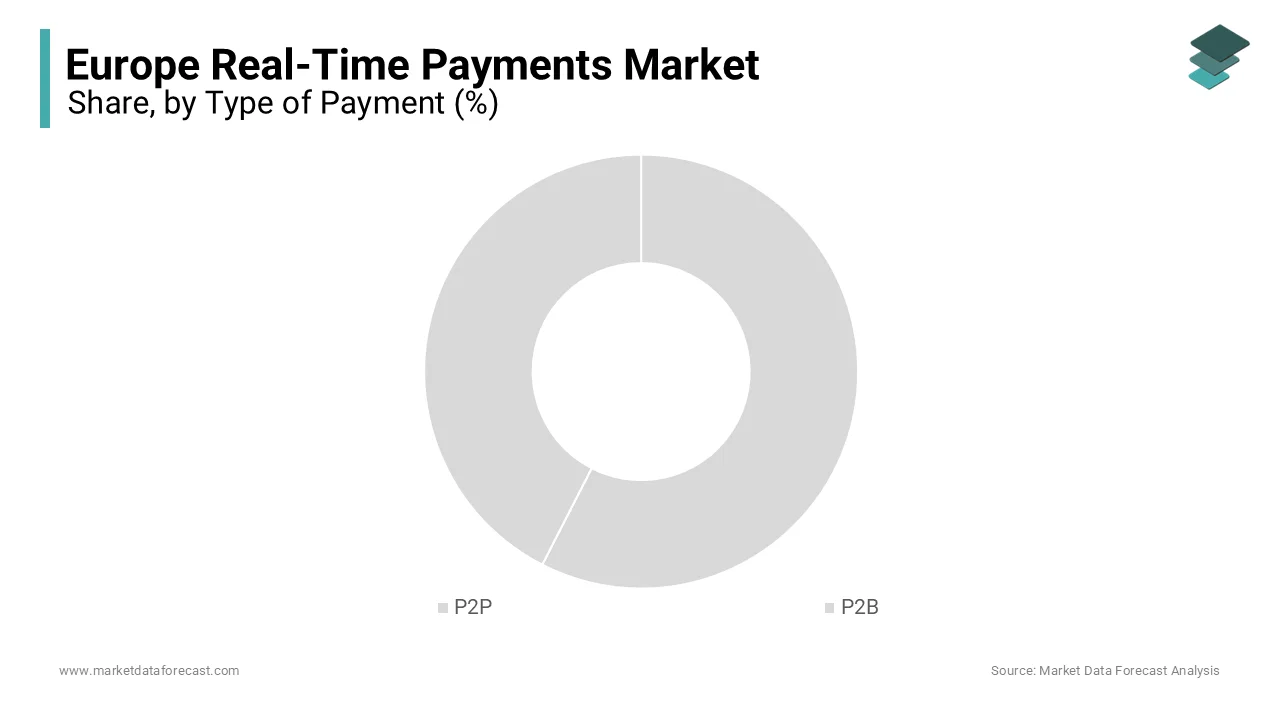
The Person to Business (P2B) segment is likely to experience the fastest CAGR of 26.4% from 2026 to 2034, owing to the transformative potential of Request-to-Pay (RTP) schemes,s which allow merchants and service providers to initiate payment requests directly within the consumer's banking environment, thereby streamlining the checkout and billing processes. Unlike traditional card networks that involve multiple intermediaries and higher fees, real-time P2B rails offer lower transaction costs and immediate liquidity for businesses, improving cash flow management significantly. Analysis of payment trends suggests that businesses implementing real-time transaction frameworks have experienced a measurable improvement in their collection processes and a decrease in payment failures compared to traditional automated methods. The ability to embed rich data such as invoice details, discount offers, and installment options directly into the payment request enhances the customer experience and reduces friction at the point of sale. Studies of consumer behavior across the region indicate that a significant majority of individuals favor managing their financial obligations directly through their mobile banking applications when the interface provides a secure and transparent experience. Furthermore, the rise of omnichannel retailing demands seamless payment experiences where online and offline transactions converge, a capability that real-time P2B infrastructure supports effortlessly. A study revealed that a notable share of European consumers prefer paying bills instantly through their banking app if the process is secure and informative, driving merchants to adopt these methods to meet evolving consumer expectations. The convergence of regulatory support, technological innovation, and merchant demand for efficiency positions P2B as the most dynamic growth engine in the market.
COUNTRY LEVEL ANALYSIS
United Kingdom Real-Time Payments Market Analysis
The United Kingdom outperformed other countries in the Europe Real-Time Payments Market and captured a 24.3% share in 2025. The supremacy of the UK market is attributed to its pioneering role as the first major economy to launch a comprehensive real-time payment infrastructure, known as Faster Payments, which has been operational since 2008 and serves as the global benchmark for speed and reliability. The UK market benefits from a highly mature digital banking ecosystem where neobanks and traditional incumbents alike have fully integrated instant payment capabilities into their core offerings. Statistics from the operator of the national retail payment system show that several billion real-time transactions are processed annually, reflecting deep consumer penetration and a high level of trust in the digital infrastructure. The proactive stance of the Financial Conduct Authority in promoting open banking has further accelerated innovation, allowing third-party providers to initiate payments directly from bank accounts with user consent. Data from national banking associations indicates that immediate payment methods now represent a substantial portion of remote banking activities, marking a clear move away from traditional, slower settlement processes. The government's push for digital inclusion and the widespread adoption of mobile wallets have created a fertile ground for new use cases ranging from instant salary payments to real-time tax settlements. Besides, the UK's early mover advantage has fostered a robust ecosystem of fintech innovators who continue to drive the evolution of real-time payment services, ensuring the country remains at the forefront of the European market.
Sweden Real-Time Payments Market Analysis
Sweden was the second largest player in the Europe Real-Time Payments Market and accounted for a 18.4% share in 2025. The growth of the Swedish market is supported by its status as one of the most cashless societies in the world. The Swedish market is characterized by an exceptionally high level of digital literacy and a consumer base that has almost entirely abandoned physical cash in favor of instant digital alternatives. The dominance of local solutions like Swish, which leverages the national real-time infrastructure, has created a unified and seamless payment experience for both individuals and businesses across the country. Official national statistics show that the use of physical currency for in-person purchases has dropped to a minimal level, with mobile real-time platforms becoming the go-to method for daily consumer spending. The collaboration between major banks to create interoperable platforms has eliminated fragmentation, ensuring that instant payments are universally accessible regardless of the financial institution. Information from regional banking groups highlights that the volume of immediate transactions per individual is among the highest in the region, illustrating how deeply these services are woven into the fabric of everyday life. The government's supportive regulatory environment and investment in digital infrastructure have further reinforced this leadership position. Regional innovation assessments suggest that local technology firms are at the forefront of developing advanced financial features, establishing new benchmarks in embedded finance that other markets are now observing. The cultural acceptance of digital immediacy, combined with robust technical foundations, ensures Sweden remains a critical hub for market growth.
Netherlands Real-Time Payments Market Analysis
The Netherlands maintains a noteworthy position in the Europe Real-Time Payments Market owing to the successful transition from its domestic instant payment scheme to the broader SEPA Instant framework. The Dutch market is distinguished by the widespread adoption of iDEAL, which has evolved to support real-time settlements, and the aggressive rollout of instant payment capabilities by all major banking groups. The country's dense urbanization and advanced telecommunications network provide the ideal infrastructure for high-volume, low-latency transactions. The Dutch central bank reports that a vast majority of online bank transfers are now settled instantly, reflecting a highly advanced and mature local digital payment environment. The strong presence of global payment processors and fintech hubs in Amsterdam fosters continuous innovation and cross-border integration. National banking groups indicate that the local financial sector achieved early alignment with regional standards, ensuring that users benefit from consistent pricing and improved security protocols. The collaborative approach between public and private sectors has facilitated the development of value-added services such as real-time invoicing and automated reconciliation. Economic analysis suggests that the efficiencies gained from immediate funds transfers have supported the operational performance of small and medium-sized businesses, fostering further technological adoption. The combination of historical leadership in digital payments and a forward-looking regulatory stance positions the Netherlands as a key driver of market expansion.
Germany Real-Time Payments Market Analysis
Germany is expected to be the most lucrative region in the Europe Real-Time Payments Market during the forecast period due to the recent modernization of its previously conservative banking sector and the mandatory adoption of instant payments. Historically reliant on cash and direct debits, the German market is undergoing a rapid transformation fueled by the European Union's regulatory mandates, which require all credit institutions to offer instant payment services. The introduction of the E2E (End-to-End) instant payment solution by the German Banking Industry Committee has standardized processes and improved interoperability across the nation's fragmented banking landscape. The national central bank has noted a significant increase in the use of immediate payments as both individuals and businesses recognize the advantages of constant availability and faster access to funds. The strong manufacturing base and export-oriented economy are increasingly leveraging real-time payments for supply chain financing and B2B settlements to optimize working capital. Industry associations for the digital economy observe that the use of specialized payment interfaces is rising, facilitating new commercial opportunities within the online and shared economy sectors. The government's commitment to digital sovereignty and secure infrastructure ensures that German real-time payment systems adhere to the highest security standards. Research shows that larger corporations are increasingly connecting real-time payment capabilities to their internal management systems to automate their financial operations. The convergence of regulatory pressure and economic necessity is unlocking significant latent potential in the German market.
France Real-Time Payments Market Analysis
France expanded steadily in the Europe Real-Time Payments Market owing to the strategic initiatives of the Banque de France and the active participation of major banking groups in the SEPA Instant scheme. The French market is witnessing a steady uptake of real-time payments as consumers become more accustomed to digital wallets and instant transfer features offered by leading banks. The government's push for financial inclusion and the modernization of public services has led to the integration of real-time payments for tax collections and benefit distributions, driving volume growth. The national central bank reports that nearly all eligible financial institutions have joined the immediate payment network, providing comprehensive coverage for the population. The vibrant fintech scene in Paris is leveraging real-time rails to create innovative solutions for peer-to-peer lending, crowdfunding, and micro-investing. Banking associations observe that new digital billing protocols are gaining momentum among major service providers, offering customers a more responsive and efficient way to manage their payments. The emphasis on data privacy and security within the French regulatory framework builds trust among users, encouraging higher transaction values. A study indicates that more retailers are considering immediate payment options at the checkout to enhance the customer experience and streamline the purchasing process. The alignment of national strategy with European objectives ensures that France continues to expand its footprint in the real-time payments landscape.
COMPETITIVE LANDSCAPE
The competition in the Europe Real-Time Payments Market is characterized by intense rivalry between established global infrastructure providers and agile regional specialists who vie for dominance in a rapidly evolving sector. Large multinational corporations leverage their extensive distribution networks and broad product suites to offer end-to-end solutions that cover everything from core banking integration to fraud management. These incumbents focus on building trust through strict compliance with European data protection laws and providing robust global support services for critical financial infrastructure. Conversely, emerging startups differentiate themselves by delivering highly innovative and niche solutions that address specific pain points, such as seamless cross-border settlements or superior user interface designs for mobile banking. The market landscape is dynamic with frequent mergers and acquisitions as larger players seek to absorb cutting-edge technologies and talent rapidly. Competitive advantage increasingly depends on the ability to demonstrate tangible return on investment through reduced operational costs and improved transaction success rates. Financial institutions are becoming more discerning and demand transparent pricing models and clear migration paths from legacy batch systems. This environment forces all participants to continuously innovate and adapt to the shifting regulatory and operational demands of diverse European clients while navigating complex compliance landscapes.
KEY MARKET PLAYERS
The leading companies operating in the Europe real-time payments market include:
- ACI Worldwide Inc.
- FIS Global
- Fiserv Inc.
- PayPal Holdings Inc.
- Temenos AG
- Mastercard Inc.
- VISA Inc.
TOP PLAYERS IN THE MARKET
- FIS Global stands as a preeminent force in the Europe Real-Time Payments Market by providing a comprehensive clearing and settlement infrastructure that connects financial institutions across the continent. The American multinational contributes significantly to the global landscape through its proprietary platforms that enable instant cross-border transactions and seamless integration with local schemes like SEPA Instant. Recently, FIS has intensified its focus on expanding its European data centers to ensure low latency and strict compliance with regional data sovereignty regulations. These enhancements allow banks to process high volumes of real-time transactions securely while adhering to evolving European mandates. The company actively collaborates with major European banks to deploy advanced fraud detection tools powered by artificial intelligence that protect instant payments from emerging threats. By continuously updating its API frameworks to support open banking initiatives, FIS reinforces its position as a trusted partner for organizations seeking scalable and resilient real-time payment solutions that drive digital transformation across the European financial sector.
- ACI Worldwide maintains a critical presence in the Europe Real-Time Payments Market through its enterprise-grade software solutions that facilitate real-time payment processing for banks, merchants, and billers. The global technology leader leverages its deep expertise in payment orchestration to help European organizations manage complex multi-rail environments and deliver instant payment experiences to end users. Recent strategic actions include the enhancement of its real-time payments hub to support the new European Union regulations mandating universal instant payment availability and fee parity. ACI focuses heavily on enabling request-to-pay capabilities that allow businesses to initiate secure payment requests directly within customer banking apps. The company partners with leading European payment service providers to implement robust liquidity management tools that optimize cash flow in real time. ACI also invests in cloud-native architectures that offer unparalleled scalability and resilience for handling peak transaction volumes during holidays or sales events. This holistic approach, combining regulatory compliance with technological innovation, solidifies their role as a key enabler of the instant economy throughout the region.
- Temenos AG serves as a specialized leader in the Europe Real-Time Payments Market, particularly within the core banking software segment, where agility and speed are paramount. The Swiss multinational contributes to the global market by supplying cloud-native banking platforms that have real-time payment capabilities embedded directly into the core ledger, eliminating the need for cumbersome overlays. Recent initiatives involve strengthening collaborations with European neobanks and traditional lenders to accelerate their migration to instant payment infrastructures that support twenty-four seven operations. Temenos prioritizes continuous innovation in open banking APIs to facilitate seamless third-party integrations and foster a vibrant ecosystem of fintech applications. The company has expanded its local implementation teams across key European markets to ensure rapid deployment and adherence to local regulatory standards. Temenos cements its reputation as a vital supplier of next-generation banking solutions through a focus on modular architecture and user-centric design. This approach enables financial institutions to launch real-time payment products quickly and efficiently.
TOP STRATEGIES USED BY THE KEY MARKET PARTICIPANTS
Key players in the Europe Real-Time Payments Market primarily employ strategic partnerships and acquisitions to expand their technological portfolios and integrate complementary capabilities such as advanced fraud detection or request-to-pay functionalities. Companies frequently collaborate with local banks and fintech startups to ensure seamless deployment and customization for diverse European regulatory environments. Another dominant strategy involves heavy investment in research and development to enhance platform scalability and reduce latency for high-volume transaction processing. Major vendors also focus on achieving rigorous regional compliance certifications to build trust with financial institutions that prioritize adherence to European Union mandates and data protection laws. Enhancing cloud-native offerings remains a priority to support the growing demand for flexible and cost-effective real-time payment solutions among small and medium-sized banks. Furthermore, participants actively engage in industry consortia and standardization bodies to shape the future of instant payment protocols and promote interoperability across borders.
MARKET SEGMENTATION
This research report on the Europe real-time payments market is segmented and sub-segmented into the following categories.
By Type of Payment
- P2P
- P2B
By Country
- UK
- France
- Spain
- Germany
- Italy
- Russia
- Sweden
- Denmark
- Switzerland
- Netherlands
- Turkey
- Czech Republic
- Rest of Europe