- Product Description Description
- Table of Contents TOC
- List of Table & Figure LOT
- Get Free Sample PDF Sample PDF
Market Size, 2025
$112.56 BnMarket Estimate, 2026
$120.18 BnMarket Forecast, 2034
$202.97 BnCAGR, 2026–2034
6.77%Europe Cross-Border Payments Market Size
The size of the Europe cross-border payments market was worth USD 112.56 billion in 2025. The market is anticipated to grow at a CAGR of 6.77% from 2026 to 2034 and be worth USD 202.97 billion by 2034 from USD 120.18 billion in 2026.
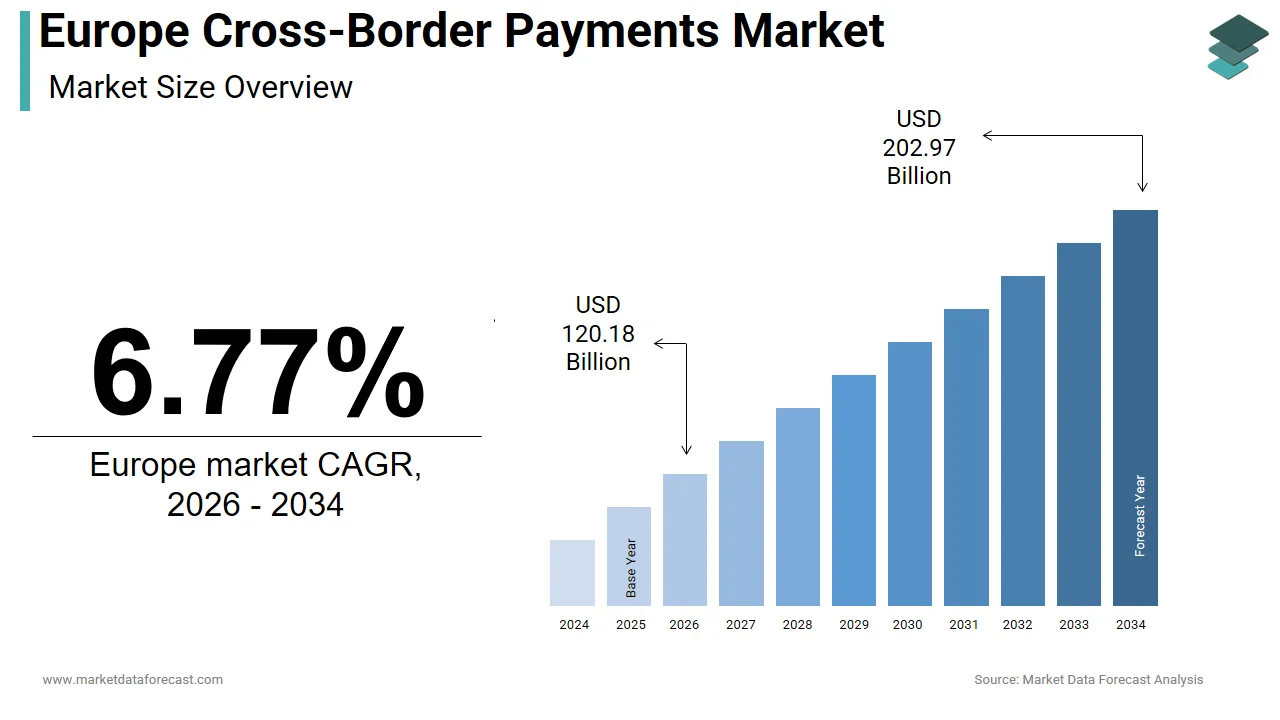
Cross-border payments enable financial transactions between parties located in different countries with at least one participant based in the European Economic Area. These transactions support international trade, remittances, e-commerce, and institutional fund movements that are facilitated through a mix of traditional correspondent banking, modern payment service providers, and real-time settlement infrastructures. The Single Euro Payments Area has dramatically simplified euro-denominated transfers across 36 participating countries, yet disparities persist for non-euro currencies and jurisdictions outside the SEPA zone. The euro area recorded a very large number of non-cash payment transactions in 2023, with cross-border volumes rising in tandem with digital trade. According to Eurostat, intra-EU trade in goods amounted to about 4.1 trillion euros in 2024, which is creating a foundational demand for efficient settlement mechanisms. Europe continues to play a central role in international financial networks.
MARKET DRIVERS
Surge in Intra-European Cross-Border E-Commerce
The exponential growth of digital retail across national borders within Europe is one of the major factors propelling the growth of the Europe cross-border payments market. Consumers now routinely purchase from online merchants in other EU countries due to the product variety, competitive pricing, and harmonised digital consumer rights. According to Eurostat, 77% of EU internet users bought or ordered goods or services online in 2024. This behavioural shift demands fast payment systems, low-cost, and capable of handling multi-currency settlements without friction. In response, merchants are adopting localised payment methods and dynamic currency conversion tools. According to reports, European e-commerce is expected to grow at an annual rate of about 9% through 2027, which is directly fuelling transaction volume growth in the cross-border payments layer and compelling infrastructure modernisation.
Regulatory Momentum Toward Instant and Sovereign Payments
The strategic regulatory agenda of the European Union is accelerating the transformation of cross-border payment capabilities, which is further boosting the growth of the European cross-border payments market. A landmark proposal mandates that all payment service providers in the EU offer instant cross-border euro credit transfers settled within ten seconds. According to the European Central Bank, instant payment transactions in the euro area surged by 72% year on year in 2024. This shift reduces dependency on slower, multi-hop correspondent banking and enhances liquidity efficiency. Complementing this, the Eurosystem’s digital euro initiative aims to provide a secure and central-bank-issued alternative for cross-border use. The policy developments are not merely technical upgrades but represent a broader push for European payment autonomy, fostering trust, standardization, and adoption across consumer and business segments.
MARKET RESTRAINTS
Regulatory Fragmentation Beyond the Eurozone
Despite SEPA’s success, significant regulatory and infrastructural divergence persists in non-Euro EEA countries, which is hindering seamless cross-border interoperability and regional market growth. Consumers now routinely purchase from online merchants in other EU countries owing to the product variety, competitive pricing, and harmonised digital consumer rights. The regulatory landscape across the EEA is marked by fragmentation. While several nations (such as Sweden, Poland and Romania) operate distinct national payment schemes, currency regimes, and supervisory expectations, and payment providers serving the full EEA must navigate oversight from a large number of national authorities, each applying the Payment Services Directive 2 (PSD2) differently. The full extent of this variation complicates scaling cross-border services. This discrepancy in national implementation increases compliance costs, delays settlements, and disproportionately affects small and medium enterprises lacking resources to manage multi-jurisdictional complexity, thereby constraining market inclusivity and efficiency.
Cybersecurity Gaps in Legacy Payment Systems
The cross-border payment infrastructure of Europe remains vulnerable due to the continued use of outdated messaging standards and decentralized fraud monitoring, which is further impeding the European market growth. While newer systems support real-time processing, a substantial volume still flows through SWIFT’s legacy MT formats that lack end-to-end encryption and robust authentication. According to a report by Tietoevry Banking, cross-border payment fraud attempts in Europe rose by 43% in 2024. The shift reduces dependency on slower, multi-hop correspondent banking and enhances liquidity efficiency. The absence of a unified cyber-incident response protocol across jurisdictions exacerbates recovery delays. These security shortcomings not only increase operational risk but also erode user confidence and slow the adoption of digital cross-border payment solutions.
MARKET OPPORTUNITIES
Distributed Ledger Technology for Multi-Currency Settlement
Distributed ledger technology offers a paradigm shift in cross-border settlement by enabling atomic and near-instantaneous transactions across currencies without intermediaries, which is a notable opportunity for the market participants in Europe. Unlike traditional nostro vostro account models, DLT-based systems use smart contracts to execute simultaneous debits and credits that reduce settlement risk and liquidity immobilization. According to the ECB’s exploratory work, a wholesale central bank digital currency platform settled nearly €1.6 billion in central-bank money in trials between May and November 2024. According to the World Economic Forum, DLT can lower cross-border transaction costs by about 40%. As per the reports of the European Payments Council, more than 15 European fintechs launched multi-currency stablecoin rails in 2024 that target SMEs in intra-EU trade. The Digital Finance Strategy of the European Commission explicitly encourages such innovation. As the Eurosystem advances its digital euro design with cross-border functionality in mind, DLT stands to become a cornerstone of a more efficient, transparent, and resilient European payment architecture.
Open Banking Enabled Cross-Border Payment Initiation
Open banking is mandated under the Revised Payment Services Directive, which is unlocking direct bank-to-bank cross-border payments through secure APIs and is a notable opportunity for the European cross-border payments market. Third-party providers can now initiate payments directly from a payer’s bank account with consent, bypassing card networks and reducing merchant fees. Open banking has expanded rapidly across the EU, with hundreds of licensed third-party providers now operating under PSD2 frameworks supporting growing cross-border payment initiation activity. Open-banking payments generally offer merchants significantly lower transaction costs than international card payments. In the Nordic region, bank-initiated transfers have become an increasingly common method for cross-border e-commerce payments between Sweden, Denmark, and Finland. As the Berlin Group’s NextGenPSD2 API standard achieves broader adoption, interoperability will improve by positioning open banking as a scalable, low-cost alternative for cross-border commerce across Europe.
MARKET CHALLENGES
Multi-Jurisdictional Compliance Complexity
Cross-border payment providers must navigate a labyrinth of overlapping regulatory obligations, including anti-money laundering rules, data protection mandates, and sanctions screening protocols, which is one of the biggest challenges to the European cross-border payments market. Although the EU’s 6th Anti Money Laundering Directive harmonizes legal definitions, national authorities apply divergent standards for customer verification and transaction monitoring. A substantial share of payment institutions reported inconsistent beneficial-ownership checks that resulted in redundant due diligence across member states. Simultaneously, the General Data Protection Regulation restricts cross-border data flows and complicates centralized fraud analytics. A notable portion of significant institutions maintain separate compliance systems for each major EU market, which increases operational costs. The extraterritorial reach of non-EU regulations such as US sanction,s adds another layer of burden. Until a unified compliance-passporting framework is implemente,d this fragmentation will impede scalability and deter market entry by smaller players.
Opaque and Volatile Foreign Exchange Pricing
The lack of transparency and consistency in foreign exchange conversion fees is also challenging the regional market expansion. Despite SEPA’s fee disclosure requirements, FX markups remain largely unregulated and often hidden until transaction completion. Effective FX margins on cross-border transfers varied significantly across major providers, which undermines consumer trust and merchant profitability. This unpredictability undermines consumer trust and merchant profitability. Many consumers abandoned cross-border online purchases in 2024 due to unexpected currency charges. For small businesses without hedging instruments, real-time FX volatility during multi-day settlement windows can significantly erode margins. The European Central Bank acknowledges that inconsistent FX practices remain a key obstacle to full payment integration across the EEA. Without binding transparency standards or a pan-European reference-rate mechanis,m pricing opacity will continue to stifle growth in non-Euro payment corridors.
REPORT COVERAGE
| REPORT METRIC | DETAILS |
| Market Size Available | 2025 to 2034 |
| Base Year | 2025 |
| Forecast Period | 2026 to 2034 |
| Segments Covered | By Transaction Type, Channel, End User, and Region. |
| Various Analyses Covered | Global, Regional and Country-Level Analysis, Segment-Level Analysis, Drivers, Restraints, Opportunities, Challenges; PESTLE Analysis; Porter’s Five Forces Analysis, Competitive Landscape, Analyst Overview of Investment Opportunities |
| Countries Covered | UK, France, Spain, Germany, Italy, Russia, Sweden, Denmark, Switzerland, Netherlands, Turkey, Czech Republic, and the Rest of Europe. |
| Market Leaders Profiled | Wise Ltd., PayPal Holdings, Inc., Stripe, Inc., SWIFT, The Western Union Company, MoneyGram International, Inc., OFX Limited, Revolut Ltd., Payoneer Global Inc., Mastercard Incorporated, Visa Inc., Nium Pte. Ltd., and Papaya Global Inc. |
SEGMENTAL ANALYSIS
By Transaction Type Insights
The Business-to-Business segment had 57.7% of the European cross-border payments market share in 2024 and emerged as the top-performing segment. The domination of the B2B segment in the European market is mainly driven by the deep integration of European supply chains and the high frequency of international trade settlements among corporations. Intra-EU trade in goods and services reached multi-trillion-euro levels in 2024, which necessitates regular cross-border invoicing and payment execution. High-value cross-border transactions in the euro area largely originate from corporate treasury operations, which reflect the scale and regularity of B2B flows. Furthermore, the adoption of SEPA Credit Transfers and ISO 20022 messaging standards has significantly reduced processing friction for businesses operating across multiple jurisdictions. A majority of large enterprises now use automated payment reconciliation systems that integrate directly with cross-border banking APIs, which enhances efficiency and reduces errors. These structural and technological enablers solidify B2B as the backbone of Ethe uropean cross-border payment market.
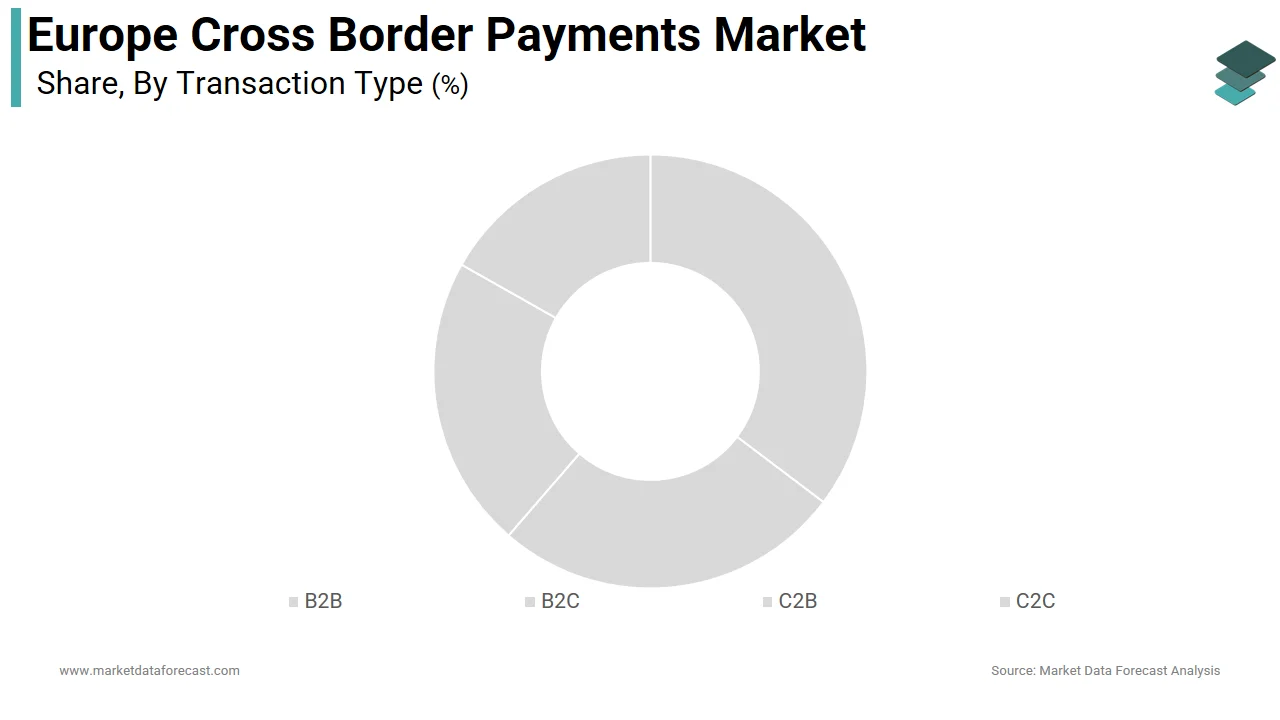
The Customer to Business segment is predicted to grow at the fastest CAGR of 12.1% over the forecast period in the European market, owing to the surge in cross-border digital commerce, where European consumers increasingly purchase from foreign online retailers. According to Eurostat, a substantial majority of EU internet users made online purchases in 2024. While participation in cross-border online shopping is increasing, it remains significantly lower than overall online purchase rates. C2B payment volumes recorded strong year-on-year growth in 2024, which far outpaced other transaction types. A key enabler is the proliferation of localized checkout solutions that support multi-currency pricing and instant bank transfers via open banking. Merchants using direct bank payment initiation experienced a notable reduction in cart abandonment compared to card-based flows. Additionally, regulatory advances such as the upcoming instant cross-border payment mandate ensure that C2B transactions settle within seconds, which improves user experience and merchant cash flow. These converging digital and policy are contributing to the growth of the C2B segment in the European market.
By Channel Insights
The bank transfers segment led the market by holding 63.6% of the regional market share in 2024. The leading position of the bank transfers segment in the European market is attributed to the maturity of the SEPA infrastructure, regulatory trust, and widespread corporate adoption. SEPA Credit Transfers accounted for a substantial volume of transactions in 2024, with cross-border activity growing steadily due to mandatory adoption by all euro area banks. A large share of European businesses prefer bank transfers for international supplier payments owing to lower fraud risk and seamless integration with enterprise resource planning systems. Moreover, the legal certainty provided by the Payment Services Directive ensures clear liability frameworks, which enhance user confidence. Bank transfers facilitate most intra-EU B2B cross-border settlements, which underscores their institutional embeddedness. The ongoing rollout of instant payment capabilities is further expected to drive the growth of the bank transfers segment in the European market by aligning legacy reliability with modern speed expectations.
The card payments segment is estimated to register the fastest CAGR of 9.9% over the forecast period in the European market due to the rising consumer preference for convenience and global acceptance, especially in e-commerce and travel. International card payment volumes increased notably in 2024, driven by post-pandemic recovery in tourism and cross-border online shopping. A majority of EU consumers used a card for at least one cross-border digital purchase in 2024, citing speed and buyer protection as key motivators. Network enhancements by Visa and Mastercar,d including dynamic currency conversion with upfront rate disclosur,e have improved transparency and reduced friction. International tourist arrivals in Europe grew strongly in 2024, with most travelers relying on cards for cross-border spending. These behavioral and infrastructural shifts are propelling card payments as the most rapidly expanding channel despite higher fees relative to bank transfers, thereby contributing to the expansion of the card payments segment in the European market.
By End User Insights
The businesses segment captured 63.6% of the European market share in 2024. The domination of the business segment is majorly driven by the deeply interconnected commercial landscape of Europe, where multinational operations, just-in-time supply chains, and intra-EU trade require frequent international settlements. According to the European Central Bank, European enterprises executed tens of millions of cross-border B2B transactions in 2024 with average invoice values in the tens of thousands of euros, which underscores the scale of regular business payments. As per the European Central Bank, corporate treasuries prioritise bank-based channels for their auditability, compliance alignment, and integration with accounting software. As per the European Commission’s Digital Economy and Society Index, a substantial majority of large EU firms now use automated cross-border payment platforms that support multi-currency reconciliation and real-time FX hedging. Furthermore, regulatory initiatives like the Corporate Sustainability Reporting Directive increase the need for transparent international fund flows and reinforce institutional reliance on formal payment rails. These structural, operationa,l and compliance-driven factors ensure businesses remain the dominant end-user segment.
The individuals segment is projected to grow at the fastest CAGR of 11.7% over the forecast period in the European market, owing to the rising remittance flows, digital nomadism, and cross-border consumption. According to reports, personal remittances to and within Europe reached very high levels in 2024, and a significant share originated from intra-European migrant workers, which reflects consistent demand for low-cost, fast personal transfers. As per the reports of the European Commission, tens of millions of EU residents lived in a member state other than their birth country in 202,4 which creates sustained demand for low-cost, fast personal transfers. Usage of non-bank payment apps for cross-border person-to-person transfers grew substantially in 202,4 which signals accelerating digital wallet adoption. Additionally, regulatory and workforce shifts such as the rise of remote work have increased cross-border salary disbursements and freelance payments. Platforms such as Wise and Revolut now offer very low-margin FX pricing for individual,s which challenges traditional bank pricing. These socio-demographic and technological forces are driving the growth of the individual segment in the European market.
COUNTRY LEVEL ANALYSIS
Germany Cross-Border Payments Market Analysis
Germany led the market by holding 212% of the European market share in 2024. Germany processes a vast volume of international trade settlements daily, being the leading exporter and industrial hub. Germany recorded substantial exports in 2024, with a majority destined for other EU nation,s which necessitatesa robust cross-border payment infrastructure. German corporations executed a very large number of cross-border B2B payments in 2024 that reflect the highest transaction volumes in Europe. The early adoption of SEPA in Germany and strong integration with TARGET2 ensure high settlement efficiency. Furthermore, Germany hosts numerous multinational headquarters and logistics centres, which amplifies transaction density. The government’s Industry 4.0 initiative has accelerated treasury automation with a high proportion of DAX-listed firms now using API-driven cross-border payment systems. This confluence of trade scale, regulatory maturity, and digital readiness is likely to boost the German cross-border payments market.
United Kingdom Cross-Border Payments Market Analysis
The United Kingdom accounted for the second-largest share of the European market in 2025. London’s role as a global financial center continues to anchor high volumes of cross-border capital flows, trade finance, and remittances. The UK-based institutions processed a large volume of cross-border payments in 2024, which reflected strong trade and financial linkages. The UK’s participation in the Single Euro Payments Area as a third country enables continued euro settlement acces,s though with added compliance layers. UK exports to the EU in 2024 remained substantial, which sustained commercial payment demand. The UK hosts Europe’s largest fintech ecosystem with firms like Wise and Checkout.com driving innovation in low-cos,t transparent cross-border payment rails. Usage of non-bank providers for at least one international transfer by UK adults in 2024 rose markedl,y which underscores evolving consumer behaviour. This blend of financial infrastructure, entrepreneurial dynamism, and persistent trade linkages is favouring the cross-border payments market in the UK.
France Cross-Border Payments Market Analysis
France is anticipated to account for a promising share of the Europe cross-border payments market over the forecast period, owing to the diversified trade relationships, a strong luxury and aerospace export base, and active participation in EU institutional frameworks. According to the National Institute of Statistics and Economic Studies, the exports of France totalled over USD 645 billion in 2024. French businesses initiated a large volume of cross-border payments in 2024, which is a substantial proportion of which were business-to-business rather than consumer. France has also been a leader in adopting instant payment schemes, with the STET platform processing tens of billions of transactions in 2024. A majority of large enterprises now use ISO 20022-compliant messaging for international settlements. Moreover, France’s extensive diaspora in North and West Africa drives consistent remittance outflows, which adds to transaction volume. Strategic investments in payment digitization and geographic trade are further boosting the French market growth.
Italy Cross-Border Payments Market Analysis
Italy is projected to grow at a healthy CAGR in the European cross-border payments market over the forecast period, owing to its manufacturing exports, particularly in fashion, machinery, and food products, alongside significant inbound tourism. Italy’s exports in 2024 were strong, with a significant portion directed to other EU countries. According to the Bank of Italy, small and medium enterprises make up virtually all Italian firms and play a major role in initiating cross-border payments that often leverage digital platforms to overcome traditional banking barriers. In 2024, Italy processed a large number of cross-border transactions with card-based payments linked to touris,m showing marked growth. According to ISTAT, Italy recorded over 130 million tourist arrivals in 2024, which is associated with substantial cross-border card spending. Additionally, the government’s digital invoicing mandate has streamlined B2B settlements, which is improving traceability and payment speed. The export intensity and tourism-driven dynamics are primarily supporting the cross-border payments market in Italy.
Netherlands Cross-Border Payments Market Analysis
The Netherlands is estimated to account for a notable share of the European cross-border payments market over the forecast period. The Netherlands has a strategic position as a logistics and trade gateway and is home to the Port of Rotterdam and Schiphol Airport which facilitates massive volumes of import and export activity. According to Statistics Netherlands, the Netherlands recorded a very high level of total trade in 2024 with a sizeable trade surplus that reflects high transaction velocity. According to De Nederlandsche Bank, Dutch multinationals and distribution centres process a large volume of cross-border payments annually, many involving intra-group treasury operations. The Netherlands also serves as a preferred EU headquarters location for global firms due to its favourable tax and regulatory environment, which is further amplifying payment flows. According to the Dutch Central Bureau of Statistics, a large majority of Dutch businesses use automated cross‐border payment systems integrated with ERP platforms. Additionally, the advanced open banking adoption in the Netherlands enables seamless C2B and P2P international transfers. The unique combination of trade logistics, corporate density, and digital maturity is boosting the cross-border payments market in the Netherlands.
COMPETITIVE LANDSCAPE
The Europe cross-border payments market features intense competition among traditional financial institutions fintech disruptors, and global payment networks. Incumbent banks leverage regulatory trust and established correspondent relationships but face pressure to modernize legacy systems. Fintech firms such as Wise and Revolut challenge with transparent pricing and seamless user experience,s particularly in consumer and SME segments. Meanwhile, global networks like Visa and Mastercard extend their reach through B2B platforms and real-time disbursement solutions. SWIFT maintains infrastructure dominance but must accelerate innovation to counter emerging alternatives like distributed ledger technology. Regulatory harmonization under EU directives creates both opportunities and compliance burdens, leveling the playing field for agile entrants. Strategic partnerships, technology upgrades, and customer-centric design now define competitive advantage as market participants race to deliver faster, cheape,r and more transparent cross-border payment services across the European landscape.
KEY MARKET PLAYERS
Some of the companies that are playing a dominating role in the Europe cross-border payments market include
- Wise Ltd.
- PayPal Holdings, Inc.
- Stripe, Inc.
- SWIFT
- The Western Union Company
- MoneyGram International, Inc.
- OFX Limited
- Revolut Ltd.
- Payoneer Global Inc.
- Mastercard Incorporated
- Visa Inc.
- Nium Pte. Ltd.
- Papaya Global Inc.
TOP PLAYERS IN THE MARKET
- SWIFT remains a foundational infrastructure provider in the Europe cross-border payments market by operating the global messaging network that connects over 11000 financial institutions across more than 200 countries. In Europe, SWIFT supports both legacy MT and modern ISO 20022 message formats, enabling interoperability across diverse banking systems. The organization has recently accelerated its migration to ISO 20022 in collaboration with the Eurosystem to enhance data richness and automation. In 2024, SWIFT launched Payment Controls and Payment Pre-validation services to reduce payment failures and improve compliance screening. These innovations strengthen transaction reliability and support real-time cross-border settlement initiatives across the European Economic Area.
- Visa plays a pivotal role in the Europe cross-border payments market through its global card network that facilitates international consumer and commercial transactions. The company has significantly expanded its B2B Connect platform in Europe to offer faster and more transparent business payments. In 2024 Visa integrated real-time FX rate disclosure into its cross-border checkout solutions for European merchants to reduce consumer friction. It also partnered with major European banks to embed Visa Direct into payroll and disbursement systems, enabling instant cross-border payouts. These strategic enhancements reinforce Visa’s position as a key enabler of digital commerce and remittance flows across European borders.
- Wise has emerged as a disruptive force in the Europe cross-border payments market by offering low-cost cost transparent international transfers for individuals and businesses. Headquartered in London, the company leverages a multi-currency account structure to bypass traditional correspondent banking and minimize FX markups. In 2024, Wise expanded its API based business payment services to over 15 European countries, enabling SMEs to automate supplier payments in 40 currencies. It also integrated with Major European accounting platforms such as Sage and DATEV to streamline reconciliation. These initiatives have significantly enhanced Wise’s utility for cross-border commerce and payroll within the European digital economy.
TOP STRATEGIES USED BY THE KEY MARKET PARTICIPANTS
Key players in the Europe cross-border payments market prioritize strategic investments in real-time payment infrastructure, interoperability enhancement,s and regulatory compliance modernization. They actively adopt ISO 20022 messaging standards to improve data quality and automation across jurisdictions. Many firms forge partnerships with fintechs and banks to embed payment capabilities into commerce and treasury workflows. Others expand multi-currency account offerings and dynamic FX pricing to increase transparency and reduce costs. Additionally, participants invest in cybersecurity frameworks and fraud detection systems to address rising threats. Several institutions also align with European policy initiatives, such as the instant cross-border payment mandate, to future-proof their services. These strategies collectively aim to enhance speed, reduce friction, and build trust in cross-border transaction ecosystems.
MARKET SEGMENTATION
This research report on the Europe cross-border payments market has been segmented and sub-segmented into the following categories.
By Transaction Type
- B2B
- B2C
- C2B
- C2C
By Channel
- Bank Transfer
- Card Networks
- MTOs
- Fintech
- Others
By End User
- Large Enterprises
- SMEs
- Individual Consumers
By Country
- United Kingdom
- France
- Spain
- Germany
- Italy
- Russia
- Sweden
- Denmark
- Switzerland
- Netherlands
- Rest of Europe