- Product Description Description
- Table of Contents TOC
- List of Table & Figure LOT
- Get Free Sample PDF Sample PDF
Market Size, 2025
$22.46 BnMarket Estimate, 2026
$20.60 BnMarket Forecast, 2034
$44.93 BnCAGR, 2026–2034
9.05%Europe Payment Processing Solutions Market Summary
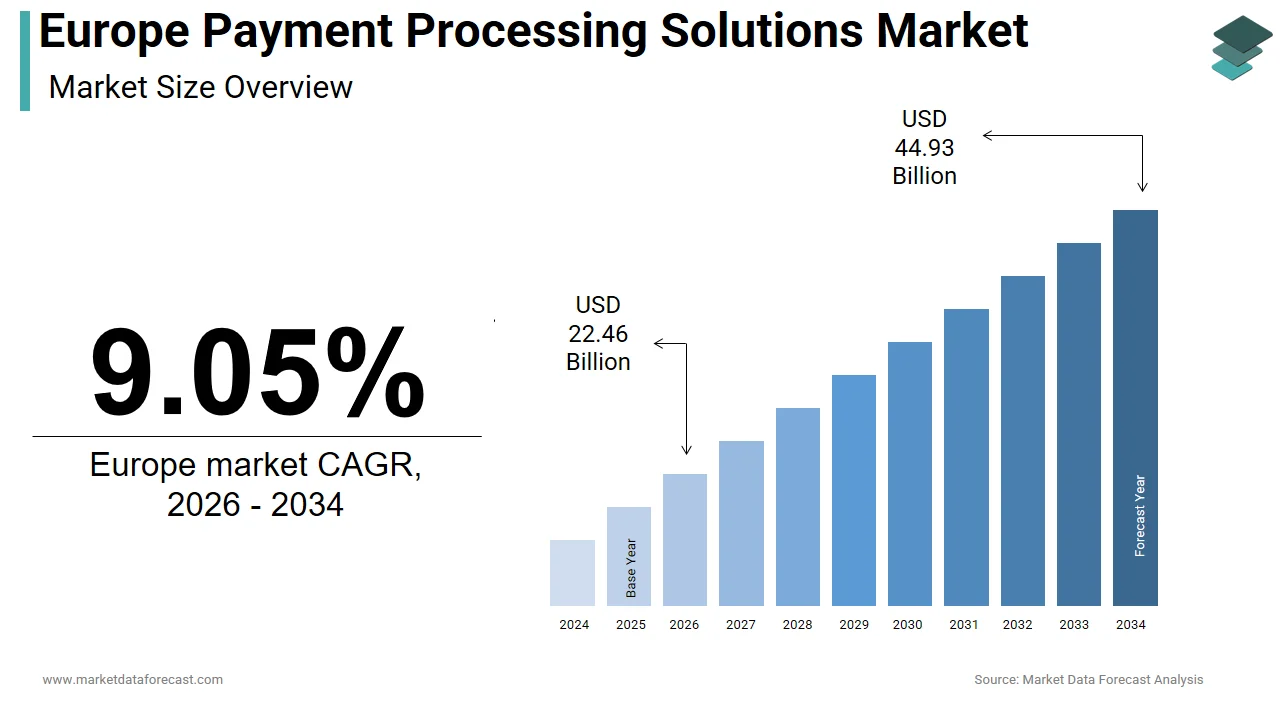
The Europe payment processing solutions market is currently undergoing a rapid transformation, with an estimated value of $22.46 billion in 2026. Driven by PSD2-mandated Strong Customer Authentication (SCA), rising adoption of SEPA Instant Credit Transfers, unified commerce integration, and the growth of account-to-account and wallet-based transactions, the market is projected to reach $44.93 billion by 2034.
Key Market Drivers
- Strong Customer Authentication Enforcement: The implementation of PSD2-driven biometric verification, 3DS 2.0 authentication, and risk-based transaction scoring has significantly strengthened payment security and accelerated migration toward compliant gateway infrastructure.
- Instant & Real-Time Payments Expansion: SEPA Instant Credit Transfers enable confirmation and settlement within 10 seconds across participating European markets, gaining traction in payroll payouts, e-commerce refunds, P2P transfers, and B2B settlements.
- Unified Commerce & Omnichannel Adoption: Retailers and enterprises are shifting toward single-stack payment orchestration platforms that support omnichannel checkout, instant refunds, loyalty synchronization, and centralized reconciliation across in-store and digital channels.
- Growth in Wallet & Account-to-Account Payment Ecosystems: Regional platforms such as Swish, Vipps, MobilePay, Lydia, and Giropay continue to expand, driven by mobile-first usage, strong security trust, and direct bank-linked transaction models.
Market Segmentation Outlook
Payment Method:
- Debit Cards: Remain the largest segment, supported by domestic networks such as Girocard (Germany), Cartes Bancaires (France), and iDEAL (Netherlands), which emphasize affordability, security, and direct bank-funded transactions.
- E-Wallets: The fastest-growing segment, driven by smartphone penetration, biometric SCA compatibility, and increasing use in mobile and e-commerce environments.
End-Use Industry:
- Retail: The dominant sector due to high transaction volume, omnichannel retail expansion, and integration of diverse local payment schemes across European markets.
- Hospitality: A major growth contributor as tourism recovery accelerates demand for contactless check-ins, mobile guest journeys, automated billing, and multi-currency settlement.
- Deployment: Cloud-based processing platforms dominate (approx. majority share) due to their scalability, centralized fraud analytics, regulatory compliance efficiency, and real-time settlement capabilities.
Regional Leaders
- United Kingdom: The largest regional market, supported by an advanced fintech ecosystem, mature digital commerce infrastructure, and high adoption of contactless and open-banking-enabled payments.
- Germany: A key processing market characterized by strong bank-centric payment preferences, domestic debit system dominance, and instant bank-transfer integration.
- France: One of the fastest-growing markets, driven by high SEPA Instant adoption and national initiatives to accelerate cashless transactions.
- Netherlands: A leading market for bank-initiated payments, where iDEAL commands strong e-commerce penetration and supports near-instant account-linked transactions.
- Sweden: A near-cashless economy powered by Swish, enabling biometric, instant, account-to-account payments across consumer and merchant environments.
Top Industry Players
- Traditional Giants: PayPal, Visa, Global Payments, First Data, and Square.
- Digital-First & European Leaders: Adyen, Worldline, Nexi, and Paysafe Group.
- Regional Powerhouses: Girocard (Germany), iDEAL (Netherlands), Swish (Sweden), and MobilePay (Denmark).
Recent Strategic Developments
- Instant Payment Integration: European payment processors expanded SEPA Instant capabilities to support instant refunds, just-in-time B2B settlements, and real-time liquidity optimization.
- Unified Commerce Expansion: Providers launched cloud-native orchestration platforms enabling cross-channel settlement visibility, centralized fraud governance, and consolidated merchant reporting.
- Open-Banking & Embedded Finance Adoption: Payment platforms strengthened account-to-account payments, embedded working-capital financing, and installment-based checkout solutions through PSD2-compliant APIs.
Europe Payment Processing Solutions Market Size
The Europe payment processing solutions market was worth USD 20.60 billion in 2025, is forecast to reach USD 22.46 billion in 2026, and is expected to reach USD 44.93 billion by 2034, growing at a CAGR of 9.05% from 2026 to 2034.
Payment processing solutions are the integrated technological and regulatory infrastructure that enables the authorization, clearing, and settlement of electronic transactions between merchants, acquirers, issuing banks, and card networks. These systems support a wide array of payment methods, including card payments, digital wallets, bank transfers, and real-time instant payments across physical and digital commerce environments. Furthermore, the Revised Payment Services Directive mandates strong customer authentication and open banking access, which has catalyzed the adoption of secure API based payment gateways. In this context, payment processing is no longer a back-office utility but a strategic layer of digital commerce infrastructure that balances innovation, security, and cross-border harmonization across Europe.
MARKET DRIVERS
Mandated Strong Customer Authentication Drives Secure Processing Adoption
The implementation of Strong Customer Authentication under the Revised Payment Services Directive has fundamentally reshaped demand for advanced payment processing solutions across Europe. This factor is elevating the growth of Europe payment processing solutions market. This regulatory shift has compelled merchants and acquirers to upgrade legacy systems to support 3D Secure 2.0 biometric verification and dynamic risk scoring engines. According to the European Central Bank, fraud losses on remote card payments fell by 31% between 2021 and 2023, directly attributable to SCA enforcement. The directive also spurred innovation in exemptions, low-value transactions under 50 euros, recurring payments, and trusted beneficiaries, which now qualify for frictionless flows if processed through certified risk-based authentication systems. This nuanced compliance landscape has made payment processors indispensable not just for transaction routing but for real-time risk intelligence and regulatory orchestration across 27 diverse national markets.
Rise of SEPA Instant Credit Transfers Transforms Settlement Expectations
The rapid adoption of SEPA Instant Credit Transfers has redefined consumer and business expectations for payment finality, and is also enhancing the growth of Europe payment solutions market. Launched in 2017, the scheme enables funds to be transferred and confirmed within ten seconds 24 hours a day, 365 days a year, across 36 participating countries. According to the European Central Bank, over 4.2 billion SCT Inst transactions were processed in 2023, representing a 58% increase from the prior year, with adoption led by payroll disbursements, e-commerce refunds, and peer-to-peer transfers. This velocity necessitates that merchants integrate with payment processors capable of real-time liquidity management, fraud screening, and settlement reconciliation. Companies like Adyen and Worldline have responded by embedding SCT Inst directly into their unified commerce platforms, allowing retailers to offer instant refunds and B2B suppliers to receive just-in-time payments. As national payment authorities phase out batch processing, France plans to sunset non-instant SEPA transfers by 2026, where the entire payment processing stack must evolve to support continuous real-time financial flows.
MARKET RESTRAINTS
Fragmented National Card Scheme Adoption Increases Integration Complexity
The coexistence of domestic card schemes alongside international networks creates significant technical and compliance burdens for payment processors operating, limiting the growth of Europe payment processing solutions market. Countries like France, Germany, and the Netherlands maintain national debit systems, Cartes Bancaires, Girocard, and iDEAL, respectively, that dominate domestic transaction volume but lack cross-border interoperability. According to the European Central Bank, while iDEAL accounts for over 60% of Dutch online payments, it is largely unusable outside the Netherlands. Similarly, Germany’s Girocard processes over 7 billion transactions annually but operates on a proprietary infrastructure incompatible with EMV standards. This fragmentation forces merchants to integrate multiple local acquiring paths and reconciliation systems, increasing development costs by 25 to 40% as per the European Retail Federation. Payment processors must maintain separate certification agreements with each national scheme operator, often involving legacy protocols and paper-based audit trails. Until national systems are fully aligned with SEPA and EMV standards, payment processors will continue to navigate a patchwork of technical requirements that undermine the single market’s promise of seamless cross-border commerce.
High Compliance Costs for Small Merchants Deter Advanced Solution Adoption
The cumulative regulatory burden of PSD2, SCA, GDPR, and anti-money laundering directives imposes disproportionate costs on small and micro merchants seeking to adopt modern payment processing solutions. This factor is another attribute hampering the growth of Europe payment processing solutions market. According to Eurostat, 93% of businesses in the EU are micro enterprises with fewer than 10 employees and limited in-house technical capacity. These firms often lack resources to implement certified PCI DSS-compliant environments, maintain transaction monitoring systems, or manage complex reconciliation across multiple payment methods. Although simplified SCA exemptions exist for low-risk transactions, many small merchants fail to qualify due to insufficient transaction history for risk scoring.
MARKET OPPORTUNITIES
Embedded Finance Integration Unlocks New Revenue Streams
The emergence of payment processing with embedded financial services across commerce platforms is expected to significantly bolster new opportunities for the expansion of Europe payment processing solutions market. Payment processors are increasingly embedding lending insurance and savings features directly into checkout, or B2B invoicing flows, using real-time transaction data to underwrite risk. According to the European Commission, over 170000 small businesses accessed embedded working capital loans in 2023 through payment platforms like Klarna and Stripe Capital, using sales history as collateral instead of traditional credit checks. In retail, point of sale financing now accounts for 22% of electronics purchases in Germany, as per the German Retail Association, with payment processors managing both installment billing and default risk. Similarly, in the travel sector, airlines and rail operators partner with processors to offer pay-later options at booking. SNCF reported a 35% increase in conversion after integrating embedded finance at checkout. The European Banking Authority’s regulatory sandbox has approved over 30 embedded finance pilots since 2022, enabling processors to operate within controlled compliance boundaries.
Expansion of Unified Commerce Platforms for Omnichannel Retailers
The demand for seamless payment orchestration across physical, digital, and social commerce channels is driving rapid adoption of unified commerce platforms, which is expected to boost the growth of Europe payment processing solutions market. Modern retailers require a single payment processing layer that synchronizes inventory, loyalty fraud rules, and settlement across brick and mortar stores, mobile apps, marketplaces, and social media checkouts. According to the European Retail Federation, 68% of omnichannel retailers in Western Europe migrated to unified payment platforms in 2023 to support features like buy online, pick up in store, endless aisle returns, and in-app tipping. In Sweden, fashion retailer H&M uses a single processor to manage payments across 2800 stores, Instagram shops, and its mobile app by enabling real-time loyalty point accrual and instant refunds regardless of channel. Payment processors like Adyen and Nexi have responded with centralized dashboards that provide consolidated reporting, liquidity management, and compliance across all touchpoints.
MARKET CHALLENGES
Persistent Cybersecurity Threats Undermine Trust in Digital Payments
The escalating sophistication of cyberattacks targeting payment processing infrastructure is certain to act as abarrier for the growth of Europe payment processing solutions market. According to Europol, organized crime groups increasingly deploy AI-generated phishing kits, credential stuffing bots, and Magecart skimming scripts to intercept card data at the point of entry. These attacks exploit vulnerabilities in third-party plugins, custom checkout scripts, and outdated TLS protocols, areas often outside the direct control of payment processors. While PCI DSS sets baseline standards, enforcement remains fragmented; the European Central Bank estimates that only 55% of small merchants maintain full compliance due to cost and complexity. High-profile breaches like the 2022 Ticketmaster incident, which exposed 40000 EU customer records, erode trust and trigger regulatory penalties under GDPR fines that can reach 4% of global turnover. Processors must now invest heavily in real-time behavioral analytics, end-to-end encryption, and proactive threat intelligence sharing through initiatives like the European Cybercrime Centre’s payment fraud task force.
Cross-Border Settlement Delays Persist Despite SEPA Harmonization
The significant settlement inefficiencies remain for non-eurozone countries, and cross-currency transactions are another factor contributing to the decline in the growth of Europe payment processing solutions market. While euro-denominated payments settle instantly or within one business day, transactions involving Polish zloty, Romanian leu, or Swedish krona often require two to three days due to legacy interbank clearing systems and limited liquidity pools. According to the European Central Bank, only 12 of 36 SEPA countries are full eurozone members, meaning over 140 million Europeans still experience payment delays when transacting with neighbors. This friction disproportionately impacts SMEs engaged in regional trade. Italian exporters to Croatia reported average payment receipt delays of 2.8 days, increasing working capital strain. Although the Euro Retail Payments Board advocates for extended instant payment coverage, non-Euro central banks cite infrastructure costs and monetary policy autonomy as barriers. Until all EU currencies are integrated into a true real-time multi-currency settlement layer, payment processors must manage complex liquidity hedging and reconciliation workflows that undermine the single market’s promise of frictionless commerce.
REPORT COVERAGE
| REPORT METRIC | DETAILS |
| Market Size Available | 2025 to 2034 |
| Base Year | 2025 |
| Forecast Period | 2026 to 2034 |
| CAGR | 9.05% |
| Segments Covered | By Payment Method, End User, and Country. |
| Various Analyses Covered | Global, Regional, and Country-Level Analysis, Segment-Level Analysis, Drivers, Restraints, Opportunities, Challenges; PESTLE Analysis; Porter’s Five Forces Analysis, Competitive Landscape, Analyst Overview of Investment Opportunities |
| Countries Covered | UK, France, Spain, Germany, Italy, Russia, Sweden, Denmark, Switzerland, Netherlands, Turkey, Czech Republic, and the Rest of Europe. |
| Market Leaders Profiled | PayPal Holdings, Inc., Global Payments Inc., First Data Corporation, Square Inc., Wirecard AG, Naspers Limited, Visa Inc., Jack Henry & Associates Inc., Adyen N.V., Paysafe Group Limited, Nexi, Worldline, and Others. |
SEGMENTAL ANALYSIS
By Payment Method Insights
The debit cards segment accounted in holding 46.5% of the Europe payment processing solutions market share in 2024, with the deep entrenchment of domestic debit networks that prioritize affordability and financial prudence. In Germany, the Girocard system processed over 7.1 billion transactions in 2023, as reported by the German Banking Industry Committee, with near universal acceptance at the point of sale and zero interchange fees for merchants. Similarly, the Netherlands’ iDEAL is used in 63% of all Dutch online payments, routing funds directly from bank accounts without card networks, minimizing fraud and cost. These schemes align with European consumer sentiment: a 2023 Eurobarometer survey found that EU citizens prefer payment methods that deduct funds immediately to avoid debt accumulation. National central banks actively promote these systems as financially inclusive. France’s Cartes Bancaires offers free debit cards to all account holders, including youth and seniors. This ecosystem of trust, cost efficiency, and public policy ensures debit cards remain the backbone of European payment processing. The integration of debit functionality into real-time payment rails is also to leverage the growth of Europe payment processing solutions market. SEPA Instant Credit Transfers now enable bank account-to-bank account payments within seconds, effectively turning bank accounts into instant debit instruments. Retailers benefit from lower fraud rates and immediate settlement without card network overhead. In Sweden, over 90% of adults use the Swish mobile payment app, which draws directly from bank accounts for peer-to-peer and merchant payments, as confirmed by the Riksbank.
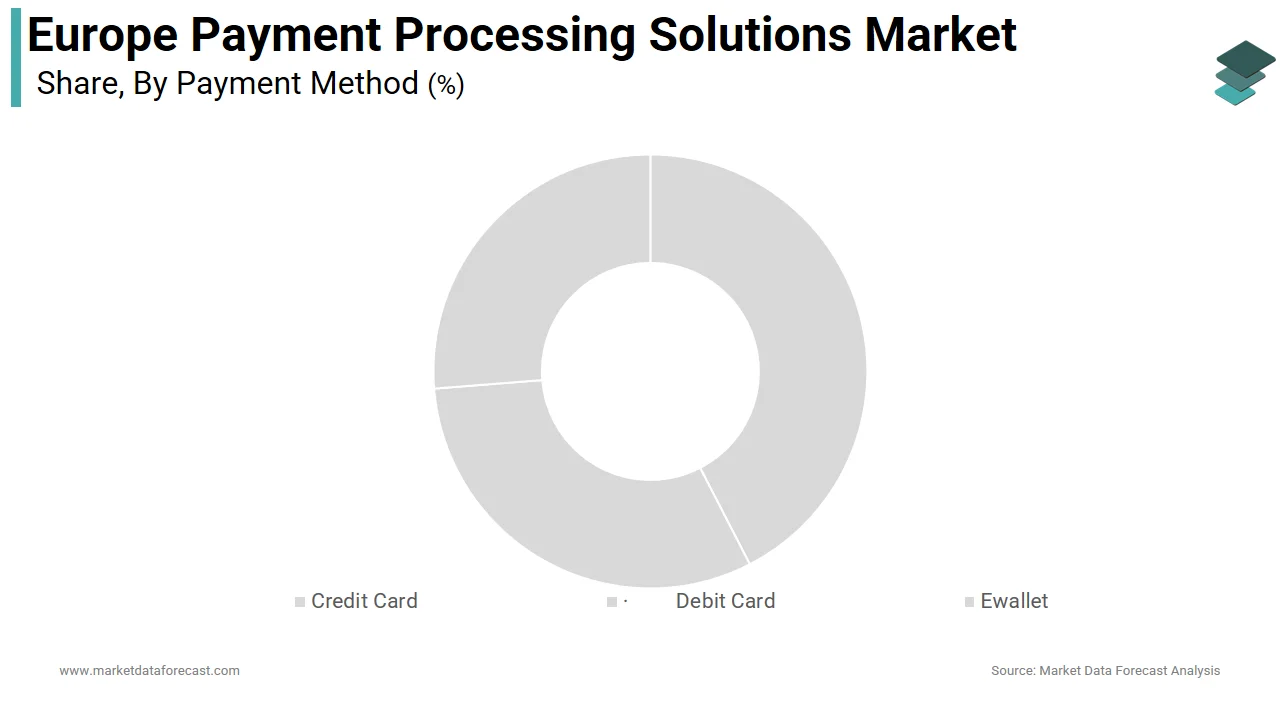
The ewallet segment is projected to expand at a CAGR of 15.3% from 2026 to 2034, with the mobile-first consumer behavior, seamless checkout experiences, and regulatory support for account-based payment innovation. The superior user experience e-wallets provide in e-commerce and mobile environments is also gaining traction with the growth of the segment. In the UK, over 58% of mobile e-commerce transactions in 2023 were completed via ewallets as per the UK Finance Payments Data report, with adoption driven by speed and tokenization that shields card details from merchants. Crucially, ewallets natively support Strong Customer Authentication through device biometrics, satisfying PSD2 without disruptive redirects. The expansion of local and regional e-wallet ecosystems that integrate loyalty payments and identity verification is also expected to escalate the growth of the segment. In the Nordics, Swish (Sweden), Vipps (Norway), and MobilePay (Denmark) have evolved from peer-to-peer apps into full merchant payment platforms with over 80% population penetration each, as per national central banks. These systems leverage bank-verified identities to enable instant payments without card networks. Similarly, France’s Lydia and Germany’s Giropay offer bank linked ewallet experiences compliant with national data sovereignty norms. The European Commission’s Digital Euro project further legitimizes account-based wallets by exploring public digital currency integration.
By End User Insights
The retail sector segment was the largest by holding 39.2% of the Europe payment processing solutions market share in 2024, with the sector’s high transaction volume, omnichannel complexity, and direct exposure to evolving consumer payment expectations. The imperative for seamless checkout across physical and digital touchpoints is another attribute fuelling the growth of this segment. Modern retailers must support dozens of local payment methods from iDEAL in the Netherlands to Bancontact in Belgium, while maintaining unified inventory, loyalty, and fraud management. According to the European Retail Federation, over 72% of omnichannel retailers in Western Europe migrated to unified payment platforms in 2023 to enable features like buy online, return in store, and endless aisle ordering. This operational complexity makes payment processing a core strategic capability rather than a utility, driving continuous investment in agile, scalable infrastructure. The regulatory burden of fraud prevention and consumer protection is also elevating the growth of the segment. The Revised Payment Services Directive mandates Strong Customer Authentication for most card transactions, yet retailers must balance security with conversion. In France, the Competition Authority requires large retailers to display all accepted payment methods transparently, compelling integration of diverse local schemes. Additionally, the EU’s upcoming Digital Fairness Act will ban dark patterns in checkout flows, necessitating transparent payment option presentation.
The hospitality end user segment is anticipated to expand at a fastest CAGR of 12.7% from 2026 to 2034, with the post pandemic recovery of tourism rising demand for contactless guest experiences and complex multi-currency settlement needs. The shift toward end-to-end digital guest journey from booking to checkout, which requires integrated payment orchestration, is also expected to amplify the growth of the segment. Hotels and restaurants are now embedding payment processing into reservation engines, mobile check-in apps, room service ordering, and split billing systems. Payment processors enable dynamic currency conversion at the point of sale by allowing guests to pay in their home currency with transparent rates, reducing cross-border friction. City break platforms like Sonder and boutique hotel chains offer monthly stays with automated billing for accommodation amenities and local experiences, all managed through a single payment profile.
COUNTRY-LEVEL ANALYSIS
United Kingdom Payment Processing Solutions Market Analysis
The United Kingdom was the top performer of the Europe payment processing solutions market by capturing 19.3% of the share in 2024, with its advanced fintech ecosystem, mature digital commerce infrastructure, and high consumer adoption of innovative payment methods. The UK processed over 26 billion non-cash transactions in 2023, with contactless payments accounting for 84% of all face-to-face card transactions, as confirmed by the Bank of England. London serves as a global hub for payment innovation, home to processors like Worldpay and fintechs like Revolut that serve millions of European customers. The Financial Conduct Authority’s regulatory sandbox has approved over 50 payment processing innovations since 2020, including open banking-enabled account-to-account payments and biometric authentication flows.
Germany Payment Processing Solutions Market Analysis
Germany held second by occupying 17.3% of the Europe payment processing solutions market share in 2024, with its robust engineering culture, preference for data privacy, and dominance of bank-centric payment schemes. This environment has fostered innovation in bank-linked solutions like Giropay and instant bank transfers integrated directly into checkout flows. At the same time, Germany is a major market for unified commerce platforms. Automotive and retail giants like BMW and Aldi require payment processors that support real-time inventory, loyalty, and cross-channel returns across 20-plus European countries. The Federal Financial Supervisory Authority enforces strict PSD2 compliance with rigorous SCA enforcement, yet promotes innovation through its BaFin Innovation Hub.
France Payment Processing Solutions Market Analysis
France payment processing solutions market growth is expected to grow at the fastest CAGR of 14.3% of share in 2024, with its centralized digital strategy, strong public banking sector, and leadership in instant payments. According to the Banque de France, over 3.8 billion SEPA Instant Credit Transfers were processed in 2023, making France the second-largest user of the scheme after Germany. France’s “France Cashless” initiative aims to reduce cash usage to under 10% by 2025, accelerating the adoption of contactless and mobile payments in transport, retail, and public services. The French Prudential Supervision and Resolution Authority mandates stringent fraud monitoring yet encourages innovation through regulatory sandboxes for open banking and digital euro pilots. In tourism, international visitors increasingly use contactless and e-wallet payments with processors enabling dynamic currency conversion at the point of sale.
Netherlands Payment Processing Solutions Market Analysis
The Netherlands payment processing solutions market is propelled by the world-leading adoption of bank-initiated payments and digital commerce maturity. This bank-centric model minimizes fraud losses, which are below 0.01% of transaction value, and enables instant settlement without card networks. The Netherlands is also a logistics and e-commerce hub, home to global platforms like Booking.com and bol.com that process millions of cross-border transactions daily, requiring support for 20-plus European payment methods in a single checkout. Dutch regulators enforce strict PSD2 compliance yet foster innovation through the Dutch Central Bank’s Innovation Hub, which has fast-tracked approvals for open banking payment initiators.
Sweden Payment Processing Solutions Market Analysis
Sweden payment processing solutions market growth is likely to grow with its near cashless society leadership in mobile payments and strong fintech collaboration. Swish leverages bank-verified identities to enable instant person-to-person and merchant payments without card details, setting a benchmark for secure account-based payments. The Swedish Financial Supervisory Authority actively collaborates with fintechs through its regulatory sandbox, promoting innovations like biometric authentication and open banking payment initiation.
COMPETITIVE LANDSCAPE
Competition in the Europe payment processing solutions market is characterized by a dynamic interplay between homegrown European processors and global technology firms, each vying for dominance through regulatory alignment, technological agility, and local payment scheme integration. Unlike more consolidated markets, Europe’s landscape is inherently fragmented due to coexisting national systems like Girocard, iDEAL, and Cartes Bancaires alongside pan-European rails such as SEPA Instant. This complexity favors players with deep local banking relationships and multi-scheme orchestration capabilities. The regulatory environment further shapes competition. PSD2 and Strong Customer Authentication have raised compliance barriers, while open banking has lowered entry costs for API first fintechs. The market is bifurcating between full-stack processors like Worldline and Nexi that manage end-to-end infrastructure and agile platforms like Adyen that offer global scalability with European compliance. Innovation is increasingly centered on real-time settlement, embedded finance, and unified commerce rather than transaction volume alone.
KEY MARKET PLAYERS
The leading companies operating in the Europe payment processing solutions market include:
- PayPal Holdings, Inc.
- Global Payments Inc.
- First Data Corporation
- Square Inc.
- Wirecard AG
- Naspers Limited
- Visa Inc.
- Jack Henry & Associates Inc.
- Adyen N.V.
- Paysafe Group Limited.
- Nexi
- Worldline
TOP PLAYERS IN THE MARKET
- Adyen is a leading global payment processor with deep roots in Europe, offering a unified commerce platform that seamlessly integrates online in store and mobile payment processing for enterprises across retail, hospitality, and digital services. Headquartered in Amsterdam, the company serves iconic European brands such as Zalando, IKEA, and L’Oreal with a single global payment infrastructure supporting over 250 payment methods and 150 currencies. Adyen expanded its real-time fraud detection engine using machine learning to reduce false declines while maintaining compliance with PSD2 Strong Customer Authentication. The company also enhanced its SEPA Instant Credit Transfer capabilities, enabling merchants to issue refunds within seconds across 36 European countries. These innovations reinforce Adyen’s role as a strategic enabler of borderless, secure, and data-driven commerce for global enterprises from its European innovation base.
- Worldline is a European payment technology leader providing end-to-end processing solutions for banks, merchants, and financial institutions across the continent. With strong operational presence in France, Germany, and the Benelux region, Worldline manages millions of point-of-sale terminals and digital payment gateways that handle both domestic schemes like Cartes Bancaires and Girocard alongside international networks. Worldline launched its Unified Commerce Cloud, a platform that synchronizes payment data, loyalty, and inventory across physical and digital channels in real time. The company also deepened integration with national instant payment systems, including France’s SCT Inst and Germany’s EBA Clearing infrastructure.
- Nexi is a pivotal payment processor in Southern Europe, offering integrated acquiring, issuing, and digital wallet solutions across Italy, Spain, and Greece. The company operates one of the largest domestic card networks in Europe and provides critical infrastructure for public services, including tax payments, transit fares, and utility billing. Nexi rolled out its Nexi Open platform, enabling third-party developers to build PSD2-compliant payment initiation and account information services through certified APIs. The company also partnered with major Italian banks to accelerate the adoption of SEPA Instant Credit Transfers for e-commerce refunds and B2B settlements.
TOP STRATEGIES USED BY THE KEY MARKET PARTICIPANTS
Key players in the Europe payment processing solutions market prioritize unified commerce platforms that synchronize payment data across online in store and mobile channels to deliver seamless customer experiences. They invest heavily in real-time fraud prevention using machine learning and behavioral analytics to reduce false declines while complying with PSD2 Strong Customer Authentication. Companies are deeply integrating with national instant payment schemes like SEPA Instant and domestic rails such as iDEAL and Swish to enable sub-ten-second settlements. Strategic partnerships with banks, fintechs, and public sector bodies ensure interoperability and regulatory alignment across 27 member states. Additionally, they leverage open banking APIs to develop embedded finance offerings, including pay-later options and account-to-account payments that reduce reliance on card networks and enhance data sovereignty for European merchants and consumers.
MARKET SEGMENTATION
This research report on the Europe payment processing solutions market has been segmented and sub-segmented into the following categories.
By Payment Method
- Credit Card
- Debit Card
- Ewallet
By End User
- Hospitality
- Retail
- Utilities & Telecommunication
- Others
By Country
- United Kingdom
- France
- Spain
- Germany
- Italy
- Russia
- Sweden
- Denmark
- Switzerland
- Netherlands
- Rest of Europe