- Product Description Description
- Table of Contents TOC
- List of Table & Figure LOT
- Get Free Sample PDF Sample PDF
Market Size, 2025
$80.80 BnMarket Estimate, 2026
$83.79 BnMarket Forecast, 2034
$112.05 BnCAGR, 2026–2034
3.70%Europe Digital Remittance Market Summary
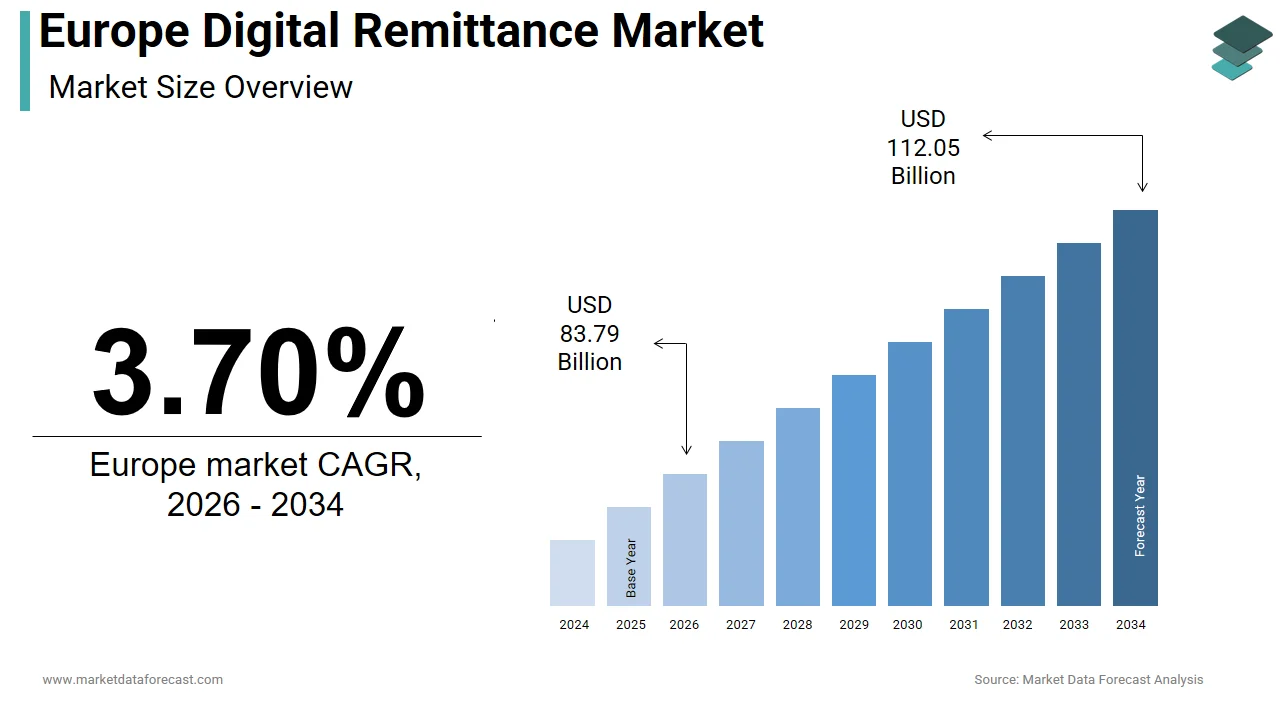
The Europe digital remittance market was valued at USD 80.80 billion in 2025, is estimated to reach USD 83.79 billion in 2026, and is projected to reach USD 112.05 billion by 2034, growing at a CAGR of 3.70% from 2026 to 2034. Market growth is driven by Europe’s large migrant population, rising preference for mobile and online money transfer platforms, and strong regulatory support for open banking and instant payment infrastructure across the region.
Digital remittance refers to the electronic cross-border transfer of funds via mobile apps, digital wallets, and online platforms, enabling faster, lower-cost, and more transparent transactions compared to traditional cash-based channels. In Europe, these services are primarily used by migrant workers, international students, and diaspora communities sending funds to Africa, Asia, and Eastern Europe, positioning digital remittance as a critical enabler of financial inclusion and cross-border economic connectivity.
Market Snapshot
- 2025 Market Size: USD 80.80 Billion
- 2026 Market Size: USD 83.79 Billion
- 2034 Projected Market Size: USD 112.05 Billion
- CAG (2026 to 2034): 3.70%
- Largest Country Market (2025): United Kingdom
- Fastest-Growing Segment: Inward Digital Remittance
Key Market Trends & Insights
- The United Kingdom dominated the European digital remittance market in 2025, supported by a strong fintech ecosystem and large diaspora communities.
- Outward digital remittances account for the largest share, reflecting Europe’s role as a major global remittance-sending region.
- Mobile app–based transfers are the preferred channel due to cost efficiency, speed, and real-time tracking features.
- Open banking and SEPA Instant Credit Transfer are reshaping cross-border payments by reducing settlement time and costs.
- Inward digital remittances are the fastest-growing segment, driven by international students, remote workers, and digital nomads.
- Trust, transparency, and compliance remain key differentiators among service providers.
Key Report Takeaways
- By remittance type, outward digital remittances dominated the market in 2025, supported by consistent fund outflows from migrant populations.
- Inward digital remittances are projected to grow at the fastest CAGR (12.3%), driven by foreign students, tourism, and remote work inflows.
- By end user, migrant workers held the largest market share due to recurring, high-frequency transfers to origin countries.
- The international students segment is expected to register the highest growth (14.1% CAGR), supported by rising non-EU enrollment in European universities.
- By country, the UK accounted for 22.2% market share in 2024, followed by Germany and France, while Southern Europe shows rising adoption through mobile-first platforms.
Europe Digital Remittance Market Size
The Europe digital remittance market was valued at USD 80.80 billion in 2025, is estimated to reach USD 83.79 billion in 2026, and is projected to reach USD 112.05 billion by 2034, growing at a CAGR of 3.70% from 2026 to 2034.
Digital Remittance is the electronic and cross-border transfer of funds by individuals (like migrant workers) to families or for services, using online platforms, mobile apps, digital wallets, or bank accounts, bypassing physical cash and traditional banks for faster, cheaper, and more accessible financial flows, which significantly boosts financial inclusion and economic development. This process effectively bypasses traditional brick-and-mortar banking infrastructure. These services cater primarily to migrant populations, foreign students, and diaspora communities sending funds to origin countries across Africa, Asia, and Eastern Europe. According to Eurostat, as of January 1, 2024, there were 44.7 million persons born outside the EU living in the EU. The population of foreign-born individuals in the EU has shown a general increase over the past decade. Moreover, the European Central Bank has observed an ongoing structural shift toward fintech-mediated transfers, characterized by a dynamic growth in digital wallet use and overall non-cash transactions. Apart from these, the European Commission's Digital Finance Strategy actively promotes initiatives like open banking APIs and instant payment interoperability, leveraging the widespread reach of the SEPA Instant Credit Transfer scheme across its participating countries and territories. These demographic, technological, and regulatory currents define the operational landscape of Europe’s digital remittance ecosystem beyond transaction volume metrics.
MARKET DRIVERS
Large and Growing Migrant Population with High Remittance Propensity
The region’s substantial and steadily expanding migrant population serves as the primary accelerator for the Europe digital remittance market. This is because of consistent cross-border financial obligations toward families in origin countries. According to Eurostat, the number and share of non-EU-born residents in the European Union are significant and have generally increased over the last decade, with diverse communities from various parts of the world residing across member states. As per sources, a large proportion of migrants, including those from Sub-Saharan Africa and South Asia, consistently send financial support (remittances) back to their home countries to cover essential needs for their families. According to studies, Many Syrian and Iraqi nationals residing in Germany provide ongoing financial assistance to support their relatives remaining in host countries within the Middle East region. Nationals from specific countries with large populations in Spain, such as Morocco and Romania, represent a substantial share of the individuals sending money from Spain to their home countries. These sustained outflows are amplified by digital literacy among younger migrants who prefer mobile-first platforms over traditional money transfer operators. This demographic reality ensures a resilient and recurring transaction base that anchors the digital remittance market across Western and Southern Europe.
Regulatory Support for Open Banking and Instant Payment Infrastructure
The European Union’s proactive digital finance regulatory framework is also a major driver of the Europe digital remittance market. This has created a fertile environment for low-cost cost high-speed remittance services by mandating interoperability and open access to payment rails. The SEPA Instant Credit Transfer scheme covers a broad number of countries and enables fund settlement in under ten seconds with near universal bank participation. Moreover, the Revised Payment Services Directive requires banks to provide third-party providers secure access to customer accounts via standardized APIs, which facilitates direct debit and credit initiation without relying on card networks. A significant majority of licensed payment institutions in the EU leverage open banking to bypass correspondent banking layers, thereby reducing both cost and transfer time. Besides, the EU’s Cross-Border Payments Regulation enforces transparency on currency conversion fees, compelling providers to disclose all charges upfront. These regulatory enablers collectively dismantle legacy inefficiencies and position Europe as a global benchmark for inclusive digital cross-border payments.
MARKET RESTRAINTS
Persistent Fragmentation of Anti-Money Laundering Compliance Frameworks
Significant divergence in national anti-money laundering interpretations and customer due diligence requirements impedes seamless scaling of digital remittance services across member states, and negatively impacts the growth of the Europe digital remittance market. This is despite EU harmonization efforts. Thresholds for triggering enhanced due diligence identity verification vary significantly across European nations. Also, the inconsistent application and enforcement of beneficial ownership verification across different jurisdictions may lead to increased compliance costs for pan-European fintech companies when compared to domestic operators. Requirements for the type of authentication method used in cross-border transfers are not uniform within Europe. Fintech startups often invest substantial time and resources to complete full regulatory onboarding in each country, extending beyond the standard EU passporting process. This fragmentation not only inflates operational overhead but also creates uneven consumer experiences that undermine trust in digital platforms across the single market.
Limited Access to Formal Banking in Key Recipient Countries
Infrastructural gaps in destination economies, where recipients often lack bank accounts or digital payment infrastructure necessary to receive electronic transfers directly, obstruct the expansion of Europe digital remittance market. Financial account ownership among adults in Sub-Saharan Africa is not yet widespread, and the use of mobile money services is primarily focused within a limited number of countries. In Ukraine, a significant portion of the rural population continues to depend on physical cash pickup methods, indicating challenges in the expansion of digital financial disbursement networks. The access to formal financial services for women in Pakistan remains low, which consequently impacts the effectiveness and reach of digital innovations originating from financial service providers. European remittance providers must therefore maintain costly partnerships with thousands of cash payout agents across Asia and Africa, increasing both operational complexity and counterparty risk. For many end users, the full benefits of rapid, low-cost digital remittances won't be accessible until financial inclusion increases in receiving nations.
MARKET OPPORTUNITIES
Integration with Digital Identity and E-Residency Programs
The region’s advancing digital identity infrastructure introduces a potential opportunity for the growth of the Europe digital remittance market. This opens the pathway for secure and frictionless remittance onboarding by enabling remote verification compliant with anti-money laundering mandates. Many European Union member states provide legally recognized digital identification schemes that work together under a specific EU regulation. A particular residency program has granted numerous digital identities to individuals who are not residents, enabling certain financial actions without requiring a physical presence. An initiative for a European Digital Identity Wallet aims to allow citizens and legal migrants to share verified personal information with service providers securely. A national visa program for digital nomads in one European country works with banking systems to automatically confirm applicants' credentials, making the financial onboarding process faster. These identity layers reduce manual verification costs and enhance trust through auditable credential exchange. This convergence of sovereign digital identity and financial services creates a scalable compliance foundation for next-generation remittance ecosystems.
Expansion of Mobile Money Interoperability with European Payment Systems
Emerging interoperability between the regional instant payment rails and mobile money platforms in Africa and Asia is unlocking direct digital disbursement channels that bypass cash agents and reduce costs, and thereby generating fresh prospects for the Europe digital remittance market. Mobile money interoperability agreements between European payment service providers and African mobile network operators have shown an increase. A technical cooperation pact enables certain European payments to be credited directly to mobile wallets in a number of African countries. Similarly, partnerships between remittance firms and M Pesa allow recipients to receive funds converted to local currency quickly with low fees. Integrations such as these have contributed to a reduction in average remittance costs to Sub-Saharan Africa. Global initiatives to link instant payment systems are expected to dismantle existing barriers, which ultimately boost financial inclusion for diaspora communities.
MARKET CHALLENGES
Exposure to Currency Volatility and FX Liquidity Constraints
Providers of electronic and cross-border transfer of funds in the region face persistent financial risk from foreign exchange rate fluctuations and shallow liquidity in exotic currency pairs, which degrades the growth of the Europe digital remittance market. This erodes margins and complicates pricing transparency. Bid-ask spreads for less common currency pairs remain consistently wider than those for major G10 currencies. The majority of digital remittance startups partially hedge or do not hedge at all against foreign exchange movements, possibly due to high collateral requirements. During times of significant geopolitical stress, exchange rates for specific non-major currencies can experience substantial and rapid fluctuation, potentially leading service providers to suspend operations or incur financial losses. A notable percentage of remittance firms have reported experiencing delays in settlement processes, often because correspondent banks are hesitant to handle transactions involving certain jurisdictions. These market structure deficiencies expose operators to unpredictable revenue erosion and service disruption that cannot be fully mitigated through technology alone.
Consumer Mistrust Stemming from Data Privacy and Fraud Incidents
Persistent concerns about data security fund interception and opaque fee structures affect consumer adoption of digital remittance platforms across the region, which in turn propels the expansion of the Europe digital remittance market. A notable portion of EU migrants expressed apprehension regarding the use of mobile-only transfer services, as per multiple sources. The primary concerns among this group centered on the potential for personal data misuse or unauthorized account takeover. Moreover, reports have indicated a significant rise in phishing attacks specifically targeting individuals who use remittance applications. Certain regions within the EU recorded particularly high rates of these security incidents. Financial regulatory bodies in member nations have taken action against remittance operators found to be operating without proper authorization. These enforcement actions addressed issues such as misleading claims about transfer speeds and the use of undisclosed currency conversion markups. These incidents reinforce reliance on established brands or informal channels, particularly among older and low-income demographics. Rebuilding trust requires not only robust cybersecurity but also real-time transaction tracking, transparent all-in pricing, and multilingual customer support, capabilities that many early-stage fintechs lack. Closing these credibility gaps is essential for uniform digital remittance growth throughout Europe's varied migrant communities.
REPORT COVERAGE
| REPORT METRIC | DETAILS |
| Market Size Available | 2025 to 2034 |
| Base Year | 2025 |
| Forecast Period | 2026 to 2034 |
| Segments Covered | By Remittance Type, Channel, End User, Provider Type, and Country. |
| Various Analyses Covered | Global, Regional, and Country-Level Analysis, Segment-Level Analysis, Drivers, Restraints, Opportunities, Challenges; PESTLE Analysis; Porter’s Five Forces Analysis, Competitive Landscape, Analyst Overview of Investment Opportunities |
| Countries Covered | UK, France, Spain, Germany, Italy, Russia, Sweden, Denmark, Switzerland, Netherlands, Turkey, Czech Republic, and the Rest of Europe. |
| Market Leaders Profiled | The Western Union Company, PayPal Holdings, Inc., Wise plc, MoneyGram International, Inc., Remitly Global, Inc., Revolut Ltd, WorldRemit Ltd, LG Electronics, and Others. |
SEGMENTAL ANALYSIS
By Remittance Type Insights
The outward digital remittance segment led the Europe digital remittance market by capturing a substantial share in 2025 as European residents consistently send funds to family and communities in origin countries across Africa, Asia, and Eastern Europe. Europe contributes significantly to global outward remittance flows. The large migrant population residing in Europe is a key factor in the continuous outflow of funds. Outbound remittance transactions within certain European nations are numerous and vary in average amount. These funds are primarily directed to various nations across different regions. Migrants from specific nationalities are sending substantial amounts of money abroad through established financial systems. Digital platforms are widely used for sending remittances, accounting for a significant volume of transactions. A majority of smaller outward financial transfers are now conducted using mobile applications. The use of mobile apps for remittances is increasing due to lower costs and immediate tracking capabilities. These persistent demographic and transactional patterns ensure outward remittance remains the market’s core segment, driven by familial obligation and economic disparity rather than episodic inflows.
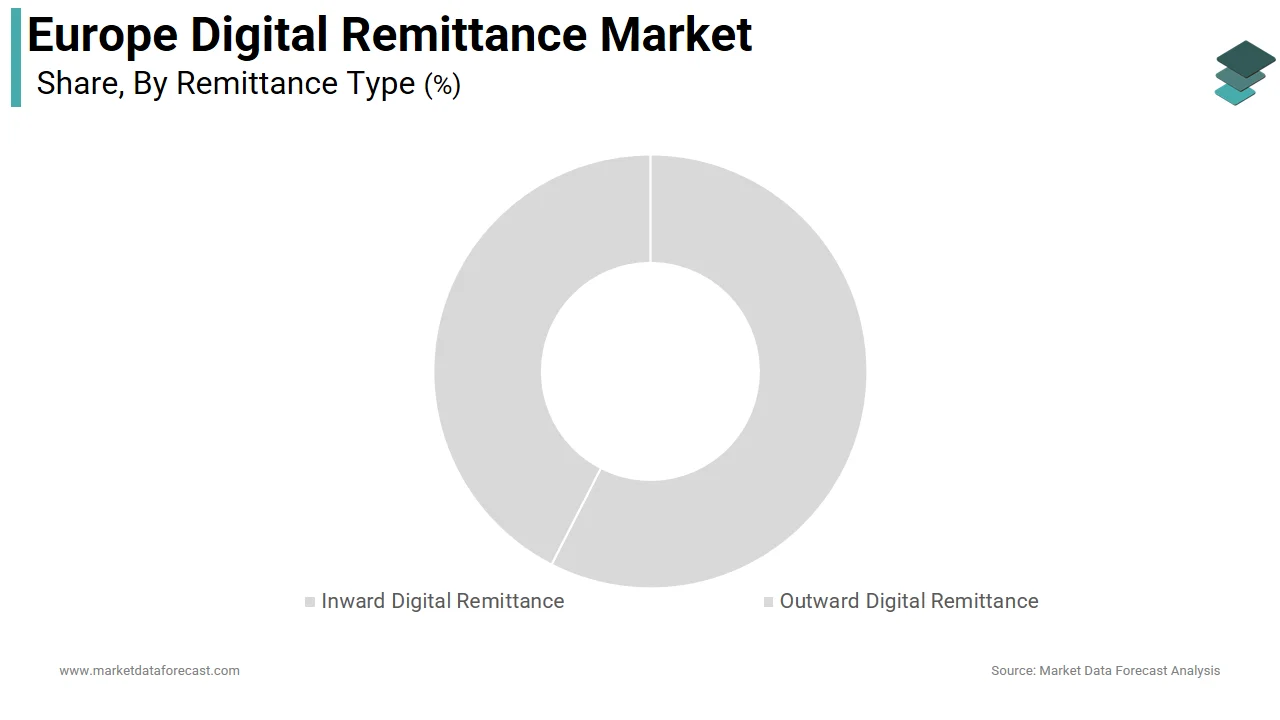
The inward digital remittance segment is likely to experience the fastest CAGR of 12.3% during the forecast period due to rising foreign student enrollment, tourism, and cross-border remote work dynamics. According to research, a large number of non-EU students were enrolled in European higher education institutions in 2024, with a notable share relying on regular parental transfers for tuition and living expenses. There has been an increase in international participants, further amplifying inbound payment needs. Apart from these, the rise of digital nomad visas in Portugal, Spain, and Croatia has attracted a considerable number of remote workers from North America and Asia who receive salaries from abroad and require compliant inward disbursement channels. Unlike outward flows, which are relatively stable, inward remittances benefit from Europe’s growing global attractiveness as an education tourism and work destination, creating a dynamic and diversifying growth trajectory.
By End User Insights
The migrant workers segment held the leading share of the Europe digital remittance market in 2025. The supremacy of the migrant workers segment is because of its consistent and high-frequency cross-border financial obligations toward households in origin countries. According to various studies, millions of migrants in the EU were employed in 2024, primarily in construction, agriculture, and domestic services, with monthly remittance behavior deeply embedded in cultural and familial norms. Moroccan agricultural workers in a region of Spain are increasingly using mobile applications to send money home frequently. The use of digital remittance services is driven by considerations of ease of access and the potential for reduced costs when compared to using traditional financial operators. Migrant workers utilize digital channels for smaller financial transactions, indicating a general preference for cost-efficient money transfer options. This pattern reflects a broader reliance on digital solutions within the migrant community for their financial activities. National integration policies include digital financial literacy modules, further accelerating adoption. These socioeconomic and policy-reinforced behaviors solidify migrant workers as the bedrock of Europe’s remittance ecosystem.
The international students segment is on the rise and is expected to be the fastest-growing segment in the market by witnessing a CAGR of 14.1% from 2025 to 2033. The rapid expansion of the international students segment is driven by surging enrollment in European universities and evolving tuition payment models. According to research, a notable number of non-EU students were registered in European higher education institutions in 2024. Countries like Germany, France, and the Netherlands now permit phased tuition payments requiring recurring inbound transfers rather than lump sum deposits. Students are using digital platforms for receiving parental support because of beneficial features like transparent exchange rates and multi-currency accounts. Immigration policies can require evidence of consistent income or fund transfers for student visa renewals, encouraging the use of structured digital financial management. Universities are incorporating payment provider services into their student portals, which allows for tuition to be automatically deducted from accounts held in other countries. These institutional and regulatory shifts transform students from occasional to systematic users of inbound digital remittance infrastructure.
COUNTRY-LEVEL ANALYSIS
United Kingdom Digital Remittance Market Analysis
The United Kingdom dominated the Europe digital remittance market by accounting for a 22.2% share in 2024. The dominance of the UK market is driven by its large diaspora communities, advanced fintech ecosystem, and historical ties to South Asia, Africa, and the Caribbean. The United Kingdom has a substantial foreign-born resident population. Also, the largest groups of foreign-born residents originate from several specific nations, including India, Pakistan, Nigeria, and Poland. A significant amount of outward digital remittances flowed from the UK. Mobile applications are a dominant channel for these remittance transactions, particularly for lower-value amounts. London's financial technology sector includes numerous licensed remittance providers. These providers use modern banking technologies to facilitate transactions with relatively low service fees. The UK continues to act as a central point for international financial flows despite its departure from the European Union. Regulatory bodies are actively approving new licenses for payment institutions. These demographic, technological, and regulatory advantages sustain the UK’s dominant and highly competitive market status.
Germany Digital Remittance Market Analysis
Germany was the second-largest player in the Europe digital remittance market and captured a 19.5% share in 2024, with its robust migrant workforce, widespread digital banking adoption, and stringent yet clear regulatory framework for payment services. Outbound remittance transactions occur, with primary senders originating from a few specific nationalities. The implementation of the key payment services directive is advanced within the region. Numerous registered third-party providers facilitate seamless fund initiation from bank accounts to applications. Supervisory authorities enforce transparency rules, which require providers to disclose all pricing information. Average digital remittance costs have shown a downward trend due to these market and regulatory conditions. Apart from these, integration of remittance services into mainstream neobanks has normalized cross-border transfers among younger demographics. These factors create a high-volume, low-friction environment that reinforces Germany’s pivotal role in the European remittance landscape.
France Digital Remittance Market Analysis
France witnessed a steady growth in the Europe digital remittance market because of its deep historical links with Francophone Africa, strong student inflows, and progressive digital identity initiatives. Outward remittances from France are significant, with a majority of the funds directed to a few specific countries in Africa. Communities from North Africa are increasingly utilizing digital platforms for their financial transfers. Mobile platforms, particularly those integrated with the national postal service's financial network, are a primary method for these digital transfers. Legislation enables secure remote verification processes for financial services, which improves efficiency by reducing the time required for identity checks. A substantial number of international students participate in specific educational programs and depend on incoming digital transfers for their living costs. Regulatory support is provided for new financial technology companies through specific development programs, aiming to encourage innovation while maintaining necessary oversight. These interconnected demographic policy and technological currents sustain France’s vibrant and inclusive remittance ecosystem.
Spain Digital Remittance Market Analysis
Spain holds a noteworthy position in the Europe digital remittance market owing to its proximity to North Africa large agricultural migrant workforce, and rapid adoption of mobile money corridors with Latin America. As per research, a significant amount of outward remittances flowed in 2023, with Moroccan and Romanian nationals accounting for a portion of the volume. Seasonal agricultural workers in regions increasingly use mobile wallets to send earnings home weekly, with digital platforms capturing a notable share of these micro transfers. Spain also serves as a key entry point for Latin American migrants, with a large number of residents from Colombia, Venezuela, and Ecuador sending funds via low-cost apps like Remitly and Sendwave. These labor market dynamics and targeted digital inclusion efforts position Spain as a critical bridge between Europe, Africa, and the Americas.
Italy Digital Remittance Market Analysis
Italy is likely to expand notably in the Europe digital remittance market from 2026 to 2034 due to its aging population’s reliance on foreign caregivers, Eastern European labor migration, and growing inbound student flows. Outward remittances show a significant flow of money from Italy to other countries. Nationals from Romania, Ukraine, and the Philippines represent the main groups sending money home. Foreign domestic workers, many of whom support elderly Italian households, regularly send their earnings abroad. Individuals use digital platforms for these transactions. The use of digital services is linked to ease of use and reduced costs when compared to traditional post office options. Simultaneously, Italy has become a destination for international students, with universities in Milan and Bologna enrolling thousands of non-EU students in 2024 who receive parental support via inbound digital channels. These dual outward and inward currents, supported by public-private digital inclusion initiatives, ensure Italy’s continued relevance in the European remittance landscape.
COMPETITIVE LANDSCAPE
Competition in the Europe digital remittance market is characterized by a dynamic interplay between specialized fintech disruptors and diversified neobanks, each vying for trust, cost efficiency, and user engagement among migrant workers, students, and diaspora communities. The market is highly regulated under the Revised Payment Services Directive and anti-money laundering frameworks, yet national implementation differences create operational complexity. Price transparency has become table stakes with leading players advertising near-zero fees and real mid-market exchange rates, forcing smaller operators to differentiate through speed, payout network breadth, or cultural localization. Strategic advantage increasingly lies in ecosystem integration, where remittance is not a standalone service but a feature within broader financial platforms offering multi-currency accounts, bill payments, and budgeting tools. Trust remains paramount with consumers favoring providers that offer clear compliance credentials, responsive customer support, and proven reliability in volatile corridors. This environment fosters continuous innovation in onboarding security disbursement methods and user interface design while pressuring margins and accelerating consolidation among undercapitalized entrants.
KEY MARKET PLAYERS
The leading companies operating in the Europe digital remittance market include:
- The Western Union Company
- PayPal Holdings, Inc.
- Wise plc
- MoneyGram International, Inc.
- Remitly Global, Inc.
- Revolut Ltd
- WorldRemit Ltd
TOP PLAYERS IN THE MARKET
- Wise plc, headquartered in the United Kingdom, is a global pioneer in digital cross-border payments with a dominant presence in the Europe digital remittance market. The company leverages its multi-currency account infrastructure and proprietary routing technology to offer near mid-market exchange rates with transparent, low fees. The company also launched localized compliance onboarding for Eastern European and North African corridors using national digital identity systems. These initiatives reinforce Wise’s position as a cost-efficient and regulatory-compliant platform for both migrant workers and international students across the continent.
- Revolut Ltd, a London-based fintech, has rapidly scaled its remittance capabilities by embedding cross-border transfers within its broader digital banking ecosystem, serving millions of customers in Europe. The company offers real-time currency conversion with zero markup during business hours and supports remittances to multiple countries. In recent developments, Revolut enhanced its anti-money laundering screening using machine learning models trained on European transaction patterns to reduce false positives and accelerate approval times. Additionally, the company rolled out dedicated remittance features for migrant communities in Germany, France, and Spain, including scheduled recurring transfers and recipient bill payment options. These user-centric innovations position Revolut as a lifestyle-integrated remittance provider rather than a standalone money transfer service.
- WorldRemit Ltd maintains a strong foothold in the Europe digital remittance market by focusing on mobile-first delivery to cash, mobile money, and bank accounts in emerging markets, particularly across Africa and South Asia. The company partners with a large payout network, enabling recipients to access funds without a formal banking infrastructure. The company also introduced biometric verification for high-value transfers in compliance with European Banking Authority guidelines. These actions strengthen WorldRemit’s relevance for diaspora communities whose families rely on non-bank disbursement channels, thereby bridging Europe’s digital infrastructure with recipient economies’ financial realities.
TOP STRATEGIES USED BY THE KEY MARKET PARTICIPANTS
Key participants in the Europe digital remittance market focus on integrating with national digital identity systems to streamline customer onboarding while ensuring anti-money laundering compliance. They leverage SEPA Instant Credit Transfer and open banking APIs to reduce reliance on correspondent banks and lower transaction costs. Companies are forming strategic partnerships with mobile money operators in Africa and Asia to enable direct digital disbursement and eliminate cash agent dependencies. User experience enhancement through multilingual interfaces, recurring transfer automation, and real-time tracking features drives retention among migrant and student segments. Additionally, firms are embedding remittance services within broader financial ecosystems, including neobanking platforms and payment wallets, to encourage cross-product usage and increase lifetime value across diverse European demographics.
MARKET SEGMENTATION
This research report on the Europe digital remittance market has been segmented and sub-segmented into the following categories.
By Remittance Type
- Inward Digital Remittance
- Outward Digital Remittance
By Channel
- Mobile (App-Based)
- Others
By End User
- Migrant Workers
- Others
By Provider Type
- Banks and Traditional Financial Institutions
- Money Transfer Operators (MTOs)
By Country
- United Kingdom
- France
- Spain
- Germany
- Italy
- Russia
- Sweden
- Denmark
- Switzerland
- Netherlands
- Rest of Europe