- Product Description Description
- Table of Contents TOC
- List of Table & Figure LOT
- Get Free Sample PDF Sample PDF
Market Size, 2025
$10.14 BnMarket Estimate, 2026
$11.85 BnMarket Forecast, 2034
$41.34 BnCAGR, 2026–2034
16.90%Europe Digital Banking Market Report Summary
The Europe digital banking market was valued at USD 10.14 billion in 2025, is estimated to reach USD 11.85 billion in 2026, and is projected to reach USD 41.34 billion by 2034, growing at a CAGR of 16.90% from 2026 to 2034. Market growth is driven by rapid digital transformation in the banking sector, increasing smartphone and internet penetration, and growing demand for convenient financial services. Digital banking platforms enable customers to access banking services such as payments, account management, lending, and investments through online and mobile channels. The rise of fintech innovation, regulatory initiatives promoting open banking, and increasing investments in digital financial infrastructure are further accelerating the expansion of the digital banking market across Europe.
Key Market Trends
- Increasing adoption of mobile and online banking platforms across retail and corporate banking.
- Rising integration of AI, automation, and advanced analytics in digital banking services.
- Expansion of open banking frameworks and fintech collaborations.
- Growing demand for secure and seamless digital payment solutions.
- Increasing investments in cloud-based banking platforms and digital financial infrastructure.
Segmental Insights
- Based on component, the solution segment dominated the Europe digital banking market in 2025, driven by the foundational need for banks to deploy robust software platforms that enable digital financial services and customer engagement.
- Based on banking mode, the online banking segment held the largest share of 58.3% in 2025, supported by widespread usage among corporate clients and older demographics who prefer the comprehensive functionality and convenience of web-based banking platforms.
Regional Insights
The Europe digital banking market is experiencing strong growth across major countries due to rapid fintech innovation, increasing digital adoption, and supportive regulatory frameworks.
- The United Kingdom led the regional market in 2025 with 22.3% share, driven by a strong fintech ecosystem, high digital banking adoption, and supportive regulatory initiatives.
- Germany ranked second with 18.4% share in 2025, supported by a strong traditional banking sector combined with rapidly expanding digital banking capabilities.
- France is witnessing steady growth in the digital banking market due to strong government support for fintech development through initiatives such as the Paris FinTech Forum and favorable startup policies.
Competitive Landscape
The Europe digital banking market is characterized by strong competition among banking technology providers, fintech companies, and digital-first financial institutions. Market participants are focusing on developing advanced banking platforms, improving customer experience through digital interfaces, and enhancing cybersecurity and regulatory compliance. Strategic partnerships between banks and fintech firms, as well as investments in cloud-based banking infrastructure, are shaping competitive dynamics across the region.
Prominent companies operating in the Europe digital banking market include Infosys Limited (EdgeVerve Systems), Fidelity Information Services (FIS), Inc., N26, Fiserv, Inc., Oracle Corporation, SAP SE, Temenos AG, The Bank of New York Mellon Corporation, Appway AG, ING Group, COR Financial Solutions Ltd., BBVA (Banco Bilbao Vizcaya Argentaria), and VSoft Corporation.
Europe Digital Banking Market Size
The Europe digital banking market was worth USD 10.14 billion in 2025. The European market is projected to reach USD 41.34 billion by 2034 from USD 11.85 billion in 2026, growing at a CAGR of 16.90% from 2026 to 2034.
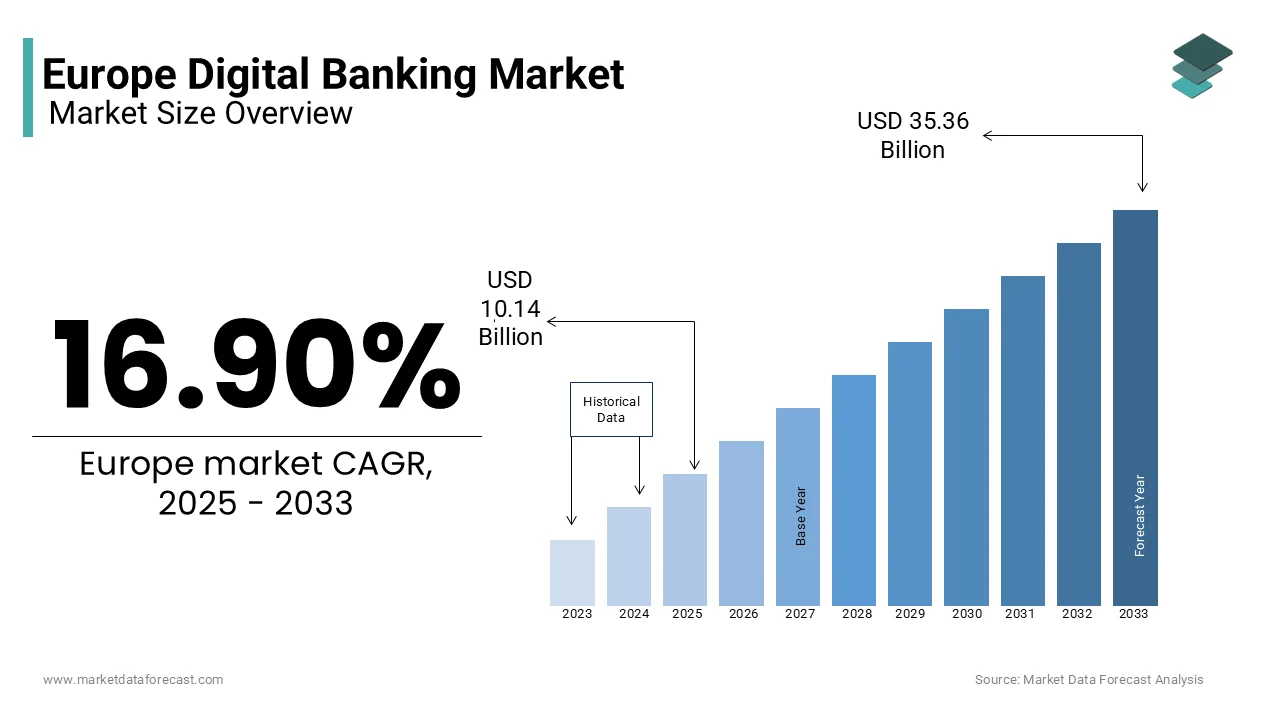
The digital banking is traditional brick and mortar operations migrate to online and mobile platforms. This ecosystem encompasses retail banking, corporate finance, and payment solutions delivered through digital channels without the need for physical branch visits. The region has witnessed a surge in adoption driven by high smartphone penetration and a tech-savvy population. As per Eurostat data from 2023, approximately 86% of individuals in the European Union aged 16 to 74 used internet banking services. This figure underscores a deep integration of digital tools into daily financial routines across nations like Germany, France, and the Netherlands. The European Central Bank notes that digital payment transactions exceeded 100 billion in volume during 2022, reflecting a robust infrastructure supporting cashless economies. Furthermore, the General Data Protection Regulation implemented by the European Union has set a global benchmark for data privacy, which shapes how digital banks operate and secure customer information. Consumers increasingly expect seamless experiences that blend banking with lifestyle management.
MARKET DRIVERS
Rapid Adoption of Mobile First Financial Behaviors Among Younger Demographics
The entrenched mobile-first behavior observed predominantly among millennials and Generation Z consumers is majorly propelling the growth of Europe digital banking market. These demographics view smartphones as their primary interface for managing finances rather than visiting physical branches or using desktop computers. The shift forces traditional banks to overhaul their legacy systems to offer intuitive mobile experiences or risk losing relevance. Recent data indicates that mobile banking users in Western Europe are projected to reach 260 million by 2025, demonstrating a compound annual growth rate that outpaces general internet usage. Neobanks like Revolut and N26 have capitalized on this trend by offering features, such as real-time spending analytics and instant currency exchange, which resonate deeply with younger users who value transparency and speed. The psychological comfort these generations have with digital interfaces reduces the friction associated with adopting new financial technologies. Consequently, banks that fail to optimize their mobile offerings face significant customer churn as users seamlessly switch to competitors providing superior digital engagement.
Regulatory Frameworks Facilitating Open Banking and Competition
The implementation of progressive regulatory frameworks, specifically the Revised Payment Services Directive, known as PSD2, which mandates open banking, is also gearing up the growth of Europe's digital banking market. This legislation requires banks to provide third-party providers with secure access to customer account data upon consent, thereby dismantling traditional data monopolies held by incumbent institutions. As per the European Commission reports, since the full enforcement of PSD2 in 2019, the number of registered third-party providers has surged to over 5000 entities across Europe by 2023. This regulatory push has stimulated intense competition and fostered an environment where fintech startups can build specialized services atop existing banking infrastructure. The directive has led to a 40% increase in the availability of aggregated financial management tools that allow consumers to view multiple bank accounts in a single interface. Such capabilities enhance user experience and drive higher engagement rates with digital banking platforms. Furthermore, the regulatory clarity provided by the European Banking Authority regarding strong customer authentication has increased consumer trust in digital transactions. Banks are now compelled to collaborate with fintech firms rather than viewing them solely as threats, leading to a hybrid ecosystem of innovation. This regulatory-induced openness accelerates the pace of product development and ensures that digital banking solutions remain aligned with evolving consumer expectations for customization and control.
MARKET RESTRAINTS
Persistent Cybersecurity Threats and Data Breach Concerns
The escalating sophistication of cyberattacks and the pervasive fear of data breaches among consumers and institutions are limiting the growth of the Europe digital banking market. According to Europol, the European Union Agency for Law Enforcement Cooperation, reported a 38% increase in cybercrime incidents targeting financial institutions in 2022 compared to the previous year. These attacks range from phishing schemes to advanced persistent threats that compromise sensitive customer data and undermine trust in digital channels. The cost of remediation and regulatory fines following a breach can be astronomical, with some incidents resulting in penalties exceeding 20 million euros under GDPR provisions. This financial risk forces banks to allocate substantial portions of their budgets to cybersecurity measures rather than innovation or customer acquisition. This hesitation slows down the adoption curve for advanced services, such as biometric authentication or AI-driven financial advice. Moreover, the complexity of maintaining compliance with varying national cybersecurity standards across different European countries adds operational burdens. The constant cat-and-mouse game between security teams and hackers creates an environment of uncertainty that can stifle the aggressive expansion strategies of digital banks.
Legacy Infrastructure Integration Challenges for Traditional Institutions
The immense difficulty traditional banks face when attempting to integrate modern digital solutions with outdated legacy core banking systems is limiting the growth of the Europe digital banking market. Many established European financial institutions operate on mainframe technologies developed decades ago, which were not designed for the agility and scalability required by today's digital economy. As per a report by McKinsey and Company, nearly 70% of European banks struggle with technical debt that delays the launch of new digital products by an average of 12 to 18 months. These legacy systems often lack the application programming interfaces necessary for seamless connectivity with fintech partners or cloud-based services. The process of migrating to modern architectures is fraught with risks, including potential data loss, service disruptions, and exorbitant costs that can run into billions of euros for large institutions. Consequently, many banks resort to patchwork solutions that create siloed data environments and inconsistent user experiences across different channels. This technological inertia prevents them from competing effectively with neobanks that are built on cloud native infrastructures from inception. The inability to rapidly iterate and deploy features leads to a loss of market share, particularly among tech-savvy customers who demand instant updates and personalized services. Furthermore, the shortage of skilled professionals capable of managing both legacy and modern systems exacerbates the problem, creating a bottleneck in digital transformation initiatives.
MARKET OPPORTUNITIES
Expansion of Embedded Finance Across Non-Financial Sectors
The rapid expansion of embedded finance, where financial services are integrated directly into non-financial platforms and customer journeys, is creating new opportunities for the growth of the Europe digital banking market. This trend allows retailers, travel agencies, and automotive companies to offer banking products, such as loans, insurance, and payment processing at the point of sale without redirecting customers to a separate bank interface. According to research by Bain and Company, the embedded finance market in Europe is expected to generate over 50 billion euros in revenue by 2025, growing at a rate significantly faster than traditional banking sectors. This integration enhances customer convenience and opens new revenue streams for digital banks that provide the underlying infrastructure via API connections. For instance, e-commerce platforms can now offer instant buy now pay later options powered by digital banking partners, increasing conversion rates and average order values. This shift transforms digital banks from destination brands into invisible enablers of commerce, allowing them to reach customers in contexts where they are already engaged in purchasing decisions. The data generated from these embedded interactions provides rich insights into consumer behavior, enabling more accurate risk assessment and personalized product offerings. Digital banks that position themselves as flexible infrastructure providers stand to capture significant market share by powering the financial ecosystems of diverse sectors.
Utilization of Artificial Intelligence for Hyper Personalization
The deployment of advanced artificial intelligence and machine learning algorithms to deliver hyper-personalized financial experiences that anticipate customer needs before they arise is expected to boost the growth of the Europe digital banking market. Unlike generic marketing campaigns, AI enables digital banks to analyze vast amounts of transactional data in real time to offer tailored advice, product recommendations, and automated savings strategies. As per a study by Accenture, 73% of European banking customers express a willingness to share their data if it results in highly personalized services and better financial outcomes. This willingness creates a fertile ground for digital banks to differentiate themselves through intelligent features, such as predictive cash flow analysis or automated investment rebalancing. AI-driven chatbots and virtual assistants are becoming sophisticated enough to handle complex queries and provide financial coaching, reducing operational costs while enhancing user satisfaction. The ability to detect fraudulent patterns instantly also improves security and builds trust. Furthermore, machine learning models can optimize credit scoring by incorporating alternative data sources, allowing banks to serve underbanked populations who lack traditional credit histories. This inclusivity expands the total addressable market and fosters social and economic growth. Institutions that master this capability will likely achieve higher customer loyalty and lifetime value in an increasingly crowded marketplace.
MARKET CHALLENGES
Navigating Fragmented Regulatory Landscapes Across Member States
The complexity of navigating fragmented regulations that persist despite efforts toward harmonization under the European Union. The navigating fragmented regulatory environment is one of the major challenges for the growth of the Europe digital banking market. While directives like PSD2 provide a common framework, individual member states often implement additional national requirements regarding consumer protection, anti money laundering protocols, and data localization. This fragmentation creates barriers to entry for smaller fintech firms that lack the resources to manage multi-jurisdictional legal complexities. It also slows down the rollout of unified products as banks must customize their offerings to meet specific national mandates. The lack of a single digital banking license valid across all member states means that expansion strategies require meticulous planning and significant legal overhead. Furthermore, differing interpretations of regulations by national supervisors can lead to uncertainty and inconsistent enforcement actions. This regulatory patchwork hinders the creation of a truly seamless single for digital financial services. The administrative burden diverts resources away from innovation and customer experience improvements, potentially stifling the overall growth momentum of the sector across the continent.
Intensifying Margin Compression Due to Aggressive Pricing Wars
The intensifying margin compression resulting from aggressive pricing wars among digital banks and neobanks striving is another attribute to impede the growth of Europe digital banking market. As per a survey, several prominent European neobanks reported net losses exceeding 100 million euros in 2023, primarily due to heavy spending on customer acquisition incentives and below-cost pricing strategies. This race to the bottom forces even established institutions to lower their fees to remain competitive, thereby shrinking overall industry margins. The reliance on interchange fees from card transactions as a primary revenue source becomes risky when transaction volumes fluctuate or when regulators cap these fees to protect consumers. Additionally, the cost of capital has risen in the recent economic climate, making it harder for loss-making digital banks to secure funding for continued expansion. Investors are increasingly demanding clear paths to profitability, which pressures companies to cut costs often at the expense of service quality or innovation. The inability to diversify revenue streams beyond basic transactional fees leaves many players vulnerable to economic downturns.
REPORT COVERAGE
| REPORT METRIC | DETAILS |
| Market Size Available | 2025 to 2034 |
| Base Year | 2025 |
| Forecast Period | 2026 to 2034 |
| Segments Covered | By Component, Deployment Type, Type, Banking Mode, and Country |
| Various Analyses Covered | Global, Regional, and Country-Level Analysis, Segment-Level Analysis, Drivers, Restraints, Opportunities, Challenges; PESTLE Analysis; Porter’s Five Forces Analysis, Competitive Landscape, Analyst Overview of Investment Opportunities |
| Countries Covered | UK, France, Spain, Germany, Italy, Russia, Sweden, Denmark, Switzerland, Netherlands, Turkey, Czech Republic, and the Rest of Europe. |
| Market Leaders Profiled | Infosys Limited (EdgeVerve Systems), Fidelity Information Services (FIS), Inc., N26, Fiserv, Inc., Oracle Corporation, SAP SE, Temenos AG, The Bank of New York Mellon Corporation, Appway AG, ING Group, COR Financial Solutions Ltd., BBVA (Banco Bilbao Vizcaya Argentaria), and VSoft Corporation. |
SEGMENTAL ANALYSIS
By Component Insights
The solution segment was the largest by holding a significant share of the Europe Digital Banking Market in 2025, owing to the foundational necessity for banks to acquire robust software platforms before they can effectively deliver digital services. The massive capital expenditure is directed toward core banking modernization and the integration of advanced modules, such as customer relationship management and fraud detection systems. As per data from Gartner Europe, banks are projected to spend over 45 billion euros on software solutions in 2024, alone reflecting a strategic priority to replace legacy infrastructure with agile digital cores. Financial institutions recognize that without sophisticated solutions, the delivery of seamless user experiences is impossible, which forces them to prioritize software acquisition over ancillary services. Furthermore, the rise of regulatory technology requirements mandates the implementation of specific solution sets that ensure compliance with evolving European Union directives. Banks are increasingly investing in modular solutions that allow for scalability and rapid feature deployment to compete with neobanks.
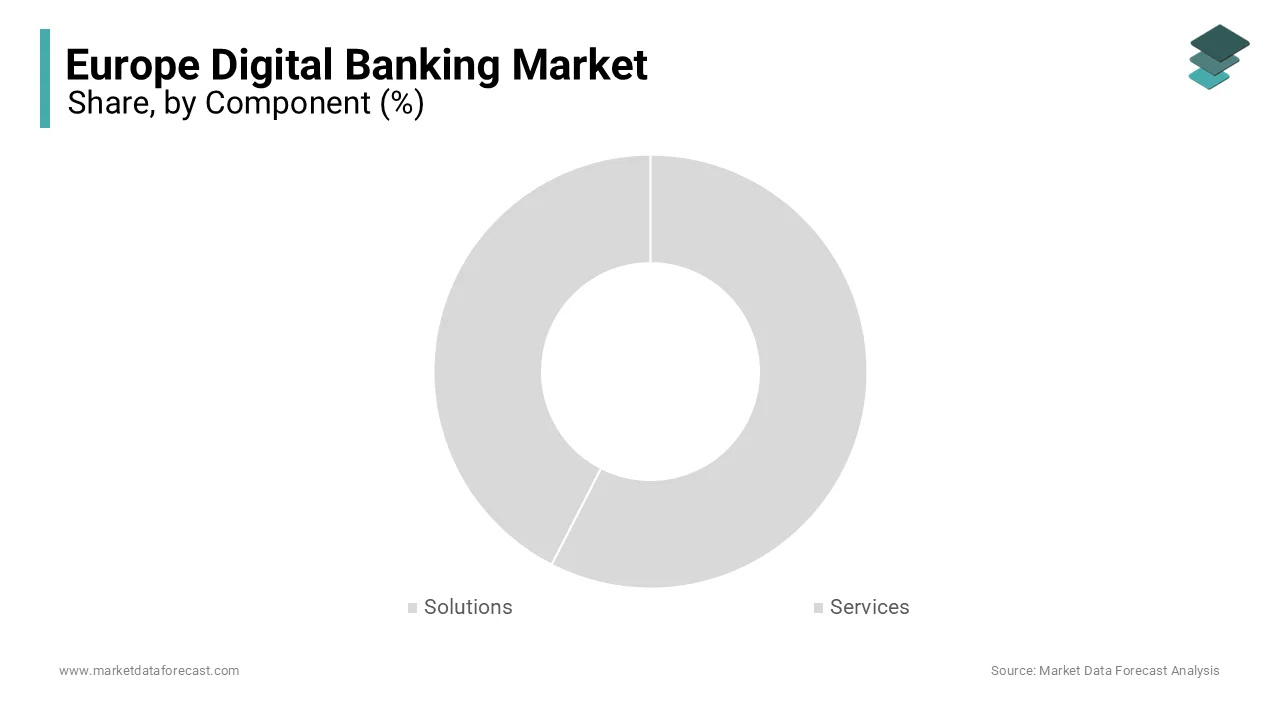
The services segment is emerging at a fastest CAGR of 14.8% throughout the forecast period for specialized expertise to implement, manage, and optimize complex digital banking solutions that internal IT teams often lack. The expansion in demand for managed services and consulting support, as banks navigate the intricacies of cloud migration and cybersecurity enhancement. The shortage of skilled professionals in areas like data analytics and regulatory compliance forces banks to rely heavily on external service providers, who offer tailored support and continuous maintenance. Additionally, the shift toward a service model means that ongoing subscription-based support and regular system updates have become recurring revenue streams for service vendors. Banks are increasingly partnering with third-party firms to handle customer support automation and back-office processing, which reduces operational costs while improving efficiency. The complexity of maintaining 24/7 digital operations across multiple jurisdictions further amplifies the need for comprehensive service contracts.
By Deployment Type Insights
The on-premise deployment segment was the largest with 55.3% of the Europe Digital Banking Market share in 2025, due to the stringent data sovereignty laws and deep-seated security concerns prevalent among major European financial institutions. Many legacy banks and government-affiliated lenders prefer to keep sensitive customer data within their own physical control centers to mitigate perceived risks associated with third-party cloud providers. As per guidelines from the European Banking Authority, a significant number of systemic banks maintain that critical core banking functions must reside on local servers to ensure immediate regulatory oversight and data residency compliance. The hesitation to move entirely to the cloud is also driven by the high costs and operational disruptions associated with migrating decades of historical data from mainframe systems. Furthermore, national regulations in countries like Germany and France often impose strict requirements on where financial data can be stored, which reinforces the preference for on-premises infrastructure. The perception of greater control over security protocols and disaster recovery mechanisms makes on-premises solutions the default choice for risk-averse institutions.
The cloud deployment segment is projected to witness the fastest CAGR of 16.2% from 2025 to 2033, owing to the urgent need for scalability, cost efficiency, and agility, which traditional on-premises systems struggle to provide. The increasing acceptance of public and hybrid cloud architectures by regulators and banks alike, as proven security measures mature. Cloud deployment allows neobanks and challenger banks to launch products rapidly without the heavy capital expenditure required for physical data centers. The ability to scale computing resources up or down based on transaction volumes enables banks to handle peak loads, such as salary days or holiday shopping seasons, efficiently. Moreover, cloud providers now offer advanced built-in security features and AI capabilities that are often superior to what individual banks can develop in-house. The European Commission has also introduced frameworks to facilitate safe cloud adoption, which has reduced regulatory uncertainty.
By Banking Mode Insights
The online banking segment held 58.3% of the Europe Digital Banking Market share in 2025, owing to the entrenched habit of corporate clients and older demographics, who prefer the comprehensive functionality and larger screen real estate offered by desktop and web-based platforms. The primary driver for this dominance is the necessity for complex financial transactions, such as bulk payments, investment management, and detailed account reconciliation, which are cumbersome to execute on mobile devices. As per Eurostat, over 70% of small and medium-sized enterprises in the European Union continue to rely primarily on online banking portals for their daily treasury operations due to enhanced security features and easier document upload capabilities. Furthermore, many legacy banking interfaces were originally designed for web browsers and have not been fully optimized for mobile transition, resulting in a persistent user base that sticks to the familiar online environment. The ability to view multiple accounts simultaneously and utilize advanced charting tools for financial analysis remains a key advantage of the online mode. Regulatory requirements for strong customer authentication also tend to be seamlessly integrated into web workflows using hardware tokens or secure browsers.
The mobile banking segment is more likely to register the fastest CAGR of 15.5% from 2026 to 2033 with the ubiquitous adoption of smartphones and the changing lifestyle preferences of consumers, who demand instant access to financial services anywhere and anytime. The development of super apps that integrate banking with lifestyle services, such as shopping, travel booking, and bill payments into a single intuitive interface, is majorly prompting the growth of the segment. According to data from Statista, the number of mobile banking users in Europe is set to surpass 300 million by 2026, driven largely by millennials and Generation Z, who rarely use desktop computers for personal finance. The integration of biometric authentication methods like fingerprint scanning and facial recognition has significantly enhanced the security and convenience of mobile transactions, encouraging wider adoption. Neobanks have pioneered features such as instant card freezing, peer-to-peer payments, and real-time spending notifications, which are exclusively optimized for mobile environments. The proliferation of 5G networks across major European cities further enhances the speed and reliability of mobile banking applications, enabling richer multimedia interactions. As banks continue to innovate with voice-activated assistants and augmented reality features for branch location finding, the mobile channel will increasingly become the primary touchpoint for retail customers.
COUNTRY-LEVEL ANALYSIS
United Kingdom Digital Banking Market Analysis
The United Kingdom was the largest contributor to the Europe Digital Banking Market by holding 22.3% of the market share in 2025. The nation has cultivated a fertile ecosystem for fintech innovation supported by proactive regulatory sandboxes and a high concentration of venture capital. The status of the UK as a global fintech hub is reinforced by the early adoption of open banking standards, which mandated data sharing and spurred competition. As per reports from UK Finance, over 25 million adults in the country now use mobile banking apps regularly, making it one of the most digitally engaged populations globally. The presence of successful neobanks like Revolut and Monzo has forced traditional incumbents to accelerate their digital transformation agendas to retain customers. London serves as the epicenter for this activity, attracting talent and investment from around the world to develop cutting-edge financial solutions. The government's commitment to becoming a cash-lite society has further driven the uptake of digital payment methods and contactless technologies. High internet penetration rates and a culturally progressive attitude toward technology adoption create a perfect storm for digital banking growth.
Germany Digital Banking Market Analysis
Germany Digital Banking Market was ranked second with 18.4% of share in 2025, with a unique blend of traditional banking strength and emerging digital capabilities. According to the Bundesbank, digital payment transactions in Germany grew by 12% in 2023, signaling a shift away from the historically dominant cash culture. The robust industrial sector, which demands efficient digital corporate banking solutions for supply chain finance and cross-border payments. German consumers are increasingly embracing digital wallets and mobile banking apps, among the younger demographic who find traditional branch hours inconvenient. Major institutions like Deutsche Bank and Commerzbank are investing billions in modernizing their IT landscapes to compete with agile fintech entrants. The strong economy and high disposable income levels provide a solid foundation for the adoption of premium digital banking services.
France Digital Banking Market Analysis
France digital banking market growth is heavily influenced by strong government support for fintech through initiatives like the Paris FinTech Forum and favorable tax regimes for startups. As per data from the French Banking Federation, the number of active digital banking customers exceeded 35 million in 2023, reflecting a widespread acceptance of online channels. French banks are leveraging artificial intelligence to personalize customer interactions and streamline loan approval processes, which enhances user satisfaction. The presence of major European players like BNP Paribas and Société Générale drives significant investment in digital platforms that serve both domestic and international markets. The rise of green finance and sustainable investing options within digital platforms appeals to the environmentally conscious French consumer base. Furthermore, the integration of banking services with e-commerce platforms is gaining traction, creating new avenues for growth.
Italy Digital Banking Market Analysis
Italy digital banking market growth is driven by the dynamic shift from a cash-dependent economy to one that is increasingly embracing digital financial tools, driven by government incentives and pandemic induced behavioral changes. The modernization of the national payment infrastructure has made digital transactions faster and more reliable. Italian banks are aggressively launching mobile-first products to capture the attention of younger users who are eager to break away from traditional banking constraints. Government programs aimed at reducing tax evasion through traceable digital payments have further accelerated adoption rates among small businesses.
Netherlands Digital Banking Market Analysis
The Netherlands digital banking market growth is likely to grow with its advanced progression toward a nearly cashless society. According to data from De Nederlandsche Bank, more than 90% of the population uses internet banking daily, making it among the highest penetration rates globally. The driving factors include a highly developed digital infrastructure and a collaborative approach between banks and fintech companies to create seamless payment ecosystems. Dutch consumers are early adopters of new technologies such as instant payment systems and open banking applications, which enhance financial management capabilities. The government actively supports digital innovation through policies that encourage electronic transactions and reduce reliance on physical cash.
COMPETITIVE LANDSCAPE
The competition within the Europe Digital Banking Market is characterized by an intense rivalry between established legacy institutions and agile neobanks vying for customer dominance. Traditional banks leverage their vast capital reserves and existing trust relationships to fund massive digital transformation projects, while neobanks compete on superior user experience and lower fees. This dynamic creates a fragmented landscape where no single entity holds absolute control, forcing all participants to innovate continuously. The entry of big tech companies into financial services adds further pressure as they utilize their enormous user data and seamless ecosystems to capture market share. Regulatory frameworks like open banking have lowered barriers to entry, enabling smaller fintech firms to challenge incumbents with specialized niche offerings. Price wars are common as institutions sacrifice short-term margins to acquire users through attractive sign-up bonuses and zero-fee structures. Differentiation now relies heavily on the ability to provide hyper-personalized services and integrated lifestyle features rather than basic transactional capabilities.
KEY MARKET PLAYERS
The leading companies operating in the Europe digital banking market include:
- Infosys Limited (EdgeVerve Systems)
- Fidelity Information Services (FIS), Inc.
- N26
- Fiserv, Inc.
- Oracle Corporation
- SAP SE
- Temenos AG
- The Bank of New York Mellon Corporation
- Appway AG
- ING Group
- COR Financial Solutions Ltd.
- BBVA (Banco Bilbao Vizcaya Argentaria)
- VSoft Corporation
TOP PLAYERS IN THE MARKET
- ING Group operates as a pioneering force in the European digital banking sector, with its distinctive orange brand identity recognized globally for innovation. The Dutch multinational leverages its fully digital bank model to serve millions of customers across multiple continents without relying on extensive physical branch networks. Recently, the company has intensified its focus on platform banking by opening its infrastructure to third-party developers through robust application programming interfaces. This strategy allows external fintech firms to build services on top of ING systems, thereby expanding the ecosystem value. The bank continuously invests in artificial intelligence to personalize customer interactions and streamline credit decisioning processes. Its global contribution involves setting benchmarks for mobile-first user experiences that other international banks strive to emulate.
- BBVA stands as a Spanish banking giant that has successfully transformed itself into a leading digital financial institution with a significant global footprint. The bank aggressively pursues a data-driven strategy, utilizing advanced analytics to offer hyper-personalized financial advice and products to its diverse customer base. Recent initiatives include the comprehensive migration of its core systems to the cloud, which enhances scalability and reduces operational costs significantly. BBVA actively collaborates with fintech startups through its venture capital arm to identify and integrate emerging technologies, such as blockchain and biometric security. The institution plays a crucial role in the global market by exporting its proprietary digital platforms to partners in Latin America and Turkey. Its commitment to financial inclusion is evident through mobile solutions designed for underbanked populations in developing regions.
- N26 represents the quintessential neobank phenomenon originating from Germany and rapidly expanding its influence across the European economic landscape. This digital-only bank disrupted the traditional sector by offering sleek mobile interfaces and fee-transparent accounts that appeal strongly to millennials and digital nomads. The company recently focused on achieving profitability by refining its product mix and introducing premium subscription tiers that offer enhanced travel insurance and investment options. N26 continues to broaden its service portfolio by launching crypto trading features and sustainable investment funds directly within its application. Its global contribution lies in proving that a bank can operate successfully without any physical branches while maintaining high customer satisfaction scores. The firm actively seeks regulatory licenses in new markets to facilitate seamless cross-border banking for its users.
TOP STRATEGIES USED BY KEY MARKET PARTICIPANTS
Key players in the Europe Digital Banking Market primarily employ aggressive merger and acquisition strategies to rapidly acquire new technologies and expand their customer bases without building capabilities from scratch. Banks frequently pursue partnerships with fintech startups to integrate innovative solutions like artificial intelligence and blockchain into their existing ecosystems efficiently. Another dominant strategy involves heavy investment in cloud migration to enhance scalability, reduce infrastructure costs, and improve system resilience against cyber threats. Institutions also focus extensively on open banking initiatives by developing robust application programming interfaces that allow third-party providers to create value-added services on their platforms. Personalization through big data analytics serves as a critical approach where banks leverage customer transaction history to offer tailored financial products and proactive advice. Furthermore, companies are increasingly adopting sustainability-linked digital products to attract environmentally conscious consumers and meet regulatory environmental goals. These collective strategies aim to foster loyalty, improve operational efficiency, and secure a competitive advantage in the rapidly evolving digital financial landscape.
MARKET SEGMENTATION
This research report on the Europe digital banking market is segmented and sub-segmented into the following categories.
By Component
- Solution
- Services
By Deployment Type
- On-premise
- Cloud
By Type
- Retail Banking
- Corporate Banking
By Banking Mode
- Online Banking
- Mobile Banking
By Country
- UK
- France
- Spain
- Germany
- Italy
- Russia
- Sweden
- Denmark
- Switzerland
- Netherlands
- Turkey
- Czech Republic
- Rest of Europe