- Product Description Description
- Table of Contents TOC
- List of Table & Figure LOT
- Get Free Sample PDF Sample PDF
Market Size, 2025
$47 BnMarket Estimate, 2026
$48.54 BnMarket Forecast, 2034
$62.84 BnCAGR, 2026–2034
3.28%Europe Display Market Report Summary
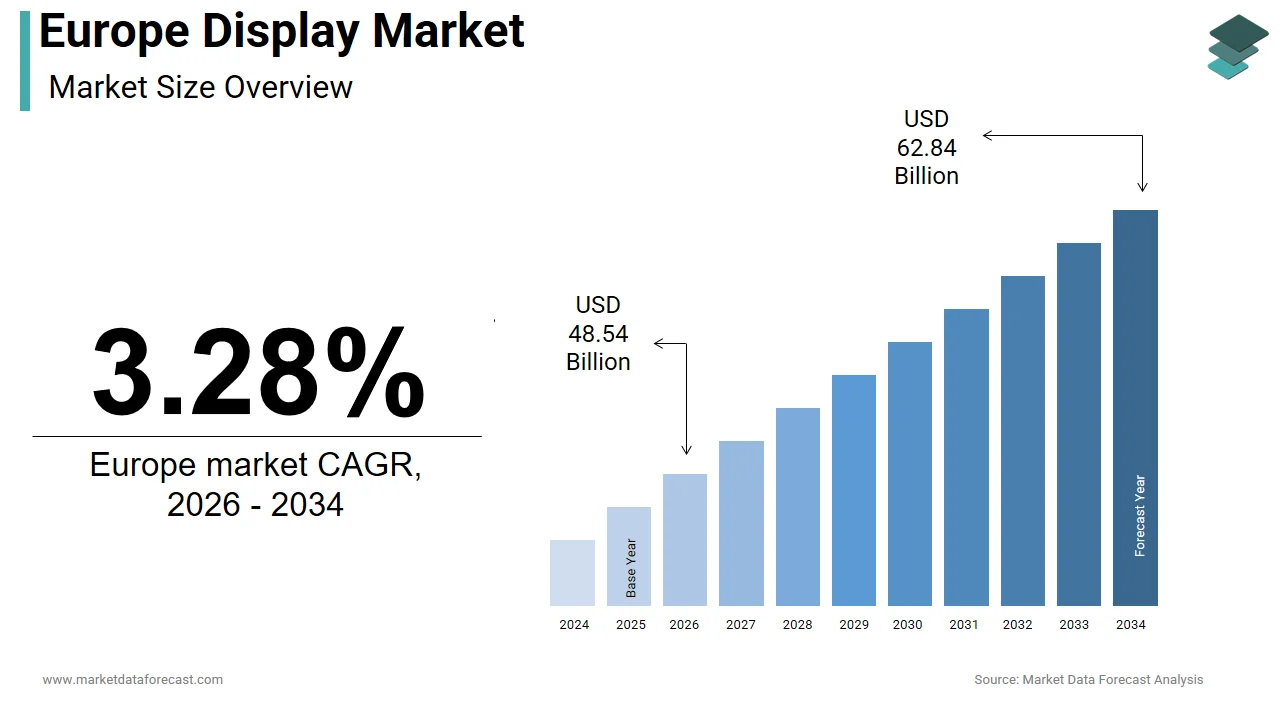
The Europe display market was valued at USD 47 billion in 2025, is anticipated to reach USD 48.54 billion in 2026, and is projected to reach USD 62.84 billion by 2034, growing at a CAGR of 3.28% from 2026 to 2034. Market growth is driven by increasing demand for advanced display technologies across consumer electronics, automotive, and commercial sectors. Displays are widely used in televisions, digital signage systems, smartphones, laptops, and automotive dashboards. The growing adoption of smart devices, expansion of digital advertising infrastructure, and increasing investments in automotive display systems are further supporting market expansion across Europe.
Key Market Trends
- Rising demand for high-resolution and energy-efficient display technologies.
- Increasing adoption of digital signage and interactive display systems in retail and public spaces.
- Growing integration of advanced displays in automotive infotainment and driver assistance systems.
- Expansion of smart home devices and consumer electronics.
- Continuous advancements in OLED, MicroLED, and next-generation display technologies.
Segmental Insights
- Based on technology, the liquid crystal display (LCD) segment dominated the Europe display market in 2025 by holding the largest share, supported by its cost efficiency, widespread availability, and broad applications across consumer electronics and commercial displays.
- Based on application, the television and digital signage segment held the leading share in 2025, driven by increasing demand for large-format displays in entertainment, advertising, retail environments, and public information systems.
Regional Insights
The Europe display market is witnessing steady growth across major economies, supported by expanding electronics manufacturing, increasing digital transformation, and rising adoption of advanced display solutions.
-
Germany dominated the regional market in 2025 with 26.2% share, driven by its strong automotive sector, advanced manufacturing capabilities, and growing demand for automotive display systems.
-
The United Kingdom maintained a prominent position in the Europe display market in 2025, supported by expanding digital advertising and consumer electronics demand.
-
France is expected to hold a promising share over the forecast period, supported by increasing investments in smart infrastructure, digital signage, and consumer electronics adoption.
Competitive Landscape
The Europe display market is characterized by strong competition among global display manufacturers and technology companies focusing on innovation and advanced panel technologies. Market players are investing in high-resolution displays, energy-efficient technologies, and next-generation panel designs to strengthen their market presence. Strategic partnerships, product launches, and expansion of production capabilities are shaping the competitive landscape across the region.
Prominent companies operating in the Europe display market include Samsung Electronics, LG Display, Sharp Corporation, Sony Group Corporation, Panasonic Holdings Corporation, Barco NV, Leyard Optoelectronic Co., Ltd., ViewSonic Corporation, BenQ Corporation, and BOE Technology Group Co., Ltd.
Europe Display Market Size
The size of the Europe display market was worth USD 47 billion in 2025. The regional market is anticipated to grow at a CAGR of 3.28% from 2026 to 2034 and be worth USD 62.84 billion by 2034 from USD 48.54 billion in 2026.
Display encompasses the comprehensive ecosystem of visual output technologies, ranging from large-format digital signage and interactive kiosks to advanced automotive heads-up displays and consumer televisions. This sector serves as the critical interface between digital information and human perception across commercial, industrial, and residential environments. The definition has expanded beyond passive screens to include touch-sensitive panels and holographic projections that facilitate two-way communication. As per Eurostat, the European Union reported that household internet access was very high in 2023, which creates a foundational demand for high-quality visual terminals to consume digital content. The proliferation of smart city initiatives across major metropolises further necessitates robust outdoor display networks for public information and traffic management. According to the International Energy Agency, the commercial building sector in Europe is recognized as a major contributor to energy consumption, which is prompting a shift toward energy-efficient display technologies. The market is characterized by a rigorous regulatory environment that mandates strict adherence to electronic waste disposal and energy labeling standards. As per the European Environment Agency, electronic waste generation in Europe has been substantial, which indicates the urgency for sustainable product lifecycles. The integration of artificial intelligence into display management systems allows for dynamic content adaptation based on audience demographics and environmental conditions. This technological evolution transforms static screens into intelligent nodes within the broader Internet of Things infrastructure, driving innovation across the region.
MARKET DRIVERS
Accelerated Digital Transformation in Retail and Hospitality Sectors
The rapid digitization of customer engagement strategies within the retail and hospitality industries is driving the growth of the Europe display market. Businesses are increasingly replacing traditional printed signage with dynamic digital displays to enhance brand visibility and deliver real-time promotional content. As per the European Retail Round Table, a significant proportion of major retailers in the EU have integrated digital signage into their store layouts to improve the shopper experience and drive impulse purchases. These interactive screens allow for instant price updates and personalized advertising, which significantly increases operational efficiency compared to manual label changes. The hospitality sector similarly leverages large-format displays for self-service check-in kiosks and digital concierge services to streamline guest operations. As per the European Hotel Association, hotels utilizing digital lobby displays have reported measurable reductions in front desk congestion during peak hours. The shift toward omnichannel retailing necessitates seamless visual communication that bridges online and offline experiences, forcing merchants to invest in high-resolution video walls. Furthermore, the recovery of foot traffic in urban shopping districts following pandemic restrictions has renewed confidence in physical store investments. Manufacturers are responding by developing ultra-thin and flexible panels that integrate easily into diverse architectural designs. This widespread commitment to modernizing customer touchpoints ensures sustained demand for advanced display solutions across the commercial landscape.
Mandates for Smart Infrastructure and Connected Urban Environments
Government-led initiatives to develop smart cities and connected urban infrastructure are driving substantial demand for ruggedized and high-brightness outdoor displays across European municipalities, which is further boosting the expansion of the Europe display market. City planners are deploying extensive networks of digital information boards to manage traffic flow, provide public safety alerts, and disseminate environmental data in real time. According to the European Commission, hundreds of cities have joined the Smart Cities Marketplace to share best practices and accelerate the deployment of intelligent urban solutions. These projects require displays capable of withstanding harsh weather conditions while maintaining visibility under direct sunlight. As per the European Topic Centre on Air Pollution, real-time air quality monitoring stations equipped with public displays have increased significantly in major capitals since 2021. The integration of these screens with central command centers allows authorities to broadcast emergency messages instantly, enhancing public safety resilience. Additionally, the push for sustainable mobility includes digital displays at electric vehicle charging stations and bike-sharing docks to guide users effectively. The European Investment Bank has allocated substantial funding for urban digitalization projects, which directly support the procurement of display hardware. Local councils prioritize vendors who offer remote management capabilities to reduce maintenance costs and energy usage. This strategic alignment between public policy and technological capability creates a robust growth trajectory for the outdoor and industrial display segments.
MARKET RESTRAINTS
Stringent Energy Efficiency Regulations and Compliance Burdens
The implementation of rigorous energy efficiency standards acts as a significant restraint on the Europe display market by increasing manufacturing costs and limiting product design flexibility. The European Ecodesign Directive imposes strict limits on power consumption and standby modes for electronic displays, forcing manufacturers to reengineer their products extensively. As per the European Committee for Electrotechnical Standardization, compliance with the new energy labeling scheme requires detailed testing and certification processes that can delay product launches. Smaller manufacturers often struggle to absorb the high costs associated with developing ultra-low power panels and advanced backlighting technologies required to meet these thresholds. According to the European Association of Electrical and Electronic Home Appliances, production costs for compliant displays have risen due to the need for specialized components. The prohibition of certain hazardous substances under the Restriction of Hazardous Substances Directive further complicates the supply chain for raw materials. Companies must maintain extensive documentation to prove adherence, which adds administrative overhead. The threat of heavy fines for non-compliance creates a cautious market environment where innovation may be stifled by regulatory risk. Furthermore, the varying interpretation of rules across different member states can lead to fragmentation in product availability. These regulatory hurdles create barriers to entry and slow down the overall pace of market expansion despite the clear demand for visual technologies.
Volatility in Raw Material Supply Chains and Component Shortages
Fluctuating availability and soaring prices of critical raw materials such as indium, gallium, zinc oxide, and rare earth elements pose severe challenges to display manufacturing stability in Europe, which is further hindering the display market growth in Europe. The region relies heavily on imports for key semiconductor components and glass substrates, making the supply chain vulnerable to geopolitical tensions and logistics disruptions. As per the European Central Bank, input price inflation for the electronics manufacturing sector has been significant, driven by the scarcity of essential minerals. The concentration of panel production capacity in Asia means that any regional disruption immediately impacts European inventory levels and lead times. According to the European Semiconductor Industry Association, delivery times for display driver integrated circuits have extended considerably during recent shortage periods. This unpredictability forces original equipment manufacturers to hold higher safety stocks, which ties up capital and increases storage costs. The volatility also makes long-term pricing contracts difficult to negotiate, leading to budget uncertainties for large-scale deployment projects. Additionally, the transition to newer technologies like micro-LED requires different material sets that are not yet produced at scale globally. Supply chain bottlenecks delay the rollout of next-generation products and hinder the ability of European integrators to meet client deadlines. The lack of domestic fabrication facilities for advanced display components exacerbates this dependency and limits strategic autonomy.
MARKET OPPORTUNITIES
Integration of Artificial Intelligence for Context-Aware Advertising
The convergence of artificial intelligence with display technology is a promising opportunity in the Europe display market. Smart displays equipped with computer vision and sensors can analyze audience demographics in real time to serve hyper-personalized content without compromising privacy. As per the European Artificial Intelligence Alliance, a significant proportion of marketing directors plan to invest in AI-driven signage solutions by 2025 to optimize return on investment. These systems can adjust brightness based on ambient light or change language settings according to the detected nationality of viewers, enhancing relevance. According to the Interactive Advertising Bureau Europe, dynamic content delivery has been shown to increase viewer recall compared to static loops. The ability to gather anonymized analytics on dwell time and engagement provides valuable insights for retailers and venue operators. Manufacturers who embed edge computing capabilities directly into display panels will gain a competitive advantage by offering turnkey smart solutions. The growing acceptance of data protection frameworks like GDPR encourages the development of privacy-first AI models that process data locally. This technological leap transforms passive screens into interactive marketing hubs that drive measurable business outcomes. The potential for programmatic advertising on digital out-of-home networks opens new revenue streams for media owners.
Expansion of Immersive Technologies in Education and Corporate Training
The rising adoption of immersive learning tools in educational institutions and corporate sectors offers a lucrative avenue for the deployment of advanced interactive displays and video walls. Schools and universities are increasingly replacing traditional whiteboards with large-format touch screens that support collaborative learning and remote participation. As per European Schoolnet, a majority of secondary schools in the EU have upgraded their classrooms with interactive display technology to facilitate hybrid teaching models. Corporations are similarly investing in high-resolution conference room displays to support seamless video conferencing and virtual reality training simulations. According to the European Training Foundation, companies using immersive visual tools have reported improvements in knowledge retention among employees. The shift toward flexible work arrangements necessitates sophisticated meeting room setups that can connect multiple locations with crystal-clear visuals. Manufacturers can capitalize on this trend by developing displays with built-in collaboration software and wireless casting capabilities. The demand for ultra-large format screens in lecture halls and auditoriums is also growing as institutions seek to create engaging environments. Government grants for digital education infrastructure further accelerate procurement cycles. This segment represents a stable and high-value market driven by the fundamental need for effective communication and knowledge transfer in a digital age.
MARKET CHALLENGES
Complexities in Data Privacy and Surveillance Regulations
Navigating the intricate landscape of data privacy laws is a significant challenge to the Europe display market growth. The General Data Protection Regulation imposes strict limitations on the collection and processing of personal data, which affects features like facial recognition and audience measurement. As per the European Data Protection Board, guidelines on video surveillance in public spaces require explicit justification and robust anonymization techniques that can be technically complex to implement. Display operators face the risk of substantial fines if their systems inadvertently capture identifiable information without proper consent mechanisms. According to the International Association of Privacy Professionals, many European businesses hesitate to deploy AI-enabled displays due to legal uncertainty. The requirement to conduct Data Protection Impact Assessments for new installations adds time and cost to project rollouts. Vendors must ensure that their hardware and software architectures are designed with privacy by default, which limits the functionality of certain advanced features. The varying enforcement approaches across different member states create a fragmented compliance environment that complicates pan-European deployments. Public skepticism regarding surveillance further pressures companies to limit data collection capabilities. Balancing the desire for interactive and intelligent displays with stringent privacy rights remains a persistent hurdle for market growth.
Environmental Impact of Electronic Waste and Recycling Logistics
The escalating volume of electronic waste generated by obsolete display units poses a significant environmental and logistical challenge for the European market. As display technology evolves rapidly with shorter replacement cycles, the burden of disposing of old screens containing hazardous materials increases substantially. As per the European Environment Agency, only a portion of electronic waste in Europe is officially collected and recycled, leaving a large share unaccounted for. The complexity of recycling modern displays, which incorporate layered composites and rare earth elements, makes the process expensive and technically demanding. Manufacturers face growing pressure under the Extended Producer Responsibility framework to finance the collection and treatment of end-of-life products. According to the Waste Electrical and Electronic Equipment Forum, recycling costs for large flat panels have risen due to stricter separation requirements. The logistical challenge of transporting bulky and fragile screens to specialized facilities further strains the supply chain. Consumers and businesses often lack awareness of proper disposal channels, leading to illegal dumping. The industry struggles to develop circular economy models that effectively recover valuable materials at scale. Addressing this waste crisis requires significant investment in recycling infrastructure and innovative design for disassembly, which impacts profit margins.
REPORT COVERAGE
| REPORT METRIC | DETAILS |
| Market Size Available | 2025 to 2034 |
| Base Year | 2025 |
| Forecast Period | 2026 to 2034 |
| Segments Covered | By Technology, Application, Display Type, Industry Vertical, and Country. |
| Various Analyses Covered | Global, Regional, and Country-Level Analysis, Segment-Level Analysis, Drivers, Restraints, Opportunities, Challenges; PESTLE Analysis; Porter’s Five Forces Analysis, Competitive Landscape, Analyst Overview of Investment Opportunities |
| Countries Covered | UK, France, Spain, Germany, Italy, Russia, Sweden, Denmark, Switzerland, Netherlands, Turkey, Czech Republic, and the Rest of Europe. |
| Market Leaders Profiled | Samsung Electronics, LG Display, Sharp Corporation, Sony Group Corporation, Panasonic Holdings Corporation, Barco NV, Leyard Optoelectronic Co., Ltd., ViewSonic Corporation, BenQ Corporation, BOE Technology Group Co., Ltd., and Others. |
SEGMENTAL ANALYSIS
By Technology Insights
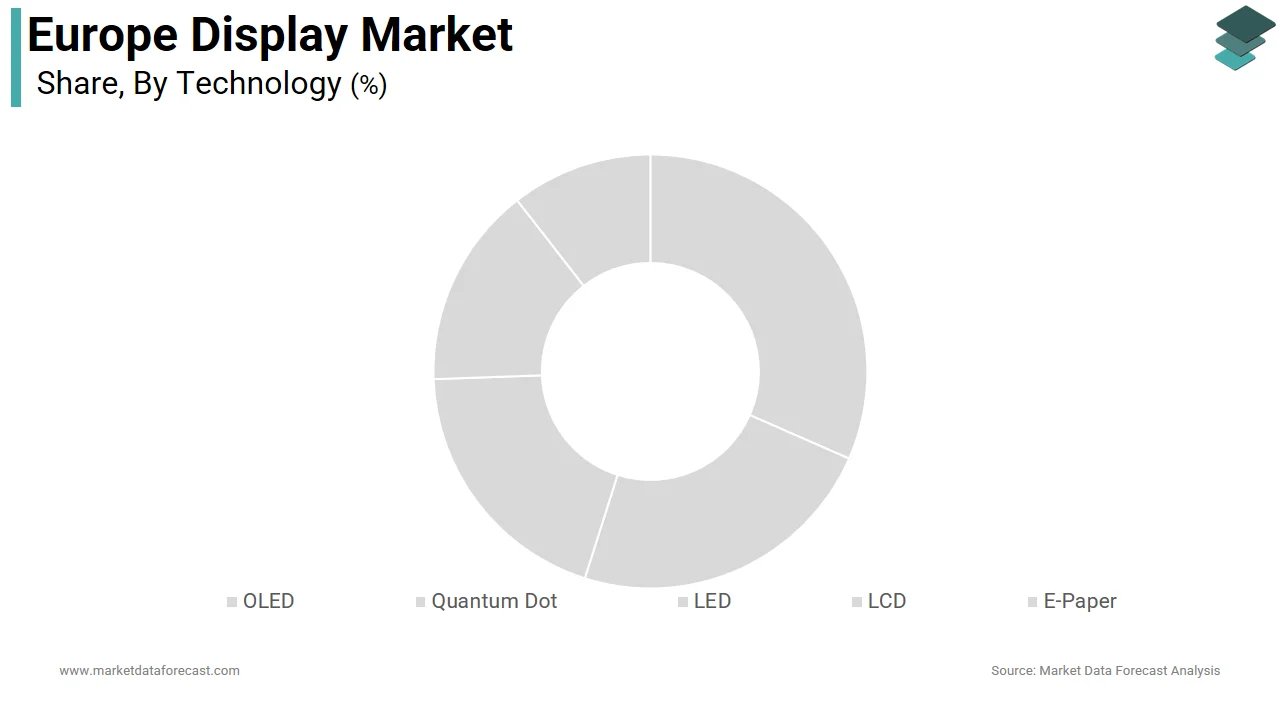
The liquid crystal display (LCD) segment commanded the highest share of the Europe display market in 2025. The dominance of the LCD segment in the European market is attributed to its mature manufacturing ecosystem, cost-effectiveness, and versatility across diverse applications. As per Eurostat, households in the European Union purchased a very large number of television sets in 2023, with the majority featuring LCD or LED backlit LCD technology due to affordability. The second major driver is the extensive use of LCDs in commercial digital signage and industrial control panels, where reliability and long operational life are paramount. According to the European Association of Electrical and Electronic Home Appliances, LCD panels represent the majority of large-format displays installed in retail and corporate environments across the region. Manufacturers have optimized production lines to achieve high yields, keeping unit costs low compared to emerging technologies like OLED. Furthermore, continuous improvements in contrast ratios and color accuracy through advancements in local dimming and quantum dot enhancement films have extended the relevance of LCD technology. The availability of various form factors ranging from small handheld screens to massive video walls ensures that LCD remains the default choice for mass-market applications. Government procurement policies for schools and public institutions often prioritize cost-efficient solutions, further solidifying the leading position of LCD panels in the regional market landscape.
The organic light-emitting diode (OLED) segment is projected to register a promising CAGR of 15.5% over the forecast period in the European market, owing to the surging demand for premium visual experiences in smartphones and high-end televisions and the inherent advantages of OLED technology, including perfect blacks, infinite contrast ratios, and flexible form factors that enable curved and foldable devices. As per the Consumer Technology Association Europe, sales of premium smartphones featuring OLED displays grew significantly in 2023 as consumers increasingly prioritize screen quality and design innovation. The automotive sector serves as another powerful catalyst with luxury vehicle manufacturers integrating OLED clusters and infotainment systems to create immersive cabin environments. According to the European Automobile Manufacturers Association, a notable share of new premium car models launched in Europe in 2023 included OLED displays as a standard or optional feature. The ability of OLED panels to be manufactured on flexible substrates opens new possibilities for wearable devices and unconventional display shapes that appeal to designers. Additionally, the elimination of backlighting units results in thinner and lighter devices, aligning with the industry trend toward portability and sleek aesthetics. Manufacturers are investing heavily in expanding production capacity within Europe to reduce supply chain dependencies and meet rising local demand. These factors collectively propel the OLED segment to the forefront of technological expansion in the European display market.
By Application Insights
The television and digital signage segment led the market by accounting for the leading share of the Europe display market in 2025. The growth of the television and digital signage segment in the European market can be credited to the pervasive presence of screens in residential living rooms and commercial public spaces, and the enduring popularity of large-screen entertainment where families gather for streaming services, gaming, and broadcast content. As per the European Audiovisual Observatory, the average European household owned multiple television sets in 2023, reflecting the deep integration of TV into daily life and culture. The second critical driver is the explosive growth of digital out-of-home advertising, which has replaced static billboards with dynamic high-resolution screens in airports, shopping malls, and city centers. According to the European Digital Signage Federation, the number of installed digital signage nodes in Europe increased significantly in 2023 as retailers and brands sought to engage customers with interactive content. The transition toward smart cities has further amplified demand for large-format displays used in traffic management, public information kiosks, and emergency alert systems. Municipalities across the continent are upgrading their infrastructure to include networked screens that provide real-time updates to citizens. The commercial sector values the ability to update content remotely and instantly, offering significant operational efficiencies over traditional printing methods. The convergence of high-definition broadcasting standards and advanced display capabilities ensures that this segment remains the largest revenue generator. The continuous refresh cycle of consumer televisions, combined with the expansion of commercial networks, secures the top spot for this application category.
The vehicle display segment is anticipated to witness the fastest CAGR of 15.9% over the forecast period in this regional market due to the rapid electrification of the automotive fleet and the integration of advanced driver assistance systems. Modern electric vehicles rely heavily on large high-resolution screens to replace traditional mechanical gauges and provide comprehensive information about battery status, navigation, and entertainment. As per the European Alternative Fuels Observatory, sales of electric vehicles in Europe surpassed several million units in 2023, with each vehicle typically featuring multiple large displays inside the cabin. The shift toward software-defined vehicles necessitates sophisticated user interfaces that can deliver over-the-air updates and personalized experiences, making high-quality displays essential components. According to the Society of Motor Manufacturers and Traders, the average number of screens per new car sold in Europe has increased significantly in recent years. Automakers are competing on the size and clarity of their infotainment systems, using them as key differentiators in a crowded market. The introduction of augmented reality heads-up displays that project navigation arrows onto the windshield is also gaining traction among premium brands. Safety regulations encouraging the adoption of digital rear-view mirrors and camera monitoring systems further boost demand. The trend toward autonomous driving requires intuitive human-machine interfaces to build trust between passengers and the vehicle. These dynamics position the vehicle display sector as the most rapidly expanding application area in the European market.
COUNTRY LEVEL ANALYSIS
Germany Display Market Analysis
Germany dominated the display market in Europe in 2025 with 26.2% of the regional market share due to its robust automotive industry and strong manufacturing base. The nation serves as the primary hub for the development and integration of advanced displays in vehicles, with major automakers headquartered there driving immense local demand. As per the German Association of the Automotive Industry, the country produced millions of passenger cars in 2023, with a significant portion featuring state-of-the-art cockpit display systems. The industrial sector also contributes heavily as German factories utilize extensive monitoring networks for automation control and quality assurance processes. According to the Federal Statistical Office of Germany, investment in digital infrastructure within the manufacturing sector grew notably in 2023, supporting the adoption of industrial-grade displays. The presence of leading chemical and material science companies facilitates the local production of specialized substrates and organic materials required for next-generation panels. Government initiatives promoting Industry 4.0 encourage the deployment of smart factory solutions that rely on real-time visual data feedback. Furthermore, the strong consumer preference for high-quality electronics ensures a steady domestic market for premium televisions and monitors. The combination of automotive innovation, industrial digitization, and technological expertise solidifies Germany's position as the dominant force in the regional display ecosystem.
United Kingdom Display Market Analysis
The United Kingdom retained a prominent spot in the Europe display market in 2025. The UK is a global center for broadcasting and advertising, which fuels consistent demand for professional-grade monitors and large-format digital signage solutions. As per the British Broadcasting Corporation, the UK television production industry generated significant revenue in 2023, requiring extensive arrays of high-resolution displays for editing and content creation. The retail sector is equally influential, with London and other major cities serving as testing grounds for innovative digital shopping experiences and interactive storefronts. According to the British Retail Consortium, spending on in-store digital marketing technologies increased considerably in 2023 as merchants sought to enhance customer engagement. The financial services industry in the City of London also drives demand for multi-monitor trading desks and secure information displays. The government's push for smart city initiatives in cities like Manchester and Birmingham has led to the installation of numerous public information screens. Additionally, the strong gaming culture in the UK supports a robust market for high-refresh-rate monitors and gaming televisions. The convergence of creative industries, retail evolution, and financial technology ensures that the UK remains a key growth engine for the display market.
France Display Market Analysis
France is estimated to hold a promising share of the Europe display market over the forecast period. The strong tourism industry and commitment to cultural digitization are propelling the French market expansion. The nation leverages display technology extensively in museums, galleries, and historical sites to create immersive educational experiences for millions of visitors annually. As per the French Ministry of Culture, hundreds of museums implemented new interactive display installations in 2023 to modernize their exhibits and attract younger audiences. The luxury goods sector, a pillar of the French economy, utilizes high-end displays in flagship stores to showcase products with exceptional visual fidelity. According to the Federation of Luxury Goods Companies, retail renovation projects involving digital signage grew significantly in 2023 to enhance brand storytelling. The transportation sector also contributes notably, with the national railway company deploying thousands of passenger information screens across its network. The government initiative to digitize public administration has led to the widespread use of self-service kiosks equipped with touch displays in town halls and post offices. Furthermore, the thriving cinema industry drives demand for large-format projection and screening technologies. The blend of cultural preservation efforts and modern retail strategies creates a unique and sustained demand profile for diverse display technologies throughout France.
Italy Display Market Analysis
Italy is likely to hold a notable share of the Europe display market during the forecast period, owing to its world-renowned design heritage and strong appliance manufacturing sector. Italian consumers and businesses place a high value on aesthetics, which drives demand for sleek and stylish display units that complement interior décor. As per the Italian National Institute of Statistics, the production of consumer electronics, including televisions and monitors, contributed significantly to manufacturing output in 2023. The fashion and design industries utilize large-format displays extensively during events like Milan Fashion Week to present collections dynamically to global audiences. According to the Italian Fashion Chamber, investment in digital presentation technologies by luxury brands increased notably in 2023 to create immersive runway experiences. The automotive design studios in Turin rely on high-resolution screens for computer-aided design and virtual prototyping of new vehicle models. Additionally, the tourism sector in cities like Rome and Florence employs digital guides and information boards to manage visitor flows and provide multilingual content. Government support for digital innovation in small and medium enterprises has encouraged the adoption of collaborative displays in office environments. The synergy between artistic sensibility and industrial capability ensures that Italy remains a vital and distinctive player in the European display landscape.
Spain Display Market Analysis
Spain is predicted to showcase a healthy CAGR in the Europe display market over the forecast period due to the robust recovery of its tourism sector and aggressive smart city deployment strategies. The influx of international visitors has prompted hotels, airports, and attractions to upgrade their visual communication systems with multilingual digital signage and interactive kiosks. As per the Spanish National Statistics Institute, tourist arrivals in 2023 neared pre-pandemic levels, driving immediate demand for hospitality-focused display solutions. Major cities like Barcelona and Madrid are leading the way in smart urbanism with extensive networks of connected screens for traffic control, environmental monitoring, and public announcements. According to Red.es, public investment in smart city infrastructure, including digital displays, grew significantly in 2023. The retail sector is also modernizing rapidly, with shopping centers adopting video walls and augmented reality mirrors to enhance the shopper journey. The education sector is undergoing digital transformation, with schools replacing traditional boards with interactive flat panels to support modern teaching methods. The favorable climate allows for year-round outdoor advertising, sustaining demand for ruggedized external displays. The combination of tourism-driven commerce and forward-looking municipal projects positions Spain as a dynamic and growing market for display technologies.
COMPETITIVE LANDSCAPE
The competition in the Europe display market is characterized by intense rivalry among global giants and specialized regional players who vie for dominance through technological superiority and strategic partnerships. Market leaders leverage their vast resources to drive innovation in panel technologies, while smaller firms often focus on niche applications such as industrial controls or bespoke digital signage. The landscape is highly dynamic with companies constantly striving to differentiate themselves via enhanced brightness, color accuracy, and energy efficiency to meet strict European standards. Regulatory compliance acts as a significant barrier to entry, ensuring that only well-capitalized entities with robust quality assurance systems can thrive. Price competition remains fierce, particularly in the consumer electronics segment, where margin pressures force manufacturers to optimize production costs continuously. Strategic collaborations with content providers and software developers are becoming increasingly common as firms seek to offer comprehensive ecosystem solutions rather than just hardware. The shift toward sustainable manufacturing practices further intensifies competition as companies race to achieve carbon neutrality goals. This competitive environment fosters rapid technological advancement and benefits end users through improved product quality and diverse options across the region.
KEY MARKET PLAYERS
The leading companies operating in the Europe display market include:
- Samsung Electronics
- LG Display
- Sharp Corporation
- Sony Group Corporation
- Panasonic Holdings Corporation
- Barco NV
- Leyard Optoelectronic Co., Ltd.
- ViewSonic Corporation
- BenQ Corporation
- BOE Technology Group Co., Ltd.
TOP PLAYERS IN THE MARKET
- Samsung Electronics stands as a global titan in the display industry, driving innovation through its extensive portfolio of OLED and QLED technologies that serve diverse European sectors. The company contributes significantly to the global market by supplying premium panels for smartphones, televisions, and automotive applications while maintaining a strong presence in European commercial signage. Recently, Samsung has strengthened its position by launching new micro-LED video walls designed specifically for high-end retail and corporate environments across major European cities. Their commitment to sustainability is evident in the introduction of energy-efficient displays that comply with strict European eco-design regulations. The firm actively collaborates with automotive manufacturers to integrate flexible OLED screens into next-generation electric vehicles. Continuous investment in research and development allows Samsung to pioneer foldable and rollable form factors that redefine user interaction. By focusing on smart city solutions, they provide integrated digital signage networks that enhance urban connectivity. These strategic initiatives ensure Samsung remains at the forefront of visual technology evolution in the region.
- LG Display operates as a leading innovator specializing in organic light-emitting diode panels that power a wide array of consumer and industrial devices throughout Europe. The company plays a pivotal role in the global market by manufacturing large-format OLED TVs and automotive display clusters that set new standards for picture quality and design flexibility. Recent actions to strengthen its market position include the expansion of its OLED production capabilities to meet surging demand from European luxury car manufacturers. LG Display has also introduced transparent OLED solutions for retail windows and museum exhibits, offering immersive experiences without obstructing views. Their partnership with European tech firms focuses on developing ultra-low power e-paper displays for sustainable digital labeling applications. The company prioritizes environmental responsibility by reducing carbon emissions in its manufacturing processes and promoting recyclable materials. By delivering cutting-edge flexible panels, LG enables designers to create curved and wraparound screens for modern interiors. These efforts solidify their reputation as a key enabler of advanced visual experiences across the continent.
- BOE Technology has emerged as a formidable force in the Europe display market, leveraging its massive production capacity to supply cost-effective LCD and OLED panels for various applications. The company contributes to the global market by providing essential components for laptops, monitors, and public information displays used widely across European institutions. Recently, BOE has strengthened its position by establishing strategic partnerships with European automotive suppliers to deliver high-resolution cockpit displays for electric vehicles. Their investment in research facilities dedicated to mini-LED backlighting technology aims to enhance contrast performance in professional monitors and televisions. BOE actively participates in European trade shows to showcase its latest innovations in interactive flat panels for education and corporate collaboration. The firm focuses on customizing solutions to meet specific regional requirements, such as ruggedized displays for outdoor smart city infrastructure. By optimizing its supply chain, BOE ensures reliable delivery schedules for large-scale deployment projects. These proactive measures enable BOE to compete effectively against established rivals and expand its footprint in the dynamic European landscape.
TOP STRATEGIES USED BY KEY MARKET PARTICIPANTS
Key players in the Europe display market primarily focus on technological differentiation and product innovation to maintain a competitive advantage in a rapidly evolving landscape. Manufacturers invest heavily in research and development to create next-generation panels such as micro-LED and flexible OLED that offer superior visual performance and unique form factors. Another major strategy involves forming strategic alliances with automotive OEMs and retail chains to secure long-term supply contracts for specialized display solutions. Companies are increasingly prioritizing sustainability by developing energy-efficient products and adopting circular economy principles to comply with stringent European environmental regulations. Expansion of local assembly and customization centers helps firms reduce lead times and tailor offerings to specific regional needs. Additionally, vendors are integrating artificial intelligence and IoT capabilities into displays to provide smart analytics and interactive features that add value for commercial clients. These combined approaches enable market participants to navigate regulatory complexities and capture growth opportunities in diverse application sectors.
MARKET SEGMENTATION
This research report on the Europe display market has been segmented and sub-segmented into the following categories.
By Technology
- OLED
- Quantum Dot
- LED
- LCD
- E-Paper
- Others
By Application
- Smartphone and Tablet
- Smart Wearable
- Television and Digital Signage
- PC and Laptop
- Vehicle Display
- Others
By Display Type
- Flat Panel Display
- Flexible Panel Display
- Transparent Panel Display
By Industry Vertical
- BFSI
- Retail
- Healthcare
- Consumer Electronics
- Military and Defense
- Automotive
- Others
By Country
- United Kingdom
- France
- Spain
- Germany
- Italy
- Russia
- Sweden
- Denmark
- Switzerland
- Netherlands
- Rest of Europe