- Product Description Description
- Table of Contents TOC
- List of Table & Figure LOT
- Get Free Sample PDF Sample PDF
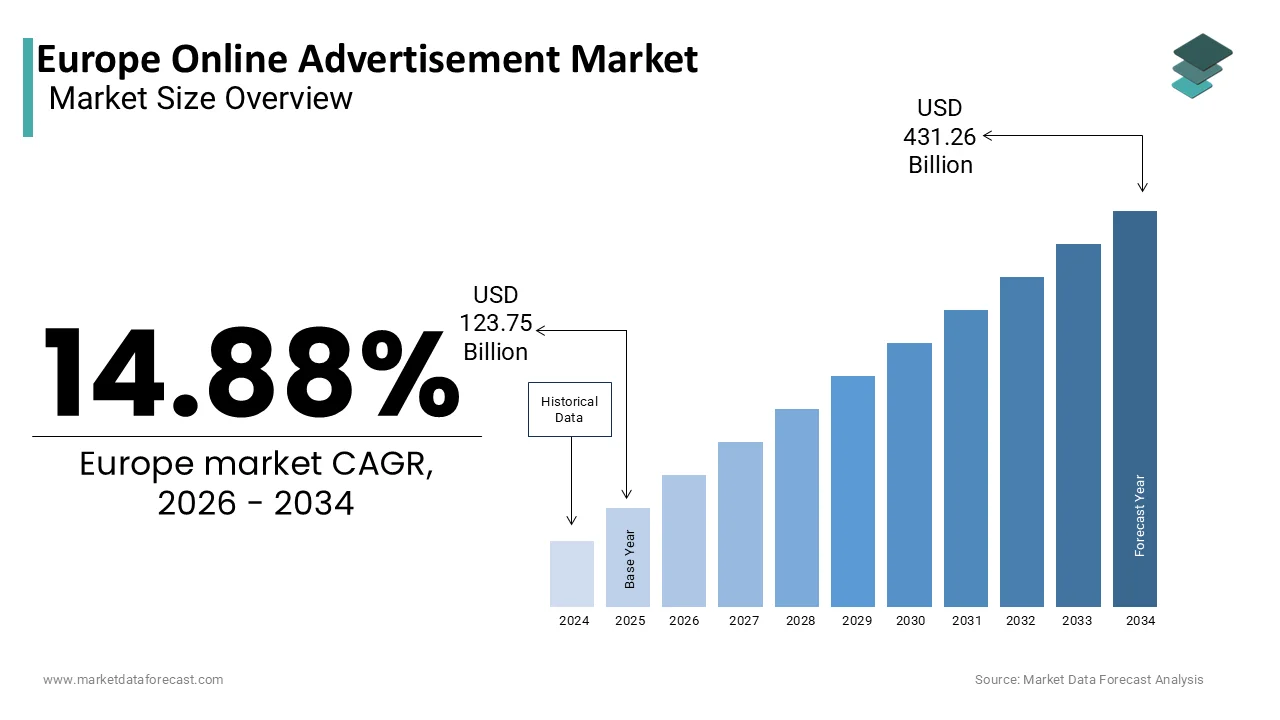
Market Size, 2025
$123.75 BnMarket Estimate, 2026
$142.16 BnMarket Forecast, 2034
$431.26 BnCAGR, 2026–2034
14.88%Europe Online Advertisement Market Size
The europe online advertisement market was valued at USD 123.75 billion in 2025, is estimated to reach USD 142.16 billion in 2026, and is projected to reach USD 431.26 billion by 2034, growing at a CAGR of 14.88% from 2026 to 2034.
Online advertising (also known as digital advertising) is the practice of using the internet and digital platforms to market products, services, or brands to a targeted audience. This domain has evolved from simple banner displays to complex algorithmic systems that leverage artificial intelligence for precise audience targeting. The fundamental shift in consumer behavior toward digital channels defines the current landscape as traditional media consumption declines steadily. As per multiple studies, daily internet usage among the EU population aged sixteen to seventy-four is approaching saturation, with the vast majority of citizens now going online daily. The penetration of high speed broadband infrastructure supports this growth. Fixed household internet connectivity in the EU is nearly universal, and the European Commission is actively expanding access to high-speed fiber networks, with a goal for full coverage in all European households by the end of the decade. Social media usage remains a critical component. The European Audiovisual Observatory noting that video on demand services and social platforms account for a significant portion of daily screen time among adults. The regulatory environment shaped by the General Data Protection Regulation influences how data is collected and utilized for ad targeting making compliance a central operational requirement. This market functions as the primary revenue engine for many technology giants and media publishers while enabling small businesses to reach global customers with minimal capital expenditure.
MARKET DRIVERS
Rapid Expansion of Mobile Internet Connectivity Drives Ad Spend
The proliferation of mobile devices is the main growth factor for the surge in digital advertising expenditure across the region and the overall Europe online advertisement market. Consumers increasingly rely on smartphones for news consumption shopping and social interaction which forces advertisers to reallocate budgets from desktop to mobile first strategies. According to research, European mobile market saturation is increasing, with 5G technology becoming the dominant connection type as adoption rises towards the end of the decade. This ubiquity ensures that ads can reach users at any moment throughout their day thereby increasing engagement rates and conversion potential. The rollout of fifth generation networks has further accelerated this trend by enabling high definition video ads and interactive rich media formats that were previously impossible on slower connections. 5G network coverage is expanding rapidly across the European Union, reducing the digital divide between urban and rural areas. Retailers specifically capitalize on this connectivity through location based advertising that targets consumers when they are near physical stores. The shift is evident in programmatic buying where mobile inventory often commands higher prices due to superior performance metrics. Mobile commerce volumes continue to climb. Therefore, dependency on mobile-optimized ad creatives has become absolute for brand survival. This structural change in device usage patterns guarantees that mobile will remain the dominant channel for digital ad investment in the foreseeable future.
Surge in E-Commerce Activity Fuels Demand for Performance Marketing
The exponential growth of the e-commerce sector acts as a primary demand driver compelling retailers to invest heavily in performance based online advertising, which further contributes to the expansion of the Europe online advertisements market. Physical retail faces ongoing challenges, so digital storefronts have become the main battleground for customer acquisition. Consequently, standing out in this crowded marketplace requires sophisticated ad strategies. According to a study, the percentage of individuals engaging in online shopping in the EU has seen a consistent, long-term increase, with high levels of adoption observed across most member states. This migration of sales volume necessitates continuous visibility on search engines and social platforms where consumers begin their product discovery journeys. Brands utilize pay per click and shopping ads to capture intent driven traffic which offers measurable returns on investment compared to traditional broadcast media. The rise of cross border e-commerce within the single market further intensifies competition as companies target customers in neighboring countries using localized ad campaigns. Cross-border e-commerce within Europe is showing strong, steady growth, driven by top, established retailers and the increased use of online marketplaces. This cross border dynamic encourages advertisers to adopt multi lingual and culturally nuanced ad creatives to resonate with diverse audiences. The need for real time analytics to optimize ad spend ensures that marketing budgets remain fluid and responsive to market fluctuations. Consequently the health of the online ad market is inextricably linked to the vitality of the regional e-commerce ecosystem.
MARKET RESTRAINTS
Stringent Data Privacy Regulations Limit Targeting Capabilities
The implementation of rigorous data protection laws is a significant restraint to the Europe online advertisement market. These laws restrict the ability of advertisers to track user behavior and deliver personalized content. The General Data Protection Regulation along with national implementations has fundamentally altered the data landscape forcing companies to obtain explicit consent before collecting personal information. As per the European Data Protection Board supervisory authorities issued fines totaling over one point two billion euros in 2024 alone with a large portion related to improper data handling by advertising tech firms. This regulatory pressure has led to the deprecation of third party cookies which were historically the backbone of programmatic advertising and audience segmentation. Major browser providers have followed suit by blocking trackers by default which reduces the pool of identifiable users available for targeting. A study found that the implementation of strict, mandatory consent banners has led to a noticeable decline in user acceptance of tracking cookies compared to the previous era of implicit consent. Advertisers now face higher costs to acquire first party data and must invest in contextual advertising which is often less precise than behavioral targeting. The fragmentation of consent mechanisms across different member states adds complexity for pan European campaigns requiring legal teams to constantly monitor compliance. These constraints reduce the overall efficiency of ad spend and limit the granularity of audience insights available to marketers. The industry continues to grapple with balancing effective monetization against the fundamental right to privacy mandated by European law.
Economic Volatility and Inflation Pressures Marketing Budgets
Several European nations are facing persistent economic uncertainty and high inflation, which negatively impacts the expansion of the Europe online advertisement market. This environment is forcing businesses to scrutinize and frequently cut back on their advertising budgets. When consumer confidence wanes due to rising living costs companies prioritize essential operations over discretionary spending such as brand building campaigns. According to the European Central Bank inflation rates in the Eurozone remained elevated above target levels for an extended period in 2024 squeezing household disposable income and corporate profit margins. This financial strain leads marketing directors to cut budgets or shift focus entirely to short term performance metrics abandoning long term brand equity investments. Small and medium sized enterprises which form the bulk of the European business fabric are particularly vulnerable and may pause digital ad activities altogether during downturns. Increased operational costs and energy prices have caused a significant segment of European small businesses to reduce discretionary spending, including marketing budgets. The volatility makes it difficult for ad platforms to forecast revenue and plan infrastructure investments effectively. Advertisers demand lower cost per acquisition rates which compresses margins for publishers and ad networks. Furthermore, the fluctuating exchange rates between the euro and other major currencies impact the profitability of multinational campaigns. This macroeconomic headwind creates a cautious environment where ad spend growth stagnates or contracts despite the underlying growth in digital audience size.
MARKET OPPORTUNITIES
Emergence of Connected Television Opens New Inventory Frontiers
The rapid adoption of connected television and streaming services offers big potential for advertisers within the Europe online advertisement market. This shift allows them to reach audiences who have abandoned traditional linear broadcasting. Viewers are increasingly migrating to on-demand platforms. As a result, advertisers can now leverage digital targeting within a premium video environment that commands higher engagement than standard display ads. Consumer spending on digital video in Europe is rising rapidly due to the proliferation of SVOD services. This transition allows brands to insert programmatic ads into streaming content offering the precision of digital marketing with the impact of television storytelling. The ability to target specific demographics interests and viewing behaviors enhances the relevance of advertisements and improves conversion rates significantly. Smart TV penetration continues to rise. Household ownership of internet-enabled, connected television sets is widespread across European nations. Advertisers are increasingly allocating portions of their television budgets to these digital channels to capture younger audiences who rarely watch live TV. The format supports interactive elements such as clickable overlays that enable direct purchasing from the screen bridging the gap between awareness and action. Content libraries are expanding and exclusive originals are attracting larger viewership. As a result, the inventory for connected television advertising will grow substantially. This evolution represents a paradigm shift where the living room becomes a programmable digital touchpoint for sophisticated marketing campaigns.
Advancement of Artificial Intelligence Enhances Campaign Efficiency
The integration of advanced artificial intelligence and machine learning technologies paves the way to optimize ad delivery and creative performance in real time. This is anticipated to propel the expansion of the Europe onoine advertisement market. These tools enable advertisers to analyze vast datasets instantly predicting user intent and automating bidding strategies to maximize return on investment without human intervention. AI adoption is increasing among large European enterprises, with significant usage in specialized sectors. Generative AI models allow for the creation of thousands of ad variations tailored to micro segments ensuring that each user sees the most relevant message possible. This level of personalization was previously unattainable at scale and significantly boosts engagement metrics while reducing wasted ad spend. Predictive analytics help brands anticipate market trends and adjust their strategies proactively rather than reacting to historical data. The technology also improves fraud detection by identifying bot traffic and invalid clicks more accurately thereby protecting advertising budgets from waste. Natural language processing facilitates better sentiment analysis allowing companies to gauge public perception and refine their messaging accordingly. Algorithms are becoming increasingly sophisticated, lowering the barrier to entry for high-performance marketing. As a result, smaller players can now compete with established giants. This technological leap ensures that the European market remains at the forefront of advertising innovation driving efficiency and effectiveness across all verticals.
MARKET CHALLENGES
Fragmentation of Digital Ecosystem Complicates Measurement
The highly fragmented nature of the region’s digital landscape poses a serious challenge for advertisers attempting to measure campaign performance and attribute conversions accurately, which impedes the growth of the Europe online advertisement market. The continent comprises numerous languages cultures and regulatory environments which necessitates localized strategies that complicate unified reporting and analysis. According to the Interactive Advertising Bureau Europe the existence of dozens of distinct national markets with varying consumer preferences and platform popularities makes it difficult to establish standardized key performance indicators. Advertisers often struggle with data silos where information from different platforms and countries does not integrate seamlessly leading to incomplete pictures of customer journeys. The lack of a single dominant super app or portal means that user attention is scattered across countless websites and applications diluting the impact of broad campaigns. Cross device tracking remains problematic especially with the rise of privacy focused operating systems that limit identifier sharing between apps and browsers. A survey by the World Federation of Advertisers revealed that over fifty percent of European marketers cite measurement inconsistency as their top operational hurdle. This fragmentation increases the cost and complexity of running pan European campaigns requiring specialized local knowledge and multiple technology stacks. The inability to attribute sales to specific touchpoints accurately undermines confidence in digital channels and hampers strategic decision making. Overcoming this disjointed ecosystem requires substantial investment in data integration tools and harmonized measurement frameworks.
Intensifying Competition for Digital Attention Elevates Costs
The saturation of the digital space with an ever-increasing number of advertisers creates intense competition for limited user attention, which in turn inhibits the expansion of the Europe online advertisement market. This rivalry is driving up the cost of inventory significantly. As more brands vie for the same eyeballs on popular platforms the auction dynamics of programmatic advertising result in inflated cost per click and cost per impression rates. Digital advertising revenues in Europe are showing robust growth driven by volume and increased consumption of search and social media. This bidding war disproportionately affects small and medium sized enterprises that lack the deep pockets of multinational corporations to sustain high acquisition costs. The sheer volume of ads displayed to consumers daily leads to banner blindness where users subconsciously ignore promotional content reducing overall effectiveness. Platforms continuously update their algorithms to prioritize paid content over organic reach forcing brands to spend more just to maintain visibility. The competition extends beyond traditional sectors as industries previously slow to adopt digital marketing now flood the space adding to the congestion. Attention spans are shrinking. Audience attention is increasingly fragmented, with viewers spending less time engaging with individual content items before switching. Advertisers must therefore invest more in high quality creative production to break through the noise which further escalates campaign budgets. This relentless upward pressure on costs threatens the sustainability of customer acquisition models for many digital native businesses.
REPORT COVERAGE
| REPORT METRIC | DETAILS |
| Market Size Available | 2025 to 2034 |
| Base Year | 2025 |
| Forecast Period | 2026 to 2034 |
| Segments Covered | By Type, Platform, Pricing Model, and Region. |
| Various Analyses Covered | Global, Regional, and Country-Level Analysis, Segment-Level Analysis, Drivers, Restraints, Opportunities, Challenges; PESTLE Analysis; Porter’s Five Forces Analysis, Competitive Landscape, Analyst Overview of Investment Opportunities |
| Countries Covered | UK, France, Spain, Germany, Italy, Russia, Sweden, Denmark, Switzerland, Netherlands, Turkey, Czech Republic, Rest of Europe |
| Market Leaders Profiled | Google LLC, Meta Platforms, Inc., Amazon.com, Inc., Microsoft Corporation, Adobe Inc., X Corp., Verizon Media, ByteDance Ltd., Tencent Holdings Ltd., Baidu, Inc., Dentsu Group Inc., IAC Inc., WebFX, Disruptive Advertising |
SEGMENTAL ANALYSIS
By Type Insights
In 2025, the video advertising segment was the largest segment in the Europe online advertisement market and occupied a 38.7% share in 2025. The prominence of the segment is attributed to the unparalleled ability of video content to capture user attention and convey complex brand narratives in short durations. The proliferation of high speed internet infrastructure across the continent has removed bandwidth barriers allowing seamless streaming of high definition advertisements. As per a study, the rapid adoption of subscription video services across Europe has established a significant inventory for digital commercial advertisements. Social media platforms have further accelerated this trend by prioritizing video content in their algorithms which forces brands to shift budgets toward visual storytelling formats. The integration of shoppable video features allows direct conversion from viewing to purchasing which appeals strongly to performance marketers seeking measurable returns. Digital video advertising continues to be a high-growth area in European markets, consistently increasing its market share within digital display advertising, according to research. The rise of connected television has also expanded the definition of video advertising beyond mobile and desktop screens into the living room environment. Advertisers favor this segment because completion rates for video ads remain significantly higher than click through rates for static banners. The emotional impact of moving images combined with sound creates stronger brand recall which justifies the premium pricing of video inventory compared to display alternatives.
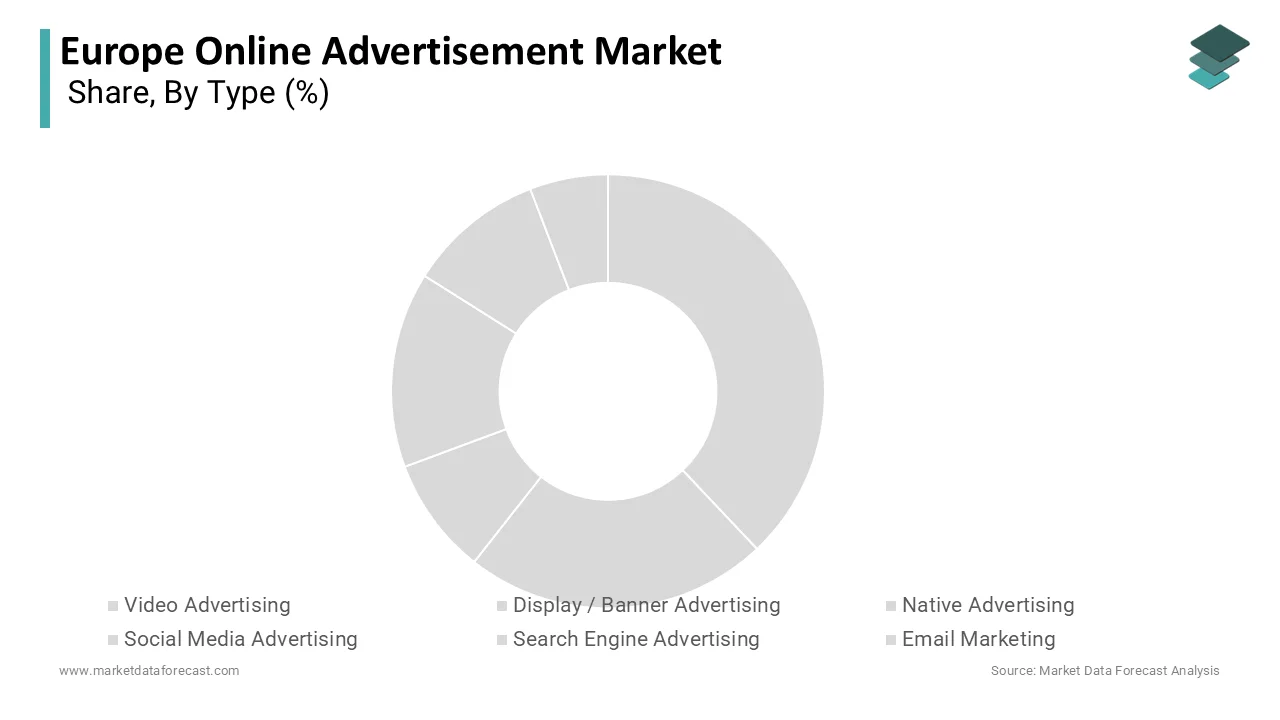
The native advertising segment is on the rise and is expected to be the fastest growing segment in the market by witnessing a CAGR of 8.5% between 2026 and 2034. The swift growth of the segment is fuelled by increasing consumer resistance to intrusive traditional banner ads and the need for content that blends seamlessly with user experiences. A further reason for this growth is the rising adoption of programmatic native platforms that allow advertisers to scale personalized content delivery across thousands of publisher sites efficiently. Native content formats are increasingly favored for brand building because they drive higher engagement rates than traditional display banner advertisements. The shift toward mobile first consumption has further boosted native formats since they adapt naturally to small screens without disrupting navigation flows. Publishers are increasingly favoring native units because they command higher cost per mille rates while maintaining user satisfaction scores. Marketers are shifting advertising investments towards native and influencer-driven content to achieve higher return on investment and better performance metrics. The ability to tell longer stories through sponsored articles and recommended content widgets addresses the demand for informative marketing in an era of information overload. Regulatory pressures regarding data privacy have also pushed brands toward contextual native placements that do not rely heavily on third party cookies. This alignment with both user preference and regulatory compliance ensures sustained double digit growth for the native segment.
By Platform Insights
The mobile devices segment held the majority share of 62.3% of the Europe online advertisement market in 2025. The supremacy of the segment is credited to the fundamental shift in consumer behavior where smartphones have become the primary device for internet access communication and commerce. The ubiquity of mobile applications provides advertisers with granular targeting capabilities based on location usage patterns and app categories which desktop environments cannot match. Mobile connectivity continues to grow across Europe, driven by increasing 5G adoption, with smartphone users forming the majority of the population, making it a primary medium for digital advertising. The integration of mobile wallets and one click payment systems has shortened the conversion funnel making mobile the preferred channel for direct response campaigns. Social media usage is heavily skewed toward mobile with users spending over three hours daily on apps like Instagram and TikTok where video and story ads thrive. Mobile devices have become the dominant, primary tool for accessing the internet in Europe, although desktop usage remains common for work and specific tasks. The rollout of fifth generation networks has enhanced mobile ad capabilities by supporting augmented reality experiences and high quality video streaming without latency issues. Retailers specifically leverage mobile geofencing technologies to target consumers near physical stores driving foot traffic and immediate sales. The portability of mobiles ensures constant connectivity allowing advertisers to engage users throughout their entire day from morning commutes to evening leisure.
The tablets segment is expected to exhibit a noteworthy CAGR of 12.8% during the forecast period owing to the evolving role of tablets as hybrid devices that bridge the gap between the portability of smartphones and the screen real estate of laptops. In addition, this area is also supported by the increasing adoption of tablets in the education and enterprise sectors where larger screens facilitate better interaction with rich media advertisements and interactive content. The tablet market in Western Europe has shown signs of stabilization, with premium, high-feature models driving demand, particularly as the market transitions away from low-end, pandemic-era devices. These superior screens offer an ideal canvas for high impact visual advertising such as interactive magazines and immersive video experiences that perform poorly on smaller mobile phones. The rise of remote work and hybrid learning models has entrenched tablets as essential household devices leading to increased screen time and ad exposure opportunities. Tablet devices are increasingly used for media consumption and online shopping, providing a high-value screen for advertisers targeting engaged users. The demographic skew toward higher income households among tablet users makes this platform particularly attractive for luxury brands and financial services advertisers. Programmatic platforms are increasingly optimizing bid strategies for tablet inventory recognizing its higher engagement rates compared to other mobile devices. As operating systems continue to enhance multitasking capabilities tablets will capture a larger share of productivity related ad spend.
By Pricing Model Insights
The cost per click pricing segment led the Europe online advertisement market and accounted for a 45.5% share in 2025. The leading position of the segment is driven by the preference of advertisers for performance based billing structures where payment is only triggered by tangible user engagement rather than mere impressions. Also, this segment is boosted by the ability of this model to provide clear accountability and measurable return on investment which is critical for small and medium sized enterprises operating with limited marketing budgets. Search remains a crucial, high-intent, performance-driven channel, but total digital investment in Europe is now driven equally by rapid growth in social media, video, and retail media formats. Advertisers favor this model because it aligns costs directly with traffic generation allowing for precise budget control and optimization based on conversion data. The sophistication of bidding algorithms on major platforms like Google and Bing enables real time adjustments to cost per click bids maximizing efficiency across diverse audiences. Small businesses in Europe increasingly favor performance-driven digital advertising, such as cost-per-click models, to better manage budgets and mitigate risks compared to traditional, fixed-price advertising. The transparency of tracking clicks allows marketers to attribute sales to specific keywords and ad creatives facilitating continuous campaign improvement. As e commerce competition intensifies the demand for guaranteed traffic through cost per click arrangements continues to outpace other pricing mechanisms. This model effectively bridges the gap between brand awareness and actual sales making it the cornerstone of digital marketing strategies across the continent.
The Cost Per Mille pricing segment is predicted to witness the highest CAGR of 14.2% during the forecast period due to the escalating demand for brand awareness campaigns particularly in the video and connected television sectors where impression volume matters more than immediate clicks. An additional factor propelling this growth is the shift of large corporate budgets toward premium video inventory where advertisers pay for visibility and reach rather than direct response actions. As per Magna Global brand advertising spend in Europe is recovering rapidly with video and display formats leading the charge under cost per mille agreements. The rise of programmatic guaranteed deals allows publishers to sell large volumes of inventory at fixed cost per mille rates providing revenue stability and predictability for both parties. Advertising-supported streaming services (AVOD) are seeing high growth in Europe, largely driven by the increasing adoption of CPM-based models for in-video ads. Advertisers are increasingly recognizing the value of viewability metrics and brand safety controls that accompany modern cost per mille transactions ensuring their ads are seen by real humans in suitable contexts. The consolidation of ad tech stacks has made it easier to buy and measure impressions at scale across multiple devices and platforms simultaneously. This model is particularly effective for launching new products or rebranding initiatives where mass exposure is the primary objective. Privacy regulations are limiting tracking capabilities. Consequently, the focus is shifting back to broad reach metrics favoring the cost per mille approach.
COUNTRY LEVEL ANALYSIS
Germany Online Advertisement Market Analysis
Germany dominated the European online advertisement market and occupied a 27.7% share in 2025. The dominance of the German market is supported by by its status as the largest economy in Europe with a highly digitized industrial base and robust consumer spending power. Besides, the market is helped by the aggressive digital transformation undertaken by the German automotive and manufacturing sectors which allocate substantial budgets to B2B and B2C digital campaigns. German internet adoption continues to grow, with a vast majority of the population now accessing the internet, providing a near-universal audience for digital advertisers. The country serves as the regional headquarters for numerous multinational corporations that centralize their European media buying operations within German borders. A strong culture of engineering excellence extends to ad tech with local firms developing sophisticated programmatic solutions that drive efficiency. Online advertising expenditure in Germany is experiencing robust growth, generally outpacing traditional media, with significant contributions from video and search formats. The widespread adoption of electronic commerce by traditional retailers has further fueled demand for search and social media advertising. Strict adherence to data privacy laws has forced the market to mature rapidly resulting in high quality compliant inventory that attracts premium global brands. The concentration of media agencies in Berlin and Munich creates a vibrant ecosystem that fosters innovation and talent retention. This combination of economic strength technological adoption and regulatory maturity ensures Germany retains its top rank.
United Kingdom Online Advertisement Market Analysis
The United Kingdom was the next prominent country in the Europe online advertisement market and accounted for a 19.6% share in 2025. Its dynamic fintech and creative industries propel the growth of the UK market. The nation benefits from a highly advanced digital infrastructure and a cultural propensity for early adoption of new media channels which keeps ad spend levels consistently high. A further key driving factor is the concentration of global technology giants and financial institutions in London which compete fiercely for digital visibility through high value programmatic campaigns. According to the Office for National Statistics online retail sales in the UK account for nearly thirty percent of total retail turnover necessitating continuous investment in performance marketing. The presence of world class advertising agencies and ad tech startups fosters an environment of rapid experimentation with formats like connected TV and influencer marketing. Data from the Advertising Association UK reveals that digital advertising overtook traditional media spend several years ago and continues to widen the gap with double digit growth rates. The post Brexit regulatory divergence has led to unique data governance frameworks that challenge advertisers but also create specialized niches for compliance focused solutions. High smartphone penetration and extensive fifth generation coverage enable sophisticated mobile advertising strategies that reach consumers everywhere. The strength of the English language content market also allows UK based campaigns to serve as templates for broader international rollouts. This blend of financial muscle creative prowess and technological readiness cements the UK as a pivotal market.
France Online Advertisement Market Analysis
France maintains a noteworthy position in the Europe online advertisement market. Its world leading luxury goods sector and aggressive retail digitalization efforts drive this position of the French market. The market status is characterized by a strong emphasis on brand image and visual storytelling which drives significant investment in high quality video and display advertising. A major driving factor is the government led initiative to accelerate the digital transition of small and medium sized enterprises which has brought thousands of new advertisers into the online ecosystem. French businesses are steadily increasing their adoption of advanced digital technologies and cloud solutions, though they still lag behind the broader EU average. The luxury industry centered in Paris relies heavily on exclusive digital placements and influencer partnerships to maintain global prestige and reach affluent consumers. Video advertising and connected-TV (CTV) are showing strong growth in France due to advertiser preference for engaging, rich media formats. The expansion of high speed broadband into rural areas has widened the reachable audience beyond major urban centers like Lyon and Marseille. Cross border e-commerce within the EU allows French brands to target neighboring markets efficiently leveraging centralized digital strategies. The growing influence of social commerce platforms has prompted retailers to integrate shopping features directly into their ad campaigns. This strategic focus on quality content and broad digital inclusion ensures France remains a key growth engine.
Italy Online Advertisement Market Analysis
Italy experienced a consistent growth in the Europe online advertisement market. The country leverages its iconic fashion design and tourism industries to sustain steady demand for visually compelling digital advertising campaigns. The market status is also led by a rapid catch up in digital adoption as traditional family owned businesses increasingly recognize the necessity of online presence for survival. Internet access among Italian households is nearly universal and has been steadily increasing, with a very high percentage of households already connected. A key driving factor is the resurgence of the tourism sector which has led hotels airlines and travel agencies to aggressively bid for search and social media inventory to attract international visitors. The fashion capital of Milan serves as a hub for digital innovation where brands experiment with augmented reality try ons and virtual fashion shows promoted through online ads. Mobile ad spend in Italy is growing rapidly, driven by a strong consumer shift toward smartphones for shopping and entertainment. Government incentives for digitalization under the National Recovery and Resilience Plan have provided funds for businesses to upgrade their marketing technologies. The fragmented nature of the retail landscape creates opportunities for localized targeting strategies that resonate with specific regional preferences. This fusion of heritage industries with modern digital tools positions Italy for sustained growth.
Spain Online Advertisement Market Analysis
Spain is predicted to expand in the Europe online advertisement market over the forecast period due to its booming telecommunications sector and vibrant startup ecosystem. The nation has emerged as a critical testing ground for new digital advertising formats due to its high mobile engagement rates and youthful demographic profile. The market status reveals rapid growth in programmatic advertising as publishers and advertisers adopt automated trading platforms to optimize inventory efficiency. Digital investment in Spain continues to increase, in line with broader, more moderate European growth trends. A primary driving factor is the dominance of major telecommunications companies that bundle digital services and leverage customer data for targeted advertising campaigns. The tourism and hospitality industries contribute significantly to ad spend especially during peak seasons when hotels and airlines compete for visibility across search and social channels. A vast majority of Spanish adults use the internet regularly, providing a massive, highly connected consumer base for digital marketing. The rise of freelance and gig economy workers has spurred demand for B2B digital services and professional networking advertisements. Urban centers like Barcelona and Madrid are becoming hubs for ad tech innovation attracting venture capital and talent from across the continent. This dynamic environment ensures Spain plays an increasingly important role in the regional digital economy.
COMPETITIVE LANDSCAPE
The competition in the Europe online advertisement market is intensely fierce characterized by a constant battle for user attention and advertiser budgets among global technology giants and specialized regional firms. Dominant players leverage vast data ecosystems and advanced artificial intelligence to offer superior targeting capabilities that smaller competitors struggle to match. However niche agencies thrive by providing bespoke services and deep local market knowledge that multinational corporations often lack. The landscape is further complicated by stringent regulatory frameworks like the General Data Protection Regulation which forces all participants to innovate around privacy compliant data usage. New entrants from the retail media sector are disrupting traditional models by offering closed loop attribution based on actual sales data. Price wars occasionally erupt in programmatic sectors but differentiation increasingly relies on creative quality and measurement transparency. Mergers and acquisitions remain common as companies seek to consolidate technology stacks and expand inventory access. This dynamic environment ensures rapid evolution where adaptability and technological prowess determine long term survival and success.
KEY MARKET PLAYERS
Some of the companies that are playing a dominating role in the global europe online advertisement market include
- Google LLC
- Meta Platforms, Inc.
- Amazon.com, Inc.
- Microsoft Corporation
- Adobe Inc.
- X Corp. (Twitter)
- Verizon Media (Yahoo/AOL)
- ByteDance Ltd.
- Tencent Holdings Ltd.
- Baidu, Inc.
- Dentsu Group Inc.
- IAC Inc.
- WebFX
- Disruptive Advertising
TOP LEADING PLAYERS IN THE MARKET
- Google operates as a foundational pillar within the Europe online advertisement ecosystem through its extensive suite of search and display solutions. The company leverages its dominant search engine and YouTube platform to connect billions of users with relevant brand messages across the continent. Recent actions focus heavily on integrating artificial intelligence to enhance ad targeting precision while simultaneously adapting to strict European privacy regulations. Google has launched new privacy sandbox initiatives to replace third party cookies ensuring compliant data usage for advertisers. The firm continues to invest in video advertising tools that allow brands to create immersive shoppable experiences. Their global contribution remains unparalleled as they set industry standards for programmatic trading and measurement analytics. Google is refining machine learning algorithms to help European businesses optimize spend. These improvements allow companies to achieve higher returns on investment without compromising user trust.
- Meta Platforms maintains a massive presence in the Europe online advertisement market by utilizing its social networking giants Facebook and Instagram. The company excels in delivering highly visual and interactive ad formats that resonate deeply with diverse European demographics ranging from Gen Z to older adults. Recent strategic moves include heavy investment in Reels and short form video content to compete with emerging social platforms and capture shifting user attention. Meta has also enhanced its commerce features allowing users to purchase products directly within ads which streamlines the customer journey. The firm actively develops augmented reality tools that enable virtual try ons for fashion and beauty brands. Globally Meta drives innovation in social commerce and community based marketing. Their commitment to transparency and data control tools helps align operations with European regulatory expectations while maintaining robust advertising performance for clients.
- Amazon Advertising has rapidly evolved into a critical player in the Europe online advertisement market by capitalizing on its vast e commerce infrastructure and rich first party data. The company offers unique sponsored product and display ads that target consumers at the precise moment of purchase intent within its marketplace. Recent actions involve expanding advertising capabilities beyond its own site to include off Amazon placements through its demand side platform. Amazon has introduced advanced video streaming ads on Prime Video to reach audiences during premium content consumption. The firm leverages its logistics network to provide closed loop measurement showing exactly how ads drive physical sales. Globally Amazon reshapes retail media by proving the value of shopping data in ad targeting. Their continuous enhancement of attribution models helps European brands understand the full impact of their campaigns across multiple touchpoints.
TOP STRATEGIES USED BY KEY MARKET PARTICIPANTS
Key players in the Europe online advertisement market primarily focus on artificial intelligence integration to automate bidding and optimize creative delivery in real time. Companies heavily invest in first party data acquisition to reduce reliance on third party cookies amidst tightening privacy laws. Strategic partnerships with premium publishers help secure high quality inventory that ensures brand safety and viewability for advertisers. Major participants are expanding into connected television and streaming video to capture audiences migrating away from traditional linear broadcasting. Development of shoppable ad formats allows direct conversion from viewing to purchasing which enhances return on investment for retail clients. Firms also prioritize sustainability initiatives by offering carbon neutral advertising options to appeal to environmentally conscious brands. Continuous localization of ad products ensures relevance across diverse European languages and cultural contexts. These strategies collectively aim to maximize engagement while navigating complex regulatory landscapes.
MARKET SEGMENTATION
This research report on the europe online advertisement market is segmented and sub-segmented into the following categories.
By Type
- Video Advertising
- Display / Banner Advertising
- Native Advertising
- Social Media Advertising
- Search Engine Advertising
- Email Marketing
- Others
By Platform
- Mobile Devices
- Desktop / Laptop
- Tablets
- Connected TV (CTV)
- Smart Devices
By Pricing Model
- Cost Per Click (CPC)
- Cost Per Mille (CPM)
- Cost Per Action (CPA)
- Cost Per View (CPV
- Hybrid Models
By Country
- Germany
- United Kingdom
- France
- Italy
- Spain
- Netherlands
- Sweden
- Rest of Europe