- Product Description Description
- Table of Contents TOC
- List of Table & Figure LOT
- Get Free Sample PDF Sample PDF
Market Size, 2025
$44.72 BnMarket Estimate, 2026
$53.43 BnMarket Forecast, 2034
$221.73 BnCAGR, 2026–2034
19.47%Europe Catalog Market Report Summary
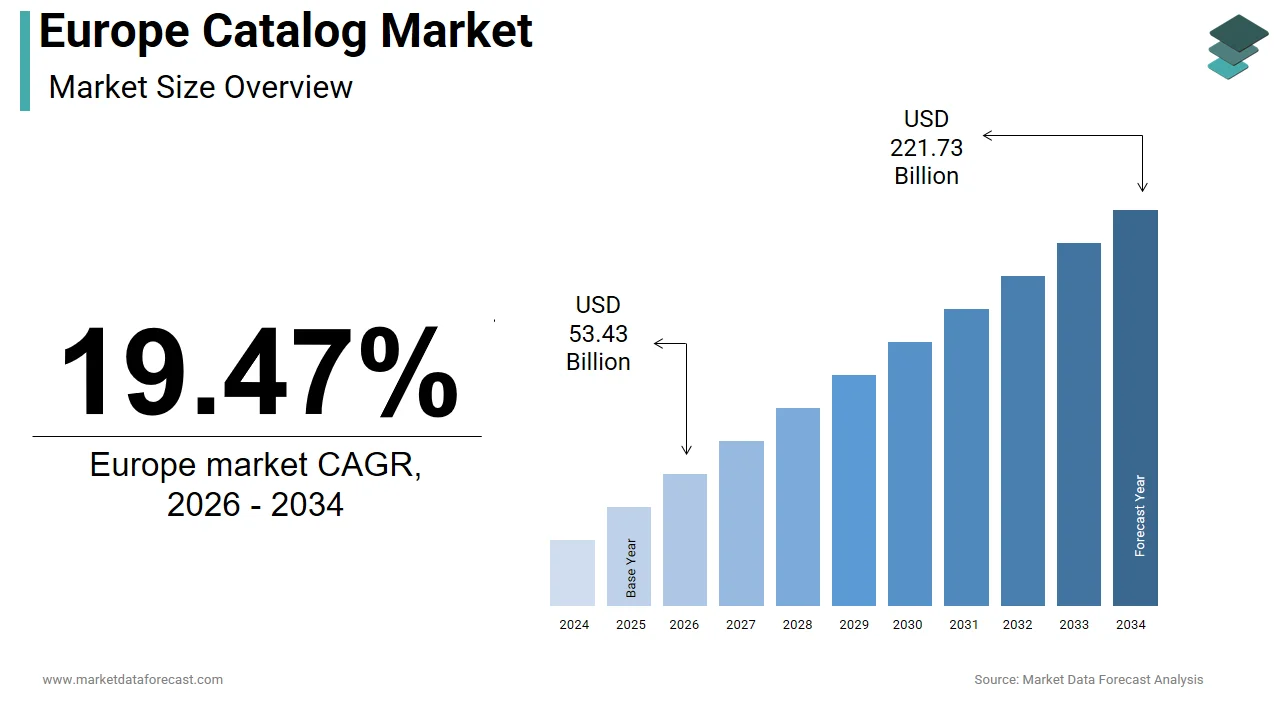
The Europe catalog market was valued at USD 44.72 billion in 2025, is estimated to reach USD 53.43 billion in 2026, and is projected to reach USD 221.73 billion by 2034, growing at a CAGR of 19.47% from 2026 to 2034. Market growth is driven by the increasing adoption of digital catalog management solutions, expansion of e-commerce platforms, and the growing need for centralized product information management across industries. Catalog systems play a critical role in enabling efficient product discovery, improving customer engagement, and supporting omnichannel retail strategies. Additionally, the integration of artificial intelligence, automation, and cloud-based catalog platforms is further accelerating market expansion across Europe.
Key Market Trends
- Rapid growth of digital catalogs integrated with e-commerce platforms.
- Increasing adoption of product information management (PIM) systems.
- Rising demand for omnichannel retail and personalized customer experiences.
- Continued relevance of print catalogs in luxury, retail, and niche segments.
- Expansion of cloud-based catalog platforms with AI-driven automation.
Segmental Insights
- Based on type, the print or paper catalogs segment dominated the Europe catalog market by accounting for 55.9% of the regional market share in 2025, driven by their continued effectiveness in customer engagement, brand storytelling, and targeted marketing campaigns.
- Based on organization size, the large enterprises segment held the majority share of 66.7% of the Europe catalog market in 2025, supported by higher adoption of advanced catalog management systems to manage extensive product portfolios and omnichannel operations.
- Based on industry vertical, the retail and e-commerce segment led the Europe catalog market by capturing 49.1% of the regional market share in 2025, driven by the rapid expansion of online retail platforms and the increasing importance of structured product data.
Regional Insights
The Europe catalog market is witnessing strong growth across major economies, supported by expanding digital commerce, advanced IT infrastructure, and increasing adoption of catalog management platforms.
- Germany led the Europe catalog market by accounting for 21.2% of the regional market share in 2025, driven by its strong manufacturing base, advanced retail sector, and widespread adoption of digital product information systems.
- France held a promising share of the Europe catalog market, supported by strong retail brands, luxury product catalogs, and growing adoption of digital catalog solutions.
- The United Kingdom is anticipated to hold a substantial share of the Europe catalog market over the forecast period owing to seamless integration of print and digital catalog strategies and strong growth in omnichannel retail.
Competitive Landscape
The Europe catalog market is highly competitive, with enterprise software providers, retail conglomerates, and digital platform vendors focusing on enhancing catalog management capabilities, improving data accuracy, and enabling seamless integration across digital channels. Companies are investing in cloud-based platforms, AI-driven product data management, and automation to strengthen their competitive position.
Leading companies operating in the Europe catalog market include IBM, SAP, Oracle Corporation, Broadcom Inc., Fujitsu, and ServiceNow, along with major retail and catalog platform providers such as OTTO Group and Axel Springer SE.
Europe Catalog Market Size
The size of the Europe catalog market was worth USD 44.72 billion in 2025. The regional market is anticipated to grow at a CAGR of 19.47% from 2026 to 2034 and be worth USD 221.73 billion by 2034 from USD 53.43 billion in 2026.
Catalog encompasses the strategic creation, distribution, and management of printed and digital product catalogs used by retailers, manufacturers, and B2B suppliers to showcase offerings, communicate brand identity, and drive sales across diverse sectors, including fashion, home goods, industrial equipment, and specialty foods. Far from being obsolete in the digital age, modern catalogs have evolved into high-impact marketing tools that blend tactile appeal with data-driven personalization. Their continued relevance is underpinned by consumer behavior patterns unique to European markets, where physical mail retains strong engagement. As per Eurostat, a large majority of EU households continued to receive commercial printed catalogs regularly in 2025, which reflects sustained publisher investment. Concurrently, the European Direct Marketing Association reported that catalog recipients are significantly more likely to make purchases compared to non-recipients, underscoring their conversion power. This duality, rooted in both tradition and analytics, positions the catalog not as a relic but as a curated, multi-sensory channel that complements e-commerce by offering structured discovery, editorial storytelling, and trusted curation in an era of digital overload.
MARKET DRIVERS
High Trust in Physical Mail Among European Consumers Sustains Print Catalog Engagement
Despite global digitalization trends, European consumers exhibit a pronounced preference for tangible marketing materials, particularly in mature markets like Germany, France, and Scandinavia, which is one of the major factors propelling the growth of the European catalog market. As per the European Advertising Standards Alliance, a majority of adults aged 45 and above consider printed catalogs more trustworthy than online ads, citing reduced exposure to fraud and algorithmic manipulation. This trust translates into measurable commercial impact. As per the German Federal Statistical Office, catalog-driven sales in home furnishings and apparel have shown stronger growth compared to pure-play e-commerce in those categories. The tactile experience of flipping through pages allows for deeper cognitive processing and emotional connection, especially for high-involvement purchases like furniture or luxury goods. Retailers leverage this by producing high-quality, magazine-style catalogs that function as brand narratives rather than mere price lists, reinforcing loyalty in markets where consumer skepticism toward digital platforms remains elevated.
Integration of Variable Data Printing Enables Hyper-Personalized Catalog Campaigns
Advancements in digital printing technology have transformed static catalogs into dynamic and personalized communication vehicles, which is further boosting the expansion of the European catalog market. Using customer purchase history, browsing behavior, and demographic data, companies now produce millions of unique catalog variants tailored to individual preferences. As per the European Printers Federation, a significant share of major European retailers utilized variable data printing for their seasonal catalogs in 2025, resulting in higher average order values compared to generic versions. For instance, a Swedish home goods retailer might feature winter textiles to customers in Oslo while showcasing garden furniture to those in Barcelona, all within the same print run. This precision reduces waste, enhances relevance, and bridges the gap between mass marketing and one-to-one communication. The ability to merge the sensory appeal of print with the targeting accuracy of digital analytics has revitalized the catalog as a sophisticated, ROI-driven tool in omnichannel strategies.
MARKET RESTRAINTS
Stringent EU Environmental Regulations Increase Production Costs and Limit Material Choices
The European Union’s Circular Economy Action Plan and Packaging and Packaging Waste Directive impose rigorous requirements on paper sourcing, ink composition, and recyclability, which directly impact catalog production and hinder the regional market expansion. As per the European Environment Agency, all printed materials distributed commercially must now use paper with a minimum of 70% post-consumer recycled content or certified sustainable virgin fiber, which is more expensive than conventional stock. Additionally, restrictions on certain pigments and coatings under REACH regulations have eliminated popular glossy finishes, reducing visual appeal. These constraints force publishers to either absorb higher costs or pass them to clients, making catalogs less competitive against digital alternatives. In countries like the Netherlands and Austria, strict municipal waste sorting mandates impose disposal penalties on non-compliant catalogs, further discouraging large-scale print runs.
Declining Postal Infrastructure Efficiency Raises Distribution Timelines and Costs
Europe’s fragmented postal landscape, coupled with workforce shortages and service rationalization, has degraded the reliability of catalog delivery, which is also hampering the growth of the European catalog market. As per the European Commission Postal Sector Report, average first-class mail delivery times have increased in recent years, with rural areas in Southern and Eastern Europe experiencing longer delays. Simultaneously, postage rates have risen annually, driven by energy costs and declining letter volumes. For time-sensitive campaigns such as holiday or seasonal collections, these delays render catalogs obsolete before they reach consumers. Retailers report that late arrivals correlate with significant drops in redemption rates, as customers have already purchased elsewhere online. This erosion of the postal value proposition undermines a core advantage of catalogs, which is pushing marketers to reduce frequency or abandon print altogether.
MARKET OPPORTUNITIES
Hybrid Print-Digital Catalogs with QR Codes and Augmented Reality Drive Engagement
Innovative publishers are transforming static pages into interactive experiences by embedding QR codes, NFC tags, and augmented reality triggers that link to video demonstrations, 360-degree product views, or real-time inventory checks. As per the European Retail Roundtable, catalogs featuring AR-enabled previews have shown notable increases in store visits and conversion rates compared to traditional versions. In Italy, a fashion brand used QR codes to offer exclusive styling tutorials, drive app downloads, and repeat engagement. This fusion leverages the trust and attention span of print while unlocking the dynamism of digital, creating a seamless omnichannel journey. For European consumers wary of screen fatigue but seeking richer product information, these hybrid catalogs offer the best of both worlds, opening new avenues for data capture, personalization, and measurable attribution.
Niche and Artisanal Brands Use Premium Catalogs to Differentiate in Crowded Markets
Amidst digital noise, small and medium-sized enterprises are leveraging high-end printed catalogs as a premium branding tool, which is another prominent opportunity in the European catalog market. These publications resemble art books or literary journals, using uncoated papers, artisanal typography, and narrative storytelling to convey authenticity and craftsmanship. As per the European Small Business Alliance, many artisanal producers in France and Portugal reported that their catalog was their most effective customer acquisition channel in 2025, outperforming social media ads. The physical artifact itself becomes a collectible, reinforcing brand prestige and justifying higher price points. This strategy aligns with Europe’s growing demand for provenance and sustainability, where the tangible nature of the catalog mirrors the tangible quality of the product. By positioning print as a luxury experience rather than a mass medium, niche players carve defensible market positions that digital platforms cannot easily replicate.
MARKET CHALLENGES
Generational Shift in Media Consumption Reduces Receptivity Among Younger Audiences
Digital-native cohorts in Europe exhibit markedly lower engagement with physical mail, posing a long-term threat to catalog efficacy, which is challenging the European catalog market expansion. As per the Eurobarometer Youth Survey, younger Europeans recalled reading catalogs far less frequently compared to older demographics. This generational divide is amplified by mobile-first shopping habits, where younger consumers prefer instant, searchable, and socially validated purchasing paths that catalogs cannot provide. Even when received, catalogs are often discarded unopened, with recycling rates for unsolicited mail exceeding high levels in urban centers like Berlin and Amsterdam. Without a compelling value proposition that resonates with younger sensibilities, such as sustainability storytelling or exclusive access, the catalog risks becoming irrelevant to future mainstream markets.
Data Privacy Regulations Restrict Personalization Capabilities Under GDPR
The EU’s General Data Protection Regulation (GDPR) imposes strict limits on the collection, storage, and use of personal data, which directly constrains the hyper-personalization that could revitalize catalogs and further challenge the regional market growth. As per the European Data Protection Board, explicit consent is required to use purchase history or behavioral data for direct marketing, and opt-in rates remain relatively low across major EU markets. This forces many retailers to revert to broad demographic segmentation rather than true individualization, diluting relevance and reducing response rates. Furthermore, cross-border data flows for pan-European campaigns face additional compliance hurdles, fragmenting execution. While anonymized data can be used, it lacks the granularity needed for effective targeting. This regulatory environment places European catalog marketers at a disadvantage compared to regions with looser privacy laws, stifling innovation in data-driven print and limiting the medium’s potential to compete with algorithmically optimized digital advertising.
REPORT COVERAGE
| REPORT METRIC | DETAILS |
| Market Size Available | 2025 to 2034 |
| Base Year | 2025 |
| Forecast Period | 2026 to 2034 |
| Segments Covered | By Type, Organization Size, Industry Vertical, and Country. |
| Various Analyses Covered | Global, Regional, and Country-Level Analysis, Segment-Level Analysis, Drivers, Restraints, Opportunities, Challenges; PESTLE Analysis; Porter’s Five Forces Analysis, Competitive Landscape, Analyst Overview of Investment Opportunities |
| Countries Covered | UK, France, Spain, Germany, Italy, Russia, Sweden, Denmark, Switzerland, Netherlands, Turkey, Czech Republic, and the Rest of Europe. |
| Market Leaders Profiled | IBM, SAP, Oracle, Salsify, OTTO Group, Coupa Software, Lagardère Active Retail, ServiceNow, Proactis, Broadcom, Fujitsu, Axel Springer SE, and Comarch. |
SEGMENTAL ANALYSIS
By Type Insights
The print or paper catalogs segment held 55.9% of the regional market share in 2025. The dominance of the print or paper catalogs segment in the European market is driven by consumer behavior and regulatory advantage. As per a neuromarketing study by the University of Amsterdam, participants retained more product details from print catalogs than digital versions after a time interval, highlighting superior cognitive engagement. This effect is especially pronounced among consumers aged 45 and above, who constitute a majority of high-value retail purchasers in Western Europe. The second driver is regulatory simplicity under the GDPR. Unlike digital channels that require explicit consent for behavioral tracking, print catalogs operate without data collection, allowing brands to reach broad audiences without compliance overhead. In countries like Germany and Austria, where privacy enforcement is strict, this legal clarity makes print a low-risk, high-reach channel for seasonal campaigns.
The digital catalogs segment is promising and is estimated to register a CAGR of 10.7% over the forecast period. The adaptability, real-time commerce, and dynamic content synchronization are propelling the growth of the digital catalogs segment in the European market. For example, Zalando updates its digital lookbooks hourly based on warehouse stock levels, reducing customer frustration from out-of-stock items. A second factor is integration with e-commerce ecosystems. Platforms like Publitas enable one-click purchasing directly from catalog pages, shortening the path to conversion. As per Eurostat, retailers using shoppable digital catalogs saw higher average order values compared to those relying on PDFs or print alone.
By Organization Size Insights
The large enterprises segment led the market by holding 66.7% of the European market share in 2025. The leading position of the large enterprises segment in the European market is driven by economies of scale and an integrated marketing infrastructure. Multinational retailers like MediaMarkt and Carrefour leverage pan-European printing contracts that reduce per-unit costs for high-volume runs. The second factor is cross-channel analytics capability. As per the European Commission Digital Commerce Report, enterprises with integrated attribution systems achieved significantly higher catalog-driven sales lift.
The SMEs segment is a promising segment and is predicted to witness a CAGR of 12.9% over the forecast period, owing to the accessible technology and strategic differentiation. Cloud-based platforms like Canva and Flipsnack enable SMEs to produce professional digital catalogs affordably. Artisanal producers in organic food and handmade furniture use limited-run, high-quality print catalogs to convey craftsmanship and provenance. As per Eurochambres, SMEs reported catalogs as their most trusted customer acquisition channel, particularly in rural and niche markets.
By Industry Vertical Insights
The retail and e-commerce segment occupied the major share of 49.1% of the regional market in 2025. The growth of the retail and e-commerce segment in the European market can be credited to the sector’s need for visual curation and seasonal storytelling. Retailers handling thousands of SKUs use catalogs to group items into thematic collections, creating an emotional context that generic websites lack. IKEA exemplifies this editorial approach with its annual catalog distributed to millions of households. As per Eurostat, a majority of consumers who receive a physical catalog later search for the same products online, making catalogs powerful top-of-funnel tools.
The travel and hospitality segment is the fastest-growing vertical in the European catalog market and is expected to witness a CAGR of 13.3% over the forecast period. The resurgence of experiential luxury travel is driving the travel and hospitality segment in the European market. High-end tour operators and hotel groups like Belmond and Six Senses use glossy print catalogs featuring evocative photography and cultural narratives to convey destination ambiance. As per the European Central Bank, older travelers account for the majority of luxury travel spending, and this cohort strongly prefers tangible planning tools. Cruise lines also reported higher conversion rates from catalog recipients compared to digital-only leads, reinforcing the role of catalogs as essential sales instruments in aspirational travel.
COUNTRY-LEVEL ANALYSIS
Germany Catalog Market Analysis
Germany dominated the catalog market in Europe in 2025 by holding 21.2% of the regional market share. The dominance of Germany in the European market is attributed to its deep-rooted mail-order heritage and consumer trust in physical media. Its market status is defined by industrial-scale print operations from companies like OTTO and Quelle, which distribute millions of catalogs annually. As per the German Federal Statistical Office, a majority of adults over 50 consider catalogs their primary source for home and fashion discovery. Germany’s stringent data protection laws make print a legally compliant alternative to targeted digital advertising. The country also hosts an advanced printing infrastructure capable of producing personalized catalogs at an industrial scale using climate-neutral processes.
France Catalog Market Analysis
France commanded a promising share of the European catalog market in 2025. The growth of France in the European market can be credited to its emphasis on aesthetic excellence and narrative depth. Its market status is shaped by luxury fashion houses, gourmet food purveyors, and furniture designers who treat catalogs as collectible art objects. As per INSEE, many French consumers aged 35–65 retain premium catalogs for months as style references. Government support for Made in France craftsmanship further incentivizes small producers to invest in high-quality print. Paris serves as a creative nexus for catalog design agencies, reinforcing France’s role as the standard-bearer for emotionally resonant, high-end catalog publishing.
United Kingdom Catalog Market Analysis
The United Kingdom is anticipated to account for a substantial share of the European catalog market over the forecast period, owing to the seamless integration of print and digital customer journeys. Retailers like John Lewis and Argos use purchase history to generate hyper-personalized print catalogs that sync with app notifications and online wishlists. As per the UK Office for National Statistics, catalog recipients spend significantly more annually than non-recipients, with many completing purchases online after browsing print. Despite Brexit, the UK maintains strong ties to European printing networks, ensuring cost efficiency. The rise of reserve-and-collect models has further revitalized catalogs as planning tools for in-store pickups.
Italy Catalog Market Analysis
Italy is projected to showcase a notable CAGR in the European catalog market over the forecast period. Italy is notable for its focus on regional specialties and family-owned enterprises. Catalogs from olive oil cooperatives, ceramic artisans, and fashion ateliers emphasize terroir and craftsmanship. As per ISTAT, millions of international visitors in 2025 received branded catalogs at hotels or airports, serving as post-trip purchasing guides for authentic Italian products. Italy’s fragmented retail landscape, with hundreds of thousands of small shops, relies on supplier catalogs for wholesale ordering, sustaining robust B2B print demand. Local printers in regions like Tuscany and Lombardy specialize in short-run, high-quality production, enabling customization without scale.
Sweden Catalog Market Analysis
Sweden is anticipated to account for a considerable share of the European catalog market during the forecast period. Sweden market is characterized by uncompromising environmental standards and digital innovation. As per Statistics Sweden, nearly all commercial catalogs use recycled paper and climate-neutral printing certified under the Nordic Swan Ecolabel. Retailers like H&M and IKEA lead in circular design, encouraging catalog returns for recycling. Simultaneously, Sweden pioneers digital catalog integration, with households accessing interactive versions via retailer apps featuring AR try-ons and live inventory checks. The government’s Fossil-Free Sweden initiative provides grants for low-impact printing, aligning catalog production with national climate goals. This dual focus on sustainability and tech-enabled engagement makes Sweden a model for the ethical, hybrid future of catalog marketing in Europe.
COMPETITIVE LANDSCAPE
The competition in the Europe catalog market is characterized by a dual dynamic between legacy mail-order giants and agile digital-native publishers. Large players leverage scale, established printing infrastructure, and deep customer databases to produce high-volume, personalized print runs that drive omnichannel sales. Simultaneously, boutique agencies and SME-focused platforms compete on creativity, sustainability, and niche targeting, offering artisanal design and eco-certified production for premium brands. The primary battleground is not just distribution reach but trust, compliance, and measurability. With stringent GDPR rules limiting data usage and EU green directives raising production costs, only players who can deliver legally compliant, environmentally responsible, and analytically trackable catalogs maintain a competitive advantage. This environment favors integrated marketers who treat the catalog not as a standalone channel but as a curated touchpoint within a broader, privacy-respecting customer journey.
KEY MARKET PLAYERS
The leading companies operating in the Europe catalog market include:
- IBM
- SAP
- Oracle
- Salsify
- OTTO Group
- Coupa Software
- Lagardère Active Retail
- ServiceNow
- Proactis
- Broadcom
- Fujitsu
- Axel Springer SE
- Comarch
TOP PLAYERS IN THE MARKET
- OTTO Group is a German multinational and one of Europe’s largest mail-order and e-commerce companies, renowned for its extensive use of high-quality printed catalogs across fashion, home, and lifestyle categories. The company contributes globally by pioneering integrated print-digital retail models that blend tactile catalog browsing with seamless online purchasing. OTTO distributes over 100 million catalogs annually in more than 20 countries, serving as a benchmark for omnichannel engagement. Recently, the group enhanced its sustainability profile by transitioning all catalogs to 100% recycled paper and climate-neutral printing certified under EU Ecolabel standards. It also launched an AI-driven personalization engine that tailors catalog content based on individual customer behavior, reinforcing its leadership in data-informed physical media within a digital-first era.
- Lagardère Active Retail, operating under Prisma Media in France, is a leading European publisher of premium branded catalogs for the luxury, beauty, and home sectors. The company leverages its editorial expertise from magazine publishing to produce visually rich, narrative-driven catalogs that function as brand storytelling vehicles. Its global contribution lies in elevating the catalog from a transactional tool to a collectible art form, influencing luxury retail marketing worldwide. In recent years, Prisma has integrated augmented reality features into its print catalogs, allowing readers to access video content and 3D product views via smartphone scanning. This innovation bridges print credibility with digital interactivity, strengthening its appeal among high-end European brands seeking immersive yet trustworthy customer engagement.
- Axel Springer is a German digital publishing giant that has strategically expanded into performance-driven catalog marketing through its subsidiary, Axel Springer Digital Marketing Solutions. While primarily known for news media, the company plays a pivotal role in the catalog market by offering data analytics, programmatic print, and cross-channel attribution services for major European retailers. Its global contribution is the development of closed-loop measurement systems that track catalog-driven sales from print exposure to online conversion. Recently, Axel Springer launched a GDPR-compliant personalization platform that enables hyper-targeted catalog production without violating EU privacy laws. This positions the firm as a critical enabler of compliant, measurable, and effective catalog campaigns in Europe’s regulated marketing landscape.
TOP STRATEGIES USED BY THE KEY MARKET PARTICIPANTS
Key players in the Europe catalog market are increasingly adopting hybrid print-digital formats that embed QR codes, NFC tags, and augmented reality to create interactive experiences. They are utilizing variable data printing to produce personalized catalog variants based on customer purchase history and demographic profiles. Companies are also shifting to 100% recycled or FSC-certified paper and climate-neutral printing processes to comply with EU environmental regulations and meet consumer sustainability expectations. Strategic integration of catalog distribution with loyalty programs and e-commerce platforms ensures seamless omnichannel journeys. Additionally, firms are investing in advanced analytics to measure offline-to-online conversion rates and optimize catalog ROI in a privacy-conscious, data-limited environment.
MARKET SEGMENTATION
This research report on the Europe catalog market has been segmented and sub-segmented into the following categories.
By Type
- Digital
- Print or Paper
By Organization Size
- Large Enterprises
- Small and Medium-sized Enterprises (SMEs)
By Industry Vertical
- Retail and E-commerce
- Fast-Moving Consumer Goods (FMCG)
- Banking, Financial Services, and Insurance (BFSI)
- Information Technology and Telecom
- Media and Entertainment
- Travel and Hospitality
By Country
- United Kingdom
- France
- Spain
- Germany
- Italy
- Russia
- Sweden
- Denmark
- Switzerland
- Netherlands
- Rest of Europe