- Product Description Description
- Table of Contents TOC
- List of Table & Figure LOT
- Get Free Sample PDF Sample PDF
Market Size, 2025
$23.80 BnMarket Estimate, 2026
$24.49 BnMarket Forecast, 2034
$30.78 BnCAGR, 2026–2034
2.9%Global Ink Market Summary
The global ink market was valued at USD 23.80 billion in 2025 and is estimated to reach USD 24.49 billion in 2026, and is projected to grow to USD 30.78 billion by 2034, registering a CAGR of 2.9% from 2026 to 2034, driven by sustained packaging demand, digital printing expansion, and the emergence of functional inks in electronics and healthcare.
Key Market Highlights
- 2025 Market Size: USD 23.80 billion
- 2026 Estimate: USD 24.49 billion
- 2034 Forecast: USD 30.78 billion
- CAGR (2026–2034): 2.9%
- Largest Application: Label & Packaging (42.5% share in 2025)
- Fastest-Growing Technology: Digital Printing (9.4% CAGR)
- Dominant Region: Asia-Pacific (41.7% share in 2025)
Quick Growth Drivers
- Rapid expansion of e-commerce is driving corrugated and flexible packaging demand
- Rising adoption of digital printing for short-run and customized packaging
- Growth in printed electronics and wearable healthcare devices
- Increased need for anti-counterfeiting and traceability inks
- Smart packaging integration with QR codes and AR markers
Principal Restraints
- Strict VOC regulations under EU and North American environmental policies
- High reformulation costs for solvent-to-water-based transition
- Raw material price volatility (TiO₂, carbon black, silver)
- Compliance delays impacting product commercialization
High-Value Opportunities
- Bio-based and biodegradable ink formulations
- Conductive inks for RFID, sensors, and flexible circuits
- Anti-counterfeiting specialty inks for pharma and luxury goods
- Water-based inkjet expansion in corrugated packaging
- Sustainable inks aligned with circular economy mandates
Key Market Challenges
- Silver scarcity is affecting conductive ink scalability
- Lack of global standardization across print technologies
- Substrate-ink compatibility issues in flexible packaging
- Margin compression in commoditized ink segments
Fastest-Growing Segments
- Digital Printing Technology: 9.4% CAGR — personalization & short runs
- Water-Based Inks: 7.9% CAGR — low VOC compliance
- Commercial Printing: 6.7% CAGR — premium short-run marketing
- Lithographic (Offset): Largest technology segment (38.2% share in 2025)
- Solvent-Based Inks: Largest ink type (36.7% share in 2025)
Regional Leadership & Dynamics
Asia-Pacific (41.7% Share – 2025 Leader)
China, India, and Southeast Asia dominate due to strong flexible packaging production and rising e-commerce penetration. India’s “Make in India” initiative and Southeast Asia’s digital press installations continue to expand ink consumption.
Europe (23.5% Share)
Regulatory-driven innovation hub focusing on water-based and bio-based inks. The EU Green Deal and Packaging & Packaging Waste Regulation (PPWR) are accelerating sustainable reformulation.
North America
Strong commercial print base and leadership in printed electronics and smart packaging. High demand for 2D barcode-compatible pharmaceutical inks.
Latin America
Brazil leads with growing flexible packaging and FMCG expansion. The increasing modernization of printing infrastructure is boosting regional ink demand.
Middle East & Africa
Gradual expansion driven by organized retail growth and packaging demand in GCC nations. South Africa and the UAE lead industrial print modernization.
What Wins Commercially (Competitive Edge)
- Sustainable, low-VOC, and bio-based ink portfolios
- Strong R&D in conductive and functional ink technologies
- Vertical integration for pigment and resin sourcing
- OEM partnerships for optimized digital ink systems
- Regionalized production hubs for supply chain resilience
Top Strategic Ask for Executives
- Accelerate transition toward eco-friendly and water-based formulations
- Invest in functional ink R&D for electronics and healthcare
- Secure long-term pigment and rare metal supply contracts
- Expand digital printing collaborations with OEMs
- Develop standardized performance benchmarks for cross-substrate compatibility
Leading Players
Some of the companies that are playing a dominating role in the global ink market include:
- Sun Chemical
- Flint Group
- Siegwerk Druckfarben
- Toyo Ink SC Holdings Co., Ltd.
- Sakata Inx Corporation
- DIC Corporation
- HP Inc.
- Huber Group
- Wikoff Color Corporation
Global Ink Market Size
The global Ink Market was valued at USD 23.80 billion in 2025, is estimated to reach USD 24.49 billion in 2026, and is projected to reach USD 30.78 billion by 2034, growing at a CAGR of 2.9% from 2026 to 2034.

Ink refers to the liquid and paste formulations designed to impart color, functionality, or traceability across printing, packaging, textiles, and industrial applications. Modern ink systems are integral to advanced technologies such as printed electronics, security tagging, and biocompatible labeling. As per research, millions of tons of printing inks are consumed each year, with solvent-based inks still dominating certain industrial sectors despite environmental scrutiny. Water-based inks have gained traction, accounting for a portion of ink formulations in the European region due to tightening VOC regulations. Furthermore, the global proliferation of digital printing, particularly in packaging, has intensified demand for fast-drying and durable inks, with digital print expected to grow in the coming years.
MARKET DRIVERS
E-commerce Growth Driving Packaging Demand
The exponential rise in e-commerce and its cascading impact on packaging demands attributes to the expansion of the ink market. The surge in online retail has necessitated durable, visually compelling, and brand-distinctive packaging, directly increasing the need for high-performance inks. According to a study, global e-commerce sales increased significantly and are projected to grow further in the coming years, which fuels demand for flexible and corrugated packaging that relies heavily on gravure, flexographic, and digital inks. Amazon ships a large number of packages annually in the U.S. alone, each requiring scannable barcodes, safety labels, and branding, all dependent on specialized ink formulations. As per research, a percentage of consumers judge brand credibility based on packaging quality, which strengthens the strategic role of inks in maintaining legibility, adhesion, and aesthetic appeal under varied shipping conditions.
Functional Inks in Electronics and Healthcare
The advancement and integration of functional inks in printed electronics, particularly in smart packaging and wearable devices, further contribute to the growth of the ink market. These inks, often composed of conductive materials such as silver nanoparticles or carbon-based composites, enable circuitry on flexible substrates without traditional silicon-based manufacturing. According to a study, the global business for printed electronics expanded, with conductive ink consumption growing annually. Silver conductive inks accounted for a share of material usage in this sector. The healthcare industry’s adoption of disposable biosensors, many of which use inkjet-printed electrodes, has further accelerated demand. As per the Journal of Materials Chemistry B, over 300 million ink-based diagnostic strips are produced annually, which emphasizes the material’s important role beyond aesthetics.
MARKET RESTRAINTS
Environmental Regulations on VOCs
Stringent environmental regulations on volatile organic compounds (VOCs) are constraining the rise of the NK market. It stands as a major restraint on traditional ink manufacturing, particularly in developed economies. The European Union’s REACH and VOC Solvents Emissions Directive limit solvent-based ink usage, mandating a shift toward water-based, UV-curable, or electron beam-curable alternatives. As per research, VOC emissions from industrial solvents, including printing, contributed a portion of total anthropogenic VOC emissions in Europe. Compliance requires costly reformulation and equipment upgrades, with small-to-medium ink producers facing disproportionately high adaptation costs. According to research, a portion of regional ink manufacturers delayed product launches due to regulatory testing requirements, which slows innovation cycles and increases time-to-market.
Supply Chain Volatility in Raw Materials
Supply chain volatility for important raw materials such as resins, pigments, and rare metal precursors impedes the growth of the ink market. The global landscape for titanium dioxide (TiO₂), a key white pigment in inks, experienced a price surge between 2021 and 2022 due to energy shortages in China and logistical disruptions, as per research. Similarly, the production of carbon black, essential for black ink pigmentation, is heavily dependent on oil refining outputs, making it vulnerable to crude oil price swings. These disruptions have forced ink manufacturers to seek alternative suppliers or to reformulate products. This increases R&D expenditures and reduces profit margins, particularly for specialty ink producers reliant on consistent material quality.
MARKET OPPORTUNITIES
Rise of Biodegradable and Bio-Based Inks
The development of biodegradable and bio-based inks derived from renewable resources is paving the way for fresh opportunities for the ink market. Companies like HP and Sun Chemical have pioneered inks using algae, soy, and lignin derivatives due to increasing corporate mandates. As per the study, bio-based ink formulations constitute a portion of new product introductions in North America’s packaging sector. The U.S. has certified many biobased products, including printing inks, encouraging federal procurement and private adoption. Furthermore, according to research, a portion of global consumers are willing to pay more for sustainable packaging, which creates a direct commercial incentive for eco-friendly ink innovation. This shift not only aligns with circular economy goals but also opens new regulatory and branding advantages.
Anti-Counterfeiting Applications of Specialty Inks
The incorporation of ink-based anti-counterfeiting technologies in high-value sectors such as pharmaceuticals, luxury goods, and defense is likely to create potential opportunities for the ink market. Invisible inks, thermochromic formulations, and taggant-laden systems are being deployed to enhance traceability and brand protection. According to a study, global trade in counterfeit goods exceeded notable billions annually, with pharmaceuticals and cosmetics among the most targeted. In response, companies have developed inks with unique spectroscopic signatures detectable only through specialized scanners.
MARKET CHALLENGES
Scarcity of Rare Conductive Materials
The escalating cost and scarcity of rare conductive materials, particularly silver, used in printed electronics, slow down the growth rate of the ink market. Silver remains the dominant conductor due to its unmatched electrical conductivity and stability despite efforts to develop alternatives. As per the study, global silver production reached significant metric tons, yet demand from electronics, solar panels, and medical devices outpaced supply, which pushes prices per ounce. This scarcity threatens the scalability of conductive ink applications by compelling manufacturers to explore copper or graphene-based substitutes, which face challenges in oxidation and print resolution.
Lack of Standardization Across Technologies
The lack of standardization in ink performance metrics across global printing technologies and substrates is an additional concern for the ink market. Variability in drying time, adhesion, color consistency, and durability complicates large-scale manufacturing, especially for multinational brands. As per the study, different test methods exist for ink adhesion, yet no universally accepted benchmark governs digital inkjet performance on porous versus non-porous materials. According to a study, a portion of ink-related print defects in flexible packaging stemmed from substrate-ink incompatibility. This inconsistency increases waste, rework costs, and client disputes.
REPORT COVERAGE
| REPORT METRIC | DETAILS |
| Market Size Available | 2025 to 2034 |
| Base Year | 2025 |
| Forecast Period | 2026 to 2034 |
| Segments Covered | By Technology, Ink Type, Application, and Region. |
| Various Analyses Covered | Global, Regional, and Country-Level Analysis, Segment-Level Analysis, Drivers, Restraints, Opportunities, Challenges; PESTLE Analysis; Porter’s Five Forces Analysis, Competitive Landscape, Analyst Overview of Investment Opportunities |
| Countries Covered | Asia Pacific North America Europe Latin America Middle East & Africa |
| Market Leaders Profiled | Sun Chemical, Flint Group, Siegwerk Druckfarben, Toyo Ink SC Holdings Co., Ltd., Sakata Inx Corporation, Huber Group, DIC Corporation, T&K Toka Co., Ltd., Wikoff Color Corporation, and HP Inc. |
SEGMENTAL ANALYSIS
By Technology Insights
In 2025, the lithographic (offset) printing segment held 38.2% of the ink market share. Its entrenched use in high-volume commercial printing, particularly for magazines, catalogs, and premium packaging, is primarily driving the dominance of the lithographic (offset) printing segment in the global market. The process’s ability to deliver sharp, consistent image quality on coated papers makes it indispensable in brand-sensitive applications. According to the study, a portion of all printed marketing collateral in North America and Western Europe is produced via offset lithography. Furthermore, the continued operation of many offset presses globally, as per the research, strengthens sustained ink consumption in regions with mature print infrastructures.
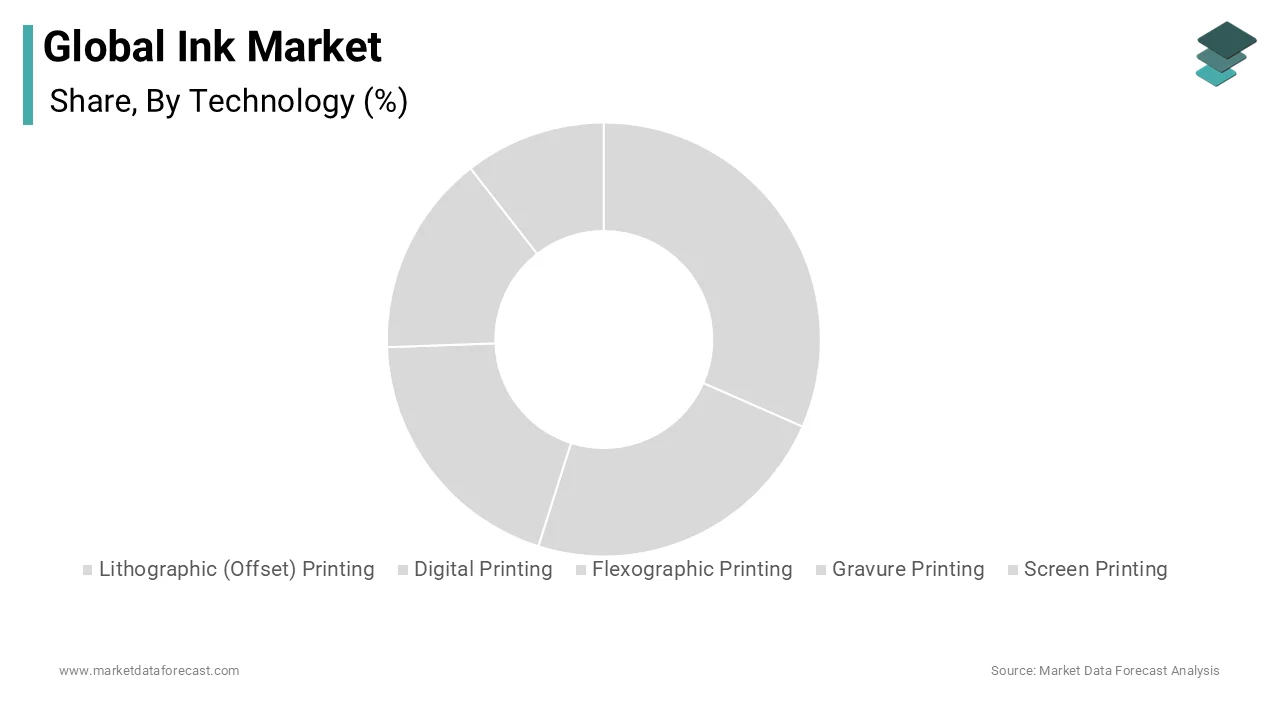
The digital printing segment is anticipated to witness the fastest CAGR of 9.4% from 2026 to 2034. The rising demand for short-run, personalized, and on-demand printing, particularly in packaging and commercial applications, has significantly contributed to the expansion of the digital printing segment. The shift away from mass production toward customized consumer engagement has elevated digital inkjet and toner-based systems. As per research, global digital press installations surpassed a notable number of units, with label and flexible packaging printers representing a portion of new deployments. The ability to vary text, images, and barcodes on every print unit without plate changes offers unmatched agility.
By Ink Type Insights
The solvent-based ink segment was the largest in the ink market by accounting for 36.7% share of the global market. The growth of the solvent-based ink segment is propelled by flexible packaging and outdoor signage, where resistance to moisture, abrasion, and UV degradation is paramount. Solvent inks remain irreplaceable in applications requiring rapid drying on non-porous substrates such as polyethylene and polypropylene films despite environmental concerns. According to research, millions of tons of flexible plastic packaging were produced, much of it printed using solvent-based flexographic inks due to their superior adhesion and rub resistance. These films do not absorb water or oils, rendering water-based or oil-based inks ineffective without corona treatment. Solvent-based formulations penetrate the surface microscopically, which creates a mechanical bond that resists delamination.
The water-based ink segment is set to be the fastest-growing segment with a CAGR of 7.9% during the forecast period. Tightening environmental regulations and corporate sustainability commitments, especially in North America and Europe, are the factors contributing to the growth ofthe water-based ink segment in the global market..Water-based inks emit negligible volatile organic compounds (VOCs), aligning with air quality standards such as the U.S. Clean Air Act and the EU’s Industrial Emissions Directive. As per research, the adoption of water-based formulations in the printing sector contributed to a reduction in VOC emissions from industrial sources. Another accelerating factor is the expansion of water-based inkjet inks in digital textile and corrugated printing, which is another accelerating factor in this segment.
By Application Insights
The label and packaging application segment dominated the ink market and accounted for 42.5% of the global market share in 2025. The relentless growth of consumer goods, pharmaceuticals, and food and beverage industries, all of which require durable, visually compelling, and compliant labelling, is largely driving the growth of the label and packaging application segment in the global market. The shift toward flexible packaging, lightweight, resealable, and shelf-attractive packaging has intensified ink demand per unit area. The increasing complexity of packaging design and regulatory labeling, particularly in pharmaceuticals and food, also propels the prominence of this segment. According to the study, a portion of pharmaceutical labels now incorporates multi-layer ink systems for security and traceability.
The commercial printing segment is expected to lead the ink market with a CAGR of 6.7% from 2025 to 203,3 owing to a renewed emphasis on high-value, short-run print for branding, direct mail, and experiential marketing. Physical print retains higher engagement despite digital media dominance. This effectiveness drives demand for premium inks in brochures, invitations, and point-of-sale materials. The integration of augmented reality (AR) and QR-coded print materials, which rely on precise ink deposition for scannability and aesthetic integration, further boosts the expansion of this segment. These hybrid campaigns bridge physical and digital experiences, increasing ROI for advertisers.
REGIONAL ANALYSIS
Asia-Pacific Ink Market Insights

Asia-Pacific led the ink market and captured 41.7% of the global market share in 2025. China, India, and Southeast Asian nations collectively drive this dominance through rapid industrialization, urbanization, and a burgeoning middle class. The region is home to the world’s largest flexible packaging manufacturing base, with China producing millions of tons annually, as per research. Moreover, India’s print and packaging sector is expanding every year. It is fueled by government initiatives like Make in India and rising e-commerce penetration. The growth is further amplified by the localization of ink production and rising investments in digital printing infrastructure. As per the study, domestic ink output in Southeast Asia grew, with Vietnam and Indonesia emerging as new hubs.
Europe Ink Market Insights
Europe is closely following the ink market with a 23.5% share in 2025due to its advanced regulatory framework, technological sophistication, and dominance in sustainable ink innovation. Germany, Italy, and France are key contributors, hosting major printing press manufacturers and ink formulators. The European packaging industry relies heavily on high-performance inks for food-safe and recyclable materials, as per research. Its pioneering role in reducing environmental impact through VOC regulation and circular economy policies also drives the growth of Europe. The EU’s Green Deal and Packaging and Packaging Waste Regulation (PPWR) mandate that all packaging be reusable or recyclable by 2030, directly influencing ink formulation.
North America Ink Market Insights
North America expanded steadily in the ink market. The United States dominates the regional market, supported by a resilient commercial printing sector, stringent food safety standards, and dominance in printed electronics. The U.S. packaging landscape witnessed a surge, with inks playing a role in labeling and branding compliance. Its robust adoption of smart packaging and anti-counterfeiting technologies is a key factor supporting the rise of North America. As per the study, a portion of U.S. pharmaceutical packaging includes 2D barcodes printed with pigmented inks resistant to smudging and fading.
Latin America Ink Market Insights
Latin America grew consistently in the global ink market. Increasing foreign investment and modernization of printing infrastructure are mainly contributing to the growth of Latin America. Brazil leads the regional segment, supported by a diversified manufacturing base and growing domestic consumption. The country’s packaging industry grew, according to research, driven by demand in food, beverages, and personal care sectors. Argentina and Mexico also contribute significantly, particularly in flexible packaging and label printing.
Middle East & Africa Ink Market Insights
Middle East & Africa is anticipated to expand in the global ink market, with South Africa, the UAE, and Saudi Arabia leading regional demand. The market is characterized by uneven development, with Gulf nations exhibiting advanced printing capabilities while sub-Saharan Africa relies on basic offset and screen printing. However, urbanization and rising consumerism are driving growth, particularly in packaging for imported and locally produced goods. The expansion of organized retail and cold-chain logistics, which require durable labeling for temperature-sensitive products, is a significant driver in the Middle East & Africa market.
COMPETITIVE LANDSCAPE
KEY MARKET PLAYERS
Some of the prominent companies in the global Ink market
- Sun Chemical
- Flint Group
- Siegwerk Druckfarben
- Toyo Ink SC Holdings Co., Ltd.
- Sakata Inx Corporation
- Huber Group
- DIC Corporation
- T&K Toka Co., Ltd.
- Wikoff Color Corporation
- HP Inc.
TOP STRATEGIES USED BY THE KEY MARKET PARTICIPANTS
Key players in the ink market are prioritizing innovation through R&D investment, particularly in sustainable and functional ink formulations. Companies are increasingly adopting vertical integration to secure raw material supply and reduce dependency on volatile global markets. Strategic partnerships with printing equipment manufacturers enable co-development of optimized ink systems for digital and industrial applications. Expansion into high-growth regions, especially Asia-Pacific, is being accelerated through local production and technical support centers. Mergers and acquisitions are being leveraged to gain access to niche technologies such as conductive inks and anti-counterfeiting solutions. Besides, compliance with environmental regulations is driving product reformulation, with a shift toward bio-based, low-VOC, and recyclable inks. Digital transformation initiatives, including AI-driven color matching and predictive ink performance modeling, are enhancing customer service and operational efficiency across the value chain.
COMPETITION OVERVIEW
The competition in the ink market is intensifying as global players contend with regional specialists and emerging local manufacturers in high-growth economies. Technological differentiation has become an important battleground, with leaders investing heavily in R&D to develop sustainable, high-performance, and functional inks. Smaller innovators are gaining traction through niche applications in digital printing and smart packaging, while established firms leverage brand reputation, global supply chain,s and regulatory expertise. Price burden from commoditized segments pushes major companies toward value-added solutions, including customized formulations and technical support services. The rise of environmental regulations across Europe and Asia is reshaping competitive dynamics, which favours those with early-mover advantages in eco-friendly inks. Furthermore, digital printing’s expansion is altering market entry barriers by enabling agile players to capture short-run and on-demand segments.
TOP LEADING PLAYERS IN THE INK MARKET
Sun Chemical
Sun Chemical is a dominant force in the global ink market, with deep integration across the Asia-Pacific region through localized manufacturing and R&D centers in Japan, India, and Singapore. The company has intensified its focus on sustainable ink solutions, launching bio-based pigment dispersions and low-migration inks tailored for food packaging compliance. It collaborates closely with Asian converters and brand owners to develop regulatory-compliant inks aligned with EU and domestic safety standards. Its investment in digital inkjet technology, including partnerships with OEMs for industrial print systems, strengthens its technological prowess in high-performance applications across packaging and electronics.
Toyo Ink Group
Toyo Ink Group maintains a formidable presence in Asia-Pacific, leveraging its Japanese roots and extensive regional footprint spanning China, Thailand, and South Korea. The company has pioneered advancements in functional inks, particularly for printed electronics and RFID tags, with production facilities dedicated to conductive silver and carbon inks. It has also strengthened supply chain resilience by regionalizing raw material sourcing to mitigate global disruptions. Toyo Ink continues to drive innovation in high-value ink applications through strategic collaborations with packaging manufacturers and electronics firmsh positioning itself at the forefront of next-generation printing technologies in the region.
DIC Corporation
DIC Corporation is one of the most vertically integrated players in the Asia-Pacific ink landscape, operating a vast network of production sites and technical centers across Southeast Asia and China. The company emphasizes sustainability and regulatory alignment, having introduced a series of water-based gravure inks that meet stringent VOC limits in Japan and South Korea. It has also expanded its digital ink portfolio, partnering with regional press manufacturers to optimize ink-substrate compatibility. DIC is strengthening its role as a solutions provider rather than just a material supplier by aligning with circular economy goals and investing in next-generation pigment technologies, which enhances its relevance in evolving packaging and industrial print markets.
MARKET SEGMENTATION
This research report on the Global Ink Market is segmented and sub-segmented into the following categories.
By Technology
- Lithographic (Offset) Printing
- Digital Printing
- Flexographic Printing
- Gravure Printing
- Screen Printing
- Others
By Ink Type
- Solvent-Based Inks
- Water-Based Inks
- UV-Curable Inks
- Others
By Application
- Label & Packaging
- Commercial Printing
- Publications
- Textiles
- Others
By Region
- Asia Pacific
- North America
- Europe
- Latin America
- Middle East & Africa