- Product Description Description
- Table of Contents TOC
- List of Table & Figure LOT
- Get Free Sample PDF Sample PDF
Market Size, 2025
$2.45 BnMarket Estimate, 2026
$3.04 BnMarket Forecast, 2034
$17.06 BnCAGR, 2026–2034
24.06%Executive Summary: Europe Print on Demand Market
- Market Scope: European market analysis covering platform types, product categories, digital infrastructure metrics, and country-level landscapes.
- Market Valuation: Valued at USD 2.45 billion (2025), estimated at USD 3.04 billion (2026), and projected to reach USD 17.06 billion by 2034, growing at a strong CAGR of 24.06% (2026–2034).
- Primary Growth Drivers: High consumer personalization trends, digital commerce expansion (94% of EU households with internet access and 72% buying online in 2025), localized fulfillment, and sustainable low-waste production models. Approximately two-thirds of Europeans possess at least basic digital skills.
Key Market Segment Metrics (2026–2034)
| Category | Leading Segment (2025 Position) | Fastest-Growing Segment |
|---|---|---|
| By Platform | Software (55.8% of regional market) | Services (12.44% CAGR) |
| By Product | Apparel (57.4% European market share) | Home Décor (13.7% CAGR) |
| By Country / Region | Germany (23.9% share; United Kingdom second; Sweden e-commerce at SEK 140B in 2025) | — |
Major Market Players & Market Structure
Market Structure: Highly dynamic competitive landscape centering on localized production hubs, seamless e-commerce platform integrations, AI-enabled design generation, environmental sustainability, high delivery speed, and strict regulatory compliance.
Key Companies: Redbubble, Teelaunch, Gooten, Gelato, CustomCat, Printify, Zazzle, Printful, Cimpress PLC, and Canva.
Europe Print on Demand Market Size
The Europe print-on-demand market size was valued at USD 2.45 billion in 2025 and is projected to reach USD 17.06 billion by 2034 from USD 3.04 billion in 2026, growing at a CAGR of 24.06%.
Print on demand refers to a digitally enabled production model wherein products such as apparel, books and home décor items are manufactured only after an order is placed,, ed thereby eliminating inventory holding and minimising waste. This market has evolved alongside advancements in digital printing automation and cloud-based design platforms, enabling rapid customisation and localised fulfilment. The strong digital infrastructure of the European Union supports this on-demand ecosystem, with 94% of households having internet access in 2025. Additionally, 72% of EU internet users ordered or bought goods or services online in 2025, which reflects robust digital commerce adoption relevant to personalised offerings. The cultural diversity across European nations further fuels demand for niche and region-specific designs. Sustainability regulations such as the EU Circular Economy Action Plan also align with the low-waste nature of print-on-demand, which is reinforcing its adoption among eco-conscious brands and consumers alike. This convergence of digital accessibility, consumer preference and regulatory alignment positions Europe as a strategically significant region for the global print-on-demand market.
MARKET DRIVERS
Rising Consumer Demand for Personalisation and Customisation
The European consumer landscape is undergoing a definitive shift toward individualised experiences, with personalisation now considered a baseline expectation rather than a luxury, which is a key factor driving the print-on-demand market growth in Europe. For instance, many consumers across Germany, France and the United Kingdom actively seek products that reflect their personal identity or values. This behavioural shift is particularly pronounced among millennials and Gen Z, who are significant drivers of online buying in Europe. The print-on-demand model caters precisely to this sentiment by enabling real-time design adjustments and bespoke outputs without incurring upfront production costs. E-commerce platforms integrated with customizable design interfaces have amplified this trend, with the European custom t-shirt printing market expected to grow at a CAGR of 10.1% from 2025 to 2030 and the broader European custom apparel market projected at a CAGR of 7.22% from 2025 to 2032. The demand is further reinforced by the region’s digital skills base, wth roughly two-thirds of Europeans having at least basic digital skills, which is enabling seamless interaction with design tools. As personalisation becomes synonymous with relevance in European retail, print-on-demand in Europe benefits from its inherent agility in delivering one-off or limited-run products that align with consumers’ evolving aesthetic and ethical preferences.
Growth of Sustainable Consumption and Circular Economy Policies
Environmental consciousness is deeply embedded in European consumer and regulatory frameworks, directly benefiting low-waste business models like print-on-demand, which is further contributing to the print-on-demand market growth in Europe. According to the European Environment Agency, textile waste in the EU is measured in millions of metric tons annually, with low recycling rates, which has intensified public and policy-level scrutiny on fast fashion and mass production in 2025. Print on demand inherently mitigates overproduction by manufacturing only what is sold, thereby aligning with the EU’s Green Deal objectives. The European Commission’s Strategy for Sustainable and Circular Textiles, launched in 2022, explicitly encourages on-demand manufacturing as a pathway to reduce carbon and water footprints. Consequently, brands adopting sustainable practices are gaining consumer trust, with Eurobarometer surveys indicating that a majority of EU citizens prefer purchasing from companies demonstrating environmental responsibility. Print on demand service providers that utilise certified, eco-friendly inks and organic substrates, such as GOTS certified cotton,,n are particularly well positioned to capture this demand. Germany and the Netherlands have seen a notable rise in micro brands leveraging localised print-on-demand hubs to minimise logistics emissions, further embedding sustainability into the supply chain. This policy creates consumer and operational synergy, creating a fertile ground for market expansion rooted in environmental accountability.
MARKET RESTRAINTS
Logistical Fragmentation Across European Markets
Despite a unified economic framework, Europe remains a complex mosaic of national regulations, languages and consumer expectations, and this presents significant logistical hurdles for print on demand operators, which is a primary restraint for the European print on demand market. The European Union comprises 27 member states,,s each with distinct import rules, packaging requirements and labelling standards, particularly for textiles and consumer goods. According to the World Bank’s Logistics Performance Index, several European countries rank in the global top ten for supply chain efficiency, while performance varies across the region, which indicates the infrastructure disparities. Cross-border fulfilment often incurs unexpected customs delays and VAT complications, with the European Commission acknowledging that micro businesses face disproportionate administrative burdens when selling across borders. For instance, pra int-on-demandnd startup based in Spain fulfilling an order to Poland may face varying textile labelling laws and e-commerce consumer return policies that differ by jurisdiction. These inconsistencies increase operational costs and delivery times, thereby eroding the speed advantage central to the print-on-demand model. As per the surveys in 2023, many small digital retailers cite cross-border logistics as a primary barrier to scaling across the EU. Without harmonised last-mile delivery networks and standardised digital customs protocols, the scalability of print-on-demand services remains constrained by Europe’s regulatory fragmentation.
Limited Economies of Scale for Small Producers
The inherent nature of print on demand emphasises low volume, high variety production, inherently restricting cost advantages typically associated with mass manufacturing, which is further hampering the growth of the European print on demand market. Unlike traditional printingwhich benefits from bulk material procurement and repetitive setup processes, print on demand relies on per-unit processing that inflates material and labour costs. Print-on-demand setups typically have higher per-unit costs compared to conventional bulk runs, which creates pricing challenges in more price-sensitive markets like Southern and Eastern Europe, where disposable income for discretionary items remains constrained. According to Eurostat data, significant disparities in household expenditure on non-essential goods across EU member states with lower spending levels in countries such as Romania and Bulgaria compared to Germany or Sweden, which is limiting market penetration. Furthermore, investments in industrial-grade digital printers capable of high-fidelity output remain capital-intensive, with entry-level direct-to-garment machines often costing tens of thousands of euros. Small creative entrepreneurs who form the backbone of the print-on-demand ecosystem often lack access to such capital or volume guarantees to justify such investments. Consequently, many rely on third-party fulfilment partners that reduce profit margins and brand control. This structural limitation impedes the financial sustainability of independent creators and curbs the market’s potential for organic grassroots growth.
MARKET OPPORTUNITIES
Integration of Artificial Intelligence in Design and Fulfilment
The convergence of artificial intelligence and digital printing technologies is unlocking unprecedented opportunities for predictive customisation and operational efficiency in the European print-on-demand market. Leading platforms are deploying generative AI tools that analyse social media trends and regional design preferences to suggest real-time product customisations. AI-driven design assistants are increasingly being used to enhance personalisation on European e-commerce sites, which is helping reduce customer drop-off rates and improve engagement. Moreover, machine learning algorithms are being applied to forecast micro trends at the city level, which is enabling hyper-localised inventory-free production. For example, a brand in Berlin can anticipate rising demand for minimalist Nordic patterns in Copenhagen based on aggregated search and engagement data. Concurrently AI AI-powered print management systems are optimising ink usage and reducing waste, with companies like Kornit Digital reporting material savings through intelligent print path algorithms. The European Union’s investment in AI under the Horizon Europe program, which allocated billions of euros in 2023 to creative industry digitisation, which is further accelerates this integration. As these technologies mature, they lower the technical barrier for designers and enhance consumer relevance, thereby expanding botsupply-sided capabilities and demand-side engagement in the print on demand ecosystem.
Expansion of Localised Micro Fulfilment Networks
The strategic deployment of small-scale localised printing hubs across Europe is emerging as a key growth vector by drastically reducing delivery times and carbon footprints, which is another promising opportunity for the European print-on-demand market. Unlike centralised production models, micro fulfilment centres situated within urban logistics zones enable same-week or even same-day delivery for custom products. European consumers increasingly expect faster delivery for personalised goods, with surveys showing strong demand for fulfilment within a few days. Companies like Gelato and Contrado have responded by establishing printing nodes in major cities, including Paris, Milan and Warsaw, which is creating a distributed manufacturing grid. This model not only meets consumer expectations but also aligns with municipal sustainability mandates such as Paris’s Low Emission Zone regulations, ns, which penalise high-mileage freight. The European Commission’s Urban Mobility Framework further incentivises last-mile solutions that minimise vehicle movementswhich localised printing inherently supports. Additionally, these hubs foster regional creative economies by enabling local artists and designers to monetise their work without managing logistics. Pilot initiatives in European cities have reported notable increases in sales for neighbourhood designers after integrating with city-based print-on-demand networks. As urban planning and consumer behaviour converge around proximity-based commerce, the proliferation of micro fulfilment infrastructure offers a scalable and sustainable pathway for market deepening across Europe.
MARKET CHALLENGES
Intensifying Competition from Vertically Integrated Fast Fashion Brands
The rapid entry of global fast fashion giants into the customisation space poses a significant competitive threat to independent print-on-demand operators, which is a significant challenge to the growth of the European print-on-demand market. Brands such as Zara and H&M have launched in-house personalisation studios in key European cities, leveraging their existing supply chains and brand equity to offer custom-printed apparel at scale. Vertically integrated fashion retailers can often price custom items lower than standalone print-on-demand services due to bulk material contracts and captive retail traffic. Major brands are increasingly embedding customisation into their flagship stores with in-store kiosks and digital interfaces, driving a growing share of sales. This competitive pressure is exacerbated by consumer loyalty, with surveys indicating that younger European shoppers frequently prefer to customise products within familiar brand ecosystems rather than explore independent platforms. The threat is not merely price-based but also experiential as fast fashion retailers embed customisation into seamless omnichannel journeys that include AR try-ons and same-day pickup. For niche print-on-demand providers lacking comparable footfall or marketing budgets, this encroachment narrows their differentiation to ethical or artisanal positioning that appeals to a smaller demographic. Without strategic alliances or technological differentiation, the independent segment risks marginalisation in an increasingly consolidated custom retail landscape.
Data Privacy and Intellectual Property Vulnerabilities
The digital nature of print-on-demand exposes both creators and platforms to escalating risks related to design theft and consumer data misuse governed by Europe’s stringent regulatory environment, which is further challenging the print-on-demand market expansion in Europe. Under the General Data Protection Regulation, any breach involving customer design uploads or personalisation preferences can incur fines up to 4% of global turnover. Simultaneously, the ease of digital replication makes original artwork highly susceptible to unauthorised reuse, with the European Union Intellectual Property Office noting that design infringement remains a significant challenge for independent creators. Unlike physical goods, digital design files can be duplicated infinitely with minimal traceability, especially when processed through third-party printing partners who may lack robust digital rights management protocols. Furthermore, the rise of AI-generated designs introduces legal ambiguity regarding authorship and copyright ownership under current EU directives. The absence of standardised watermarking or blockchain-based provenance tracking across the fragmented European print-on-demand ecosystem compounds these vulnerabilities. Designers often hesitate to upload high-resolution work, fearing exposure, while consumers remain wary of platforms that cannot guarantee data sovereignty. Until cohesive technical and legal frameworks for digital creative assets are implemented, this dual vulnerability will constrain innovation and trust, both critical for market maturity.
REPORT COVERAGE
| REPORT METRIC | DETAILS |
| Market Size Available | 2025 to 2034 |
| Base Year | 2025 |
| Forecast Period | 2026 to 2034 |
| CAGR | 24.06% |
| Segments Covered | By Platform, Product, and Region |
| Various Analyses Covered | Global, Regional, & Country Level Analysis; Segment-Level Analysis; DROC, PESTLE Analysis; Porter’s Five Forces Analysis; Competitive Landscape; Analyst Overview of Investment Opportunities |
| Regions Covered | UK, France, Spain, Germany, Italy, Russia, Sweden, Denmark, Switzerland, Netherlands, Turkey, and the Czech Republic |
| Market Leaders Profiled | Redbubble, Teelaunch, Gooten, Gelato, CustomCat, Printify, Zazzle, Printful, Cimpress PLC, and Canva |
SEGMENTAL ANALYSIS
By Platform Insights
The software segment dominated the market and accounted for 55.8% of the regional market share in 2025. The software segment’s dominance is primarily driven by its role as the foundational enabler of end-to-end print on demand operations, in integrating design tools e e-commerce connectivity, automated order routing and production management into unified platforms. This integrated functionality has become indispensable for both established brands and micro entrepreneurs seeking scalable and low-friction market entry. Cloud-based software platforms have become the operational backbone of the print-on-demand market by offering seamless interoperability with major e-commerce channels such as Shopify, Etsy, and Amazon. As per a 2025 survey, the majority of European digital micro businesses rely on cloud-hosted software for daily operations, which indicates the critical dependency on SaaS solutions. Platforms like Printful and Gelato provide API driven plug-ins that automate inventory synchronisation, order fulfilment and real-time pricing, which reduces manual intervention and errors. The European Commission’s Digital Europe Programme has further accelerated adoption by funding interoperability standards that ensure plug-and-play compatibility across platforms. Additionally, the shift toward headless commerce architectures wherein front-end customer experiences are decoupled from back-end fulfilment logic has increased demand for modular software solutions. For instance, many new print-on-demand startups in the EU launched in 202that 4 that used fully cloud-based software stacks. This structural reliance on digital infrastructure is primarily propelling the dominance of the software segment in the European market.
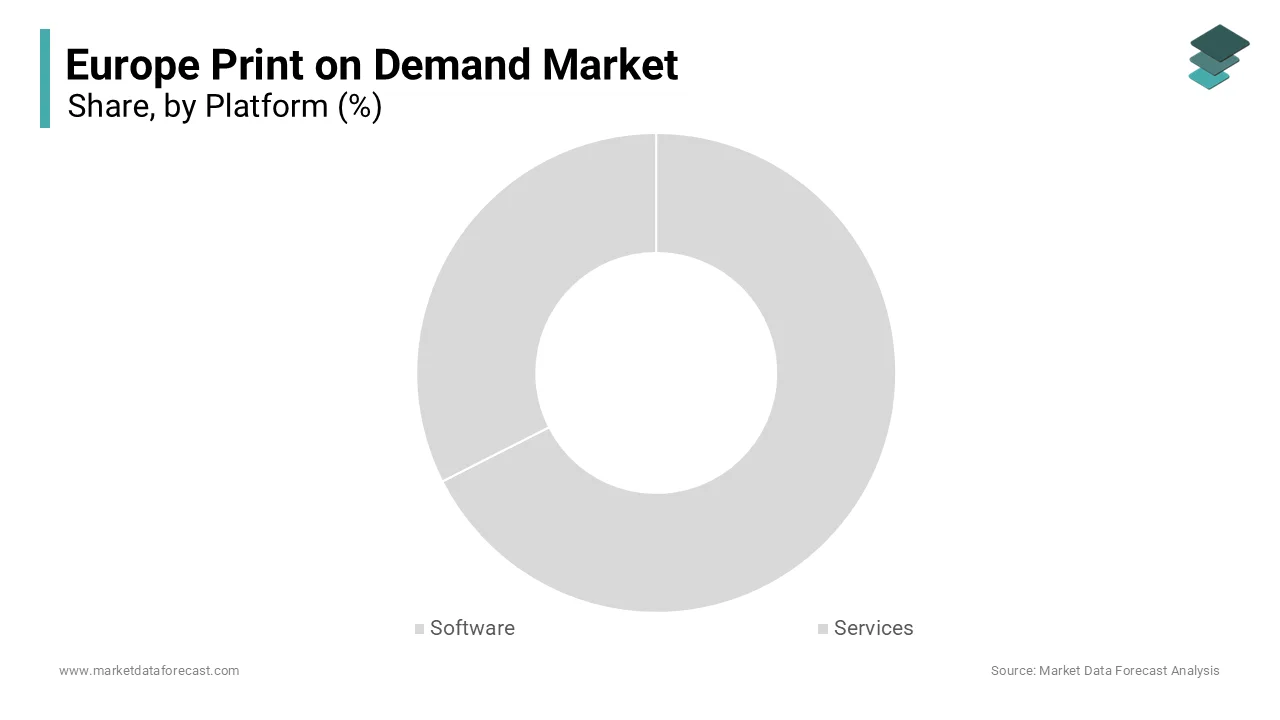
The services segment is expected to exhibit the fastest CAGR of 12.44% over the forecast period in the European print-on-demand market. The rising demand for end-to-end managed solutions among non-technical entrepreneurs and legacy brands transitioning to digital customisation is propelling the growth of the services segment in the European market. As the creator economy expands across Europe, a growing cohort of content creators, influencers, and small retailers lacks the operational capacity to manage printing, packaging and logistics. This gap is being filled by value-added service providers offering integrated services where ppproductshipped under the client’s brand identity. Many social media-based sellers in France and Italy outsource fulfilment activities, including custom packaging, branded inserts and gift wrapping, which enhance perceived value. The Netherlands has emerged as a hub for such services with numerous specialised fulfilment centres catering to pan-European clients. The ability to deliver premium unboxing experiences without capital investment makes service-based models highly attractive, particularly for seasonal or campaign-driven sellers, and these factors are majorly driving the growth of the services segment in the European market.
By Product Insights
The apparel segment remains the dominant product category in the European print-on-demand market by capturing 57.4% of the European print-on-demand market share in 2025. The growth of the apparel segment in the European market is attributed to its cultural resonance, high repeat purchase potential, and alignment with self-expression trends across age groups. Apparel serves as a primary canvas for personal and group identity in Europe, with custom t-shirts, hoodies, and sportswear widely used to signal affiliation,,s beliefs and aesthetics. For instance, a significant share of young Europeans aged 16 to 34 have purchased or gifted a custom-printed garment in the past year. Music festivals, team sports and university communities drive recurring demand with event-specific designs generating bulk micro-orders. In the United Kingdom, fan merchandise for local football clubs printed on demand has seen notable growth, which reflects rising consumer interest in personalised sports apparel. Additionally, the rise of body positivity and size-inclusive fashion has expanded addressable audiences as print-on-demand eliminates minimum order quantities that traditionally excluded niche sizing. Brands like Contrado and OYOY in Scandinavia report that a substantial portion of their apparel sales now cater to non-standard sizes. This social functionality, combined with low barriers to design, is majorly driving the dominance of the apparel segment in the European market.
The home decor segment is the fastest-growing product category in the European print-on-demand market with a projected CAGR of 13.7% over the forecast period, owing to post-pandemic lifestyle shifts and the integration of interior design into digital social culture. The normalisation of hybrid work has intensified demand for personalised home environments, with consumers investing in custom wall art, throw pillows, and bedding that reflect individual taste. Many households in Western Europe have renovated or redecorated their home offices in recent years. Social media platforms like Pinterest and Instagram amplify trends with algorithm-driven inspiration, leading to spikes in region-specific design requests, such as Scandinavian minimalism in Sweden or Mediterranean motifs in Southern Europe. In France, a significant share of interior design-related print-on-demand purchases has been influenced by influencer content. The ability to produce one-off art prints on archival paper or custom photo blankets enables emotional personalisation that mass retailers cannot replicate. This convergence of functional need and aesthetic aspiration fuels the rapid expansion of the home decor segment in the European market.
REGIONAL ANALYSIS
Germany Market Analysis
Germany dominated the print-on-demand market in Europe by holding 23.9% of the regional market share in 2025. The leading position of Germany in the European market is attributed to its robust engineering base, e-commerce adoption, and stringent sustainability standards that align with print-on-demand’s low-waste model. A large share of German online retailers offer customisation options, which reflects deep market integration. The presence of industrial printing equipment manufacturers like KBA and Durst provides access to cutting-edge technology, while vocational training programs ensure a skilled workforce in digital textile finishing. Additionally, Germany’s dual system of vocational education produces thousands of printing technicians annually who are fluent in both analogue and digital workflows. Regulatory alignment further accelerates adoption with the German government’s National Action Plan for Circular Economy, mandating reduced overproduction in fashion. Berlin and Munich have emerged as innovation clusters where startups collaborate with Fraunhofer institutes on oAI-driAI-driven pproductionC.onsumer behaviour also supports growth, with surveys showing that many Germans prioritise locally produced custom goods. This ecosystem of technology, policy and consumer preference is contributing to the top position of Germany in the European print on demand market.
United Kingdom Market Analysis
The United Kingdom captured the second-largest share of the European print-on-demand market in 2025. The vibrant, creative economy supported by world-class design education and a mature digital retail landscape is propelling the print-on-demand market growth in the UK. Over 90% of UK households shopped online in 2025, with custom merchandise representing a growing share of discretionary spending. London serves as a launchpad for designer-led print-on-demand brands, many of which originate from institutions like Central Saint Martins and the Royal College of Art. The UK’s departure from the EU has paradoxically boosted local production as brands seek to avoid cross-border complexities, which is favouring domestic print networks. Companies like Zippi and Awesome Merch have scaled rapidly by offering same-week UK-wide delivery. Moreover, the British public shows high receptivity to personalisation, with surveys indicating that a majority of adults purchased a custom gift in the past year. The integration of print-on-demand into music, entertainment and sports fandom further drives volume, with Premier League fan gear accounting for significant seasonal spikes. Despite regulatory divergence, the UK remains a dynamic and innovation-led market.
France Market Analysis
France is anticipated to hold a prominent share of the European print on demand market during the forecast period, owing to the country’s deep-rooted appreciation for a, rt and artisanal craftsmanship creates fertile ground for personalised products. French consumers exhibit a strong preference for unique, aesthetically refined items, with surveys showing that many associate custom-printed goods with higher quality. Paris remains a global fashion capital, and emerging designers increasingly use print on demand to test collections without inventory risk. The government’s “France Relance” recovery plan allocated significant funding to support digital transformation in creative industries, accelerating adoption among small studios. Additionally, French e-commerce law mandates clear labelling of production origin, which benefits print-on-demand and operators who emphasise made in France credentials. Regions like Lyon and Marseille have developed specialised textile printing clusters leveraging historical expertise in silk and fabric printing. Social trends also contribute to custom home decor inspired by French provincial and art deco styles, seeing strong growth in France. This cultural and policy alignment positions France as a premium segment leader.
Netherlands Market Analysis
The Netherlands is likely to account for a considerable share of the European print-on-demand market over the forecast period. The Netherlands has world-class logistics infrastructure and leadership in circular economy practices, which are favouring the print-on-demand market growth in the Netherlands. Amsterdam and Rotterdam have become pivotal distribution nodes for the European print-on-demand market, with the Randstad region hosting a majority of fulfilment centres thanks to its proximity to major markets and Schiphol Airport’s cargo facilities. The Dutch government’s Circular Economy Implementation Program, mandating that all textile products sold by 2026 must be recyclable or reusable, directly favours on-demand production models that minimise waste. A 2025 study by the Dutch Ministry of Infrastructure found that localised printing reduced last-mile emissions by up to fortycompared to centralised models, which is reinforcing sustainability benefits. Companies like Gelato and Printify have established European headquarters in the Netherlands to capitalise on this ecosystem. Dutch consumers further strengthen the market with high sustainability awareness, as surveys show that a majority actively avoid fast fashion. This convergence of progressive policy, efficient logistics and eco-conscious demand positions the Netherlands as a critical operational hub for the European print-on-demand industry.
Sweden Market Analysis
Sweden is projected to witness a notable CAGR in the European print-on-demand market during the forecast period. Sweden stands out for its early adoption of ethical consumption norms and high digital maturity. E-commerce in Sweden reached SEK 140 billion in net sales in 2025, which is marking a 5% increase from 2023. Globally, consumers are willing to pay on average 9.7% more for sustainably produced goods and in Sweden with surveys show strong interest in sustainable alternatives despite cost concerns. Swedish design principles emphasising minimalism, functionality and nature-inspired aesthetics align perfectly with print on demand’s customisation ethos. Stockholm has emerged as a hotspot for sustainable fashion tech startups, many of which integrate blockchain for material traceability. National initiatives like the Swedish Textile Strategy actively promote on-demand manufacturing to meet climate targets, with Sweden’s broader climate policy aiming for net-zero emissions by 2045. Additionally, Sweden’s public procurement policies favour suppliers with low environmental impact, giving local print-on-demand vendors a competitive edge in B2B segments. Educational institutions like Beckmans College of Design embed digital production into curricula, ensuring a pipeline of talent fluent in both design and technology. This forward-looking ecosystem ensures Sweden’s outsized influence despite its smaller population.
COMPETITIVE LANDSCAPE
KEY MARKET PLAYERS
Some of the notable key players in the European print-on-demand market are
- Redbubble
- teelaunch
- Gooten
- Gelato
- CustomCat
- Printify
- Zazzle
- Printful
- Cimpress PLC
- Canva
TOP STRATEGIES USED BY THE KEY MARKET PLAYERS
Key players in the European print-on-demand market consistently adopt strategies centred on localised production networks to reduce delivery times and carbon footprints. They invest heavily in cloud-based software that integrates seamlessly with major e-commerce platforms, enhancing user experience for merchants. Sustainability is a core pillar with firms obtaining eco certifications and using low-impact inks and materials to meet stringent EU regulations. Many players are embedding artificial intelligence to enable predictive design and automated order routing. Strategic partnerships with designers, influencers, and retail brands help expand reach and credibility. Additionally, ly companies prioritise compliance automation for VValabellinanddigital reporting under evolving EU directives to reduce friction for cross-border sellers.
 COMPETITION OVERVIEW
The European print-on-demand market features intense competition among global platforms, regional specialists, and emerging tech-enabled startups. Competition revolves not only around pricing but also speed of delivery, print quality, sustainability credentials and software usability. Large players leverage distributed manufacturing and deep e-commerce integrations to dominate scale, while niche operators differentiate through premium material,,s artisanal production or designer collaborations. Regulatory alignment with EU environmental and data laws has become a critical competitive parameter. The market is further shaped by the rising entry of vertically integrated fashion brands offering customisation in-house, which pressures independent platforms to innovate continuously. Barriers to entry remain moderate due to accessible cloud infrastructure, long-term success demands robust logistics partnerships, proprietary technology and deep trust around intellectual property protection. This dynamic landscape fosters rapid innovation but also consolidation.
TOP PLAYERS IN THE MARKET
- Gelato is a leading global print-on-demand platform headquartered in Norway with extensive operations across Europe. The company operates a distributed network of over one hundred local production partners across the continent, enabling fa,, st sustainable and localised fulfilment. Gelato has significantly contributed to the global market by pioneering cloud-based print automation that connects creators directly to local printers. In recent years, the company strengthened its position by integrating AI-driven design tools and expanding its product catalogue to include photo books and wall art. It also deepened partnerships with major e-commerce platforms like Shopify and WooCommerce to streamline merchant onboarding and has invested in carbon-neutral shipping across all European deliveries.
- Printful is a US-based but Europe-active print-on-demand provider with fulfilment centres in Latvia and Spain serving the entire region. It plays a pivotal role in the global ecosystem by offering seamless integration with over seventy e-commerce platforms and providing real-time mockup generation. To fortify its European presence, Printful launched a dedicated EU-based customer support team and enhanced its apparel offerings with certified sustainable fabrics. The company also introduced automated VAT handling for cross-border sales and rolled out solar-powered printing facilities in Riga. These initiatives support compliance, ease of use, and environmental responsibility,t y aligning with European consumer and regulatory expectations.
- Contrado is a UK-founded print-on-demand manufacturer known for its premium quality and designer-centric approach. It operates a vertically integrated production facility in London, ensuring tight control over print fidelity, material sourcing and delivery speed. Contrado contributes to the global market by emphasising artisanal craftsmanship with over three hundred unique substrates, including silk, ens and recycled textiles. Recently, the company launched a brand collaboration program, inviting independent European designers to co-create limited collections. It also enhanced its 3D room visualisation tool and achieved B Corp certification, reinforcing its commitment to ethical production and deepening its appeal among conscious consumers and luxury micro brands across Europe.
MARKET SEGMENTATION
This research report on the European print-on-demand market has been segmented and sub-segmented based on categories.
By Platform
- Software
- Services
By Product
- Apparel
- Home Decor
- Drinkware
- Accessories
- Others
By Country
- UK
- France
- Spain
- Germany
- Italy
- Russia
- Sweden
- Denmark
- Switzerland
- Netherlands
- Turkey
- Czech Republic
- Rest of Europe