- Product Description Description
- Table of Contents TOC
- List of Table & Figure LOT
- Get Free Sample PDF Sample PDF
Market Size, 2025
$3.58 BnMarket Estimate, 2026
$3.80 BnMarket Forecast, 2034
$6.10 BnCAGR, 2026–2034
6.09%Europe Online Art Market Report Summary
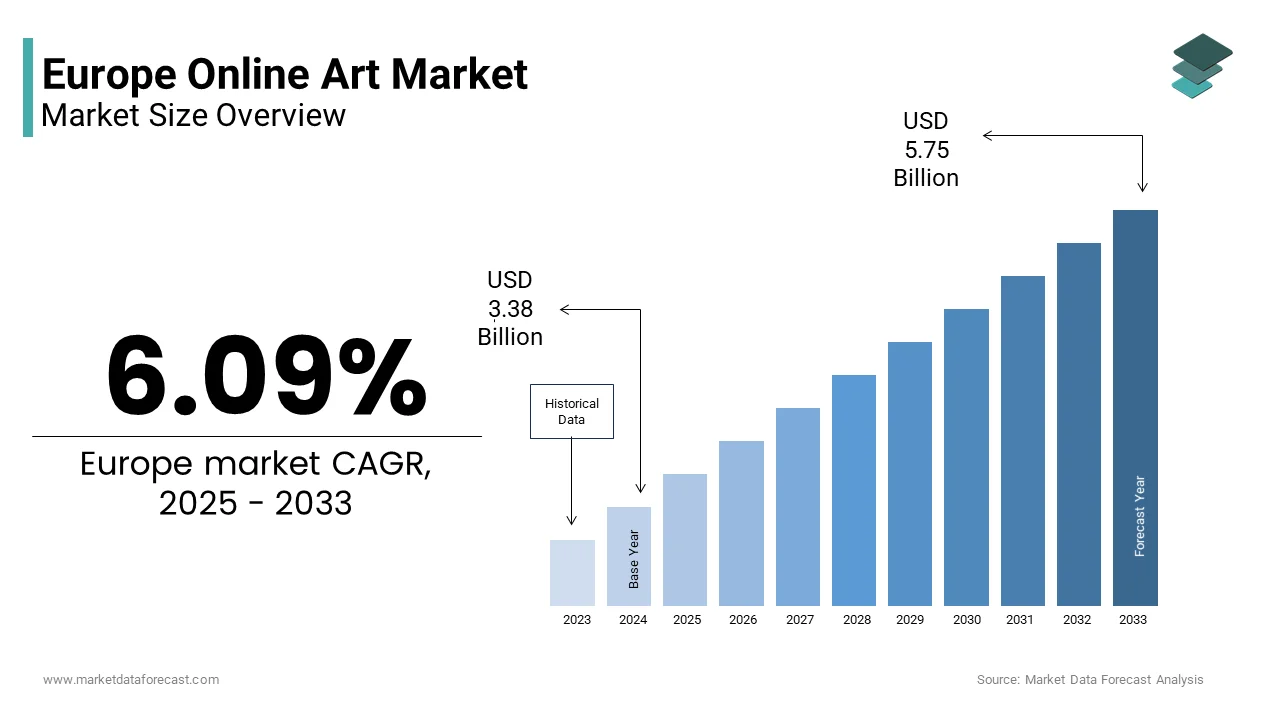
The European online art market was valued at USD 3.58 billion in 2025, is estimated to reach USD 3.80 billion in 2026, and is projected to reach USD 6.10 billion by 2034, growing at a CAGR of 6.09% during the forecast period. The growth of the European online art market is driven by the digital transformation of the art industry, increasing adoption of e-commerce platforms for art sales, and rising demand for accessible, authenticated, and curated digital art experiences. Furthermore, the pandemic-driven shift toward online exhibitions and virtual galleries has permanently accelerated online art transactions across the region.
Key Market Trends
- The growing popularity of online art platforms offering global exposure to artists and collectors.
- Expansion of blockchain and NFT technology to ensure authenticity and provenance tracking.
- Increasing participation of millennials and Gen Z buyers in digital art auctions and private sales.
- Integration of augmented and virtual reality tools for immersive online viewing experiences.
- The rising influence of social media and digital storytelling in promoting contemporary artists.
Segmental Insights
- Based on type, the paintings segment was the largest in the European online art market, accounting for 48.6% share in 2025. Paintings remain the most traded art form due to their enduring aesthetic value, strong collector base, and high resale potential through both digital and hybrid auctions.
- Based on end user, the domestic customers segment led the European online art market, capturing 63.1% share in 2025. The dominance of this segment is attributed to increased accessibility of online platforms, affordable pricing models, and the growing trend of home décor investment among European consumers seeking unique, locally produced artworks.
Regional Insights
The European online art market is evolving rapidly, supported by widespread digitalization and a strong network of art institutions and collectors.
- The United Kingdom was the top performer in the European online art market, accounting for 22.4% share in 2025, driven by its vibrant art ecosystem, established auction houses like Christie’s and Sotheby’s, and high online art trade volumes.
- France continues to hold a strong position, benefiting from its deep-rooted art culture, growing presence of online galleries, and government-backed digital art initiatives.
- Germany is witnessing increasing traction in contemporary and digital art sales through online channels, driven by a large tech-savvy audience and innovative digital marketplaces.
- Italy and Spain are emerging as fast-growing markets due to rising artist collaborations, local gallery digitization, and cross-border art commerce within the EU.
Competitive Landscape
The European online art market is moderately fragmented, characterized by the presence of established digital art marketplaces and niche online galleries catering to collectors and first-time buyers alike. Market participants are focusing on AI-powered personalization, secure payment systems, and transparent authentication processes to build trust and drive repeat purchases. Major companies operating in the Europe online art market include Artsper, Singulart, Artmajeur, Artfinder, and Artprice.
Europe Online Art Market Size
The Europe online art market size was valued at USD 3.58 billion in 2025 and is projected to reach USD 6.10 billion by 2034 from USD 3.80 billion in 2026, growing at a CAGR of 6.09%.
Online art refers to the digital ecosystem facilitating the discovery, purchase, and sale of original artworks, prints,,s a limited editions through e-commerce platforms, virtual galleries, nd auction websites. Unlike traditional brick and mortar channels, this market leverages high-resolution imaging, augmented reality provenance documentation, and secure transaction systems to replicate the gallery experience remotely. Europe’s rich cultural heritage and dense network of professional visual artists, as per studies, provide a robust supply base for digital platforms. The region hosts public museums and commercial galleries, according to sources, many of which have adopted hybrid sales models since 2020. Digital adoption accelerated during the pandemic. The European Union’s Digital Single Market strategy has further enabled cross-border transactions by harmonizing consumer rights and VAT rules for digital goods. This convergence of cultural depth, technological infrastructure, nd regulatory alignment positions the European online art market as a dynamic nexus of heritage and innovation.
MARKET DRIVERS
Digital Transformation of Cultural Institutions and Galleries
The systematic digitization of European museums and commercial galleries has significantly expanded online art accessibility and consumer confidence, which boosts the growth of the European online art market. According to studies, museums across Europe are increasingly expanding their digital commerce operations, offering online access to exclusive artworks, prints, and creative collaborations. According to sources, leading cultural institutions in countries such as the Netherlands and France are now generating a growing share of their retail income through online platforms integrated with their public outreach strategies. Commercial art galleries are also strengthening their digital presence by developing interactive virtual spaces and curator-led online experiences. European cultural programs continue to provide financial support for small and medium-sized enterprises that invest in digital transformation within the creative sector. This institutional shift not only broadens audience reach but also legitimizes online transactions by anchoring them in trusted cultural authority. Hence, this digital transition is improving accessibility while reinforcing institutional credibility and consumer confidence in art-related transactions.
Rise of Millennial and Gen Z Collectors Seeking Accessible Entry Points
Younger generations are reshaping art consumption patterns in the region by prioritizing affordability, digital convenience, nd social relevance over traditional investment criteria that bolsters the expansion of the European online art market. According to research, a portion of first-time buyers made their initial purchase online with notable spending per transaction. This cohort favors platforms that offer installment payments, augmented reality previews, nd artist storytelling features. Social media plays a catalytic role. Platforms like Saatchi Art and Artsy have responded by curating algorithm-driven feeds based on user aesthetics and regional preferences. This demographic transition from passive viewers to active digital collectors is creating a sustainable demand base that values immediacy, authenticity, and narrative over pedigree and provenance.
MARKET RESTRAINTS
Persistent Consumer Hesitation Around Authenticity and Condition Verification
Many European buyers remain reluctant to purchase high-value artworks online due to concerns about authenticity, condition, and accurate color representation, which impedes the growth of thEthe European art market. Unlike standardized goods, art is inherently unique and subjective, making digital mediation insufficient for high-stakes decisions. Also, platforms employ high-resolution imaging and blockchain certificates. The absence of EU-wide standardized return policies for art exacerbates risk perception, with cross-border purchases often subject to complex customs and VAT reclamation procedures. These trust deficits disproportionately affect mid-tier and emerging artists who lack institutional backing, making digital channels less effective for building collector confidence without physical touchpoints.
Fragmented Regulatory Framework for forCross-Borderr Art Transactions
A complex patchwork of national regulations governing cultural goods taxation and export controls hinders seamless cross-border commerce, which restrains the expansion of the European online art market. Implementation of cultural trade regulations across the European Union remains uneven, reflecting varying levels of policy alignment among member states, according to studies. Countries maintain strict export licensing requirements for artworks over 50 years old, which online platforms often cannot verify in real time. Value-added tax rates on art also vary significantly, which complicates price transparency and checkout experiences. Apart from these, the EU’s General Data Protection Regulation imposes stringent consent requirements for sharing buyer data with third-party shippers and insurers, increasing operational friction. This regulatory fragmentation contradicts the Digital Single Market vision and suppresses the scalability of pan-European art e-commerce despite high consumer interest.
MARKET OPPORTUNITIES
Integration of Augmented Reality and Virtual Viewing Rooms
The deployment of immersive technologies is transforming how European consumers experience art digitally by bridging the gap between physical presence and online convenience, which in turn creates new opportunities for the European online art market. Augmented reality applications now allow users to project life-size artworks onto their walls using smartphone cameras with accurate lighting and scale simulation. Platforms have pioneered virtual viewing rooms that replicate white cube gallery environments accessible via web browsers without specialized hardware. These technological enablers are redefining digital art engagement from transactional browsing to experiential immersion.
Growth of Artist Direct Platforms and Decentralized Marketplaces
The emergence of artist-led digital storefronts and blockchain-based marketplaces gives a structural possibility to democratize access and increase creator revenue share, and provides fresh opportunities for the European online art market. Platforms enable artists to manage their own inventory pricing and storytelling without gallery commissions, which traditionally vary. Blockchain technology further enhances this shift by enabling non-fungible tokens that authenticate digital and physical works while embedding resale royalty smart contracts. This creator-centric model aligns with European values of cultural diversity and fair remuneration, fostering a more equitable and resilient art ecosystem.
MARKET CHALLENGES
Logistical Complexities in Secure and Insured Art Shipping
The physical delivery of purchased artworks remains a vital barrier in the European online art market. This is due to the fragility, high value, and irregular dimensions of cultural goods. Unlike standardized parcels, art requires custom crating climate climate-controlled transport, and white glove handling, which significantly elevates shipping costs and insurance premiums. Cross-border shipments face additional delays at customs, where artworks may be subject to cultural heritage inspections, particularly when originating from countries like Greece or Italy with strict patrimony laws. Most small online galleries lack negotiated rates with specialized art logistics firms such as Crozier or Hasenkamp, forcing them to rely on general carriers ill-equipped for fine art handling. These logistical frictions disproportionately impact emerging artists whose works are often shipped uncrated to reduce costs, increasing breakage risk. Digital art's growth is limited by the logistics and costs of physical delivery, which will persist until the EU standardizes shipping and insurance.
Limited Digital Literacy Among Established Artists and Traditional Galleries
Insufficient digital skills and technological infrastructure continue to be a major challenge for the European online art market. Traditional galleries, particularly in Southern and Eastern Europe, often operate with legacy inventory systems incompatible with the digital marketplace, requiring manual data entry that deters online expansion. Language barriers further compound the issue, with artists in non-English speaking regions struggling to optimize multilingual product descriptions or navigate international payment gateways. Scheduling conflicts and limited outreach continue to result in low workshop uptake, despite initiatives like the Creative Europe Desk network. This digital divide not only excludes valuable artistic voices from the online ecosystem but also deprives collectors of diverse regional perspectives, thereby narrowing the cultural scope of Europe’s digital art landscape.
REPORT COVERAGE
| REPORT METRIC | DETAILS |
| Market Size Available | 2025 to 2034 |
| Base Year | 2025 |
| Forecast Period | 2026 to 2034 |
| CAGR | 6.09% |
| Segments Covered | By Type, End User, and Region |
| Various Analyses Covered | Global, Regional, & Country Level Analysis; Segment-Level Analysis; DROC; PESTLE Analysis; Porter’s Five Forces Analysis; Competitive Landscape; Analyst Overview of Investment Opportunities |
| Regions Covered | UK, France, Spain, Germany, Italy, Russia, Sweden, Denmark, Switzerland, Netherlands, Turkey, Czech Republic, Rest of Europe |
| Market Leaders Profiled | Artsper, Singulart, Artmajeur, Artfinder, Artprice, and others |
SEGMENTAL ANALYSIS
By Type Insights
The paintings segment was the largest segment of the European art market by accounting for a 48.6% share in 2025. The dominance of the paintings segment is driven by enduring cultural prestige, collector preference, and strong institutional validation. European collectors historically associate original paintings with artistic legacy and investment value more than other media. According to research, a share of high-net-worth collectors in the EU prioritize acquiring original paintings for both aesthetic and portfolio diversification purposes. National museums further reinforce this preference through curated online exhibitions that spotlight painting collections, thereby shaping public taste. Furthermore, the tactile and chromatic richness of paintings translates effectively through high-resolution imaging and color-calibrated displays now standard on premium devices. This convergence of cultural capital, technological fidelity, and collector psychology sustains paintings as the dominant online art category.
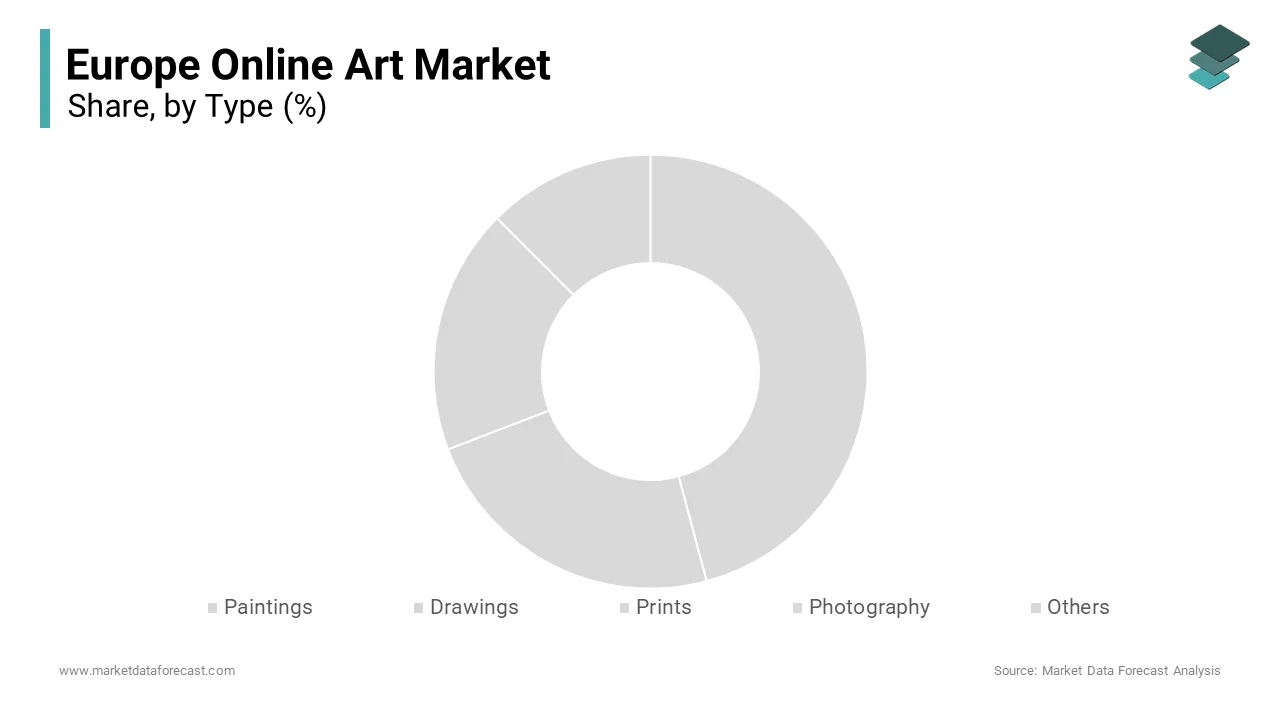
The photography segment is likely to experience the fastest CAGR of 12.3% from 2026 to 2034. The rapid expansion of the photography segment is led by its accessibility, thematic relevance, and seamless compatibility with digital display environments. Unlike paintings, photography is often produced in limited editions with transparent pricing, making it ideal for first-time online buyers. Social media has also normalized photographic aesthetics, with Instagram and Pinterest serving as discovery channels for emerging talents. Technological enablers further boost adoption as high-quality photo prints can be produced on demand with archival inks and shipped flat, reducing logistics costs and damage risk. Museums have launched successful online print sales programs. These factors position photography as the most dynamically expanding segment in the digital art marketplace.
By End User Insights
The domestic customers segment led the European online art market and captured a 63.1% share in 2025. The growth of the domestic customers segment is driven by cultural proximity, trust in local artists, and streamlined logistics. European buyers exhibit a strong preference for artworks that reflect regional aesthetics, historical narratives, or linguistic contexts. National platforms curate region-specific collections that resonate with domestic sensibilities and comply with local consumer protection laws. VAT harmonization within individual EU countries also simplifies pricing transparency with no cross-border tax complications. Apart from these, public funding for local artists through municipal grants and cultural councils increases the visibility and credibility of homegrown talent on digital platforms. This localized consumption pattern ensures domestic buyers remain the backbone of the online art economy.
The foreign customers segment is on the rise and is expected to be thefastest-growingg segment in the global market by witnessing a CAGR of 9.8% over the forecast period, owing to global interest in European artistic heritage, digital tourism, and cross-cultural collecting trends. International cultural tourism in Europe has shown a strong recovery, with visitors increasingly engaging in digital art purchases following physical museum experiences, according to studies. Online art marketplaces are witnessing rising participation from European galleries, many of which are expanding their sales reach to buyers in regions such as the United States and Asia, as per sources. Cross-border cultural exchange programs across the European Union are leveraging virtual platforms to strengthen connections between local artists and global collectors, according to studiesBlockchain-baseded provenance systems further reassure international buyers about authenticity and export compliance. These global linkages transform European online galleries into cultural export channels, amplifying reach beyond geographic boundaries.
REGIONAL ANALYSIS
United Kingdom Market Analysis
The United Kingdom was the top performer in the European online art market by accounted for 22.4% share in 2025. The prominence of the United Kingdom is primarily driven by its mature digital infrastructure, global collector base, and world-class art institutions. London remains a global art capital h,, hosting commercial galleries and major auction houses whose online platforms serve international clientele. The country’s high internet penetration rate enables seamless digital art discovery and acquisition. Educational institutions like the Royal College of Art and Goldsmiths foster digital literacy among artists who actively engage in online sales. Post Brexit, the UK has strengthened digital trade agreements with non-EU countries, facilitating cross-border art exports. Besides, platforms such as Rise Art and Artfinder originated in the UK and serve global markets while maintaining strong domestic roots. This blend of technological readiness, institutional strength, and entrepreneurial innovation ensures the UK’s continued leadership in Europe’s online art ecosystem.
Germany Market Analysis
Germany followed closely in the European online art market and accounted for 18an .8% share in 2025. The growth of Germany is because of its robust middle class, strong public arts funding, and engineering-driven approach to digital commerce. The country hosts publicly funded art museums and commercial galleries, many of which have adopted hybrid sales models. German consumers prioritize data privacy and secure transactions w,, which local platforms like Kunstmatrix address through GDPR compliant architectures and encrypted payment gateways. Furthermore, Germany’s central geographic location enables efficient logistics across Europe. This combination of public support, rt digital trust, and operational efficiency sustains Germany’s position as a core market for online art.
France Market Analysis
France is moving ahead consistently in the European online art market and is driven by its rich artistic legacy state state-backed cultural policies, and vibrant contemporary scene. National initiatives provided funds to support the digital transformation of small galleries. French collectors exhibit strong loyalty to domestic creators. Paris remains a global art hub, hosting FIAC and Paris Photo, whose digital extensions attract international traffic. The country’s strict cultural exception policy also protects local artists from undervaluation in global marketplaces. This state artist and collector alignment creates a resilient and culturally rooted online art market.
Netherlands Market Analysis
The Netherlands grew moderately in the European online art market, which was fueled by its progressive digital culture, strong design heritage, and international outlook. Amsterdam and Rotterdam serve as innovation hubs where galleries collaborate with tech startups on blockchain provenance and AR viewing tools. The country’s advanced logistics network ensures domestic art deliveries are completed within 24 hours, as per Statistics Netherlands. Platforms originated in the Netherlands and emphasize transparency with real-time bidding and artist revenue sharing. High English proficiency and open attitudes toward global art trends make Dutch consumers early adopters of cross-border online acquisitions. This forward-looking ecosystem positions the Netherlands as a digital art gateway in Northwestern Europe.
Italy Market Analysis
Italy is likely to grow in the European online art market owing to its unparalleled artistic heritage, contemporary design influence, and growing digital adoption among younger collectors. The country is home to commercial galleries and public museums, many of which launched e-commerce portals after the 2020 cultural closures, as per sources. Platforms like ArtRights and Exibart have gained traction by offering multilingual interfaces and VAVAT-inclusivericing services for international buyers. Italy’s strong fashion and furniture sectors also drive demand for decorative art. Regional authorities provide grants for digitizing small gallery inventories in cities like Florence and Bologna. Despite historical reliance on physical sales t,, he digital shift is accelerating. This blend of tradition and modernization secures Italy’s relevance in the evolving European online art landscape.
COMPETITIVE LANDSCAPE
KEY MARKET PLAYERS
Some of the notable key players in the European online art market are
- Artsper
- Singulart
- Artmajeur
- Artfinder
- Artprice
TOP STRATEGIES USED BY THE KEY MARKET PLAYERS
Key players in the European art market are investing heavily in augmented reality and high-resolution imaging to replicate in-person viewing experiences remotely. Companies are forming strategic alliances with museums, galleries, and art fairs to enhance credibility and expand curated inventory. Platforms are implementing multilingual interfaces, localized payment options, and GDPR compliant data practices to improve regional user trust. Firms are also offering artist-centric features such as direct messaging, transparent pricing, and revenue sharing to attract top creative talent. Apart from these, participants are adopting sustainable logistics, including carbon offset shipping and recyclable packaging, to align with European environmental values and consumer expectations.
COMPETITION OVERVIEW
The European online art market features a dynamic mix of global platforms, regional specialists, and artist-led marketplaces competing on curation, tchnolo,gy tr, and cultural relevance. Unlike standardie-commerceerce art transactions hinge on subjective value, provenance assurance, and emotional connection, making user experience and brand authenticity critical differentiators. Global players like Artsy and Saatchi Art leverage scale and institutional partnerships to dominate high-end segments, while European natives such as Singulart and Kunstmatrix focus on local artist representation and regulatory compliance. The barrier to entry remains moderate due to low infrastructure cost, yet scaling requires significant investment in logistics, cs authentication, and digital storytelling. Fragmentation persists as many small galleries operate independentlyonlinee stores resisting aggregation. Ho, consolidation is emerging through SaaS solutions that empower traditional dealers to digitize without surrendering brand identity.
TOP PLAYERS IN THE MARKET
- Saatchi Art is a leading global online art gallery headquartered in the United States with a strong operational presence across Europe. In Europe, Saatchi Art has localized its curation by region-specific collections from emerging talents in Berlin, Pari, and Barcelona. The company has strengthened its position by introducing augmented reality previews, secure international shipping, a dedicated concierge service, and high-value acquisitions. Recent enhancements include AI-driven art recommendations and multilingual customer support tailored to European markets. These initiatives reinforce Saatchi Art’s role as a bridge between global creators and European collectors seeking diverse and accessible fine art.
- Artsy operates as a premier digital marketplace linking collectors with galleries, museums, and auction houses worldwide, including prominent European institutions such as Hauser and Wirth and Galerie Perrotin. The platform provides in-depth artist profiles, auction results, ts, and editorial content that contextualize artworks within art historical narratives. In Europe, Artsy has deepened its footprint by partnering with major art fairs like Art Basel and Frieze to offer virtual viewing rooms and exclusive online exhibitions. The company recently launched Artsy for Galleries s a suite of digital tools enabling European dealers to manage inventory, analytics, and client relationships. By combining institutional credibility with advanced digital infrastructure, rrtsyy has become a trusted gateway for serious collectors engaging with the European art scene remotely.
- Singulart is a Paris-based online art platform specializing in contemporary works by vetted European and international artists. The company emphasizes transparency, authenticity, and artist empowerment by offering certificates of authenticity,, ect artist stories, and a return policy compliant with EU consumer law. Singulart has expanded its European reach through localized websites in French, GGermanItalian, and English, serving collectors across the continent. The platform also hosts virtual studio tours and live Q and A sessions to foster direct collector artist engagement. These efforts position Singulart as a culturally rooted yet digitally agile player shaping the future of accessible fine art in Europe.
MARKET SEGMENTATION
This research report on the European online art market has been segmented and sub-segmented based on categories.
By Type
- Paintings
- Drawings
- Prints
- Photography
- Others
By End User
- Foreign Customers
- Domestic Customers
By Country
- UK
- France
- Spain
- Germany
- Italy
- Russia
- Sweden
- Denmark
- Switzerland
- Netherlands
- Turkey
- Czech Republic
- Rest of Europe