- Product Description Description
- Table of Contents TOC
- List of Table & Figure LOT
- Get Free Sample PDF Sample PDF
Market Size, 2025
$217.09 BnMarket Estimate, 2026
$265.07 BnMarket Forecast, 2034
$1,309.45 BnCAGR, 2026–2034
22.1%Europe Programmatic Advertising Market Summary
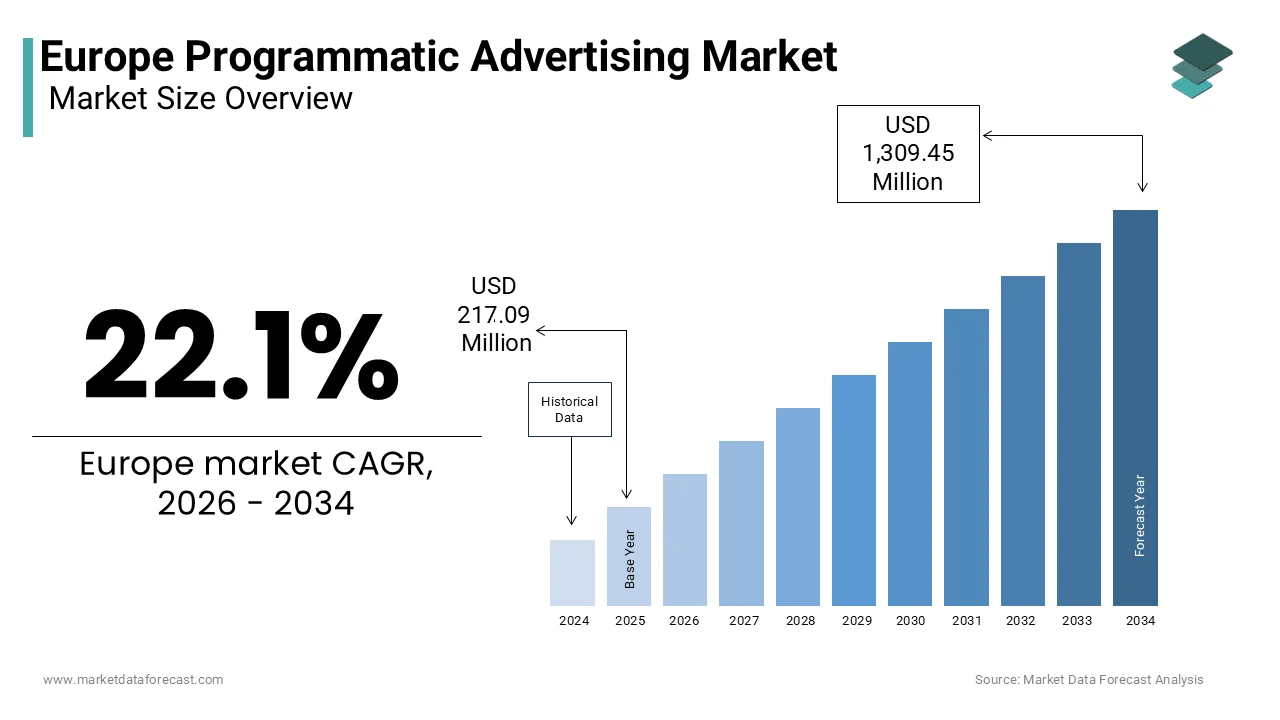
The Europe programmatic advertising market, valued at USD 217.09 billion in 2025, is projected to reach USD 1,309.45 billion by 2034, expanding at a CAGR of 22.1% driven by privacy-compliant automation, rapid connected TV adoption, retail media expansion, and AI-powered optimization across digital channels.
Market Snapshot
- 2025 Market Size: USD 217.09 billion
- 2026 Estimate: USD 265.07 billion
- 2034 Forecast: USD 1,309.45 billion
- CAGR (2026–2034): 22.1%
- Base Year: 2025
- Forecast Period: 2026–2034
Quick Growth Drivers
- Widespread shift from manual to automated digital media buying
- GDPR-driven innovation in privacy-safe targeting and first-party data usage
- Rapid growth of connected TV (CTV) and streaming ad inventory
- Expansion of retail media networks using deterministic purchase data
- AI-led bidding, targeting, and creative optimization improving ROAS
Principal Restraints
- Fragmented identity resolution frameworks across devices and platforms
- Overdependence on walled gardens limiting transparency and interoperability
- Inconsistent viewability, fraud, and brand safety standards across markets
- Measurement and attribution challenges in a post-cookie environment
High-Value Opportunities
- Growth of retail media programmatic ecosystems with closed-loop attribution
- Programmatic direct and private marketplace deals for premium inventory
- AI-powered creative personalization at scale across languages and regions
- Contextual and cohort-based targeting replacing third-party cookies
Key Market Challenges
- Concentration of market power among major digital gatekeepers
- Exposure to ad fraud and invalid traffic in long-tail inventory
- Regulatory complexity across GDPR, DMA, and national ePrivacy laws
- Limited cross-channel measurement consistency across open web and platforms
Fastest-Growing Segments
- Programmatic Direct / Reserved Deals: ~14.6% CAGR — guaranteed premium inventory
- Display Banner Advertising: ~12.3% CAGR — AI-driven personalization and retail media
- Financial Services Vertical: ~16.8% CAGR — regulated, consent-based personalization
Regional Leadership & Dynamics
- United Kingdom (26.7%) — most mature programmatic ecosystem and retail media leadership
- Germany (21.8%) — privacy-first, brand-safe, premium publisher-driven growth
- France — regulatory leadership and strong retail media platforms
- Netherlands — innovation hub for header bidding and sustainable programmatic
- Sweden — ethical, cookie-less, and low-carbon advertising models
What Wins Commercially
- GDPR- and DMA-compliant identity and consent management frameworks
- Premium video, CTV, and retail media inventory access
- Transparent supply path optimization and fraud prevention
- AI-enabled targeting, bidding, and creative orchestration
- Interoperability between open web, retail media, and publisher ecosystems
Top Strategic Ask for Executives
Invest aggressively in privacy-first identity infrastructure, premium programmatic channels, and AI-powered optimization while reducing reliance on walled gardens to build a resilient, transparent, and future-proof advertising strategy in Europe.
Leading Players
Some of the companies that are playing a dominating role in the Europe programmatic advertising market include:
- The Trade Desk
- Google Marketing Platform
- Meta Platforms
- Amazon Advertising
- Adobe Advertising Cloud
- PubMatic
- Magnite
- Criteo
- Xandr (Microsoft Advertising)
- Index Exchange
- OpenX Technologies
- Adform
Europe Programmatic Advertising Market Size
The Europe programmatic advertising market was valued at USD 217.09 billion in 2025, is estimated to reach USD 265.07 billion in 2026, and is projected to reach USD 1,309.45 billion by 2034, growing at a CAGR of 22.1% from 2026 to 2034.
Programmatic advertising is the automated buying and selling of digital ad space in real time using software and AI, rather than manual negotiations and human-led processes. Unlike traditional media planning, programmatic systems execute millions of micro auctions per second, enabling advertisers to reach users based on behavior, context, and identity signals while optimizing for performance metrics such as viewability and conversion. A significant majority of digital display advertising across Europe is now transacted through automated, programmatic methods, cementing it as the primary buying method for digital media. Near-universal internet access among European households ensures that almost all active users regularly encounter automated, algorithmically targeted digital ads, demonstrating the deep integration of programmatic technology into daily online browsing. The market operates within a complex regulatory environment shaped by the General Data Protection Regulation, the Digital Markets Act, and national ePrivacy directives, which collectively restrict tracking mechanisms and mandate transparency in automated decision-making. This confluence of technological sophistication, scale, and legal constraint defines Europe’s unique trajectory in the global programmatic landscape.
MARKET DRIVERS
Stringent Data Privacy Regulations Drive Adoption of Privacy-Compliant Targeting Solutions
The region’s robust data protection framework, particularly the General Data Protection Regulation, has accelerated innovation in consent-based and contextual advertising technologies, which in turn drives the growth of the European programmatic advertising market. Rather than stifling programmatic growth, these rules have pushed advertisers and publishers toward compliant alternatives such as first-party data clean rooms, cohort-based targeting, and semantic content analysis. Major European publishers increasingly adopted the updated IAB Europe Transparency and Consent Framework to meet new compliance requirements for user data consent. This shift has spurred demand for identity resolution solutions that operate without third-party cookies. Data technology companies enabling privacy-safe audience targeting experienced strong demand from European enterprise clients looking for alternatives to third-party cookies. Additionally, advertisers in Europe significantly increased investments in AI-driven contextual targeting as a reliable alternative to traditional, consent-dependent behavioral tracking. Far from halting automation, privacy regulation has catalyzed a more sustainable and transparent form of programmatic advertising aligned with European digital rights norms.
Rise of Connected TV and Streaming Platforms Expands High-Value Inventory Availability
The fragmentation of television viewership across streaming services has created a surge in premium programmatic video inventory across the region and is propelling the expansion of the European programmatic advertising market. Linear television viewership is falling, prompting ad-supported platforms to turn to programmatic sales to monetize increasing digital audiences. Connected TV has become a significant driver for digital video ad impressions in Western Europe. These environments offer high engagement, full-screen visibility, and brand-safe contexts, commanding CPMs higher than standard display. Publishers benefit from header bidding integrations that allow simultaneous auction participation across multiple demand sources, maximizing yield. For advertisers, connected TV enables precise household-level targeting using deterministic data from smart TV operating systems, bridging the gap between broadcast reach and digital precision. This convergence of premium content, scalable automation, and measurable outcomes positions connected TV as a cornerstone of Europe’s next-generation programmatic ecosystem.
MARKET RESTRAINTS
Persistent Fragmentation of Identity Solutions Undermines Cross-Channel Measurement
The absence of a unified and privacy-compliant identity framework across the region impedes accurate audience recognition, campaign attribution across devices and platforms, and the growth of the European programmatic advertising market. With Apple’s App Tracking Transparency, Google’s cookie deprecation, and varying national interpretations of ePrivacy, advertisers rely on a patchwork of probabilistic models, publisher-specific logins, and contextual proxies that lack interoperability. Marketers increasingly report significant inconsistencies between platform-provided data and internal CRM systems, driving diminished confidence in return on ad spend calculations. Simultaneously, in Germany, stringent data privacy regulations limit data pooling, resulting in high measurement errors for cross-device advertising reach. This fragmentation forces brands to overallocate budgets to walled gardens like Meta and Google that maintain proprietary identity graphs, reducing competition and inflating costs. Programmatic efficiency will remain below potential despite technological maturity, at least until Europe implements a neutral, industry-endorsed, and interoperable identity layer.
Lack of Standardized Viewability and Brand Safety Benchmarks Reduces Trust
Inconsistent definitions and verification methodologies for critical quality metrics such as viewability, ad fraud, and brand safety create opacity that deters premium advertisers from fully embracing programmatic channels. This constrains the expansion of the European programmatic advertising market. Despite global certification from the Media Rating Council, European adoption of these standards varies significantly. Programmatic campaigns in Southern Europe show significantly lower adoption of accredited third-party verification compared to the higher adoption rates seen in the Nordics. Disparities in verification lead to inflated performance claims, with certain supply-side platforms reporting high viewability rates that do not match the lower figures found by independent audits. Investigations into programmatic ads for financial services indicate that improper contextual filtering results in ads being displayed next to inappropriate or misinformation content. The lack of unified, audited measurement tools exposes advertisers to risks that slow the adoption of open programmatic buying for premium industries.
MARKET OPPORTUNITIES
Expansion of Retail Media Networks Creates High-Intent Programmatic Opportunities
Major European retailers are leveraging their first-party purchase data to build private programmatic marketplaces that offer advertisers access to consumers at the point of commercial intent and provide new opportunities for the European programmatic advertising market. Platforms like Tesco’s Dunnhumby, Carrefour Links, and Zalando Marketing Services enable brands to target shoppers based on actual basket history, loyalty status, and in-store behavior, data far more predictive than inferred online activity. These closed ecosystems provide deterministic attribution, linking ad exposure directly to sales, and command premium CPMs due to proximity to conversion. Crucially, they operate under clear consent frameworks since data is collected within the retailer’s own environment, satisfying GDPR requirements. Retail media is establishing itself as a premier, highly accountable segment of European programmatic advertising, as an increasing number of grocery and e-commerce entities introduce their own ad networks to securely integrate shopping data with media.
Integration of AI-Powered Creative Optimization Enhances Campaign Performance
Generative artificial intelligence opens up fresh prospects for the European programmatic advertising market. This is transforming programmatic advertising from a media buying tool into a dynamic creative engine capable of real-time message adaptation. Platforms now use machine learning to test thousands of headline, image, and call to action combinations, automatically serving the variant that maximizes engagement for each audience segment. Campaigns utilizing artificial intelligence for creative optimization and targeting achieve significantly higher user engagement and better cost efficiency compared to traditional, static creative approaches. Companies like Quantcast and Adform have embedded generative AI tools that produce localized ad copy in many European languages while adhering to brand guidelines. In markets valuing linguistic nuance, such as France, AI-generated advertisements are proving to be effective in driving higher brand recall and better audience engagement through superior personalization. This capability addresses a longstanding bottleneck, the inability of creatives to keep pace with media automation, unlocking new levels of personalization and efficiency. The advancement of AI models is driving a shift in programmatic from merely targeting audiences to orchestrating holistic messages.
MARKET CHALLENGES
Over-reliance on Walled Gardens Concentrates Power and Limits Innovation
A significant portion of the region’s programmatic activity occurs within closed ecosystems controlled by Meta, Google, and Amazon, which restrict data portability, algorithmic transparency, and the growth of theEuropeane programmatic advertising market. These platforms account for a notable share of digital ad spend in Europe, creating dependency that stifles competition among independent demand-side platforms and data providers. Advertisers cannot export audience insights or retarget users outside these environments, fragmenting customer understanding and inflating acquisition costs. Furthermore, the lack of interoperability prevents true cross-channel optimization; campaigns on Google Display Network cannot be coordinated with open web inventory in real time. The Digital Markets Act designates these firms as gatekeepers and mandates data sharing and fair access, but enforcement remains nascent. The programmatic landscape will keep skewing toward major platforms until open-web alternatives catch up in scale and standardisation, limiting choice for advertisers and revenue streams for publishers.
Inadequate Fraud Detection in Long Tail Inventory Exposes Advertisers to Waste
Sophisticated invalid traffic, particularly domain spoofing and bot farms, continues to exploit the vulnerabilities of lower-traffic websites and mobile apps, even while premium publishers maintain rigorous anti-fraud measures. This poses a major obstacle to the European programmatic advertising market. Despite the widespread adoption of anti-fraud measures across Europe, a significant portion of programmatic ad spend remains exposed to fraudulent, non-human traffic, resulting in substantial financial losses for advertisers, particularly in channels without strict, certified, and audited protection. Many small publishers unknowingly integrate ad tech stacks that include unvetted supply side platforms, creating opaque supply chains where bad actors inject fake inventory. Recent industry audits in Europe, including those covering emerging regional markets, indicate that a notable amount of programmatic inventory is still miscategorized or misrepresents its content type, creating significant risks for ad placement transparency and brand safety. Although initiatives aim to increase transparency, adoption is inconsistent. The open programmatic ecosystem will keep struggling with trust issues, brand apathy, and low integrity until mandatory certification and real-time blockchain verification are implemented.
REPORT COVERAGE
| REPORT METRIC | DETAILS |
| Market Size Available | 2025 to 2034 |
| Base Year | 2025 |
| Forecast Period | 2026 to 2034 |
| Segments Covered | By Trading Platform, Advertising Media, Industry Vertical, and Region. |
| Various Analyses Covered | Global, Regional, and Country-Level Analysis, Segment-Level Analysis, Drivers, Restraints, Opportunities, Challenges; PESTLE Analysis; Porter’s Five Forces Analysis, Competitive Landscape, Analyst Overview of Investment Opportunities |
| Countries Covered | UK, France, Spain, Germany, Italy, Russia, Sweden, Denmark, Switzerland, Netherlands, Turkey, Czech Republic, Rest of Europe |
| Market Leaders Profiled | The Trade Desk, Google LLC (Google Marketing Platform), Meta Platforms, Inc. (Facebook/Instagram), Amazon Advertising, Adobe Inc. (Adobe Advertising Cloud), PubMatic, Inc., Magnite, Inc., Criteo S.A., Xandr (Microsoft Advertising), AppNexus (Xandr/Microsoft), Sizmek (Amazon), Verizon Media, Index Exchange Inc., OpenX Technologies, Inc., Zeta Global, SpotX (Magnite), The ADEX Group, Amobee (Digital Marketing Solutions), Adform A/S |
SEGMENTAL ANALYSIS
By Trading Platform Insights
The Private Marketplace (PMP) segment was the largest segment in the European programmatic advertising market by occupying a 58.5% share in 2025. The prominence of the PMP segment is credited to demand for brand safety and premium inventory, and regulatory alignment with GDPR and the Digital Markets Act favors controlled transactions. Advertisers increasingly prioritize placement quality over sheer scale, favoring PMPs where publishers pre-negotiate inventory access with select buyers under transparent terms. Due to heightened concerns regarding ad adjacency and fraud, brand marketers across major European markets are increasingly shifting budgets away from open real-time bidding towards private marketplace transactions. PMPs guarantee inventory from verified publishers, such as news outlets, streaming platforms, and retail media networks, reducing exposure to long tail sites with questionable content. Data indicates that premium private marketplace transactions, while requiring higher advertising costs, deliver significantly better performance and conversions compared to open, competitive bidding environments. This value exchange, higher cost for greater efficacy and safety, resonates strongly in a regulatory climate where brands face reputational risk from non-compliant placements. Publishers also benefit by retaining pricing control and reducing reliance on opaque auction dynamics, creating a mutually reinforcing ecosystem of trust and performance. Europe’s stringent data and competition laws incentivize structured deals that minimize third-party data leakage and enhance auditability. PMPs operate within closed loops where consent signals, audience segments, and pricing are pre-agreed, simplifying compliance with the General Data Protection Regulation’s accountability principle. Additionally, the Digital Markets Act’s requirement for gatekeepers to enable interoperability has accelerated PMP adoption as advertisers seek alternatives to walled gardens. This regulatory tailwind transforms PMPs from a tactical option into a strategic necessity for responsible, future-proof advertising in Europe’s privacy-centric digital economy.
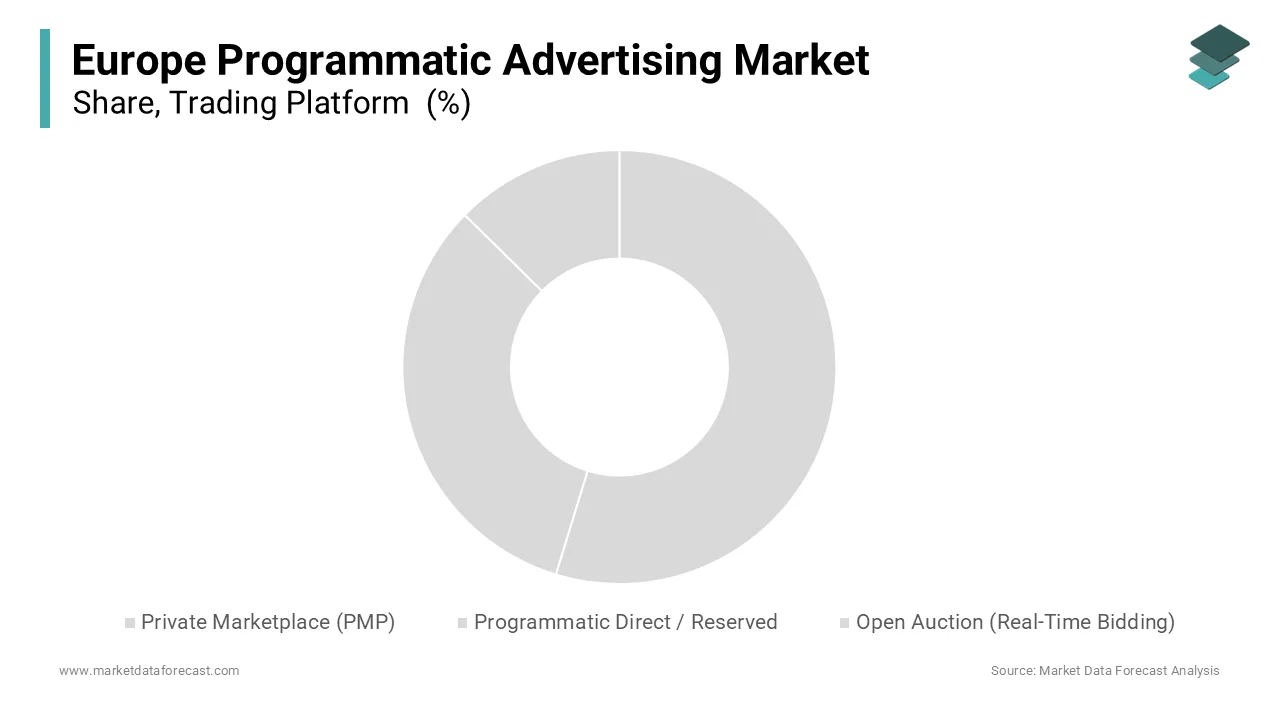
The Programmatic Direct/Reserved segment is predicted to witness the highest CAGR of 14.6% between 2026 and 2034 due to the need for guaranteed impressions in high-stakes campaigns, which fuels fixed deals, as well as publisher revenue stability and first-party data monetization driving supply-side adoption. For product launches, seasonal promotions, and brand-building initiatives, advertisers require certainty in reach and placement, something auction-based models cannot provide. Programmatic direct allows buyers to reserve specific inventory at fixed prices and flight dates, ensuring campaign visibility during critical windows. Retailers like Zalando and ASOS use this model to lock in Black Friday inventory months in advance, avoiding last-minute price spikes. Unlike PMPs, which still involve competition, programmatic direct offers truereservationsn akin to traditional media but with digital targeting and reporting. This hybrid approach satisfies both marketing and procurement teams seeking predictability in an otherwise volatile marketplace. Publishers facing subscription fatigue and ad blocking pressures are turning to programmatic direct to stabilize yield and monetize high-value audiences without auction erosion. For example, Le Monde in France sells Politics Enthusiast segments derived from article consumption, available only via direct reservation. This model preserves direct client relationships while automating trafficking and billing, reducing operational costs. Crucially, it aligns with GDPR by keeping data within the publisher’s ecosystem, avoiding third-party sharing. Permutive and similar identity tools are accelerating the adoption of programmatic direct, enabling European publishers to boost revenue through ethical, high-yield audience targeting.
By Advertising Media Insights
The online video and CTV segment held the majority share at 49.1% of the European programmatic advertising market in 2025. The supremacy of this segment is attributed to superior engagement metrics and full-screen immersion that commands premium investment. Furthermore, the fragmentation of Linear TV audiences is accelerating streaming ad migration. Video ads, particularly in connected TV environments, deliver significantly closer attention and recall than static banners. Eye-tracking research confirms that Connected TV advertising generates substantially higher viewer attention and significantly longer, more consistent engagement times compared to traditional online display banners. This performance justifies CPMs that are two to four times higher, attracting brand budgets seeking impact over efficiency. Streaming platforms like ITVX, RTL+, and Viaplay have opened their inventories programmatically, offering household-level targeting using deterministic login data. A majority of UK households now access streaming services with advertising, driving significant year-over-year increases in the programmatic investment for Connected TV ads. The format’s ability to blend broadcast scale with digital precision makes it indispensable for cross-channel campaigns aiming to drive both awareness and conversion in a fragmented media landscape. Traditional television continues to lose ground among key demographics, and adults aged 18 to 49 reduced linear viewing year on year. Advertisers are reallocating budgets to where audiences have migrated: streaming services with robust programmatic capabilities. The rise of free ad-supported television (FAST) channels on Samsung TV Plus and Roku further expands addressable inventory. Unlike social video, CTV offers brand-safe, full-screen, non-skippable environments that align with premium messaging. The decline of linear TV, coupled with the rise of programmatic CTV, is reshaping Europe’s ad ecosystem from a strategic choice into a structural standard.
The display banner segment is estimated to register the fastest CAGR of 12.3% over the forecast period, owing to AI-powered personalization and retail media integration. Generative AI now enables real-time customization of banner creatives based on user context, weather, inventory levels, and behavioral intent. A travel advertiser can dynamically insert destination images, pricing, and urgency cues (“Only 2 rooms left!”) into thousands of unique banner variants served programmatically. Retail media networks like Carrefour Links and Tesco Dunnhumby leverage purchase history to serve hyper-relevant product banners. This transformation turns static banners into responsive, data-fueled conversations, reversing years of creative stagnation and restoring their role as scalable performance drivers in omnichannel strategies. Contextual targeting and retailer first-party data are reviving open web display effectiveness by providing privacy-compliant alternatives to restricted behavioral tracking. Platforms like Taboola and Outbrain use natural language processing to place banners alongside relevant editorial content, sports shoes next to marathon articles, without cookies. Simultaneously, retailer-owned ad networks offer deterministic audience segments based on actual purchases, making banner ads highly predictive. These developments address historical weaknesses of banners, irrelevance, and low viewability by anchoring them in intent and context. Far from obsolete, display banners are experiencing a renaissance as agile, accountable, andAI-enhancedd touchpoints in Europe’s post-cookie advertising future.
By Industry Vertical Insights
The retail and e-commerce segment led the Europe programmatic advertising market by capturing a 36.2% share in 2025. The leading position of the retail and e-commerce segment is attributed to performance orientation and data richness. Retailers and e-commerce brands operate in a performance-driven environment where every euro must demonstrate attributable revenue. Programmatic advertising provides granular tracking from impression to checkout, especially when integrated with CRM and e-commerce platforms. Retail media networks like Zalando Marketing Services and Otto Ads offer closed-loop measurement, showing that a banner ad led directly to a sneaker purchase, enabling real-time budget shifts. During peak seasons like Black Friday, programmatic systems auto-allocate spend to the highest converting placements, maximizing yield. This accountability, combined with access to first-party shopping behavior, makes programmatic indispensable for retailers competing in a crowded digital marketplace where marginal gains determine profitability. Major European retailers have transformed their digital properties into powerful advertising channels where brands can reach consumers actively browsing or purchasing. These platforms offer deterministic audiences, users who bought organic milk last week, that outperform inferred segments in conversion rate. CPG brands allocate a notable portion of digital budgets to retail media, recognizing the proximity to purchase. Unlike broad awareness campaigns, retail programmatic operates at the bottom of the funnel where decisions are made, delivering unmatched efficiency. This symbiotic ecosystem, where retailers monetize traffic and brands acquire customers, cements retail and e-commerce as the engine of Europe’s programmatic growth.
The financial services segment is anticipated to witness the fastest CAGR of 16.8% between 2026 and 2036. The swift expansion of this segment is fuelled by digital transformation and regulated personalization. Traditional financial institutions are aggressively migrating customers to digital platforms for account opening, loan applications, and insurance quotes, processes that begin with targeted awareness. Programmatic enables precise targeting of life event audiences, recent home buyers for mortgages, and new parents for insurance, using contextual and declared data compliant with GDPR. In Germany, where BaFin mandates strict ad transparency, banks use PMPs on trusted news sites to ensure brand-safe messaging. This shift from branch-based to digital lead generation makes programmatic essential for financial services’ growth in an increasingly cashless and app-centric Europe. Financial services, bound by stringent data rules, are early adopters of clean room and cohort-based targeting that respect privacy while enabling relevance. Partnerships with platforms like InfoSum allow banks to match anonymized customer lists with publisher audiences without exposing personal data. Additionally, the rise of open banking under PSD2 provides consented transaction data that can inform contextual bidding, e.g., targeting users with high savings balances for wealth management services. These innovations demonstrate that even in highly regulated sectors, programmatic can deliver personalized experiences when built on transparency and user control. Hence, programmatic becomes the bridge between trust and technology in Europe’s financial ecosystem.
COUNTRY LEVEL ANALYSIS
United Kingdom Programmatic Advertising Market Analysis
The United Kingdom dominated the European programmatic advertising market by accounting for a 26.7% share in 2025. The country serves as a testing ground for global ad tech innovations due to its advanced digital infrastructure, high internet penetration,n and advertiser sophistication. London hosts the headquarters of major agencies, e-trading desks,s SKS, and ad tech firms, including GroupM, Xaxis, and Magnite, creating a dense talent and capital ecosystem. The UK leads in retail media with Tesco Dunnhumby and Boots Media Group offering some of the world’s most advanced programmatic platforms powered by loyalty card data. Despite Brexit, the UK maintains alignment with EU data standards through the UK GDPR, ensuring continued interoperability. This combination of market maturity, regulatory clarity, and retail data depth solidifies the UK’s position as Europe’s programmatic vanguard.
Germany Programmatic Advertising Market Analysis
Germany was the next prominent country in the European programmatic advertising market by holding a 21.8% share in 2025. The growth of the German market is driven by its rigorous data protection culture and high-quality publisher base. German advertisers prioritize brand safety and contextual targeting over behavioral tracking in compliance with the Federal Data Protection Act, which often exceeds GDPR stringency. Major publishers like Axel Springer and Funke have formed the Programmatic Quality Initiative to standardize viewability fraud prevention and consent signaling across the supply chain. The country also leads in connected TV adoption and in creating premium video inventory. Germany’s engineering mindset extends to ad tech, ch with companies like Adform and Smartclip developing privacy by design solutions. This emphasis on ethical quality and technical excellence makes Germany the benchmark for responsible programming in continental Europe.
France Programmatic Advertising Market Analysis
France is another key player in the European market and plays an outsized role in defining the region’s regulatory and ethical advertising framework. The French Data Protection Authority CNIL has issued landmark rulings on cookie consent and real-time bidding that influence EU-wide policy. Moreover, France fosters innovation through initiatives like the AI for Media Alliance, which promotes generative AI in creative production under ethical guidelines. Retail media is strong with Carrefour Links and Auchan Media leveraging loyalty data for programmatic campaigns. The government’s France Relance plan for the digital sovereignty project,s including sovereign ad tech infrastructure. This dual focus on regulation and innovation positions France as Europe’s conscience and catalyst for sustainable programmatic growth.
Netherlands Programmatic Advertising Market Analysis
The Netherlands is growing steadily in Europe programmatic advertising market and serves as a launchpad for new programmatic technologies due to its high digital literacy and compact media landscape. Dutch advertisers were among the first in Europe to adopt header bidding server-to-server integration and unified ID solutions. Companies like Adyen and Improve Digital, headquartered in Amsterdam, drive global ad tech innovation. The country also leads in sustainability; Dutch publishers formed the Green Programmatic Coalition to reduce the carbon footprint of ad auctions through energy-efficient data centers. This blend of technical agility, environmental consciousness,s and regulatory compliance makes the Netherlands a microcosm of Europe’s programmatic future.
Sweden Programmatic Advertising Market Analysis
Sweden is likely to expand in the European market from 2026 to 2034 and champions transparency,cy sustainability,ity, and public service values in digital advertising. The Swedish Competition Authority actively monitors ad tech anti-competitive practices, while the Swedish Data Protection Authority enforces strict consent requirements. Public broadcasters SVT and UR pioneeredcookie-lesss programmatic using contextual and declared interest data, setting a standard for ethical monetization. Sweden also leads in gender balanced targeting; advertisers avoid stereotyping by using neutral audience segments promoted by the Swedish Advertising Association. Renewable energy powers most data centers with Stockholm’s hydroelectric grid,d enabling low carbon ad serving. This commitment to social responsibility, technological integrity, ty and environmental stewardship positions Sweden as a moral compass for Europe’s programmatic evolution.
COMPETITIVE LANDSCAPE
The European programmatic advertising market features intense rivalry between global tech giants, independent platforms,s and specialized vertical players operating under strict regulatory oversight. Competition is increasingly defined by compliance innovation and ecosystem control rather than pricing alone. Walled gardens like Google and Meta leverage scale and proprietary data but face mounting pressure from the Digital Markets Act to open their systems. Independent players such as The Trade Desk and Magnite differentiate through neutrality, transparency, and publisher-friendly models, yet struggle to match the reach of dominant platforms. New entrants focus on niche areas like retail media sustainability or AI-driven creative automation to carve defensible positions. Regulatory fragmentation across member states adds complexity, requiring localized solutions for consent management and data handling. Ultimately, success depends on balancing performance accountability and ethical data use in a market where trust is as valuable as technology.
KEY MARKET PLAYERS
Some of the companies that are playing a dominating role in the global europe programmatic advertising market include
- The Trade Desk
- Google LLC (Google Marketing Platform)
- Meta Platforms, Inc. (Facebook/Instagram)
- Amazon Advertising
- Adobe Inc. (Adobe Advertising Cloud)
- PubMatic, Inc.
- Magnite, Inc.
- Criteo S.A.
- Xandr (now part of Microsoft Advertising)
- AppNexus (part of Xandr/Microsoft)
- Sizmek (by Amazon)
- Verizon Media (formerly Oath)
- Rubicon Project (part of Magnite)
- Index Exchange Inc.
- OpenX Technologies, Inc.
- Zeta Global
- SpotX (by Magnite)
- The ADEX Group
- Amobee (by Digital Marketing Solutions)
- Adform A/S
TOP LEADING PLAYERS IN THE MARKET
- Google LLC plays a central role in the European programmatic advertising market through its Display & Video 360 platform, Google Ad Manager, and demand-side capabilities that connect advertisers to inventory across YouTube, Discover, and the open web. The company contributes globally by setting technical standards for header bidding, privacy sandbox development, and measurement interoperability. In Europe, Google has strengthened its position by aligning its Privacy Sandbox initiatives with GDPR requirements and launching publisher support programs for cookieless targeting. It also enhanced transparency in its ad tech stack by providing detailed reporting on auction dynamics and data usage in response to Digital Markets Act scrutiny. These actions reinforce trust while maintaining scale in a rapidly evolving regulatory landscape.
- The Trade Desk Inc is a leading independent demand-side platform with deep penetration across European agency trading desks and brand advertisers seeking alternatives to walled gardens. The company contributes globally by pioneering universal ID solutions like Unified ID 2.0 and advancing retail media interoperability through its OpenPath initiative. In Europe, The Trade Desk has reinforced its market presence by integrating first-party data from major retailers, including Carrefour and Tesco,o into its platform, enabling privacy-compliant audience targeting. It also launched localized AI-powered campaign optimization tools for German, French,h and Spanish markets that adapt bidding strategies based on regional consumer behavior and regulatory constraints.
- Magnite Inc is the largest independent platform in Europe, representing premium publishers,s including news broadcasters and streaming services. The company contributes globally by developing transparent supply path optimization and advocating for publisher sustainability in programmatic ecosystems. In Europe, Magnite has strengthened its position by expanding its connected TV and CTV offerings through partnerships with RTL Gro, up, Sky, and Viaplay, enabling programmatic accesshigh-qualitylity video inventory. It also implemented GDPR compliant consent integration across its European publisher base and introduced carbon footprint tracking for ad auctions in collaboration with Climate Action Tech, addressing growing advertiser demand for sustainable media buying.
TOP STRATEGIES USED BY THE KEY MARKET PARTICIPANTS
Key players in the European programmatic advertising market are investing heavily in privacy-preserving identity solutions, such as clean rooms, contextual targeting, and third-party data collaborations, to comply with GDPR and ePrivacy regulations. They are expanding connected TV and retail media integrations to accesshigh-intentt audiences in brand-safe environments. Companies are enhancing transparency through detailed supply chain reporting, auction diagnostics,,s and carbon impact metrics to build advertiser trust. Strategic partnerships wwith publishersretailers, and technology providers enable interoperable data sharing while respecting user consent. Additionally, they are deploying artificial intelligence forfor real-timeeative optimization, bid forecasting, and fraud detection to improve campaign efficiency and performance in a post-cookie landscape.
MARKET SEGMENTATION
This research report on the europe programmatic advertising market is segmented and sub-segmented into the following categories.
By Trading Platform
- Private Marketplace (PMP)
- Programmatic Direct / Reserved
- Open Auction (Real-Time Bidding)
By Advertising Media
- Online Video & Connected TV (CTV)
- Display Banner
- Mobile Advertising
- Native Advertising
- Audio Advertising
By Industry Vertical
- Retail & E-commerce
- Financial Services
- Media & Entertainment
- Automotive
- Travel & Hospitality
- Telecommunications
- Healthcare & Pharmaceuticals
- Others
By Country
- United Kingdom
- Germany
- France
- Netherlands
- Sweden
- Italy
- Spain
- Rest of Europe