- Product Description Description
- Table of Contents TOC
- List of Table & Figure LOT
- Get Free Sample PDF Sample PDF
Market Size, 2025
$14.37 BnMarket Estimate, 2026
$19.22 BnMarket Forecast, 2034
$196.97 BnCAGR, 2026–2034
33.76%Europe Enterprise Artificial Intelligence (AI) Market Overview
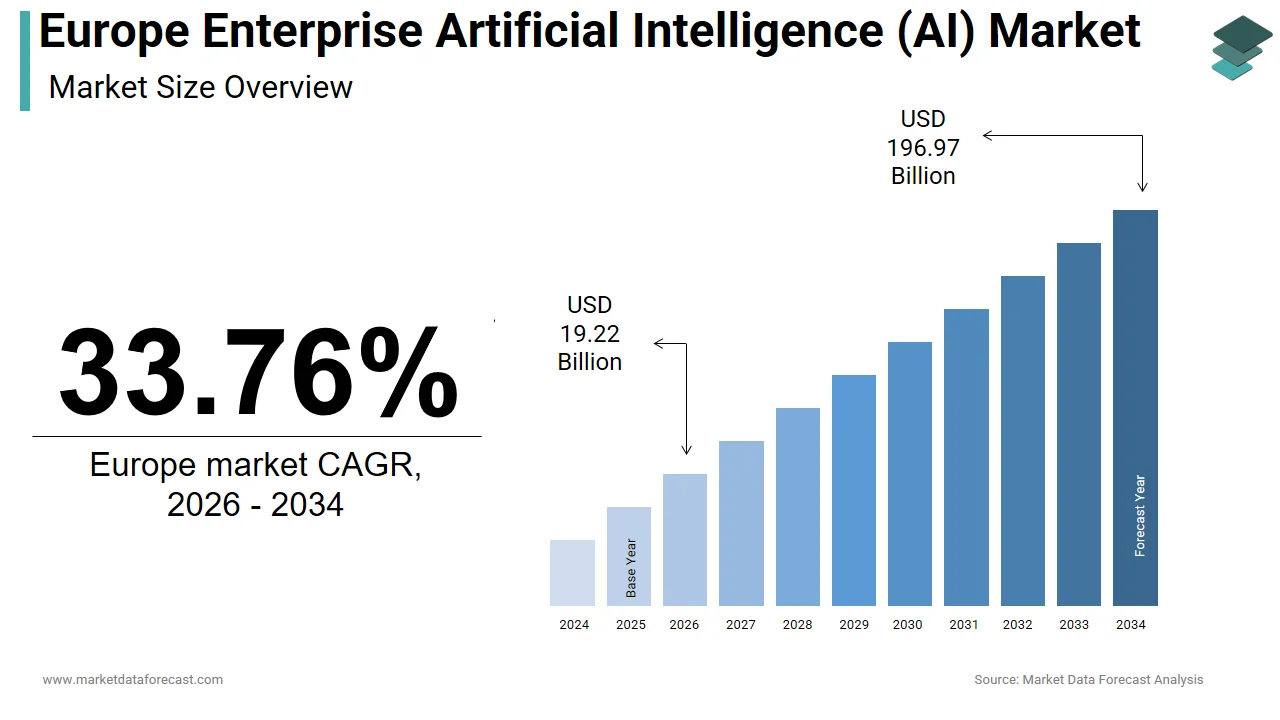
The Europe enterprise artificial intelligence (AI) market was valued at USD 14.37 billion in 2025, is estimated to reach USD 19.22 billion in 2026, and is projected to reach USD 196.97 billion by 2034, growing at a CAGR of 33.76% during the forecast period (2026 to 2034).
This growth is driven by accelerated digital transformation across European enterprises, rising adoption of cloud and big data analytics, increasing labor productivity pressures, and a strong regulatory push for structured AI adoption under EU digital policies.
Key Trends and Insights
- Regional Leadership: Western Europe dominates the market, led by Germany, the United Kingdom, and France.
- Fastest Adoption: Northern and Eastern Europe are witnessing accelerating AI adoption as digital infrastructure matures.
- By Technology: Machine learning dominated the market, accounting for 33.2% of the total share in 2024.
- By Capabilities: Robotic process automation held the largest share due to strong demand for enterprise automation.
- By Use Case: Service operations optimization accounted for the highest market share of 32.1% in 2024.
- Leading Country: Germany is the largest market in Europe, supported by its strong industrial base and national AI strategy.
Market Revenue Figures
- 2025 Market Size: USD 14.37 billion
- 2026 Market Size: USD 19.22 billion
- 2034 Projected Market Size: USD 196.97 billion
- CAGR (2026 to 2034): 33.76%
- Dominating Countries: Germany, the United Kingdom, and France
Key Market Players
The Europe enterprise artificial intelligence market is shaped by global technology leaders and enterprise solution providers offering compliance-ready AI platforms, sovereign cloud infrastructure, and industry-specific AI solutions aligned with European regulatory requirements.
Major players operating in the market include Microsoft Corporation, Google, IBM Corporation, SAP SE, Amazon Web Services, Oracle Corporation, NVIDIA Corporation, Intel Corporation, DataRobot, Inc., Hewlett Packard Enterprise Development LP, and Wipro Limited. These companies are strengthening their European presence through investments in ethical AI frameworks, local data centers, workforce upskilling, and public–private collaborations, supporting long-term enterprise AI adoption across the region.
Europe Enterprise Artificial Intelligence (AI) Market Size
The Europe enterprise artificial intelligence (AI) market was valued at USD 14.37 billion in 2025, is estimated to reach USD 19.22 billion in 2026, and is projected to reach USD 196.97 billion by 2034, growing at a CAGR of 33.76% from 2026 to 2034.
Enterprise artificial intelligence is the integration of artificial intelligence technologies, including machine learning, natural language processing, computer vision, and predictive analytics, into business operations. These technologies are deployed to enhance decision-making, automate complex processes, improve customer experience, and optimize resource allocation. As per Eurostat, large enterprises in the European Union employed cloud computing services in 2024, a foundational enabler for scalable artificial intelligence deployment. According to the European Commission, many European enterprises with more than 250 employees engaged in big data analytics activities during 2023, reflecting growing readiness for artificial intelligence adoption. Furthermore, a study revealed that digital intensity among European firms increased between 2021 and 2024, with artificial intelligence emerging as a core component of digital transformation strategies.
MARKET DRIVERS
Accelerated Digital Transformation Mandates Across European Union Member States
The European regulatory and policy frameworks are increasingly compelling enterprises to embed digital capabilities, including artificial intelligence, into their operational fabric, which is a primary driving factor for the growth of the Europe enterprise artificial intelligence market. The European Commission’s Digital Decade Policy Programme targets that by 2030, at least 75% of European enterprises should use cloud and big data, artificial intelligence, or other advanced digital technologies. This ambition is already shaping corporate investment behavior, with digital transformation budgets expanding substantially. As per the study, large enterprises in Germany, France, and the Netherlands reported active investment in artificial intelligence as part of broader digital modernization initiatives. Concurrently, the European Union’s Artificial Intelligence Act, although primarily regulatory in nature, is pushing organizations to formalize artificial intelligence governance, which in turn accelerates structured adoption. A 2024, a survey by the Centre for European Policy Studies indicated that European chief information officers cited compliance with upcoming artificial intelligence regulations as a driver for internal artificial intelligence capability building.
Escalating Labor Shortages and Workforce Productivity Pressures
The persistent labor market constraints are intensifying enterprise reliance on artificial intelligence to maintain operational continuity and enhance productivity. The escalating labor shortages and workforce productivity pressures are also fuelling the growth of Europe's enterprise artificial intelligence market. Eurofound reported in early 2025 that the European Union faces a shortage of over 3 million information and communications technology professionals, with vacancy rates in sectors such as manufacturing and logistics exceeding many countries, like Poland and Italy. In response, enterprises are turning to artificial intelligence to bridge human resource gaps through intelligent automation and augmented decision support. According to the International Labour Organization, the average labor productivity growth in the European Union, annually from 2020 to 2024 significantly below pre-pandemic levels, necessitating technological intervention.
MARKET RESTRAINTS
Stringent and Evolving Data Privacy and Artificial Intelligence Governance Regulations
The regulatory landscape for the rapid scaling of enterprise artificial intelligence solutions, primarily due to the complexity and compliance burden imposed by overlapping legal frameworks, is one of the major restraining factors for the growth of the Europe enterprise artificial intelligence market. Furthermore, the European Union’s Artificial Intelligence Act, which classifies enterprise artificial intelligence applications into risk tiers, requires high-risk systems to undergo rigorous conformity assessments prior to deployment. As per the European Commission, enterprise artificial intelligence use cases in human resources, financial services, and insurance fall under the high-risk category, thereby triggering extensive documentation, testing, and human oversight obligations. A 2025 analysis by the European Policy Centre indicated that compliance with these requirements increases average artificial intelligence deployment timelines by 4 to 7 months. Additionally, fragmented national interpretations of regulations across member states complicate unified enterprise strategies, with legal teams of surveyed multinational firms citing regulatory inconsistency as a barrier to artificial intelligence scaling, according to a report by the Centre for Data Innovation.
Persistent Deficits in Artificial Intelligence Talent and Technical Infrastructure Readiness
The acute scarcity of skilled artificial intelligence professionals, coupled with uneven technical infrastructure, is additionally hampering the growth of the Europe enterprise artificial intelligence market. According to the European Centre for the Development of Vocational Training, the European Union will face a deficit of over four hundred thousand artificial intelligence and data science specialists by 2026 if current education and training trajectories persist. This talent gap disproportionately affects small and medium enterprises, which lack the resources to compete with large corporations for scarce expertise. Concurrently, infrastructure limitations hinder artificial intelligence scalability, as found in 2024, that only 43% of enterprises in Southern and Eastern Europe possessed the necessary data architecture and computing capacity to support real-time artificial intelligence workloads. Moreover, European firms have implemented enterprise-wide data governance frameworks, a prerequisite for reliable artificial intelligence model performance. These structural deficiencies create a dual barrier, where even willing adopters lack either the human capital or the foundational systems to operationalize artificial intelligence effectively.
MARKET OPPORTUNITIES
Expansion of Artificial Intelligence Integration in Sustainable Business Operations
Enterprises are increasingly leveraging artificial intelligence to meet stringent environmental, social, and governance commitments, creating a substantial growth corridor for specialized artificial intelligence applications. The expansion of artificial intelligence integration in sustainable business operations is significantly creating new opportunities for the growth of the Europe enterprise artificial intelligence market. The European Green Deal mandates that European Union member states reduce greenhouse gas emissions by at least 55% by 2030 compared to 1990 levels, compelling businesses to adopt intelligent resource optimization tools. As per the European Environment Agency, artificial intelligence-driven energy management systems deployed in industrial facilities have demonstrated average energy savings of 18% across pilot programs in Sweden, Finland, and Austria during 2024. Similarly, large European manufacturers now use artificial intelligence to monitor and reduce scope one and scope two emissions in real time. In the logistics sector, Deutsche Post DHL Group revealed in its 2024 sustainability update that route optimization algorithms reduced fuel consumption across its European fleet. Moreover, artificial intelligence applications in circular economy models, such as predictive maintenance and material recovery, are projected to generate cumulative resource efficiency gains worth 23 billion euros annually by 2027.
Rise of Industry-Specific Artificial Intelligence Ecosystems and Collaborative Innovation Hubs
The emergence of vertically integrated artificial intelligence ecosystems that foster co-development between enterprise technology providers and research institutions is accelerating domain-specific adoption. The rise of industry-specific artificial intelligence ecosystems and collaborative innovation hubs is another attribute surging new opportunities for the expansion of the Europe enterprise artificial intelligence market. Initiatives, such as the German AI Innovation Network supported by the Federal Ministry for Economic Affairs and Climate Action, have been supporting artificial intelligence consortia since 2022, focusing on sectors like automotive, healthcare, and agriculture. These consortia have transitioned pilot projects into commercial deployments within 18 months. In healthcare, the European Health Data Space, launched in 2024, provides a secure framework for hospitals and artificial intelligence developers to collaborate on diagnostic and predictive tools with early data from the Netherlands and Denmark, showing an improvement in early disease detection accuracy. Similarly, the European High Performance Computing Joint Undertaking has established six exascale artificial intelligence supercomputing centers across Europe, enabling resource-intensive model training for enterprises without in-house capacity. According to the European Commission, these centers supported more than seven hundred enterprise artificial intelligence projects in 2024 alone.
MARKET CHALLENGES
Persistent Algorithmic Bias and Explainability Deficits in Enterprise Decision Systems
The limited transparency and potential bias embedded within artificial intelligence-driven decision systems undermine trust and regulatory acceptance. The persistent algorithmic bias and explainability deficits in enterprise decision systems are one of the major challenges for the growth of the European enterprise artificial intelligence market. Many enterprise applications in recruitment, credit scoring, and insurance underwriting continue to exhibit discriminatory outcomes due to unrepresentative training data or flawed model design. Furthermore, the European Parliament’s Scientific Foresight Unit found that only 29% of commercial artificial intelligence systems used by European enterprises provide interpretable outputs sufficient for human review as mandated under the Artificial Intelligence Act.
Fragmentation of Data Silos and Inadequate Interoperability Standards
Enterprise artificial intelligence systems in Europe frequently underperform due to the pervasive fragmentation of data across legacy systems departments and organizations, which constrains model accuracy and scalability. As per the European Data Portal, large enterprises in Europe operate with data stored in more than ten distinct and non-integrated repositories, impeding the creation of unified training datasets. This fragmentation is compounded by the absence of harmonized data interoperability standards across sectors. In healthcare, for example, the European Health Management Association reported that patient data interoperability gaps reduce diagnostic artificial intelligence model performance in cross-hospital deployments. Similarly, in manufacturing, a study by the Fraunhofer Institute indicated that production line artificial intelligence applications achieve their potential efficiency gains when data from machines, enterprise resource planning systems, and supply chain platforms remain siloed. These structural data challenges elevate development costs, increase time to value, and significantly curtail the generalizability of artificial intelligence solutions across the European enterprise landscape.
REPORT COVERAGE
| REPORT METRIC | DETAILS |
| Market Size Available | 2025 to 2034 |
| Base Year | 2025 |
| Forecast Period | 2026 to 2034 |
| Segments Covered | By Technology, Capabilities, Use Cases, Function, Industry, and Country. |
| Various Analyses Covered | Global, Regional, and Country-Level Analysis, Segment-Level Analysis, Drivers, Restraints, Opportunities, Challenges; PESTLE Analysis; Porter’s Five Forces Analysis, Competitive Landscape, Analyst Overview of Investment Opportunities |
| Countries Covered | UK, France, Spain, Germany, Italy, Russia, Sweden, Denmark, Switzerland, Netherlands, Turkey, Czech Republic, and the Rest of Europe. |
| Market Leaders Profiled | Amazon Web Services, Inc., IBM Corporation, Google, Microsoft Corporation, Oracle Corporation, Intel Corporation, Alphabet Inc., SAP SE, ai, Inc., DataRobot, Inc., Hewlett Packard Enterprise Development LP, Wipro Limited, and NVidia Corporation |
SEGMENTAL ANALYSIS
By Technology Insights
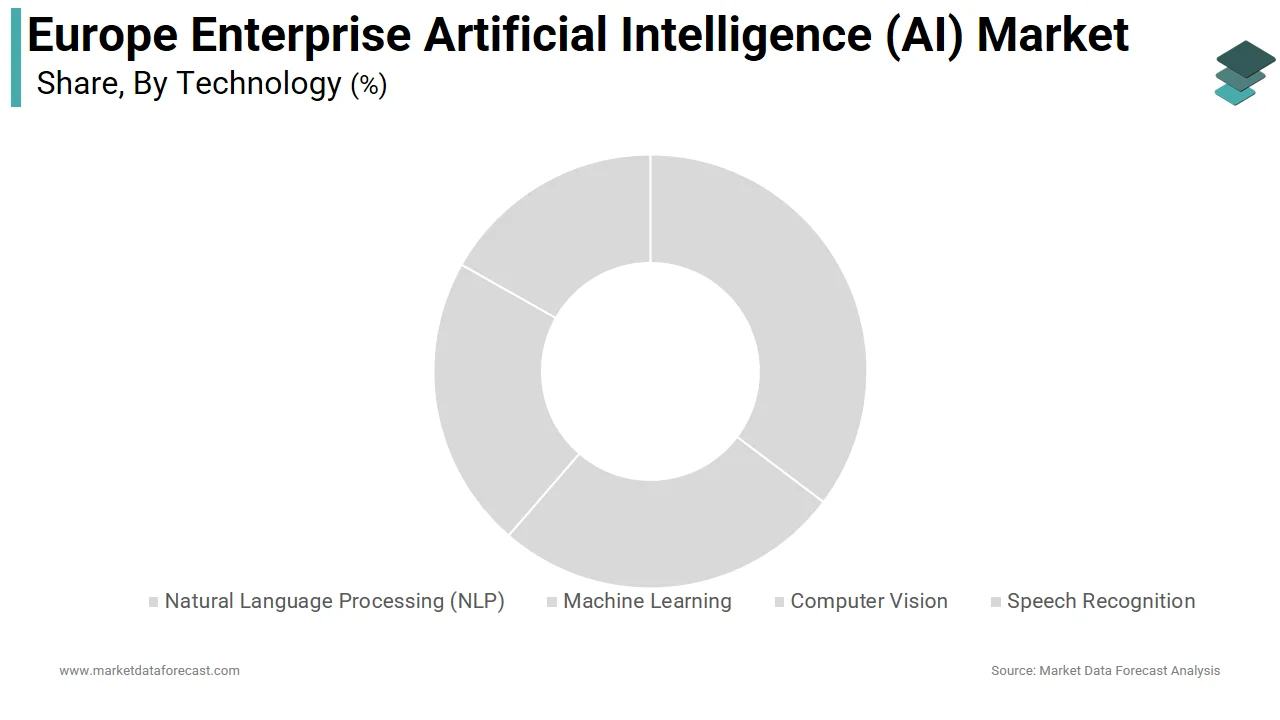
The machine learning segment was the largest by holding 33.2% of the Europe enterprise artificial intelligence market share in 2024 due to its foundational role in predictive analytics, anomaly detection, and autonomous decision systems across industries. Enterprises rely on machine learning to extract actionable insights from rapidly expanding data volumes generated by digital operations. The technology’s adaptability is further amplified by open source frameworks, such as TensorFlow and Scikit Learn, which have lowered development barriers. According to Eurostat, European enterprises using artificial intelligence reported machine learning as a core component of their analytics stack in 2024. Additionally, machine learning powered credit scoring systems are now used by major European banks to assess small business loan applications, reducing default risk. These applications underscore machine learning’s centrality in operationalizing artificial intelligence at scale in finance, manufacturing, and logistics, where real-time data-driven decisions directly impact competitiveness and efficiency.
The computer vision segment is likely to register the fastest CAGR of 11.2% from 2025 to 2033, driven by surging adoption in quality control automation and workplace safety monitoring. Industrial manufacturers are increasingly integrating vision-based inspection systems to minimize defects and comply with stringent product standards. The automotive and electronics plants in Germany and France implemented computer vision quality assurance systems in 2024, resulting in a reduction in post-production defect rates. The construction and energy sectors are deploying drone-mounted computer vision for infrastructure inspection, with an increase in such deployments across Nordic countries in 2024. In retail, the technology supports inventory management and loss prevention, with a study by the European Retail Roundtable indicating that computer vision reduced stock discrepancies in pilot stores across the Netherlands and Spain.
By Capabilities Insights
The robotic process automation segment held a dominant share of the Europe enterprise artificial intelligence market in 2025, with its proven ability to automate high-volume repetitive back office tasks with minimal human intervention. Additionally, the European Public Sector Innovation Monitor found that government agencies in Sweden, Denmark, and the Netherlands achieved average labor cost savings of 22% through robotic process automation in citizen services. The capability’s rapid scalability is further supported by low-code platforms, which enable non-technical staff to configure automation workflows.
The virtual agents segment is expected to witness a CAGR of 12.5% during the forecast period, owing to the escalating demand for 24/7 customer engagement and labor-constrained service environments. Enterprises across telecommunications, banking, and e-commerce are replacing static chat interfaces with context-aware conversational agents capable of resolving complex queries. As per the Bank for International Settlements, European banks using advanced virtual agents achieved a reduction in average call center handle time while maintaining customer satisfaction scores. In healthcare, the European Health Consumer Powerhouse observed that virtual triage agents deployed in primary care clinics across Finland and Belgium handled initial patient inquiries in 2024, freeing clinical staff for higher-value tasks.
By Use Cases Insights
The Service Operations Optimization segment was the largest by capturing 32.1% of the Europe enterprise artificial intelligence market share in 2024. The integration of artificial intelligence into service management enables predictive maintenance, dynamic scheduling, and real-time resource allocation. As per the European Federation of Transport and Logistics in 2024, large logistics providers in Europe used artificial intelligence to optimize last-mile delivery routes, reducing average delivery times. In manufacturing, the predictive maintenance systems based on artificial intelligence decreased unplanned downtime across German and Italian factories. Similarly, the European Energy Exchange noted that utility companies in France and Spain deployed artificial intelligence-driven grid maintenance platforms that improved outage response times by 41% in 2024. These efficiency imperatives are further reinforced by the European Green Deal, which incentivizes resource optimization and waste reduction, making service operations optimization not just a cost-saving measure but a strategic compliance enabler across regulated industries.
The AI-based Product Enhancement segment is likely to grow at the fastest CAGR of 13.2% from 2026 to 2034, with the embedding of artificial intelligence directly into physical and digital offerings to create differentiated value. Automotive manufacturers lead this trend with intelligent driver assistance and adaptive user interfaces now standard in premium vehicles. In software, the European Software Federation reported that 43% of enterprise SaaS providers integrated generative artificial intelligence features, such as automated report writing or data summarization, in 2024. This rapid growth reflects a strategic pivot from artificial intelligence as an internal tool to artificial intelligence as a core product attribute driving customer retention and premium pricing across multiple sectors.
COUNTRY-LEVEL ANALYSIS
Germany Enterprise Artificial Intelligence (AI) Market Analysis
Germany was the top performer of the Europe enterprise artificial intelligence market by holding 26.7% of share in 2024 with its advanced industrial base and proactive national artificial intelligence strategy. As per Germany’s Federal Ministry for Economic Affairs and Climate Action, medium and large industrial firms deployed artificial intelligence solutions in 2024, with the automotive and machinery sectors, totaling enterprise artificial intelligence investment. The government’s AI Made in Germany initiative has allocated over three billion euros since 2020 to support research and commercialization, with 16 artificial intelligence competence centers now operational nationwide.
United Kingdom Enterprise Artificial Intelligence (AI) Market Analysis
The United Kingdom was next by capturing 17.8% of the European enterprise artificial intelligence market share in 2024, owing to its strength in financial technology, healthcare innovation, and artificial intelligence startups. London remains Europe’s premier artificial intelligence ecosystem, hosting over 1,500 artificial intelligence companies, as per a recent report. In healthcare, the National Health Service deployed artificial intelligence diagnostic tools in over two hundred hospitals, resulting in an improvement in radiology reporting speed, according to NHS Digital.
France Enterprise Artificial Intelligence (AI) Market Analysis
The French enterprise artificial intelligence market growth is likely to grow with an expected CAGR propelled by a coordinated national strategy and strong public sector digitization efforts. The French government’s Artificial Intelligence for Humanity plan has mobilized over 2.5 billion euros in public and private investment since 2021, focusing on healthcare mobility and defense applications. The aerospace and luxury goods sectors are notable adopters, with Airbus reporting a 35% reduction in aircraft maintenance inspection time through computer vision systems deployed in Toulouse. Additionally, the French Data Protection Authority observed that public hospitals in Paris, Lyon, and Marseille implemented natural language processing tools to automate medical coding, achieving a gain in administrative efficiency. France’s emphasis on ethical artificial intelligence and multilingual models aligned with European values further enhances its appeal as a responsible innovation hub.
COMPETITIVE LANDSCAPE
Competition in the Europe enterprise artificial intelligence market is characterized by a dynamic interplay between global technology giants and specialized European vendors, each navigating stringent regulatory expectations and diverse industry demands. Major players differentiate through compliance-ready AI platforms, data sovereignty features, and localized deployment models that adhere to the Artificial Intelligence Act and General Data Protection Regulation. Regional vendors gain traction by offering niche solutions in sectors like manufacturing, healthcare, and public services where domain expertise and proximity to local workflows are critical. Strategic acquisitions, partnerships, and investments in ethical AI research further intensify rivalry. This multifaceted landscape fosters innovation while compelling vendors to balance scalability with contextual relevance across Europe’s fragmented yet high-value enterprise ecosystem.
KEY MARKET PLAYERS
The leading companies operating in the Europe enterprise artificial intelligence (AI) market include:
- Amazon Web Services, Inc.
- IBM Corporation
- Microsoft Corporation
- Oracle Corporation
- Intel Corporation
- Alphabet Inc.
- SAP SE
- ai, Inc.
- DataRobot, Inc.
- Hewlett Packard Enterprise Development LP
- Wipro Limited
- NVIDIA Corporation
TOP PLAYERS IN THE MARKET
- Microsoft plays a pivotal role in the Europe enterprise artificial intelligence market through its Azure AI suite, which offers scalable machine learning, natural language processing, and computer vision services tailored for European regulatory compliance. The company has deepened its presence by embedding responsible AI principles aligned with the European Union’s Artificial Intelligence Act. In early 2024, Microsoft launched Azure AI Studio in multiple European data centers, enabling local enterprises to develop and deploy models with enhanced data sovereignty. It also partnered with Germany’s Fraunhofer Society to advance industrial AI use cases and expanded its AI skilling initiatives across France and Sweden to address talent shortages. These actions reinforce Microsoft’s commitment to supporting secure, ethical, and locally relevant artificial intelligence adoption across European industries.
- Google contributes significantly to the Europe enterprise artificial intelligence market via its Google Cloud Vertex AI platform, which provides end-to-end machine learning capabilities with strong multilingual and privacy-preserving features. The company has intensified its focus on European data residency by opening a new cloud region in Madrid in 2024 and enhancing on-device AI tools compliant with General Data Protection Regulation standards. Google also collaborated with European healthcare institutions in the Netherlands and Denmark to pilot diagnostic AI models under the European Health Data Space framework. Additionally, it launched the European AI Research Alliance with universities in Paris, Zurich, and Helsinki to foster foundational research. These efforts demonstrate Google’s strategy to position its AI offerings as both innovative and institutionally trusted across the European regulatory landscape.
- IBM strengthens its footprint in the Europe enterprise artificial intelligence market through its WatsonX platform, which emphasizes transparent and auditable AI workflows critical for regulated sectors such as finance and public administration. The company has invested in hybrid cloud AI deployments that allow European enterprises to maintain data control while leveraging advanced analytics. IBM established an AI ethics lab in Milan to support clients in implementing the European Union’s high-risk AI compliance requirements. It also expanded partnerships with Nordic energy firms to deploy AI for grid optimization and sustainability reporting. Furthermore, IBM’s collaboration with European vocational training agencies to certify AI governance professionals underscores its focus on building institutional capacity. These initiatives highlight IBM’s commitment to delivering enterprise-grade artificial intelligence that aligns with Europe’s emphasis on trust and accountability.
TOP STRATEGIES USED BY THE KEY MARKET PARTICIPANTS
Key players in the Europe enterprise artificial intelligence market prioritize strategic alignment with European regulatory frameworks by embedding ethical and explainable AI principles into their product architectures. They invest heavily in local data infrastructure, including sovereign cloud regions, to ensure compliance with data residency mandates. Companies actively form public-private partnerships with research institutions and government bodies to co-develop industry-specific AI solutions. Workforce upskilling initiatives are launched in collaboration with European educational entities to address talent gaps. Additionally, firms tailor multilingual and domain-specialized AI models to meet the continent’s linguistic and sectoral diversity. These strategies collectively reinforce market relevance, trust, and long-term adoption across European enterprises.
MARKET SEGMENTATION
This research report on the Europe enterprise artificial intelligence (AI) market has been segmented and sub-segmented into the following categories.
By Technology
- Natural Language Processing (NLP)
- Machine Learning
- Computer Vision
- Speech Recognition
- Others
By Capabilities
- Robotic process automation
- Computer vision
- NL text understanding
- Virtual agents
By Use Cases
- Service operations optimization
- Creation of AI-based products
- Customer segmentation
- Customer service analytics
- AI-based product enhancement
By Function
- Marketers
- Salespeople
- Service Professionals
By Industry
- Media & Advertising
- Retail
- BFSI
- IT & Telecom
- Healthcare
- Automotive & Transportation
- Others
By Country
- United Kingdom
- France
- Spain
- Germany
- Italy
- Russia
- Sweden
- Denmark
- Switzerland
- Netherlands
- Rest of Europe