- Product Description Description
- Table of Contents TOC
- List of Table & Figure LOT
- Get Free Sample PDF Sample PDF
Market Size, 2025
$10.54 BnMarket Estimate, 2026
$12.74 BnMarket Forecast, 2034
$57.99 BnCAGR, 2026–2034
20.86%Europe Cloud-Based Contact Center Market Report Summary
The Europe cloud-based contact center market was valued at USD 10.54 billion in 2025, is estimated to reach USD 12.74 billion in 2026, and is projected to reach USD 57.99 billion by 2034, growing at a CAGR of 20.86% from 2026 to 2034. Market growth is driven by the increasing adoption of cloud computing technologies, rising demand for scalable customer engagement platforms, and growing digital transformation initiatives across enterprises. Cloud-based contact centers enable organizations to manage customer interactions efficiently through voice, email, chat, and social media channels while reducing infrastructure costs. The expansion of omnichannel communication solutions, integration of artificial intelligence in customer support systems, and increasing adoption of remote workforce models are further supporting the growth of the market across Europe.
Key Market Trends
- Increasing adoption of cloud-based customer engagement platforms.
- Rising demand for omnichannel communication and customer experience solutions.
- Growing integration of AI-driven chatbots, automation, and analytics in contact centers.
- Expansion of remote and hybrid customer support work environments.
- Increasing enterprise focus on improving customer experience and operational efficiency.
Segmental Insights
- Based on solution, the Automatic Call Distributor (ACD) segment dominated the Europe cloud-based contact center market by accounting for 28.7% share in 2025, supported by its ability to efficiently route incoming customer calls to appropriate agents.
- Based on service, the professional services segment held the largest share of 58.8% in 2025, driven by increasing demand for consulting, implementation, and support services associated with cloud-based contact center deployment.
- Based on application, the call routing and queuing segment led the market by capturing 32.9% share in 2025, supported by the growing need to optimize customer interaction workflows and reduce response times.
- Based on vertical, the banking, financial services, and insurance (BFSI) segment dominated the market with 24.1% share in 2025, driven by increasing demand for efficient customer service and digital communication platforms in the financial sector.
Regional Insights
The Europe cloud-based contact center market is witnessing strong growth across major countries due to increasing digitalization, expanding customer service operations, and adoption of cloud technologies.
- The United Kingdom led the regional market in 2025 with 22.2% share, driven by a strong digital economy and widespread adoption of cloud-based enterprise solutions.
- Germany ranked second with 18.3% share in 2025, supported by increasing enterprise cloud adoption and digital transformation initiatives.
- France also holds a significant position in the market due to government initiatives promoting digital public services and the rapid growth of the e-commerce sector.
Competitive Landscape
The Europe cloud-based contact center market is characterized by strong competition among global cloud communication platform providers and enterprise software companies. Market participants are focusing on integrating AI-driven analytics, automation, and omnichannel capabilities to enhance customer engagement. Strategic partnerships with enterprises, telecom providers, and cloud service platforms are shaping competitive dynamics across the region.
Prominent companies operating in the Europe cloud-based contact center market include 8x8 Inc., Five9, Cisco Systems, Genesys, NICE, Oracle, NewVoiceMedia, Connect First, Aspect Software, and 3CLogic.
Europe Cloud-Based Contact Center Market Size
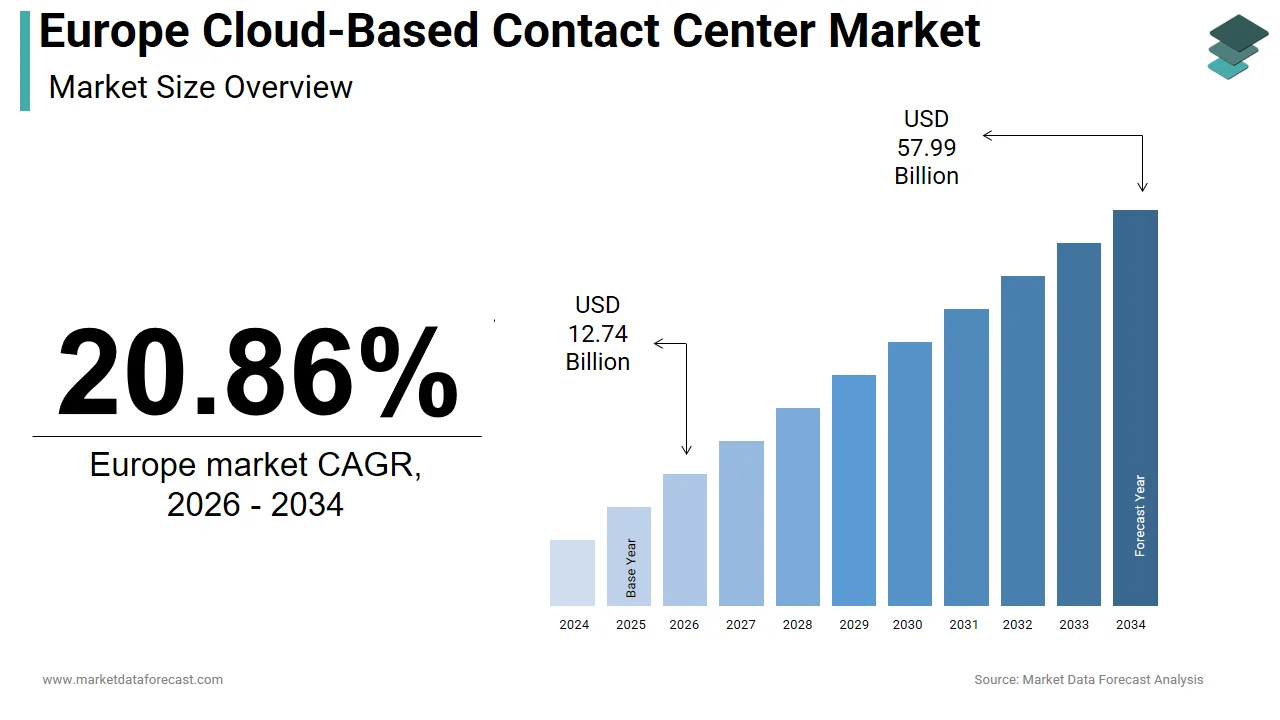
The cloud-based contact center market in Europe was worth USD 10.54 billion in 2025. The europe market is anticipated to be worth USD 57.99 billion by 2034 from USD 12.74 billion in 2026, growing at a CAGR of 20.86% during the forecast period.
A cloud-based contact center is a digital-first customer engagement platform that is hosted entirely on the internet rather than on physical, on-premises servers. This domain encompasses unified communications, omnichannel routing, and artificial intelligence-driven analytics delivered via public, private, or hybrid cloud environments. The transition is fundamentally altering how European enterprises manage customer interactions, enabling seamless connectivity across voice, video, chat, and social media platforms without the constraints of physical server rooms. As per Eurostat's Digitalisation in Europe (2025 Edition), digital interaction levels across the EU remain high, with 85.9% of individuals aged 16–74 using the internet on a daily basis in 2023. Communication remains the primary driver, with 87% of internet users sending or receiving emails and 85% using instant messaging services. Furthermore, data from the European Commission and national institutes indicate that remote work has stabilised into a hybrid equilibrium rather than a 25% permanent shift. In 2024, approximately 18.2% of the workforce in France teleworked at least one day per week, while in Germany, 24.4% of employees worked from home at least some of the time as of August 2025. The General Data Protection Regulation has also reshaped operational protocols, forcing organizations to adopt cloud architectures that offer robust compliance features and data sovereignty controls. This market is no longer defined merely by call handling but by the integration of cognitive computing to predict customer needs and personalize experiences in real time. According to the Broadband Coverage in Europe 2023 report, 94% of all EU households had internet access by 2024. While rural areas reached 92% coverage, the focus has shifted toward the "Digital Decade" target of 100% Gigabit connectivity by 2030 to support low-latency, mission-critical operations.
MARKET DRIVERS
Accelerated Adoption of Remote and Hybrid Workforce Models
The structural shift toward remote and hybrid work environments serves as a primary driver for the growth of the Europe cloud-based contact center market. Traditional on-premise systems tether agents to specific physical locations, rendering them obsolete in an era where talent acquisition is no longer geographically bound. Although employees still prefer flexible arrangements, the actual availability of remote positions is decreasing as companies shift back toward office-based or traditional hybrid models. Cloud platforms enable supervisors to manage dispersed teams, monitor performance metrics, and route inquiries dynamically without relying on local area network infrastructure. Technology providers frequently cite productivity gains from cloud-based tools, but these figures are not yet part of standard global labor productivity reporting. This flexibility allows businesses to tap into a broader talent pool across borders, addressing local labor shortages by hiring agents in regions with lower unemployment rates. Furthermore, the ability to scale agent numbers up or down instantly based on fluctuating call volumes ensures operational efficiency during peak periods without the capital expenditure of additional physical seats. The demand for business continuity has also intensified, as cloud systems provide inherent redundancy and disaster recovery capabilities that on-premise setups cannot match, making them indispensable for modern European enterprises navigating an unpredictable operational landscape.
Rising Consumer Expectations for Omnichannel and Personalized Engagement
Escalating consumer demands for seamless, personalized, and instant interactions across multiple digital channels are propelling the rapid expansion of cloud-based contact center technologies in the region. This escalation further boosts the expansion of the Europe cloud-based contact center market. Modern customers expect to initiate conversations on social media, continue via chat, and resolve issues through voice calls without repeating information, a level of continuity that fragmented legacy systems fail to deliver. Customer loyalty is increasingly fragile, as a majority of buyers now expect immediate resolution and will leave a brand following even a single negative interaction. Cloud platforms aggregate data from diverse touchpoints into a unified customer view, enabling agents to access comprehensive interaction histories and preferences in real time. While social media use is widespread across Europe, the frequency and choice of platform vary significantly between different age groups and countries. Artificial intelligence integrated into these cloud solutions analyzes sentiment and intent to offer proactive support, reducing resolution times and enhancing satisfaction scores. Providing a seamless experience across all contact channels, such as chat, email, and phone, is becoming a standard requirement for maintaining high satisfaction scores in the UK market. The ability to leverage big data analytics within the cloud allows companies to predict customer needs and tailor offerings dynamically, transforming the contact center from a cost center into a strategic revenue generator that fosters deep brand loyalty in a highly competitive European marketplace.
MARKET RESTRAINTS
Stringent Data Sovereignty and Privacy Compliance Requirements
The complex landscape of data sovereignty laws and stringent privacy regulations impedes the growth of the Europe cloud-based contact center market. The General Data Protection Regulation imposes rigorous obligations on how personal data is collected, stored, and processed, requiring organizations to ensure that customer information remains within specific geographic boundaries or adheres to strict transfer mechanisms. According to the European Data Protection Board, fines for non-compliance reached record levels in 2023, with penalties exceeding 1.2 billion euros issued to major technology firms, creating a climate of caution among potential adopters. Many European enterprises hesitate to migrate sensitive customer interaction data to public cloud environments due to fears of unauthorized access or jurisdictional conflicts regarding data residency. Concerns over international data laws are leading businesses to seek cloud providers that can guarantee data storage strictly within European borders. The requirement for detailed audit trails and the right to be forgotten necessitates complex architectural configurations that can increase implementation costs and timelines. Furthermore, varying interpretations of regulations across different member states create a fragmented compliance environment, forcing multinational corporations to navigate a labyrinth of legal requirements. This regulatory friction slows down decision-making processes and compels organizations to invest heavily in legal counsel and specialized compliance tools, thereby dampening the speed of market penetration for standard cloud offerings.
Persistent Concerns Regarding Security Vulnerabilities and Downtime Risks
Persistent concerns regarding potential vulnerabilities, data breaches, and service downtime continue to grow and inhibit the expansion of the Europe cloud-based contact center market. These issues restrain market growth among risk-averse European organizations. This remains true despite recent advancements in cloud security. The centralized nature of cloud repositories makes them attractive targets for cybercriminals employing sophisticated ransomware and phishing attacks tailored to disrupt customer service operations. Adversaries are frequently exploiting weak security settings in online platforms to gain unauthorized access to sensitive communication networks. High-profile outages involving major cloud providers have eroded trust, with businesses fearing that reliance on third-party infrastructure could lead to catastrophic service interruptions that irreparably damage brand reputation. Smaller businesses are gradually realizing that professional cloud facilities often offer better physical protection than their own private offices can provide. The dependency on internet connectivity also poses a risk, as network failures can render entire contact centers inoperative, a scenario unacceptable for critical services like banking and healthcare. Additionally, the shared responsibility model of cloud security often leads to confusion regarding liability, with organizations unsure whether the provider or the client is accountable for specific security lapses. These apprehensions force many companies to maintain hybrid or on-premise systems as a safeguard, limiting the total addressable market for pure cloud solutions until universal security standards and guaranteed uptime Service Level Agreements become more robust and trustworthy.
MARKET OPPORTUNITIES
Integration of Generative Artificial Intelligence and Cognitive Automation
The convergence of cloud-based contact centers with generative AI and cognitive automation is opening up new growth opportunities for the European cloud-based contact center market. Unlike traditional rule-based bots, generative AI can understand context, generate human-like responses, and handle complex queries without human intervention, drastically reducing operational costs and improving service quality. There is a broad industrial shift toward using artificial intelligence to handle simple, repetitive customer questions, allowing human staff to manage more complex and emotional situations. Cloud platforms provide the necessary computational power and data accessibility to train and deploy these advanced models at scale, enabling real-time sentiment analysis and dynamic script generation. New software tools are helping customer service agents find the right information faster, which shortens wait times and makes the overall experience more positive for callers. The ability to analyze vast amounts of unstructured data from voice and text interactions allows companies to uncover hidden trends and proactively address emerging issues before they escalate. Furthermore, multilingual capabilities inherent in modern AI models allow European businesses to serve diverse linguistic demographics effortlessly, breaking down language barriers that previously limited market reach. This technological leap transforms the contact center into an intelligent hub that not only resolves issues but also drives sales and innovation, offering a compelling value proposition that will accelerate cloud adoption across various industry verticals.
Expansion of Contact Center as a Service for Small and Medium Enterprises
The burgeoning Contact Center as a Service model offers a significant growth avenue for the expansion of the Europe cloud-based contact center market. It achieves this by democratizing access to enterprise-grade communication tools for small and medium-sized enterprises across the region. Historically, the high capital expenditure associated with building and maintaining contact center infrastructure excluded smaller players from adopting advanced technologies, but the subscription-based nature of CCaaS removes these financial barriers. As per the European Small Business Alliance, SMEs constitute 99% of all businesses in the EU, representing a vast untapped market for scalable cloud solutions. The flexibility to pay only for used features and the ability to scale resources instantly allow these businesses to compete with larger corporations in terms of customer service quality. European financial institutions are channelling billions of euros into programs that help smaller businesses buy the latest digital technology and move their operations to the cloud. The modular nature of CCaaS enables businesses to start with basic voice capabilities and gradually add omnichannel features, analytics, and AI tools as they grow, ensuring a future-proof investment. Moreover, the reduction in IT maintenance burdens allows SME owners to focus on core business activities rather than technical upkeep. This shift empowers a new segment of the market to professionalize their customer interactions, driving volume growth for cloud providers who tailor their offerings to the specific budgetary and operational needs of smaller organizations.
MARKET CHALLENGES
Complexity of Integrating Legacy Systems with Modern Cloud Architectures
The intricate challenge of integrating decades-old legacy systems with modern cloud-based contact center architectures poses a significant hurdle for many European enterprises attempting digital transformation and hampers the growth of the European cloud-based contact center market. A vast number of organizations still rely on entrenched on-premise Private Branch Exchange systems and proprietary databases that were not designed to communicate with cloud application programming interfaces. Retrofitting these systems often requires extensive customization, middleware development, and prolonged testing phases that delay deployment and inflate costs. The risk of data loss or corruption during the transition phase further exacerbates hesitation among IT leaders who are reluctant to disrupt critical customer service operations. Additionally, the scarcity of skilled professionals capable of bridging the gap between old and new technologies creates a bottleneck, as existing staff may lack the expertise to manage hybrid environments effectively. This technical fragmentation forces companies to maintain parallel systems for extended periods, increasing operational overhead and preventing them from realizing the full benefits of cloud agility and scalability, thereby slowing the overall pace of market adoption.
Shortage of Skilled Professionals for Cloud Management and Optimization
A critical deficit in professionals possessing the specialized skills required to manage, optimize, and secure cloud-based contact center environments is a major obstacle for the Europe cloud-based contact center market. The transition to cloud technologies demands a workforce proficient in cloud architecture, cybersecurity, data analytics, and AI configuration, yet the current European labor market faces a severe shortage of such qualified individuals. Traditional IT staff trained on on-premise hardware often struggle to adapt to the dynamic, software-defined nature of cloud platforms, leading to suboptimal configurations and underutilization of advanced features. This skills mismatch results in increased reliance on external consultants, driving up operational costs and creating dependencies that hinder long-term autonomy. Educational institutions are struggling to update curricula fast enough to meet the evolving needs of the industry, resulting in a prolonged talent drought. A lack of skilled technicians and architects makes it difficult for companies to effectively manage cloud security and maximize their investment returns. Consequently, these operational hurdles act as a barrier to rapid expansion across the entire market.
SEGMENTAL ANALYSIS
By Solution Insights
The Automatic Call Distributor (ACD) segment dominated the Europe cloud-based contact center market and accounted for a 28.7% share in 2025. This dominance is driven by the fundamental necessity of ACD systems to route incoming communications efficiently, serving as the backbone of any contact center operation, regardless of industry or size. Apart from these, a major driver for ACD supremacy is the escalating volume of customer interactions, which necessitates sophisticated algorithms to distribute calls based on agent skill, availability, and customer value. As more people use digital services, customer support teams are finding that their old ways of answering phones are no longer fast enough to keep up with the number of incoming calls. Modern cloud ACD solutions utilize real-time data to balance loads across geographically dispersed teams, ensuring that no single agent is overwhelmed while others remain idle. Businesses that use smart software to route their calls are seeing much shorter hold times, which makes customers more likely to stay with the brand. The ability to prioritize high-value customers or urgent issues through skills-based routing transforms the contact center from a reactive cost center into a proactive service hub. Furthermore, the integration of ACD with mobile devices allows supervisors to manage queues remotely, a feature increasingly demanded in the hybrid work era. This operational criticality ensures that ACD remains the most widely purchased and deployed solution component, forming the essential foundation upon which other advanced features are built. A further reason for this growth is the inherent scalability and cost efficiency offered by cloud-native architectures compared to legacy hardware-based switches. Traditional on-premise ACD systems require substantial capital expenditure for physical servers and dedicated lines, whereas cloud solutions operate on a subscription model that aligns costs with actual usage. Most small businesses in Europe are switching to online phone systems because they don't want to spend large amounts of money buying and maintaining their own physical servers. These systems allow businesses to instantly add or remove lines and agents during seasonal peaks without technical delays or penalties, providing unparalleled agility. Online retailers are increasingly using flexible cloud software to handle the massive rush of shoppers during the holidays without needing to buy new equipment for just a few weeks of the year. The pay-as-you-go model also includes automatic software updates and security patches, reducing the burden on internal IT teams. This financial flexibility democratizes access to enterprise-grade routing capabilities for organizations of all sizes, driving widespread adoption and securing the dominant market position of the ACD segment across the European landscape.
The Reporting and Analytics segment is likely to experience the fastest CAGR of 16.5% during the forecast period. This rapid expansion is fueled by the increasing strategic importance of data-driven decision-making and the need to extract actionable insights from vast amounts of customer interaction data. One of the crucial drivers is the urgent corporate need to understand customer sentiment and behavior patterns in real time to personalize experiences and prevent churn. Modern cloud platforms generate terabytes of unstructured data from voice, chat, and email interactions, which traditional reporting tools cannot process effectively. According to multiple studies, a majority of modern shoppers now want brands to understand their individual habits so well that they can provide relevant suggestions before the customer even begins a search. Businesses that use live data to track customer problems are resolving issues much faster, often on the very first try. Artificial intelligence algorithms now automatically tag calls with emotional indicators and topic clusters, providing managers with immediate visibility into agent performance and customer satisfaction levels. The shift from historical reporting to predictive analytics allows companies to forecast call volumes and staffing requirements with greater accuracy, optimizing operational efficiency. This transition from descriptive to prescriptive analytics makes the reporting segment indispensable for competitive survival, driving its accelerated adoption rate. Stringent regulatory requirements and the need for rigorous performance benchmarking are further catalyzing the rapid adoption of advanced reporting and analytics solutions across Europe. Industries such as finance and healthcare face strict mandates to record, monitor, and report on customer interactions to ensure compliance with data protection and consumer rights laws. Despite a dip in the total value of penalties last year, European regulators remain highly active in punishing companies that fail to protect user data properly. These systems provide immutable audit trails and generate standardized reports required by regulators, significantly reducing the risk of human error and legal liability. Companies in Italy are facing stricter penalties for failing to keep their security software and internal data-tracking rules up to date. Furthermore, executives demand granular visibility into key performance indicators to justify return on investment and drive continuous improvement initiatives. The ability to benchmark agent performance against industry standards and internal goals using comprehensive dashboards empowers leadership to make informed strategic decisions. This dual pressure of regulatory adherence and operational excellence ensures that reporting and analytics will remain the fastest-growing solution segment.
By Service Insights
The Professional Services segment led the Europe cloud-based contact center market and captured a 58.8% share in 2025. The leading position of the segment is attributed to the complex nature of cloud migrations and the critical need for customized implementation, integration, and training to ensure successful deployment. The main reason this segment is growing is the intricate and risky process of migrating from entrenched legacy on-premise telephony systems to modern cloud architectures. Most European enterprises possess decades-old infrastructure with custom integrations and proprietary data formats that cannot be lifted and shifted directly to the cloud without significant re-engineering. Large companies are finding that moving their complex daily operations to the cloud requires significant outside expertise to ensure the new systems actually match their old ways of working. Professional service providers offer the specialized expertise needed to assess current environments, design migration roadmaps, and execute data transfers with minimal disruption to business operations. Businesses that rush into new technology without a clear strategy are much more likely to see their projects stall or fail to deliver the expected results. These services include gap analysis, system architecture design, and custom coding to bridge incompatible systems, ensuring a seamless transition. The high stakes involved in maintaining business continuity during migration compel organizations to invest heavily in professional guidance, making this segment the largest contributor to service revenue. An additional factor sustaining the dominance of professional services is the extensive requirement for solution customization and comprehensive workforce training to maximize the value of cloud investments. Off-the-shelf cloud contact center solutions rarely meet the specific workflow requirements of diverse European industries without tailored configuration and integration with existing CRM and ERP systems. A lack of up-to-date technical skills among staff is preventing many European businesses from getting the most out of the expensive software they buy. Professional service firms provide essential training programs that upskill agents and supervisors on new interfaces, features, and best practices, ensuring high adoption rates and operational efficiency. Employees who receive formal training on new office tools become proficient and efficient significantly faster than those left to learn the systems on their own. Furthermore, ongoing optimization services help businesses refine their configurations as their needs evolve, ensuring the system remains aligned with strategic goals. The necessity for bespoke solutions and human capital development ensures that professional services remain the cornerstone of the cloud contact center ecosystem, driving sustained demand and market leadership.
The Managed Services segment is on the rise and is expected to be the fastest-growing segment in the market by witnessing a CAGR of 14.2% from 2026 to 2034, owing to the increasing desire among European businesses to offload the operational burden of managing complex cloud environments to specialized third-party providers. The rapid growth of managed services is primarily propelled by the strategic imperative for organizations to focus on their core business activities while leaving technical management to experts. Managing a cloud contact center involves continuous monitoring, patching, security updates, and performance tuning, tasks that divert valuable internal resources from innovation and customer engagement. Many technology departments are handing off day-to-day computer repairs to outside experts so their own staff can build new digital tools for the future. Managed service providers offer 24/7 support and proactive issue resolution, ensuring high availability and reliability without the need for large in-house teams. Using specialized service companies to manage office technology is helping businesses save on overhead while keeping their systems running almost constantly. The predictability of fixed monthly fees also aids in budget planning and financial stability, appealing to CFOs looking to convert variable capital expenditures into predictable operating expenses. This shift towards operational leverage enables businesses to scale rapidly without the constraints of internal hiring and training, driving the accelerated adoption of managed services. The escalating sophistication of cyber threats and the complexity of regulatory compliance are further propelling the rapid expansion of the managed services sector. Cloud contact centers handle sensitive personal data, making them prime targets for ransomware and data breaches, necessitating advanced security measures that many internal teams lack the expertise to implement effectively. Hackers are increasingly targeting the digital tools used to talk to customers, making it vital for companies to have expert security teams on guard. Managed service providers employ dedicated security operations centers and stay abreast of the latest threat intelligence and compliance regulations, offering a layer of protection that is difficult for individual companies to replicate. Companies that work with certified experts are finding fewer mistakes in their security settings, which helps prevent accidental data leaks. These providers also manage compliance audits and reporting, ensuring adherence to GDPR and other regional laws, thereby reducing legal liability. The assurance of robust security and compliance governance makes managed services an attractive option for risk-averse enterprises, fueling its status as the fastest-growing service segment.
By Application Insights
The Call Routing and Queuing application segment held the majority share of 32.9% of the Europe cloud-based contact center market in 2025. The supremacy of this segment is credited to the absolute necessity for robust routing and queuing mechanisms to handle the massive volume of inbound interactions generated by European consumers daily. It shows the fundamental mechanism for managing inbound customer traffic and ensuring efficient service delivery. Without effective routing, contact centers would descend into chaos, with customers facing endless hold times and agents unable to manage their workflows efficiently. The increasing complexity of digital life is leading people to contact support teams more often, creating a constant flow of questions that companies must sort automatically. Modern cloud routing applications use sophisticated algorithms to direct calls to the most appropriate agent based on skills, language, and previous interaction history, significantly enhancing the customer experience. Banks that use smart systems to manage their phone lines are seeing fewer customers hang up in frustration, which helps keep those customers loyal to the brand. The ability to provide estimated wait times and offer callback options further improves perception of service quality. As the first point of contact for most customers, the efficiency of routing and queuing systems dictates the overall success of the contact center operation, ensuring its position as the most widely deployed application. In addition, this area is supported by its critical role as the central nervous system for omnichannel communication strategies. As customers switch between voice, chat, email, and social media, the routing engine must seamlessly unify these channels to provide a consistent and continuous experience. Most people now expect to start a conversation on an app and finish it over the phone without having to explain their problem all over again. Cloud-based routing applications aggregate inputs from all channels into a single queue, applying consistent logic to prioritize and distribute interactions regardless of origin. Companies that keep all their customer information in one place are finding it much easier to suggest new products that their customers actually want to buy. The flexibility to redefine routing rules in real time allows businesses to adapt quickly to changing circumstances, such as product launches or service outages. This centrality to the omnichannel ecosystem ensures that call routing and queuing remain the cornerstone applications, driving its substantial market share.
The Real-Time Decision-Making application segment is expected to exhibit a noteworthy CAGR of 18.3% during the forecast period due to the increasing reliance on instantaneous data analysis to guide agent actions and optimize customer outcomes dynamically. The swift acceleration of real-time decision-making applications is also driven by the need to empower agents with instant, context-aware guidance during live customer interactions to improve resolution rates and sales conversion. Traditional systems provide data after the fact, but modern cloud applications analyze voice and text streams in real time to suggest next-best-actions, upsell opportunities, or de-escalation techniques. Customer service staff who receive live suggestions from smart software are finding it easier to close sales and resolve problems more quickly. These applications leverage natural language processing to detect customer intent and sentiment instantly, displaying relevant knowledge base articles or scripts on the agent's screen without manual searching. People are significantly happier with their service when the person on the other end of the phone already knows exactly why they are calling. The ability to intervene proactively during a call transforms agents from order takers into trusted advisors, significantly enhancing the value of each interaction. This direct impact on performance metrics drives the aggressive adoption of real-time decision-making tools. The capability to facilitate dynamic resource allocation and instant fraud detection is further accelerating the adoption of real-time decision-making applications across the European market. These systems continuously monitor operational metrics and customer behavior patterns to automatically adjust staffing levels, reroute calls, or flag suspicious activities as they happen. Banks are using high-speed data analysis to catch and stop suspicious activity the moment it happens, protecting billions of euros from theft. Additionally, dynamic allocation algorithms predict short-term spikes in demand and automatically activate backup agents or adjust queue priorities to maintain service levels. Financial institutions are moving away from fixed staff schedules to flexible systems that can automatically move workers to the busiest phone lines when call volumes spike. The ability to react instantaneously to both internal operational shifts and external threats provides a competitive advantage that static systems cannot match. This proactive approach to management and security ensures that real-time decision-making becomes an indispensable application, fueling its rapid growth trajectory.
By Vertical Insights
The Banking, Financial Services, and Insurance (BFSI) segment was the largest segment in the Europe cloud-based contact center market and occupied a 24.1% share in 2025 because of the sector's critical dependence on secure, compliant, and high-quality customer communication to manage complex financial relationships. Besides, the top factor for this segment is the intense regulatory pressure to maintain rigorous security standards and comprehensive interaction records, which cloud solutions are uniquely positioned to address. Financial institutions must adhere to strict directives such as PSD2 and GDPR, requiring immutable recording, secure data storage, and detailed audit trails for every customer interaction. Financial regulators are becoming more active in monitoring how banks handle data, pushing institutions to upgrade their communication systems to ensure they meet strict legal requirements. These platforms offer built-in encryption, role-based access control, and automated compliance reporting features that simplify adherence to complex regulations. Banks and investment firms are moving their operations to the cloud primarily to make it easier for regulators to check their records and to keep customer data safer from hackers. The ability to mask sensitive data like credit card numbers in real time further reduces the risk of data breaches. Given the high cost of non-compliance and the critical nature of trust in financial services, the BFSI sector leads in adopting robust cloud contact center solutions, securing its top market position. Also, this sector is boosted by the growing demand for highly personalized and accessible wealth management and customer support services, which cloud platforms enable through advanced data integration and omnichannel capabilities. High-net-worth individuals and retail investors expect seamless access to their financial advisors and instant resolution of complex queries across multiple devices. As per the European Fund and Asset Management Association, assets under management in Europe reached 30 trillion euros in 2023, increasing the volume and complexity of client interactions that require sophisticated handling. Cloud contact centers integrate with core banking systems to provide agents with a 360-degree view of customer portfolios, enabling personalized advice and proactive service. Swiss banks are using modern digital platforms to offer more tailored services to their clients, helping them stay competitive as customer expectations for personalized service grow. The flexibility to scale during market volatility and the ability to offer video conferencing for remote advisory sessions further enhance the customer experience. This drive to deepen client relationships and provide superior service ensures that the BFSI sector remains the largest adopter of cloud contact center technologies.
The Healthcare and Life Sciences segment is predicted to witness the highest CAGR of 17.8% between 2026 and 2034. This expansion is attributed to the digital transformation of patient services, the rise of telemedicine, and the need for efficient appointment management and support. The rapid growth in this segment is further propelled by the widespread adoption of telemedicine and remote patient monitoring services, which require robust communication infrastructures to connect patients with healthcare providers effectively. The pandemic accelerated the shift to virtual care, and European health systems are now institutionalizing these practices to improve access and reduce costs. Cloud contact centers facilitate this by managing scheduling, conducting video consultations, and following up on treatment plans through automated reminders and multi-channel communication. The ability to triage patients efficiently and route them to the appropriate specialist ensures optimal use of medical resources. As healthcare systems continue to expand virtual care offerings to serve aging populations and rural areas, the demand for specialized cloud contact center solutions in this sector will surge. The critical need for efficient management of sensitive patient data while adhering to strict privacy regulations is further catalyzing the rapid adoption of cloud contact centers in the healthcare sector. Handling patient inquiries involves accessing protected health information, which requires secure, compliant, and auditable communication channels that legacy systems often lack. These solutions offer HIPAA and GDPR-compliant recording, secure messaging, and integration with Electronic Health Records to ensure data integrity and privacy. The ability to automate routine inquiries about test results and appointments frees up medical staff to focus on clinical care, addressing the chronic shortage of healthcare professionals. This combination of regulatory necessity and operational efficiency drives the healthcare sector to become the fastest-growing vertical in the cloud contact center market.
COUNTRY LEVEL ANALYSIS
United Kingdom Cloud-Based Contact Center Market Analysis
The United Kingdom outperformed other countries in the European cloud-based contact center market and accounted for a share of 22.2% in 2025. The driving force behind this dominance is the aggressive modernization of customer service frameworks by major banking and retail conglomerates seeking to maintain global competitiveness. The nation's position is also strengthened by its mature digital infrastructure, strong fintech sector, and early adoption of remote work policies,s which have normalized distributed contact center operations. The post-Brexit regulatory environment has also spurred innovation, with companies investing heavily in compliant cloud solutions to navigate new trade and data transfer complexities. The presence of numerous global technology vendors establishing their European headquarters in London further accelerates technology diffusion and local expertise. This confluence of robust infrastructure, digital-first consumer behavior, and regulatory dynamism secures the UK's status as the primary market for cloud contact center innovations in the region.
Germany Cloud-Based Contact Center Market Analysis
Germany was the second largest market for cloud-based contact centers in Europe and occupied a 18.3% share in 2025. The growth of the German market is fuelled by its powerful industrial base and meticulous approach to data sovereignty and security. The market status in Germany shows a cautious but steady migration from on-premise systems to private and hybrid cloud environments that strictly adhere to stringent data protection standards. A key driving factor is the "Mittelstand" or small and medium-sized enterprise sector, which is increasingly adopting cloud solutions to compete with larger corporations through improved customer agility. The government's "Digital Strategy 2025" provides subsidies and frameworks that encourage digital transformation, lowering barriers for traditional industries to modernize. The emphasis on engineering excellence and reliability ensures that German organizations demand high-performance, secure cloud contact center solutions, sustaining robust market growth.
France Cloud-Based Contact Center Market Analysis
France also holds a significant position in the European market due to strong government initiatives aimed at digitizing public services and supporting the burgeoning e-commerce ecosystem. The country's market status reveals a centralized push towards "Tech Sovereignty," encouraging the adoption of cloud solutions that align with national security interests while fostering innovation. A major driving factor is the rapid expansion of the luxury goods and tourism sectors, which rely heavily on personalized, multilingual customer support to cater to a global clientele. The "France 2030" investment plan allocates billions to digital infrastructure, including cloud computing, facilitating the upgrade of legacy systems across various industries. The cultural emphasis on high-quality service and the strategic importance of the service economy ensure that France remains a critical and growing market for advanced cloud contact center technologies.
Netherlands Cloud-Based Contact Center Market Analysis
The Netherlands is moving ahead steadfastly in the Europe cloud-based contact center market by leveraging its strategic position as a digital gateway to Europe and a hub for international logistics and trade. The market is known for an exceptionally high level of English proficiency and digital literacy, making it a preferred testing ground for new cloud contact center features and a base for multinational shared service centers. A primary driving factor is the concentration of global headquarters and distribution hubs that require seamless, 24/7 communication capabilities to manage complex supply chains and international customer bases. The government's ambitious climate goals also drive the adoption of cloud solutions that reduce the carbon footprint associated with physical infrastructure. This progressive digital mindset and strategic geographic advantage cement the Netherlands' role as a key influencer and adopter in the European market.
Italy Cloud-Based Contact Center Market Analysis
Italy is anticipated to grow notably in the European market during the forecast period, owing to a dynamic blend of traditional family-owned businesses and a rapidly modernizing fashion and design sector that demands agile customer engagement solutions. The market status in Italy is evolving from fragmented local systems to integrated cloud platforms as companies seek to expand their reach beyond domestic borders and compete globally. The main driver is the resurgence of the tourism and luxury retail industries, which require sophisticated, multilingual contact centers to handle high volumes of international inquiries and bookings. Government incentives under the "National Recovery and Resilience Plan" provide tax credits for digital transformation, encouraging SMEs to migrate to the cloud. The unique requirement to blend heritage brand values with modern digital convenience drives the adoption of flexible, high-quality cloud contact center solutions, positioning Italy as a significant growth market.
COMPETITIVE LANDSCAPE
The competition within the Europe cloud-based contact center market is intensely dynamic, characterized by a fierce rivalry between established global giants and agile niche specialists vying for dominance. Major incumbents leverage their extensive product portfolios and broad partner networks to secure large enterprise contracts, while newer entrants disrupt the sector with specialized artificial intelligence tools and superior user experiences. The rivalry drives continuous innovation as companies race to integrate generative AI and predictive analytics into their platforms to offer smarter autonomous capabilities. Price competition remains moderate because clients prioritize security compliance and system reliability over initial cost savings, given the critical nature of customer communications. Strategic differentiation now hinges on the ability to provide seamless omnichannel integration and localized data residency options rather than just basic call handling features. This complex environment forces all participants to constantly evolve their offerings and expand service ecosystems to retain customer loyalty and capture emerging opportunities across diverse verticals.
KEY MARKET PLAYERS
The leading companies operating in the Europe cloud-based contact center market include:
- 8x8 Inc.
- Five9
- Cisco Systems
- Genesys
- NICE
- Oracle
- NewVoiceMedia
- Connect First
- Aspect Software
- 3CLogic
TOP PLAYERS IN THE MARKET
- Genesys operates as a global leader in customer experience and contact center solutions with a profound impact on the European market through its cloud-native platform. The company enables organizations to orchestrate personalized journeys across voice, digital, and social channels using advanced artificial intelligence. Genesys contributes significantly to the global landscape by pioneering predictive engagement technologies that anticipate customer needs before they arise. Recently, the firm has strengthened its European position by expanding its data center footprint in Germany and France to ensure strict compliance with local data sovereignty laws. It also launched enhanced generative AI capabilities that allow agents to resolve complex queries faster. These strategic moves demonstrate a commitment to providing secure, scalable, and intelligent solutions that help European enterprises transform their customer service operations into competitive advantages while maintaining the highest standards of privacy and performance.
- NICE stands as a pivotal innovator in the cloud contact center sector by delivering comprehensive solutions that combine workforce optimization with real-time analytics and automation. The company plays a crucial role globally by empowering businesses to harness the power of data to improve agent performance and customer satisfaction continuously. In Europe, NICE has reinforced its market standing through the aggressive integration of generative AI into its CXone platform, enabling automated coaching and instant knowledge retrieval for agents. The firm recently established innovation hubs in London and Amsterdam to collaborate closely with regional clients on custom AI deployments. By focusing on unified cloud architectures that seamlessly blend voice and digital interactions, NICE helps organizations achieve operational excellence. Its continuous investment in research and development ensures that European customers receive cutting-edge tools capable of adapting to rapidly changing consumer expectations and regulatory environments.
- Five9 maintains a prominent presence in the European market by offering intelligent cloud contact center software designed to maximize agent productivity and elevate customer experiences. The company impacts the global sector through its robust platform that supports seamless omnichannel routing and deep CRM integrations for major enterprise systems. To solidify its leadership in Europe, Five9 recently introduced advanced virtual agent capabilities powered by large language models to handle routine inquiries with human-like empathy. The organization has also expanded its partner ecosystem across the continent to provide localized implementation and support services tailored to specific industry needs. By prioritizing reliability and scalability, Five9 enables businesses to manage fluctuating contact volumes efficiently without compromising service quality. These initiatives reflect a strategic focus on delivering flexible, AI-driven solutions that empower European companies to innovate their customer engagement strategies and achieve sustainable growth in a digital-first economy.
TOP STRATEGIES USED BY THE KEY MARKET PARTICIPANTS
Key players in the Europe cloud-based contact center market primarily employ strategic acquisitions to rapidly integrate emerging artificial intelligence capabilities and expand their geographic footprints. Companies frequently purchase specialized startups focused on natural language processing or sentiment analysis to enhance their existing platforms with advanced cognitive features. Another dominant strategy involves forming extensive partnerships with major cloud infrastructure providers like Microsoft Azure and Google Cloud to ensure seamless interoperability and global scalability. Market leaders also focus heavily on establishing local data centers within key European nations to address stringent data sovereignty concerns and build trust with regulated industries. Additionally, firms are increasingly adopting a customer-centric innovation model by launching dedicated research labs in major cities to co-create solutions with clients. These approaches allow participants to maintain technological superiority and respond swiftly to evolving regulatory requirements and customer demands in a highly competitive landscape.
MARKET SEGMENTATION
This research report on the Europe cloud-based contact center market has been segmented and sub-segmented based on the following categories.
By Solution
- ACD
- APO
- Diallers
- IVR
- CTI
- Reporting and Analytics
- Security
By Service
- Professional
- Managed
By Application
- Call Routing and Queuing
- Data Integration and Recording
- Chat Quality and Monitoring
- Real-Time Decision-Making
- Workforce Optimization (WFO)
By Deployment Mode
- Public Cloud
- Private Cloud
- Hybrid Cloud
By Organization Size
- Small and Medium-sized Enterprises
- Large Enterprises
By Vertical
- Banking, Financial Services, and Insurance
- Consumer goods and retail
- Government and public sector
- Healthcare and life sciences
- Manufacturing
- Media and entertainment
- Telecommunication and Information Technology Enabled Services
- Others
By Region
- UK
- France
- Spain
- Germany
- Italy
- Russia
- Sweden
- Denmark
- Switzerland
- Netherlands
- Turkey
- Czech Republic
- Rest of Europe