- Product Description Description
- Table of Contents TOC
- List of Table & Figure LOT
- Get Free Sample PDF Sample PDF
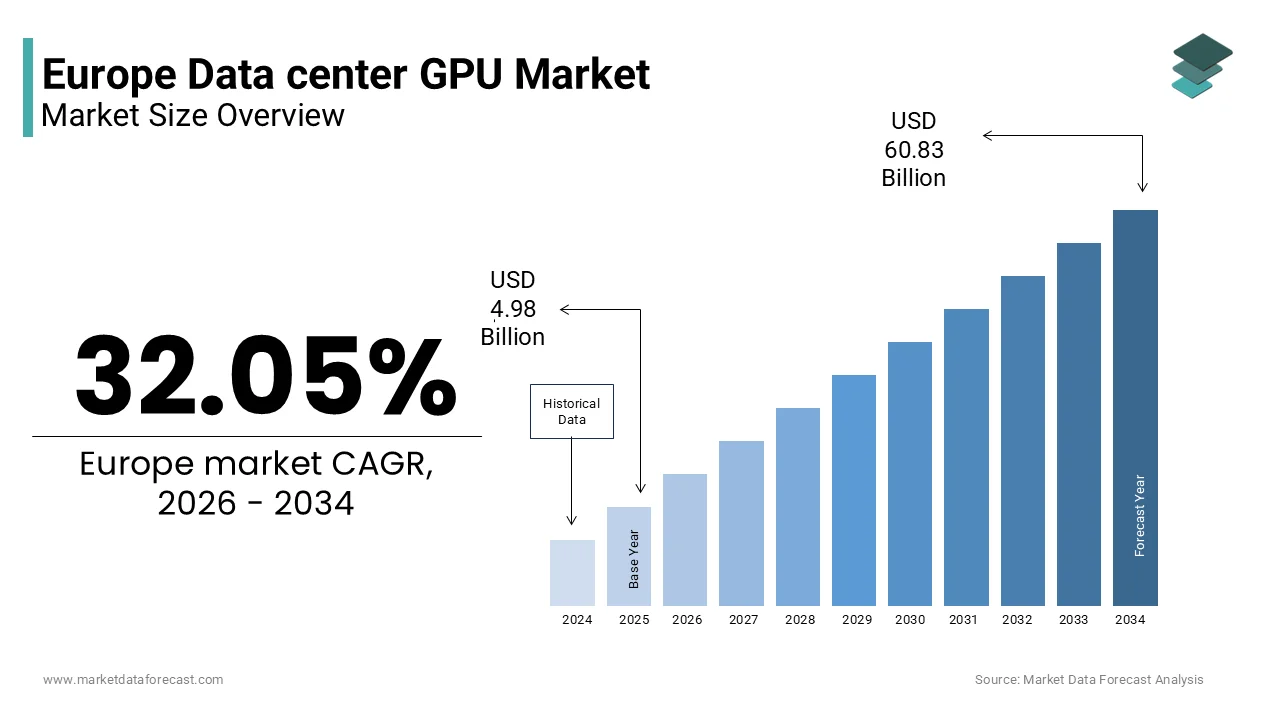
Market Size, 2025
$4.98 BnMarket Estimate, 2026
$6.58 BnMarket Forecast, 2034
$60.83 BnCAGR, 2026–2034
32.05%Europe Data Center GPU Market Report Summary
The Europe data center GPU market was valued at USD 4.98 billion in 2025 and is estimated to reach USD 6.58 billion in 2026, further projected to reach USD 60.83 billion by 2034, growing at a CAGR of 32.05% during the forecast period. The market is expanding rapidly due to accelerating adoption of artificial intelligence, machine learning, high performance computing, and generative AI workloads across enterprises and cloud environments. Increasing investments in hyperscale data centers, rising demand for accelerated computing infrastructure, and growing deployment of AI driven analytics across industries such as healthcare, automotive, finance, and manufacturing are major growth drivers. In addition, Europe’s focus on digital sovereignty, edge computing expansion, and AI regulatory frameworks is supporting large scale GPU infrastructure deployment across the region.
Key Market Trends
- Surging demand for AI training and inference workloads requiring high performance GPUs with advanced parallel processing capabilities.
- Rapid expansion of hyperscale and colocation data centers driven by cloud service providers and enterprise digital transformation initiatives.
- Growing adoption of cloud based GPU as a service models to enable scalable and cost efficient AI infrastructure access.
- Increasing focus on energy efficient GPU architectures and liquid cooling technologies to address power consumption challenges in European data centers.
- Rising government support for AI innovation, semiconductor ecosystem development, and regional data localization initiatives.
Segmental Insights
- Based on end user, the cloud service providers segment accounted for 61.6% of the Europe data center GPU market share in 2025. The segment’s dominance is attributed to massive investments by hyperscalers in AI optimized infrastructure, large scale GPU clusters, and cloud based accelerated computing platforms.
- Based on deployment type, the cloud deployment segment held 65.9% of the European market share in 2025. This leadership position is driven by increasing enterprise migration to cloud environments, scalable GPU resource allocation, and demand for flexible AI training infrastructure.
- Based on function, the training workloads segment captured 55.9% of the European market share in 2025. Growth of this segment is fueled by rising development of large language models, autonomous systems, predictive analytics solutions, and deep learning applications requiring intensive GPU compute power.
Regional Insights
- Germany led the Europe data center GPU market in 2025 by accounting for 25.5% of the regional market share. The country’s dominance is supported by strong industrial digitization, expanding hyperscale data center investments, advanced manufacturing ecosystem, and increasing AI adoption across automotive and industrial sectors.
- Other major markets across Western Europe are witnessing steady growth due to digital transformation initiatives and expanding cloud infrastructure.
Competitive Landscape
The Europe data center GPU market is highly competitive and technology driven, characterized by rapid innovation cycles and strategic partnerships. Leading companies are focusing on AI optimized GPU architectures, advanced memory technologies, chiplet integration, and software ecosystem development to strengthen their competitive positioning. Major players operating in the Europe data center GPU market include NVIDIA Corporation, Intel Corporation, Advanced Micro Devices Inc., Samsung Electronics Co. Ltd., Micron Technology Inc., Qualcomm Incorporated, IBM Corporation, Google LLC, Microsoft Corporation, and Imagination Technologies Limited.
Europe Data Center GPU Market Size
The Europe data center GPU market size was valued at USD 4.98 billion in 2025 and is projected to reach USD 60.83 billion by 2034 from USD 6.58 billion in 2026, growing at a CAGR of 32.05%.
Graphics processing units have evolved from rendering visual content to becoming the computational backbone of artificial intelligence workloads in European data centers. Unlike general purpose central processing units, GPUs offer massively parallel architectures ideally suited for training deep learning models and accelerating high performance computing tasks. The European data center landscape is undergoing a structural transformation as AI adoption intensifies across finance healthcare and scientific research sectors. According to Eurostat, European data centers consumed a significant amount of electricity in 2023, with AI infrastructure accounting for an increasingly disproportionate share of this demand due to the energy intensity of GPU clusters. The European Union’s Artificial Intelligence Act establishes a risk based regulatory framework that directly influences GPU deployment strategies, particularly for high-risk applications requiring extensive validation datasets processed on compliant hardware. As per Eurostat, a notable portion of EU citizens possessed only basic digital skills in 2023, creating acute demand for automated AI systems powered by GPU acceleration to compensate for human capital constraints. This convergence of regulatory, technological, and workforce dynamics positions specialized GPU infrastructure as a critical enabler of Europe’s digital sovereignty ambitions while simultaneously introducing new operational complexities around power, thermal management, and supply chain resilience.
MARKET DRIVERS
Surging Demand for AI Model Training Across Regulated European Sectors
European financial institutions and healthcare providers face unprecedented pressure to deploy explainable AI systems compliant with the EU’s stringent regulatory frameworks, which is one of the major factors driving the growth of the European data center GPU market. The European Banking Authority mandates that all credit scoring algorithms undergo rigorous bias testing using representative datasets, a process requiring extensive GPU resources. According to Banque de France, French banks conducted a large number of algorithmic impact assessments in 2023, each necessitating dedicated GPU clusters for synthetic data generation and fairness validation. Similarly, the European Medicines Agency requires pharmaceutical companies to validate AI driven drug discovery pipelines through reproducible computational workflows, with AstraZeneca reporting significant volumes of molecular simulation data processed monthly on GPU infrastructure across its Cambridge and Gothenburg facilities. As per the European Commission, the Digital Europe Programme allocated billions of euros in 2023 specifically for AI testing and experimentation facilities equipped with sovereign GPU resources to support regulatory compliance. These mandated validation processes create non-discretionary demand for high performance GPU infrastructure that cannot be substituted by cloud alternatives due to data residency requirements under the General Data Protection Regulation. Consequently, European data centers are retrofitting existing facilities with specialized GPU racks featuring enhanced cooling and power delivery systems to accommodate these mission critical workloads.
European Scientific Research Initiatives Requiring Exascale GPU Computing
Europe’s commitment to scientific leadership manifests through massive GPU intensive research programs spanning climate modeling, particle physics, and genomics, which is further boosting the expansion of the European data center GPU market. The European High Performance Computing Joint Undertaking deployed exascale supercomputers such as LUMI in Finland, LEONARDO in Italy, and MareNostrum 5 in Spain, each containing vast GPU cores dedicated to scientific discovery. According to official reports, LUMI’s GPU array achieved breakthrough performance during 2023 climate simulations that modeled atmospheric carbon dispersion at high resolution across the European continent. The Human Brain Project leveraged GPU clusters at Jülich Supercomputing Centre to simulate neural networks containing billions of neurons, requiring continuous access to thousands of NVIDIA GPUs. As per CERN, European research institutions generated massive volumes of scientific data in 2023, with GPU accelerated analysis reducing processing time for complex datasets like those from the Large Hadron Collider. The European Strategy Forum on Research Infrastructures identified GPU computing as critical for maintaining competitiveness in quantum chemistry and materials science, prompting national investments such as Germany’s Gauss Centre expansion. These publicly funded initiatives create sustained demand for data center GPU infrastructure that operates independently of commercial cloud platforms to ensure uninterrupted access for strategic research priorities.
MARKET RESTRAINTS
Severe Power Infrastructure Limitations Constraining GPU Deployment Density
European data centers face fundamental physical constraints in deploying high density GPU clusters due to aging electrical grid infrastructure, which is impeding the growth of the European data center GPU market. A single NVIDIA H100 GPU consumes up to 700 watts under full load, with typical AI server configurations housing eight such units drawing over 7 kilowatts per rack, nearly triple traditional server power requirements. As per EirGrid, Ireland’s data center sector already consumes a significant portion of national electricity generation, forcing the government to impose a moratorium on new hyperscale developments in Dublin due to grid capacity limitations. Similarly, the Netherlands suspended data center permits in Amsterdam and Eemshaven regions after grid operator TenneT reported insufficient transmission capacity to support additional large facilities. According to Uptime Institute, European data centers average lower megawatt capacity per facility compared to US counterparts, directly limiting GPU cluster scale. The European Environment Agency documented that a majority of European substations operate beyond 80% capacity during peak hours, creating unacceptable risk for GPU workloads requiring uninterrupted power. Without massive grid modernization investments, which the European Commission estimates will require hundreds of billions of euros by 2030, GPU deployment density will remain artificially constrained across the continent.
Stringent EU Environmental Regulations Increasing GPU Operational Costs
The European Union’s aggressive climate policies impose substantial compliance burdens on GPU intensive data center operations, which is further hampering the regional market growth. The Energy Efficiency Directive mandates that all new data centers above 1 megawatt implement real time energy monitoring and achieve Power Usage Effectiveness ratings below 1.3 by 2025, a challenging threshold for GPU clusters that generate exceptional heat loads. According to Fraunhofer Institute, GPU servers produce significantly more heat per rack unit than conventional servers, requiring advanced liquid cooling solutions that increase capital expenditure considerably. The EU’s Carbon Border Adjustment Mechanism indirectly affects operations by increasing electricity costs, with industrial power prices in Germany during 2023 reported by Bundesnetzagentur as nearly double US levels. Additionally, the Ecodesign for Sustainable Products Regulation requires GPU manufacturers to provide detailed lifecycle carbon footprint declarations starting in 2025, complicating procurement decisions for environmentally conscious operators. As per the European Environment Agency, data centers contributed a measurable share of EU electricity related emissions in 2023, triggering scrutiny from national regulators who now require quarterly sustainability audits for facilities housing large GPU deployments. These regulatory pressures force operators to implement suboptimal GPU utilization strategies like workload throttling during high carbon intensity grid periods, directly compromising AI training efficiency and return on investment.
MARKET OPPORTUNITIES
Sovereign AI Infrastructure Development Under EU Digital Autonomy Initiatives
The European Commission’s push for technological sovereignty creates unprecedented funding opportunities for domestic GPU infrastructure development. According to official documentation, the Chips Act allocates billions of euros specifically for AI accelerator manufacturing, with STMicroelectronics receiving substantial funding in 2023 to develop European designed GPUs at its Crolles fab. As per the European High Performance Computing Joint Undertaking, the EuroHPC LUMI AI facility was established containing thousands of AMD GPUs, making it the largest sovereign AI cluster globally, available to European researchers and enterprises through competitive allocation. National initiatives complement this effort, with France’s Jean Zay AI supercomputer providing thousands of NVIDIA GPUs exclusively to EU entities developing GDPR compliant AI models. According to the European Commission, the Digital Europe Programme committed billions of euros in 2024 for AI testing facilities equipped with sovereign GPU resources to validate high risk applications under the Artificial Intelligence Act. These publicly funded resources address critical gaps in Europe’s AI ecosystem by providing guaranteed access to cutting edge GPU infrastructure without reliance on US cloud providers. Enterprises developing medical diagnostic or financial compliance AI systems can now train models on European soil while meeting strict data residency requirements, creating a virtuous cycle of innovation that reinforces the continent’s strategic autonomy in critical technologies.
Industrial AI Adoption in European Manufacturing Driving Edge GPU Demand
European manufacturers are deploying specialized GPU infrastructure at the network edge to enable real time AI inference in production environments, which is another prominent opportunity in the European data center GPU market. Automotive plants such as BMW’s Munich facility utilize NVIDIA EGX platforms with A2 GPUs to run computer vision models that inspect weld points per vehicle with extremely high accuracy, processing large volumes of image data daily without cloud dependency. As per the European Commission, the Made in Europe strategy allocated hundreds of millions of euros in 2023 for AI integration in manufacturing, with particular focus on GPU enabled quality control systems that reduce waste in resource intensive sectors. Semiconductor fabs across Dresden and Leuven employ GPU accelerated metrology systems that analyze wafer defects at nanometer resolution, cutting inspection time significantly per lot. According to the European Environment Agency, GPU powered predictive maintenance reduced unplanned downtime across heavy industrial facilities during 2023, translating to millions of tons of avoided CO2 emissions from optimized production scheduling. These edge deployments circumvent cloud latency and bandwidth constraints while satisfying strict data sovereignty requirements for proprietary manufacturing processes. As European factories digitize under Industry 5.0 principles, demand for ruggedized industrial GPUs capable of operating in harsh environments will create a new growth vector distinct from traditional data center markets.
MARKET CHALLENGES
Geopolitical Export Controls Disrupting Advanced GPU Supply Chains
European data centers face severe constraints in acquiring cutting edge AI accelerators due to US export restrictions targeting advanced computing technologies, which is a significant challenge to the growth of the European data center GPU market. The Bureau of Industry and Security’s October 2023 regulations prohibit the sale of NVIDIA A100, H100, and AMD MI300 series GPUs to Chinese entities but also impose licensing requirements for re-exports from Europe, creating significant procurement delays. According to Eurocloud surveys, European AI startups reported average lead times for H100 GPUs during 2024 that were considerably longer compared to pre restrictions. The situation deteriorates when considering technical specifications, as restricted GPUs feature firmware locks that reduce performance when detecting certain workloads, rendering them unsuitable for large language model training. European semiconductor fabs lack capacity to produce alternative accelerators, with facilities such as GlobalFoundries’ Dresden site focusing on automotive chips rather than the advanced processes required for competitive AI silicon. As per the European Commission, attempts to negotiate GPU allocation quotas with US manufacturers yielded limited success, with only a small portion of requested units delivered to EU research institutions in early 2024. These supply constraints force European operators to over provision older generation GPUs, increasing power consumption and physical footprint for equivalent AI workloads, directly conflicting with EU sustainability mandates.
Escalating Water Consumption Conflicts with European Sustainability Mandates
GPU intensive data centers face growing opposition due to their extraordinary water consumption for cooling operations, conflicting with Europe’s environmental priorities. According to VITO environmental research, a single 10-megawatt AI data center consumes massive volumes of water annually for evaporative cooling, equivalent to the annual needs of tens of thousands of Europeans. As per the Irish Environmental Protection Agency, Microsoft’s Dublin facility drew significant amounts of potable water in 2023, triggering public protests during summer droughts when reservoir levels fell below critical capacity. The European Environment Agency documented that data center water usage increased notably between 2022 and 2023, with GPU clusters accounting for the majority of this growth due to their exceptional thermal density. New regulations compound this challenge, with France’s Climate and Resilience Law prohibiting data centers from using potable water for cooling starting in 2025, forcing operators to invest in expensive closed loop systems that increase capital costs considerably. The conflict intensifies in water stressed regions, as Spain’s Ministry for Ecological Transition denied multiple GPU data center permits in 2024 citing unsustainable aquifer depletion in metropolitan areas. Without breakthroughs in air cooled GPU designs or widespread adoption of immersion cooling using dielectric fluids, water scarcity will increasingly constrain AI infrastructure development across the continent.
REPORT COVERAGE
| REPORT METRIC | DETAILS |
| Market Size Available | 2025 to 2034 |
| Base Year | 2025 |
| Forecast Period | 2026 to 2034 |
| CAGR | 32.05% |
| Segments Covered | By End User, Deployment Type, Function, and Region |
| Various Analyses Covered | Global, Regional, & Country Level Analysis; Segment-Level Analysis; DROC, PESTLE Analysis; Porter’s Five Forces Analysis; Competitive Landscape; Analyst Overview of Investment Opportunities |
| Regions Covered | UK, France, Spain, Germany, Italy, Russia, Sweden, Denmark, Switzerland, Netherlands, Turkey, and the Czech Republic |
| Market Leaders Profiled | NVIDIA Corporation, Intel Corporation, Advanced Micro Devices Inc., Samsung Electronics Co. Ltd. under Samsung Group, Micron Technology Inc., Qualcomm Incorporated through Qualcomm Technologies Inc., IBM Corporation, Google LLC under Alphabet Inc., Microsoft Corporation, and Imagination Technologies Limited |
SEGMENTAL ANALYSIS
By End User Insights
The cloud service providers segment dominated the market by holding 61.6% of the European market share in 2025. The dominating position of cloud service providers segment in the European market is attributed to their role as primary enablers of scalable AI infrastructure for enterprises and public sector entities lacking in house expertise. For instance, hyperscalers have collectively deployed vast numbers of NVIDIA GPUs across European regions by early 2025 to support generative AI services. According to the European Commission, the Digital Europe Programme allocated billions of euros in 2023 to establish sovereign cloud GPU pools accessible via GAIA-X compliant platforms, further consolidating CSP leadership. These providers benefit from economies of scale in power procurement, with long term renewable energy contracts documented by RTE. Additionally, CSPs lead in liquid cooling innovation, with Microsoft’s Dublin data center achieving benchmark efficiency using immersion cooling for GPU racks. Their ability to bundle GPU capacity with managed AI services creates sticky customer relationships that reinforce market control.
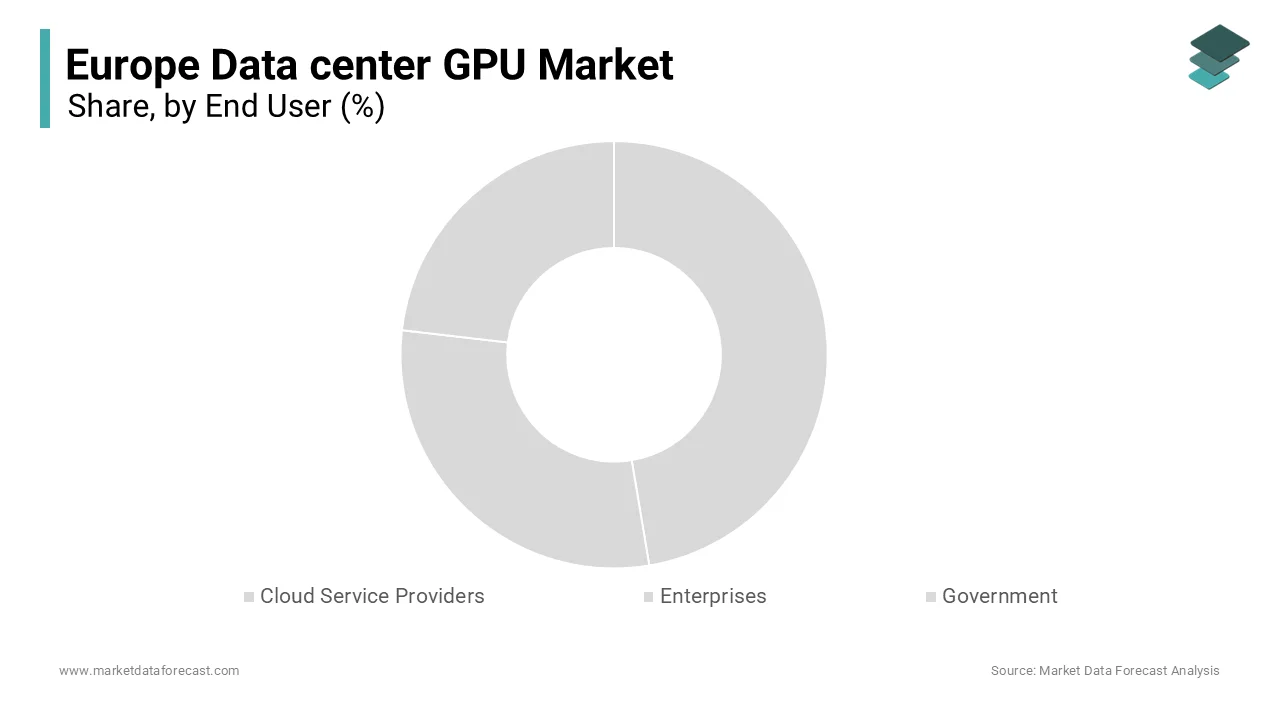
The government segment is a promising segment and is expected to exhibit a CAGR of 33.6% over the forecast period. The strategic investments in sovereign AI capabilities for defense, scientific research, and public administration is fuelling the growth of government segment in the European market. As per the European High Performance Computing Joint Undertaking, billions of euros were committed in 2024 to deploy GPU powered supercomputers exclusively for public sector use, including the LUMI AI facility in Finland. National initiatives amplify this trend, with Germany’s Federal Ministry of Education and Research allocating significant funding in 2023 for AI research infrastructure under the “Secure AI for Public Good” program. The European Medicines Agency requires all regulatory submissions involving AI to include validation runs on EU based GPU clusters, compelling pharmaceutical companies to partner with national research centers. Furthermore, the EU’s Artificial Intelligence Act classifies law enforcement and critical infrastructure management as high-risk domains requiring transparent model training, only feasible on government-controlled GPU infrastructure.
By Deployment Type Insights
The cloud deployment segment led the market by holding 65.9% of the European market share in 2025. The growth of the cloud segment in the European market can be credited to its prohibitive capital intensity of building private GPU infrastructure. According to industry documentation, cloud platforms offer immediate access to cutting edge accelerators without lengthy procurement cycles, critical given US export controls that delay physical GPU deliveries. Major CSPs have established sovereign cloud zones compliant with EU data residency laws, with AWS’s EU Sovereign Cloud launched in 2024 providing dedicated GPU instances verified by TÜV Rheinland. The model particularly appeals to financial institutions subject to the European Banking Authority’s accountability framework, which mandates reproducible AI validation environments. Additionally, cloud providers absorb compliance burdens, with Microsoft Azure’s GPU offerings including automated logging for EU AI Act conformity assessments. The pay as you go pricing structure enables startups to access exascale computing at manageable monthly costs, impossible with on premise alternatives requiring multi-million-euro investments.
The on-premises GPU deployments segment is predicted to register a CAGR of 30.6% over the forecast period. The escalating concerns about intellectual property leakage in shared cloud environments is driving the growth of the on-premises segment in the European market. For instance, automotive manufacturers mandate on premise GPU clusters for training proprietary autonomous driving models after detecting risks in multi-tenant clouds. The European Commission’s Cyber Resilience Act requires critical infrastructure operators to maintain air gapped AI systems for high-risk applications, compelling energy and defense firms to build private GPU facilities. National security considerations further drive adoption, with France’s ANSSI cybersecurity agency banning cloud-based GPU training for defense contractors in 2024, triggering billions of euros in new on-premise investments. Technological advances reduce barriers, with NVIDIA’s DGX BasePOD architecture enabling modular GPU scaling starting at 16 nodes with integrated liquid cooling. Additionally, on premise deployments satisfy the EU’s strict data localization requirements for healthcare AI, with German hospitals deploying GPU systems to process patient imaging data without third party involvement.
By Function Insights
The training workloads segment dominated the market by capturing 55.9% of the European market share in 2025. The leading position of training workloads segment in the European market is attributed to the extraordinary computational demands of developing foundation models. As per Meta’s Llama research, training large language models requires millions of GPU hours on advanced hardware. European research institutions lead this activity, with projects such as the Human Brain Project consuming extensive GPU hours monthly simulating cortical microcircuits. Regulatory requirements amplify demand, with the European Medicines Agency mandating retraining of AI driven drug discovery pipelines whenever clinical trial parameters change. Financial institutions face similar obligations, with Banque de France requiring quarterly retraining of credit scoring models using updated datasets. The European Commission’s AI Office established validation protocols requiring independent replication of model training on sovereign GPU infrastructure, creating duplicate workloads across public and private sectors.
The inference segment is predicted to register a CAGR of 35.5% over the forecast period in this regional market. The operationalization of trained models into real time decision systems across regulated industries is propelling the growth of the inference segment in the European market. For instance, automotive manufacturers deploy inference engines processing large volumes of sensor data daily per vehicle fleet. The European Banking Authority’s Payment Services Directive mandates rapid fraud detection response times, achievable only through dedicated inference GPU clusters co located with transaction databases. Healthcare applications show similar urgency, with hospitals such as Charité in Berlin using GPU accelerated inference to analyze radiology images within minutes, meeting EU Medical Device Regulation requirements. Energy grid operators leverage inference for real time load balancing, processing millions of smart meter readings hourly on GPU infrastructure. The shift toward edge inference, where a majority of European manufacturers plan GPU deployments by 2026 according to VDMA, further accelerates growth as latency sensitive applications proliferate beyond traditional data centers.
REGIONAL ANALYSIS
Germany Data Center GPU Market Analysis
Germany dominated the data center GPU market in Europe in 2025 by holding 25.5% of the European market share in 2025. The dominance of Germany in the European market is driven by its world leading automotive and industrial manufacturing base that demands massive GPU resources for AI development. As per industry reports, BMW’s Munich AI campus and Siemens’ simulation centers operate extensive GPU clusters dedicated to autonomous driving and digital twin applications. The government’s “Secure AI for Public Good” initiative allocated hundreds of millions of euros in 2023 specifically for sovereign GPU infrastructure, with strict requirements for on premise deployment to protect industrial intellectual property. Germany’s robust power grid supports high density GPU clusters, with Bundesnetzagentur documenting a high renewable energy supply enabling sustainable AI operations. The country’s dual education system produces thousands of certified AI specialists annually who possess the hybrid skills necessary for GPU cluster management, creating an unmatched talent pipeline that attracts multinational AI investments seeking EU compliant development environments.
France Data Center GPU Market Analysis
France had the second largest share of the European data center GPU market in 2025. The growth of France in the European market is driven by its strategic focus on sovereign AI capabilities through national champions and research institutions. As per GENCI, the Jean Zay supercomputer provides thousands of NVIDIA GPUs exclusively to EU entities developing GDPR compliant AI models, with priority access for French defense contractors under the ANSSI cybersecurity directive. The government’s France 2030 investment plan committed billions of euros in 2023 for AI infrastructure, including the construction of sovereign GPU data centers in Paris, Lyon, and Toulouse. Cultural emphasis on technological autonomy drives adoption, with Airbus’ Toulouse facility training proprietary aerodynamic simulation models on in house GPUs rather than using cloud alternatives. France’s nuclear powered grid offers stable low carbon electricity at costs below EU average as documented by RTE, making it ideal for energy intensive GPU operations. The country’s strong mathematical tradition ensures continuous innovation in efficient AI algorithms that maximize GPU utilization while minimizing computational waste.
United Kingdom Data Center GPU Market Analysis
The United Kingdom is estimated to capture a promising share of the European data center GPU market during the forecast period. Despite Brexit related uncertainties, the UK maintains strong AI adoption driven by its world class pharmaceutical and financial sectors. As per AstraZeneca, its Cambridge AI hub operates thousands of GPUs for drug discovery simulations. The UK’s regulatory environment uniquely supports innovation, with the Medicines and Healthcare products Regulatory Agency pioneering real time AI validation protocols requiring continuous GPU based model monitoring. London’s financial district hosts specialized AI data centers serving banks that must comply with the Bank of England’s algorithmic trading oversight framework. The government’s Industrial Strategy allocated hundreds of millions of pounds in 2024 for AI infrastructure including the Isambard AI supercomputer. English language dominance in global AI research enables faster adoption of international frameworks while maintaining data residency through partnerships with sovereign cloud providers like UKCloud.
Netherlands Data Center GPU Market Analysis
The Netherlands is anticipated to record a healthy CAGR in the European data center GPU market during the forecast period. The country’s strategic advantage lies in its advanced digital infrastructure and progressive data governance framework. As per Tennet, Amsterdam’s data center corridor hosts hyperscale GPU facilities benefiting from offshore wind power that supplies high renewable electricity. The Dutch Data Exchange Platform enables secure GPU resource sharing among cooperatives, hospitals, and logistics firms through federated learning protocols that preserve data privacy. ASML’s Veldhoven facility represents the pinnacle of GPU application, where extreme ultraviolet lithography machines generate large volumes of metrology data processed by custom GPU clusters to maintain nanometer scale alignment accuracy. The government’s National Growth Fund allocated hundreds of millions of euros in 2023 for AI infrastructure including the Snellius 2 supercomputer dedicated to climate modeling. The country’s multilingual workforce and central European location make it an ideal testbed for multinational GPU deployments requiring compliance with diverse regulatory regimes.
Sweden Data Center GPU Market Analysis
Sweden is projected to grow at a steady CAGR in the European data center GPU market during the forecast period owing to its exceptional combination of renewable energy abundance and cold climate that enables highly efficient GPU cooling. As documented by Svenska Kraftnät, data centers in Stockholm and Luleå benefit from hydroelectric and nuclear power supply at some of the lowest costs in Europe. The KTH Royal Institute of Technology operates the Berzelius supercomputer funded by the Wallenberg Foundation’s billion-euro AI initiative. Swedish manufacturers like Ericsson deploy GPU clusters for 6G network simulation requiring real time channel modeling across extensive virtual base stations. The government’s AI in Society program mandates that all public sector AI systems undergo bias testing on sovereign GPU infrastructure, creating steady demand from healthcare and education ministries. Sweden’s stringent environmental regulations prohibit water cooled data centers, driving innovation in air side economization techniques that achieve benchmark efficiency unmatched elsewhere in Europe.
COMPETITIVE LANDSCAPE
The Europe data center GPU market features intense rivalry among global semiconductor leaders vying for dominance in a highly regulated and strategically significant landscape. Competition centers on compliance with stringent EU data sovereignty cybersecurity and environmental mandates which act as formidable barriers to entry. Differentiation arises through software ecosystem maturity energy efficiency certifications and alignment with national digital sovereignty initiatives like GAIA-X and EuroHPC. While NVIDIA maintains technological leadership in AI acceleration AMD gains traction through open architecture commitments and Intel leverages its manufacturing resurgence under the EU Chips Act. Cloud service providers increasingly influence GPU selection by bundling hardware with managed AI services creating ecosystem lock in. The absence of European designed GPU alternatives intensifies reliance on US vendors despite political pressures for technological autonomy. Continuous innovation in liquid cooling compatibility power management and inference optimization remains critical to maintaining competitive advantage in this capital intensive and regulation driven market.
KEY MARKET PLAYERS
Some of the notable key players in the Europe data center GPU market are
- NVIDIA Corporation
- Intel Corporation
- Advanced Micro Devices, Inc.
- Samsung Electronics Co., Ltd. (Samsung Group)
- Micron Technology, Inc.
- Qualcomm Incorporated (Qualcomm Technologies, Inc.)
- IBM Corporation
- Google LLC (Alphabet Inc.)
- Microsoft Corporation
- Imagination Technologies Limited
Top Players in the Market
- NVIDIA Corporation is a foundational technology provider in the Europe data center GPU market, supplying the majority of AI accelerators used for training and inference workloads across cloud service providers research institutions and enterprises. The company’s A100 and H100 Tensor Core GPUs have become the de facto standard for large scale AI deployments due to their exceptional performance in mixed precision computing. In recent developments, NVIDIA expanded its partnership with European hyperscalers to establish sovereign AI clouds compliant with EU data regulations. It also launched the NVIDIA AI Enterprise software suite optimized for European language models and regulatory frameworks, enabling faster deployment of generative AI applications while ensuring compliance with the EU Artificial Intelligence Act.
- Advanced Micro Devices Inc plays a critical role in the Europe data center GPU market through its MI300 series accelerators designed for high performance computing and artificial intelligence workloads. AMD has strategically aligned with European initiatives promoting technological sovereignty by supplying GPUs to EuroHPC supercomputers like LUMI in Finland and LEONARDO in Italy. The company recently enhanced its ROCm open software platform with native support for European language processing models and GDPR compliant data handling protocols. AMD also established a dedicated AI solutions lab in Munich to collaborate with automotive and industrial customers on optimizing GPU workloads for edge inference and digital twin simulations under strict EU cybersecurity requirements.
- Intel Corporation contributes to the Europe data center GPU market through its Data Center GPU Max Series and upcoming Gaudi AI accelerators tailored for both training and inference tasks. The company actively supports European digital autonomy by participating in the EU Chips Act ecosystem and supplying GPUs to national research infrastructures such as France’s Jean Zay supercomputer. Intel recently integrated its oneAPI programming model with GAIA-X compliant data spaces to enable seamless GPU workload portability across sovereign cloud environments. It also launched a developer program focused on optimizing generative AI models for European languages and regulatory constraints, strengthening its position among public sector and enterprise clients seeking alternatives to dominant AI accelerator architectures.
Top Strategies Used by the Key Market Participants
Key players in the Europe data center GPU market focus on establishing sovereign AI ecosystems compliant with EU data protection and cybersecurity regulations. They invest heavily in localized software stacks that support European languages and regulatory frameworks including the Artificial Intelligence Act. Strategic partnerships with national research institutions and hyperscalers enable deployment of GPU infrastructure within EU borders ensuring data residency. Companies prioritize energy efficient GPU designs to align with the European Green Deal and reduce operational costs in power constrained regions. Additionally, they develop open software platforms to avoid vendor lock in and foster developer communities tailored to European industrial and scientific use cases.
MARKET SEGMENTATION
This research report on the European data center GPU market has been segmented and sub-segmented based on categories.
By End User
- Cloud Service Providers
- Enterprises
- Government
By Deployment Type
- On-premises
- Cloud
By Function
- Training
- Inference
By Country
- UK
- France
- Spain
- Germany
- Italy
- Russia
- Sweden
- Denmark
- Switzerland
- Netherlands
- Turkey
- Czech Republic
- Rest of Europe