- Product Description Description
- Table of Contents TOC
- List of Table & Figure LOT
- Get Free Sample PDF Sample PDF
Market Size, 2025
$2.64 BnMarket Estimate, 2026
$2.98 BnMarket Forecast, 2034
$7.96 BnCAGR, 2026–2034
13.07%Europe Data Center Interconnect Market Report Summary
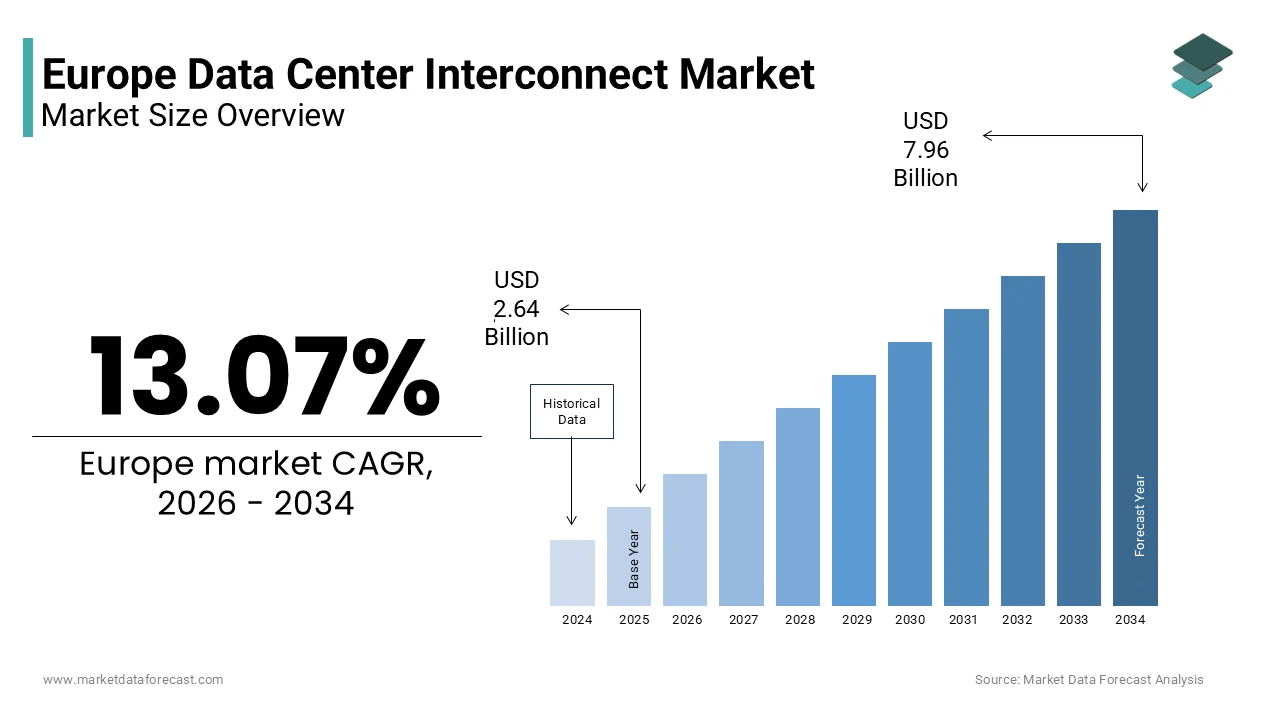
The Europe data center interconnect market was valued at USD 2.64 billion in 2025, is estimated to reach USD 2.98 billion in 2026, and is projected to reach USD 7.96 billion by 2034, growing at a CAGR of 13.07% during the forecast period. Market growth is driven by rapid cloud adoption, rising hyperscale data centers, and increasing demand for low latency, high bandwidth connectivity across geographically distributed facilities. The growing need for secure data transfer, real time disaster recovery, and business continuity planning is accelerating investments in advanced interconnect solutions. Additionally, the expansion of hybrid and multi cloud architectures is strengthening the role of data center interconnect technologies across Europe.
Key Market Trends
- Increasing deployment of high capacity optical interconnect solutions to support hyperscale and edge data centers.
- Rising demand for real time disaster recovery and business continuity driven by regulatory compliance and data protection requirements.
- Strong adoption of data center interconnect services by communication service providers to enable scalable network infrastructure.
- Growing focus on data mobility, including replication, backup, and migration across distributed cloud environments.
- Expansion of carrier neutral colocation facilities supporting cross border and inter regional data traffic growth.
Segmental Insights
- Based on technology, the communication service providers segment dominated the Europe data center interconnect market by accounting for 51.5% of the market share in 2025. This dominance is attributed to CSPs’ extensive fiber networks, ability to deliver high capacity interconnect services, and growing partnerships with cloud and colocation providers.
- Based on application, the real time disaster recovery and business continuity segment captured 58.5% of the European market share in 2025. The segment’s leadership is driven by increasing enterprise focus on minimizing downtime, ensuring data availability, and meeting stringent compliance requirements.
- Based on consumer and workload, the data storage mobility segment, which includes replication, backup, and migration of stored data, held 60.7% of the market share in 2025. This growth is supported by rising hybrid cloud deployments and the need for seamless data movement across distributed data centers.
Regional Insights
- The Europe data center interconnect market is experiencing strong growth across major economies, supported by expanding digital infrastructure, cloud investments, and cross border data flows.
- Germany emerged as the largest market, accounting for 23.6% of the European market share in 2025, driven by its robust data center ecosystem, strong enterprise demand, and position as a central connectivity hub in Europe.
- Other countries including the United Kingdom, France, and the Netherlands are also witnessing steady growth due to hyperscale data center expansion and increasing colocation activity.
Competitive Landscape
The Europe data center interconnect market is moderately competitive, with the presence of global networking technology providers, colocation operators, and optical equipment manufacturers. Key players are focusing on high speed optical solutions, scalable interconnect platforms, and strategic partnerships with cloud service providers to strengthen their market position. Investments in next generation coherent optics, automation, and software defined networking are shaping competitive differentiation. Prominent players in the Europe data center interconnect market include Ciena Corporation, Juniper Network Inc., CoreSite Realty Corporation, Digital Realty Trust, Ranovus Inc., Equinix Inc., Brocade Communications Systems Inc., Cisco Systems Inc., Extreme Networks, Infinera Corporation, XKL LLC, Innovium Inc., and Cologix.
Europe Data Center Interconnect Market Size
The Europe data center interconnect market size was valued at USD 2.64 billion in 2025 and is projected to reach USD 7.96 billion by 2034 from USD 2.98 billion in 2026, growing at a CAGR of 13.07%.
Data center interconnect (DCI) comprises high-capacity optical networking solutions that enable low latency high bandwidth connectivity between geographically dispersed data centers within and across national borders. These systems facilitate critical functions including cloud replication disaster recovery hybrid cloud orchestration and distributed computing. Europe’s DCI landscape is uniquely shaped by stringent data sovereignty laws energy efficiency mandates and a fragmented yet rapidly consolidating data center footprint. According to the European Data Centre Association, thousands of operational data centers existed across the EU and EFTA countries as of 2023, with a large share concentrated in five metro areas including London, Frankfurt, Amsterdam, Paris, and Dublin. As per the European Commission’s Data Act, non-personal data generated in the EU must remain accessible within the region, reinforcing intra-European connectivity needs. Additionally, according to Eurostat, data center electricity consumption reached high levels in 2023, which is accounting for a notable share of total EU demand, which is driving demand for energy-optimized interconnect technologies. This regulatory and infrastructural context positions the Europe DCI market as a high-performance, high-compliance segment essential to the continent’s digital sovereignty and cloud resilience.
MARKET DRIVERS
Expansion of Hyperscale Cloud Regions and Intra-Region Replication
Major cloud service providers are aggressively deploying multiple availability zones within single European metros to meet latency and redundancy requirements, which directly fuels demand for high-speed DCI links and propelling the European data center interconnect market growth. According to the European Cloud Infrastructure Observatory, leading providers such as Microsoft Azure and AWS operate multiple availability zones across European regions as of 2023. Each zone typically requires several high-capacity coherent optical links to synchronize data in real time for disaster recovery and load balancing. In Frankfurt, numerous hyperscale data centers are interconnected via dark fiber networks managed by providers like euNetworks and Colt. As per the Fraunhofer Institute for Reliability and Microintegration, intra-metro DCI traffic has grown rapidly in recent years, driven by multi-zone cloud architectures. The European Commission’s Gaia-X initiative further mandates that critical data workloads remain within certified European infrastructure, accelerating the build-out of sovereign cloud regions interconnected by secure, high-capacity links. This architectural shift from single-site to distributed resilience makes DCI the nervous system of Europe’s cloud economy.
Rise of Edge Computing and Distributed Data Processing
The proliferation of edge computing nodes across European industrial and urban centers necessitates robust backhaul connectivity to core data centers, which is creating new DCI use cases beyond traditional cloud replication and further fuelling the regional market expansion. According to the European 5G Observatory, thousands of edge data centers were operational in the EU by the end of 2023, supporting applications in autonomous manufacturing, smart cities, and connected vehicles. These micro facilities generate time-sensitive data that must be aggregated and processed in regional hubs, requiring low-latency links often spanning tens to hundreds of kilometers. In Germany, automotive manufacturers operate edge sites near production lines that stream real-time quality control video to central AI training clusters via dedicated DWDM rings. As per the European Telecommunications Standards Institute, a majority of European enterprises now deploy hybrid edge cloud architectures demanding scalable and secure interconnect. Unlike legacy DCI focused on metro clusters, this new paradigm requires cost-efficient modular optics and automated provisioning across diverse topologies, driving innovation in open line systems and disaggregated networking solutions across the continent.
MARKET RESTRAINTS
Stringent Cross-Border Data Localization and Sovereignty Laws
Europe’s complex data governance framework restricts data flows outside national or EU boundaries, which is creating legal and technical barriers to seamless interconnection and hampering the growth of the European data center interconnect market. According to the European Data Protection Board, many EU member states have enacted additional national data residency requirements beyond the GDPR, such as France’s Cloud Sovereignty Charter and Germany’s Gaia-X compliance mandates. These laws compel organizations to maintain mirrored data sets within specific jurisdictions, forcing redundant DCI deployments even when centralized hubs would be more efficient. As per the European Network and Information Security Agency, a significant share of multinational enterprises operates separate DCI networks for each major EU country to comply with localization rules. This fragmentation increases capital expenditure, operational complexity, and latency as traffic cannot be dynamically routed across the most efficient path. Unlike the US or Asia where cross-regional data movement is largely unimpeded, Europe’s regulatory patchwork turns DCI from a technical optimization challenge into a legal compliance necessity, slowing deployment and inflating costs for both operators and end users.
Limited Availability of Dark Fiber and Right-of-Way Constraints
The physical expansion of DCI networks is increasingly bottlenecked by scarcity of dark fiber infrastructure and bureaucratic hurdles in securing municipal right-of-way permits and impeding the regional market growth. According to the European Competitive Telecommunications Association, only a limited share of major European urban corridors had readily available dark fiber suitable for new DCI builds as of 2023. In cities like Paris and Rome, historical preservation laws restrict underground cabling, requiring costly micro-trenching or aerial deployment. The European Commission’s Broadband Cost Reduction Directive mandates that public infrastructure projects share civil works for fiber deployment, but implementation varies widely, with some countries reporting long permitting delays as per national telecom regulator data. Consequently, hyperscalers and carriers resort to leasing existing lit fiber at premium rates or building private conduit networks, which can be highly expensive in dense urban cores. This physical scarcity not only constrains bandwidth scalability but also concentrates market power among incumbent fiber owners, limiting competitive pricing and innovation in next-generation optical transport.
MARKET OPPORTUNITIES
Deployment of Subsea and Cross-Border Sovereign DCI Corridors
Europe is witnessing strategic investment in sovereign interconnect corridors that bypass traditional internet exchange points to ensure secure and low-latency data flows between national cloud infrastructures, which is a prominent opportunity in the European data center interconnect market. According to the European High Performance Computing Joint Undertaking, the EU is co-funding the EuroHPC DCI backbone, a large-scale optical network linking supercomputing centers across multiple countries with dedicated high-capacity channels. Similarly, the Nordic DCI Alliance launched a subsea cable system in 2023 connecting data centers in Stockholm, Helsinki, and Copenhagen to support joint AI training and climate modeling. These initiatives are driven by the European Strategy for Data, which mandates trusted infrastructures for public sector and critical industry workloads. As per the European Investment Bank, billions of euros have been allocated through 2027 for sovereign DCI projects under its Digital Europe lending portfolio. By creating policy-aligned physical pathways, these corridors reduce reliance on third-country transit and enhance digital autonomy, positioning DCI as a pillar of Europe’s technological sovereignty.
Adoption of Open and Disaggregated DCI Architectures
European operators are increasingly shifting from proprietary optical platforms to open line systems and disaggregated software-defined networking to reduce vendor lock-in and optimize total cost of ownership, which is another notable opportunity in the European data center interconnect market. According to the Open Networking Foundation, a growing share of new DCI deployments in Western Europe in 2023 used open ROADM or IP-over-DWDM architectures, allowing best-of-breed selection of transceivers and control software. Telefónica and Orange have jointly piloted open DCI fabrics across their Iberian and French networks, achieving lower operational costs and faster service provisioning as reported in their technical disclosures. As per the European Telecommunications Standards Institute, the F5G Advanced framework further encourages interoperability through standardized northbound APIs. This open ecosystem enables smaller service providers and national cloud operators to build scalable interconnect without dependency on single vendors, accelerating innovation and fostering a more competitive and resilient European DCI market aligned with the EU’s digital self-reliance objectives.
MARKET CHALLENGES
Persistent Shortage of Skilled Optical Networking Engineers
The Europe data center interconnect market faces a critical talent gap in designing, deploying, and maintaining advanced coherent optical networks. According to the European Commission’s Digital Skills Gap Report, the telecommunications sector suffers a significant shortfall in qualified optical engineers with expertise in DWDM, coherent detection, and network automation. In countries like Poland and Greece, local universities offer very few specialized courses in photonic networking, leaving operators dependent on international contractors. As per the European Fibre Optic Association, a majority of DCI project delays in 2023 were attributed to workforce unavailability, particularly for high-capacity system integration and troubleshooting. The complexity of next-generation systems featuring advanced modulation and real-time performance monitoring exacerbates the problem. Without targeted upskilling initiatives through vocational programs or cross-industry certification, the talent bottleneck will continue to constrain deployment velocity and increase reliance on automated but less flexible solutions across Europe’s expanding DCI infrastructure.
Energy Consumption and Thermal Management in High-Density Optical Links
As DCI systems scale to 800G and beyond per wavelength, their power draw and heat output impose significant operational challenges in space-constrained data center interconnect rooms, which is also challenging the expansion of the European data center interconnect market. According to the European Environment Agency, high-capacity coherent transponders consume considerably more power than their predecessors, leading to thermal density challenges in aggregation zones. In legacy data centers with limited cooling capacity, this necessitates costly retrofitting or underutilization of port capacity. As per the Technical University of Berlin, many European metro DCI sites operate below theoretical bandwidth due to thermal throttling. Furthermore, the EU Energy Efficiency Directive now requires data center operators to report network equipment power usage, adding compliance pressure. Vendors are responding with silicon photonics and co-packaged optics to reduce wattage per bit, but adoption remains slow due to reliability concerns. Until energy-optimized coherent optics mature, this thermal ceiling will limit the effective scalability of Europe’s DCI backbone despite rising bandwidth demand.
REPORT COVERAGE
| REPORT METRIC | DETAILS |
| Market Size Available | 2025 to 2034 |
| Base Year | 2025 |
| Forecast Period | 2026 to 2034 |
| CAGR | 13.07% |
| Segments Covered | By Technology, Application, Consumer and Workload, and Region |
| Various Analyses Covered | Global, Regional, & Country Level Analysis; Segment-Level Analysis; DROC, PESTLE Analysis; Porter’s Five Forces Analysis; Competitive Landscape; Analyst Overview of Investment Opportunities |
| Regions Covered | UK, France, Spain, Germany, Italy, Russia, Sweden, Denmark, Switzerland, Netherlands, Turkey, and the Czech Republic |
| Market Leaders Profiled | Ciena Corporation, Juniper Network Inc., Coresite Realty Corporation, Digital Realty Trust, Ranovus Inc., Equinix, Inc., Brocade Communications Systems Inc., CISCO Systems, Inc., Extreme Networks, Infinera Corporation, XKL, LLC, Innovium Inc., and Cologix |
SEGMENTAL ANALYSIS
By Technology Insights
The communication service providers (CSPs) segment dominated the market by accounting for 51.5% of the European data center interconnect market share in 2025. The dual role of CSPs as network infrastructure owners and wholesale connectivity providers to cloud and enterprise clients is one of the major factors driving the dominance of this segment in the European data center interconnect market. CSPs such as Deutsche Telekom, Orange, and Telefónica operate extensive fiber backbones that form the physical foundation of Europe’s DCI ecosystem. According to the European Fibre Optic Association, CSPs control the majority of available dark fiber in major metro corridors including London, Frankfurt, and Amsterdam. Hyperscalers increasingly lease dark fiber or lit wavelengths from these carriers rather than building private networks due to right-of-way constraints and capital efficiency. As per the European Telecom Operators Union, CSPs generated billions of euros in wholesale DCI revenue from hyperscalers in 2023. Deutsche Telekom’s TeraStream platform now offers on-demand wavelength services across multiple European countries with rapid provisioning. This infrastructure advantage allows CSPs to monetize existing assets while supporting Europe’s cloud expansion, ensuring their continued dominance in the DCI value chain.
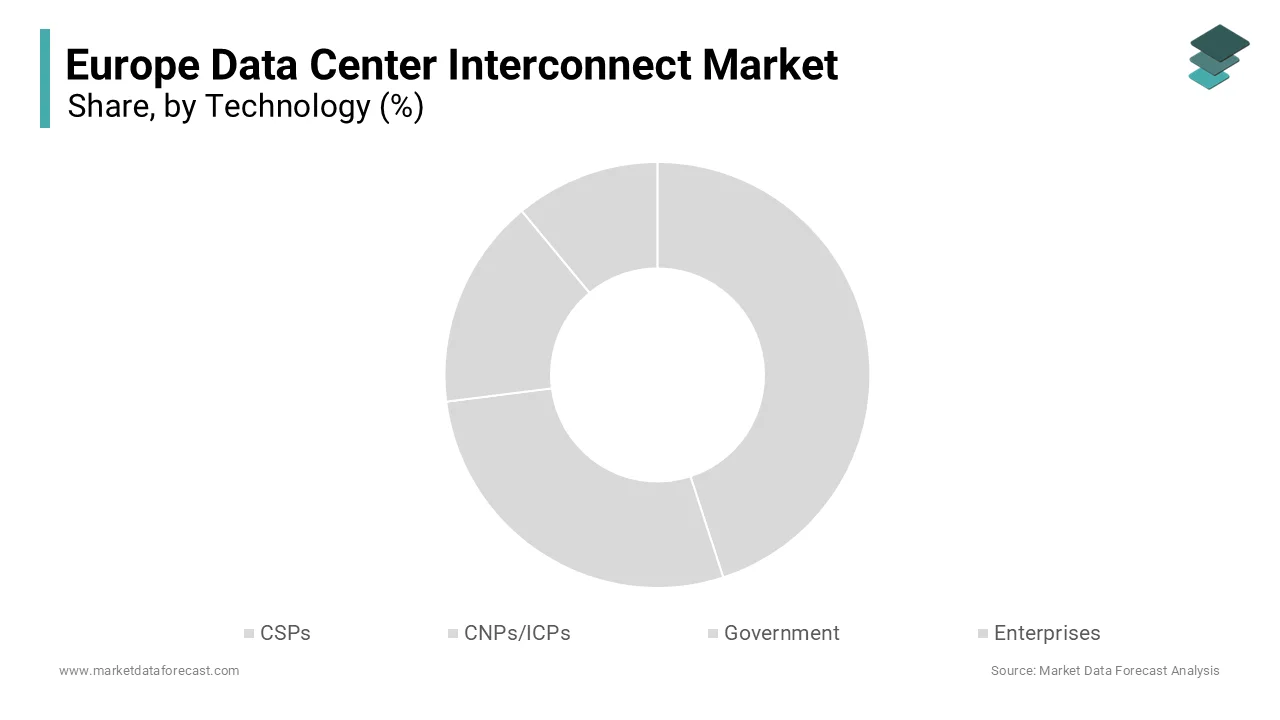
The enterprise segment is the fastest growing end-user category with a CAGR of 22.5% over the forecast period in this regional market owing to the digital transformation and hybrid cloud adoption. European enterprises are rapidly adopting multi-cloud strategies that necessitate private high-speed interconnects between on-premises data centers and cloud regions. According to a survey by the European CIO Association, a large share of enterprises now run workloads across at least two public clouds requiring secure, low-latency data synchronization. Automotive manufacturers operate private DCI networks linking engineering data centers to cloud regions for real-time simulation sharing. Similarly, financial institutions use dedicated links to replicate transaction databases between on-site systems and cloud disaster recovery sites. As per the European Banking Authority, guidelines on operational resilience mandate strict replication standards for critical systems, accelerating enterprise DCI investment. This shift from single-site IT to distributed cloud-native architectures transforms DCI from an infrastructure afterthought into a strategic enabler of business agility.
By Application Insights
The real-time disaster recovery and business continuity segment captured 58.5% of the European data center interconnect market share in 2025. The growth of the real-time disaster recovery and business continuity segment in the European market is attributed to the non-negotiable need for zero data loss and rapid failover in regulated industries. European regulators enforce rigorous resilience standards that mandate continuous synchronous replication between primary and secondary data centers. According to the European Banking Authority, systemically important banks must maintain strict recovery objectives requiring real-time replication over dedicated DCI links. In 2023, the European Central Bank fined institutions for failing to meet these thresholds during stress tests, highlighting enforcement seriousness. Similarly, the EU’s NIS2 Directive requires operators in energy, water, and transport to maintain geographically redundant systems with automatic failover. As per the European Critical Infrastructure Association, a large majority of such entities upgraded their DCI capacity in 2023 to support synchronous mirroring across sites. These legal imperatives transform DCI from an optional IT investment into a compliance necessity, ensuring sustained high demand for low-latency, high-bandwidth interconnects across Europe’s most vital sectors.
The geoclustering for shared data and server high availability segment is the fastest growing application segment and is estimated to grow at a CAGR of 20.6% over the forecast period. European research institutions and enterprises are increasingly running AI training and analytics workloads that span multiple data centers requiring shared access to massive datasets. According to the EuroHPC initiative, European supercomputers collaborate through high-capacity DCI backbones to pool GPU resources and training data. In 2023, these geoclusters processed vast volumes of scientific data, demanding consistent low-latency access to shared storage pools. Similarly, automotive companies use geoclusters to run concurrent simulations across sites accessing unified databases via high-speed DCI. As per the European Commission, the AI Act encourages federated learning models that keep data local while enabling collaborative model training, accelerating demand for shared resource architectures. This shift from siloed computing to distributed resource pooling makes geoclustering a strategic enabler of Europe’s scientific and industrial AI ambitions.
By Consumer and Workload Insights
The data (storage) mobility, encompassing replication, backup, and migration of stored data segment led the market by holding 60.7% of the European market share in 2025 due to the exponential growth of structured and unstructured data requiring constant movement for resilience, analytics, and compliance. European organizations generate vast volumes of unstructured data from industrial IoT sensors, video surveillance, and media assets that must be replicated for governance and analytics. According to Eurostat, the EU produced large volumes of data in 2023, with unstructured formats comprising the majority. Broadcasters replicate high-resolution video libraries between data centers daily, requiring sustained DCI capacity. Similarly, automotive factories in Germany stream large amounts of sensor data to central data lakes via dedicated optical links as per the German Automotive Industry Association. This data gravity necessitates high-throughput storage mobility that far exceeds virtual machine migration volumes. As the EU’s Data Governance Act promotes data sharing across sectors, this trend will intensify, solidifying storage mobility as the backbone of Europe’s DCI demand.
The VM (virtual machine) mobility segment is the fastest growing workload segment and is likely to grow at a CAGR of 23.5% over the forecast period. European enterprises increasingly use VM mobility to dynamically shift workloads between private and public clouds during demand spikes. According to a study by the European CIO Association, a significant share of large manufacturers now implements cloud bursting for seasonal production planning, moving entire VM clusters to cloud platforms during peak periods then migrating back post cycle. Utilities in Spain use this model to handle meter data surges during billing cycles, shifting analytics VMs to cloud GPUs then returning results to on-premises systems. As per the European Commission, the Cloud Rulebook mandates interoperability standards for such migrations, accelerating adoption. As hybrid cloud becomes the default architecture, VM mobility transitions from niche to mainstream, which is fuelling rapid growth in this segment.
REGIONAL ANALYSIS
Germany Data Center Interconnect Market Analysis
Germany stood as the largest data center interconnect market in Europe and held 23.6% of the European market share in 2025. The growth of Germany in the European market is attributed to its status as Europe’s primary digital hub, with Frankfurt hosting numerous data centers including major nodes for DE-CIX, one of the world’s largest internet exchanges. Germany’s strong industrial base, particularly in automotive and manufacturing, drives demand for low-latency DCI to support Industry 4.0 and AI workloads across distributed sites. According to the German Engineering Federation, a majority of large manufacturers now operate private DCI networks linking production facilities to cloud regions. The Federal Office for Information Security enforces strict resilience standards under the IT Security Act, requiring real-time replication for critical infrastructure. Additionally, Germany’s stable power grid and fiber-dense corridors make it the preferred interconnection point for hyperscalers expanding in Central Europe.
United Kingdom Data Center Interconnect Market Analysis
The United Kingdom captured 20.4% of the regional market share in 2025. London’s position as a global financial center creates strong demand for ultra-low latency connectivity between trading data centers in Slough, Croydon, and the City. According to the Bank of England, systemically important institutions must maintain strict replication standards between primary and backup sites, achievable only through dedicated dark fiber. The UK also hosts major cloud availability zones for AWS, Azure, and Google, with many hyperscale facilities operational as per the UK Data Centre Association. Despite Brexit, the UK maintains alignment with EU data standards through the Data Protection Act, enabling continued cross-border data flows. The National Cyber Security Centre’s guidelines further mandate encrypted DCI for critical sectors.
France Data Center Interconnect Market Analysis
France is estimated to register a promising CAGR in the European data center interconnect market during the forecast period. The nation’s leadership is anchored in its digital sovereignty strategy, which includes sovereign cloud initiatives and healthcare data hubs. According to the French Ministry of Economy, billions of euros were allocated in 2023 for sovereign DCI infrastructure linking government and healthcare data centers across Paris, Lyon, and Marseille. The ANSSI cybersecurity agency mandates that all critical data remain within national borders, requiring dedicated interconnects that bypass foreign transit. Additionally, France’s major telecom operators like Orange operate extensive fiber backbones connecting data centers nationwide. The country’s investment in quantum-secure communications through the National Quantum Plan further drives next-generation DCI deployment.
France Data Center Interconnect Market Analysis
The Netherlands is predicted to hold a notable share of the European data center interconnect market during the forecast period. The country’s strength lies in Amsterdam’s status as a major internet hub with AMS-IX peering traffic among the highest in Europe. Major hyperscalers including Microsoft, Google, and Meta operate large campuses in the Amsterdam region interconnected via dense private fiber networks. According to the Dutch Data Center Association, many hyperscale facilities are operational, with most interconnected through dark fiber rings managed by operators like Equinix and Global Switch. The Netherlands’ strategic location, flat terrain, and abundant renewable energy make it ideal for DCI expansion. The Dutch Data Protection Authority enforces strict GDPR compliance requiring intra-EU replication for personal data, further stimulating interconnect demand.
Ireland Data Center Interconnect Market Analysis
Ireland is estimated to witness a healthy CAGR in the European data center interconnect market during the forecast period. The country serves as the primary European landing point for US hyperscalers, with Dublin hosting major AWS, Azure, and Google Cloud regions that support millions of European customers. According to the Irish Data Centre Industry Association, these campuses consume a significant share of national electricity, highlighting their scale. To meet EU data residency requirements, cloud providers have built extensive private fiber networks linking Dublin sites to each other and to subsea cable landing stations in Galway and Cork. The Irish government’s Climate Action Plan mandates renewable energy use for new data centers, driving investment in green-powered DCI infrastructure. Ireland’s English-speaking workforce and common law system also attract global enterprises that require secure interconnect for EMEA operations.
COMPETITIVE LANDSCAPE
The Europe data center interconnect market features intense competition defined by technological sophistication regulatory alignment and strategic partnerships rather than price. Global optical networking leaders dominate due to their ability to deliver high capacity secure and energy efficient coherent systems that meet Europe’s stringent data sovereignty and cyber resilience requirements. Competition is increasingly shaped by software capabilities with vendors differentiating through AI driven automation intent-based provisioning and multi-vendor interoperability. The rise of sovereign cloud initiatives and public sector mandates has elevated the importance of local presence compliance certifications and government trust, which is creating advantages for vendors with deep European integration. At the same time open networking and disaggregation are lowering barriers for specialized players in coherent optics and control software. Hyperscalers exert significant influence through direct procurement and technical specifications while CSPs act as critical channel partners and infrastructure owners. Ultimately success in Europe hinges on a vendor’s ability to deliver not just bandwidth but digital autonomy resilience and sustainability within a fragmented yet policy driven continental framework.
KEY MARKET PLAYERS
Some of the notable key players in the Europe data center interconnect market are
- Ciena Corporation
- Juniper Network Inc.
- CoreSite Realty Corporation
- Digital Realty Trust
- Ranovus Inc.
- Equinix, Inc.
- Brocade Communications Systems Inc.
- Cisco Systems, Inc.
- Extreme Networks
- Infinera Corporation
- XKL, LLC
- Innovium Inc.
- Cologix
Top Players in the Market
- Ciena Corporation plays a pivotal role in the Europe data center interconnect market through its WaveLogic coherent optics and Waveserver platforms that power high-capacity links between major cloud regions. The company actively supports Europe’s digital sovereignty goals by enabling secure encrypted 800G connectivity compliant with EU Cyber Resilience Act requirements. Recently Ciena deployed its ROADM based interconnect fabric across a pan European sovereign cloud consortium linking data centers in Germany France and the Netherlands. It also enhanced its Manage Control and Plan software suite with AI driven optical impairment prediction tailored for European metro rings. These initiatives reinforce Ciena’s position as a trusted enabler of Europe’s high performance resilient and policy aligned DCI infrastructure.
- Nokia contributes significantly to the Europe data center interconnect market via its PSE coherent silicon and fiber network solutions that serve both CSPs and hyperscalers. The company has deepened its integration with European cloud ecosystems by certifying its FP5 IP routers for direct 800G pluggable optics interoperability with major cloud platforms. Recently Nokia launched a sovereign DCI solution for public sector clients in Sweden and Finland featuring hardware root of trust and zero touch provisioning. It also partnered with national research networks to support the EuroHPC supercomputing initiative with low latency interconnects. Through its focus on open standards energy efficiency and national security alignment Nokia strengthens its relevance in Europe’s evolving DCI landscape.
- Infinera maintains a strong presence in the Europe data center interconnect market through its ICE6 800G coherent technology and Instant Network architecture designed for rapid deployment. The company has prioritized sustainability by reducing power consumption per bit by 40 percent in its latest generation systems aligning with the EU Energy Efficiency Directive. Recently Infinera enabled a cross-border DCI network for a European financial services consortium connecting London Frankfurt and Paris with sub 5 millisecond latency and end to end encryption. It also integrated its network control software with open orchestration platforms like ONAP to support multi-vendor environments. These actions underscore Infinera’s strategy of combining performance efficiency and openness to meet Europe’s complex and compliance driven interconnect demands.
Top Strategies Used by the Key Market Participants
Key players in the Europe data center interconnect market employ strategies centered on coherent optics innovation open and disaggregated architectures sovereign infrastructure enablement and energy efficiency optimization. They develop 800G and 1.6T pluggable transceivers with integrated security features to meet EU regulatory mandates while reducing power per bit through advanced silicon photonics. Companies actively participate in European standardization bodies like ETSI to shape F5G Advanced and cloud interoperability frameworks. Strategic partnerships with hyperscalers national cloud initiatives and research networks ensure alignment with sovereign digital agendas. Simultaneously vendors offer software defined control planes with AI driven automation to simplify operations across multi-vendor environments. These integrated approaches allow leading firms to balance cutting edge performance with policy compliance sustainability and operational agility in Europe’s high stakes DCI ecosystem.
MARKET SEGMENTATION
This research report on the European data center interconnect market has been segmented and sub-segmented based on categories.
By Technology
- CSPs
- CNPs/ICPs
- Government
- Enterprises
By Application
- Real-Time Disaster Recovery and Business Continuity
- Shared Data and Resources/Server High-Availability Clusters (Geoclustering)
By Consumer and Workload
- VM
- Data (Storage)
By Country
- UK
- France
- Spain
- Germany
- Italy
- Russia
- Sweden
- Denmark
- Switzerland
- Netherlands
- Turkey
- Czech Republic
- Rest of Europe